
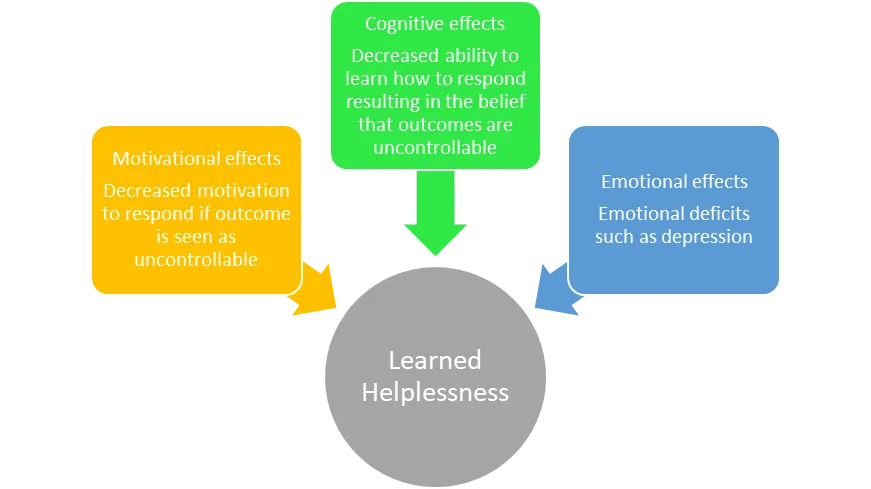
Repeated exposure to uncontrollable harm can teach people or animals that their actions are futile, even after an escape route becomes available. Learned helplessness is acquired rather than innate, can generalize beyond its original setting, and can suppress recognition of new evidence that control exists. Later research emphasized how internal, stable, and global explanations can make helplessness more persistent and damaging.
In the winter of 1967, two psychologists at the University of Pennsylvania were running what appeared to be a straightforward conditioning experiment. Martin Seligman and Steven Maier divided dogs into three groups. The first group received no shocks at all.
The second group received electric shocks but could terminate them by pressing a panel with their nose: control was available, and the dogs quickly learned to use it. The third group received shocks of identical intensity and duration to the second group, but their panel did nothing.
Their shocks ended only when the paired dog in group two pressed its panel. The third group had no control whatsoever over what happened to them.
This first phase was the setup. The critical experiment came next.
All the dogs were placed in a shuttle box, a two-compartment chamber in which one side could be electrified and the other could not. A low barrier separated the compartments. When shocks were administered to the electrified side, most dogs could simply jump the barrier to safety.
Dogs from groups one and two did exactly that. They hesitated briefly, felt the shock, and within seconds had leapt to the safe compartment.
The dogs from group three did something different. Most of them did not try to escape. They walked to the electrified floor, lay down, and whimpered. When the shock came, they endured it.
They had learned, through repeated inescapable experience, that their behavior had no effect on their suffering. And when the situation changed, when escape became genuinely possible, that learning held.
Seligman and Maier published these findings in the Journal of Experimental Psychology in 1967. They called the phenomenon learned helplessness.
"When animals and people are exposed to uncontrollable events, they learn that their behavior is futile, and this learning generalizes to new situations." (Martin Seligman, 1975)
What Learned Helplessness Is
Learned helplessness is a psychological state in which an organism, having repeatedly experienced uncontrollable aversive events, stops attempting to escape or avoid those events even when escape or avoidance later becomes possible.
The prior experience has established the expectation that outcomes are independent of behavior, and that expectation persists even when it is no longer accurate.
The key features are:
- It is learned: The passivity is not innate but acquired through specific experience
- It generalizes: The expectation of futility transfers beyond the original context to new situations
- It persists: The learned expectation continues to influence behavior even when circumstances change
- It suppresses learning: Organisms in a learned helpless state fail to notice or learn from new evidence that control is available
From Animals to Humans: Hiroto's Extension
Before the cognitive reformulation of the theory, Donald Hiroto demonstrated in a 1974 paper in the Journal of Experimental Psychology that learned helplessness transferred cleanly to human subjects using a simple modification: instead of electric shock, he used loud, aversive noise.
Hiroto divided participants into three groups: controllable noise (terminated by pressing a button), uncontrollable noise (no button effect), and no noise, and then gave all participants a finger shuttle box in which moving a lever from one side to the other terminated the noise.
Participants in the uncontrollable noise group were significantly less likely to attempt the shuttle task and, when they did attempt it, took significantly longer to learn the escape response. Their performance mirrored the dogs' behavior almost exactly.
Hiroto's study established that learned helplessness was not a species-specific quirk of canine conditioning but a fundamental property of how organisms process control information.
Hiroto also found that participants with an external locus of control, those who habitually believed outcomes were not under their personal control, were more susceptible to induced learned helplessness than those with an internal locus of control. This individual difference anticipated the attributional reformulation that would follow.
The 1978 Reformulation: Attribution Theory Enters
The original 1967 framework was behavioral and left several questions unanswered. Why did learned helplessness generalize across tasks? Why were some individuals more susceptible than others?
In 1978, Lyn Abramson, Martin Seligman, and John Teasdale published a landmark reformulation in the Journal of Abnormal Psychology. They replaced the behavioral conditioning account with a cognitive one grounded in attribution theory.
Abramson and colleagues argued that helplessness in humans depends not just on experiencing uncontrollability, but on how the person explains that uncontrollability to themselves. They proposed three attributional dimensions:
Locus: Is the cause internal ("I am the problem") or external ("this situation is the problem")? Internal attributions produce lower self-esteem alongside helplessness; external attributions produce helplessness without the self-esteem damage.
Stability: Is the cause stable ("this will always be true") or unstable ("this happened this time")? Stable attributions produce chronic, persisting helplessness; unstable attributions produce temporary helplessness that dissipates.
Globality: Is the cause global ("this affects everything in my life") or specific ("this only applies here")? Global attributions produce helplessness that generalizes across situations; specific attributions contain it.
The worst-case attribution profile, internal, stable, and global, is what Abramson, Seligman, and Teasdale called the depressogenic attributional style: "I failed because of something about me, which will always be true, which contaminates everything." This profile, they argued, is the cognitive mechanism by which repeated uncontrollable experiences translate into clinical depression.
| Attribution Dimension | Helplessness-Promoting | Resilience-Promoting |
|---|---|---|
| Locus | Internal (my fault) | External (situational) |
| Stability | Stable (always like this) | Unstable (just this time) |
| Globality | Global (everything) | Specific (just here) |
| Combined effect | Severe, chronic, widespread | Mild, temporary, contained |
Their 1978 paper is now one of the most cited papers in clinical psychology and serves as the foundation for the cognitive model of depression that underlies much of cognitive behavioral therapy.
Learned Helplessness and Depression
The clinical application of the learned helplessness model to depression has been one of the most productive frameworks in clinical psychology. The connection is direct: depression is characterized by a pervasive sense that one's actions cannot improve one's situation, which is the cognitive signature of learned helplessness.
Christopher Peterson and Martin Seligman developed the Attributional Style Questionnaire (ASQ) in 1984 to measure the internal-stable-global depressogenic attribution pattern.
Prospective studies using the ASQ have found that individuals with depressogenic attributional styles at baseline, before any depressive episode, show significantly elevated rates of depression onset following negative life events compared to individuals with more optimistic attributional styles.
A particularly compelling study by Gregory Metalsky, Timothy Halberstadt, and Lyn Abramson (1987) assessed students' attributional styles before midterm exams and then examined their mood responses after receiving their grades.
Students with the depressogenic attributional style showed significantly greater mood deterioration following poor grades, and this effect was mediated by their tendency to make internal-stable-global attributions for the failure.
The treatment implications are direct. Behavioral activation therapy, one of the most empirically supported treatments for depression, works by restoring the experience of behavioral contingency: patients are assigned progressively challenging activities chosen because their completion is reliably achievable, so that the patient experiences their own behavior producing outcomes.
This is the learned helplessness antidote made therapeutic.
The 2016 Neuroscience Revision
Almost exactly 50 years after their original experiment, Maier and Seligman published a major revision of learned helplessness theory in Psychological Review (2016). By this point, neuroscience had advanced sufficiently to examine the brain mechanisms underlying the phenomena they had documented behaviorally in 1967.
The revision was conceptually radical. Maier and Seligman argued that their original framework had the causal direction backwards. The original account held that control prevents learned helplessness.
The new account holds that helplessness is the default state, mediated by the dorsal raphe nucleus's serotonergic activity, and that controllability must be actively detected and learned via the ventromedial prefrontal cortex (vmPFC).
In this revised framework, the organism's nervous system does not start from a neutral baseline and learn helplessness through bad experiences.
Instead, it starts from a state of passivity in the face of aversive events, and experiences of controllability, experiences in which actions reliably produce outcomes, activate vmPFC circuitry that inhibits the default helplessness response.
The animal that turns off a shock by pressing a lever does not learn to escape; it learns that control is possible, and this learning recruits prefrontal inhibition of the subcortical structures that would otherwise produce passive behavior.
This has substantial clinical implications. It suggests that building control experiences is not merely motivationally useful but neurologically necessary: that the vmPFC pathway must be actively exercised through genuine experiences of controllability.
The therapeutic implication is that creating early, salient, reliable experiences of behavioral control may be more important than cognitive reframing or insight.
Dweck's Educational Research
Carol Dweck's 1975 work, published in the Journal of Personality and Social Psychology, addressed learned helplessness in academic contexts and added a critical intervention dimension.
Dweck identified elementary school children who showed a characteristic learned-helplessness pattern: they performed competently on moderately difficult problems but, when they encountered failure, quickly deteriorated in performance, showed negative self-attributions, and gave up.
Dweck assigned these children to one of two intervention conditions. The first involved success experiences only: problems calibrated to ensure correct answers.
The second involved attribution retraining: deliberate practice at encountering failure followed by explicit instruction to attribute that failure to insufficient effort rather than insufficient ability.
The results were striking: children in the success-only condition showed no improvement in their response to failure. Children in the attribution retraining condition showed significantly improved persistence and problem-solving under failure conditions.
The change in how they explained failure to themselves, not the accumulation of success experiences, was what moved their behavior.
This finding prefigured Dweck's later work distinguishing fixed and growth mindsets: the belief that ability is fixed produces the internal-stable attribution that makes failure devastating; the belief that ability is developable produces an unstable attribution that makes failure informative.
Learned Helplessness in Schools
The educational domain has produced some of the most precise documentation of learned helplessness mechanisms.
Classrooms with a performance-goal orientation, where students are evaluated relative to one another and where the primary signal of worth is rank, produce significantly higher rates of helplessness-pattern responses to failure compared to classrooms with a mastery-goal orientation, where effort, improvement, and strategy use are the primary evaluative criteria.
The mechanism is straightforward: in a performance-goal classroom, failure is informative about fixed ability, which is internal, stable, and global.
A student who fails receives the depressogenic attribution signal: "I failed because I'm not smart enough, and this is how it will always be." In a mastery-goal classroom, failure is informative about effort and strategy, which are controllable, unstable, and specific.
The same objective failure experience routes through a different attributional framework and produces a different behavioral outcome.
Students identified as struggling who are placed in environments that systematically remove challenge, in the mistaken belief that they need to be protected from failure, may show accelerated learned helplessness development precisely because the protective environment eliminates the genuine contingency experiences that build resilience.
This is the cruel irony that Dweck's research first revealed: the success-only condition does not build resilience. Only genuine failure, interpreted through a controllable attributional frame, does.
Learned Helplessness in the Workplace
Organizations produce and sustain learned helplessness with remarkable efficiency. Workplaces in which decisions are made arbitrarily, feedback is inconsistent, effort is not reliably rewarded, and negative consequences arrive without clear behavioral antecedents are, in functional terms, exactly the inescapable shock condition.
Research has consistently found that employees in organizations with inconsistent performance-outcome relationships show lower initiative, more compliance-without-engagement behavior, and higher rates of absenteeism.
The behavioral profile matches learned helplessness: not incompetence, but suppressed effort, because the expectation of outcome-behavior independence has generalized from specific past experiences to current performance contexts.
Managers held accountable for outcomes they cannot control (unit performance figures dependent on decisions made above their authority, customer satisfaction scores dependent on product quality decisions made in different divisions) often develop exactly the behavioral shift documented by Seligman and Maier: reduced initiative, reduced problem-solving effort, and compliance with existing processes even when those processes are visibly failing.
A 2014 Gallup survey found that 51% of U.S. employees were "not engaged" at work, and that the primary predictors of disengagement included lack of clarity about what was expected, lack of materials to do the job, and lack of recognition for good work.
All three are forms of outcome-behavior independence: the structural signature of organizational learned helplessness.
Learned Helplessness and Poverty
Economists and poverty researchers have documented behavioral patterns consistent with learned helplessness among chronically poor populations.
Extended experience with economic conditions that do not respond predictably to effort, where work does not produce proportional material improvement, where institutions are unresponsive, where outcomes are determined by forces beyond individual control, can produce learned helplessness responses that reduce motivated behavior even when circumstances change.
Esther Duflo and Abhijit Banerjee's field research on poverty traps documented that poor households often do not take up available opportunities, such as vaccinations, savings accounts, and agricultural improvements, not from indifference but from a history of unresponsive outcomes that has suppressed action initiation.
The intervention implication is important: providing resources alone may be insufficient if the underlying attributional framework has been shaped by decades of uncontrollable outcomes.
The success of conditional cash transfer programs, which tie payments to specific behaviors, may work in part because they create genuine, reliable contingencies between behavior and outcome, restoring the experience of control that is the neurological antidote to learned helplessness, as Maier and Seligman's 2016 revision suggests.
The Immunization Effect
One of the most practically significant findings in the learned helplessness literature is the immunization effect, documented by Seligman and Maier in 1967 and replicated in subsequent studies.
Dogs who had first experienced controllable shocks were significantly more resistant to learned helplessness induction when subsequently exposed to inescapable shocks.
This finding has been replicated in human populations. Prior success on a solvable problem buffers participants against learned helplessness induction by subsequent unsolvable problems.
The implication is that early experiences of genuine controllability, particularly in childhood and early education, may have long-term protective effects against helplessness vulnerability.
This shapes how we should think about challenge and failure in educational settings.
The goal is not to minimize failure but to ensure that failure occurs in contexts where the attributional frame is controllable (this is about effort and strategy, which I can change) rather than fixed (this is about ability, which I cannot change).
Genuine challenge with a mastery-oriented frame builds the vmPFC pathway that constitutes resilience.
Seligman's Later Shift: Toward Learned Optimism
The trajectory of Seligman's career illustrates the shift from learned helplessness to what he called learned optimism: the application of the same attributional framework in reverse.
Seligman's 1990 book "Learned Optimism" argued that just as helplessness can be learned through experience with uncontrollable outcomes, optimism, specifically, the explanatory style characterized by external, unstable, specific attributions for negative events, can be trained.
The Penn Resiliency Program, developed with Karen Reivich and others, teaches children to identify their explanatory style and practice more optimistic attributions.
Evidence on learned optimism interventions is mixed but generally positive. A 2009 meta-analysis by Brunwasser and colleagues found that resiliency training programs based on the reformulated model reduced depressive symptoms and some anxiety symptoms in school-aged children, with effects maintained at follow-up.
The later development of positive psychology, which Seligman co-founded with Mihaly Csikszentmihalyi in 1998, continued this trajectory. Where learned helplessness research focused on the origins and treatment of psychopathology, positive psychology focused on the conditions for flourishing.
The connection is direct: learned helplessness describes what suppresses flourishing; learned optimism and positive psychology describe what enables it.
Limits and Important Qualifications
The Overgeneralization Problem
Learned helplessness is a specific psychological state with specific antecedent conditions, not a universal explanation for all passive behavior. The construct requires that the passivity result from prior experience of genuine uncontrollability, not from rational appraisal of genuinely uncontrollable current conditions.
A person who does not attempt to escape an impossible situation because they have accurately assessed it as impossible is not exhibiting learned helplessness.
The learned helplessness pattern requires that the situation has changed, that escape or control is now possible, while the behavior has not, because prior experience has not been updated.
The popular use of the term often collapses this distinction, describing any passive behavior or failure to try as "learned helplessness." This strips the term of its specific meaning and obscures the distinction between rational appraisal of actual constraints and irrational generalization of outdated expectations.
Individual Differences in Susceptibility
Not all organisms exposed to inescapable aversive events develop learned helplessness. In Seligman and Maier's original studies, approximately one-third of dogs exposed to inescapable shocks did not develop the helpless response: they continued to try to escape and eventually succeeded.
The sources of this variation include pre-existing locus of control orientation, genetic variation in serotonergic systems, social support availability, and prior history of controllable experiences (the immunization effect).
Understanding what protects some individuals from learned helplessness induction is as important as understanding what causes it.
Cross-Cultural Variation
The attributional style research has been conducted primarily in North American and Western European populations. Cross-cultural work has found variation in the locus and globality dimensions in particular.
Cultures with more collectivist self-construal show different patterns of attribution for failure, tending toward situational or relational rather than purely internal attributions, which should produce different patterns of learned helplessness susceptibility.
The cross-cultural evidence base remains incomplete.
Why Learned Helplessness Matters
Learned helplessness is one of the most influential concepts in psychology because it connects laboratory findings in animal conditioning to clinical phenomena in depression, educational failure, organizational dysfunction, and poverty.
The mechanism, prior experience of uncontrollable outcomes suppresses future action even when action becomes possible, is simple, well-documented, and has clear practical implications.
Those implications run in both directions. Understanding learned helplessness tells us what to avoid: systems that are structurally unresponsive to individual effort, feedback that does not reliably signal what behavior produces what outcome, educational and organizational environments that remove meaningful challenge.
And it tells us what to build: conditions for genuine experiences of behavioral control, attributional frameworks that make failure informative rather than defining, and the early, repeated experience of one's actions mattering that builds the neurological substrate of resilience.
The 2016 revision by Maier and Seligman suggests this is not merely motivationally useful but neurologically necessary: that the capacity to persist in the face of adversity is itself a learned achievement, built from experiences in which the relationship between effort and outcome is real, reliable, and recognized.