
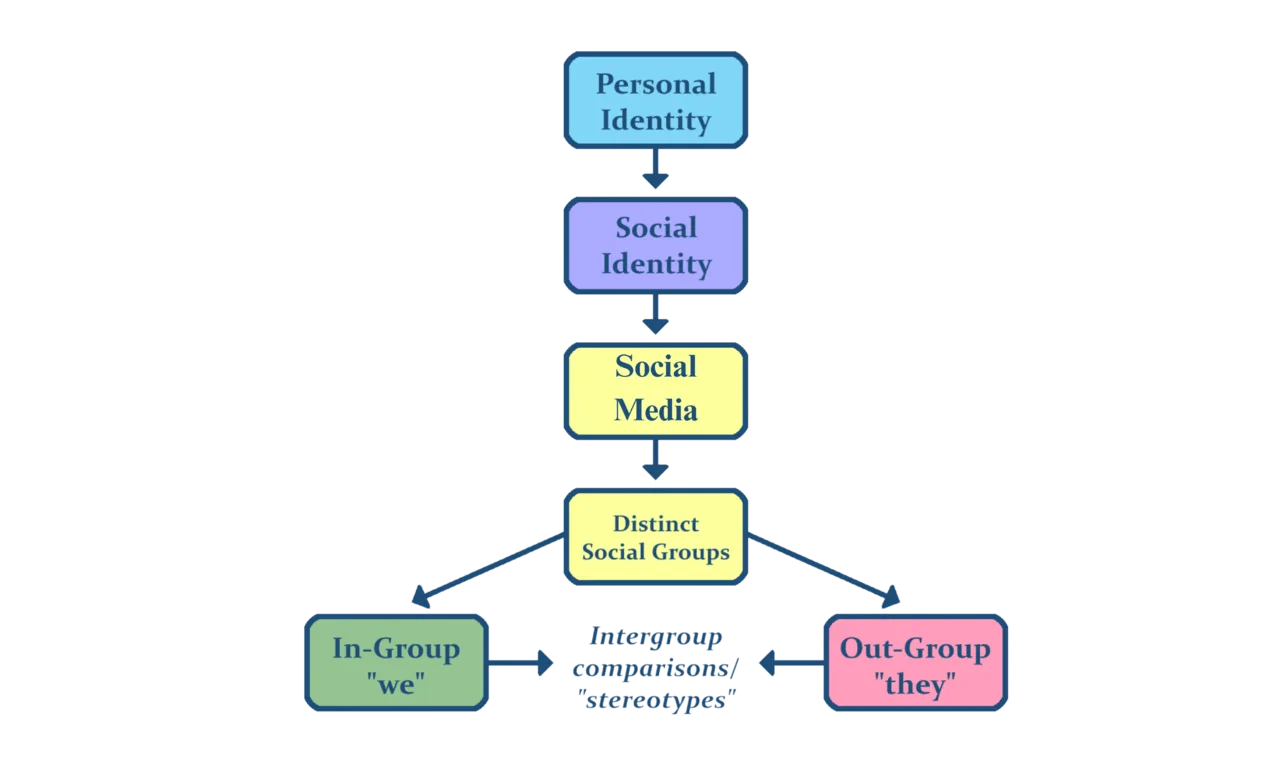
Social identity theory holds that part of self-concept comes from membership in social groups and the value attached to those groups. Categorization simplifies social perception but can accentuate differences, while identification makes group status personally meaningful. Minimal-group research showed that even arbitrary labels can produce in-group favoritism and relative advantage seeking without a history of conflict or material competition.
In the spring of 1970, Henri Tajfel walked into a laboratory at the University of Bristol and set up what would become one of the most consequential experiments in the history of social psychology. He needed to find the minimum conditions under which a person would discriminate against a stranger.
Previous research on prejudice had assumed that hostility between groups required a long history of conflict, real competition over resources, or at minimum some meaningful difference between the groups involved.
Tajfel suspected the requirements were considerably more modest. To test this, he created the most meaningless groups he could devise. Schoolboys were shown slides of paintings by Wassily Kandinsky and Paul Klee and asked which style they preferred.
They were then told, falsely, that they were either "Klee types" or "Kandinsky types." The groups had no history, no face-to-face interaction, no prior grievance, and no real difference in tastes - the assignment was arbitrary.
Then each boy was asked, privately and anonymously, to allocate small sums of real money to other participants identified only by their group label and a code number. The allocator never knew who the recipients were. He only knew which group they belonged to.
What Tajfel found has never fully lost its power to disturb. The boys systematically gave more money to members of their own group - whoever that was - than to members of the other, even when doing so meant accepting a lower absolute payout for their own group.
More strikingly still, many participants chose to maximize the difference between in-group and out-group allocations even when a more generous strategy would have given more money to their own group member in absolute terms.
The preference was not simply for one's own group to do well. It was for one's own group to do better. The drive for relative advantage over the other group was robust enough to override basic economic self-interest.
Tajfel, Billig, Bundy, and Flament published these findings in the European Journal of Social Psychology in 1971, and the "minimal group paradigm" was born.[1]
Tajfel had come to this question from a place of personal urgency. Born in 1919 to a Polish Jewish family, he had survived the Holocaust because he was studying in France when the war began and was captured by the Germans as a French soldier rather than as a Polish Jew.
His entire family in Poland was killed. The knowledge that his survival was a function of which label the Nazis had applied to him - and that the extermination of his family was a function of a different label applied to them - gave the abstract question of intergroup categorization a weight that was never merely academic.
"I became determined," he wrote in a 1981 memoir, "to understand how it was possible for normal men to act as the SS acted." The minimal group experiments were not a curiosity. They were the beginning of an answer.
"Part of a person's self-concept is derived from their knowledge of membership in social groups, together with the value and emotional significance of that membership." - Henri Tajfel & John Turner, 1979
Personal Identity vs. Social Identity: A Structural Comparison
| Dimension | Personal Identity | Social Identity |
|---|---|---|
| Definition | Idiosyncratic attributes, traits, and personal history | Self-concept derived from membership in social groups |
| Source | Individual experience, biography, personality | Group membership: nationality, religion, profession, ethnicity, team |
| Salience | High in interpersonal, one-on-one contexts | High when group membership is made psychologically relevant |
| Motivation | Self-esteem as individual | Self-esteem via positive distinctiveness of the in-group |
| Behavior shaped | Personal goals, private preferences | Conformity to group norms, in-group favoritism, out-group derogation |
| Response to threat | Defense of personal attributes or achievements | Defense of group status, comparison with out-groups |
| Classic measure | Self-concept scales, personality inventories | Luhtanen and Crocker (1992) Collective Self-Esteem Scale |
| Theoretical home | Classic ego psychology, self-concept research | Social Identity Theory, Self-Categorization Theory |
The Architecture of Social Identity Theory
Tajfel and Turner presented Social Identity Theory in its full form in a 1979 chapter, "An Integrative Theory of Intergroup Conflict," in the edited volume The Social Psychology of Intergroup Relations, edited by William G.[2] Austin and Stephen Worchel.
The theory was refined and given its most authoritative statement in Tajfel and Turner's 1986 chapter, "The Social Identity Theory of Intergroup Behavior," in Stephen Worchel and William G.[3]
Austin's Psychology of Intergroup Relations (2nd edition). The theory rests on three psychological processes that operate in sequence.
The first is social categorization. Human beings organize the world by placing people - including themselves - into categories. This is not pathology; it is cognitive economy. The mind cannot process every individual it encounters as a unique configuration of attributes.
Categories allow rapid, low-effort inferences: knowing someone is a nurse, a soldier, or a professor activates a set of expectations that make social life manageable. But categorization does something else as well.
It accentuates perceived similarities within categories and perceived differences between them - a phenomenon Tajfel had demonstrated in earlier research on perceptual judgment (Tajfel and Wilkes, 1963, Quarterly Journal of Experimental Psychology).
Applied to persons, this means that group membership is not merely a label but an active organizing principle that shapes perception.
The second process is social identification. Having categorized, people do not merely note their group membership; they internalize it. The group becomes part of the self.
A person who identifies as Irish, as a nurse, as a Manchester United supporter, or as working-class is not making a factual report about group membership in the way they might report their blood type.
They are announcing that their self-concept is partially constituted by this membership. The group's characteristics become, to a degree, their own. Its success reflects on them; its failures are a personal concern.
The third process is social comparison. Leon Festinger had established in 1954, in Human Relations, that people evaluate their opinions and abilities by comparing themselves to others. Tajfel and Turner extended this principle to group level: people evaluate the worth of their social groups by comparing them to other groups.
And since social identity contributes to self-esteem, the standing of the in-group relative to relevant out-groups has direct psychological consequences. A positive self-concept requires a positively valued social identity, which requires the in-group to compare favorably.
This is the engine of what the theory calls positive distinctiveness - the motivated drive to perceive one's in-group as distinct from and superior to relevant out-groups.
It is what drove Tajfel's Bristol schoolboys to sacrifice absolute earnings in order to maximize the gap between their group and the other. The preference was not mere greed. It was identity maintenance.
Cognitive Science: Mechanisms and Neural Correlates
Social Identity Theory was formulated at the level of social cognition, but subsequent decades have extended its claims into experimental and even neuroscientific territory.
Marilynn Brewer, at Ohio State University, published a highly influential paper in 1991 in Personality and Social Psychology Bulletin proposing the theory of optimal distinctiveness.[7] Brewer argued that social identity is not simply about positive evaluation - it serves two competing needs simultaneously.
The need for inclusion drives people toward belonging, toward assimilation into groups; but the need for differentiation drives people toward distinctiveness, away from total absorption into any collective.
Social identities at the optimal level satisfy both needs at once: the group is large enough to provide belonging but distinctive enough to provide a sense of uniqueness.
This framework predicted that people would be especially attached to identities in minority groups when assimilation pressure was high, which a substantial body of research has since confirmed.
David Wilder, at Rutgers University, demonstrated in a series of experiments published in Journal of Personality and Social Psychology (1978, 1986) that the mere act of categorizing strangers into two groups was sufficient to produce a range of perceptual distortions: exaggerated homogeneity within each group, enhanced perceptual distance between groups, and preferential evaluation of in-group members.
These effects held even when participants were explicitly told the groups had been formed randomly.
Richard Crisp and Miles Hewstone, working at the universities of Birmingham and Cardiff, developed the literature on multiple social categorization - the fact that any individual belongs simultaneously to many groups, and that crosscutting category memberships can reduce intergroup bias.[8]
Their research, synthesized in Crisp and Hewstone's 2007 chapter in European Review of Social Psychology (Volume 18), showed that when people recognize that a member of an out-group on one dimension is a fellow in-group member on another - when, say, a perceived political opponent turns out to share your profession - the activation of in-group/out-group distinctions on either dimension is weakened.
Crossed categorization reduces rather than compounds prejudice, a finding with substantial practical implications for how diverse institutions might be structured.
More recently, neuroscientific work has probed the brain basis of in-group favoritism. Mina Cikara, then at Carnegie Mellon University, and colleagues published work in Nature Neuroscience (2011) showing that the ventral striatum - a region associated with reward processing - shows enhanced activation in response to out-group misfortune.
The neural signature of Schadenfreude was detectable, and it was modulated by group identification. More strongly identified fans of a rival sports team showed greater neural reward responses when that team suffered setbacks.
This provided a biological dimension to the motivation for positive distinctiveness that purely cognitive accounts had left implicit.
Four Case Studies in Social Identity Research
Case Study 1: The Minimal Group Paradigm (Tajfel, Billig, Bundy, and Flament, 1971)
The founding study, published in the European Journal of Social Psychology (Volume 1, pages 149-178), established that trivially defined groups - preference for Klee vs. Kandinsky, or even assignment by a coin flip that participants knew was random - were sufficient to generate systematic in-group favoritism in resource allocation.
The critical finding was the preference for relative over absolute advantage: many participants chose allocation strategies that maximized the difference between the in-group's and out-group's totals even when doing so meant giving less money to the in-group member in absolute terms.
This "maximum difference" strategy, rather than maximum joint profit or maximum in-group profit, demonstrated that the goal was not simply to benefit one's own group but to ensure its superiority.
The study has since been replicated in dozens of countries with diverse participant populations, making it one of the most robust demonstrations in social psychology.
Case Study 2: Threats to Social Identity and Response Strategies (Branscombe, Wann, Noel, and Coleman, 1993)
Nyla Branscombe, at the University of Kansas, and colleagues published a study in the Journal of Personality and Social Psychology (Volume 65, pages 115-126) examining how people respond when their social identity is threatened.[5]
Branscombe and Wann distinguished between two types of threat: threats to the in-group as a whole ("your group is viewed negatively by others") and threats to the individual's membership status within the group ("you are not a true member").
Their findings showed that the response to these threats diverged sharply depending on the degree of group identification. High-identifiers responded to collective threats by increasing out-group derogation and in-group glorification - intensifying the very mechanisms the theory predicts.
Low-identifiers, facing the same information, were more likely to simply distance themselves psychologically from the group. The study demonstrated that identification level was a crucial moderating variable, not a constant, and that threats to social identity could amplify rather than simply activate its effects.
Case Study 3: Group Identification and Negative Information About the In-Group (Doosje, Ellemers, and Spears, 1995)
Bertjan Doosje, Naomi Ellemers, and Russell Spears, at the University of Amsterdam, published research in the Journal of Personality and Social Psychology (Volume 68, pages 626-635) that examined a theoretically important problem: what happens when members of a group are confronted with negative information about their own group?
The researchers found a systematic interaction between the ambiguity of the negative information and the level of group identification.[6]
When the negative information was ambiguous - that is, when there was room for interpretation - high identifiers showed greater in-group bias than low identifiers, actively interpreting ambiguous evidence more favorably.
But when the information was unambiguous and damning, high identifiers showed a different response: they still maintained stronger in-group identification and were less likely to psychologically distance themselves from the group, even accepting collective guilt more readily than low identifiers did.
The study revealed that high identification does not simply mean defensiveness; it can also mean a willingness to confront and accept unflattering truths about the group while remaining committed to it - a nuance that simple "motivated cognition" accounts would miss.
Case Study 4: Self-Categorization and Stereotyping (Oakes, Haslam, and Turner, 1994)
Penelope Oakes, S. Alexander Haslam, and John Turner, at the Australian National University, published Stereotyping and Social Reality (Blackwell, 1994), a sustained empirical and theoretical argument that stereotypes are not simply errors or biases but representations of real intergroup differences as perceived from a particular social vantage point.
Using the framework of Turner's Self-Categorization Theory, Oakes and colleagues argued that stereotypic perceptions are context-dependent - the same individual will categorize others differently, and will perceive different group attributes as relevant, depending on which comparative context is currently salient.[12]
In a series of experiments, they showed that judgments of group homogeneity and typicality shifted systematically with changes in the comparison context, and that these shifts followed the predictions of self-categorization theory.
The work reframed the question of stereotyping from "why are people biased?" to "what are people doing when they categorize, and what does it tell us about their social positioning?"
Intellectual Lineage
Social Identity Theory sits at the intersection of two large traditions: the European experimental social psychology that Tajfel helped create, and the American cognitive revolution in personality and social psychology.
Tajfel drew directly on the New Look movement in perception psychology - the research, associated with Jerome Bruner, Leo Postman, and Elliot McGinnies in the 1940s and 1950s, showing that perception is not passive registration of sensory information but is actively shaped by needs, expectations, and values.
Tajfel extended this into his early work on perceptual categorization, demonstrating that when a value-laden label (richer/poorer) was applied to stimuli, judgments of magnitude were systematically distorted. This was the conceptual seed from which the minimal group paradigm grew.
Gordon Allport's The Nature of Prejudice (1954) provided the cultural context for Tajfel's work. Allport had argued that categorization was a fundamental cognitive process and that prejudice was not an aberration but an extension of the normal tendency to think in categories.
Tajfel took Allport's insight about categorization and gave it a motivational dimension: categories mattered not merely because they simplified perception but because they provided identity.
Leon Festinger's Social Comparison Theory (1954) provided the direct precursor to the social comparison process in Social Identity Theory. Tajfel and Turner acknowledged this debt while extending the comparison from individual attributes to group standing.
John Turner, who had been a graduate student of Tajfel's at Bristol, carried the tradition forward most directly.
His Self-Categorization Theory, developed across papers in the early 1980s and synthesized in Turner, Hogg, Oakes, Reicher, and Wetherell's Rediscovering the Social Group (Blackwell, 1987), extended Social Identity Theory in a critical direction: rather than treating "the group" as a given that people then identify with, Self-Categorization Theory proposed that groupness itself was a psychological achievement, produced by the operation of categorization processes.
The self, in this view, is not a fixed entity that sometimes identifies with groups; it is a dynamic process that shifts between personal and social levels of abstraction depending on context.[4]
At the personal level, individuals compare themselves with other individuals; at the social level, the individual depersonalizes - perceiving themselves as interchangeable with other in-group members - and the relevant comparison unit becomes the group against the out-group.
Turner and Tajfel had a complex intellectual relationship in their later years. Turner believed that Tajfel had over-emphasized the political and structural dimensions of intergroup conflict - the real differences in power and resources between groups - at the expense of the purely psychological mechanisms.
Their 1979 and 1986 chapters together represented an uneasy integration of both emphases that subsequent researchers have had to disentangle.
Empirical Research and Applications
Social Identity Theory has generated one of the most productive empirical programs in social psychology. Its applications extend far beyond the laboratory.
In organizational psychology, Blake Ashforth and Fred Mael published a landmark paper in Academy of Management Review (1989, Volume 14, pages 20-39) applying Social Identity Theory to organizations.[11]
Organizational identification, they argued, was a form of social identification: employees who strongly identified with their organization would perceive its successes as their own, conform to its norms, and resist information that cast the organization in a negative light.
This framework has since generated hundreds of studies on commitment, citizenship behavior, turnover, and ethical decision-making.
Michael Hogg and Deborah Terry extended this analysis into leadership theory, arguing in Personality and Social Psychology Review (2000) that charismatic leaders derive their influence partly from their position as prototypical group members - those who embody the defining characteristics of the group - rather than from personal charisma alone.
In the domain of prejudice and discrimination, the theory has provided a framework for understanding not only individual bias but structural inequality.
When group boundaries are perceived as impermeable - when a low-status group member cannot realistically become a high-status group member - the theory predicts that people will not adopt individual mobility strategies (trying to leave the group) but will instead adopt social competition strategies: challenging the basis of the group comparison directly, arguing that the evaluation criteria used to rank the groups are illegitimate.
This provided a social-psychological vocabulary for understanding collective protest and social movements, connections developed by Turner and the Bristol school and later formalized by Steve Reicher in his analyses of crowd behavior (British Journal of Social Psychology, 1982).
In political psychology, Social Identity Theory has been applied to nationalism, partisan identity, and intergroup conflict.
Jonathan Renshon, at the University of Wisconsin, published work in the American Journal of Political Science (2017) showing that status threat - the perception that one's national group was losing status relative to others - was a robust predictor of anti-immigration attitudes and support for nationalist parties.
This was precisely the positive-distinctiveness mechanism operating at political scale: when the group's relative standing appeared threatened, members responded with strategies designed to re-establish superiority.
Limits, Critiques, and Nuances
Social Identity Theory has not been without serious challenge. Matthew Hornsey, at the University of Queensland, published a comprehensive review of the theory's development, reception, and limitations in Social and Personality Psychology Compass (2008, Volume 2, pages 204-222) that remains the most useful single guide to these debates.[9]
Hornsey identifies a central ambiguity in the original formulation: is the drive for positive distinctiveness universal, or is it contingent on individual differences in self-esteem or group identification?
The original theory implied a universal motivation - everyone seeks a positively valued social identity - but the empirical record is considerably messier. People with low trait self-esteem sometimes show weaker in-group favoritism, not stronger.
And cross-cultural research has found that in collectivist cultures, where the boundary between self and group is already more fluid, the minimal group effect is attenuated and sometimes absent.
People in East Asian cultural contexts, for instance, show weaker in-group favoritism in minimal group experiments than their North American or European counterparts, suggesting that the drive for positive distinctiveness may itself be shaped by cultural beliefs about the relationship between the individual and the collective.
Mark Rubin and Miles Hewstone raised a direct challenge to the theory's core motivational claim in a 1998 review in Personality and Social Psychology Review (Volume 2, pages 40-62).[10]
They distinguished between three versions of the self-esteem hypothesis: that high self-esteem would predict in-group favoritism; that successful intergroup discrimination would boost self-esteem; and that low self-esteem would motivate discrimination.
Their meta-analytic review found inconsistent support for all three.
The relationship between self-esteem and in-group favoritism proved to be considerably more complex than the original formulation suggested, and moderated by a range of variables - type of self-esteem measure, type of discrimination task, and level of group identification - that the original theory had not specified.
Deborah Terry and Michael Hogg, at the University of Queensland, published work in Personality and Social Psychology Bulletin (1996) showing that the relationship between group identification and normative behavior was itself moderated by subjective uncertainty.
People turned to group identity most strongly when they felt uncertain about themselves or their social world - a finding that connected Social Identity Theory to uncertainty-reduction motives that the original formulation had not explicitly incorporated.
This launched a substantial program of research on uncertainty and group identification, reviewed by Hogg in Psychological Bulletin (2007).
Perhaps the deepest challenge came from Turner himself, who grew increasingly dissatisfied with interpretations of Social Identity Theory that treated group identification as simply another individual difference variable - a stable trait predicting behavior in the same way that personality traits do.
Turner insisted, throughout the 1990s until his death in 2011, that the Self-Categorization framework had fundamentally changed the nature of the explanatory project.
In his view, social identity was not a property that individuals possessed in varying degrees; it was a process that operated contextually, producing different levels of self-categorization in response to different comparative contexts.
The attempt to measure "degree of identification" with a questionnaire item was, in Turner's analysis, conceptually confused - like trying to measure whether someone "generally" sees the figure or the ground in an ambiguous figure.
What matters is the context that makes one or the other salient.
This remains an unresolved tension in the field. The individual-differences approach has proven empirically tractable and has generated enormous research productivity. The process approach Turner advocated is theoretically more coherent but considerably harder to operationalize in standard experimental designs.
The debate has not been settled so much as partitioned: organizational and applied psychologists tend to work within the individual-differences framework, while social cognition researchers more often use designs sensitive to contextual variation in self-categorization.
Conclusion
Henri Tajfel died in 1982, before the full ramifications of the theory he had founded became clear.
He had spent the last years of his career arguing, with characteristic stubbornness, that social psychology could not understand prejudice or group behavior without taking seriously the reality of the social structures in which individuals were embedded - the real differences in power, status, and resources between groups, and the real constraints these placed on psychological responses.
His collaborator Turner thought this went too far toward sociology and not far enough toward psychology. The tension between them was never resolved, and it has been generative precisely because it has never been resolved.
What the minimal group experiments established, and what fifty years of subsequent research has confirmed and complicated, is that the boundary between self and group is not a fixed architectural feature of the mind but a dynamic psychological achievement, responsive to context, culture, and social structure.
The identity that feels most private and individual - who I am, what I value, what I will sacrifice - is partly constituted by the groups to which I belong and the comparative position those groups occupy.
Tajfel, the Jewish survivor who had watched category labels determine who lived and who died, understood this with a clarity that made him unable to view it as merely academic.
The theory he built from that understanding remains, five decades later, the most comprehensive account social psychology has produced of why belonging matters so much, and why it so reliably turns cruel.
Sources & Further Reading
Tajfel, H., Billig, M. G., Bundy, R. P., and Flament, C. (1971). Social categorization and intergroup behaviour. European Journal of Social Psychology, 1(2), 149-178.
Tajfel, H., and Turner, J. C. (1979). An integrative theory of intergroup conflict. In W. G. Austin and S. Worchel (Eds.), The Social Psychology of Intergroup Relations (pp. 33-47). Brooks/Cole.
Tajfel, H., and Turner, J. C. (1986). The social identity theory of intergroup behavior. In S. Worchel and W. G. Austin (Eds.), Psychology of Intergroup Relations (2nd ed., pp. 7-24). Nelson-Hall.
Turner, J. C., Hogg, M. A., Oakes, P. J., Reicher, S. D., and Wetherell, M. S. (1987). Rediscovering the Social Group: A Self-Categorization Theory. Blackwell.
Branscombe, N. R., Wann, D. L., Noel, J. G., and Coleman, J. (1993). In-group or out-group extremity: Importance of the threatened social identity. Personality and Social Psychology Bulletin, 19(4), 381-388.
Doosje, B., Ellemers, N., and Spears, R. (1995). Perceived intragroup variability as a function of group status and identification. Journal of Experimental Social Psychology, 31(5), 410-436.
Brewer, M. B. (1991). The social self: On being the same and different at the same time. Personality and Social Psychology Bulletin, 47(2), 475-482.
Crisp, R. J., and Hewstone, M. (2007). Multiple social categorization. In M. P. Zanna (Ed.), Advances in Experimental Social Psychology (Vol. 39, pp. 163-254). Academic Press.
Hornsey, M. J. (2008). Social identity theory and self-categorization theory: A historical review. Social and Personality Psychology Compass, 2(1), 204-222.
Rubin, M., and Hewstone, M. (1998). Social identity theory's self-esteem hypothesis: A review and some suggestions for clarification. Personality and Social Psychology Review, 2(1), 40-62.
Ashforth, B. E., and Mael, F. (1989). Social identity theory and the organization. Academy of Management Review, 14(1), 20-39.
Oakes, P. J., Haslam, S. A., and Turner, J. C. (1994). Stereotyping and Social Reality. Blackwell.