
What Is Lying and Why Do Humans Do It?
Understanding: Lying is the intentional communication of false information with the purpose of creating a false belief in another person.
Empirical research reveals that deception is far more common than most people recognize or admit: diary studies by psychologist Bella DePaulo found that people lie in approximately 20 percent of their social interactions, and laboratory research shows that many lies are produced automatically, without deliberate planning or subsequent awareness.
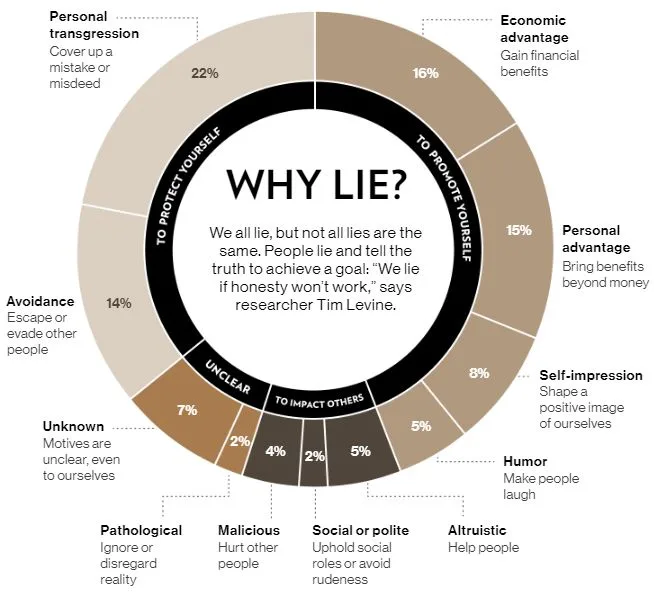
Humans lie for a range of motivations - to protect others' feelings, manage their own self-image, avoid punishment, and gain social or material advantage - and a significant proportion of deception is directed inward, in the form of self-deception that serves to protect self-esteem and sustain motivated reasoning.
In 1988, psychologist Robert Feldman sat down with undergraduate volunteers and asked them to watch, and then analyze, a video of themselves having a conversation with a stranger.[3] None of the subjects knew what they would be looking for. After the video began, Feldman pointed out specific moments and asked: "Was that accurate?"
Most of the participants were astonished. In a ten-minute conversation they had just had, watching their own behavior, they identified moments they had said things that simply were not true - without having had any intention to deceive and without any memory of having done so.
A 2002 follow-up study quantified the finding: 60% of subjects had lied at least once in a ten-minute conversation with a stranger, averaging 2.92 lies. The lies came automatically, fluently, and largely without awareness.
The finding provoked predictable backlash - people do not like to think of themselves as liars - but it sits within a much larger, more uncomfortable empirical picture. Bella DePaulo's diary studies, in which subjects recorded every lie they told each day, found participants lying in approximately 20% of their social interactions.[1]
Most liars - when informed of the research - doubted the relevance to themselves. They estimated their own lying frequency at a fraction of the measured rate.
The gap between how much we lie and how much we believe we lie is itself a form of self-deception - which turns out to be where the most interesting science lives.
"The truth is rarely pure and never simple." - Oscar Wilde, The Importance of Being Earnest (1895)
Key Definitions
Deception - Intentional communication intended to create a false belief in another person that the communicator has not consented to and does not have the right to create. Deception can involve false statements, misleading truths, selective omission, implicature, and non-verbal behavior.
Lie - A false statement made with intent to deceive. A subset of deception.
| Lie Type | Primary Motive | Frequency | Detection Difficulty |
|---|---|---|---|
| Prosocial / white lie | Protect another's feelings; maintain social harmony | High | Low (often acknowledged) |
| Self-presentation lie | Manage one's image; appear more capable or virtuous | High | Moderate |
| Self-serving lie | Gain an advantage; avoid punishment | Moderate | Moderate-High |
| Antisocial lie | Harm another; manipulate for personal gain | Low | High |
White lie - A lie told to benefit the listener or to maintain social harmony, typically involving minor matters (compliments, social pleasantries). The most common category of everyday lying.
Self-deception - Holding false beliefs about oneself that serve psychological functions: protecting self-esteem, maintaining cognitive consistency, supporting motivated reasoning. Distinct from interpersonal deception but potentially more consequential for behavior and decision-making.
Theory of mind (ToM) - The cognitive ability to attribute mental states - beliefs, desires, intentions, knowledge - to others, and to understand that these states may differ from one's own. The prerequisite for intentional deception: you must understand what the other person believes in order to create a false belief in them.
Motivated reasoning - The tendency to evaluate evidence, arguments, and information in ways that favor preferred conclusions. A form of cognitive self-deception in which the conclusion precedes the evaluation rather than following from it.
Illusory superiority (better-than-average effect) - The near-universal tendency to rate oneself as above average on positive traits. Logically impossible for the majority to be above average; the bias reflects self-serving self-perception rather than accurate self-assessment.
Unrealistic optimism - The tendency to believe one's own future outcomes will be more positive than the outcomes of others in similar situations. Documented across cultures and for dozens of life outcomes.
The liar's dividend - The phenomenon by which, as public awareness of deepfakes and AI-generated content grows, people become more willing to deny genuine evidence by claiming it is fabricated. Increasing sophistication of deceptive technology reduces the credibility of authentic evidence.
Detection accuracy - The measured accuracy with which people, including trained professionals, can identify lies from behavioral and physiological cues. Meta-analyses consistently find approximately 54% accuracy - barely above chance.
Why Humans Evolved to Lie
Deception is not uniquely human. It evolved repeatedly in nature - from stick insects that resemble twigs, to orchids that mimic female bees to attract pollinators, to cuckoos that lay eggs mimicking host species coloration, to chimpanzees that adopt deceptive behavior to conceal resources from dominant individuals.
In humans, the cognitive prerequisites for intentional deception are bound to the most sophisticated capacities of the human mind. Intentional deception requires:
- Theory of mind: understanding that the other person has beliefs that may differ from your own, and knowing what they believe
- Metarepresentation: representing the difference between what is true and what you are communicating
- Behavioral control: suppressing the truth while producing an alternative, without giving away the suppression
- Strategic modeling: anticipating how the lie will be received, whether it will be detected, and how to respond to challenges
These are not simple capacities. The fact that children develop the ability to lie at approximately age 3-4 - coinciding with the emergence of theory of mind - strongly supports the developmental connection.
Canonical false-belief tasks, such as the Sally-Anne task (Baron-Cohen, Leslie, and Frith, 1985), show that children reliably fail to understand that others can hold beliefs the child knows to be false until roughly this developmental window - the same window in which intentional lying becomes possible.
The evolutionary case for deception is straightforward: access to resources through deception - food, mates, status, alliances - without the costs of direct competition. The costs of being caught: social ostracism, damaged reputation, loss of cooperative relationships.
The game-theoretic equilibrium depends on the relative magnitude of these costs and benefits, and on the sophistication of deception detection in the social environment.
Crucially, the same cognitive architecture that enables deception also enables cooperation, empathy, and complex social coordination. Theory of mind is the foundation of both understanding others' suffering (empathy) and strategically misleading them (deception). The moral valence depends on application, not mechanism.
The primatologist Frans de Waal documented tactical deception in chimpanzees with extensive observations: subordinate males concealing erections from dominant males; chimpanzees masking their direction of travel to a food source; individuals producing alarm calls when no threat existed to scatter competitors from food.
These are not culturally transmitted - they emerge from the basic architecture of a social intelligence capable of modeling others' mental states.
Richard Byrne and Andrew Whiten (1992) proposed the Machiavellian intelligence hypothesis: that the primary evolutionary driver of primate intelligence was not ecological challenge (finding food, avoiding predators) but social competition - the need to navigate, manipulate, and cooperate within complex social groups.[14]
On this account, the cognitive machinery for deception is not an unfortunate side effect of intelligence but one of its primary selective targets.
What Happens in the Brain When You Lie
Lying is cognitively more demanding than truth-telling. It requires suppressing the true response, constructing an alternative, maintaining internal consistency, and monitoring behavioral cues - all simultaneously.
fMRI studies across multiple research groups consistently show elevated activity in prefrontal regions during deception:
- Anterior prefrontal cortex: involved in prospective memory and holding multiple mental representations simultaneously - necessary for maintaining the deceptive representation alongside the true one
- Dorsolateral prefrontal cortex (DLPFC): executive control, working memory, suppression of dominant responses
- Anterior cingulate cortex (ACC): conflict monitoring - the ACC fires when two competing responses (the true answer and the lie) are in conflict, flagging the need for controlled resolution
- Parietal cortex: attention and action selection
The cognitive load of lying is why deception becomes less effective under conditions that tax cognitive resources: sleep deprivation, divided attention, time pressure, alcohol, stress. Interrogators have long used time pressure specifically to exploit this effect.
Vrij, Mann, and Fisher (2006) demonstrated that cognitive load interviews - designed to tax working memory and reduce the cognitive resources available for managing the deception - produced more behavioral and verbal cues to deception than standard interview approaches.[6]
A particularly striking finding by Neil Garrett and colleagues (2016): the amygdala responds to self-serving dishonesty with diminishing activation across repeated lies.[4]
In a task where participants could financially benefit by misreporting to a partner's disadvantage, amygdala activity was highest for the first lie and declined with each subsequent lie - the emotional cost of dishonesty diminished through repetition.
The study's title captured the implication: "The Brain Adapts to Dishonesty." Lying becomes emotionally easier with practice, providing a mechanistic basis for the escalation of dishonesty that is clinically and legally observed.
This emotional desensitization mechanism has significant real-world implications. Small workplace dishonesty - expense padding, minor misrepresentations - does not represent a stable equilibrium. The emotional brakes that initially constrain dishonesty weaken with each instance, making larger violations progressively easier.
This is consistent with studies of corporate fraud and corruption, which typically involve gradual escalation from small transgressions rather than sudden large leaps.
The Neural Signature of Lies vs. Omissions
An important distinction in the neuroscience of deception concerns lies by commission (stating falsehoods) versus lies by omission (withholding relevant truths). Research by Abe and colleagues (2007) found overlapping but partially distinct neural signatures for these two forms of deception.
Both activated prefrontal regulatory systems, but lies by omission showed less anterior cingulate activation - consistent with lower internal conflict, because the person is not actively producing a false statement.
This may explain why omission-based deception is subjectively experienced as less dishonest, despite often having the same practical effect.
Types of Lies and Their Frequency
DePaulo's diary studies provide the most systematic picture of everyday lying. Key findings:
Most lies are not dramatic: approximately 25% of lies involved major matters; 75% were minor or trivially low-stakes. The stereotype of lying as a significant moral event is inconsistent with its actual everyday prevalence - most lies are social lubricants.
Prosocial lies are common: approximately 25% of lies were told to benefit others - to protect feelings, to maintain social harmony, to manage social situations. These are qualitatively different from self-serving deception and most moral frameworks treat them differently.
Self-serving lies predominate: approximately 40-50% of lies served the liar's interests: impression management, avoiding consequences, or claiming credit.
Protective lies: avoiding punishment, embarrassment, or conflict - approximately 25-30% of lies.
Lies vary dramatically by relationship: people lie more to strangers than to close friends and intimate partners; but the lies told to intimates, when they occur, are often more consequential.
Couples tell each other highly targeted, relationship-protective lies that differ qualitatively from the social lubrication lies told to acquaintances.
DePaulo and Kashy (1998) specifically examined lying in close relationships and found that the frequency of lying to intimates was lower than to strangers or acquaintances - but the lies that did occur in close relationships were more serious and more exclusively self-serving.[2]
The "little white lie to spare feelings" pattern is more characteristic of acquaintance relationships than intimate ones, where the strategic value of relationship-protective deception is higher and the stakes of detection greater.
Prolific Liars and the Distribution of Deception
An important finding that complicates the picture of universal everyday deception: the distribution of lying is highly skewed. A 2010 large-scale diary study by Serota, Levine, and Boster found that a small minority of individuals - approximately 1% - accounted for a disproportionate share of all lies told.[11]
Half of all lies in the sample were told by just 5% of participants. The "average" frequency of lying conceals enormous individual variation; most people lie relatively rarely, while a small number are highly prolific.
This skewed distribution has significant practical and ethical implications. Treating lying as a universal human behavior at uniform rates misrepresents the empirical picture.
The more accurate framing is that dishonesty is common but not uniformly distributed - and that addressing the behavior of prolific liars in high-trust environments (institutions, professions, relationships) may yield greater benefits than general honesty campaigns aimed at average individuals.
Self-Deception: Lying to Yourself
The most consequential lies may not be the ones told to others.
Robert Trivers' evolutionary theory of self-deception argues that self-deception evolved to enhance interpersonal deception.[9]
The logic: a person who genuinely believes the false thing they are communicating does not produce the behavioral cues (hesitation, elevated stress responses, gaze aversion) that signal deception to observers. Self-deception provides authentic confidence in the lie.
"Self-deception is the ultimate form of deception - it is so thorough that it deceives even the deceiver." - Robert Trivers, The Folly of Fools (2011)
The empirical record of self-deception is extensive:
Illusory superiority: the better-than-average effect is one of social psychology's most robust findings. In surveys of American college students, 70% rate themselves as above-average drivers; 80% as above-average in their ability to get along with others; 90% as above-average in their sense of humor.
These distributions are mathematically impossible. The effect persists across cultures, ages, and domains, and diminishes but does not disappear among people with knowledge of the bias.
Unrealistic optimism: Tali Sharot's research finds that people consistently underestimate their probability of divorce, cancer, robbery, and car accidents - and overestimate their probability of success, longevity, and positive life outcomes - relative to base rates for people in their situations.
The brain actively updates beliefs more readily in response to good news than bad news, maintaining the optimistic bias. In a 2011 analysis, Sharot found this optimism bias was present in approximately 80% of the population studied across multiple cultures - a near-universal cognitive tendency.[10]
Motivated reasoning: Kahan's cultural cognition research and Ditto's motivated skepticism research document that people evaluate the quality of evidence based primarily on whether it supports their prior beliefs.
Identical scientific studies are rated as more rigorous and credible when their conclusions support the evaluator's worldview; the same flawed methodology is criticized or endorsed based on conclusion, not design quality. This is not lying - it often feels like careful reasoning.
It is self-deception at the level of epistemic process.
Moral credentialing: having done something virtuous recently makes people less likely to behave virtuously subsequently ("moral licensing").
Having performed a past good action is used to license a current transgression, through the implicit self-belief that "I'm a good person, so this exception is permissible" - a self-deception that undermines the behavioral consistency moral intentions are supposed to produce.
Merritt, Effron, and Monin (2010) documented this pattern across multiple studies: individuals who recalled past moral behavior subsequently donated less to charity, showed more racial bias in hiring decisions, and were more willing to express politically incorrect opinions.
The Adaptive Value of Self-Deception
Positive illusions are not uniformly harmful. Taylor and Brown (1988) documented that mildly positive self-views, unrealistic optimism, and exaggerated sense of control over outcomes are characteristics of psychologically healthy individuals - not neurotic ones.[12]
Depressed individuals show more accurate self-assessment (a phenomenon called depressive realism) but suffer for it in motivation and resilience. Moderate self-enhancement may support the persistence through difficulty that achievement requires.
The adaptive interpretation: self-deceptive positivity sustains motivation and reduces learned helplessness, at the cost of accuracy. The maladaptive version: self-deception escalates to the point of blocking course corrections that genuine self-assessment would provide.
The difference lies in degree and in whether the self-deception is responsive to reality feedback over time.
The Limits of Lie Detection
Perhaps the most practically consequential finding in deception research is the inability of humans to detect lies reliably.
Aldert Vrij - who has conducted more research on lie detection than any other researcher - summarizes the meta-analytic picture: people detect lies at approximately 54% accuracy, across dozens of studies and hundreds of thousands of judgments.
Trained professionals - police, judges, customs officers, intelligence agents, psychiatrists - perform no better than untrained civilians, and sometimes worse. Confidence in detection ability is uncorrelated with actual accuracy.
The behavioral cues most laypeople and many trained investigators associate with deception - gaze aversion (the "shifty eyes" of popular imagination), increased blinking, self-touching - have weak or no correlation with actual deception in controlled research.
Gaze aversion is more strongly associated with cognitive effort and embarrassment than with lying. Many excellent liars maintain confident eye contact.
A comprehensive meta-analysis by Bond and DePaulo (2006), examining 206 studies with over 24,000 judges making nearly 250,000 deception judgments, found a mean detection accuracy of 54% - with no meaningful advantage for any judge type including law enforcement and judicial professionals.[5]
The analysis found that judges were somewhat better at detecting truths than lies - consistent with a truth bias in human social judgment - but accuracy for lies specifically was barely above chance.
The polygraph measures physiological arousal (heart rate, blood pressure, galvanic skin response, respiration) and assumes that arousal indicates deception. It does not - arousal accompanies any emotionally significant state, including truthful responses to genuinely threatening questions.
The polygraph has no scientific consensus support as a reliable lie detection method; it is not admissible as evidence in most jurisdictions; and it can be defeated by techniques that regulate the arousal response.
Brain-based lie detection - fMRI, EEG - has excited attention as a more direct neural measure. Current evidence does not support reliability sufficient for individual assessment; group-level findings do not reliably translate to individual classification.
The technical, ethical, and legal barriers to brain-based lie detection in practice are substantial.
Verbal Cues vs. Behavioral Cues
A productive shift in deception detection research has moved from behavioral cues (body language, gaze) toward verbal content analysis. Scientific Content Analysis (SCAN) and Criteria-Based Content Analysis (CBCA) examine patterns in the content and structure of testimony.
Reality Monitoring (Johnson and Raye, 1981) distinguishes memories of real events from invented ones based on the expectation that genuine memories contain more sensory and contextual detail, more spatial and temporal information, and more cognitive operations (thoughts, feelings) than fabricated accounts.
These verbal approaches show modestly better detection rates than behavioral cue methods, though still well below the accuracy required for reliable individual classification.
Vrij and colleagues (2015) reported that Strategic Use of Evidence (SUE) interview techniques - which strategically withhold known evidence to catch inconsistencies in a suspect's account - improved detection accuracy to approximately 70% in controlled studies, among the highest reported in the literature.
What Actually Increases Honesty
The behavioral economics literature has identified several interventions that reliably increase honest behavior:
Moral salience at decision point: Nina Mazar and colleagues found that asking people to recall the Ten Commandments before a task significantly reduced cheating - even among people who remembered zero commandments.[7]
The moral reminder at the moment of decision activated the moral self-concept, making the self-image as honest person more salient. Critically, this only works when activated before the decision, not after.
Signing at the top: Shu, Mazar, Gino, Ariely, and Bazerman (2012) found that signing a pledge at the top of a form (rather than the bottom) increased honest reporting.[8]
Signing at the top activates the moral self-concept before the dishonest opportunity; signing at the bottom merely confirms the already-completed (and already potentially dishonest) behavior.
Identity framing: asking "Are you the kind of person who cheats?" rather than "Will you cheat?" activates identity-level processing and significantly reduces self-reported willingness to engage in dishonest behavior. People are more protective of their moral identity than of their specific behavior patterns.
Accurate social norms: in contexts where people believe cheating is common (tax evasion, insurance fraud), they are more likely to engage in it themselves. Correcting the perceived norm - "in fact, 97% of taxpayers report accurately" - reduces dishonest behavior.
The message that cheating is the exception rather than the rule shifts the social comparison.
Observation and transparency: both actual and believed observation substantially increase honest behavior. The Hawthorne effect is real.
The implication for institutional design: transparency mechanisms, audit trails, and accountability structures produce honest behavior at the level of system design, reducing the reliance on individual virtue.
The Limits of Moral Reminders
It is important to note that moral reminders and identity-framing interventions have limits.
Gino and colleagues (2011) found that when dishonest behavior could be rationalized as creative rather than dishonest, standard moral reminders lost effectiveness - people who were primed to think of themselves as creative subsequently cheated more rather than less.
The effectiveness of honesty interventions depends on whether the behavior in question is encoded as a morality issue in the first place.
This points to a broader principle in behavioral ethics: most dishonesty is not experienced as dishonesty by the person committing it.
Cognitive mechanisms including rationalization, moral disengagement (Bandura), and the malleable threshold of what counts as acceptable loosening of honesty norms - operate to allow people to maintain self-images as honest while engaging in behavior that outside observers would clearly classify as deceptive.
Interventions that assume dishonesty is a fully conscious choice miss the degree to which the behavior precedes moral categorization.
Deception in the Digital Age
The digital environment has transformed both the scale and detection of deception in ways that raise urgent new questions.
Disinformation and synthetic media: Large-scale computational disinformation - coordinated inauthentic behavior on social media platforms, AI-generated text and images, deepfake video - represents deception operating at industrial scale.
The mechanisms are the same as individual deception (creating false beliefs without consent) but the agents, scale, and detection challenges are categorically different.
Lazer and colleagues (2018) documented in Science that false news stories spread faster, broader, and deeper on Twitter than true stories, driven by human sharing behavior rather than bots - a finding that challenged the assumption that automation is primarily responsible for misinformation spread.[13]
The liar's dividend - as digital fabrication becomes more sophisticated, genuine evidence can be dismissed as fabricated.
This creates a perverse dynamic in which the spread of deepfake technology ultimately benefits those who seek to deny authentic evidence, even when they are not themselves using deepfakes.
The mere possibility of fabrication undermines the evidentiary status of authentic recordings and photographs.
Behavioral data and deception detection: Social media and digital communication generate behavioral data at scales and levels of detail that allow new approaches to deception detection at the account level.
Bot detection algorithms, network analysis of coordinated inauthentic behavior, and linguistic analysis of AI-generated text represent the frontier of deception detection research - operating through statistical pattern analysis rather than the individual cue-based approaches that have historically failed.
Sources & Further Reading
- DePaulo, B. M., et al. (1996). Lying in Everyday Life. Journal of Personality and Social Psychology, 70(5), 979-995. DOI: 10.1037/0022-3514.70.5.979
- DePaulo, B. M., & Kashy, D. A. (1998). Everyday Lies in Close and Casual Relationships. Journal of Personality and Social Psychology, 74(1), 63-79.
- Feldman, R. S., Forrest, J. A., & Happ, B. R. (2002). Self-Presentation and Verbal Deception: Do Self-Presenters Lie More? Basic and Applied Social Psychology, 24(2), 163-170.
- Garrett, N., et al. (2016). The Brain Adapts to Dishonesty. Nature Neuroscience, 19(12), 1727-1732. DOI: 10.1038/nn.4426
- Bond, C. F., & DePaulo, B. M. (2006). Accuracy of Deception Judgments. Personality and Social Psychology Review, 10(3), 214-234.
- Vrij, A. (2008). Detecting Lies and Deceit: Pitfalls and Opportunities. Wiley.
- Mazar, N., Amir, O., & Ariely, D. (2008). The Dishonesty of Honest People: A Theory of Self-Concept Maintenance. Journal of Marketing Research, 45(6), 633-644.
- Shu, L. L., Mazar, N., Gino, F., Ariely, D., & Bazerman, M. H. (2012). Signing at the Beginning Makes Ethics Salient and Decreases Dishonest Self-Reports. Proceedings of the National Academy of Sciences, 109(38), 15197-15200.
- Trivers, R. (2011). The Folly of Fools: The Logic of Deceit and Self-Deception in Human Life. Basic Books.
- Sharot, T. (2011). The Optimism Bias. Current Biology, 21(23), R941-R945.
- Serota, K. B., Levine, T. R., & Boster, F. J. (2010). The Prevalence of Lying in America. Human Communication Research, 36(1), 2-25.
- Taylor, S. E., & Brown, J. D. (1988). Illusion and Well-Being: A Social Psychological Perspective on Mental Health. Psychological Bulletin, 103(2), 193-210.
- Lazer, D. M. J., et al. (2018). The Science of Fake News. Science, 359(6380), 1094-1096.
- Byrne, R. W., & Whiten, A. (1992). Cognitive Evolution in Primates: Evidence from Tactical Deception. Man, 27(3), 609-627.
For related concepts, see why we procrastinate, how propaganda works, and why conspiracy theories spread.