
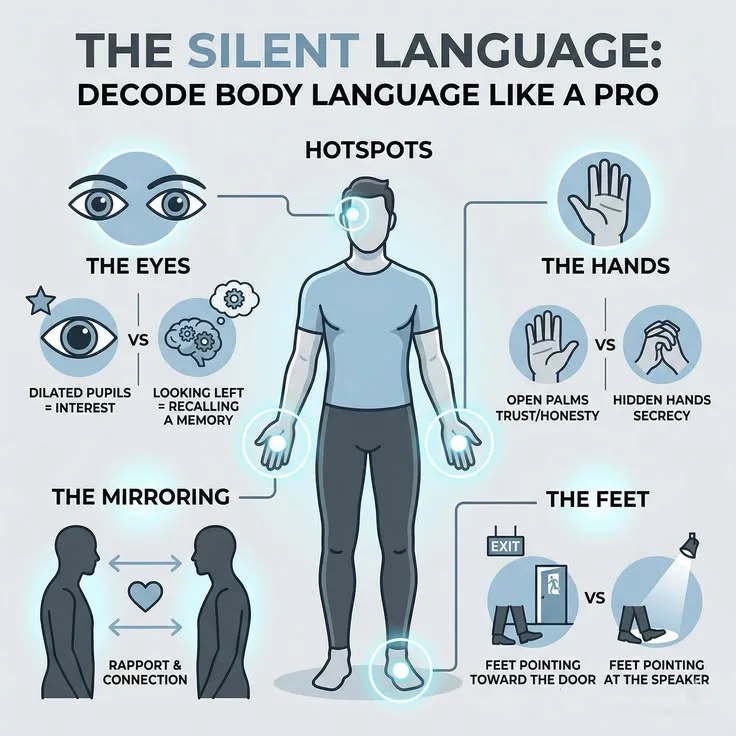
Decoding body language requires caution: nonverbal communication affects interaction, but single gestures rarely reveal lies, confidence, or hidden emotion with reliable precision. Facial expression, gaze, posture, touch, gesture, voice, and distance are shaped by context and culture. Evidence is stronger for cues such as engagement and mirroring than for popular claims about crossed arms, gaze direction, or microexpressions detecting deception.
There is a persistent belief, popularized by business books, law enforcement training manuals, and countless TED Talks, that people skilled in reading body language can detect lies, assess confidence, and decode true feelings from physical signals with meaningful accuracy.
The belief is appealing: it offers a kind of social superpower, a way to see past what people say to what they actually mean.
It also happens to be substantially wrong, at least in its stronger formulations - and the gap between what people believe about body language and what research actually supports is wide enough to cause real harm when applied in high-stakes contexts like interrogation, hiring, or clinical assessment.
This is not an argument that body language is meaningless. Nonverbal communication is real, studied, and consequential. The problem is specificity: confident claims about reading individual cues (crossed arms means defensive, looking up-left means lying, touching the face means deception) are not supported by the research record.
What research does support is considerably more interesting and more nuanced, and understanding the difference is practically valuable whether you are managing relationships, navigating professional settings, or simply trying to understand other people more accurately.
The science of nonverbal communication spans facial expressions, gaze, touch, spatial behavior, gesture, posture, and vocal tone.
It is cross-disciplinary - drawing from evolutionary biology, cultural anthropology, social psychology, and cognitive neuroscience - and it is more contested within the research community than popular accounts acknowledge.
Understanding where the evidence is strong, where it is weak, and where it has been actively misrepresented is the foundation for a genuinely useful understanding of how people communicate without words.
"The face is not a readout of internal emotional states. It is a social tool, shaped by context, culture, and the presence of others." - Lisa Feldman Barrett, How Emotions Are Made, 2017
Key Definitions
Nonverbal communication: The transmission of meaning through channels other than words, including facial expression, gaze, gesture, posture, touch, spatial proximity, and vocal qualities (paralanguage).
Microexpression: A brief, involuntary facial expression theorized to reveal suppressed or concealed emotion. Associated with Paul Ekman's research program, but their reliability as deception cues is disputed.
| Signal | Common Interpretation | Accuracy Caveat |
|---|---|---|
| Crossed arms | Defensiveness or discomfort | Can also indicate cold, or habitual posture |
| Maintained eye contact | Confidence, engagement, honesty | Varies significantly by culture; liars often over-correct by staring |
| Downward gaze / gaze aversion | Deception or shame | Context-dependent; common in high-status listeners |
| Leaning forward | Interest and engagement | Most reliable nonverbal engagement cue |
| Facial micro-expressions | Leaking true emotions | Very brief, require training to detect reliably |
| Mirroring | Rapport and affiliation | Automatic; one of the more reliable positive signals |
Proxemics: The study of how people use and respond to spatial distance in social interaction. Developed by Edward T. Hall in the 1960s.
Display rules: Culturally specific norms governing when and how emotional expressions are shown, first studied systematically by Paul Ekman and Wallace Friesen.
Behavioral mirroring: The unconscious tendency to imitate the posture, gesture, and movement of interaction partners, associated with rapport and affiliation.
Paul Ekman and the Universal Emotions Framework
The dominant framework for reading faces scientifically comes from Paul Ekman's research beginning in the late 1960s.[1]
Working with Wallace Friesen, Ekman proposed that six basic emotions - happiness, sadness, fear, anger, disgust, and surprise - produce facial expressions that are universal across cultures: the product of evolved biological programming rather than learned cultural convention.[2]
Ekman's cross-cultural studies (1969, 1972) asked participants in literate Western societies and, crucially, in the Fore people of Papua New Guinea - a pre-literate culture with minimal Western media exposure - to match photographs of posed facial expressions to emotion descriptions.
Agreement rates were high. Ekman interpreted this as evidence for universality: if a culture that had never seen Western media agreed on which face expressed fear, the recognition must be based on a shared biological signal.
Ekman also developed the Facial Action Coding System (FACS) in 1978 with Friesen: a comprehensive, anatomically based system for coding every visible muscular movement in the human face. FACS enabled precise, replicable description of facial behavior and formed the basis for later research on deception, emotion, and clinical conditions.
The FACS System and Microexpressions
The FACS system led Ekman to describe microexpressions: brief (1/5 to 1/25 of a second), involuntary facial expressions that supposedly reveal emotions a person is trying to conceal.
Ekman claimed that trained individuals could learn to reliably detect microexpressions and thereby identify concealed emotional states - with implications for deception detection in security and law enforcement contexts.
Microexpression training programs developed from this work were adopted by US Transportation Security Administration (TSA) and other agencies following 9/11, at considerable expense. The underlying claim was that trained officers could detect deceptive or threatening individuals at airports through behavioral observation.
The Barrett Challenge: Emotions Are Constructed, Not Read
Lisa Feldman Barrett's 2017 book How Emotions Are Made and the research program behind it represents the most serious contemporary challenge to Ekman's framework.[3]
Barrett argues that emotions are not fixed biological programs expressed through universal facial signals but are constructed in the moment by the brain using prior experience, context, and cultural learning to make meaning from undifferentiated arousal.
Barrett's critique of Ekman's cross-cultural studies has methodological teeth. The original studies used forced-choice designs: participants were given a set of emotion labels and asked to match them to photographs. This constrains responses in ways that inflate apparent agreement.
When researchers use free-response designs - asking participants to spontaneously describe what emotion a face shows - cross-cultural agreement drops substantially.
A 2012 review by James Russell and colleagues, and Gendron et al.'s 2014 studies, found that free-response methods produced significantly lower cross-cultural agreement than forced-choice studies, suggesting Ekman's methodology inflated the universality finding.
Barrett also challenges the claim that facial expressions reliably reveal internal emotional states even within cultures.
Her research finds substantial within-culture variability: people experiencing the same emotion (as measured by self-report or physiological indicators) show highly variable facial behavior, and people showing the same facial behavior are experiencing highly variable internal states.
The face is not a transparent window into emotion; it is a social communication system that is influenced as much by context, audience, and social goals as by internal feeling states.
The Lie Detection Problem
If there is one finding from body language research that should most dramatically revise popular beliefs, it is the meta-analytic evidence on lie detection accuracy.
Charles Bond and Bella DePaulo's 2006 meta-analysis examined 206 published studies involving over 24,000 participants in lie-detection tasks.[4] The results were stark: people detect lies at approximately 54% accuracy - barely above the 50% expected from random guessing.
This result held across observers, including professionals (police officers, judges, customs inspectors, psychiatrists) who might be expected to perform better than naive participants. Professionals did not significantly outperform chance.
This finding has been replicated consistently. A 1991 study by Paul Ekman and Maureen O'Sullivan had previously claimed that some individuals - "wizards" - could achieve very high accuracy in lie detection.
Later research examining these claims found that the wizard effect was not reliably replicable, and that the studies identifying wizards had methodological problems including small samples and selection effects.
The research identifies why lie detection is so difficult: there is no reliable behavioral cue to deception.[11]
The popular cues - gaze aversion, touching the face, speech hesitation, postural shifting - are weakly and inconsistently associated with deception in experimental studies, and their baseline rates vary substantially across individuals and cultures.
A person who habitually averts their gaze is no more likely to be lying than a person who maintains direct eye contact. A person who speaks slowly may be choosing their words carefully rather than constructing a deception.
Critically, confident lie detectors are not more accurate than uncertain ones. The feeling of certainty that a detection technique works is a psychological phenomenon independent of whether it does work.
The practical implication for security screening, hiring, and interpersonal contexts is significant: behavioral cue-based lie detection does not work reliably, and the confidence with which people apply it is a social hazard, producing false accusations and false clearances in equal measure.
The Mehrabian Myth: 55-38-7
Perhaps the most frequently cited statistic in body language literature is the claim that communication is 55% body language, 38% vocal tone, and only 7% words - the so-called Mehrabian rule, attributed to UCLA psychologist Albert Mehrabian's research in the late 1960s.
This figure is cited in corporate training courses, communication workshops, and business books as evidence that words are nearly irrelevant and nonverbal signals dominate communication. It is not what Mehrabian's research showed.
Mehrabian's actual studies examined a very specific and narrow situation: the communication of like-dislike or positive-negative feelings using single-word utterances.[10]
Subjects heard someone say a single word (such as "brute" or "honey") with varying vocal tone and while viewing photographs with varying facial expressions.
The 55/38/7 proportions described how much variance in listeners' judgments of like-dislike was explained by face, voice, and word respectively - in a task specifically designed to put these channels in conflict.
Mehrabian himself has explicitly and repeatedly stated that this rule does not apply to general communication. In a 2009 communication, he wrote: "Total Liking = 7% Verbal Liking + 38% Vocal Liking + 55% Facial Liking.
Please note that this and other equations regarding relative importance of verbal and nonverbal messages were derived from experiments dealing with communications of feelings and attitudes (i.e., like-dislike).
Unless a communicator is talking about their feelings or attitudes, these equations are not applicable."
In any communication involving complex information, instructions, argument, or narrative, the semantic content of words carries the overwhelming majority of the meaning. The 55/38/7 rule applied outside its original context - as it almost universally is - is a methodological error masquerading as scientific fact.
Amy Cuddy's Power Poses: Replication Failure
Amy Cuddy, Dana Carney, and Andy Yap published a 2010 paper in Psychological Science claiming that holding "high-power poses" (expansive postures, taking up space) for two minutes produced measurable physiological changes - increased testosterone, decreased cortisol - and led to greater risk tolerance in subsequent decision tasks.[6]
The paper generated enormous public attention, a widely viewed TED Talk, and widespread adoption in confidence-building coaching contexts.
In 2015, Eva Ranehill and colleagues published a pre-registered replication with a larger sample (n=200 vs.[7] the original n=42) that found no effect of power poses on hormone levels. The behavioral effects were also smaller and less consistent in the replication.
Subsequent meta-analyses found that while power poses may produce mild subjective feelings of confidence in some contexts, the hormonal effects reported in the original study were not reliable.
Dana Carney, one of the original paper's co-authors, publicly stated in 2016 that she no longer believed the effect was real and described concerns about the original study's methodology, including small sample size, multiple measurements with selective reporting, and analysis choices made after data collection.
The power poses episode is an instructive case study in how research on nonverbal communication can generate compelling claims that do not hold up to replication - and in how those claims can achieve widespread practical adoption before the replications are complete.
What Body Language Research Does Support
The cautions above are not an argument that body language is irrelevant. Several domains of nonverbal communication research have more robust support.
Gaze and Attention
Eye contact and gaze direction are among the most reliably studied signals. Gaze direction conveys attention and interest; sustained mutual gaze in Western contexts signals intimacy or challenge (context determining which); gaze aversion signals discomfort, lack of interest, or deference (again, context-dependent).
These signals are broadly consistent across cultures, though specific norms about appropriate eye contact levels vary.
Eckhard Hess's pupil dilation research found that pupil size increases in response to stimuli of interest, and that observers respond positively to dilated pupils even without consciously noticing them.
This signal is not controllable and does not vary with deception - making it one of the few genuinely involuntary and consistent nonverbal signals, though one that is difficult to observe in normal social interaction.
Mirroring and Rapport
Tanya Chartrand and John Bargh's 1999 research on the chameleon effect documented that people unconsciously mimic the posture, gesture, and mannerisms of interaction partners, and that this mimicry increases liking.[5]
In their studies, confederates who subtly mirrored participants' behavior were liked more than non-mirroring confederates, and participants who were mirrored showed more prosocial behavior toward third parties subsequently - a downstream empathy effect.
The mirroring effect is robust across multiple replications and appears to be a real signal of social attunement.
However, the deliberate strategic use of mirroring - consciously attempting to build rapport through imitation - is less consistently effective and can be noticed and found off-putting, undermining the effect it is intended to produce.
Proxemics and Spatial Behavior
Edward Hall's proxemics research (1966) documented that people organize space in interaction according to relationship type: intimate distance (0-18 inches), personal distance (18 inches to 4 feet), social distance (4-12 feet), and public distance (over 12 feet).[8]
Violation of spatial expectations - standing too close for the relationship level - produces discomfort, often without the person being able to articulate why.
Proxemics norms vary substantially across cultures: what is comfortable spatial distance in one culture is uncomfortable intrusion in another. Hall documented systematic differences between Northern European and Mediterranean cultures, and subsequent research has found similar variation across many cultural dimensions.
The practical implication is that spatial behavior interpreted as aggressive, intimate, or disrespectful in one cultural context may simply reflect different normative expectations.
Touch and Social Bonding
Stanislaw Dolinski's 2010 research and earlier work by Robert Cialdini and colleagues found that brief, appropriate touch - a light hand on the arm or shoulder - significantly increases compliance with requests, willingness to help, and ratings of the person doing the touching.[9]
The effects are consistent across contexts from restaurant tipping (waitresses who briefly touched customers received larger tips) to compliance with survey requests.
Touch is among the most powerful social signals and also the most culturally and contextually constrained. Its appropriateness depends heavily on relationship type, context, gender, and cultural norms. Its effects are real but not universal.
Baseline Behavior Is Everything
One of the most important practical lessons from body language research is the importance of baseline behavior. Most confident body-language interpreters commit the fundamental error of interpreting cues in isolation rather than relative to an individual's baseline.
A person who always blinks rapidly is not more deceptive when they blink rapidly in a specific interaction. A person who characteristically maintains minimal eye contact is not averting your gaze when they characteristically avert gaze.
Meaningful nonverbal signals are deviations from an individual's baseline in response to a specific context - not absolute levels of a behavior. Establishing baseline behavior requires time and attention, which is precisely what most social situations do not allow for.
Practical Takeaways
The evidence supports a more modest but more accurate approach to reading nonverbal communication:
Attend to context, not isolated cues. Crossed arms in a cold room is not defensiveness. Slow speech in a second language is not deception. Any cue must be interpreted in light of context, relationship, culture, and the individual's baseline behavior.
Trust broad patterns more than specific signals. The research is more reliable on aggregate patterns (this person seems comfortable in this interaction; this group dynamic seems tense) than on specific inferences (that touch to the nose means they are lying).
Recognize the limits of lie detection. If you think you can reliably tell when someone is lying from behavioral cues, the research says you are wrong - and that confidence in this belief is not correlated with accuracy. Design decision processes that do not depend on behavioral deception detection.
Learn the cultural context. Body language norms vary substantially across cultures. Behaviors that signal respect in one culture (avoiding direct eye contact with authority figures) signal evasiveness in another. Operating across cultural contexts without understanding these differences leads to systematic misinterpretation.
Use nonverbal signals to inform questions, not to draw conclusions. Noticing that someone's behavior changed when a topic arose is more useful as a prompt to ask a clarifying question than as evidence of a conclusion about their internal state.
For the underlying cognitive mechanisms that make social inference both powerful and unreliable, see the article on how the mind actually works and the discussion of heuristics in most common cognitive biases.
Sources & Further Reading
- Ekman, P. & Friesen, W.V. "The Repertoire of Nonverbal Behavior: Categories, Origins, Usage, and Coding." Semiotica, 1, 49-98, 1969. DOI: 10.1515/semi.1969.1.1.49
- Ekman, P. "Universals and Cultural Differences in Facial Expressions of Emotion." Nebraska Symposium on Motivation, 19, 207-283, 1972.
- Barrett, L.F. How Emotions Are Made: The Secret Life of the Brain. Houghton Mifflin Harcourt, 2017.
- Bond, C.F. & DePaulo, B.M. "Accuracy of Deception Judgments." Personality and Social Psychology Review, 10(3), 214-234, 2006. DOI: 10.1207/s15327957pspr1003_2
- Chartrand, T.L. & Bargh, J.A. "The Chameleon Effect: The Perception-Behavior Link and Social Interaction." Journal of Personality and Social Psychology, 76(6), 893-910, 1999. DOI: 10.1037/0022-3514.76.6.893
- Cuddy, A.J.C., Carney, D.R., & Yap, A.J. "Power Posing: Brief Nonverbal Displays Affect Neuroendocrine Levels and Risk Tolerance." Psychological Science, 21(10), 1363-1368, 2010. DOI: 10.1177/0956797610383437
- Ranehill, E., Dreber, A., Johannesson, M., Leiberg, S., Sul, S., & Weber, R.A. "Assessing the Robustness of Power Posing." Psychological Science, 26(5), 653-656, 2015. DOI: 10.1177/0956797614553946
- Hall, E.T. The Hidden Dimension. Doubleday, 1966.
- Dolinski, D. "Touch, Compliance, and Homophobia." Journal of Nonverbal Behavior, 34(3), 179-192, 2010. DOI: 10.1007/s10919-010-0090-1
- Mehrabian, A. & Ferris, S.R. "Inference of Attitudes from Nonverbal Communication in Two Channels." Journal of Consulting Psychology, 31(3), 248-252, 1967. DOI: 10.1037/h0024648
- Vrij, A. Detecting Lies and Deceit: Pitfalls and Opportunities. 2nd ed. Wiley, 2008. View source