
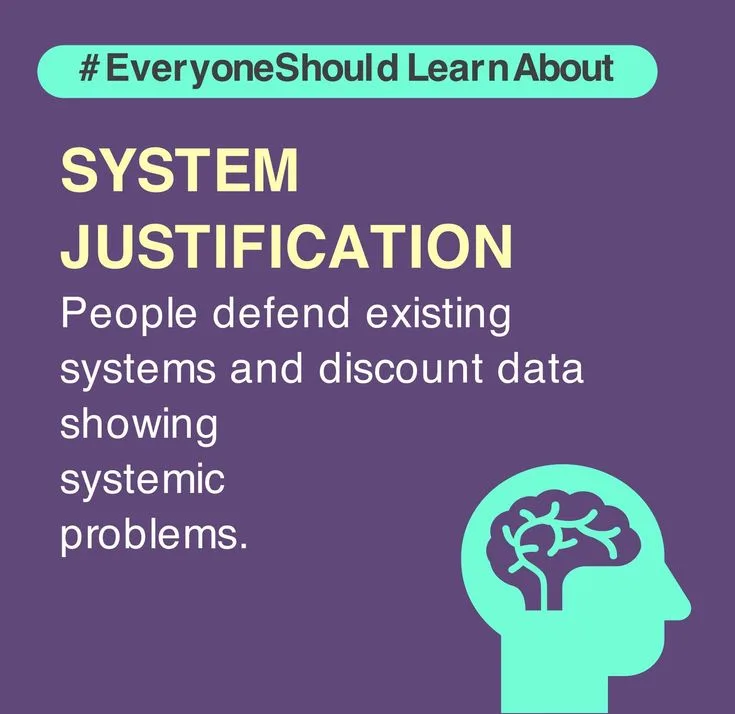
What Is System Justification Theory?
System justification theory is a social psychological framework, developed by John Jost and Mahzarin Banaji in 1994, proposing that people are motivated to perceive existing social, economic, and political arrangements as legitimate, fair, and desirable - even when those arrangements are personally or collectively costly to them.[1]
The theory extends beyond self-interest and group-interest to identify a third motivational force: a need to see the social order as ordered and just, which can lead disadvantaged individuals to endorse ideologies that explain and rationalize their own disadvantage.
This motivated defense of the status quo has been documented across decades of experimental and correlational research and has significant implications for understanding political attitudes, intergroup relations, and the psychology of inequality.
In 1994, two psychologists at Yale University published a paper that upended a core assumption of social psychology. The assumption was simple and seemingly reasonable: people support social arrangements that benefit them. Members of high-status groups defend hierarchy because hierarchy works in their favor.
Members of low-status groups challenge it because they have something to gain from change. The logic was intuitive, consistent with rational-choice models, and - John Jost and Mahzarin Banaji argued - empirically wrong.
In their founding paper, "The Role of Stereotyping in System Justification and the Production of False Consciousness," published in the British Journal of Social Psychology, Jost and Banaji identified a psychological tendency far more troubling than simple self-interest.
They found that people across the status hierarchy - including those at the bottom - showed a motivated tendency to perceive the existing social order as legitimate, fair, and desirable.
The poor defended the logic of their own poverty. Members of stigmatized groups rated the dominant group more favorably than they rated their own group. People at a disadvantage endorsed the very ideologies that explained their disadvantage as justified.
The empirical fingerprints were everywhere once researchers began looking. Studies on implicit racial attitudes using the Implicit Association Test showed that Black Americans, on average, showed less in-group favoritism than white Americans - and in some samples, measurable out-group preference.
Women in experimental conditions rated male job candidates as more competent than identical female candidates. Working-class respondents expressed stronger opposition to wealth redistribution than economic self-interest would predict.
These findings did not fit neatly into social identity theory, which predicted that low-status group members would either psychologically distance themselves from their group or mobilize to challenge the hierarchy.
What system justification theory proposed was a third path: a motivated defense of the status quo that could work directly against a person's ego-based and group-based interests, and that was driven not by ignorance but by a genuine psychological need to see the world as ordered, legitimate, and fair.
What made the Jost and Banaji paper so generative was not simply the claim that disadvantaged people sometimes defend the system - that had been noted before, in scattered observations.
What it did was construct a theoretical architecture to explain why, situate the mechanism in cognitive processes, and link it to the production of what they, borrowing from Marx, called false consciousness: a distorted understanding of one's own social position and interests.
The paper launched three decades of experimental and correlational research, eventually constituting one of the most tested frameworks in political and social psychology.
"People are motivated to defend and justify existing social arrangements even when those arrangements are personally costly or unjust." - John Jost & Mahzarin Banaji, 1994
Three Levels of Justification - and When They Collide
Jost and Banaji distinguished among three psychological motives that can operate simultaneously, each serving a different object of justification. Understanding all three is essential, because they frequently pull in different directions.
| Dimension | Ego Justification | Group Justification | System Justification |
|---|---|---|---|
| Object being defended | The self | One's in-group | The existing social order |
| Core need | Self-esteem, consistency of self-image | In-group pride, positive social identity | Legitimacy, order, predictability |
| Typical behavior | Self-serving attributions, reduced blame for own failures | In-group favoritism, out-group derogation | Endorsing hierarchy, accepting unfair outcomes as fair |
| Conflict situation | Occurs when the self has failed or is threatened | Occurs when the group is stereotyped or ranked low | Occurs when the system appears arbitrary or unjust |
| Who experiences conflict? | Individuals who are low performers | Members of low-status groups | Members of disadvantaged groups, particularly under threat |
| When they conflict | A person may sacrifice self-esteem to defend the group, or sacrifice group loyalty to defend the system | Group justification can conflict with system justification when the group is stigmatized | System justification often undermines ego and group justification for low-status group members |
| Example | "I failed because the task was unfair to me personally" | "Our group is underrepresented because of discrimination" | "People at the top got there through talent and hard work" |
The conflict between these three levels is the theoretical heart of the framework.
When a disadvantaged person endorses a meritocratic ideology that attributes their group's low status to lack of effort or ability, they are engaging in system justification at the cost of both ego justification (accepting a negative self-image) and group justification (accepting a negative group image).
Jost and colleagues argued this trade-off is psychologically real and measurable - and it has profound implications for understanding political behavior, intergroup relations, and the psychology of inequality.
The Cognitive Architecture: Stereotypes as Rationalizations
The mechanism Jost and Banaji identified as central to system justification was stereotyping - not as a simple error in categorization, but as a motivated process that rationalized existing status hierarchies. If women earn less than men, the stereotype that women are less competent or less ambitious explains the gap as natural.
If Black Americans are disproportionately incarcerated, the stereotype that they are more violent or less law-abiding explains the disparity without implicating the system.
If the poor remain poor across generations, the stereotype that poor people are lazy or impulsive explains their position as self-inflicted.
This is a different claim from the usual account of stereotyping. The dominant model - rooted in Tajfel and Turner's social identity theory - treated stereotypes primarily as tools of in-group favoritism and inter-group competition.
Jost and Banaji argued that many stereotypes serve a different function: they reconcile people to a world that distributes outcomes unequally. The stereotype does not merely describe the world; it justifies it.
The most elegant empirical demonstration of this came from Aaron Kay and John Jost's 2003 paper in the Journal of Personality and Social Psychology, titled "Complementary Justice: Effects of 'Poor but Happy' and 'Poor but Honest' Stereotype Exemplars on System Justification and Implicit Activation of the Justice Motive."
Kay and Jost showed that so-called complementary stereotypes - the idea that low-status groups have compensatory virtues ("poor but happy," "uneducated but street-smart," "powerless but morally pure") - function specifically to reconcile observers to inequality.
When participants were shown exemplars of poor people who were happy or honest, system-justifying beliefs increased.[3] When they were shown poor people who were unhappy, system justification did not increase.
The compensatory attribute was doing ideological work: it made the inequality seem tolerable by suggesting that the disadvantaged had something the advantaged lacked. This is not compassion. It is rationalization dressed as recognition.
The notion of complementary stereotypes also illuminated a broader pattern documented by Susan Fiske and colleagues in the stereotype content model: groups are typically rated on two dimensions, warmth and competence, and low-status groups are systematically assigned high warmth with low competence (the "poor but nice" slot), while high-status groups receive high competence with variable warmth.
Jost and Kay's contribution was to show that this pattern is not merely descriptive of how people perceive the world but functional - it serves to make a stratified world feel just.
Four Case Studies in System Justification
Case Study 1: The Haines and Jost Experiments (2000)
Elizabeth Haines and John Jost published a series of laboratory experiments in Personality and Social Psychology Bulletin demonstrating that exposure to system-legitimizing information increased system-justifying endorsements among low-status group members in ways that were not reducible to simple learning or mere response to authority.
In one paradigm, participants were assigned to low- or high-status positions in an artificial group hierarchy and then given information about the hierarchy's basis - either meritocratic (status was earned) or arbitrary (status was randomly assigned).
Low-status participants who received meritocratic framing subsequently rated the existing arrangement as more fair, rated high-status participants more positively, and showed reduced in-group favoritism.[4]
The system justification increased precisely among those who had the most to lose from the system - a finding that reversed the predictions of social identity theory and confirmed the core paradox of SJT.
Case Study 2: Jost and Thompson (2000) - Threat and Increased Endorsement
In a paper published in the Journal of Experimental Social Psychology, John Jost and Eric P. Thompson examined how system justification interacted with perceived threat to the system.
Drawing on the hypothesis that system justification serves an anxiety-buffering function, they predicted that conditions that make the system's legitimacy uncertain - economic instability, social upheaval, or direct challenges to existing arrangements - would increase, not decrease, system-justifying beliefs.
Their analysis of survey data found that low-income respondents showed stronger endorsement of economic system justification when primed with reminders of social instability.[5]
This finding was theoretically important because it suggested that system justification was not simply a passive reflection of socialization but an active, motivated response to psychological threat.
Case Study 3: Friesen, Laurin, Shepherd, and Kay - System Threat Studies
Jaime Napier and John Jost, along with subsequent work by Justin Friesen, Kristin Laurin, Steven Shepherd, and Aaron Kay, extended the threat hypothesis into experimental settings.[10]
In a series of studies published across the 2000s and 2010s, they showed that exposing participants to information that threatened the legitimacy of a social or political system - for instance, describing the economic system as based on chance rather than merit - produced compensatory increases in system endorsement.
Participants rated the system more favorably after being told it was arbitrary than after being told nothing. They also showed that reminders of mortality (following terror management theory logic) and reminders of system randomness had similar system-justifying effects.
This convergence of threat manipulations produced a robust finding: uncertainty about legitimacy paradoxically increases investment in legitimacy claims.
Case Study 4: Rankin, Jost, and Wakslak - Economic System Justification Scale
Laura E. Rankin and colleagues developed and validated the Economic System Justification Scale (ESJ), a measure of the tendency to view the economic system as fair, legitimate, and deserving of defense.[12]
This instrument allowed researchers to move beyond single-item measures and examine system justification as a relatively stable individual-difference variable, with predictable correlates including political conservatism, authoritarianism, and opposition to redistribution.
Crucially, Rankin and Jost found that ESJ scores predicted opposition to social welfare programs and to affirmative action - and that this relationship was stronger among low-income than high-income respondents in some samples, again inverting the prediction from economic self-interest models.
The scale has since been used across dozens of studies to examine how system justification intersects with ideology, identity, and political behavior.
Intellectual Lineage
System justification theory did not emerge from a vacuum. Jost and Banaji explicitly positioned their framework at the intersection of several prior traditions.
The most direct ancestor was Leon Festinger's theory of cognitive dissonance (1957). The idea that people are motivated to reduce psychological inconsistency - and that this motivation can override accurate perception - was foundational.
System justification extended this logic: when a person perceives the system as unjust, cognitive discomfort results, and one resolution is to revise the perception of injustice rather than the perception of the system.
Melvin Lerner's just-world theory (1980) was the other most proximate influence. Lerner had argued that people have a fundamental need to believe in a just world - that people get what they deserve - because without that belief, the randomness and cruelty of life becomes intolerable.[8]
Jost and Banaji built on this but moved the analysis from individual justice perceptions to systemic ones: the object of justification shifted from individual outcomes to social arrangements.
Karl Mannheim's sociology of knowledge and Antonio Gramsci's concept of hegemony (cultural dominance of ruling-class ideas) provided the broader theoretical frame, and the borrowing of "false consciousness" from Marxist sociology was explicit and deliberate.
Jost and Banaji were careful to distinguish their use of the term from its prescriptive Marxist valence, but the connection signaled that they were interested in a question older than experimental social psychology: why do subordinated groups frequently accept, endorse, and transmit the ideologies that explain their subordination as deserved?
Jim Sidanius and Felicia Pratto's social dominance theory (SDT), developed in the 1990s, offered a competing framework that overlapped substantially with SJT.[7] SDT focused on the role of social dominance orientation (SDO) - a personality variable measuring preference for group-based hierarchy - in sustaining inequality.
Jost and colleagues acknowledged this overlap but argued that system justification was distinct: where SDO focused on dominants' preference for hierarchy, SJT addressed the specific question of why subordinates also endorse it.
The relationship between the two frameworks has been a source of productive theoretical dispute, with researchers such as Turner and Reynolds pointing out that SJT and SDT sometimes predict conflicting outcomes and that their boundary conditions needed sharper specification.[11]
Empirical Research: What the Evidence Shows
The empirical record accumulated over three decades is substantial. In their 2004 review, "A Decade of System Justification Theory: Accumulated Evidence of Conscious and Unconscious Bolstering of the Status Quo," published in Political Psychology, Jost, Banaji, and Brian Nosek surveyed findings from laboratory experiments, survey studies, and cross-national datasets.[2]
Several findings were particularly robust.
First, measures of system justification - including the ESJ scale and domain-specific variants - consistently predicted opposition to redistribution, reduced support for social welfare programs, and lower political activism, even after controlling for income and standard political identity variables.
Second, implicit measures of in-group favoritism consistently showed smaller effects among low-status group members than among high-status group members, and in some studies showed implicit out-group favoritism among stigmatized groups. Third, experimental manipulations of system threat reliably increased system-justifying endorsements.
Cross-national research added an important dimension. Using data from European Values Study surveys and World Values Survey data, Jost and colleagues found that economic inequality - measured by Gini coefficients - positively predicted average endorsement of meritocratic ideology at the country level.
Countries with greater inequality produced populations more likely to believe that people got what they deserved economically. The more unequal the system, the more its inhabitants justified it.
Research by Cheryl Wakslak and colleagues added temporal nuance.[9] They found that system justification was associated with a tendency to construe outcomes in abstract terms - to think about poverty in terms of broad principles rather than concrete individual circumstances.
This abstraction served a palliative function: it was easier to maintain that the system was fair when thinking in generalities than when confronted with specific, vivid cases of unfair treatment.
Limits, Critiques, and Nuances
System justification theory has attracted sustained and substantive criticism, much of it productive. The most influential comes from Julia Becker and Concordia researchers, from Turner and Reynolds, and from Wakslak's own subsequent revisions.
Julia Becker and Stephen Wright's 2011 paper in the Journal of Personality and Social Psychology, "Yet Another Dark Side of Chivalry: Benevolent Sexism Undermines and Hostile Sexism Motivates Collective Action in Women," was part of a broader research program examining when disadvantaged group members mobilize rather than justify.
Becker and Wright showed that the relationship between system-justifying ideologies and reduced collective action was not uniform: framing inequality in ways that activated anger - rather than guilt or resignation - reliably increased collective action intentions.[6]
The implication was that system justification was not an inevitable psychological fate but one of several possible responses to perceived unfairness, and that the conditions determining which response occurred were identifiable and manipulable.
Turner and Reynolds offered a more fundamental theoretical challenge, arguing that SJT underspecified the conditions under which subordinate group members would justify versus resist the system.
Social identity theory, they contended, already provided resources for explaining both identification and disidentification with social arrangements, and the added explanatory value of positing a distinct system justification motive was not demonstrated.
The boundary between when SJT's predictions differed from SIT's predictions - and who was right on those points of divergence - remained insufficiently clarified.
A statistical and methodological critique concerned the implicit attitude evidence. While Jost and colleagues cited IAT data showing reduced in-group bias among Black Americans as evidence of system justification, subsequent meta-analyses complicated the picture.
The effect sizes for implicit out-group favoritism among disadvantaged groups were modest, and some researchers argued that the IAT was measuring familiarity and cultural exposure rather than motivated endorsement of hierarchy. This did not invalidate SJT, but it raised questions about the strength of the implicit evidence.
Wakslak and colleagues also introduced important moderators: the system-justifying effects of complementary stereotypes and of meritocratic framing were stronger when participants were led to believe that the disadvantaged group had accepted its situation voluntarily, or when the system was presented as modifiable in principle but currently just.
When systems were presented as entirely beyond control, system justification sometimes gave way to fatalistic acceptance, which is psychologically and politically distinct from active endorsement.
Finally, the original theoretical claim about "false consciousness" has been contested on normative grounds.
Some sociologists and political theorists have argued that endorsing the system's legitimacy is not always psychologically motivated distortion - it may reflect genuine value differences, reasonable disagreement about the role of structure versus agency, or pragmatic adaptations to conditions that cannot easily be changed.
The distinction between motivated rationalization and sincere political belief is difficult to operationalize, and critics have argued that SJT's framing sometimes treats conservative or hierarchy-accepting beliefs as inherently the product of bias while leaving left-leaning challenges to hierarchy unscrutinized.
What Remains
System justification theory endures as one of the most provocative and empirically productive frameworks in political psychology because it takes seriously a genuinely uncomfortable phenomenon: the willing endorsement, by those who lose the most, of the ideas that explain their losing as fair.
Whether this is best understood as a distinct motivational system, as a manifestation of existing dissonance-reduction processes, or as a situationally contingent response to threat is still being debated.
What is not in serious dispute is that the psychological pull of legitimacy - the need to see the world as ordered and deserved - is real, measurable, and consequential. It shapes how poverty is perceived, how racial disparities are explained, how political coalitions form, and whose interests get served when people vote against them.
The theory forces a question that no account of human social life can fully avoid: when people defend arrangements that harm them, are they confused, or are they satisfying a need that runs deeper than material advantage?
Jost and Banaji's answer, developed over three decades of research, is that the need for legitimacy is not a mistake in reasoning.
It is a feature of how minds manage the intolerable possibility that the world is neither just nor ordered - and that one's own position in it is neither earned nor deserved.
Sources & Further Reading
Jost, J. T., & Banaji, M. R. (1994). The role of stereotyping in system-justification and the production of false consciousness. British Journal of Social Psychology, 33(1), 1-27.
Jost, J. T., Banaji, M. R., & Nosek, B. A. (2004). A decade of system justification theory: Accumulated evidence of conscious and unconscious bolstering of the status quo. Political Psychology, 25(6), 881-919.
Kay, A. C., & Jost, J. T. (2003). Complementary justice: Effects of "poor but happy" and "poor but honest" stereotype exemplars on system justification and implicit activation of the justice motive. Journal of Personality and Social Psychology, 85(5), 823-837.
Haines, E. L., & Jost, J. T. (2000). Placating the powerless: Effects of legitimate and illegitimate explanation on affect, memory, and stereotyping. Social Justice Research, 13(3), 219-236.
Jost, J. T., & Thompson, E. P. (2000). Group-based dominance and opposition to equality as independent predictors of self-esteem, ethnocentrism, and social policy attitudes among African Americans and European Americans. Journal of Experimental Social Psychology, 36(3), 209-232.
Becker, J. C., & Wright, S. C. (2011). Yet another dark side of chivalry: Benevolent sexism undermines and hostile sexism motivates collective action in women. Journal of Personality and Social Psychology, 101(1), 62-77.
Sidanius, J., & Pratto, F. (1999). Social Dominance: An Intergroup Theory of Social Hierarchy and Oppression. Cambridge University Press.
Lerner, M. J. (1980). "The Belief in a Just World: A Fundamental Delusion". Plenum Press.
Wakslak, C. J., Jost, J. T., Tyler, T. R., & Chen, E. S. (2007). Moral outrage mediates the dampening effect of system justification on support for redistributive social policies. Psychological Science, 18(3), 267-274.
Friesen, J. P., Laurin, K., Shepherd, S., Gaucher, D., & Kay, A. C. (2019). System justification: Experimental evidence, its contextual nature, and implications for social change. British Journal of Social Psychology, 58(2), 315-339.
Turner, J. C., & Reynolds, K. J. (2003). Why social dominance theory has been falsified. British Journal of Social Psychology, 42(2), 199-206.
Rankin, L. E., Jost, J. T., & Wakslak, C. J. (2009). System justification and the meaning of life: Are the existential benefits of ideology distributed unequally across racial and socioeconomic groups? Social Justice Research, 22(2-3), 312-333.