
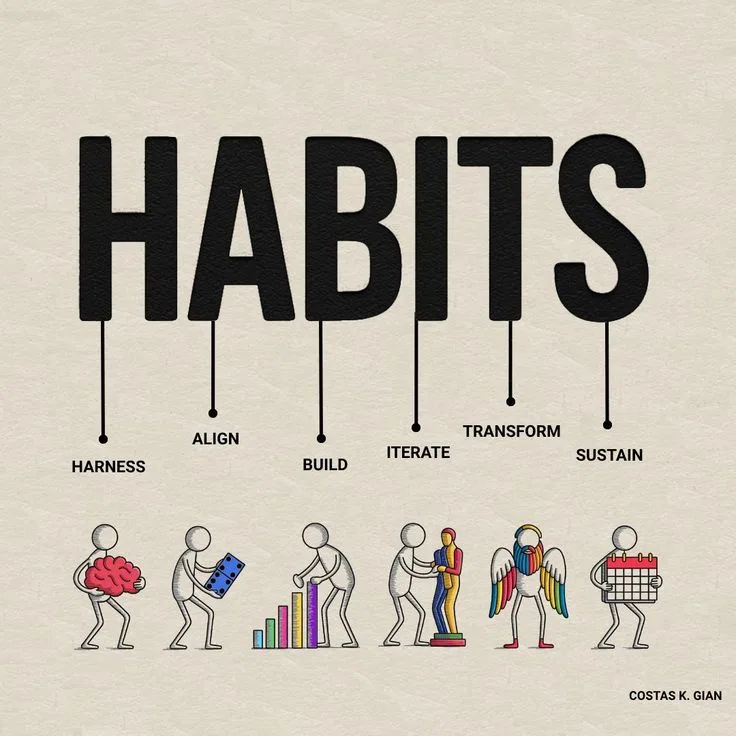
Building better habits works best by shaping the cue, routine, reward, and environment that drive automatic behavior. Repeated actions become chunked patterns that require little conscious effort, so motivation alone is unreliable. Specific implementation intentions, habit stacking, lower friction, immediate reinforcement, and identity-based framing make desirable actions easier to repeat until they become established.
What Is Habit Formation?
Habit formation is the neurological process by which repeated behaviors become automatic responses to environmental cues, encoded in the basal ganglia as chunked action sequences that fire without conscious deliberation.
A habit consists of a three-part loop - cue, routine, and reward - and once established, operates largely outside conscious awareness, consuming minimal attentional resources.
The science of habit formation, developed through research in neuroscience, behavioral psychology, and decision science, shows that lasting behavior change is achieved primarily by designing environments and cue structures that make desired behaviors automatic, rather than by relying on willpower or motivation to override existing patterns.
In 2010, physician Anne Thorndike was running a study in a Massachusetts General Hospital cafeteria.[4] She didn't change the menu, didn't run health campaigns, didn't lecture the hospital staff about nutrition.
She simply moved the water bottles to be adjacent to the cash register, rearranged which foods were placed at eye level in the refrigerator cases, and put fruit in baskets at checkout.
The result: water sales increased 25.8%. Soda sales dropped 11.4%. Healthier food choices increased across the board. Nobody made a decision to eat healthier. Nobody exercised willpower or consulted their values. The environment changed, and behavior followed automatically.
Thorndike's study is a small piece of a larger, uncomfortable scientific finding: most of what we call "choices" about daily behavior are not really choices at all. They are automatic responses to environmental cues, executed by a brain system that operates largely below the level of conscious awareness.
The part of you that decides to make coffee, check your phone, or eat something at 3pm is not the deliberative, rational part of you that attends meetings and reads articles about self-improvement.
This creates a profound practical implication. The strategy most people use to change behavior - willpower, motivation, reminders, and repeated attempts to "be better" - is targeting the wrong system.
It is attempting to override, through conscious effort, a neural apparatus that is faster, more automatic, and more persistent than conscious control. The research is fairly clear on how this ends: not well, for long.
The science of habit formation, which has matured substantially in the past 30 years, offers a more effective framework - one that works with the automatic system rather than against it.
"You do not rise to the level of your goals. You fall to the level of your systems." - James Clear, Atomic Habits (2018)
Key Definitions
Habit loop - The three-component structure identified by MIT researchers and popularized by Charles Duhigg: cue (the trigger), routine (the behavior), and reward (the reinforcement).[7] The basal ganglia encode this loop as a chunked behavior sequence that fires automatically when the cue is detected.
Chunking - The process by which a sequence of individual decisions or actions becomes compressed into a single automatic unit.
Ann Graybiel's research at MIT found that rats navigating a maze in early trials showed high brain activity throughout; after extensive practice, activity dropped almost entirely, with peaks only at the beginning and end of the routine.[3] The middle became automatic.
| Habit-Building Strategy | Mechanism | Evidence Level |
|---|---|---|
| Implementation intentions | Ties behavior to specific cue-context | Strong (meta-analysis: ~2x follow-through) |
| Habit stacking | Attaches new habit to existing routine | Moderate - exploits existing cue chains |
| Reduce friction | Lowers effort threshold for desired behavior | Strong - environmental design research |
| Reward proximity | Makes reward immediate to reinforce loop | Strong - operant conditioning basis |
| Tracking and streaks | Creates identity reinforcement and loss aversion | Moderate - depends on personality |
Implementation intention - A specific "when then" plan (Gollwitzer, 1999): "When situation X arises, I will perform behavior Y." More effective than goal intentions alone by 2-3x for follow-through, because the cue-response link is pre-specified rather than requiring deliberate decision in the moment.
Habit stacking - Linking a new habit to an existing established behavior: "After [current habit], I will [new habit]." The existing habit's automaticity provides a reliable cue for the new behavior.
Identity-based change - Framing behavior change as an expression of identity rather than achievement of a goal. "I am a runner" as the driving construct rather than "I want to run more." Research suggests identity-level change is more durable because behavior naturally aligns with self-concept.
Temporal discounting - The neural tendency to prefer smaller rewards now over larger rewards later. Habit-forming behaviors with delayed natural rewards (health improvements from exercise, financial gains from saving) are harder to reinforce because the brain's reward circuitry is tuned to immediate feedback.
Environment design - Changing the physical and social context to make desired behaviors easier and undesired behaviors harder, reducing the need for deliberate conscious effort.
Keystone habit - A habit that, once established, triggers cascading positive changes in other areas. Exercise is a commonly cited keystone habit: people who start exercising regularly tend, without deliberate intent, to eat better, sleep more, and drink less.
The mechanisms likely involve identity change, improved mood regulation, and the experience of self-efficacy generalizing across domains.
Friction - The concept of reducing behavioral "friction" (making things easier) to increase frequency. Adding friction (making things harder) decreases frequency. Small changes in friction have disproportionate behavioral effects because they bypass deliberative processing entirely.
The plateau of latent potential - The observation that habits often show no visible results for extended periods before a threshold is crossed and results accumulate rapidly. Like ice that remains at 31F despite heating before suddenly melting at 32F - the progress is occurring invisibly until the threshold.
Why Most Habit Attempts Fail
The conventional approach to behavior change runs roughly as follows: identify the behavior you want to change, commit to changing it, apply willpower and motivation to overcome resistance, and repeat until the new behavior becomes natural.
This approach has an excellent short-term success rate and an abysmal long-term one. The research on habit persistence - whether for exercise, dietary change, smoking cessation, or virtually any other behavioral target - consistently shows that the majority of initial change attempts are not sustained.
The classic "gym rush in January, empty gym by February" pattern is not human weakness. It is the predictable result of an approach that relies on motivation (which is variable) and willpower (which depletes) to maintain behaviors against the resistance of established neural pathways.
Several specific failure modes are well-documented:
Motivation Is Not Reliable
Motivation - the felt desire to pursue a goal - is highly variable, influenced by mood, sleep, blood glucose, recent successes and failures, and dozens of other factors. A behavior change strategy dependent on motivation will succeed when motivation is high and fail when it isn't.
The distinction researchers make is between approach motivation (moving toward a desired state) and avoidance motivation (moving away from an undesired one). Both can initiate behavior change. Neither sustains it automatically.
The goal of habit formation research is to move the behavior from the motivational system (effortful, variable, depleting) to the habitual system (automatic, consistent, requiring no motivation to sustain).
Goals Without Systems
Goal-setting research (Locke and Latham's 40 years of work) shows that specific, challenging goals are better than vague ones at driving short-term performance. But goals have a structural limitation for habit formation: they define a destination without specifying the daily path.
"Run a 5K in May" is a goal. "After work on Monday, Wednesday, and Friday, I will put on running shoes and run for 20 minutes" is a system. The goal describes where you want to end up; the system describes what you will actually do today. Most habit formation failures represent goals without systems.
Environment Unchanged
Behavior exists in context. The neural cues that trigger habitual behavior are embedded in environments - the kitchen triggers snacking, the couch triggers Netflix, the commute triggers podcast listening.
Attempting to change behavior while leaving the environment unchanged is fighting the cue system with willpower. The cues keep firing; resistance requires constant effort.
Research on behavior change in general consistently finds that environmental change is one of the most powerful interventions available. Moving to a new city, changing jobs, or even rearranging a room often breaks established habits because the environmental cues that supported them no longer fire.
This is also why habit formation is often easier during life transitions - not because the person has changed, but because the environment has, freeing behavior from established cue-response patterns.
What the Research Actually Shows Works
1. Implementation Intentions: The "When Then" Protocol
Peter Gollwitzer at NYU has spent decades studying why people fail to follow through on intentions that are genuinely held. His finding: most failures are not failures of wanting but failures of linking the intention to a specific situational cue.
Implementation intentions close this gap by pre-specifying the cue: "When I finish my morning coffee, I will spend 10 minutes reading." The behavior is planned not just as an abstract intention but as a response to a specific stimulus.
When that stimulus is encountered, the planned response fires with much less deliberate effort.
Gollwitzer's meta-analyses show that implementation intentions increase follow-through by approximately 2-3 times compared to goal intentions alone.[2] The effects hold across exercise, dietary change, screening behaviors, medication adherence, and academic performance - suggesting a general mechanism rather than domain-specific effects.
The practical formula: "When [cue/situation], I will [specific behavior] in [specific location]."
Not: "I will meditate more." Instead: "When I sit down at my desk every morning before opening email, I will meditate for five minutes."
2. Habit Stacking
Existing habits are powerful anchors because they fire automatically, reliably, and without conscious effort. This reliability makes them ideal cues for new behaviors.
Habit stacking: "After [established habit], I will [new habit]."
Examples:
- After I pour my morning coffee, I will write in my journal for five minutes
- After I sit down at my desk, I will review my three most important tasks for the day
- After I brush my teeth, I will do two minutes of stretching
The key selection criterion for the anchor habit: it must occur consistently (daily, at a predictable time), in approximately the right context for the new behavior. Anchoring "call my parents" to "arrive home from work" works because it happens in the right location and time.
Anchoring it to "whenever I think of it" does not work because the cue is not reliably generated.
3. Environment Design
Design your physical environment to make desired behavior easier and undesired behavior harder. The goal is to reduce the friction between yourself and the behaviors you want while increasing friction for those you don't.
Making desired behaviors easier:
- Place workout clothes by the bed the night before
- Put the book you're trying to read on the pillow
- Prepare tomorrow's healthy lunch the night before
- Keep a water bottle visible on the desk
- Put meditation app at the home screen; move social media to a folder
Adding friction to undesired behaviors:
- Put the phone in another room during focused work
- Remove credit cards from digital wallets to create a pause before online spending
- Log out of time-wasting websites (requires login to access again)
- Store the Xbox controller in a closet rather than beside the couch
The power of friction is in its automaticity: it works regardless of motivation. You don't have to decide not to check social media when the app has been removed from the home screen. The decision is already made.
Anne Thorndike's cafeteria study stands as one of the cleanest demonstrations of this principle: behavior changed dramatically with zero intervention at the level of motivation, awareness, or conscious decision-making. Only the environment changed.
4. Make It Immediately Rewarding
The basal ganglia learn through dopaminergic reinforcement: behaviors that produce immediate reward are strengthened. Behaviors that produce only delayed reward are weakly reinforced, even if the ultimate reward is large.
This creates a structural problem for health behaviors whose natural rewards are distant: exercise (health benefits in months), saving (financial security in years), dietary change (chronic disease prevention in decades). The brain's reward circuitry barely registers these distant consequences.
Solutions:
- Attach an immediate reward to the habit: a specific podcast only listened to during runs; a favorite tea only made after completing morning exercise; a satisfying completion ritual
- Make progress visible: habit trackers, calendars, apps that register streaks. The act of marking a completion provides an immediate small reward - the brain registers completing the streak
- Find intrinsic immediate reward: the mood improvement from exercise is immediate (within 20 minutes); focusing on this rather than the long-term health outcomes bridges the reward gap
James Clear's formulation: "The first mistake is never the one that ruins you.[6] It is the spiral of repeated mistakes that follows. Missing once is an accident. Missing twice is the start of a new habit." The streak preserves the habit through periods of low motivation.
5. The Two-Minute Rule
BJ Fogg's "Tiny Habits" research and James Clear's "two-minute rule" converge on the same insight: the biggest barrier to many habits is initiation. Getting started is the hardest part.
The two-minute rule: any new habit should take less than two minutes to begin. "Read before bed" becomes "read one page before bed." "Do yoga" becomes "put on yoga clothes." "Practice guitar" becomes "pick up the guitar."
This is not a trick to make you feel good about tiny actions. It is a designed intervention against the initiation barrier. Once you are doing the first two minutes of a habit, the probability of continuing is dramatically higher than the probability of starting from rest. The two-minute version is the entry point.
For Fogg, the design principle extends further: start with the smallest viable version of a behavior, allow it to become automatic, and then expand.[5] A single pushup that reliably happens every morning is infinitely more valuable than 30 pushups that you do sporadically when motivation is high.
Identity: The Level Where Change Lasts
The deepest mechanism for durable habit change operates at the level of identity - how you see yourself.
There is substantial psychological research behind this. Social identity theory (Tajfel and Turner) established that people tend to behave consistently with the identities they hold. Self-perception theory (Bem) showed that we often infer our attitudes and identities from our behavior rather than the reverse.
And research on the "fresh start effect" (Dai, Milkman, and Riis) showed that people are more likely to pursue behavior change after temporal landmarks - new years, birthdays, Mondays - because these create a perception of the past and future as separate, enabling a revised identity narrative.
The practical application:
Outcome-based identity (most people): "I want to lose weight." The goal is an outcome; the identity may not change. When the goal is achieved (or not), the behavior may not persist because the underlying identity hasn't shifted.
Identity-based habit change: "I am someone who takes care of their body." Each instance of exercise, each healthy meal, each sleep-protective choice is a vote for that identity. The behavior doesn't depend on goal achievement - it is an expression of who you are.
Each small action is evidence accumulating toward or against an identity. Missing one workout is not a moral failing; it is one data point among thousands. What matters is whether the overall pattern of evidence supports the identity you're building.
This shift has a practical corollary: when you break a habit, what you say to yourself in the aftermath matters. Self-criticism ("I'm a failure," "I'll never change") provides evidence for a negative identity and increases the probability of further non-compliance.
Self-compassionate response - "I missed this time; I'll do better next time" - preserves the identity without the catastrophic spiral.
Breaking Habits: The Other Direction
The same mechanisms that build habits can disrupt them. Habits persist because:
- The cue reliably fires
- The routine is rewarded
- The behavior has become automatic (requires no deliberate decision)
Disruption strategies target each component:
Disrupting the cue: change the environment that contains the cue. Alcoholics are advised to avoid social contexts associated with drinking; not because the environments are inherently problematic, but because the environmental cues trigger powerful automatic urges.
Smokers who successfully quit often report avoiding places associated with smoking. The cue is the vulnerability.
Disrupting the routine: substitute a different behavior for the same cue that provides the same core reward. Duhigg's research with MIT showed that the "reward" of the habit (what the basal ganglia are actually seeking) is sometimes surprisingly different from what people assume.
A "habit" of walking to a vending machine at 3pm may be serving a social need (the walk past colleagues) rather than a food need. Identifying the actual reward points to more effective substitutes.
Making the behavior no longer automatic: inserting a pause between cue and routine - a five-second delay (Mel Robbins' "5 Second Rule" has a behavioral science basis), a rule requiring a 24-hour wait before a purchase, a commitment device that requires an active decision to engage in the unwanted behavior - partially interrupts automaticity and reintroduces conscious decision-making.
What the Evidence Doesn't Support
"Breaking the habit in 21 days": the 21-day figure originates from Maxwell Maltz's observation that amputees took a minimum of 21 days to adjust psychologically to limb loss. It has no empirical basis for habit formation. Lally et al.'s actual data: 18 to 254 days, mean 66.[1] Plan for months.
Willpower training: some research (Roy Baumeister's ego depletion work) suggested that exercising willpower strengthens it like a muscle.[8] Replication attempts have been mixed.
The more consistent finding is that people who maintain desired behaviors long-term report using willpower less, not more - because they've designed systems that make the behavior automatic or easy.
Punishing yourself for lapses: evidence consistently suggests that self-criticism after behavioral lapses increases the probability of further lapses, not decreases it.
The "what the-hell effect" (Polivy and Herman) shows that dieters who violate their diet often abandon it entirely after a single violation, reasoning: "I've already blown it, I might as well continue." Self-compassion after lapses is more effective at sustaining behavior change than self-punishment.
For related concepts, see how habits form and change, why we procrastinate, and how to improve your memory.
Sources & Further Reading
- Lally, P., van Jaarsveld, C. H. M., Potts, H. W. W., & Wardle, J. (2010). How Are Habits Formed: Modelling Habit Formation in the Real World. European Journal of Social Psychology, 40(6), 998-1009. DOI: 10.1002/ejsp.674
- Gollwitzer, P. M. (1999). Implementation Intentions: Strong Effects of Simple Plans. American Psychologist, 54(7), 493-503. DOI: 10.1037/0003-066X.54.7.493
- Graybiel, A. M. (2008). Habits, Rituals, and the Evaluative Brain. Annual Review of Neuroscience, 31, 359-387. DOI: 10.1146/annurev.neuro.29.051605.112851
- Thorndike, A. N., et al. (2012). A 2-Phase Labeling and Choice Architecture Intervention to Improve Healthy Food and Beverage Choices. American Journal of Public Health, 102(3), 527-533. DOI: 10.2105/AJPH.2011.300391
- Fogg, B. J. (2019). Tiny Habits: The Small Changes That Change Everything. Houghton Mifflin Harcourt.
- Clear, J. (2018). Atomic Habits: An Easy and Proven Way to Build Good Habits and Break Bad Ones. Avery.
- Duhigg, C. (2012). The Power of Habit: Why We Do What We Do in Life and Business. Random House.
- Baumeister, R. F., et al. (1998). Ego Depletion: Is the Active Self a Limited Resource? Journal of Personality and Social Psychology, 74(5), 1252-1265. DOI: 10.1037/0022-3514.74.5.1252