
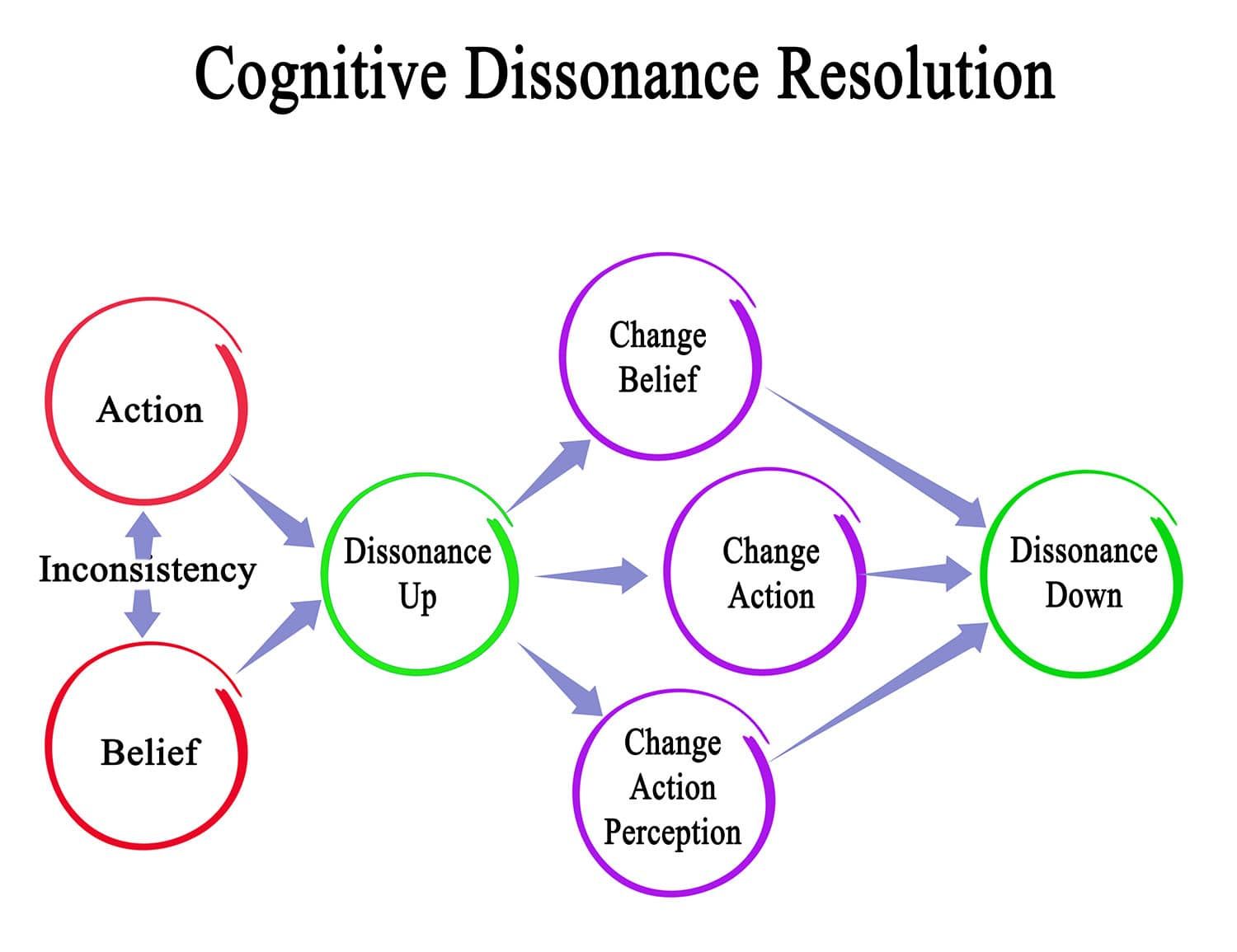
Continuing a harmful habit while knowing its risks creates pressure to make the behavior and belief fit together. Cognitive dissonance reduction strategies can include changing behavior, revising beliefs, or supplying reassuring explanations that make the contradiction feel less urgent to confront.
A man named Harold has smoked a pack a day for thirty years. He is sixty-one years old, educated, intelligent, and he reads the news. He knows, with full conscious awareness, that cigarette smoking is the leading preventable cause of death in the United States.
He has seen the data. He has watched the public health campaigns. He has, on at least one occasion, attended the funeral of a friend who died of lung cancer. Harold also continues to smoke every day, without pause, and shows no serious intention of stopping.
When Harold's adult daughter presses him on this - not urgently, just in conversation - Harold does not fumble or look away. He produces a coherent, confident reply. His grandfather, he explains, smoked his entire adult life and died at ninety-three.
He personally knows three people who quit smoking and then developed cancer anyway - "probably from stress," he suggests. He read somewhere that the statistics are skewed because heavy industrial workers are grouped with light social smokers, inflating the risk estimates for the latter.
And besides, he adds, if you looked at everything that caused cancer, you'd never leave the house.
Harold has not changed his behavior. He has not changed his knowledge of smoking's harms.
What he has done - with the fluency and completeness of someone who has rehearsed these thoughts many thousands of times - is construct a cognitive architecture designed to make his behavior and his knowledge feel consistent. He has not resolved the contradiction.
He has engineered its disappearance.
This is cognitive dissonance reduction: the suite of psychological strategies by which the mind neutralizes the discomfort of holding mutually inconsistent cognitions, almost always without changing the behavior that created the inconsistency in the first place.
"The human mind is a story processor, not a logic processor - and it will rewrite the story to preserve consistency." - Jonathan Haidt, 2012
What Cognitive Dissonance Reduction Is
Cognitive dissonance reduction is the set of mental operations - rationalization, trivialization, reframing, self-affirmation, and social validation-seeking - by which people eliminate the aversive tension arising from conflicting beliefs and behaviors, typically by revising cognitions rather than the behavior that generated the conflict.
This definition requires a distinction from a process it superficially resembles: rational updating. When a genuinely rational agent encounters new information that conflicts with a held belief, they update the belief in proportion to the strength of the evidence.
Cognitive dissonance reduction works oppositely: it begins with a behavior or commitment that the person will not abandon, and works backward to eliminate or neutralize the cognitions that create pressure to change that behavior. The goal is not truth. The goal is relief.
Dissonance Reduction vs. Rational Updating
The following table compares the mechanics of genuine belief revision with the mechanics of dissonance reduction across the dimensions that distinguish them most cleanly:
| Dimension | Rational Updating | Dissonance Reduction |
|---|---|---|
| Starting point | New evidence arrives; beliefs are open | Behavior or commitment is fixed; evidence creates pressure |
| Direction of change | Beliefs shift toward evidence | Evidence is reinterpreted to fit behavior |
| Outcome | More accurate beliefs about the world | More comfortable beliefs about the self |
| Response to strong evidence | Larger belief revision | Greater defensive intensity; stronger rationalization |
| Awareness | Usually conscious and deliberate | Usually automatic and post-hoc |
| Social function | Improves coordination and prediction | Maintains self-concept and group belonging |
| Emotional tone | Neutral to mildly uncomfortable | Relieves discomfort; produces felt resolution |
| Long-term trajectory | Beliefs converge toward reality over time | Beliefs diverge from reality; commitments deepen |
The practical implication is that rational updating and dissonance reduction can be distinguished by what happens when the evidence gets stronger. A person engaging in rational updating should revise their beliefs more when presented with more compelling evidence.
A person engaged in dissonance reduction often does the opposite: more threatening evidence produces more elaborate rationalization, not more honest revision.
This is the self-justification cascade that Carol Tavris and Elliot Aronson documented in their 2007 book Mistakes Were Made (But Not by Me): as a person doubles down on a bad decision, each subsequent commitment makes the original commitment harder to abandon, because abandoning it would require acknowledging the entire chain of errors that followed from it.
The Four Routes: Festinger's Original Framework
Leon Festinger's 1957 monograph A Theory of Cognitive Dissonance specified four distinct mechanisms by which dissonance could be reduced.[1] These remain the organizing framework for the field nearly seven decades later, though each has been substantially elaborated.
Route 1: Change the Behavior
The most straightforward resolution of dissonance is to bring behavior into alignment with the conflicting cognition. Harold, in this resolution, quits smoking. The smoker who knows that smoking causes cancer resolves the inconsistency by eliminating the behavior that created it.
This route is the one most recommended by health educators, therapists, and rationalist advisors.
It is also, in Festinger's model, the route least frequently taken - precisely because it eliminates the behavior rather than the belief, and behavior is often harder to change than belief, particularly when the behavior is addictive, socially embedded, or identity-constitutive.
Festinger observed that behavior change was most likely when the behavior was easy to change and the dissonant cognition was highly important.
When the opposite conditions held - when the behavior was entrenched and the dissonant information was threatening - the other three routes became more probable.
Route 2: Change the Belief
If the behavior cannot be abandoned, the conflicting belief can be revised. The smoker in this route comes to genuinely disbelieve the health evidence, or substantially downgrade their confidence in it.
This is not mere lying to others; research consistently shows that belief revision under dissonance pressure can be genuinely internalized.
Participants in forced-compliance experiments do not merely claim to believe things they do not; their actual attitudes shift.
Festinger and James Carlsmith's 1959 experiment in the Journal of Abnormal and Social Psychology demonstrated this with remarkable precision.[2]
Participants who performed a genuinely tedious task - turning pegs on a pegboard a quarter-turn at a time for an hour - were then asked to tell a waiting confederate that the task was interesting and enjoyable.
Half were paid one dollar for this lie; half were paid twenty dollars. When participants subsequently rated their actual enjoyment of the task, those paid one dollar rated it significantly more positively than those paid twenty dollars.
The one-dollar group had insufficient external justification for their lie, and so resolved the dissonance - "I said it was interesting but it was not" - by shifting toward genuine belief: the task was, on reflection, somewhat interesting after all.
The twenty-dollar group had ample justification ("I said it was interesting because I was well compensated") and needed no belief revision. The smaller the external justification for an inconsistent behavior, the more internal attitude change occurs.
This is the insufficient justification effect, and it has been replicated across dozens of studies.
Route 3: Add Consonant Cognitions
Rather than changing either the behavior or the conflicting belief, a person can neutralize dissonance by introducing new beliefs that are consistent with the behavior and that thereby shift the balance between consonant and dissonant elements.
Harold's grandfather, the studies with skewed statistics, the "stress causes cancer" hypothesis - these are all consonant cognitions added to dilute the force of the single, powerful dissonant cognition: smoking causes cancer.
This route is peculiarly susceptible to motivated reasoning, because the search for consonant cognitions is not random. The mind does not survey the entire epistemic landscape neutrally; it preferentially attends to, retrieves, and evaluates information that supports the behavior it is defending.
Ziva Kunda's 1990 paper "The Case for Motivated Reasoning" in Psychological Bulletin (Volume 108, Number 3, pages 480-498) reviewed the experimental literature on this selectivity and concluded that the motivation to reach a particular conclusion distorts not just what evidence people seek but how they evaluate its quality: arguments supporting a desired conclusion are accepted with considerably less scrutiny than arguments threatening it.
Route 4: Reduce the Importance of the Dissonant Cognition
The fourth route is to psychologically demote the conflicting element - to decide that the inconsistency does not much matter. "We all die of something," Harold might add.
"Quality of life matters more than quantity." This is not an argument that smoking does not cause cancer; it is an argument that cancer is not a paramount concern. The dissonant cognition is not rebutted but trivialized.
Festinger's original model specified that the magnitude of dissonance depended on the importance of the cognitions involved. Route 4 operates directly on importance: by reducing the perceived significance of the health risk, the smoker reduces the dissonance it generates.
Joel Cooper and Russell Fazio's 1984 "new look" model in Advances in Experimental Social Psychology (Volume 17) added precision here: they argued that dissonance was specifically produced by behaviors that the person perceived as having aversive consequences they were responsible for.[7]
Trivialization reduces the perceived aversiveness of those consequences, thereby reducing the dissonance at its source.
Cognitive Science: The Mechanisms in Detail
The Role of the Self-Concept
Elliot Aronson, working at Harvard and later the University of California Santa Cruz, proposed in a 1969 paper in Advances in Experimental Social Psychology a crucial refinement to Festinger's framework: dissonance is most powerful not when any two abstract cognitions conflict, but when a behavior conflicts with a person's core self-concept - their sense of themselves as decent, intelligent, and consistent.
In Aronson's reformulation, dissonance is fundamentally a threat to self-integrity, not merely a logical inconvenience.[11]
This reframing has substantial empirical support. Aronson and David Mettee demonstrated in 1968 in the Journal of Personality and Social Psychology (Volume 8, pages 204-210) that participants with high self-esteem showed stronger dissonance effects in response to dishonest behavior than participants with low self-esteem - precisely because high self-esteem individuals had more to defend.
The behavior ("I cheated") conflicted more severely with their self-concept ("I am a good person") than with the self-concept of participants who already held a more mixed view of themselves.
This self-concept account explains why dissonance reduction is often so emotionally urgent. The stakes are not abstract logical tidiness. They are, in Aronson's phrase, the coherence of the self-narrative - the story a person tells about who they are, what they believe, and what kind of person they have been.
When behavior violates that narrative, the psychological pressure is to revise the narrative to accommodate the behavior rather than to revise the behavior to restore the narrative's integrity.
Self-Affirmation as an Alternative Pathway
Claude Steele proposed an important theoretical alternative in 1988.[4] In his self-affirmation theory, published in Advances in Experimental Social Psychology (Volume 21, pages 261-302), Steele argued that dissonance reduction is not the only way to restore a sense of self-integrity after a threatening inconsistency.
If a person can affirm their positive self-concept in a domain unrelated to the inconsistency, the threat is psychologically neutralized even though the inconsistency itself remains unresolved.
Steele and colleagues tested this by having participants write a counter-attitudinal essay (a classic dissonance-induction procedure) and then providing half of them with an opportunity to affirm an important personal value before measuring attitude change.
Participants who self-affirmed showed dramatically reduced attitude change - they did not need to shift their beliefs toward the essay position to restore their self-integrity, because that integrity had been shored up by the affirmation.
This finding complicates the simple picture of dissonance reduction. The mind does not necessarily eliminate the specific inconsistency; it seeks to restore a global sense of self-adequacy.
If that can be done by other means - charitable donation, competent performance in another domain, affirmation of a core value - the specific dissonance loses urgency.
This has practical implications for behavior change: interventions that boost general self-esteem without addressing the specific behavior may inadvertently reduce the motivation to change the behavior by providing alternative dissonance relief.
The Hypocrisy Paradigm
Joel Stone, Elliot Aronson, Alan Crain, Matthew Winslow, and Michael Fried published a study in 1994 in the Personality and Social Psychology Bulletin (Volume 20, Number 1, pages 116-128) that demonstrated a particularly powerful way to induce dissonance - and, consequently, to produce genuine behavior change.[5]
Participants were students at the University of California Santa Cruz. They were asked to compose a speech advocating for condom use to prevent AIDS. Half were then made mindful of their own past failures to use condoms by being asked to recall specific occasions when they had not used protection.
This produced a condition of high hypocrisy: participants had publicly advocated for behavior they knew they themselves had not consistently practiced. The combination of public commitment and personal awareness of past inconsistency created acute dissonance.
The outcome measure was behavioral: participants were then given the opportunity to purchase condoms at a reduced price.
Eighty-three percent of participants in the high-hypocrisy condition purchased condoms, compared to 33% of those who had only given the speech without being reminded of their past behavior, and 50% of those who had only been reminded of past failures without giving the speech.
The hypocrisy paradigm is notable because it produces actual behavior change rather than mere rationalization. When the behavior is immediately available and the dissonance is specifically tied to that behavior, Route 1 - changing the behavior - becomes more accessible.
The strategic implication is that effective persuasion sometimes requires not just presenting information but making people publicly accountable for the gap between their stated values and their actual behavior.
Four Case Studies: Dissonance Reduction Across Domains
Case Study 1: The Investor Who Doubled Down
Consider a composite scenario, typical of patterns described in the behavioral finance literature on the 2008 financial crisis: a financial analyst had recommended significant client exposure to mortgage-backed securities throughout 2006 and 2007. When the housing market began deteriorating in early 2008, the analyst's initial assessment was that the correction would be temporary.
As the situation worsened through the year, the analyst advised clients to hold positions. After the collapse of Lehman Brothers on September 15, 2008, clients had lost, in several cases, more than half the assets under management.
The analyst did not, in the months and years that followed, revise his assessment of his earlier judgment.
This pattern, self-justification following a costly professional error, is consistent with the broader behavioral finance research on the 2008 crisis by researchers such as Meir Statman of Santa Clara University, whose work on investor psychology describes how financial professionals commonly deploy every available dissonance-reduction route after a losing call.
They add consonant cognitions (no one predicted the crisis; regulators failed; ratings agencies were unreliable), reduce the importance of the outcome (clients' overall financial situations were complex), or in some cases shift the belief itself (the market correction was an anomaly rather than a genuine signal).
The self-concept as a competent professional is preserved. The underlying reasoning about financial markets is not updated.
This is the self-justification cascade at operational scale. Each rationalization that protects an analyst's self-concept from an initial loss also makes it harder to learn from that loss, because learning would require acknowledging the judgment error, which the rationalizations foreclose.
Case Study 2: The Initiation Effect
Elliot Aronson and Judson Mills conducted an experiment in 1959, published in the Journal of Abnormal and Social Psychology (Volume 59, pages 177-181), that demonstrated dissonance reduction in the domain of group commitment.[3]
Female undergraduates at the University of Minnesota who wanted to join a discussion group about the psychology of sex were required to pass an initiation. For some participants, the initiation was mild: they read aloud a few words that were only mildly embarrassing.
For others, the initiation was severe: they read aloud, to a male experimenter, a list of obscene words and two vivid sexual passages from contemporary fiction.
All participants then listened to a recording of the group discussion they had supposedly just been admitted to. The recording was, by design, extraordinarily dull: a halting, confused, pedantic conversation about secondary sex characteristics in lower animals.
Participants who had undergone the mild initiation rated the group as only moderately interesting. Participants who had undergone the severe initiation rated it as significantly more interesting and the members as more intelligent and dynamic.
The mechanism is Route 3 in combination with Route 4. Having endured an embarrassing initiation to join a group (a behavior), participants faced dissonance when the group turned out to be worthless (a threatening cognition).
The resolution was to add consonant cognitions: the group was actually excellent, interesting, and worth belonging to.
The harder the admission, the greater the dissonance, the greater the need to see the group as valuable.
This is the psychological engine behind hazing traditions, cult induction rituals, and military basic training's group-cohesion effects: effort produces commitment not through any rational logic but through the need to justify the effort already expended.
Case Study 3: Political Belief and the Escalation of Commitment
In the years between 2003 and 2007, a substantial proportion of American politicians who had voted in October 2002 to authorize the use of military force in Iraq were confronted with escalating evidence that the original justifications - weapons of mass destruction, connections to Al-Qaeda - were false or fabricated.
The behavior was fixed: they had voted for the war. The dissonant cognition was increasingly powerful: the stated grounds for the war did not exist.
The dissonance reduction that followed was extensively documented. Few legislators who had voted for the authorization concluded publicly that they had made an error of judgment.
The dominant response was Route 3: new consonant cognitions were introduced (Saddam Hussein was still a dangerous tyrant; the region was strategically important; the removal of a dictator was intrinsically good) that shifted the justification without acknowledging the error.
A secondary response was Route 4: the intelligence failure was attributed to the CIA, the British, or the White House, reducing personal responsibility and therefore the personal dissonance.
Tavris and Aronson discuss a closely related pattern in Mistakes Were Made (But Not by Me) (2007, Harcourt), a book built around cognitive dissonance and self-justification; their most extensively documented Iraq-era example is President George W.[6] Bush's own justification of the decision to invade after the expected weapons of mass destruction were not found, rather than a specific accounting of individual legislators' votes.
Case Study 4: The New Convert's Zeal
Religious conversion and ideological conversion both produce a well-documented pattern: converts - people who have recently and decisively changed major beliefs - frequently become more ardent, more intolerant of dissent, and more actively proselytizing than people who have held the same beliefs all their lives.
This pattern is observed in religious contexts (the born-again Christian who is more fervent than lifelong churchgoers), political contexts (the ex-communist turned neoconservative), and dietary contexts (the recent vegan who lectures friends about meat consumption).
The dissonance mechanism is one of several contributors. A person who converts from one system of beliefs to another has not merely adopted new beliefs; they have implicitly indicted their previous self - the person who held the old beliefs and who may have acted on them for years.
The dissonance between the new belief ("veganism is morally essential") and the old behavior ("I ate meat for thirty years") is resolved partly through trivialization of the old self and partly through the accumulation of consonant cognitions.
It is also reduced through social validation-seeking: converting others provides confirmation of the new belief's correctness, which retroactively justifies the conversion, which reduces the dissonance generated by the previous years of inconsistent behavior.
The convert's zeal is in part a dissonance-reduction strategy disguised as conviction.
Intellectual Lineage
Festinger's 1957 framework did not emerge from a vacuum. Its deepest roots are in field theory, which Festinger absorbed directly from his doctoral adviser Kurt Lewin at Iowa in the 1940s.
Lewin's central insight was that behavior was determined by the dynamic tension between psychological forces operating in what he called the life-space - an approach that conceived the mind as a field of competing pressures rather than a collection of fixed traits.
Festinger extended this tension-reduction logic from Lewin's interpersonal and motivational domains to the domain of belief consistency.
Gestalt psychology contributed the principle of Praegnanz - the mind's tendency to resolve perceptual ambiguity into the simplest, most coherent form.
Fritz Heider's balance theory (1946) and Theodore Newcomb's communicator-recipient model (1953) had already applied consistency principles to interpersonal perception: people are uncomfortable when they like someone who holds positions they dislike, and they are motivated to resolve that asymmetry by changing their attitude toward the person, toward the position, or both.
Festinger generalized this across the entire domain of belief.
Brehm's free-choice paradigm (1956) extended the framework to post-decisional rationalization.
Joel Cooper and Russell Fazio's "new look" model (1984) narrowed the conditions under which dissonance is aroused: not all logical inconsistency produces dissonance, but specifically inconsistency between a behavior and a cognition when the behavior was freely chosen, produced an aversive outcome, and the person bears personal responsibility.
Steele's self-affirmation theory (1988) provided the most important theoretical alternative, suggesting that the goal of dissonance reduction is not consistency per se but self-integrity, and that self-integrity can be restored through pathways that bypass the specific inconsistency.
The social identity tradition, particularly work by Henri Tajfel and John Turner on in-group identity, intersects with dissonance theory in explaining why group commitments are especially resistant to revision: an attack on a belief that defines group membership is simultaneously an attack on the self-concept that derives from group belonging, multiplying the dissonance stakes.
More recent work by Matthew Lieberman and colleagues using functional neuroimaging (2001, Psychological Science, Volume 12, pages 135-140) has identified neural correlates of cognitive consistency processing.
Their findings suggest that the anterior cingulate cortex - a structure involved in conflict monitoring - shows increased activation in response to dissonant information, consistent with Festinger's original characterization of dissonance as a motivational state rather than merely a cognitive description.
Empirical Research: What the Evidence Shows
The Magnitude of Justification Effects
The Festinger-Carlsmith result ($1 vs. $20) has been conceptually replicated across numerous domains.
Lepper, Greene, and Nisbett's 1973 "overjustification effect" study in the Journal of Personality and Social Psychology (Volume 28, pages 129-137) showed the mirror image: children who were given large external rewards for activities they already enjoyed subsequently showed less intrinsic motivation for those activities than children who had received no reward.
External justification crowds out internal justification; internal justification produces both more durable attitudes and more authentic engagement.
The Durability of Attitude Change from Dissonance
Bem's self-perception theory (Daryl Bem, Psychological Review, 1967, Volume 74, pages 183-200) proposed an alternative account of the Festinger-Carlsmith results that did not require positing an internal motivational state: people infer their own attitudes from their behavior in the same way an outside observer would.
"I said the task was interesting; therefore I must find it somewhat interesting." The debate between dissonance theory and self-perception theory dominated social psychology through the 1970s.
It was largely resolved by Zanna and Cooper's 1974 misattribution studies, which showed that the arousal component was essential: when participants could attribute their arousal to a placebo pill, they showed less attitude change, indicating that the internal state - not merely self-observation - was driving the shift.[10]
Boundary Conditions: When Dissonance Does Not Reduce
Building on Harry Triandis's individualism-collectivism framework, researchers including Steven Heine and Darrin Lehman demonstrated in cross-cultural research during the 1990s that dissonance magnitude and reduction strategies vary with collectivist versus individualist cultural orientation.[9]
In collectivist cultures, behavior that violates group norms may produce more dissonance than behavior that violates personal beliefs, reversing the priority structure assumed in most Western laboratory research.
Consistent with Cooper and Fazio's 1984 model, research has also established that dissonance requires perceived choice. Brehm and Cohen (1962) showed that when participants believed they had no alternative but to behave inconsistently, attitude change did not occur.
The felt freedom to have acted differently is a necessary condition for dissonance, which is why propaganda systems that explicitly deny individual agency may produce less attitude change than systems that preserve the appearance of choice while constraining its substance.
Individual Differences in Dissonance Sensitivity
Arie Kruglanski's work on need for cognitive closure - the motivation to have definite answers and to avoid ambiguity - predicts that individuals high in need for closure should show stronger dissonance effects, because they are more threatened by unresolved inconsistency.
Research by Webster and Kruglanski in the Journal of Personality and Social Psychology (1994, Volume 67, pages 1049-1062) confirmed that high-closure individuals seize on and freeze around available cognitions more rapidly, consistent with aggressive dissonance reduction.
Limits, Nuances, and Complications
The Measurement Problem
A persistent methodological difficulty in dissonance research is that the internal state Festinger posited - the felt aversive tension - has historically been inferred from behavioral outcomes rather than directly measured. If attitude change occurs after a counter-attitudinal behavior, dissonance reduction is inferred.
But multiple processes can produce attitude change, and self-perception theory showed that at least some of the same results could be explained without invoking an internal motivational state at all.
The neuroimaging work since 2000 has provided some convergent validity, but the tight integration between cognitive, motivational, and neural levels of analysis remains a work in progress.
Cultural and Developmental Variation
Much of the canonical dissonance literature was conducted with American undergraduate participants - a group that is, in the language of contemporary cross-cultural psychology, WEIRD (Western, Educated, Industrialized, Rich, and Democratic).
Heine and Lehman (1997), in the Journal of Personality and Social Psychology (Volume 72, pages 5-19), failed to find the free-choice dissonance effect in Japanese participants, who showed instead a pattern of spreading alternatives in their ratings of others' choices rather than their own.
The authors argued that in cultures where the self is defined relationally rather than individually, the same behavior does not generate the same self-threat, and therefore the same dissonance dynamics do not obtain.
The Rationalization That Isn't
Not all post-hoc justification is dissonance reduction. Timothy Wilson and Jonathan Schooler showed in a 1991 paper in the Journal of Personality and Social Psychology (Volume 60, pages 181-192) that verbal articulation of reasons for preferences can actually disrupt non-conscious evaluation processes and produce worse decisions.
People who analyzed their reasons for preferring a poster rated their choices less accurately than people who did not analyze them.
The verbalization of justification is not always rationalization in the defensive sense; sometimes it simply reflects the genuine, if imperfect, products of reflective deliberation.
Dissonance as Motive vs. Dissonance as Description
Fazio and Cooper (1983) pointed out that dissonance theory's power as a description of certain phenomena does not establish that dissonance is the generating cause.
Behavior change, belief change, and rationalization all occur for many reasons, and the presence of a logical inconsistency in a person's belief system does not by itself guarantee that they will experience aversive arousal.
High chronic ambiguity tolerance, strong mindfulness practice, and certain personality configurations appear to attenuate the dissonance response, suggesting that the motivational force of logical inconsistency varies substantially across individuals and contexts.
Practical Implications: Where Reduction Strategies Show Up
The four routes are not equally accessible in all contexts, and understanding which routes are available shapes how change can or cannot occur.
Behavior change (Route 1) is most accessible when the behavior has not yet become identity-constitutive and when external support for change is immediately available.
This is why addiction treatment specialists emphasize early intervention: the longer a behavior has been practiced, the more thoroughly the person's self-concept has been organized around that behavior, and the more acute the identity-threat created by abandoning it.
Belief revision (Route 2) tends to occur through social contact rather than through argument alone. Mere information provision is rarely sufficient to override the motivated evaluation that protects dissonance-reducing beliefs.
But sustained, personal exposure to people whose experience disconfirms the belief - without triggering defensive closure - can gradually shift the belief's credibility.
The "contact hypothesis" in prejudice research (Gordon Allport, The Nature of Prejudice, 1954) operates partly through this mechanism.
Consonant cognition addition (Route 3) is the route most exploited by motivated reasoning in public and political discourse.
The proliferation of politically siloed information environments that confirm preferred beliefs while discrediting threatening ones gives Route 3 enormous institutional support - and makes it increasingly easy to sustain inconsistencies that a less curated information environment would make harder to maintain.
The hypocrisy paradigm (Stone et al., 1994) suggests that behavior change is most likely when a person is made vividly aware of the gap between their stated values and their actual behavior, in a context where the behavior change is immediately possible. This is not a comfortable intervention, but it is a demonstrably effective one.
Sources & Further Reading
Festinger, L. (1957). A Theory of Cognitive Dissonance. Stanford University Press.
Festinger, L., & Carlsmith, J. M. (1959). Cognitive consequences of forced compliance. Journal of Abnormal and Social Psychology, 58(2), 203-210.
Aronson, E., & Mills, J. (1959). The effect of severity of initiation on liking for a group. Journal of Abnormal and Social Psychology, 59(2), 177-181.
Steele, C. M. (1988). The psychology of self-affirmation: Sustaining the integrity of the self. Advances in Experimental Social Psychology, 21, 261-302.
Stone, J., Aronson, E., Crain, A. L., Winslow, M. P., & Fried, C. B. (1994). Inducing hypocrisy as a means of encouraging young adults to use condoms. Personality and Social Psychology Bulletin, 20(1), 116-128.
Tavris, C., & Aronson, E. (2007). "Mistakes Were Made (But Not by Me): Why We Justify Foolish Beliefs, Bad Decisions, and Hurtful Acts". Harcourt.
Cooper, J., & Fazio, R. H. (1984). A new look at dissonance theory. Advances in Experimental Social Psychology, 17, 229-266.
Kunda, Z. (1990). The case for motivated reasoning. Psychological Bulletin, 108(3), 480-498.
Heine, S. J., & Lehman, D. R. (1997). Culture, dissonance, and self-affirmation. Personality and Social Psychology Bulletin, 23(4), 389-400.
Zanna, M. P., & Cooper, J. (1974). Dissonance and the pill: An attribution approach to studying the arousal properties of dissonance. Journal of Personality and Social Psychology, 29(5), 703-709.
Aronson, E. (1969). The theory of cognitive dissonance: A current perspective. Advances in Experimental Social Psychology, 4, 1-34.
Further Reading
Steele, C. M., & Aronson, J. (1995). Stereotype threat and the intellectual test performance of African Americans. Journal of Personality and Social Psychology, 69(5), 797-811.