
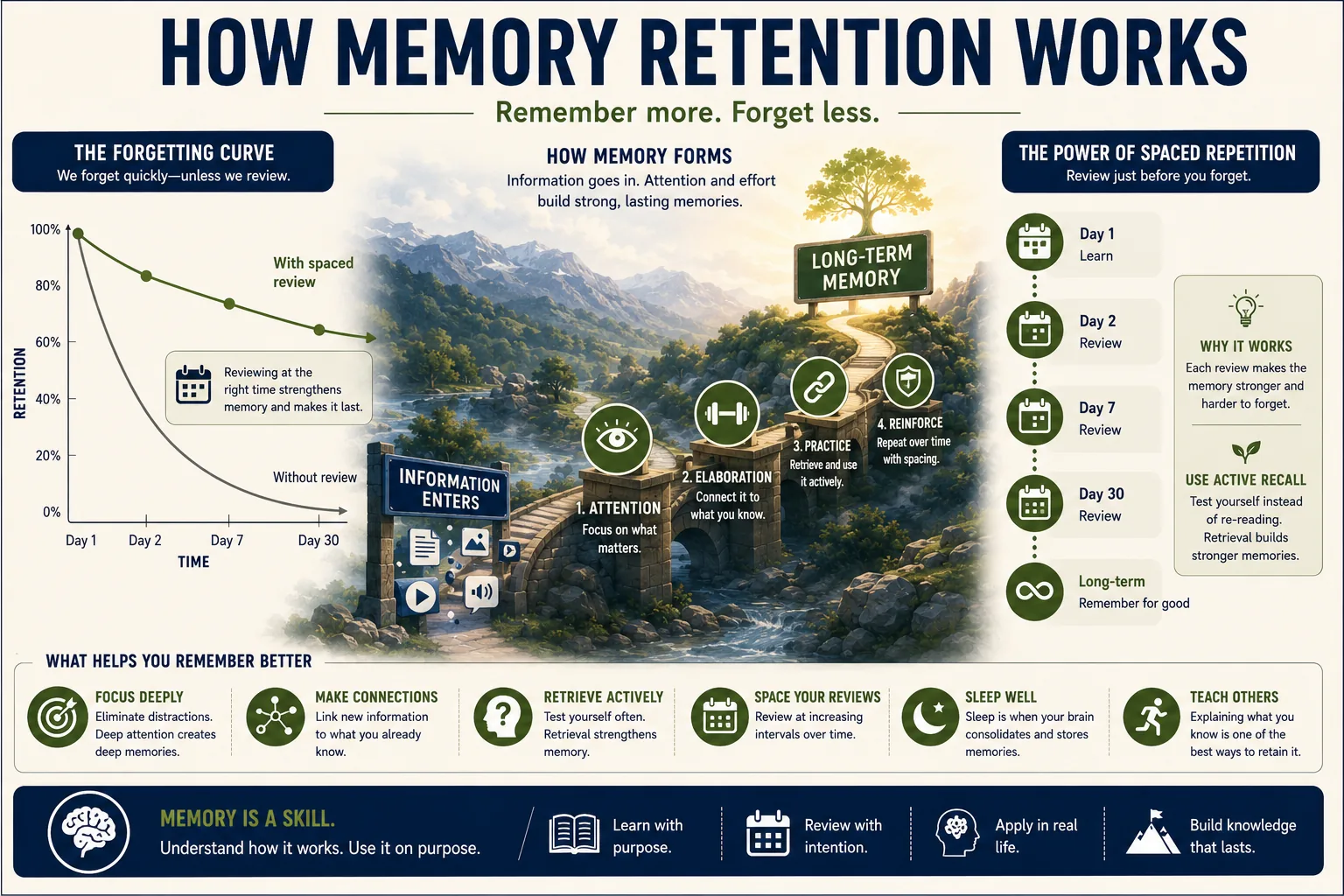
Memory: You read something important. You understand it. You even make notes. A week later, it's gone-vague recollection at best, complete blank at worst.
This isn't a failure of intelligence or attention. It's how memory actually works. Understanding the cognitive science of memory retention-encoding, consolidation, and retrieval reveals why we forget and, more importantly, how to remember.
The Three Stages of Memory
Stage 1: Encoding
Encoding is the process of transforming sensory input into a form that can be stored in memory.
| Encoding Type | Description | Durability |
|---|---|---|
| Shallow (structural) | Physical features (font, sound) | Weak, fades quickly |
| Moderate (phonological) | Sound, pronunciation | Moderate retention |
| Deep (semantic) | Meaning, relationships, connections | Strong, long-lasting |
Key principle: Depth of processing determines retention. The more meaningful connections you make during encoding, the better you'll remember.
"Retention is a direct function of depth of processing. The more elaborately and meaningfully we process information, the more durable the memory trace." - Fergus Craik & Robert Lockhart, Levels of Processing: A Framework for Memory Research (1972)[2]
Example: Remembering a name
Shallow encoding: Notice that it's spelled with a "ph" not "f"
- Result: Forget within minutes
Deep encoding: "Stephen-like Stephen Hawking. Physicist studying black holes. This Stephen also mentioned space..."
- Result: Remember days or weeks later
Why the difference: Deep encoding creates multiple retrieval cues (Stephen, Hawking, physics, space, black holes). Shallow encoding creates only one (spelling).
Stage 2: Consolidation
Consolidation is the process of stabilizing memories, transferring them from temporary to long-term storage.[11]
Timeline:
- Immediate (seconds to minutes): Synaptic consolidation-strengthening connections between neurons
- Delayed (hours to days): Systems consolidation-integrating memories into existing knowledge networks
- Ongoing (weeks to years): Continued reorganization and integration
What affects consolidation:
| Factor | Effect on Consolidation |
|---|---|
| Sleep | Critical-memory consolidation happens primarily during sleep, especially slow-wave and REM sleep |
| Time | Memories need time to stabilize; cramming doesn't allow consolidation |
| Interference | Learning similar information immediately after impairs consolidation |
| Emotion | Emotional arousal enhances consolidation (via amygdala activation) |
| Retrieval practice | Testing yourself during consolidation window strengthens memories |
Sleep and memory:
Research consistently shows:
- 24 hours with sleep: 60-80% retention
- 24 hours without sleep: 30-40% retention
- Sleep deprivation effects: Even one night impairs consolidation for days afterward
Mechanism: During sleep, the hippocampus "replays" experiences, transferring them to neocortex for long-term storage. Disrupting this process destroys memories before they stabilize.
Stage 3: Retrieval
Retrieval is accessing stored information when needed.
Critical insight: Retrieval is not passive playback. It's active reconstruction-you rebuild the memory from fragments using cues.
Implications:
- Memory is malleable (reconstructed each time, can change)
- Retrieval strengthens memory (testing effect)
- Forgetting is often retrieval failure, not storage loss (information is there but inaccessible)
"Memory is not like reading a book; it is more like writing a book from fragments." - Daniel Schacter, The Seven Sins of Memory (2001)
Retrieval cues:
| Cue Type | Example | Effectiveness |
|---|---|---|
| Context | Same location, environment | Moderate-why studying where you'll test helps |
| Emotional state | Same mood | Weak but measurable |
| Associated information | Related concepts | Strong-why connecting ideas aids recall |
| Deliberate structure | Organizational schemas | Very strong-why frameworks improve memory |
The Forgetting Curve
Ebbinghaus's discovery (1885): Forgetting follows a predictable pattern.[1] As Hermann Ebbinghaus documented in his pioneering self-experiments, "The curve of forgetting is steepest immediately after learning and then gradually levels off-most of what we lose, we lose quickly."
Without review:
- 20 minutes later: Forget ~40%
- 1 hour later: Forget ~55%
- 1 day later: Forget ~70%
- 1 week later: Forget ~80%
- 1 month later: Forget ~90%
Pattern: Rapid initial forgetting, then slowing curve
Forgetting curve with spaced repetition:
| Review Schedule | Retention After 30 Days |
|---|---|
| No review | ~10% |
| 1 review (day 1) | ~30% |
| 3 reviews (days 1, 3, 7) | ~60% |
| 5 reviews (days 1, 3, 7, 14, 21) | ~80-90% |
Key insight: Each review resets the forgetting curve at a higher baseline. After enough reviews, information moves to long-term memory with minimal forgetting.
Why We Forget
Reason 1: Weak Initial Encoding
Problem: Information never properly entered memory in the first place.
Causes:
| Cause | Mechanism |
|---|---|
| Inattention | Focusing elsewhere during encoding |
| Shallow processing | Not making meaningful connections |
| Cognitive overload | Too much information simultaneously |
| Lack of relevance | No connection to existing knowledge or goals |
Example: You're introduced to someone but forget their name immediately-you were thinking about what to say next instead of encoding their name.
Reason 2: Lack of Consolidation
Problem: Memory didn't have chance to stabilize.
Causes:
| Cause | Why It Matters |
|---|---|
| No sleep | Consolidation happens during sleep |
| Immediate interference | Learning similar material right after |
| Insufficient time | Cramming doesn't allow stabilization |
| Stress/cortisol | High stress impairs hippocampal consolidation |
Example: Cram for exam the night before, no sleep, take test. Pass the test but forget everything within days because consolidation never happened.
Reason 3: Interference
Two types:
Retroactive interference: New learning interferes with old
- Learn Spanish, then learn Italian → Italian interferes with Spanish recall
Proactive interference: Old learning interferes with new
- Know Spanish well, start learning Italian → Spanish patterns interfere with Italian acquisition
Why similar information interferes:
| Factor | Effect |
|---|---|
| Similar cues | Multiple memories compete for same retrieval cues |
| Overlapping patterns | Brain confuses which pattern applies |
| Limited distinctiveness | Can't distinguish one memory from another |
Solution: Create distinctiveness through elaboration, unique associations, different contexts.
Reason 4: Retrieval Failure
Problem: Information is stored but inaccessible-you know you know it, can't access it (tip-of-tongue phenomenon).
Causes:
| Cause | Mechanism |
|---|---|
| Missing cues | Encoded with specific cues, those cues aren't present during retrieval |
| Weak retrieval pathways | Haven't practiced retrieval, so pathways are weak |
| Context mismatch | Different context from encoding (state-dependent memory) |
| Insufficient associations | Too few connections to reach the memory |
Evidence: Recognition is easier than recall because recognition provides cues (see the right answer, recognize it). Recall requires self-generated retrieval.
"Memories are not retrieved from storage like books from a shelf. The encoding specificity principle tells us that retrieval depends critically on the match between the conditions of encoding and retrieval." - Endel Tulving, Elements of Episodic Memory (1983)[9]
Reason 5: Decay (Controversial)
Traditional theory: Memories fade over time if unused.
Modern view: Forgetting is mostly retrieval failure and interference, not pure decay.
Evidence:
- Hypnosis can recover "forgotten" memories (they were stored, just inaccessible)
- Recognition works even when recall fails
- Relearning is faster than initial learning (savings)
Implication: Most "forgotten" information isn't lost-it's inaccessible. Improving retrieval strategies matters more than preventing decay.
How to Improve Encoding
Improving encoding starts with protecting attention, since divided attention during learning produces weak memories and multitasking can cut retention by 30 to 40 percent. From there, elaborative processing, connecting new information to what you already know, builds multiple retrieval pathways and deepens how thoroughly the material gets processed in the first place.
Strategy 1: Attention and Focus
Memory requires attention. Divided attention during encoding produces weak memories.
Research: Multitasking while learning reduces retention by 30-40% compared to focused attention.
Practical tactics:
| Tactic | Why It Works |
|---|---|
| Eliminate distractions | Allows full attentional resources |
| Single-task | Deeper processing than task-switching |
| Pomodoro technique | Sustains focus through work intervals |
| Environmental cues | Consistent study space signals brain to focus |
Strategy 2: Elaborative Processing
Elaboration: Connect new information to existing knowledge through meaningful associations.
Why it works: Creates multiple retrieval pathways, deeper processing, integration with existing schemas.
Elaboration techniques:
| Technique | Application |
|---|---|
| Self-explanation | Explain concept in your own words |
| Generate examples | Create your own instances of concept |
| Ask "why" | Connect to reasons, causes, mechanisms |
| Relate to personal experience | Link to your life, work, interests |
| Create analogies | Map to familiar domains |
Example: Learning "confirmation bias"
- Shallow: "Confirmation bias is seeking confirming evidence"
- Elaborated: "Confirmation bias is why I keep reading news that agrees with my politics (my example). It's like having a hypothesis and only looking for supporting data (scientific analogy). Happens because our brain wants to be right (why). Leads to polarization because we never see contradictory perspectives (consequence). Similar to how I used to only follow people who agreed with me on Twitter (personal connection)."
Strategy 3: Dual Coding
Dual coding theory: Information encoded in multiple formats (verbal + visual) is better retained.[6]
Why: Creates redundant memory traces; if one fails, another might work.
Practical application:
| Material Type | Dual Coding Strategy |
|---|---|
| Text | Create diagrams, flowcharts, or visual metaphors |
| Concepts | Draw concept maps showing relationships |
| Processes | Sketch step-by-step illustrations |
| Data | Generate graphs, tables, visual representations |
Research finding: Students who create visual representations alongside reading retain 30-50% more than those who only read.
Strategy 4: Emotion and Meaning
Emotionally arousing information is better remembered.
Mechanism: Amygdala activation during emotional experiences enhances hippocampal encoding and consolidation.
Creating emotional engagement:
| Strategy | Application |
|---|---|
| Personal relevance | "Why does this matter to me?" |
| Narrative structure | Frame as story with tension, resolution |
| Concrete examples | Real people, situations, not abstractions |
| Surprising elements | Violations of expectation grab attention |
Example: Medical students remember patient cases (concrete, emotional, narrative) far better than textbook descriptions of the same diseases.
How to Improve Consolidation
Improving consolidation depends heavily on sleep, which is non-negotiable for memory retention: students who sleep after studying retain 30 to 40 percent more than those who stay awake the same duration. Spaced repetition compounds this effect, since distributing practice over time consistently beats cramming and is one of the most robust findings in cognitive psychology.
Strategy 1: Sleep
Non-negotiable for memory retention.
Recommendations:
| Sleep Factor | Guideline |
|---|---|
| Duration | 7-9 hours for adults |
| Timing | Study before sleep (sleep consolidates recent learning) |
| Quality | Prioritize slow-wave sleep (first half of night) and REM (second half) |
| Consistency | Regular schedule supports consolidation |
Evidence: Students who sleep after studying retain 30-40% more than those who stay awake the same duration.[5]
Strategy 2: Spaced Repetition
Spacing effect: Distributing practice over time beats massed practice (cramming).
"Spacing is one of the most robust and replicable phenomena in the cognitive psychology of learning.[4] The evidence is overwhelming: distributed practice produces better long-term retention than massed practice." - Robert Bjork, Memory and Metamemory Considerations in the Training of Human Beings (1994)[8]
Optimal spacing schedule (approximation):
| Review # | Timing After Initial Learning |
|---|---|
| Review 1 | 1 day later |
| Review 2 | 3 days later |
| Review 3 | 7 days later |
| Review 4 | 14 days later |
| Review 5 | 30 days later |
Pattern: Gradually increasing intervals (expanding retrieval practice)
Why spacing works:
| Mechanism | Explanation |
|---|---|
| Retrieval practice | Each review requires effortful retrieval, strengthening memory |
| Varied contexts | Different times/contexts create multiple retrieval cues |
| Consolidation time | Allows memory stabilization between reviews |
| Desirable difficulty | Slight forgetting between reviews makes retrieval harder but more effective |
Strategy 3: Minimize Interference
Avoid learning highly similar material in quick succession.
Tactics:
| Tactic | Rationale |
|---|---|
| Interleave dissimilar topics | Study math, then history, then programming (different domains) |
| Delay similar content | Learn Spanish morning, Italian evening (time separation) |
| Create distinctiveness | Emphasize differences between similar concepts |
| Use different contexts | Study different subjects in different locations |
Strategy 4: Retrieval Practice During Consolidation
Testing yourself during the consolidation window (hours to days after learning) enhances memory.[3]
Not just assessment-retrieval itself strengthens memory.
As Henry Roediger and colleagues demonstrated, "Practicing retrieval of information produces much greater gains in long-term retention than additional study-an effect robust enough that we call it the testing effect." (Psychological Science, 2006)[7]
Methods:
| Method | How to Apply |
|---|---|
| Flashcards | Test yourself on key concepts, facts |
| Practice problems | Apply knowledge without looking at notes |
| Self-quizzing | Close book, write what you remember |
| Teaching | Explain to someone else (retrieval + elaboration) |
How to Improve Retrieval
Improving retrieval means deliberately building retrieval cues during encoding, using techniques like acronyms, the method of loci, or chunking to create pathways back to the information. Practicing retrieval in varied contexts also matters: relying on one study location or question format makes memory context-dependent, while varying locations and formats produces more flexible, reliable recall.
Strategy 1: Create Retrieval Cues
Build deliberate retrieval pathways during encoding.
Techniques:
| Technique | Application |
|---|---|
| Acronyms | HOMES (Great Lakes: Huron, Ontario, Michigan, Erie, Superior) |
| Method of loci | Associate information with locations on familiar route |
| Chunking | Group information (phone numbers: 555-123-4567 not 5551234567) |
| Hierarchical organization | Create categories, subcategories |
Strategy 2: Vary Retrieval Contexts
Practice retrieval in multiple contexts to create context-independent memories.
Why: If you only retrieve in one context (e.g., your desk), memory becomes context-dependent.[13] Varying contexts creates flexible retrieval.
Tactics:
| Tactic | Benefit |
|---|---|
| Change study locations | Prevents location-dependent retrieval |
| Vary question formats | Multiple choice, short answer, essay |
| Test yourself at different times | Morning, evening, different days |
| Use information in different ways | Read, write, discuss, apply |
Strategy 3: Generation Effect
Generating information (vs. reading it) produces stronger memory.
Examples:
| Passive | Active (Generation) |
|---|---|
| Read definition | Write definition from memory |
| Review notes | Close notes, recreate from scratch |
| Reread chapter | Answer questions without looking |
| Highlight text | Create summary without text |
Why it works: Generation requires retrieval and elaboration, both strengthen memory.[14]
Strategy 4: Interleaved Practice
Mix different topics/problem types instead of blocking.
Example:
| Blocked Practice | Interleaved Practice |
|---|---|
| 10 addition problems, then 10 subtraction, then 10 multiplication | Addition, subtraction, multiplication, addition, multiplication, subtraction... |
Research: Interleaving produces 30-80% better retention and transfer than blocking, despite feeling harder during practice.[15]
Why: Forces discrimination (which strategy applies?), creates varied retrieval practice, prevents rote pattern application.
What Destroys Memory Retention
Destroyer 1: Sleep Deprivation
Effect: Impairs all three stages (encoding, consolidation, retrieval)
Quantified impact:
- One night of poor sleep → 40% reduction in ability to form new memories
- Chronic sleep restriction → Cumulative cognitive impairment that can approach that of total sleep deprivation
Destroyer 2: Stress and Cortisol
Acute stress: Can enhance memory (emotional arousal)
Chronic stress: Impairs memory formation and retrieval
- High cortisol damages hippocampus over time
- Stress during retrieval interferes with access
Destroyer 3: Passive Review
Rereading, highlighting, reviewing notes without testing: Feels productive but produces minimal retention.
Why it fails: No retrieval practice, shallow processing, illusion of fluency (familiar feels learned).[10]
Evidence: Students who reread perform worse than students who self-test, despite spending equal time.[12]
Destroyer 4: Multitasking
Task-switching during learning impairs encoding.
Cost: 20-40% reduction in retention when multitasking vs. focused attention.
Mechanism: Attention divided means shallow encoding, working memory overload.
Destroyer 5: Cramming
Massed practice (cramming):
- May pass immediate test
- Fails to consolidate
- Retention drops to near zero within weeks
Evidence: Students who cram score similarly on immediate tests but dramatically worse on delayed tests (days or weeks later) compared to students who space practice.
Practical Memory System
Building a retention-focused learning approach:
Phase 1: During Initial Learning (Encoding)
| Action | Purpose |
|---|---|
| Eliminate distractions | Enable attention |
| Elaborate deeply | Create connections, ask why, generate examples |
| Create visual representations | Dual coding |
| Engage emotionally | Make it personally relevant |
| Organize information | Build structure, hierarchies |
Phase 2: After Learning (Consolidation)
| Action | Purpose |
|---|---|
| Sleep | Allow consolidation |
| Schedule reviews | Spaced repetition (days 1, 3, 7, 14, 30) |
| Test yourself | Retrieval practice during consolidation |
| Avoid interference | Don't learn very similar content immediately after |
Phase 3: Long-Term (Retrieval)
| Action | Purpose |
|---|---|
| Continued spaced practice | Maintain memory |
| Apply knowledge | Use in real contexts |
| Teach others | Retrieval + elaboration |
| Vary retrieval contexts | Create flexible access |
What Research Actually Shows About Memory Formation
Memory research has produced some of the most replicated and practically applicable findings in all of cognitive science.
Alan Baddeley and Graham Hitch at the University of York proposed the working memory model in 1974, replacing the earlier "short-term memory" concept with a more functional architecture.
Baddeley's model identifies a central executive (attentional control), a phonological loop (verbal information), a visuospatial sketchpad (visual and spatial information), and an episodic buffer (integrating information across systems).
The practical consequence of this architecture is that the phonological loop and visuospatial sketchpad operate independently: reading text while listening to music with lyrics creates interference between two systems competing for the same phonological resources.
Studying while listening to instrumental music - which uses the visuospatial sketchpad less than the phonological loop - creates less interference.
Baddeley's model explains why dual-coding (using both visual and verbal representations) improves retention: you are encoding information in two separate subsystems, creating redundant retrieval pathways.
Larry Squire at the University of California San Diego spent four decades mapping the different memory systems in the brain through careful study of amnesiac patients.
His most important distinction is between declarative memory (explicit, conscious recall of facts and events) and non-declarative memory (implicit, unconscious memory for skills, habits, and conditioning).
The famous patient H.M., who had his hippocampus removed in 1953 to treat severe epilepsy, could no longer form new declarative memories but continued to improve on procedural tasks - mirror drawing, puzzle-solving - each session, without any conscious memory of having performed them.
Squire's work demonstrates that "memory" is not a single system but a family of distinct biological processes, each with its own neural basis and vulnerability to interference.
Elizabeth Loftus at UC Irvine has produced perhaps the most practically important and disturbing memory research: memory is not a recording but a reconstruction, and reconstructions can be systematically distorted.
In her classic 1974 car crash studies, Loftus showed participants films of car accidents and varied the verb in questions afterward: "How fast was the car going when it smashed/hit/contacted the other car?" Participants who heard "smashed" estimated higher speeds and were more likely to falsely report seeing broken glass.
In later work, Loftus demonstrated that entirely false memories - of being lost in a shopping mall as a child, of witnessing a demonic possession - could be implanted in roughly 25-30% of participants through suggestive questioning and social pressure.
Her findings have direct implications for eyewitness testimony and for any reliance on unaided human memory as an accurate record.
Endel Tulving at the University of Toronto made the distinction between episodic memory (personally experienced events) and semantic memory (general knowledge) in 1972, and spent subsequent decades mapping the differences between them.
Episodic memory is characterized by mental time travel - reexperiencing the context of a past event - and is uniquely human.
Semantic memory stores factual knowledge without the experiential context. This distinction explains why you can remember the fact that Paris is the capital of France (semantic) without being able to recall when or how you learned it (episodic).
For practical learning, Tulving's work implies that creating episodic associations for semantic information - linking facts to specific personal experiences and contexts - makes them easier to retrieve.
Real-World Applications: Memory Research in Practice
The findings from memory science have been applied in medical training, legal systems, and technology.
Medical educators have applied spaced repetition research like that of Susan Ambrose and colleagues to redesign anatomy curricula. Traditional anatomy courses present each body system once in intensive lectures; a spaced-repetition redesign introduces systems multiple times at increasing intervals, with low-stakes testing between encounters, an approach consistent with the broader retention research this article describes.
The Innocence Project, founded by Barry Scheck and Peter Neufeld in 1992, has helped exonerate hundreds of wrongfully convicted people in the United States using DNA evidence. In approximately 70% of these cases, mistaken eyewitness identification was a contributing factor.
The organization worked with memory researchers including Gary Wells at Iowa State University to develop evidence-based eyewitness identification reforms: double-blind lineups (where the administrator doesn't know which person is the suspect), sequential rather than simultaneous presentation of lineup members, and collection of confidence statements before witnesses receive any feedback.
These reforms, now adopted in several U.S. states, directly apply Loftus's findings about memory malleability.
Google's internal learning platform uses spaced repetition to train employees on information security practices. After finding that traditional one-time annual security training showed near-zero retention, Google's security team designed a series of short security exercises delivered at 30-day, 90-day, and 180-day intervals.
Employees who completed the full spaced sequence were 40% less likely to fall for phishing simulations than those who had completed only the initial training.
The program has been cited by Google's security team as one of the most cost-effective security interventions they have implemented.
Military sleep research conducted by Matthew Walker at UC Berkeley has helped quantify sleep deprivation's effects on memory consolidation.
Separate research by Williamson and Feyer found that 17-19 hours of wakefulness produces performance impairment equivalent to a blood alcohol level of 0.05%, and 24 hours of wakefulness is equivalent to 0.10% blood alcohol.
Walker's research found that REM sleep specifically consolidates emotional memories and procedural skills, while slow-wave sleep consolidates declarative factual memories.
These findings led the U.S. Army to revise training schedules to protect sleep between high-information learning sessions, recognizing that training time lost to sleep is more than recovered in consolidation quality.
Sleep and Memory Consolidation: The Neuroscience
The role of sleep in memory consolidation has moved from behavioral observation to mechanistic understanding over the past two decades, driven primarily by research from Matthew Walker at UC Berkeley and Jan Born at the University of Tubingen.
Walker's 2017 book Why We Sleep synthesized decades of research establishing that sleep is not passive rest but an active period of memory processing.
His laboratory's research demonstrated that the hippocampus - the brain's primary site for new declarative memory formation - acts as a temporary buffer that is cleared during sleep.
Information accumulated during waking hours is transferred to the neocortex during slow-wave sleep through a process called memory replay: the hippocampus replays experience in compressed form approximately 20 times faster than real-time, allowing the neocortex to gradually incorporate the new information into its existing knowledge network.
This transfer is why sleep-deprived learners experience not just fatigue but specific deficits in forming new memories - the buffer is full and the transfer mechanism is offline.
Born and colleagues demonstrated in a 2004 study published in Nature that subjects who slept between training and testing on a mathematical insight task were roughly twice as likely to discover a hidden shortcut than subjects who remained awake for the same interval.
The finding revealed that sleep does not merely preserve memories passively - it appears to actively restructure them, finding abstractions and relationships not evident in the original experience. This memory restructuring during sleep may be a mechanism through which sleep contributes to creative insight and problem-solving.
A landmark study by Mednick, Nakayama, and Stickgold (2003) at Harvard and UC San Diego established that even a 60-90 minute nap containing both slow-wave and REM sleep restored performance on a perceptual learning task that had declined through repetition fatigue.
The restoration effect was specific to the nap condition - subjects who remained awake for the same period showed no recovery.
The practical implication is that a post-learning nap, rather than an additional study session, may be more valuable for consolidating information learned in the morning.
Mednick's research at UC San Diego quantified the nap effect systematically. A 2003 study found that 60-90 minute naps containing REM sleep produced learning benefits equivalent to a full night's sleep for perceptual discrimination tasks.
Shorter naps (under 30 minutes) reduced fatigue without producing the same memory consolidation. The REM sleep finding is consistent with the memory replay theory: REM sleep generates the neural oscillations during which hippocampal-to-neocortex transfer occurs most efficiently.
Eyewitness Memory and the Malleability of Recall
One of the most practically important and disturbing findings in memory research is that memories, far from being stable records, are actively reconstructed each time they are retrieved - and reconstruction introduces distortion.
Elizabeth Loftus at UC Irvine has spent five decades documenting memory malleability, beginning with her 1974 studies showing that the wording of questions after viewing a filmed car accident changed participants' recall.
Asking "How fast were the cars going when they smashed into each other?" produced higher speed estimates than "How fast were the cars going when they contacted each other?" - and a week later, the "smashed" group was twice as likely to falsely report seeing broken glass that was never in the film.
The verb choice had altered the memory trace itself, not merely the verbal report.
In more dramatic experiments, Loftus demonstrated that entirely fabricated memories could be implanted in approximately 25-30% of participants. In the "lost in the mall" paradigm (1995), participants were given short accounts of childhood events, some true and some fabricated by the researchers.
Many participants not only accepted the fabricated mall-loss event but elaborated it with rich sensory detail - describing the clothing of the person who helped them, their emotional state, even features of the mall - none of which were provided and none of which could be accurate.
The Innocence Project, applying Loftus's research, has demonstrated its real-world consequences. Of the first 375 DNA exonerations in the United States, approximately 69% involved mistaken eyewitness identification - eyewitnesses who were confident, sincere, and wrong.
Gary Wells at Iowa State University developed evidence-based lineup reforms based on memory science: sequential rather than simultaneous lineup presentation (which reduces relative judgment errors), double-blind administration (where the administrator doesn't know the suspect's identity), and confidence collection immediately at identification before any feedback.
Jurisdictions adopting these reforms have seen significant reductions in false identification rates without corresponding increases in failure to identify actual perpetrators.
For learners, the malleability of memory has direct practical consequences: the act of retrieving a memory slightly changes it, incorporating current context and expectations.
This means that retrieval practice not only strengthens memories but can also update them - both a feature (memories become integrated with new knowledge) and a risk (incorrect retrieval or misleading feedback can corrupt accurate memory traces).
The implication is that feedback after retrieval practice should be accurate and prompt: allowing an incorrect memory to consolidate without correction makes subsequent correction more difficult.
The Science Behind the Spacing Effect
The spacing effect - that distributed practice produces better retention than massed practice - has one of the longest research histories in psychology, but its mechanistic basis was not understood until recently.
Cepeda, Pashler, Vul, Wixted, and Rohrer's 2006 meta-analysis of 317 experiments confirmed the spacing effect's robustness but also revealed something that simpler accounts had missed: optimal spacing depends on the intended retention interval.
For a test one week after learning, spacing of one day between sessions is optimal. For a test one year after learning, spacing of three weeks between sessions is optimal. The relationship follows a mathematical pattern: the optimal gap is approximately 10-20% of the intended retention interval.
This finding means there is no single "correct" spacing schedule - the right schedule depends on when you need the information.
Robert Bjork at UCLA proposed the "new theory of disuse" (1992) to explain the spacing effect mechanistically. Bjork distinguishes between storage strength (how well consolidated a memory is) and retrieval strength (how easily accessible it currently is).
A recently reviewed item has high retrieval strength but low storage strength - it is easy to access but not durably encoded. An item reviewed at a long interval has lower current retrieval strength (it takes more effort to retrieve) but gains more storage strength from each successful retrieval.
The spacing effect works because effort during retrieval is the mechanism by which storage strength increases. Reviewing items before they have been partially forgotten means retrieving them when retrieval strength is still high, which requires little effort and adds little storage strength.
Neural evidence for the spacing effect comes from studies by Bhattacharya and Bhattacharya (2016) using functional MRI. Spaced learning produced significantly greater activation in the hippocampus - the brain region critical for new declarative memory formation - compared to massed learning, even when total study time was equated.
Massed learning showed higher prefrontal activation, reflecting increased effort to maintain information in working memory.
The distinction suggests that massed learning keeps information in working memory without triggering the hippocampal processes that support long-term consolidation, while spaced learning repeatedly recruits consolidation processes with each retrieval attempt.
Sources & Further Reading
Ebbinghaus, H. (1885/1913). Memory: A Contribution to Experimental Psychology. Teachers College, Columbia University.
Craik, F. I. M., & Lockhart, R. S. (1972). "Levels of Processing: A Framework for Memory Research." Journal of Verbal Learning and Verbal Behavior, 11(6), 671-684.
Karpicke, J. D., & Roediger, H. L. (2008). "The Critical Importance of Retrieval for Learning." Science, 319(5865), 966-968.
Cepeda, N. J., Pashler, H., Vul, E., Wixted, J. T., & Rohrer, D. (2006). "Distributed Practice in Verbal Recall Tasks: A Review and Quantitative Synthesis." Psychological Bulletin, 132(3), 354-380.
Walker, M. P., & Stickgold, R. (2006). "Sleep, Memory, and Plasticity." Annual Review of Psychology, 57, 139-166.
Paivio, A. (1991). "Dual Coding Theory: Retrospect and Current Status." Canadian Journal of Psychology, 45(3), 255-287.
Roediger, H. L., & Karpicke, J. D. (2006). "Test-Enhanced Learning: Taking Memory Tests Improves Long-Term Retention." Psychological Science, 17(3), 249-255.
Bjork, R. A., & Bjork, E. L. (2020). "Desirable Difficulties in Theory and Practice." Journal of Applied Research in Memory and Cognition, 9(4), 475-479.
Tulving, E., & Thomson, D. M. (1973). "Encoding Specificity and Retrieval Processes in Episodic Memory." Psychological Review, 80(5), 352-373.
Brown, P. C., Roediger, H. L., & McDaniel, M. A. (2014). Make It Stick: The Science of Successful Learning. Belknap Press.
McGaugh, J. L. (2000). "Memory-A Century of Consolidation." Science, 287(5451), 248-251.
Dunlosky, J., Rawson, K. A., Marsh, E. J., Nathan, M. J., & Willingham, D. T. (2013). "Improving Students' Learning with Effective Learning Techniques." Psychological Science in the Public Interest, 14(1), 4-58.
Godden, D. R., & Baddeley, A. D. (1975). "Context-Dependent Memory in Two Natural Environments: On Land and Underwater." British Journal of Psychology, 66(3), 325-331.
Slamecka, N. J., & Graf, P. (1978). "The Generation Effect: Delineation of a Phenomenon." Journal of Experimental Psychology: Human Learning and Memory, 4(6), 592-604.
Rohrer, D., & Taylor, K. (2007). "The Shuffling of Mathematics Problems Improves Learning." Instructional Science, 35(6), 481-498.
About This Series: This article is part of a larger exploration of learning, memory, and knowledge. For related concepts, see Why Most Learning Fails, Spaced Repetition Explained, How Experts Build Mental Representations, and Learning Myths That Refuse to Die.