
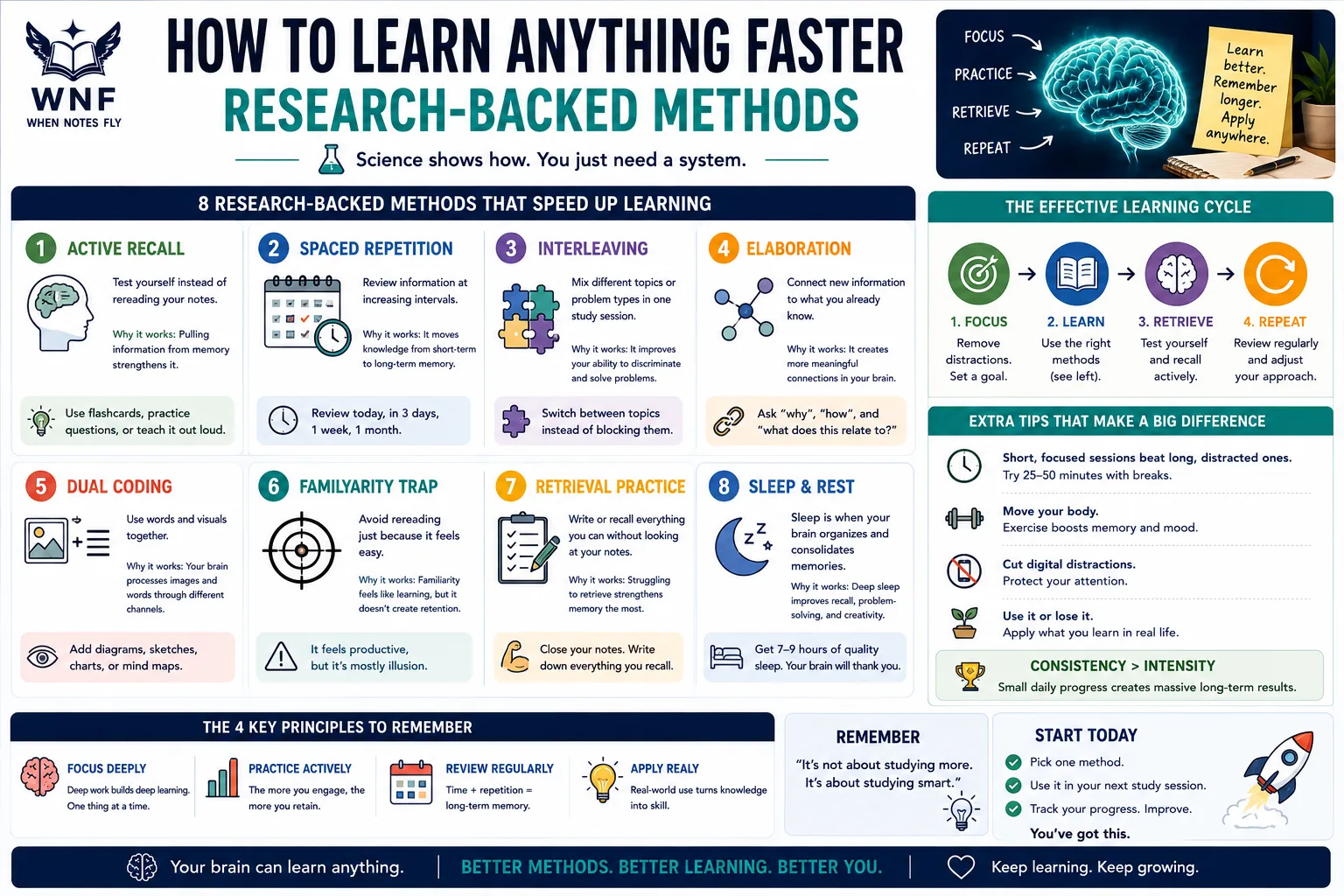
What the Research Actually Says
Most popular advice about accelerated learning is recycled from a small body of peer-reviewed cognitive science research.
The canonical synthesis is Dunlosky, Rawson, Marsh, Nathan, and Willingham's 2013 paper "Improving Students' Learning With Effective Learning Techniques" in Psychological Science in the Public Interest, which evaluated ten common study techniques against experimental evidence.[1]
Two techniques earned the "high utility" rating: practice testing (active recall) and distributed practice (spaced repetition). Three, elaborative interrogation, self-explanation, and interleaved practice, earned moderate utility. Five earned low utility.
The techniques in the low-utility category include almost everything learners naturally gravitate toward: highlighting, rereading, summarizing, imagery for text, and the keyword mnemonic. The gap between what feels productive and what produces durable learning is the central insight of the last four decades of learning science.
Robert Bjork of UCLA, along with his frequent collaborator Elizabeth Bjork, developed the influential framework of "desirable difficulties," the idea that conditions which slow down or add friction to learning, such as spacing practice out or testing yourself instead of rereading, often produce weaker performance during practice itself but far stronger long-term retention.[8]
Their account of the concept appears in the co-authored chapter "Making Things Hard on Yourself, But in a Good Way," published in the 2011 volume Psychology and the Real World.
This article covers nine techniques. Each is grounded in peer-reviewed research, each has documented time benchmarks, and each can be implemented without specialized tools.
The Nine Techniques in One Table
| Technique | Research Utility | Time Investment | Best For |
|---|---|---|---|
| Active Recall | High | Low | Factual knowledge, concepts |
| Spaced Repetition | High | Low (long-term) | Large fact stores, language |
| Feynman Technique | Moderate-High | Moderate | Conceptual understanding |
| Deliberate Practice | High | High | Skill acquisition |
| Interleaving | Moderate | Low | Discrimination problems |
| Dual Coding | Moderate | Low | Complex systems, diagrams |
| Chunking | Moderate-High | Moderate | Sequences, procedures |
| 80/20 Curation | N/A (strategic) | Low | Breadth before depth |
| Deep Work Blocks | High (correlational) | High | All complex learning |
1. Active Recall (Retrieval Practice)
Active recall is the act of producing information from memory rather than reviewing it. The gap between "can I recognize this" and "can I produce this" is where durable learning forms.
Karpicke and Roediger's 2008 paper in Science, "The Critical Importance of Retrieval for Learning," compared students who repeatedly studied a passage against students who alternated study with repeated self-testing.[2]
On a test given one week later, the repeated-testing group scored roughly 61 percent correct compared to roughly 40 percent for the repeated-study group, a substantial and now widely replicated advantage for retrieval over rereading.
How to apply:
- After reading, close the source and write what you remember.
- Use flashcards, but generate the cards yourself rather than using premade sets.
- Practice essays, problem sets, and simulations rather than re-reading solutions.
Time benchmark: A 25-minute active-recall session produces better one-week retention than a 60-minute rereading session. The differential compounds over weeks.
2. Spaced Repetition
Ebbinghaus's forgetting curve, published in 1885, established that memory decays without retrieval. Spaced repetition schedules retrievals at increasing intervals (1 day, 3 days, 7 days, 14 days, 30 days) matched to the decay rate.
Cepeda, Pashler, Vul, Wixted, and Rohrer's 2006 meta-analysis in Psychological Bulletin, drawing on hundreds of assessments across more than 300 experiments, found that spaced practice consistently outperformed massed practice, with the size of the advantage varying by task and by the interval between study and test, generally landing in the moderate-to-large range by conventional effect-size standards.
Tools:
- Anki (free, SRS algorithm, desktop and mobile)
- Quizlet (easier onboarding, less customizable)
- Physical Leitner box system (zero-tech, three to five boxes at increasing review intervals)
Time benchmark: For a typical professional certification with 500 to 1,000 discrete facts, 15 to 20 minutes daily of Anki review for 90 to 180 days produces near-ceiling retention.
3. Feynman Technique
Richard Feynman's reported study method: pick a concept, explain it in plain language as if teaching a twelve-year-old, identify gaps where the explanation breaks down, return to source material on those gaps, and repeat until the explanation flows without technical jargon.
The technique is a hybrid of active recall and self-explanation. Chi, de Leeuw, Chiu, and LaVancher's 1994 paper in Cognitive Science found that students prompted to explain a science text to themselves as they read it understood and could apply the material better afterward than students who simply reread the same text, one of the foundational studies supporting self-explanation as a learning strategy.[6]
How to apply:
- Write the concept name at the top of a blank page.
- Explain it as if to a bright 12-year-old, in plain language, with analogies.
- Identify sentences where you slipped into jargon or hand-waved.
- Return to the source material and fill the gaps.
- Rewrite until the explanation flows.
Time benchmark: 30 to 60 minutes per concept. Slower per concept than passive review, but retention and transfer are dramatically higher.
4. Deliberate Practice
Anders Ericsson's research on expert performance, synthesized in Peak: Secrets from the New Science of Expertise (2016), distinguishes deliberate practice from mere experience. Deliberate practice requires: a specific sub-skill goal, immediate feedback, operation at the edge of current capability, and full attention.
Ericsson's studies of violinists at the Music Academy of West Berlin found that by age 20, the top performers had accumulated a little over 10,000 hours of solitary deliberate practice, the good-but-not-elite performers somewhat less, and the group headed for music teaching careers less again, a clear ordering of accumulated practice hours by performance level.[4]
The 10,000-hour figure popularized by Malcolm Gladwell is drawn from the top group's average, not a fixed threshold that guarantees expertise, and applies most cleanly to domains, like music performance, where expert performance is well-defined and practice time is countable.
Key distinction: Hours of deliberate practice, focused, effortful, feedback-rich, produce far more skill gain per hour than casual, unstructured practice.
5. Interleaving
Instead of practicing one skill or topic until mastered, interleaving mixes related-but-distinct problems in the same session.
Rohrer, Dedrick, and Stershic's 2015 study in the Journal of Educational Psychology, conducted with seventh-grade math students, found that students who practiced interleaved problem types retained their performance much better on a test given weeks later than students who practiced the same problem types in isolated blocks, even though the two groups had performed similarly on quizzes given immediately after each practice session.[5]
The mechanism: interleaving forces the learner to discriminate between problem types and select the right solution method, a cognitive operation that blocked practice skips.
Application example: When studying for a certification exam, mix question types within each study session rather than completing all of one section before moving to the next.
6. Dual Coding
Paivio's dual coding theory, introduced in 1971 and studied extensively since, holds that information encoded in both verbal and visual modalities is remembered better than information encoded in one.
Richard Mayer's multimedia learning research at UC Santa Barbara, spanning several decades, has found consistent, though variable in size, benefits for pairing visual and verbal explanations of the same material over verbal explanation alone, with some specific principles (such as pairing narration with matched animation rather than narration alone) showing particularly large effects.[7]
Application: When studying a complex system, draw it. Concept maps, flowcharts, and hand-drawn diagrams outperform pure text study for systems-level content. The drawing does not need to be artistic. Rough shapes and arrows are sufficient.
7. Chunking
George Miller's 1956 paper "The Magical Number Seven, Plus or Minus Two" argued that working memory holds a limited number of independent units, commonly cited as around seven, though later research has revised that estimate downward. Chunking is the process of building larger meaningful units from smaller ones so that working memory can hold more functional content per unit.
Chess research provides one of the clearest examples. Chase and Simon's 1973 study in Cognitive Psychology found that chess experts could recall far more pieces from a briefly viewed, realistic mid-game position than novices could.
This advantage collapsed almost entirely when the same pieces were arranged randomly rather than in a pattern that could occur in a real game, showing that the experts' advantage came from recognizing meaningful chunks of position rather than from superior raw memory.
Application: Break new material into a handful of meaningful units, learn each unit, then combine. For a programming language, learn syntax (chunk 1), control flow (chunk 2), data structures (chunk 3), and so on. For a medical topic, organize by system, then condition, then presentation.
8. 80/20 Curation (Strategic, Not Cognitive)
The Pareto principle applied to learning: in most domains, a minority of the material produces the large majority of functional capability. The technique predates modern cognitive science but is complementary to it.
Tim Ferriss's The 4-Hour Chef popularized the method for adult learning: before studying a domain, ask which portion of the content is most frequently used, most often tested, or most load-bearing.
For language learning, a relatively small set of the highest-frequency words covers the large majority of typical conversation. For many professional certifications, a core set of concepts recurs across a large share of exam questions.
9. Deep Work Blocks
Cal Newport's Deep Work (2016) synthesizes research on attention and productivity into the argument that uninterrupted, focused work is both rarer and more valuable than most knowledge workers recognize.
The research base includes Sophie Leroy's 2009 work on "attention residue," the finding that switching tasks before finishing the first one leaves a lingering cognitive trace that impairs performance on the new task.
It also includes Gloria Mark's research at UC Irvine on the real cost of workplace interruptions, which has documented that returning to a task after an interruption takes a meaningful amount of time and often leads people to work faster but with more stress once they resume, though the precise number of minutes this takes varies across her studies and has been widely oversimplified in secondary reporting.
Practical benchmark: A 90-minute uninterrupted deep work block produces more learning progress than three 30-minute blocks punctuated by notifications. The broader research on the cost of task-switching is robust across decades and methodologies, even where any single precise number should be treated with some caution.
Tools that remove friction from deep work include distraction blockers (Freedom, Cold Turkey), physical environment design (phone in another room), and markdown-based note systems that do not require context-switching into cloud apps.
Four Study Schedules
The schedules below are calibrated for typical adult learners with 10 to 25 hours per week to invest.
Certification Study (10 weeks, 15 hours per week)
- Week 1 to 2: 80/20 curation. Map the exam objectives. Identify high-weight domains.
- Week 3 to 6: Active recall and spaced repetition. Build Anki deck of core facts. Study 60 to 90 minutes daily.
- Week 7 to 8: Interleaved practice testing. Mixed-topic practice exams.
- Week 9: Feynman technique on the five weakest areas.
- Week 10: Rest, light review, and exam.
Language Acquisition (6 months to conversational fluency)
- Month 1: Highest-frequency words via spaced repetition (Anki). 30 minutes daily.
- Month 2 to 3: Comprehensible input (podcasts, children's shows) 30 minutes daily, plus continued SRS.
- Month 4 to 5: Speaking practice with tutors (iTalki, Preply), 60 to 90 minutes weekly.
- Month 6: Immersion blocks (movies, books, conversation partners).
Programming Skill (3 to 6 months to employable)
- Month 1: Core syntax and data structures via CS50x or equivalent. Problem sets daily.
- Month 2: Interleaved projects. Rotate between frontend, backend, and data projects.
- Month 3 to 4: One shipped project per month, deployed publicly.
- Month 5 to 6: Open-source contributions and interview preparation with active recall on system design.
Academic Exam (4 weeks intensive)
- Week 1: 80/20 syllabus review, active recall during initial reading.
- Week 2: Spaced repetition on core terminology. Interleaved practice problems.
- Week 3: Feynman technique on the hardest concepts. Deep work blocks of 90 minutes.
- Week 4: Full practice exams under timed conditions. Light review on weak areas.
Benchmarks and Realistic Expectations
| Skill | Realistic Time to Entry Competency | Time to Advanced |
|---|---|---|
| Programming (full-stack) | 800 to 1,500 hours | 3,000 to 5,000 hours |
| Conversational language | 500 to 750 hours (category I) | 2,200+ hours (hardest tier) |
| Chess (from 0 to 1500 ELO) | 500 to 1,000 hours | 3,000+ hours |
| Musical instrument (basic proficiency) | 600 to 900 hours | 4,000+ hours |
| Data analyst portfolio | 400 to 600 hours | 1,500+ hours |
Language time estimates come from the U.S. Foreign Service Institute, which ranks languages by how long they typically take a native English speaker to reach professional working proficiency, from around 600 to 750 hours for languages closely related to English, such as Spanish, French, and Italian, up to around 2,200 hours for the small set of languages FSI ranks as most difficult for English speakers, including Mandarin, Arabic, Japanese, and Korean.
Robert Bjork's "desirable difficulties" framework captures a theme that runs through all nine techniques above: the study methods that feel hardest in the moment, retrieval instead of review, spacing instead of cramming, are consistently the ones that produce the strongest long-term retention. The question worth asking while studying is less "what should I read next" than "what can I try to retrieve right now."
Working memory, processing speed, and pattern recognition each predict learning speed in different domains, and self-awareness about which is relatively stronger or weaker shapes study design.
What Does Not Work
The Dunlosky et al. 2013 review was blunt about five widely-used techniques with weak empirical support:
| Technique | Utility Rating | Why It Fails |
|---|---|---|
| Highlighting and underlining | Low | Passive, no retrieval |
| Rereading | Low | Illusion of mastery, no retrieval |
| Summarization | Low (for most learners) | Requires skill most students lack |
| Keyword mnemonic | Low | Narrow applicability, fragile |
| Imagery for text | Low | Limited to concrete text |
The common feature of low-utility techniques is that they feel productive while requiring no retrieval. The common feature of high-utility techniques is that they require retrieval under some difficulty.
Frequently Asked Questions
Is the Feynman technique really worth the extra time per concept?
Yes, for any material where conceptual understanding matters more than memorization of isolated facts. The underlying mechanism is self-explanation, which Chi and colleagues demonstrated in their 1994 Cognitive Science paper produces meaningfully better understanding and application of material compared to rereading alone.
The technique is slower per concept than passive review. The retention and transfer advantage compounds. For pure memorization tasks such as vocabulary or medical anatomy terminology, spaced repetition outperforms the Feynman technique.
For conceptual domains such as programming, statistics, economics, physics, and machine learning, the Feynman approach is superior. The combination of both, Feynman for understanding and spaced repetition for retention, is a robust pattern supported across the learning science literature.
How much faster can someone realistically learn using these techniques?
The cleanest experimental comparisons, from Karpicke and Roediger's 2008 Science paper on retrieval practice, show a substantial retention advantage, on the order of twenty percentage points or more on a delayed test, from active recall versus rereading across comparable time investment.
Cepeda and colleagues' 2006 meta-analysis on spaced versus massed practice similarly found a consistent, meaningful advantage for spacing, with the exact size depending on the task and the delay before testing.[3]
Stacking active recall, spaced repetition, interleaving, and deep work blocks produces compounding gains that, across a 10-week study program, can plausibly produce substantially more retained learning compared to an equivalent time investment in highlighting and rereading, though claims of a precise multiplier should be treated cautiously given how much the effect varies by material and learner.
The ceiling is not infinite. Individual differences in working memory and processing speed set a hard limit on rate of skill acquisition, and most dramatic claims of accelerated learning (learn Mandarin in 3 months, become a programmer in 30 days) ignore the realistic time ranges documented above.
What is the single most impactful change for someone starting from a highlighter-and-reread background?
Replace one hour of rereading per week with one hour of self-testing. The switch is simple, costs no additional time, and produces measurable retention gains within the first study cycle.
Practical implementation: after reading a textbook chapter or watching a lecture, close the source, set a 20-minute timer, and write everything you can recall about the material.
Then open the source and fill the gaps. This single practice, repeated across a study program, is among the highest-leverage changes documented in the learning science literature.
It replicates across elementary school, medical school, professional certification, and adult learning contexts. The resistance most learners feel to self-testing, because it feels harder and exposes what they do not know, is precisely what makes it effective, consistent with Bjork's account of desirable difficulties.
Sources & Further Reading
Dunlosky, J., Rawson, K. A., Marsh, E. J., Nathan, M. J., & Willingham, D. T. (2013). Improving students' learning with effective learning techniques: Promising directions from cognitive and educational psychology. Psychological Science in the Public Interest, 14(1), 4-58. DOI: 10.1177/1529100612453266
Karpicke, J. D., & Roediger, H. L. (2008). The critical importance of retrieval for learning. Science, 319(5865), 966-968. DOI: 10.1126/science.1152408
Cepeda, N. J., Pashler, H., Vul, E., Wixted, J. T., & Rohrer, D. (2006). Distributed practice in verbal recall tasks: A review and quantitative synthesis. Psychological Bulletin, 132(3), 354-380. DOI: 10.1037/0033-2909.132.3.354
Ericsson, K. A., Krampe, R. T., & Tesch-Romer, C. (1993). The role of deliberate practice in the acquisition of expert performance. Psychological Review, 100(3), 363-406. DOI: 10.1037/0033-295X.100.3.363
Rohrer, D., Dedrick, R. F., & Stershic, S. (2015). Interleaved practice improves mathematics learning. Journal of Educational Psychology, 107(3), 900-908. DOI: 10.1037/edu0000001
Chi, M. T. H., de Leeuw, N., Chiu, M. H., & LaVancher, C. (1994). Eliciting self-explanations improves understanding. Cognitive Science, 18(3), 439-477. DOI: 10.1207/s15516709cog1803_3
Mayer, R. E. (2009). Multimedia Learning (2nd ed.). Cambridge University Press. DOI: 10.1017/CBO9780511811678
Bjork, R. A., Dunlosky, J., & Kornell, N. (2013). Self-regulated learning: Beliefs, techniques, and illusions. Annual Review of Psychology, 64, 417-444. DOI: 10.1146/annurev-psych-113011-143823
This article is part of How Learning Works: A Research Guide to Learning Science - our complete guide to the evidence on how people actually learn.