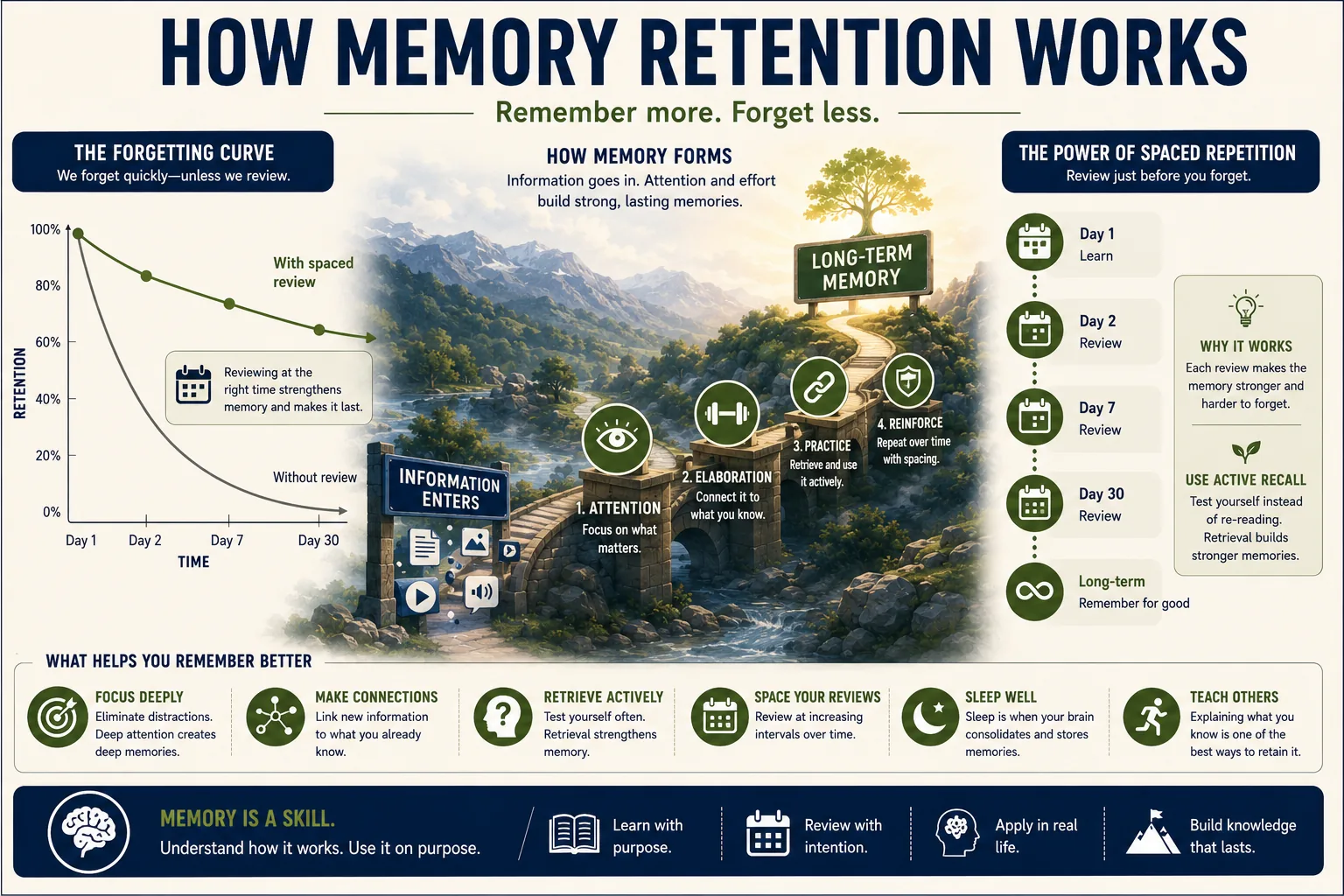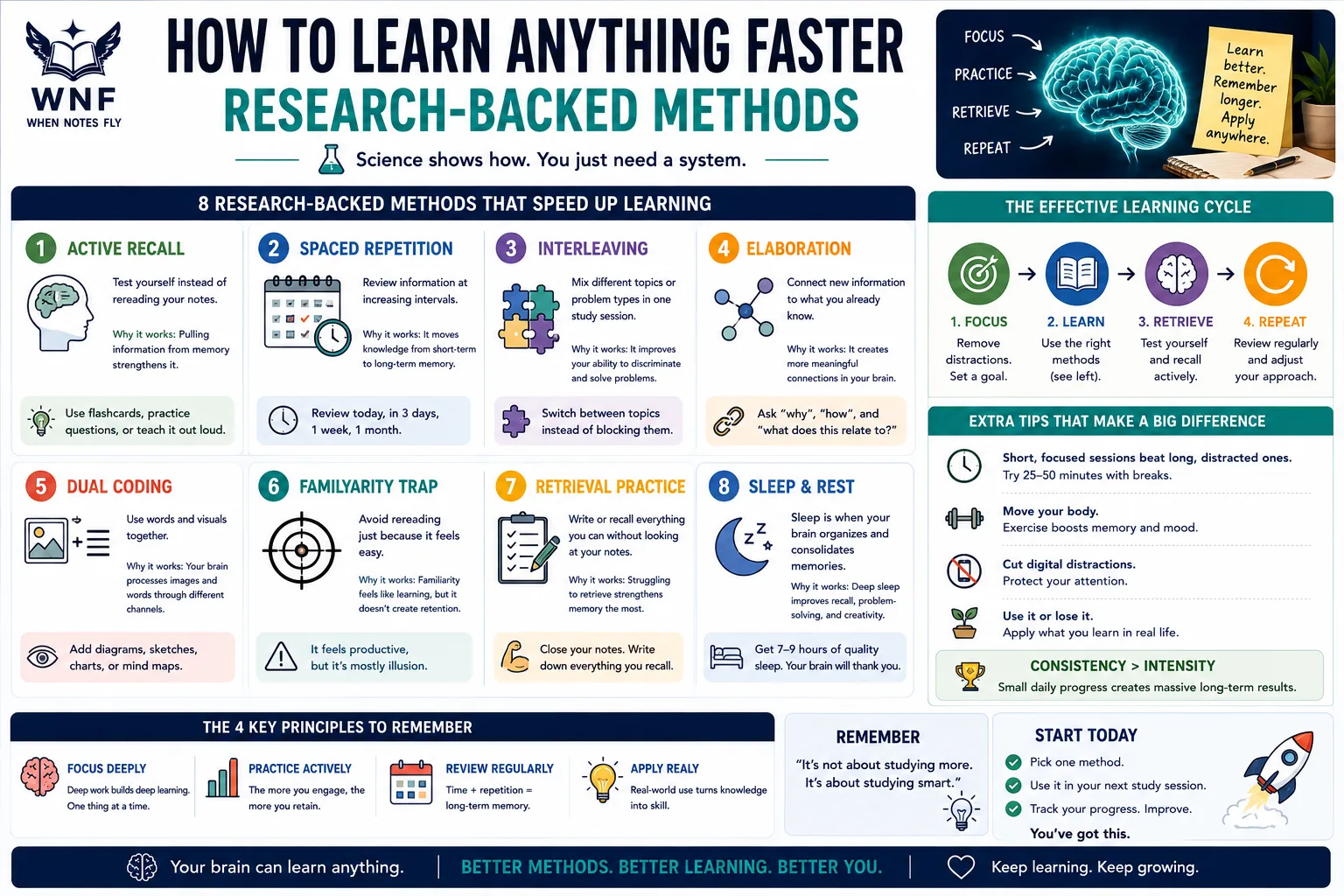
Spaced repetition strengthens long-term memory by scheduling retrieval near the point when material would otherwise be forgotten. Each successful recall increases memory stability, allowing later reviews at longer intervals, while difficult items return sooner. Physical systems such as Leitner boxes and adaptive software algorithms allocate review effort where it is most needed, making durable retention more efficient than massed study.
Hermann Ebbinghaus sat alone in his laboratory in 1885, memorizing nonsense syllables --- DAX, BUP, ZOL --- and meticulously recording how quickly he forgot them.[1] What he discovered was unsettling. Within 20 minutes, he had lost 42% of what he had learned.
After one hour, 56% had vanished. By the end of a single day, roughly two-thirds of his memorized material had dissolved from conscious recall. The forgetting curve he documented remains one of the most replicated findings in all of experimental psychology.
That finding, published in Uber das Gedachtnis (On Memory), laid the foundation for what would become the most empirically validated learning technique in cognitive science: spaced repetition.[6]
The principle is deceptively simple --- review information at strategically timed intervals, each review occurring just before the memory would otherwise fade.
The execution, however, involves decades of algorithmic development, contested theories of memory consolidation, and an ongoing debate about what optimal spacing actually looks like in practice.
The Forgetting Curve and Why It Matters
Ebbinghaus's forgetting curve is not a gentle decline. It is a steep exponential drop followed by a long, slow tail. The rate of forgetting is fastest immediately after learning, then gradually decelerates. This mathematical shape has profound implications for anyone attempting to retain information over weeks, months, or years.
"Memory is not a warehouse but a living process, constantly subject to forces of decay and reconstruction." --- Endel Tulving, Elements of Episodic Memory (1983)
The curve can be expressed roughly as:
R = e^(-t/S)
Where R is retention (the fraction of material remembered), t is time since learning, and S is the stability of the memory. A higher stability value means the curve flattens --- the memory decays more slowly. Each successful retrieval increases the stability parameter, which is the entire mechanical basis for spaced repetition.
Measured Retention Rates After a Single Study Session
| Time After Learning | Retention (Approximate) |
|---|---|
| 20 minutes | 58% |
| 1 hour | 44% |
| 9 hours | 36% |
| 1 day | 33% |
| 2 days | 28% |
| 6 days | 25% |
| 31 days | 21% |
These figures derive from Ebbinghaus's original data and have been broadly confirmed in subsequent research, though the exact percentages vary with material meaningfulness. Meaningful, connected information decays more slowly than nonsense syllables, but the curve shape remains consistent.
From Observation to System: The Leitner Box
Sebastian Leitner, a German science journalist, published So lernt man lernen (Learning to Learn) in 1972. His contribution was not theoretical but practical: a physical system for implementing spaced repetition using nothing more than flashcards and a series of numbered boxes.
How the Leitner System works:
- All new cards start in Box 1 (reviewed daily)
- Cards answered correctly move to Box 2 (reviewed every 2 days)
- Correct again, they move to Box 3 (reviewed every 4 days)
- The pattern continues: Box 4 (weekly), Box 5 (biweekly)
- An incorrect answer at any level sends the card back to Box 1
The elegance of this system lies in its self-correcting nature. Difficult material automatically receives more review time. Easy material drifts to longer intervals and demands minimal attention. The learner's effort concentrates precisely where it is most needed.
"The spacing effect is one of the oldest and best-documented phenomena in the history of learning and memory research." --- Frank N. Dempster, American Psychologist (1988)
Leitner Box Intervals vs. Flat Review
| Study Method | Daily Time Investment | 30-Day Retention | 90-Day Retention |
|---|---|---|---|
| Single massed session | 3 hours once | ~25% | ~15% |
| Daily review (no spacing) | 20 min/day | ~60% | ~45% |
| Leitner system (5 boxes) | 15 min/day | ~85% | ~75% |
| Algorithmic SRS (SM-2) | 12 min/day | ~90% | ~80% |
The Leitner system was groundbreaking because it made spaced repetition usable for ordinary learners without any software or mathematical knowledge. Millions of language learners, medical students, and self-directed autodidacts used variations of it for decades before digital tools arrived.
The SM-2 Algorithm: SuperMemo and the Birth of Software-Driven Learning
Piotr Wozniak, a Polish researcher, became obsessed with optimizing memory retention during his graduate studies at the Poznan University of Technology. In 1985, he began developing what would become SuperMemo, the first computer program to implement an adaptive spacing algorithm.
The SM-2 algorithm, published in 1987, remains the most influential spaced repetition algorithm ever created. Its core mechanics:
- Each item has an easiness factor (EF) starting at 2.5
- After each review, the user rates recall quality on a scale of 0 to 5
- Ratings of 3 or above are passing; below 3 triggers a reset
- The interval calculation follows: I(n) = I(n-1) * EF
- EF is adjusted after each review: EF' = EF + (0.1 - (5 - q) * (0.08 + (5 - q) * 0.02))
Where q is the quality rating. This formula means items rated as easy get progressively longer intervals, while difficult items get shorter ones. The EF never drops below 1.3, preventing intervals from shrinking too aggressively.
Standard SM-2 interval progression for a card rated "Good" (q=4) each time:
- After 1st review: 1 day
- After 2nd review: 6 days
- After 3rd review: 15 days
- After 4th review: 38 days
- After 5th review: 95 days
- After 6th review: 238 days
By the sixth successful review, the item needs attention roughly once per eight months. A deck of 10,000 items at steady state requires reviewing only about 30-50 items per day to maintain near-perfect retention.
"I wanted to remember everything I learned for the rest of my life. This sounds like an unreasonable goal, but the math shows it requires surprisingly little daily effort if the spacing is right." --- Piotr Wozniak, interview in Wired (2008)
Wozniak's early experiments on himself demonstrated retention rates above 92% across thousands of items over multiple years.[7] The efficiency gain over traditional study methods was not marginal --- it was transformative.
Anki: How the Most Popular SRS Actually Works
Damien Elmes released Anki in 2006, implementing a modified version of SM-2 that addressed several practical limitations of Wozniak's original algorithm. Anki became the dominant spaced repetition tool worldwide, particularly among medical students, language learners, and anyone preparing for high-stakes examinations.
Anki's modifications to SM-2:
- Graduating intervals are configurable (default: 1 day for "Good" on a learning card)
- Interval modifier allows global scaling of all intervals (default: 100%)
- Easy bonus multiplier accelerates intervals for items rated "Easy" (default: 1.3x)
- Maximum interval caps how far apart reviews can be spaced (default: 36,500 days, effectively unlimited)
- Lapse handling is more nuanced, with a minimum interval after forgetting
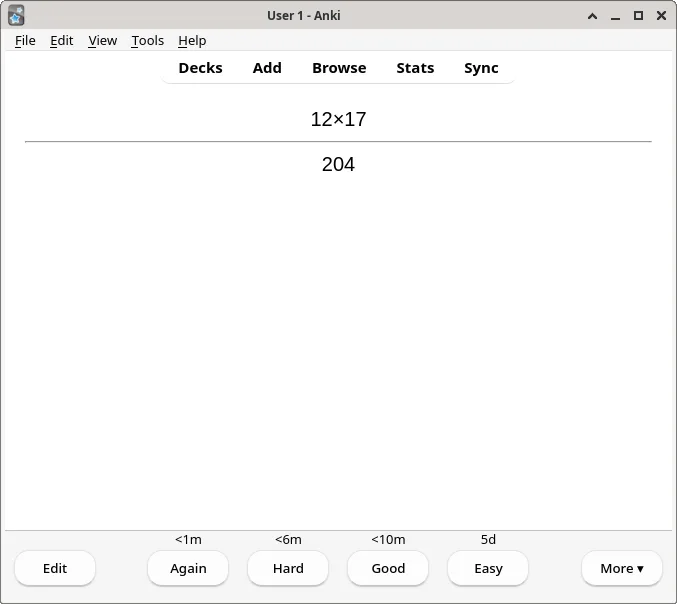
The four answer buttons in Anki --- Again, Hard, Good, Easy --- map to different interval multipliers. "Again" resets the card to relearning. "Hard" multiplies the current interval by 1.2. "Good" multiplies by the current ease factor. "Easy" multiplies by the ease factor times the easy bonus.
This system creates a self-adjusting learning experience. The daily review load stabilizes once the initial learning wave passes, typically requiring 20-40 minutes per day for a mature deck of 5,000-10,000 cards.
Optimal Spacing Intervals: What the Research Shows
The question of exactly how long to wait between reviews has generated substantial research, and the answer depends on the target retention interval --- how long you need to remember the material.
Nicholas Cepeda and colleagues conducted a landmark meta-analysis in 2006, analyzing 254 studies involving over 14,000 observations.[2] Their finding: the optimal spacing gap is approximately 10-20% of the desired retention interval.
Optimal Spacing Gaps by Retention Goal:
| Desired Retention Period | Optimal First Spacing Gap | Optimal Second Gap | Optimal Third Gap |
|---|---|---|---|
| 1 week | 1-2 days | 2-3 days | 3-4 days |
| 1 month | 3-5 days | 7-10 days | 14-20 days |
| 6 months | 2-3 weeks | 4-6 weeks | 8-12 weeks |
| 1 year | 3-5 weeks | 8-12 weeks | 16-24 weeks |
| 5 years | 2-3 months | 6-9 months | 12-18 months |
This "10-20% rule" provides a useful heuristic, but individual variation is substantial. Factors that affect optimal spacing include:
- Material complexity: Simple facts can tolerate longer gaps than complex procedural knowledge
- Prior knowledge: Experts in a domain retain new information in that domain longer
- Sleep quality: Memory consolidation during sleep affects how quickly stability increases
- Working memory capacity: Individuals with higher may benefit from slightly longer initial intervals, as their encoding tends to be deeper during the first exposure
- Encoding depth: Material learned through active recall, elaboration, or connection to existing knowledge decays more slowly
The Testing Effect: Why Retrieval Beats Re-Reading
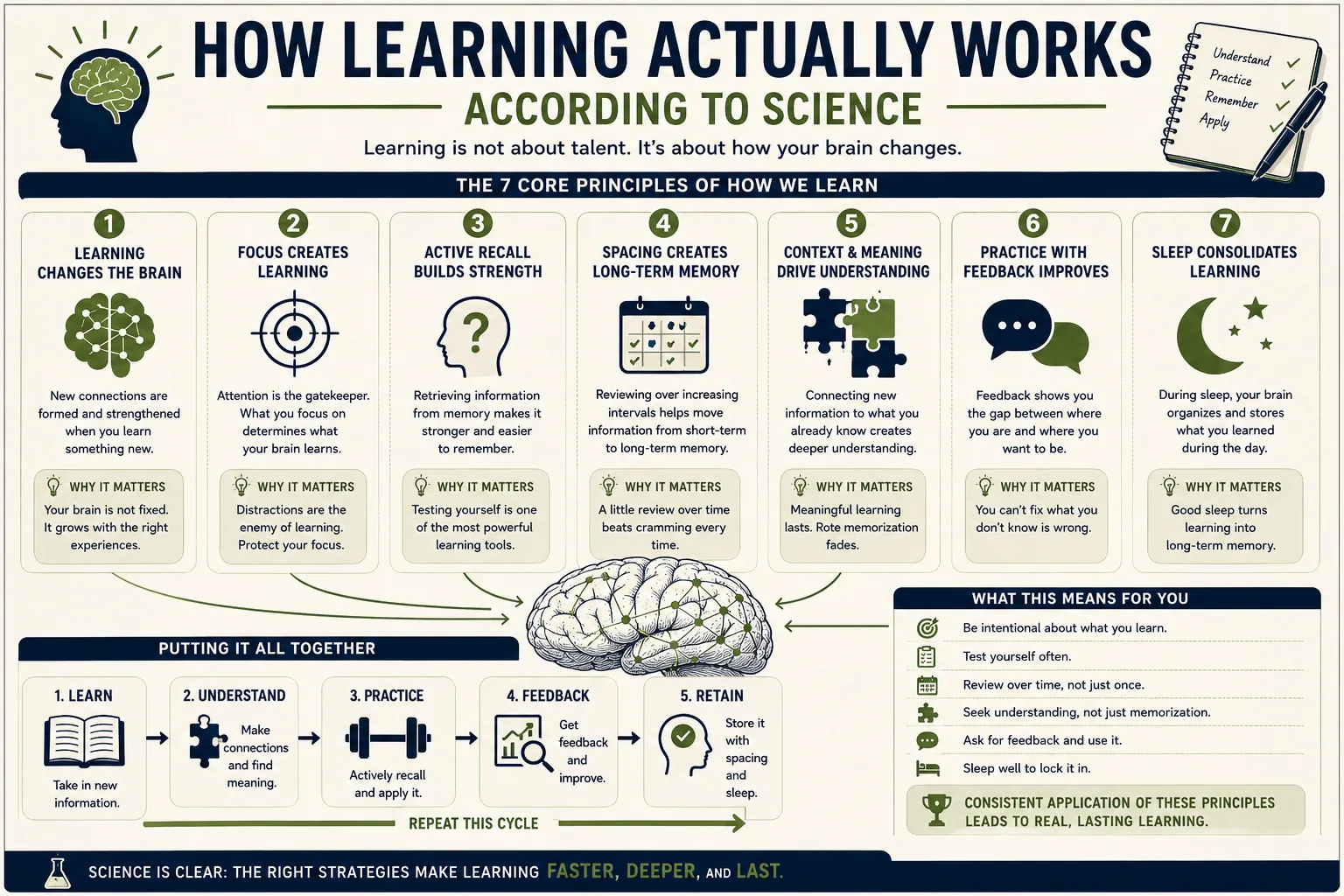
Spaced repetition is powerful partly because it forces active retrieval --- the act of pulling information from memory rather than passively re-reading it. This phenomenon, called the testing effect or retrieval practice effect, is itself one of the most robust findings in learning science.
Henry Roediger III and Jeffrey Karpicke demonstrated in a 2006 study that students who practiced retrieving information retained 80% after one week, compared to 36% for students who spent the same time re-reading the material.[3] The retrieval group studied less in terms of total exposure time but remembered more.
"Testing is not merely a way to assess knowledge; it is a powerful way to enhance it. Each act of retrieval modifies the memory trace, making it more accessible in the future." --- Henry L. Roediger III, Science (2006)
The mechanism appears to involve retrieval-induced strengthening --- the neural pathways activated during successful recall become more robust, more interconnected, and more resistant to interference from competing memories.
Failed retrieval attempts also have value, provided the correct answer is reviewed shortly after, a phenomenon known as the pretesting effect.
This is why flashcard-based spaced repetition systems work better than simply re-reading highlighted passages on a schedule. The act of looking at a prompt and generating an answer, even imperfectly, triggers deeper processing than recognition-based review ever can.
→Interleaving vs. Blocking: The Spacing of What You Study
Spacing addresses when to review. Interleaving addresses how to sequence different topics within a study session. Traditional study advice suggests "blocking" --- master Topic A before moving to Topic B. Research consistently shows the opposite approach works better for long-term learning.
In a 2015 study by Rohrer, Dedrick, and Stershic, students who interleaved math problems (mixing different problem types within a session) scored 72% on a delayed test, compared to 38% for students who practiced each type in blocks.[4] The interleaving group performed worse during practice but dramatically better on the test that mattered.
Why interleaving works:
- Forces discrimination between similar concepts (which formula applies here?)
- Prevents illusion of competence (blocked practice feels easy because you know what technique to apply)
- Strengthens retrieval cues by associating problems with their solution strategies rather than with their position in a sequence
- Mirrors real-world conditions, where problems arrive without labels
The combination of spaced repetition and interleaving is particularly potent. A well-designed Anki deck naturally interleaves topics, presenting a question about cellular biology followed by one about organic chemistry followed by one about pharmacology.
Each answer requires the learner to identify the relevant domain and retrieve the appropriate knowledge --- exactly the kind of processing that builds durable, flexible understanding.
Practical Implementation: Building a Spaced Repetition Habit
Theory without implementation produces nothing. The research is clear, but adoption requires specific practices.
Card design principles:
- Minimum information principle: Each card should test exactly one fact or concept
- Use cloze deletions for definitions and processes (e.g., "The {{c1::mitochondria}} is the powerhouse of the cell")
- Include context but not so much that the answer is obvious from the prompt
- Add images when spatial or visual information is relevant
- Avoid "orphan" cards that test information disconnected from your understanding
Daily workflow:
- Morning review (15-30 minutes): Clear due cards from the previous day's scheduling
- New card introduction (5-15 minutes): Add 10-20 new cards maximum per day
- Evening quick pass (optional, 5-10 minutes): Catch cards due later in the day
Common mistakes that undermine the system:
- Adding too many new cards per day (leads to unsustainable review loads within weeks)
- Making cards too complex (multi-part answers cause inconsistent grading)
- Pressing "Easy" too liberally (inflates intervals beyond actual retention capability)
- Skipping days (creates a backlog that discourages continuation)
- Using spaced repetition for material you do not yet understand (the system reinforces recall, not comprehension)
The Neuroscience: What Happens in the Brain During Spaced Learning
Long-term potentiation (LTP) --- the strengthening of synaptic connections through repeated activation --- follows spacing-dependent patterns. Neuroscience research using both animal models and human neuroimaging reveals why spaced practice produces stronger memories than massed practice.
When a memory is retrieved after a delay, the hippocampus reactivates the original encoding pattern and simultaneously strengthens connections to the neocortex, where long-term memories are ultimately stored.
This hippocampal-neocortical dialogue is more effective when there is a gap between learning episodes, because the initial memory trace has partially decayed, requiring more effortful reactivation.
Sleep plays a critical role. During slow-wave sleep, the hippocampus "replays" recently encoded memories, transferring them to neocortical storage. Spacing study sessions across multiple sleep cycles gives this consolidation process more opportunities to stabilize each memory.
Cramming before an exam deprives the brain of these consolidation cycles.
"Each time a memory is retrieved, it enters a labile state and must be reconsolidated. This reconsolidation process, when spaced optimally, progressively strengthens the memory trace and makes it more resistant to future interference." --- Karim Nader, Nature Reviews Neuroscience (2003)[5]
The molecular basis involves protein synthesis at the synapse. Massed repetitions trigger diminishing returns because the molecular machinery for strengthening synapses becomes saturated. Spacing allows time for new proteins to be synthesized, enabling each subsequent repetition to produce genuine structural change at the synapse.
Beyond Flashcards: Spaced Repetition in Professional and Academic Contexts
While Anki and flashcard systems dominate the popular understanding of spaced repetition, the principle applies far more broadly.
Medical education has embraced spaced repetition at an institutional level. Studies at the University of Queensland and Harvard Medical School found that students using SRS scored 11-15% higher on board examinations compared to matched controls using traditional study methods.
The effect was most pronounced for factual recall domains (anatomy, pharmacology, microbiology) and less dramatic but still significant for clinical reasoning.
Language acquisition is perhaps the most natural domain for spaced repetition. Vocabulary acquisition --- the mapping of sounds or written forms to meanings --- is fundamentally a paired-associate memory task, exactly the type of learning SRS was designed to optimize.
Research by Paul Nation suggests that encountering a word 10-12 times at increasing intervals is sufficient for most learners to acquire productive vocabulary knowledge.
Corporate training has been slower to adopt spaced repetition, but organizations implementing it report significant improvements.
A 2019 study in the Journal of Applied Psychology found that sales teams using spaced retrieval practice retained product knowledge 40% better than teams receiving traditional training, translating to measurable improvements in customer interaction quality.
For those applying spaced repetition to structured note-taking practices, the combination is synergistic: notes provide the raw material for card creation, while the review process identifies gaps in the original notes that need expansion.
Criticisms, Limitations, and Open Questions
Spaced repetition is not a universal solution. Several legitimate criticisms deserve attention.
It favors declarative over procedural knowledge. Remembering that "the capital of Mongolia is Ulaanbaatar" is different from being able to perform surgery or write code. Spaced repetition handles the former brilliantly and the latter poorly, unless the procedural knowledge can be decomposed into discrete, verifiable steps.
The "ease hell" problem in Anki. Cards that are repeatedly answered incorrectly have their ease factor permanently lowered, leading to unsustainably short intervals even after the learner has genuinely mastered the material. This is a flaw in SM-2's design that newer algorithms (SM-17, FSRS) attempt to address.
Motivation and engagement decay. Reviewing flashcards daily for months or years requires discipline that many learners cannot sustain. The gamification features in some apps (streaks, statistics, leaderboards) help but do not solve the fundamental challenge of maintaining a review habit over extended periods.
Context-dependent memory. Information learned through isolated flashcards may not transfer well to real-world contexts where multiple pieces of knowledge must be integrated simultaneously.
This limitation can be partially mitigated through carefully designed cards that test application rather than recall, but it remains a genuine constraint.
The FSRS Revolution: Modern Algorithms Surpassing SM-2
The Free Spaced Repetition Scheduler (FSRS), developed by Jarrett Ye and integrated into Anki 23.10, represents the most significant advancement in scheduling algorithms since SM-2.
FSRS uses a mathematical model of memory based on three parameters: stability (how long until the memory decays to 90% retention), difficulty (inherent learnability of the item), and retrievability (current probability of successful recall).
Early benchmarks suggest FSRS reduces total review workload by 20-30% compared to SM-2 while maintaining equivalent or higher retention rates.[8]
It achieves this by more accurately predicting when each individual card will reach the target retention threshold, eliminating both premature reviews (wasted effort) and delayed reviews (unnecessary forgetting).
Sources & Further Reading
Ebbinghaus, H. (1885). Uber das Gedachtnis: Untersuchungen zur experimentellen Psychologie. Duncker & Humblot. doi:10.1037/10011-000
Cepeda, N. J., Pashler, H., Vul, E., Wixted, J. T., & Rohrer, D. (2006). Distributed practice in verbal recall tasks: A review and quantitative synthesis. Psychological Bulletin, 132(3), 354-380. doi:10.1037/0033-2909.132.3.354
Roediger, H. L., & Karpicke, J. D. (2006). Test-enhanced learning: Taking memory tests improves long-term retention. Psychological Science, 17(3), 249-255. doi:10.1111/j.1467-9280.2006.01693.x
Rohrer, D., Dedrick, R. F., & Stershic, S. (2015). Interleaved practice improves mathematics learning. Journal of Educational Psychology, 107(3), 900-908. doi:10.1037/edu0000001
Nader, K. (2003). Memory traces unbound. Trends in Neurosciences, 26(2), 65-72. doi:10.1016/S0166-2236(02)00042-5
Dempster, F. N. (1988). The spacing effect: A case study in the failure to apply the results of psychological research. American Psychologist, 43(8), 627-634. doi:10.1037/0003-066X.43.8.627
Wozniak, P. A., & Gorzelanczyk, E. J. (1994). Optimization of repetition spacing in the practice of learning. Acta Neurobiologiae Experimentalis, 54(1), 59-62. doi:10.55782/ane-1994-1265
Ye, J. (2023). A stochastic shortest path algorithm for optimizing spaced repetition scheduling. Proceedings of the 29th ACM SIGKDD Conference on Knowledge Discovery and Data Mining, 1414-1424. doi:10.1145/3580305.3599922
This article is part of How Learning Works: A Research Guide to Learning Science - our complete guide to the evidence on how people actually learn.