
The belief that adults cannot learn new skills as effectively as children is one of the most consequential myths in education. It leads people to avoid learning opportunities, accept limitations prematurely, and attribute slow progress to age rather than method.
The reality, supported by decades of cognitive science research, is more nuanced and considerably more hopeful: adults retain significant capacity for learning and skill acquisition throughout their lives, but the methods that work best for adults are often different from the intuitive approaches most people use.
This guide explains what cognitive science and learning science research have established about how adults actually learn, which techniques produce strong long-term retention, and how to structure practice to move from novice to competent as efficiently as research suggests is possible.
Why Adult Learning Differs from Childhood Learning
The brain remains plastic, capable of forming new neural connections, throughout adult life. The concept of neuroplasticity, once thought to decline sharply after a critical developmental period, is now understood to be a lifelong capacity, though it does change in character.
The work of Michael Merzenich and colleagues at UCSF demonstrated through decades of neuroscience research that adult cortical maps reorganize in response to experience throughout the lifespan.
Merzenich's research on brain training and neuroplasticity, synthesized in his 2013 book Soft-Wired, showed that targeted practice can produce measurable changes in the organization of adult sensory and motor cortex.
These changes are not as rapid or as sweeping as the cortical reorganization that occurs during childhood developmental windows, but they are real and can be substantial.
What differs in adult learning is not the fundamental capacity for plasticity, but the conditions under which it operates.
Adults face different conditions for learning than children:
Prior knowledge cuts both ways. Adults have extensive existing knowledge frameworks that new information can be linked to, which accelerates acquisition of conceptual and procedural knowledge. But prior habits and mental models can also interfere with learning skills that require different approaches than what was effective before.
Motivation is typically more intentional. Adults choose to learn; children often do not. This means adult learning can be more strategically directed toward specific goals, but also that motivation must be maintained consciously rather than being enforced by institutional structures.
Time is constrained. Adults learning alongside work and family responsibilities have less total practice time than full-time students, making efficiency of learning methods more critical. Methods that produce the same learning in fewer hours are substantially more valuable for adults.
Fear of failure is higher. Children expect to be incompetent at new skills: that is their default state. Many adults have not been in a learning position for years or decades and find incompetence uncomfortable, which leads to avoiding the type of challenging practice that produces the fastest progress.
The Self-Directed Learning Advantage
Malcolm Knowles, whose theory of andragogy (adult learning) provided one of the earliest systematic frameworks for adult education, argued that adult learners differ from children primarily in their self-concept, their accumulated experience, their readiness to learn, and their orientation toward learning.
Adults are more motivated by problems they actually face than by abstract curricula, and they learn more effectively when they can draw on and contribute their existing experience.
Knowles's framework, while influential, has been critiqued for overstating the differences between adult and child learning: the underlying cognitive mechanisms are largely the same.
But his practical observation remains useful: adults who connect new learning explicitly to their existing goals, experience, and problems tend to persist longer and apply learning more effectively than those who approach new skills as abstract achievements.
The Learning Techniques That Science Actually Endorses
Cognitive psychology has studied learning and memory for over a century, and the research has identified a clear hierarchy of technique effectiveness. The techniques with the strongest research support are often not the most intuitively obvious or comfortable.
A landmark 2013 review by Dunlosky and colleagues, published in Psychological Science in the Public Interest, evaluated the scientific evidence for ten commonly used learning techniques. The review is the most comprehensive comparison of learning strategy effectiveness available. Their ratings:
| Technique | Evidence Rating | Why |
|---|---|---|
| Retrieval practice (testing) | High | Consistently large effects across populations and domains |
| Distributed practice (spacing) | High | Large, robust effects; well-replicated |
| Interleaved practice | Moderate | Good evidence; fewer studies in applied domains |
| Elaborative interrogation | Moderate | Useful for factual material; less evidence for complex skills |
| Self-explanation | Moderate | Improves when learners generate explanations |
| Highlighting/underlining | Low | Widely used; little evidence of benefit |
| Keyword mnemonics | Low | Narrow application; limited transfer |
| Imagery for text | Low | Mixed evidence; works for some material types |
| Re-reading | Low | Popular; consistently inferior to retrieval practice |
| Summarization | Low | Requires skill to be effective; untrained, minimal benefit |
The gap between what most learners do (re-read, highlight, summarize) and what the evidence supports (retrieval practice, spacing, interleaving) is one of the largest mismatches in applied cognitive psychology.
Retrieval Practice: Testing Beats Rereading
Retrieval practice (attempting to recall information from memory rather than passively re-exposing yourself to it) is consistently one of the most powerful learning techniques research has identified.
The mechanism is straightforward: when you try to retrieve something from memory and succeed, the neural pathway for that information is strengthened more than if you had simply read it again.
When you fail to retrieve it, the failure itself flags the information as something requiring additional study and primes the brain to encode it more strongly on the next encounter.
Research by Karpicke and Roediger (2008) demonstrated that students who studied a passage once and then took three retrieval tests retained 80% of the material a week later, versus 36% retention for students who studied the same passage four times without testing.
The single-exposure-plus-retrieval group performed more than twice as well despite spending the same or less time studying.
The effect generalizes beyond simple factual recall. Research by McDaniel and colleagues (2013) showed that retrieval practice benefits complex conceptual learning in real classroom settings, not just laboratory memorization tasks.
Students who answered inference questions about material (rather than re-reading) showed better conceptual understanding on delayed tests.
Practical retrieval practice techniques include:
- Flashcards (traditional or spaced repetition software like Anki)
- The blank page method: After studying, close all materials and write everything you can remember
- Self-quizzing before reviewing notes
- Teaching or explaining concepts to another person (forces retrieval)
- Practice problems rather than worked examples (for skills with well-defined solutions)
The uncomfortable truth is that retrieval practice feels less effective during the learning session than rereading or re-watching, because it requires effortful recall. This fluency illusion (feeling as if you know material better because it is familiar) is one reason many learners default to passive review despite its inferiority.
Familiarity with material is not the same as being able to retrieve it when needed, and only retrieval practice tests the distinction that matters.
Spaced Repetition: Timing Your Reviews
Spaced repetition exploits the psychological spacing effect: the well-replicated finding that distributing practice over time produces far stronger long-term memory than massing the same amount of practice into a single session (massed practice, or "cramming").
The optimal schedule spaces reviews at increasing intervals as material becomes more firmly encoded: review new information after one day, then three days, then a week, then two weeks, then a month. Material you are finding easier to recall is pushed to longer intervals; material that is difficult is reviewed more frequently.
Hermann Ebbinghaus first documented the spacing effect in 1885 through painstaking self-experimentation. More than a century of research has replicated and refined his findings. The effect size is large: spaced practice typically produces 150-300% better retention at equivalent study time compared to massed practice.
Spaced repetition software (SRS) like Anki automates interval scheduling. Users create flashcard decks; the system tracks performance on each card and schedules reviews using algorithms optimized for long-term retention.
SRS is particularly powerful for large vocabulary sets (foreign language words, medical terminology, legal concepts) and has been shown to enable medical students to retain far more pharmacology than conventional study methods.
A 2015 study by Kerfoot and colleagues followed medical students using spaced repetition software for pharmacology and found retention rates of over 90 percent at six-month follow-up, compared to approximately 40 percent for students using conventional study methods.
The difference was not in the content studied but entirely in the spacing and retrieval structure of the review.
The practical challenge of spaced repetition is that it requires planning ahead. Learners who study for a test next week cannot use spaced repetition effectively for that test: the intervals require that study begin weeks or months earlier.
This is one reason cramming persists despite its well-documented inferiority: it is the method that works when the study schedule was not planned in advance.
Interleaving: Mixing Practice Types
Interleaving mixes practice across different problem types, skills, or subjects within a single study session, rather than completing all practice of one type before moving to another (blocked practice).
Example: Learning to solve three types of math problems (A, B, C). Blocked practice: AAABBBCCC. Interleaved practice: ABCABCABC.
Interleaved practice consistently produces better test performance than blocked practice despite feeling more difficult and less productive during the learning session.
The mechanism appears to involve forcing the brain to actively select the appropriate strategy for each problem type, rather than relying on the primed momentum of the current block.
A study by Rohrer and Taylor (2007) found that interleaved practice produced test scores 43% higher than blocked practice on geometry problems one week after training.
The same pattern has been found in musical practice (mixing different pieces rather than drilling one to completion before starting another), sports training (mixing serve practice with rally practice), and language learning.
The challenge is that interleaved practice feels less efficient during the session because errors are more frequent. This creates the desirable difficulties paradox: the conditions that produce the strongest long-term learning are the ones that feel the most difficult and generate the most errors in the moment.
Robert Bjork at UCLA, who coined the term "desirable difficulties," has argued that the mismatch between what learners feel is working and what the evidence shows is working is one of the central problems in self-regulated learning.
Learners consistently prefer blocked practice, re-reading, and massed study because these techniques feel productive. They are not wrong that progress is happening: blocked practice and massed study do produce short-term performance improvements.
What they miss is that the short-term gains do not translate to long-term retention and transfer in the way that the harder, less comfortable techniques do.
Deliberate Practice: The Structure That Produces Expertise
The most influential framework for understanding how experts develop their skills comes from psychologist Anders Ericsson, whose decades of research on expert performers in chess, music, medicine, and sports produced the concept of deliberate practice.
Ericsson defined deliberate practice as:
- Designed to improve a specific aspect of performance identified as a weakness
- At or slightly beyond current ability level, not so easy that it becomes automatic, not so hard that progress is impossible
- With immediate feedback on errors, preferably from a teacher or coach
- Requiring focused, effortful attention (cannot be performed on autopilot)
Deliberate vs. Naive Practice
Most people, when practicing a skill, engage in naive practice: repeating things they already do reasonably well, staying within comfortable capability levels. A guitarist who repeatedly plays through songs they have learned, enjoying the music, is practicing naively.
A guitarist who isolates a difficult chord transition, plays it slowly enough to execute correctly, repeats it 50 times, gradually speeds up while maintaining precision, and seeks feedback on finger placement from a teacher is practicing deliberately.
Ericsson's research found that expert performance in chess, classical music performance, and sports correlated strongly with accumulated hours of deliberate practice, not total hours of practice. Ten thousand hours of naive practice produces a skilled amateur; ten thousand hours of deliberate practice produces an expert.
(The "10,000 hour rule" popularized by Malcolm Gladwell was an oversimplification of Ericsson's research and omitted the critical qualifier that the hours must be deliberate.)
"The most important thing in skill acquisition is to spend time at the edge of your ability. Not in your comfort zone, where you can do things you already know how to do. Not so far beyond your ability that progress feels impossible.
Right at the edge, where you fail enough to learn but succeed enough to persist.", paraphrased from Anders Ericsson's research on deliberate practice
Ericsson documented specific examples of deliberate practice in his research. In a study of violin students at the Berlin Academy of Music (Ericsson, Krampe, and Tesch-Romer, 1993), students were divided by their teachers into groups based on projected achievement.
The superior students averaged approximately 10,000 hours of deliberate practice by age 20, compared to roughly 4,000 hours for the least accomplished group.
Crucially, the groups did not differ significantly in total hours of music-related activity: they differed in how much of that activity was deliberate practice versus enjoyable playing.
The Role of Mental Representations
A key finding from Ericsson's research is that experts develop sophisticated mental representations of their domain, cognitive structures that allow them to perceive, organize, and respond to situations in ways that novices cannot.
A chess grandmaster sees patterns where a novice sees individual pieces. A skilled radiologist sees diagnostic features in an X-ray that a student cannot detect.
The goal of deliberate practice is building these mental representations. This is why feedback and working at the edge of current ability are essential: both force the development of more sophisticated representations rather than reinforcing existing ones.
Ericsson's research on chess masters, summarized in Peak: Secrets from the New Science of Expertise (2016), found that chess masters have committed approximately 50,000 to 100,000 chess positions and patterns to long-term memory, not through explicit memorization but through thousands of hours of exposure during deliberate practice.
When they face a new position, their vast library of stored patterns allows rapid recognition of relevant structure that novices cannot perceive.
This finding has important implications for learning. Building mental representations is not the same as memorizing facts. It happens through the process of deliberate practice itself: encountering variations, making decisions, receiving feedback, and refining the underlying pattern recognition that constitutes expertise.
Growth Mindset: The Research Behind the Concept
Carol Dweck's growth mindset research at Stanford introduced the distinction between:
- Fixed mindset: Belief that intelligence and talent are innate, fixed traits. Failure indicates lack of ability.
- Growth mindset: Belief that ability is developed through effort, strategy, and instruction. Failure indicates what needs more work.
Dweck's research found that these mindset differences (which are malleable, not fixed themselves) produce meaningful differences in learning behavior and outcomes.
Students with growth mindsets are more likely to take on challenging tasks, persist through failure, view criticism as useful feedback, and ultimately develop higher ability than those with fixed mindsets who protect self-image by avoiding challenges.
Importantly, Dweck has been explicit that growth mindset is not simply telling people to "believe you can do it." The research supports specific practices: praising effort and strategy rather than ability, framing challenges as learning opportunities rather than threats, and explicitly teaching that the brain develops through effortful learning.
However, subsequent attempts to replicate growth mindset interventions have produced mixed results. A large pre-registered replication by Sisk et al. (2018) found an overall effect near zero, with growth mindset interventions benefiting students at risk of academic failure but not general populations.
A 2019 large-scale study by Yeager and colleagues in Nature found significant but small effects of growth mindset interventions on academic outcomes, most pronounced in lower-income students with weaker academic records.
The nuanced conclusion from the replication literature is that growth mindset matters as an orientation to learning (it shapes whether you engage with challenge or avoid it) but that changing mindset through brief interventions is harder than early studies suggested, and that mindset is not a substitute for effective learning strategies.
The concept remains valuable as a framework for learning orientation, but should be paired with evidence-based learning techniques rather than treated as sufficient on its own.
Overcoming Plateaus: What to Do When Progress Stalls
Almost all skill acquisition follows an S-curve: rapid early progress as foundational elements are acquired, followed by a plateau where improvement becomes painfully slow despite continued practice. The plateau is not evidence of reaching your ceiling.
It is evidence that current practice methods have produced the skill gains they are capable of, and that different approaches are needed.
What Causes Plateaus
When practice becomes routine and comfortable, it stops challenging the adaptive mechanisms that produce improvement. Automaticity, the efficiency gain of performing familiar actions without conscious attention, is essential for skilled performance, but the process of automatization itself stops producing new capabilities.
Fitts and Posner's classic three-stage model of skill acquisition (1967) describes the transition from the cognitive stage (understanding what to do, high conscious attention, many errors) to the associative stage (practicing and refining, fewer errors, less cognitive demand) to the autonomous stage (performance largely automatic, little conscious attention required).
Plateau typically occurs at the transition to autonomy, when the skill has been automated at its current level but no mechanism is pushing development to the next level.
Breaking Through a Plateau
Increase the challenge gradient: Seek variations of the task that are just beyond current comfortable performance. A runner who has plateaued at 8-minute miles should not keep running at 8-minute miles: interval training, hill work, and tempo runs that require 7-minute-mile performance for short durations push adaptation.
Seek expert feedback: Plateaus often occur because practitioners cannot perceive their own errors. A tennis player who has developed a technically flawed serve may not be able to identify what is wrong.
An instructor who can observe from the outside and identify specific technical errors provides the information needed to target the right improvements.
Deliberately practice weaknesses: Naive practice gravitates toward strengths because strengths feel good to perform. Deliberate practice targets the specific weak points that limit overall performance.
Study expert models: Studying how skilled practitioners handle the situations where you struggle builds the mental representations needed for improvement. This means not just observing but actively analyzing: What is the expert noticing? What decisions are they making? How does their approach differ from yours?
Vary the practice context: Ericsson's research on transfer showed that skills practiced in a single context often fail to transfer to slightly different contexts. Varying practice conditions (different environments, different constraints, different problem formulations) builds the flexible knowledge structures that support transfer.
The Neuroscience of Skill Consolidation
Understanding what happens in the brain during skill learning provides useful guidance for structuring practice.
Motor skill learning has been particularly well studied at the neurological level. Initial learning of a motor sequence involves heavy engagement of the prefrontal cortex, the region associated with conscious attention and executive control.
As the skill becomes more practiced, control shifts toward the basal ganglia and cerebellum, which support automatic, proceduralized performance. This shift is what produces the fluency of expert performance and what explains why experts can perform their skills while simultaneously attending to other things.
Sleep plays a critical role in this consolidation process. Walker and Stickgold (2004) showed that a night of sleep after initial practice produced significantly better performance on a motor sequence task than equivalent time awake.
The improvement during sleep was comparable in magnitude to several additional practice sessions during waking hours.
The practical implication is direct: practicing a skill the evening before sleep may consolidate more effectively than equivalent practice spaced throughout the day.
Spaced practice benefits are partly explained by this consolidation mechanism. Each practice session deposits learning, sleep consolidates it, and the subsequent session builds on the consolidated foundation.
Massed practice provides the initial deposits but does not allow consolidation to occur between sessions: the learning is partially overwritten or interfered with before it can stabilize.
Learning Techniques: Evidence Summary
| Technique | Mechanism | Research Effect | Common Mistake |
|---|---|---|---|
| Retrieval practice | Strengthens memory trace through effortful recall | Very large: 80% vs 36% retention (Karpicke & Roediger, 2008) | Mistaking re-reading for effective review |
| Spaced repetition | Exploits spacing effect; reviews at optimal intervals | Large: 150-300% better retention than massed practice | Cramming everything the night before |
| Interleaving | Forces strategy selection; builds discrimination | 43% higher test scores vs blocked practice (Rohrer & Taylor, 2007) | Drilling one problem type to completion before moving on |
| Deliberate practice | Targets specific weaknesses at the edge of ability | Correlates strongly with expert performance across domains | Repeating what is already comfortable |
| Growth mindset | Shapes approach to difficulty and failure | Small to moderate; strongest for at-risk learners (Yeager et al., 2019) | Treating it as a substitute for technique |
| Sleep scheduling | Consolidates motor and declarative memories during sleep | Motor sequence improvement equivalent to several practice sessions | Studying late and reducing sleep |
The Role of Motivation and Habit
Research on learning consistently shows that technique superiority means nothing if the learner does not maintain practice. Long-term skill acquisition requires not just the right methods but the motivational and habitual structures that sustain them.
Self-determination theory (Deci and Ryan, 1985) identifies three psychological needs that support sustained motivation: autonomy (feeling that your learning is self-directed), competence (experiencing growth and mastery), and relatedness (connection to others who share the learning).
Adult skill learners who maintain practice over time tend to have structures that support all three: they chose the skill themselves, they can track their progress, and they have some community or accountability relationship around the learning.
Habit formation research by Wood and Neal (2007) found that behaviors performed in consistent contexts and linked to stable cues become automatic over time, reducing the motivational demand of executing them.
This principle applies directly to study habits: a learner who studies at the same time, in the same place, with the same opening routine will eventually find that the habit executes with minimal willpower expenditure, the cue-routine-reward loop has been established.
James Clear's popularization of habit science in Atomic Habits (2018) added practical implementation guidance: making practice behaviors obvious (environment design), attractive (linking to genuine interest), easy (reducing friction), and satisfying (immediate positive feedback).
These principles do not change what learning techniques work, but they affect whether those techniques get used consistently enough to produce results.
A Practical Framework for Skill Acquisition
Applying these principles to a new skill produces a structured approach:
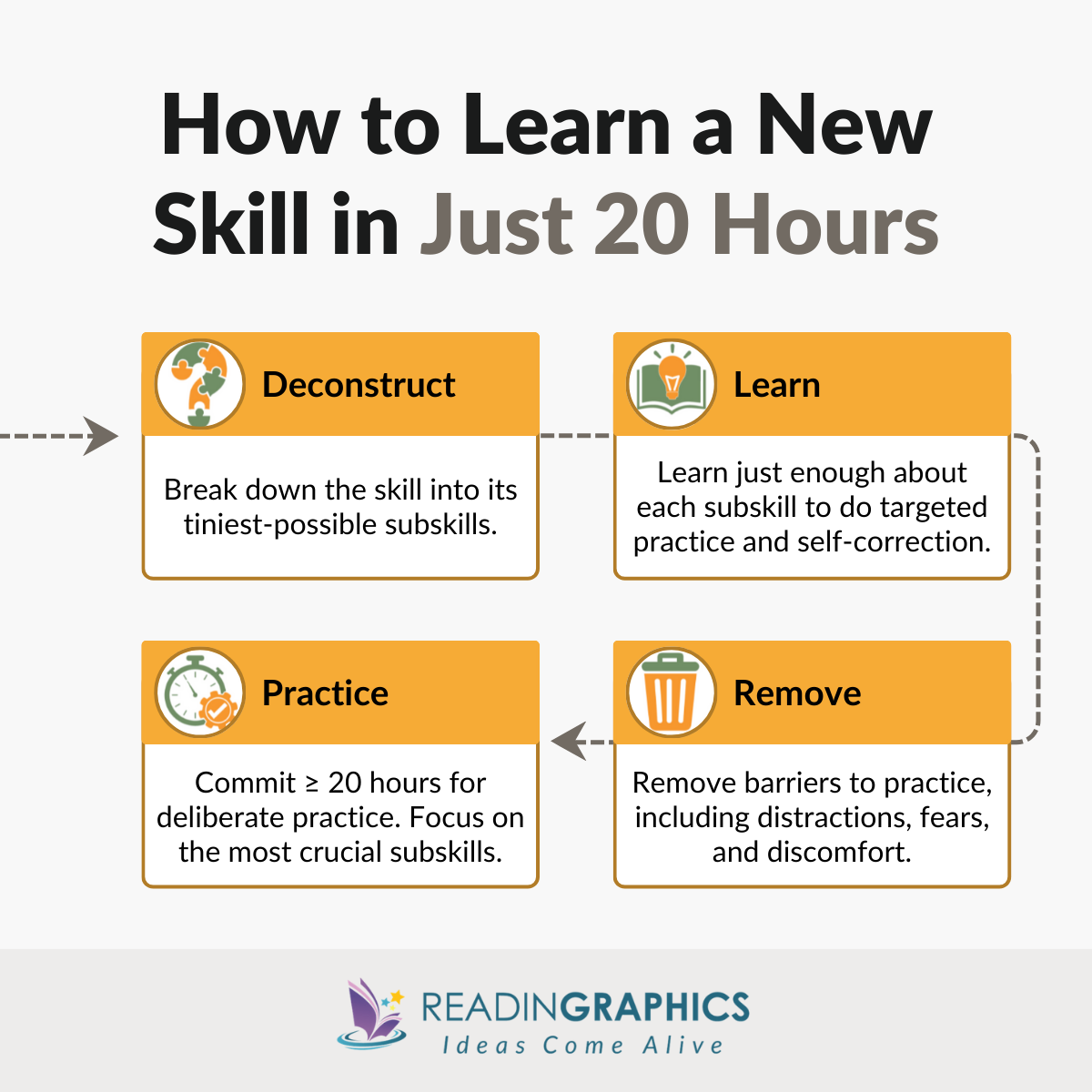
Week 1-2: Deconstruct the skill. Identify the component skills that make up the larger ability. A new programming language requires: syntax, standard library, debugging, design patterns, testing, each of which can be practiced somewhat independently.
Identify which components have the highest element interactivity (must be learned together) and which can be learned independently.
Weeks 2-8: Build foundations with retrieval practice. Study foundational material, then test yourself extensively rather than rereading. Use spaced repetition software for vocabulary, terminology, and syntax that must be memorized. Begin spacing your reviews immediately, do not wait until you feel you know the material.
Weeks 4 onwards: Mix deliberate practice and interleaving. Practice the hardest components, not the most comfortable. Mix different problem types in each session rather than drilling one type to completion. Seek feedback on your specific errors rather than your overall performance.
Throughout: Seek feedback and models. Find the gap between your current performance and expert performance. A teacher, coach, code review, or expert critique provides information about what to improve that self-assessment cannot. Study expert models actively: analyze what they are doing that you are not yet doing.
When plateau hits: Change methods, not effort. More time practicing the same way will not break a plateau. Identify what the next level of performance requires and design practice specifically around that requirement.
Sleep and consolidation: Structure demanding new learning for the evening when possible, and protect sleep in the consolidation period. Do not sacrifice sleep for additional study hours, the trade-off consistently works against learning.
Learning is genuinely hard. It involves sustained discomfort, frequent failure, and slow progress that requires patience to trust. The research does not make it easy, but it does reveal the specific methods that convert effort into lasting capability most efficiently.
The gap between how most people study and how the evidence suggests studying works is large enough that changing methods, not increasing hours, is often the highest-leverage improvement available.