
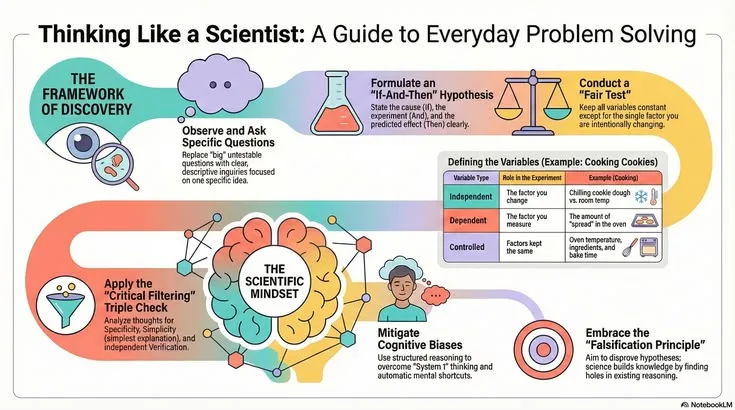
Scientists do not have a monopoly on accurate beliefs. But they do have something valuable: a set of habits, heuristics, and disciplines that have been developed and refined over centuries to help human minds, which are not naturally built for truth-seeking, overcome their own systematic errors.
Thinking like a scientist does not mean wearing a lab coat or running controlled experiments. It means applying specific intellectual tools to the questions you face every day: Is this treatment actually working? Is my strategy succeeding because of what I'm doing or despite it?
Am I updating my beliefs because the evidence warrants it, or because I want to be right?
These tools are learnable. They are not the exclusive property of academics. And using them consistently produces meaningfully better decisions, beliefs, and outcomes.
Why Our Natural Thinking Is Often Wrong
Before discussing the tools, it helps to understand why they are necessary. Human cognition evolved under conditions very different from the information environment we now live in. Our brains are remarkably good at pattern recognition, social inference, narrative construction, and fast heuristic judgment.
They are less good at reasoning about probability, separating correlation from causation, and updating beliefs proportionally to evidence.
The field of cognitive psychology, pioneered by Daniel Kahneman and Amos Tversky through a series of landmark experiments in the 1970s and 1980s, has documented these failures in meticulous detail.
Their work, summarized in Kahneman's Thinking, Fast and Slow (2011), shows that the same minds capable of extraordinary intellectual achievement are reliably deceived by systematic errors that run beneath conscious awareness.
Several cognitive tendencies work against accurate belief formation:
Confirmation bias: The tendency to seek out, notice, and remember evidence that confirms existing beliefs while downgrading or ignoring disconfirming evidence. This is arguably the most pervasive error in human reasoning.
Peter Wason's 2-4-6 rule-discovery experiment (1960) demonstrated that even when the task is purely logical, people test hypotheses by looking for confirming cases rather than falsifying ones, a pattern that Wason found extremely difficult to train people out of.
The availability heuristic: Judging the probability of events by how easily examples come to mind, rather than by actual frequency. Plane crashes feel more probable than they are because they receive intensive news coverage; car accidents feel less probable because they are so common they are barely newsworthy.
Kahneman and Tversky (1973) showed that this leads to systematic probability misjudgment across a wide range of everyday domains.
The narrative fallacy: The tendency to construct causal stories that explain outcomes, even when those outcomes were largely random. Nassim Taleb, who coined this phrase in The Black Swan (2007), argues that retrospective narratives about success and failure are almost always more deterministic than reality warranted.
A company succeeds; we construct a story about the wisdom of its leadership. A company fails; we find the strategic errors. The outcome-driven story is rarely the whole truth.
Motivated reasoning: Using reasoning to arrive at a conclusion that was emotionally or socially preferred in advance. The conclusion drives the process, not the evidence.
Dan Kahan's research at Yale on "identity-protective cognition" (2012) shows that when beliefs are tied to group identity, people with higher analytical intelligence are actually better at generating motivated arguments for pre-committed positions: they apply their intelligence in service of rationalization rather than truth-seeking.
Scientific thinking is largely a set of practices designed to counteract these tendencies.
Falsifiability: The First Tool
In 1934, Austrian philosopher Karl Popper published The Logic of Scientific Discovery, which introduced one of the most important ideas in the philosophy of science: falsifiability.
Popper observed that a theory is scientifically useful not when it can be confirmed but when it can be tested in a way that could, in principle, prove it wrong. A theory that can explain any possible observation is not a theory at all: it is a just-so story.
The classic contrast is between Einstein's theory of general relativity and Freudian psychoanalytic theory (in Popper's own example). Einstein's theory made specific, counterintuitive predictions about how gravity bends light, predictions that could be verified or falsified by observation.
Arthur Eddington's 1919 expedition to observe a solar eclipse produced measurements consistent with Einstein's prediction. The theory was confirmed, but crucially, it could have been disconfirmed.
Freudian theory, by contrast, seemed capable of explaining any human behavior in any direction: it predicted everything and therefore nothing.
The same logic applies to astrology, certain management theories, and some investment theses: if any outcome can be explained post-hoc by the theory, the theory provides no genuine predictive power.
Applying Falsifiability to Everyday Beliefs
The everyday version of Popper's criterion is a simple question: "What would it take to change my mind?"
If you believe a particular diet is responsible for your improved energy, ask: what result would convince me it isn't working? If the answer is "nothing could convince me, I know it works," the belief is unfalsifiable and you should hold it more loosely.
If you believe your company's new marketing strategy is driving growth, ask: what data pattern would tell me the strategy is failing? If you cannot answer, you are not evaluating the strategy: you are rationalizing it.
| Unfalsifiable belief | Falsifiable reformulation |
|---|---|
| "This supplement improves my energy" | "My energy levels are higher on days I take this supplement than on comparable days I don't" |
| "My leadership style is effective" | "My team's output and engagement metrics are higher under my leadership than under comparable leaders" |
| "The economy is getting worse" | "GDP growth, employment, and median income are declining compared to a defined baseline" |
| "My intuition about people is accurate" | "My predictions about people's behavior are correct more often than chance" |
| "This team dynamic is dysfunctional" | "Specific, measurable indicators (turnover, deadlines missed, reported conflict) exceed comparable teams" |
The reformulation does not always make the belief easier to test. But it makes clear what would count as evidence, and that clarity is itself valuable. An unfalsifiable belief is not necessarily false; it is simply outside the domain of empirical evaluation and should be recognized as such.
Null Hypothesis Thinking
Scientists typically begin an investigation with a null hypothesis: the assumption that there is no effect, no relationship, no difference. Evidence must be strong enough to overcome this default before concluding that something real is happening.
The logic is asymmetric: it is easier to generate false positive evidence (finding patterns that are actually noise) than to avoid it. By defaulting to skepticism and requiring a high evidentiary bar, null hypothesis thinking protects against the constant temptation to see effects everywhere.
Ronald Fisher formalized this approach in Statistical Methods for Research Workers (1925), establishing the framework that underlies virtually all quantitative research today.
The p-value (the probability of observing a result at least as extreme as what was found, assuming the null hypothesis is true) is the most widely used operationalization of null hypothesis testing.
In everyday life, the null hypothesis is a powerful tool for evaluating claims:
A new management technique claims to improve team productivity. Null hypothesis: it makes no difference. Evidence required: well-controlled comparison showing the technique produces better outcomes than no technique.
A doctor recommends a treatment for a condition. Null hypothesis: the treatment has no effect. Evidence required: randomized controlled trial showing significant improvement over placebo.
A financial advisor claims to beat the market consistently. Null hypothesis: their returns reflect luck and market conditions rather than skill. Evidence required: sustained outperformance over long periods that cannot be explained by risk level alone.
(Extensive research, including Malkiel's A Random Walk Down Wall Street and Fama and French's factor models, shows that this evidence rarely exists for active fund managers.)
The null hypothesis is not permanent skepticism: it is a starting point that evidence can move. The key discipline is requiring the evidence to actually move it before updating.
Updating Beliefs with Evidence: Bayesian Thinking
The scientific approach to belief is not binary: believing something or not believing it. It is probabilistic: assigning a degree of confidence to a belief, then revising that confidence as new evidence arrives.
Bayesian thinking formalizes this process. Named after the Reverend Thomas Bayes, whose posthumous 1763 paper established the mathematical foundation, Bayesian reasoning starts with a prior probability: an initial assessment of how likely something is before new evidence.
When new evidence arrives, they update to a posterior probability that incorporates both the prior and the likelihood of the evidence given the hypothesis.
The practical habit is simpler than the math: ask yourself, before evaluating new information, "how confident was I in this before?" Then ask "how likely is this evidence if my belief is true, versus if it's false?" A piece of evidence that is equally likely whether or not a theory is true should not move your confidence much.
Evidence that is much more likely if the theory is true than if it isn't should move your confidence significantly.
This asymmetry is crucial and frequently ignored. A positive mammogram result sounds alarming, but its diagnostic significance depends on the prior probability: how likely the patient was to have breast cancer before the test. In a 40-year-old woman with no risk factors, the base rate of breast cancer is roughly 0.1%.
A test with 90% sensitivity and 91% specificity produces a positive result that is still only about 1% likely to represent true cancer (Bayes' theorem applied). Understanding this does not mean ignoring the test; it means interpreting it correctly.
"The mark of a genuinely rational person is the ability to update their beliefs smoothly and proportionally when new evidence arrives, not stubbornly resisting change, and not swinging wildly with every new data point." Common paraphrase of Bayesian updating principles
Avoiding Both Anchoring and Overreaction
Two failure modes work in opposite directions. Anchoring (holding too firmly to your prior even when evidence strongly suggests revision) produces the confident expert who can't acknowledge being wrong.
Kahneman and Tversky documented anchoring extensively in the 1970s, showing that even arbitrary numbers (like the outcome of a roulette spin) influenced subsequent numerical estimates.
Overreaction (updating too dramatically on each new piece of information) produces the opinion-changer who lacks stable, considered views.
Financial markets exhibit this pattern: investors systematically overreact to recent news, producing predictable reversals in asset prices that researchers including DeBondt and Thaler (1985) documented in the Journal of Finance.
Good epistemic practice involves calibrated updating: moving proportionally to the strength of the evidence, accounting for the reliability of the source, and asking how the new evidence changes the probability landscape.
Philip Tetlock's multi-decade research on forecasting, reported in Superforecasting (2015), found that the best forecasters update frequently in small increments rather than rarely in large ones: they are neither stubbornly anchored nor reflexively responsive.
Base Rates: The Prior You're Probably Ignoring
In 1973, psychologists Daniel Kahneman and Amos Tversky described a phenomenon they called base rate neglect: the systematic tendency for people to ignore background frequency information when evaluating specific cases.
The original paper, published in Psychological Review, became one of the most-cited papers in the history of social science.
Their classic example involved a brief personality sketch of a fictitious man named Tom. The description emphasized characteristics stereotypically associated with engineers.
When participants were asked to estimate the probability that Tom was an engineer, they gave high estimates, regardless of whether they were told that Tom was drawn from a population of 70 percent engineers and 30 percent lawyers, or from a population of 30 percent engineers and 70 lawyers.
The specific description dominated the statistical background.
Base Rates in Practice
Medical diagnosis: A test for a rare disease that is 99 percent accurate sounds impressive. But if the disease affects 1 in 10,000 people, a positive test result is still more likely to be a false positive than a true positive. The base rate (how common the condition is in people with your characteristics) must enter the calculation.
This insight, formalized by Eddy (1982) in research on physician decision-making, found that a majority of physicians substantially overestimated the probability of disease given a positive test, systematically failing to incorporate the base rate.
Business success: Entrepreneurs routinely overestimate their chances of success because they focus on the features of their specific business rather than the base rate of small business success.
According to Bureau of Labor Statistics data, approximately 20% of new businesses fail in their first year; around 45% fail within five years; and roughly 65% fail within ten.
The entrepreneurs who succeed are disproportionately visible and vocal, creating a misleading impression that success is the norm.
Project timelines: The planning fallacy (identified by Kahneman and Tversky, 1979) describes the near-universal tendency to underestimate how long projects will take and how much they will cost.
The solution is to consult the outside view: how long do projects of this type actually take, as opposed to how long does this specific project feel like it should take?
Bent Flyvbjerg's research (2003) on large infrastructure projects found that nine out of ten exceeded their initial cost estimates, and that the average cost overrun was 45%.
The habit of asking "what is the base rate for this kind of thing?" before reasoning about the specific case is one of the highest-value applications of scientific thinking outside the laboratory. It is not a counsel of pessimism; it is a corrective to the systematic overconfidence that produces most planning failures.
Distinguishing Correlation from Causation
"Correlation does not imply causation" is perhaps the most-repeated principle of scientific reasoning, and also the most frequently violated in practice. Understanding why the violation is so common helps build resistance to it.
When two variables move together (crime rates and ice cream sales, shoe size and reading ability, Nicholas Cage film releases and swimming pool drownings, a real correlation documented by Tyler Vigen's Spurious Correlations project), our narrative-constructing minds immediately seek a causal story.
The story feels explanatory even when the correlation is entirely spurious.
The Four Possibilities
When variables A and B are correlated, the possibilities are:
- A causes B: the obvious interpretation
- B causes A: reverse causation
- C causes both A and B: confounding variable
- The correlation is coincidental: sampling variation, multiple testing, or genuinely random co-occurrence
Reverse causation is common in social science. Does success cause confidence, or does confidence cause success? Does economic development cause democracy, or does democracy cause economic development? Does exercise cause better mental health, or do people with better mental health exercise more?
The correlations exist; the causal direction is not obvious and frequently runs in unexpected ways.
Confounding is the most common source of misleading correlations. Countries with high chocolate consumption win more Nobel Prizes (a real published correlation). The confounding variable is GDP: richer countries eat more chocolate and also invest more in research and education.
Controlling for national wealth eliminates the relationship. The cholesterol-heart disease debate spent decades being confused by confounders before carefully designed longitudinal studies established the causal pathway more rigorously.
The randomized controlled trial (RCT) is the scientific tool designed to isolate causation. By randomly assigning participants to treatment and control groups, it eliminates confounding.
When an RCT is not possible, as in most economic, social, and historical questions, researchers use quasi-experimental methods that approximate random assignment: natural experiments, regression discontinuity designs, and instrumental variable approaches.
In everyday thinking, the question to ask before accepting a causal claim is: "what alternative explanations could produce this correlation?"
The Multiple Testing Problem
A less well-known but increasingly important failure mode is the multiple testing problem (also called the multiple comparisons problem). If you test 20 independent hypotheses at a 5% significance threshold, you expect to get at least one false positive result purely by chance, even if none of the hypotheses are true.
In an era of large datasets and computational power, researchers can test thousands of hypotheses simultaneously, producing an epidemic of reported findings that do not replicate.
John Ioannidis's 2005 paper "Why Most Published Research Findings Are False" (published in PLOS Medicine and among the most-downloaded medical papers ever published) argued that in many research fields, a majority of published findings are likely to be false positives, largely due to this combination of small samples, high noise, and undisclosed multiple testing.
This does not mean science is unreliable; it means that any single study, even a published, peer-reviewed one, is much weaker evidence than it appears.
Pre-Mortems: Prospective Failure Analysis
Most planning processes focus on reasons for success. The pre-mortem, developed by cognitive psychologist Gary Klein, deliberately inverts this.
Before a decision is implemented, participants are asked to imagine that the project has been carried out and has failed. They then work backward to identify what went wrong.
Klein's research, reported in Sources of Power (1998), found that this prospective framing (imagining failure as already accomplished) makes it psychologically easier to raise concerns that might otherwise be suppressed by groupthink, optimism, or social pressure to support the group's plan.
The technique exploits prospective hindsight: the cognitive phenomenon that imagining an event as having occurred increases our ability to identify reasons for it. Deborah Mitchell, J.
Edward Russo, and Nancy Pennington (1989) found in experimental research that prospective hindsight improves the ability to identify reasons for outcomes by approximately 30%.
A standard pre-mortem involves three steps:
- The team is told: "Imagine it is twelve months from now. We implemented this plan, and it failed completely. What happened?"
- Each person writes down, independently, the most plausible reasons for the failure
- The group discusses and consolidates the failure scenarios, then uses them to stress-test the plan
Klein reported that pre-mortems can increase the identification of potential failure modes by approximately 30 percent compared to conventional risk discussions.
The technique is widely used in medicine, military planning, and product development, and has been adopted by organizations ranging from the U.S. Army to Google's project planning teams.
Designing Personal Experiments
Scientists do not just observe the world: they intervene in controlled ways to test specific hypotheses. This approach can be adapted to personal and professional life.
The self-experimentation tradition has a long and intellectually serious history.
Seth Roberts, a psychologist who tracked his sleep, mood, and cognitive performance over years and published his findings in peer-reviewed journals, demonstrated that disciplined self-experimentation could produce genuine insights about individual responses to interventions that population-level studies might miss.
Eric Topol's advocacy for "n-of-1 trials" in precision medicine (reported in The Patient Will See You Now, 2015) argues that personalized, self-directed health experimentation is increasingly viable and valuable.
Track metrics before and after changes: If you change your sleep schedule, diet, exercise routine, or work process, measure a relevant outcome variable before and after the change. Don't just remember whether you "feel better," measure.
Memory of pre-intervention states is systematically distorted toward whatever narrative you are constructing about the intervention's effects.
Change one variable at a time: When multiple things change simultaneously, attributing outcomes to specific causes is impossible. The scientific discipline of changing one thing at a time while holding others constant is directly applicable to personal experiments.
The frustration of slow, sequential testing is precisely what separates disciplined self-experimentation from anecdotal self-improvement.
Build in a waiting period: Many interventions produce short-term effects from novelty and attention (the Hawthorne effect, documented by Elton Mayo in his studies at the Western Electric Hawthorne Works in the 1920s-30s) that do not persist. Wait long enough to observe whether effects last beyond the initial novelty period.
Keep a decision journal: Record the reasoning behind significant decisions, including predictions about outcomes. Review these periodically. This is the personal equivalent of a pre-registered study: it prevents retroactive reconstruction of the reasons you decided what you decided.
Tetlock's research found that even experts dramatically revise their memories of what they predicted before an outcome, making a contemporaneous record the only reliable protection against this distortion.
The Replication Crisis and What It Tells Us About Evidence
One of the most important developments in scientific methodology in the last fifteen years is the replication crisis: the widespread discovery that many published scientific findings, particularly in psychology and nutrition research, fail to replicate when tested by independent researchers.
The Open Science Collaboration's 2015 effort to replicate 100 psychology studies (published in Science) found that only 36-39% of the original findings were replicated at a similar magnitude and significance level.
Nosek et al.'s analysis represented a serious empirical challenge to the assumption that peer-reviewed publication reliably signals true findings.
For everyday scientific thinking, the replication crisis has several practical implications:
- A single study is weak evidence. Replication by independent teams in different populations is the standard that separates robust findings from artifacts.
- Effect sizes matter more than p-values. A statistically significant result with a tiny effect size may be real but practically meaningless.
- Pre-registration strengthens evidence. Studies where researchers specify their hypotheses and analysis plans before collecting data are substantially more reliable than those where analyses are adjusted after seeing results (a practice called "p-hacking").
- Meta-analyses, when well-conducted, are more informative than individual studies but are only as good as the underlying data quality.
This does not mean scientific evidence is unreliable or that empirical inquiry should be abandoned in favor of intuition. It means that scientific thinking requires calibrating confidence to the cumulative evidence base, not to any single study, however well-publicized.
Intellectual Humility: The Foundation
All of the specific tools described above rest on a deeper disposition: intellectual humility, the recognition that your current beliefs are probably wrong about many things, that you have systematic biases you cannot fully see, and that revising your views in response to evidence is a sign of strength, not weakness.
Research by Peter Ditto and colleagues (2019), published in Perspectives on Psychological Science, found that motivated reasoning is pervasive across the political spectrum: people on all sides process evidence about their preferred positions less critically than evidence against them, and the effect is remarkably consistent across ideological positions.
The implication is not that some people reason well and others do not, but that everyone is subject to these tendencies and the differentiation comes from whether one actively monitors and corrects for them.
Scientists live with uncertainty as a professional norm. The phrase "the evidence suggests" rather than "we know" is not hedging: it is an accurate description of the epistemic status of scientific claims, which are always provisional and revisable.
Richard Feynman captured this norm memorably: "I think it is much more interesting to live not knowing than to have answers that might be wrong."
The Disposition vs. the Skills
A critical distinction in developing scientific thinking is between skills (the cognitive tools described in this article) and dispositions (the motivation to actually apply them honestly). Many people learn about confirmation bias and then use their knowledge of it to accuse others of it while remaining blind to their own.
The disposition toward intellectual humility requires what psychologist Jonathan Haidt calls "epistemic cowardice" avoidance: the willingness to accept uncomfortable conclusions rather than retreating to vague, non-committal positions that preserve social peace at the cost of honest inquiry.
It requires genuine curiosity about being wrong, not just the performance of open-mindedness.
Bringing this norm into everyday thinking does not mean chronic uncertainty about everything.
It means holding strong beliefs proportionally to evidence, remaining genuinely open to revision when that evidence changes, and being suspicious of yourself when you find that evidence for your preferred conclusions always seems more reliable than evidence against them.
That suspicion, more than any specific technique, is the essence of scientific thinking applied to life.
A Practical Protocol for Scientific Thinking in Daily Life
Drawing together the tools above, the following protocol can be applied to any significant belief or decision:
- State the claim clearly and falsifiably: What would count as evidence against it?
- Establish the null hypothesis: What would we expect to see if there were no effect?
- Check the base rate: What is the background frequency of this type of outcome?
- Identify alternative explanations: If this correlation is real, what other causal pathways besides the obvious one could produce it?
- Assess your prior: How confident were you before this evidence arrived? Update proportionally to the strength and reliability of new evidence.
- Run the pre-mortem: If you act on this belief and it turns out to be wrong, what will most likely have gone wrong?
- Track and review: Record your prediction, act, and revisit the record when outcomes are known.
No one applies this protocol to every decision. But applying it to the decisions that matter most (medical choices, major investments, strategic pivots, significant relationship decisions) produces meaningfully better outcomes than the default mode of narrative construction and motivated reasoning that most people use most of the time.