
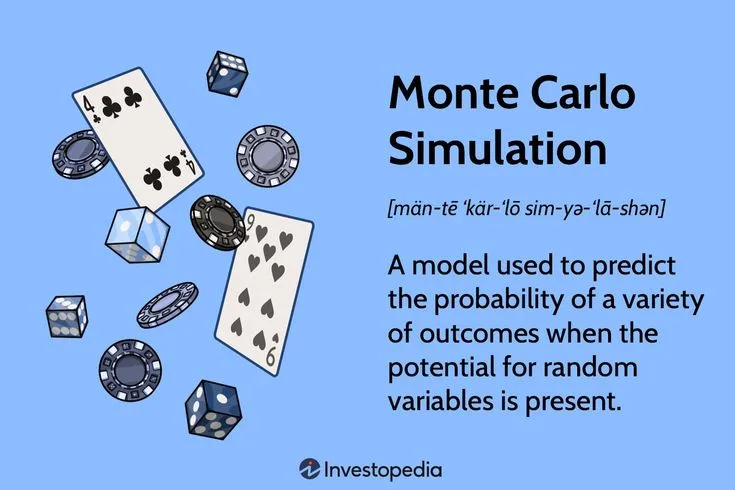
The monte carlo method estimates a complex system by running a model many times with randomly sampled inputs and examining the resulting distribution of outputs. It is useful when direct calculation is impractical and uncertainty must be propagated through a model. More repetitions improve precision, though the rate of improvement follows the square root of the number of samples.
In the spring of 1946, Stanislaw Ulam was recovering from a brain illness at his home in Los Alamos, New Mexico, playing game after game of solitaire to pass the time. Ulam began wondering: what are the actual odds of a successful game of Canfield solitaire?
The problem was not particularly important, but it was genuinely difficult. Canfield solitaire has so many possible card arrangements and decision branches that computing the exact probability analytically, working through all possibilities with algebra and combinatorics, would be extraordinarily time-consuming.
Ulam's insight was that there was another way to find the answer: simply play the game many times and observe what fraction of games could be won. If you played 1,000 games and 212 succeeded, you had a reasonable estimate that the probability of success was around 21.2%.
You would not need to enumerate every possible game state. You would let randomness do the sampling for you.
This observation, seemingly trivial in the context of card games, turned out to have profound implications. Ulam was working on the design of thermonuclear weapons as part of the Manhattan Project.
Some of the most important calculations involved neutrons passing through fissile material: problems with so many interacting variables and so much randomness embedded in quantum mechanics that direct analytical solutions were practically impossible.
Ulam realized the same logic applied: instead of solving these systems algebraically, you could simulate the behavior of individual particles with randomly sampled trajectories, run thousands of simulations, and observe the aggregate distribution of outcomes.
Ulam shared the idea with his colleague John von Neumann, who immediately recognized its power and the new generation of computers available at Los Alamos to execute it.
Together with Nicholas Metropolis, they formalized the technique and gave it a name: Monte Carlo, after the famous casino in Monaco, chosen by Metropolis as a coded reference to Ulam's gambling-inspired insight, and because the randomness of roulette wheels and dice perfectly captured the spirit of the method.
"The first thoughts and attempts I made to practice [the Monte Carlo method] were suggested by a question which occurred to me in 1946 as I was convalescing from an illness and playing solitaire." (Stanislaw Ulam)
What the Monte Carlo Method Is
The Monte Carlo method is a broad class of computational algorithms that use repeated random sampling to obtain numerical results.
The underlying idea is elegant: when a system is too complex to analyze directly, you simulate it many times with randomly varying inputs, observe the distribution of outputs, and use that distribution as your estimate of the system's behavior.
It is a technique of learning through simulation rather than calculation.
The key components of any Monte Carlo simulation are:
- A model of the system you want to understand, defining the relationships between inputs and outputs
- Probability distributions for each uncertain input, specifying the range and likelihood of different values
- A random sampling mechanism that draws input values according to their distributions
- Many repetitions (typically thousands to millions) of running the model with sampled inputs
- An output distribution that aggregates all the results, from which you read probabilities, averages, and percentiles
The method belongs to a broader class of techniques called stochastic simulation: simulation that incorporates randomness as a fundamental feature rather than a nuisance to be eliminated. This distinguishes Monte Carlo from deterministic simulation, which runs the same model with the same inputs every time and produces the same output.
How the Simulation Works: A Simple Example
Consider estimating the area of an irregular shape inside a square. Analytically, you would need a formula describing the shape's boundary, which might not exist in closed form. The Monte Carlo approach is different.
Step 1: Draw a bounding square around the shape.
Step 2: Randomly place thousands of dots inside the square, each at a randomly chosen position.
Step 3: For each dot, determine whether it falls inside or outside the irregular shape.
Step 4: The fraction of dots inside the shape, multiplied by the area of the square, approximates the area of the shape.
With 1,000 randomly placed dots, you will get a rough approximation. With 100,000 dots, the estimate becomes quite accurate. The precision improves proportionally to the square root of the number of samples, a mathematical property that defines both the method's power and its limitation.
This example illustrates the core principle: you use randomness to probe a system, and the aggregate behavior of many random samples tells you something about the underlying structure.
Researchers at the Sandia National Laboratories (Helton and Davis, 2003) have described this sampling approach as the most general-purpose method available for propagating uncertainty through complex computational models, precisely because it makes no assumptions about the mathematical form of the model itself.
Origins: The Manhattan Project and the Birth of Simulation
The Manhattan Project in the 1940s presented computational challenges of a different order than physicists had previously encountered.
Designing a nuclear weapon required understanding how neutrons would travel through layers of different materials: how many would be absorbed, how many would cause fission, and what the chain reaction dynamics would be.
The mathematics of these problems involved thousands of interacting probabilistic processes. Exact solutions were either impossible or would take years to compute by hand.
Von Neumann and Ulam's insight was that this was precisely the kind of problem that Monte Carlo simulation could address.
Using the ENIAC computer (one of the first electronic computers, itself built partly for weapons calculations), they ran simulations of neutron transport through fissile material that would have been completely intractable with pen and paper.
The first classified Monte Carlo computation was performed in 1948, and within a few years the method had become central to weapons design, reactor physics, and eventually a vast range of scientific and engineering problems.
The publication that introduced the method to the broader scientific community was a 1949 paper by Metropolis and Ulam in the Journal of the American Statistical Association, titled simply "The Monte Carlo Method." That paper remains a landmark in computational science: it described a technique so general and so powerful that it has since found application in virtually every quantitative field.
| Era | Primary Applications | Typical Number of Simulations |
|---|---|---|
| 1940s-1950s | Nuclear weapons design, reactor physics | Thousands (limited by computing) |
| 1960s-1970s | Molecular dynamics, particle physics | Tens of thousands |
| 1980s-1990s | Financial modeling, operations research | Hundreds of thousands |
| 2000s-present | Business risk, climate modeling, AI training | Millions to billions |
Why Single-Point Estimates Are Dangerous
Before Monte Carlo simulation became widely accessible, business and engineering decisions routinely relied on single-point estimates: a project will take 18 months, a new product will capture 8% market share, a portfolio will return 7% annually.
These estimates feel precise, but they are not: they are educated guesses that discard all information about uncertainty.
Single-point estimates create three specific problems:
They hide the range of outcomes. An estimate of "18 months" says nothing about whether 12 months is possible or 36 months is possible. The distribution of realistic scenarios is invisible.
They disguise systematic biases. The planning fallacy (the well-documented tendency to underestimate how long tasks take and overestimate how well things will go) operates invisibly inside single-point estimates.
Kahneman and Tversky (1979) identified this bias in their foundational work on prospect theory, and Bent Flyvbjerg's extensive analysis of infrastructure projects (2003, Megaprojects and Risk) found that 90% of large projects exceeded their initial cost estimates, with average overruns of 45% for rail projects and 20% for roads.
Optimism is baked into single-point estimates with no mechanism to surface it.
They produce false confidence. Decision-makers who receive a single number tend to treat it as more certain than it is. A Monte Carlo output that shows a 35% probability of finishing within 18 months and a 10% probability of exceeding 30 months conveys genuinely different information and produces more realistic planning.
"It is better to be roughly right than precisely wrong." (Carveth Read) This principle captures exactly why probabilistic estimates surpass false single-point precision.
The shift from single-point estimates to probability distributions as the primary unit of business analysis is one of the most significant practical benefits of Monte Carlo thinking, even for organizations that never run a formal simulation.
Business Applications
Financial Modeling and Investment Risk
Investment banks and asset managers use Monte Carlo simulation to model portfolio behavior under uncertainty. Rather than assuming a fixed 7% annual return, a Monte Carlo model might specify that annual returns are drawn from a normal distribution with a mean of 7% and standard deviation of 15%, reflecting historical volatility.
After simulating 10,000 years of investment returns, you can see what fraction of scenarios end in ruin, what fraction meet retirement goals, and what the distribution of outcomes looks like at different time horizons.
This approach underpins value-at-risk (VaR) calculations that financial institutions use to estimate potential losses, and it is central to options pricing models across derivatives markets. J.P.
Morgan's introduction of VaR as a risk management standard in the early 1990s, described in the RiskMetrics Technical Document (1994), brought Monte Carlo simulation into mainstream institutional finance.
Today, virtually every major financial institution maintains Monte Carlo infrastructure as a core risk management tool.
A 2015 study by Pfau and Kitces published in the Journal of Financial Planning found that Monte Carlo retirement planning methods, when properly calibrated, significantly outperformed deterministic rate-of-return methods in accounting for sequence-of-returns risk: the danger that poor early returns can permanently impair a retirement portfolio even if average returns are adequate over time.
Project Management
In project management, Monte Carlo simulation is applied to schedule risk analysis. Each task is assigned a probability distribution for its duration: perhaps a minimum of 2 days, a most likely value of 5 days, and a maximum of 12 days, following a PERT distribution (Program Evaluation and Review Technique).
When tasks are simulated in combination, accounting for dependencies between them, the overall project completion distribution emerges.
This matters because the critical path method in traditional project management computes schedule by adding up most-likely estimates, which systematically underestimates project duration.
Tasks on parallel paths can each run slightly over estimate and still push the project over deadline through what statisticians call merge bias: the critical path method does not account for the probability that any one of several parallel paths becomes delayed.
Monte Carlo captures this interaction naturally.
Studies of large infrastructure projects consistently find that final costs and durations exceed initial estimates by 40-80% on average (Flyvbjerg, Bruzelius, and Rothengatter, 2003), suggesting that the adoption of probabilistic project planning methods has significant practical value.
The Project Management Institute now recommends Monte Carlo schedule analysis in its PMBOK Guide as a best practice for complex programs.
Product Development and R&D
Pharmaceutical companies use Monte Carlo simulation to model the probability that a drug will advance through clinical trials and receive approval, the likely costs at each phase, and the expected revenue if approved.
DiMasi, Hansen, and Grabowski (2003), writing in the Journal of Health Economics, estimated the average cost of developing a new drug at $802 million (in 2000 dollars), with an enormous range driven by the varying probability of clinical success.
Monte Carlo models allow pharma companies to allocate R&D spending across a portfolio of candidates based on the expected value of information, recognizing that each compound has a distribution of possible outcomes rather than a single predicted one.
The same logic applies in technology product development. Teams at Google, Amazon, and Microsoft routinely use Monte Carlo methods in A/B test planning, capacity planning, and feature valuation, estimating not just whether a feature will have a positive effect but the distribution of how large that effect might be.
Supply Chain and Operations
Supply chain risk modeling represents one of the fastest-growing applications of Monte Carlo methods in business.
McKinsey & Company research (2020) found that supply chain disruptions lasting one month or more occur every 3.7 years on average for major industries, and the financial impact of these disruptions can be severe: the semiconductor shortage of 2021 alone cost the automotive industry an estimated $210 billion in lost revenue according to AlixPartners.
Monte Carlo simulation of supply chains allows planners to model demand variability, supplier reliability, transportation delays, and inventory policy simultaneously, producing a distribution of outcomes that informs safety stock decisions, supplier diversification strategies, and contingency planning.
Climate and Environmental Modeling
Climate scientists use Monte Carlo methods to propagate uncertainty through complex climate models, producing the probability ranges commonly seen in IPCC reports.
The IPCC Sixth Assessment Report (2021) presents temperature projections as likely ranges (for example, global mean surface temperature is projected to increase by 2.1 to 3.5 degrees Celsius under intermediate emissions scenarios), and these ranges reflect Monte Carlo propagation of uncertainty across thousands of model parameters and scenario assumptions.
The Mathematics: How Accurate Are Monte Carlo Estimates?
The accuracy of a Monte Carlo estimate improves with the number of simulations, but the rate of improvement follows the law of large numbers: to halve the estimation error, you need to quadruple the number of simulations.
More precisely, the standard error of a Monte Carlo estimate is proportional to 1/sqrt(N), where N is the number of simulations. This means:
| Number of Simulations | Standard Error | Relative Accuracy |
|---|---|---|
| 100 | 10.0% | Rough order-of-magnitude |
| 1,000 | 3.2% | Useful for directional decisions |
| 10,000 | 1.0% | Adequate for most business applications |
| 100,000 | 0.32% | High accuracy for financial modeling |
| 1,000,000 | 0.10% | Research-grade precision |
For most business applications, 10,000 simulations provides sufficient precision and is computationally trivial on modern hardware, typically completing in under a second in Python or R. For research-grade accuracy or complex financial risk calculations, 100,000 or more is standard.
Variance reduction techniques can improve accuracy beyond what raw sampling numbers suggest.
Methods such as Latin hypercube sampling, which stratifies the input space more evenly than purely random sampling, and importance sampling, which concentrates simulations on the most consequential regions of the outcome space, can reduce standard error by a factor of 10 or more compared to naive random sampling (Hammersley and Handscomb, 1964).
Practical Tools
Monte Carlo simulation is available through several accessible platforms:
- Excel with @RISK or Crystal Ball: adds simulation capability to spreadsheet models, allowing users to specify distributions for cells and run simulations without programming
- Python: the NumPy and SciPy libraries provide all necessary tools; the
scipy.statsmodule alone covers dozens of probability distributions; a basic Monte Carlo simulation can be written in under 20 lines of code - R: the base installation includes all necessary random number generation functions; packages such as
mc2dandsimmerprovide more specialized Monte Carlo tools for risk and process simulation - Oracle Primavera P6: includes built-in Monte Carlo schedule risk analysis for project management, widely used in large construction and infrastructure projects
- @Risk for Project: a widely used project risk analysis tool built on Monte Carlo foundations, with integration into Microsoft Project
- Palantir, Analytica, and enterprise platforms: large organizations increasingly embed Monte Carlo capability into enterprise analytics platforms where analysts without programming backgrounds can access simulation results
The key skill is not technical. It is conceptual: learning to think about inputs as distributions rather than fixed values, and interpreting output distributions rather than reading off a single expected value.
This cognitive shift is the most valuable thing a practitioner can take from Monte Carlo methods, whether or not they ever write a line of simulation code.
The Limits of Monte Carlo Simulation
Monte Carlo is powerful but not infallible. Three limitations deserve serious attention.
Garbage in, garbage out: A Monte Carlo simulation is only as good as the model it simulates and the input distributions it uses.
If your model of how a project behaves is wrong, or if you define your uncertainty distributions too narrowly (a common failure mode called optimism bias in uncertainty ranges), the simulation will produce precise but inaccurate results.
Kahneman, Lovallo, and Sibony (2011), writing in the Harvard Business Review, documented how organizations systematically narrow their uncertainty estimates when making forecasts, producing what they call the inside view trap: planners focus on the specific project rather than the reference class of similar projects, which leads to overconfident distributions.
Correlated risks: Basic Monte Carlo implementations assume independent uncertain inputs. In reality, risks are often correlated: an economic downturn raises construction costs, delays permits, and reduces demand simultaneously.
Failing to model correlations between inputs can substantially underestimate tail risks. This is the exact failure mode that contributed to the 2008 financial crisis, when mortgage default correlations across geographies were dramatically higher than the models assumed (Salmon, 2009, "The Formula That Killed Wall Street," Wired).
Model risk: The choice of mathematical model to simulate is itself a source of uncertainty. Different models of the same process can produce very different distributions of outcomes, and Monte Carlo simulation does not help you choose between models.
This is sometimes called Knightian uncertainty: uncertainty about the model itself, as distinct from uncertainty within a given model.
Advanced Variants: Beyond Basic Monte Carlo
As the method has matured, several important variants have developed that address the limitations of simple random sampling.
Markov Chain Monte Carlo (MCMC) is a family of algorithms that generates samples from complex probability distributions by constructing a random walk through the distribution's parameter space.
MCMC is the computational engine behind modern Bayesian statistical inference and has made previously intractable posterior distributions accessible to analysis.
Gelman and colleagues' Bayesian Data Analysis (1995, 3rd edition 2013) is the standard reference for MCMC methods in applied statistics.
Quasi-Monte Carlo methods replace pseudorandom sampling with low-discrepancy sequences: deterministically generated sequences that cover the sample space more uniformly than random samples.
For problems in up to 10 or 15 dimensions, quasi-Monte Carlo methods converge significantly faster than standard Monte Carlo, offering accuracy gains that can reduce required computation by orders of magnitude.
Sequential Monte Carlo, also known as particle filtering, extends Monte Carlo methods to dynamic systems where the state of the system evolves over time and must be inferred from noisy observations. Applications include tracking moving objects, robot navigation, and financial state estimation.
Why Monte Carlo Thinking Matters Beyond the Simulation
Even without running a formal simulation, the mental habit Monte Carlo methods instill is valuable: thinking about the future in terms of distributions of outcomes rather than single-point forecasts.
A manager who asks "what's your confidence interval around that estimate?" rather than just "what's your estimate?" is applying Monte Carlo thinking without the software. A product team that maps out a range of user growth scenarios before committing to infrastructure investment is doing the same.
A strategist who evaluates a decision based on its expected value across multiple scenarios rather than its performance in a single assumed future is practicing the core discipline of probabilistic thinking.
The philosopher and statistician Nassim Nicholas Taleb has argued, most prominently in The Black Swan (2007) and Antifragile (2012), that the financial crisis of 2008 was partly a failure of exactly this kind of thinking: risk models treated uncertain parameters as fixed, underestimated the correlation between different types of risk, and produced precise probability estimates that conveyed false confidence.
The institutions that were most damaged, Taleb argued, had systems that were optimized for the expected distribution of outcomes and fragile to outcomes outside that distribution. Monte Carlo, used properly, pushes against all three of those failure modes.
The broader lesson of the method is also the lesson of its origin: Ulam was lying in bed playing solitaire when he had one of the most productive mathematical insights of the twentieth century.
The insight was not elaborate. It was simply that sometimes the best way to understand how likely something is, is to try it many times and see what happens.
This has turned out to be a rather powerful principle, one whose applications continue to expand as computing power grows and as more domains of human activity are described in quantitative models amenable to simulation.
The world is genuinely uncertain. The Monte Carlo method does not eliminate that uncertainty. What it does, and what makes it worth understanding deeply, is ensure that uncertainty is measured honestly, communicated clearly, and incorporated into decisions rather than hidden inside a single optimistic number.