
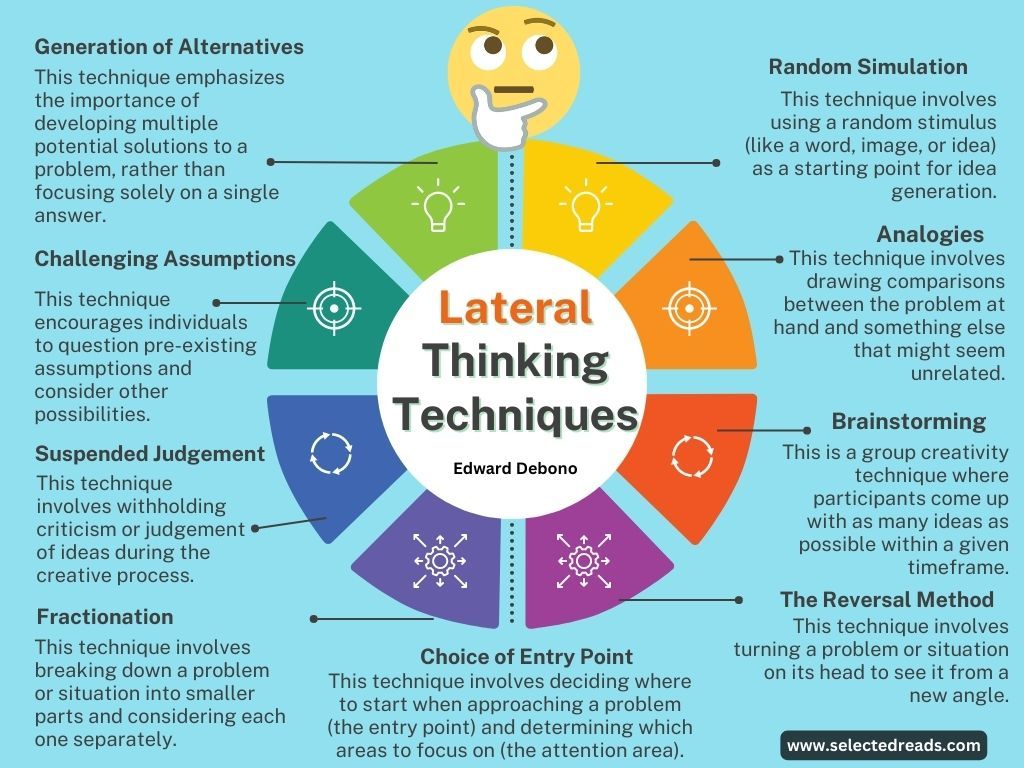
What is lateral thinking? It is a deliberate approach to generating possibilities by challenging the current problem frame, interrupting familiar patterns, and connecting distant ideas. Lateral thinking complements rather than replaces logical analysis: it helps discover alternative routes, while vertical thinking evaluates and develops them. Research on creative insight supports the value of pattern interruption, though not every technique has been directly tested.
Most thinking about thinking focuses on making existing thinking processes better. More rigorous analysis. Fewer cognitive biases. Stronger logical frameworks. More accurate use of evidence.
These are all legitimate and valuable, but they all operate within an implicit assumption: that the problem is being framed correctly, and that the relevant lines of inquiry are already being pursued.
Lateral thinking, a concept developed by physician and prolific author Edward de Bono beginning in 1967, challenges this assumption. It is a deliberate set of techniques for escaping established thinking patterns, not to be illogical, but to be creative in a specific, purposeful way.
Where conventional analytical thinking deepens inquiry along existing lines, lateral thinking moves sideways: questioning whether the current lines of inquiry are the right ones, looking for angles that conventional analysis would skip over, and generating ideas that vertical thinking would never produce.
De Bono coined both the term "lateral thinking" and the phrase "six thinking hats" and wrote more than 85 books on thinking, creativity, and cognitive tools. His work has been applied in education, business, design, and public policy across the world.
Understanding lateral thinking means understanding not just the specific techniques he developed but the deeper insight about how minds get trapped, and how to escape those traps deliberately.
The Problem With Vertical Thinking
De Bono's original insight was that the Western intellectual tradition, built on Socratic logic and Aristotelian categories, was extraordinarily powerful for analysis and verification but had a built-in weakness for generation of new ideas.
Vertical thinking (the standard logical model) works by following established sequences, building on sound premises, and arriving at correct conclusions through valid reasoning. It is selective: it picks the most promising line of inquiry and deepens it.
It is correct at each step: each move must be justified by the previous one. It is analytical: it breaks problems into components and works through them systematically.
These are genuine virtues. For a large class of problems, engineering calculations, legal analysis, medical diagnosis, vertical thinking is exactly what is needed.
But vertical thinking has a structural limitation: it optimizes within the current frame. If the most promising approach is actually a dead end, vertical thinking produces increasingly sophisticated analysis of the wrong path. If the problem's framing contains a hidden assumption that is wrong, vertical thinking never surfaces it.
If the most valuable solution requires thinking that would not follow logically from current assumptions, vertical thinking will not generate it.
"You cannot dig a hole in a different place by digging the same hole deeper," Edward de Bono
This metaphor captures the core insight precisely. Vertical thinking digs the existing hole deeper. Lateral thinking asks whether you are digging in the right place.
De Bono developed this argument most rigorously in The Mechanism of Mind (1969), where he proposed that the brain functions as a self-organizing information system, one that creates patterns and then uses those patterns to filter and interpret new information.
Patterns are efficient: they allow rapid recognition and response. But they are also self-reinforcing. Once a pattern is established, it preferentially directs attention along familiar channels and makes it difficult to perceive information that does not fit.
Lateral thinking is, in this neurological framing, a method for deliberately escaping pattern-lock.
The Neuroscience of Creative Constraint
Research in cognitive neuroscience has provided independent support for De Bono's intuitions about how minds get trapped.
A landmark study by Dijksterhuis and Meurs (2006) at the University of Amsterdam found that participants who were instructed to stop consciously thinking about a complex problem and instead engage in unrelated tasks subsequently produced more creative solutions than those who continued thinking about it, suggesting that structured pattern interruption, not just harder analysis, is essential to novel idea generation.
Separately, Mark Beeman and colleagues at Northwestern University (2004) identified a distinctive neural signature associated with creative insight: a burst of gamma-band activity in the right anterior temporal lobe in the moments just before a problem is solved in an "aha" fashion, as opposed to the more gradual neural activity associated with analytical problem-solving.
The insight-associated solutions consistently required connecting concepts across distant semantic domains, exactly the kind of cross-domain connection that De Bono's random entry technique is designed to stimulate.
These findings do not validate De Bono's specific techniques as scientifically tested interventions, but they do support his fundamental claim: that creative insight involves different cognitive mechanisms from analytical reasoning, and that those mechanisms can be deliberately activated.
What Lateral Thinking Is Not
Before examining the specific techniques, several clarifications help:
Lateral thinking is not brainstorming. Brainstorming, as traditionally practiced, generates many ideas without evaluation. Lateral thinking is a more structured approach that deliberately uses specific provocative moves to escape established patterns: it is not simply thinking freely.
Lateral thinking is not random. The goal is to generate novel ideas through deliberate techniques, not through accident. De Bono was explicit that the randomness used in some lateral thinking tools is functional, a means of escape, not an end in itself.
Lateral thinking is not the opposite of logical thinking. Lateral thinking is used to generate possibilities; vertical thinking is used to evaluate and develop them. They are complementary rather than competing. De Bono consistently argued that lateral thinking produces the ideas that vertical thinking then tests and refines.
Lateral thinking is not restricted to creative professions. De Bono developed these tools explicitly for business, education, science, and policy, any domain where problem-solving is required and conventional approaches have run out of good options.
A 2019 survey of Fortune 500 innovation programs by the consultancy Doblin found that companies reporting above-average innovation output were three times more likely to use structured creative thinking methodologies, including lateral thinking frameworks, than companies reporting below-average innovation output.
The use of formal technique, not raw creative talent, was the differentiating factor.
The Core Mechanisms
Lateral thinking works through several cognitive mechanisms that de Bono identified as the key moves for escaping established patterns:
Escaping Dominant Ideas
Most problems come with a set of dominant ideas, assumptions about what the problem is, what solutions are available, and what constraints must be respected. These dominant ideas are often unstated, and their power comes precisely from going unexamined.
The first lateral move is to identify and challenge dominant ideas explicitly. What are we taking for granted? Which assumptions are we treating as fixed that might actually be variable? What would we do differently if that assumption were not true?
This is not skepticism for its own sake. It is a deliberate audit of the frame within which thinking is operating, looking for the constraint that is artificially limiting the solution space.
A useful practical exercise is the assumption audit: list every assumption implicit in the current approach to a problem, then methodically ask which ones are genuinely fixed constraints (physical laws, regulatory requirements) and which are merely habitual ways of doing things that could be changed.
Most constraint lists turn out to be mostly the latter.
Generating Alternatives
One of the specific lateral thinking disciplines is generating multiple alternatives before evaluating any of them, not because all alternatives are equally valid, but because the process of generating alternatives often produces the insight that would not emerge from direct analysis.
De Bono advocated a specific discipline: before settling on any approach, generate at least three to five genuinely different alternatives, different in structure and approach, not just in parameter values. The third or fourth alternative often points toward something the first two obscured.
This practice has empirical support from design research. A study by Dow and colleagues (2010) at Carnegie Mellon's Human-Computer Interaction Institute found that designers who generated and sketched multiple alternatives before committing to a direction produced higher-quality final solutions, rated by independent experts, than designers who pursued their first idea in depth.
The quantity of early exploration was a stronger predictor of final quality than the time spent on refinement.
Random Entry
The random entry technique introduces a random stimulus, a word from a dictionary, a random image, an object in the room, and uses it to generate connections with the problem being explored.
The logic, which seems paradoxical, actually works because of how associative thinking operates. Any random input will have some connections to any domain if you are committed to finding them.
And the randomness of the entry point means the connections generated will not be predictable from the problem's dominant ideas. You are essentially hacking the associative process to produce starting points that analysis alone would not reach.
Example: You are designing a new customer service system. You open a dictionary to a random page and find the word "coral." Coral: a fragile but beautiful ecosystem, built by tiny individual polyps, grows slowly but creates complex structure, can bleach and die under stress.
What connections are there to customer service? Perhaps: resilience to stress through redundancy, the importance of small individual interactions building complex relationship structures, the need for supportive environmental conditions for the system to thrive rather than bleach under pressure.
Some of these will be useless. One or two may generate genuinely useful design ideas.
The technique is not magic, it is a structured way to populate the conceptual starting points for creative association with inputs that are deliberately uncontaminated by the problem's established frame.
The PO Technique
PO (short for "provocation operation") is one of de Bono's most original contributions. It is a linguistic device that signals: what follows is deliberately illogical or contrary-to-fact, and is offered as a stepping stone to new ideas, not as a factual claim.
The value of PO is that it removes the evaluation reflex. Normally, when someone says "cars should have square wheels," the response is immediate rejection: that is impractical; it would not work. PO says: we know it would not work as stated, what does thinking about it lead to?
Consider: "PO: cars should have square wheels." If you sit with this instead of rejecting it: square wheels provide intermittent contact with the road at fixed intervals. What would be useful about controlled intervals of contact?
Sensors that monitor road surface quality at each contact point? Vibration-based road feedback systems? Tires that actively change shape? The provocation escapes the assumption that continuous smooth contact is the only design goal and opens consideration of periodic, variable, or adaptive contact.
De Bono deliberately introduced the word "PO" as a new part of speech, one that fits between yes and no, to signal the mental mode in which a statement is offered. It is not true. It is not a proposal. It is a stepping stone.
Reversal
Reversal involves taking an established assumption or conventional approach and deliberately inverting it.
Instead of "how do we get customers to come to us?", ask "how do we go to the customers?" Instead of "how do we reduce complaint volume?", ask "how do we make complaints more valuable?" Instead of "how do we speed up the process?", ask "what would slowing it down unlock?"
Reversal does not mean the reversed approach is correct. It means the reverse view illuminates aspects of the problem that the original frame concealed.
The reversal technique has a structural cousin in the engineering methodology of fault tree analysis and the business technique of pre-mortem, both of which start from the assumption of failure and work backward to identify its causes.
Gary Klein's research on naturalistic decision-making found that pre-mortems, asking "imagine it's one year from now and this project has failed; what went wrong?", increased the identification of potential failure causes by 30 percent compared to standard risk assessment (Klein, 2007).
The Six Thinking Hats
De Bono's most widely adopted practical tool is the Six Thinking Hats framework, introduced in his 1985 book of the same name. It addresses a specific problem in group thinking: when people with different roles, perspectives, and agendas engage in discussion, the conversation becomes adversarial rather than productive.
The finance director plays devil's advocate. The marketer pushes enthusiasm. The engineer raises technical constraints. The debate produces heat rather than light, and good ideas get killed by premature criticism while bad ideas survive because they were never adequately questioned.
The Six Thinking Hats framework solves this by introducing parallel thinking: rather than different people adopting different roles simultaneously, everyone adopts the same thinking mode at the same time, indicated by which "hat" is currently in use.
| Hat Color | Thinking Mode | What It Asks |
|---|---|---|
| White | Factual and analytical | What do we know? What data do we have? What is missing? |
| Red | Emotional and intuitive | How do I feel about this? What does my gut say? |
| Black | Critical and cautious | What could go wrong? What are the weaknesses and risks? |
| Yellow | Positive and optimistic | What is the best case? What value does this offer? |
| Green | Creative and generative | What are the new ideas? What alternatives have we not considered? |
| Blue | Processual and meta | What kind of thinking do we need now? Are we making progress? |
The framework produces several benefits:
Psychological safety: Because everyone is adopting the same role, critical thinking is not perceived as personal attack. "I am wearing the black hat" signals that critique is a shared discipline, not a personality position.
Completeness: All six modes get attention in sequence, rather than the discussion being dominated by whichever frame is most socially powerful in the room.
Efficiency: Focusing one mode at a time (all emotional reactions, then all facts, then all critical concerns) is more efficient than mixing modes throughout a discussion.
Permission for green hat thinking: In most organizations, undisciplined creative speculation is socially awkward. The green hat gives explicit permission for lateral thinking within the structured framework, signaling that this is the appropriate mode right now.
A 2019 study by Dingli and Seychell at the University of Malta found that student groups using the Six Thinking Hats framework produced solutions rated as significantly more novel and more complete than control groups using standard discussion.
The biggest measured difference was in the completeness of risk analysis: the black hat phase forced explicit critical evaluation that standard discussion groups consistently skipped.
The Sequence of Hats Matters
De Bono specified that the order of hats in a session should be chosen deliberately rather than fixed. Different problems benefit from different sequences. A common productive sequence for evaluating a new proposal is:
- Blue (set agenda) -> White (establish facts) -> Yellow (explore value) -> Black (identify risks) -> Green (generate mitigations or alternatives) -> Red (gut check) -> Blue (conclusion and next steps)
Beginning with yellow before black is intentional: surfacing the genuine value of an idea before subjecting it to criticism prevents premature rejection and ensures that the critical analysis is applied to the idea's best possible version, not its least-developed articulation.
Lateral Thinking in Practice: Examples
Medical Diagnosis
Experienced diagnosticians unconsciously use lateral thinking when facing puzzling cases. The standard diagnostic process (vertical thinking) follows symptom clusters toward the most likely diagnoses. When that process repeatedly fails, the skilled clinician steps back and asks: what assumption in my framing is wrong?
What if this is not a disease I have considered? What if the symptoms I am treating as independent are actually one syndrome I have not recognized?
This deliberate escape from the established diagnostic frame, identifying which assumption to challenge, generating genuinely alternative frameworks, is lateral thinking in its practical clinical form.
Pat Croskerry, a cognitive psychologist specializing in clinical decision-making, has documented the role of what he calls "cognitive forcing strategies" in reducing diagnostic error, strategies that deliberately interrupt pattern-recognition and force explicit consideration of alternative diagnoses (Croskerry, 2003).
These are lateral thinking applied to medicine.
Business Strategy
Companies that produce genuinely novel strategies, rather than competitive improvements to existing approaches, typically engage in lateral thinking about their industry. The dominant ideas of an industry often get taken as constraints rather than choices.
When Southwest Airlines challenged the assumption that airlines should use hub-and-spoke networks, charge for luggage, and pursue business travelers, they were engaging in lateral thinking about their industry.
The resulting point-to-point, no-frills model was not produced by analyzing how to be a better version of existing carriers; it came from escaping the assumptions that defined existing carriers.
Similarly, when Netflix challenged the assumption that video rental required physical media and retail locations, the reversal ("what if the store came to the customer?") led first to DVD-by-mail and then, through a second reversal of the physical delivery assumption, to streaming.
Neither innovation was produced by analyzing how to be a better Blockbuster.
Product Design
The Post-it note, famously, was the product of a "failed" adhesive, one that did not permanently bond. The vertical thinking response to a failed adhesive is to try to fix the failure. The lateral response was: what is this good for, even though it is not what we were trying to make?
3M scientist Spencer Silver spent years unable to find an application for his low-tack adhesive before Art Fry, a colleague, connected it to his problem of bookmarks that fell out of his choir hymnal.
The connection was made through an institutional lateral thinking mechanism: 3M's practice of allowing researchers to present half-developed ideas to colleagues in informal settings, a structured form of random entry, generating unexpected associations across unrelated projects.
The random entry technique is explicitly used by product designers who introduce random objects, images, or words into design sessions to avoid the trap of designing incremental variations on existing products.
Lateral Thinking vs. Design Thinking: How They Relate
Design thinking, popularized by IDEO and Stanford's d.school in the 2000s, shares significant structural overlap with lateral thinking while approaching the problem from a user-centered rather than purely cognitive angle.
| Aspect | Lateral Thinking | Design Thinking |
|---|---|---|
| Origin | Edward de Bono, 1967 | IDEO/Stanford d.school, popularized 1990s-2000s |
| Primary focus | Escaping established cognitive patterns | Empathy with users; prototyping and iteration |
| Key technique | PO, random entry, reversal, Six Hats | Empathize, Define, Ideate, Prototype, Test |
| Group vs. individual | Both, with explicit group tools (Six Hats) | Strongly team-oriented |
| When to use | When conventional approaches are exhausted | When the problem is user-centered and iterative |
The two approaches are complementary. Design thinking's empathize phase is a form of escaping dominant ideas by forcing attention onto actual user experience rather than assumed user needs. The ideate phase of design thinking explicitly borrows from lateral thinking's commitment to quantity of alternatives before evaluation.
Many practitioners use the frameworks in combination: design thinking to ensure user-centered framing, lateral thinking to generate ideas within and beyond that frame.
The Limits of Lateral Thinking
Understanding what lateral thinking is requires understanding what it is not appropriate for:
Not a replacement for domain expertise: Lateral thinking can help an expert escape established patterns. It cannot compensate for not having established patterns in the first place. You cannot think laterally about a field you do not understand, you will just be confused rather than creatively confused.
Not appropriate for all problems: Problems with deterministic correct answers do not need lateral thinking. Tax calculations, structural engineering safety margins, medication dosing, these need accurate vertical thinking, not creative alternatives.
Not a guarantee of quality ideas: Lateral thinking generates unexpected ideas, not automatically good ones. Most provocations will lead nowhere useful. The process is a generator of raw material for evaluation, not a quality filter.
Not magic: De Bono was explicit that lateral thinking is a skill that develops with practice. Reading about the techniques and applying them under pressure for the first time will produce modest results. The tools improve with deliberate use.
Research on the effectiveness of creativity training (Scott, Leritz, and Mumford, 2004) analyzed 70 studies and found that structured creative thinking programs, those using specific techniques like those De Bono developed, showed significantly stronger effects on creative output than unstructured brainstorming programs.
Technique matters. The discipline of practice matters. But the ceiling is genuinely high: with regular use, lateral thinking processes become internalized and begin to appear spontaneously in everyday reasoning.
Developing the Lateral Thinking Habit
Lateral thinking becomes more accessible with practice, and several habits develop the underlying cognitive flexibility:
Question the question: Before solving a problem, spend time asking whether the problem as stated is the right problem. What assumptions are built into how it is framed? Who defined it this way and why?
This habit alone, simply pausing to reframe before solving, catches a large proportion of the problems that lateral thinking is designed for.
Seek analogies from other domains: How is this problem similar to problems in biology, music, architecture, or military history? Cross-domain analogies are a form of lateral entry, they approach the problem from outside its established frame.
The historian of science Thomas Kuhn documented how scientific revolutions frequently depend on exactly this kind of inter-domain analogy: Crick and Watson's double helix structure was partly inspired by X-ray crystallography of proteins developed in a completely different research program.
Deliberately generate bad ideas: When generating alternatives, explicitly include implausible, impractical, or deliberately wrong ideas. The evaluation of why a bad idea is bad often illuminates what properties a good idea would need that you had not articulated.
Practice PO provocations: Take an assumption central to your current approach and invert it. The factory produces the product. PO: the customer produces the product. Where does that lead?
IKEA's flat-pack furniture model, Airbnb's asset-light accommodation model, and Wikipedia's crowdsourced encyclopedia all emerge from following exactly this kind of provocation to its productive conclusion.
Use the random entry technique in low-stakes contexts: Apply random stimuli to small problems before using the technique for high-stakes ones. Develop the muscle of finding connections between disparate ideas before you need to depend on it.
Keep a lateral thinking journal: Record PO provocations, random entry results, and unexpected analogies that occurred to you across the week. Review them periodically. Many ideas that seemed impractical in the moment of generation become useful when a different problem arises later.
Building a Lateral Thinking Culture in Teams
Lateral thinking as a solo practice is valuable. As an organizational practice, it is transformative, but it requires explicit permission structures, because most organizational cultures punish lateral thinking implicitly through social pressure toward convergence.
The research on psychological safety by Amy Edmondson at Harvard Business School (1999, 2019) is directly relevant here.
Edmondson found that team psychological safety, the shared belief that the team is safe for interpersonal risk-taking, was the strongest predictor of team learning behavior, including the generation and surfacing of unconventional ideas.
Teams with low psychological safety self-censor lateral ideas before voicing them.
The Six Thinking Hats framework addresses this directly by creating a structural permission system: when the green hat is in use, everyone is expected to generate unconventional ideas, and evaluation is explicitly deferred. The social norm is changed by the process, not by asking individuals to be more psychologically courageous.
Organizations that want to build lateral thinking capacity systematically should consider:
- Regular "assumption audit" sessions for ongoing projects
- Explicitly protected time for green hat thinking in meetings
- Retrospectives that ask "what were we taking for granted?" after both successes and failures
- Rewards for surfacing unconventional ideas, separate from rewards for successful implementation
Lateral thinking is, at its core, a discipline of deliberate freedom, the structured practice of escaping the gravitational pull of established ideas when those ideas are preventing you from seeing something more useful.
It requires confidence that leaving the established path is sometimes the most rigorous thing you can do, and the specific tools to make that departure systematic rather than merely random.