
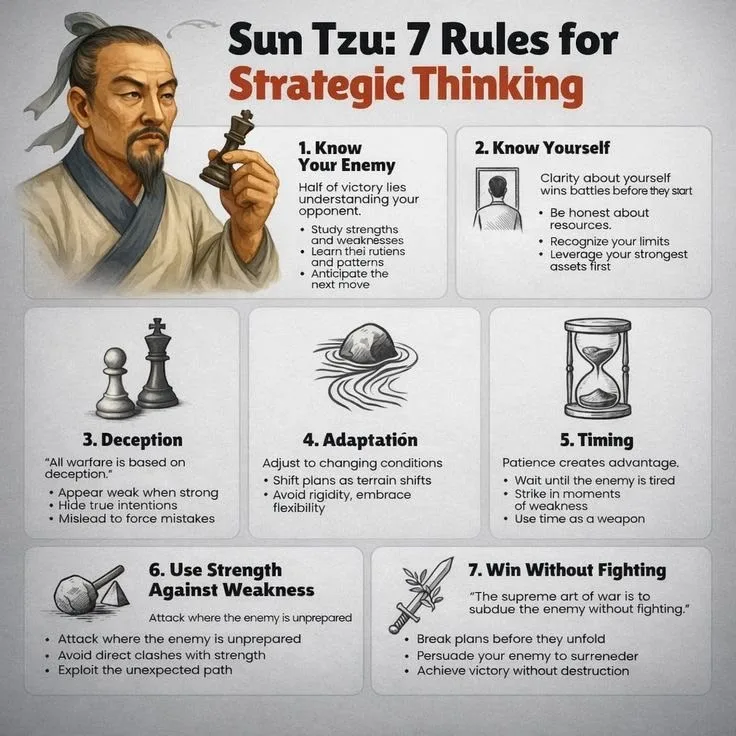
There is a common confusion at the heart of how organizations discuss strategy. Executives announce "strategic plans." Consultants produce "strategic frameworks." Meetings are called "strategic offsites." Yet very little of what happens in these contexts is actually strategic thinking, and the gap between the ritual and the real thing explains a great deal about why most corporate strategies underperform.
Strategic thinking is not a planning process. It is a cognitive capability: the ability to analyze complex, uncertain situations, identify what actually matters, anticipate how conditions might evolve, and determine what actions today create the best outcomes over time.
It is rare, genuinely valuable, and significantly developable with the right approach.
This article explains what strategic thinking actually is, how it differs from the planning rituals it is confused with, what frameworks genuinely support it, and how to build the capability deliberately.
The Difference Between Strategic Thinking and Strategic Planning
These two activities are frequently conflated, but they are fundamentally different.
Strategic planning is an organizational process. It happens at scheduled intervals, follows a defined structure, produces documents and roadmaps, and allocates resources to stated priorities. It is administrative. At its best, it communicates and coordinates the output of strategic thinking.
At its worst, it substitutes the appearance of strategy for the substance of it.
Strategic thinking is a cognitive activity. It happens continuously, often informally, frequently alone or in small conversations.
It involves questioning whether current activities actually produce competitive advantage, examining assumptions that have gone unexamined, noticing patterns in how markets or conditions are changing, and developing genuine insight about what should be done differently.
"Strategy without tactics is the slowest route to victory. Tactics without strategy is the noise before defeat." (attributed to Sun Tzu)
The organizational theorist Henry Mintzberg drew a sharp distinction between these activities in his landmark 1994 critique The Rise and Fall of Strategic Planning.
His argument was that formal planning processes are inherently backward-looking (they codify what worked before), analytical (they decompose and measure), and political (they reflect organizational power rather than competitive reality).
Real strategy, Mintzberg argued, emerges from strategic thinking: an ongoing, creative process that cannot be scheduled into a quarterly calendar.
This does not mean strategic planning is useless. It means planning is downstream of thinking, not a substitute for it. A plan without prior strategic thinking is just an operational budget with aspirational language attached.
The scale of the misalignment is substantial. A survey by McKinsey & Company (2018) of more than 2,000 executives found that fewer than 45% were satisfied with the strategic planning process in their organizations, and only 23% reported that their company's strategic planning process led to good strategic decisions.
The gap between planning activity and genuine strategic output is not a niche problem.
What Strategic Thinking Actually Involves
Researchers who study strategic cognition have identified several distinct capabilities that characterize good strategic thinkers:
Systems Thinking
Strategic thinkers see systems rather than events. Where an operational thinker sees a problem to solve, a strategic thinker asks what structural conditions are producing that problem and whether solving the symptom addresses the cause.
A retailer that responds to falling foot traffic by discounting prices is solving an event. A strategic thinker asks whether the structural shift to online purchasing means the physical retail model itself needs rethinking, and then examines the second and third-order consequences of different responses.
Peter Senge's The Fifth Discipline (1990) formalized the discipline of systems thinking within organizational strategy, introducing concepts like feedback loops, delays, and archetypes: recurring structural patterns that produce predictable strategic dynamics.
Senge argued that most organizational failures trace back to an inability to see the system generating the problems, not just the problems themselves.
Long Time Horizons
Strategy involves trading short-term costs for long-term advantage. This is uncomfortable and politically difficult in organizations where performance is measured quarterly.
The ability to hold long time horizons (to make decisions that appear suboptimal in the near term because they position well for the future) is one of the rarest and most valuable strategic capabilities.
Amazon famously operated at near-zero profit for years while building logistics infrastructure, Prime membership, and AWS capabilities that have since produced enormous competitive advantage. That was not bad financial management; it was deliberate strategic patience.
Jeff Bezos articulated the logic explicitly in his 1997 letter to shareholders: "We believe that a fundamental measure of our success will be the shareholder value we create over the long term...
We will continue to make investment decisions in light of long-term market leadership considerations rather than short-term profitability considerations."
The behavioral economics research on temporal discounting (Loewenstein and Thaler, 1989) explains why long time horizons are rare: humans systematically overweight near-term outcomes relative to long-term ones, a bias that is particularly pronounced under pressure.
Organizations must actively counteract this tendency through governance structures, incentive design, and explicit cultural norms.
Comfort with Ambiguity
Strategic decisions are almost always made under conditions of incomplete information.
Good strategic thinkers are comfortable with ambiguity: they can reason rigorously without requiring certainty before acting, and they distinguish between decisions that should be delayed pending better information and decisions where delay is itself a strategy-destroying choice.
Roger Martin, the former dean of the Rotman School of Management, articulated this as the willingness to engage in "integrative thinking": holding two opposing ideas in mind simultaneously without prematurely collapsing to one (Martin, 2007, The Opposable Mind).
The best strategists are not people who have certainty; they are people who can reason usefully despite the absence of it.
Questioning Assumptions
Every strategy rests on assumptions: about what customers value, about how competitors will respond, about what capabilities matter, about which trends are permanent versus temporary. Strategic thinkers explicitly surface and examine these assumptions rather than inheriting them.
The Innovator's Dilemma, documented by Clayton Christensen in his 1997 book of the same name, is essentially a failure of assumption examination.
Established companies with excellent managers are disrupted by new entrants not because the managers are incompetent but because they never question the assumption that serving their current customers well is the right strategic priority.
Christensen showed that this assumption is rational in the short term and fatal over longer horizons when disruptive technologies serve overlooked customer segments from the bottom of the market.
Porter's Five Forces
Michael Porter's Five Forces framework, introduced in his 1979 Harvard Business Review article "How Competitive Forces Shape Strategy" and expanded in Competitive Strategy (1980), remains one of the most durable tools for analyzing competitive position.
It identifies five forces that determine the profitability potential of an industry:
| Force | What It Asks | Example Application |
|---|---|---|
| Competitive rivalry | How intense is competition among existing players? | Airlines: extremely high; luxury goods: lower |
| Threat of new entrants | How easy is it for new competitors to enter? | Software: lower barriers; utilities: very high |
| Threat of substitutes | Can customers meet the same need another way? | Taxis face Uber; newspapers face social media |
| Bargaining power of buyers | How much can customers push for lower prices? | One large retail buyer vs. many small customers |
| Bargaining power of suppliers | How much can suppliers charge? | Sole-source components vs. commodity inputs |
The value of Five Forces is not that it produces answers but that it structures the right questions. An industry with high rivalry, easy entry, multiple substitutes, powerful buyers, and powerful suppliers will be structurally unattractive regardless of how well any individual company executes.
Understanding structural forces helps explain why some industries are persistently profitable and others are persistently marginal.
"The essence of strategy formulation is coping with competition." Michael Porter, Competitive Strategy (1980)
Porter's framework has been extended by subsequent researchers. Adam Brandenburger and Barry Nalebuff's co-opetition model (1996) proposed complementors as an additional strategic factor, sometimes informally described as a sixth force: complementors, businesses whose products increase the value of yours, recognizing that strategic actors can simultaneously compete and cooperate in ways the original five forces model did not capture.
The app developer ecosystem for smartphone platforms is a canonical example of complementors at scale.
A limitation of Five Forces worth noting: it models industries as relatively static structures. In rapidly changing environments (digital platforms, biotechnology, artificial intelligence), the boundaries of industries shift faster than the framework's assumptions allow.
Porter's model is most powerful in mature, structurally stable industries and requires careful adaptation when applied to rapidly disrupting markets.
SWOT Analysis: A Useful Starting Point With Real Limits
SWOT analysis (Strengths, Weaknesses, Opportunities, Threats) is the most widely used strategy tool in the world, with origins attributed to Albert Humphrey's research at Stanford Research Institute in the 1960s and 1970s, though the exact history is disputed.
Its appeal is accessibility: any team, with no training, can complete a SWOT analysis in an hour and feel they have done strategic work.
The problem is that this accessibility is also its limitation.
What SWOT does poorly:
- It produces lists without priorities. A SWOT with twenty items in each quadrant tells you nothing about what matters most.
- It does not create strategy, it inventories the current state. Moving from a completed SWOT to an actual strategic choice requires analysis the framework does not provide.
- It is highly susceptible to bias. People list strengths they are proud of, weaknesses they are comfortable acknowledging, opportunities that are fashionable, and threats that are already widely discussed, rather than the ones that are actually strategically significant.
- It conflates internal and external factors in ways that create false symmetry. Some strengths matter enormously in one competitive environment and not at all in another.
What SWOT does well:
- Forces explicit articulation of assumptions about position
- Creates a common starting vocabulary for a team
- Surfaces information asymmetries (different team members know different things)
- Works as a preliminary step before more rigorous analysis
The appropriate use of SWOT is as a starting point that identifies what needs deeper analysis, not as an endpoint that provides strategic answers.
Weihrich (1982), writing in Long Range Planning, proposed the TOWS matrix as an extension: using SWOT inputs to generate SO strategies (using strengths to exploit opportunities), ST strategies, WO strategies, and WT strategies. This extension moves closer to actionable output than SWOT alone.
Mental Models That Support Strategic Thinking
Beyond formal frameworks, strategic thinkers rely on a set of mental models, generalized thinking tools, that help them reason more effectively across diverse situations.
First Principles Thinking: Breaking a problem down to its most fundamental components and reasoning up from those components rather than from analogy to how things have been done before.
Elon Musk has popularized this approach, using it to question assumptions about rocket manufacturing costs that the industry had treated as fixed, ultimately reducing launch costs by roughly 80% through vertical integration and reusability.
Inversion: Instead of asking "how do I achieve X?", asking "what would guarantee that X never happens?" Inversion often surfaces obstacles and failure modes that forward reasoning misses.
Charlie Munger, Warren Buffett's long-time business partner, is one of inversion's most prominent advocates: "Tell me where I'm going to die, that is, so I don't go there." Applied to strategy, inversion asks: what would make our competitive position collapse?
What assumptions, if wrong, would invalidate this strategy?
Second-Order Thinking: Asking not just "what happens if we do X?" but "what happens as a result of that, and then what?" First-order consequences are usually obvious. Second and third-order consequences are where most strategic surprises lie.
Howard Marks, co-founder of Oaktree Capital Management, made second-level thinking the centerpiece of his 2011 book The Most Important Thing: "First-level thinking is simplistic and superficial... Second-level thinking is deep, complex, and convoluted."
Jobs to Be Done: Rather than asking what product features customers want, asking what fundamental progress customers are trying to make in their lives. Developed by Clayton Christensen and colleagues, this framework reframes competitive analysis entirely.
The famous example, described in Christensen, Hall, Dillon, and Duncan (2016, Competing Against Luck), is that people hiring a milkshake for their morning commute are hiring it to be more interesting than nothing, a functional role with specific performance requirements that most competitors analyze incorrectly because they segment by product rather than by job.
Long-Term vs Short-Term Tradeoffs
One of the most consequential and underappreciated dimensions of strategic thinking is the management of temporal tradeoffs: decisions that sacrifice near-term performance for long-term position, or vice versa.
Most organizational incentive structures create systematic pressure toward short-term decisions:
- Quarterly earnings pressure from public markets
- Annual bonus cycles that reward this year's results
- Promotion systems that reward visible wins over patient positioning
- Planning cycles that cannot evaluate payoffs beyond a 3-5 year horizon
A study by McKinsey Global Institute (Barton, Manyika, and Williamson, 2017) found that companies focused on the long term (defined by investment behavior, earnings guidance, and capital allocation) outperformed short-term-oriented peers by 47% in revenue growth and 36% in earnings growth from 2001 to 2015.
Long-term companies also added an average of 12,000 more jobs between 2001 and 2015 than their short-term peers. The evidence that short-termism is costly is substantial; what is less clear is how organizations build the institutional will to resist it.
Good strategic thinkers recognize these pressures and develop explicit frameworks for counteracting them.
They distinguish between investments that should produce returns in the current period, investments that position for the next period, and investments in optionality: capabilities that expand the range of future choices available without committing to a specific direction.
Real options analysis, borrowed from financial derivatives theory, provides a formal framework for valuing strategic optionality (Dixit and Pindyck, 1994, Investment Under Uncertainty).
The tension is real. Sacrificing current performance for future position can be strategically correct and politically catastrophic. Organizations that consistently reward long-term thinking are genuinely rare, and executives who practice it face legitimate career risk.
How to Practice Strategic Thinking
Strategic thinking is a skill, and like all skills it develops through deliberate practice. Several approaches build the capability over time:
Write strategic memos: The act of writing forces precision. Drafting a memo on what you believe the key strategic question facing your team or organization is, and what you think the answer is, surfaces assumptions and reveals gaps in reasoning that conversation can hide.
Amazon's culture of written memos, requiring six-page narratives before major decisions rather than PowerPoint decks, is explicitly justified on the grounds that narrative writing requires more coherent thinking than bullet points allow.
Jeff Bezos described this practice as producing "much higher-quality thinking" than presentation formats.
Study cases in depth: Reading about strategic decisions, especially ones that failed, builds pattern recognition. The goal is not to memorize frameworks but to develop intuitions about how different strategic situations tend to unfold. Business history, military strategy, and competitive sports all offer rich material.
Richard Rumelt's Good Strategy Bad Strategy (2011) remains one of the most rigorous treatments of what distinguishes genuine strategic insight from what Rumelt calls the "fluff" of aspirational language masquerading as strategy.
Seek second opinions from outside your domain: Strategic blind spots often come from shared assumptions within an industry. Deliberately consulting people from different industries, disciplines, or backgrounds forces articulation of assumptions that insiders take for granted.
The practice of outside-in analysis (evaluating your strategy as a new entrant or outside investor would) systematically surfaces assumptions that internal analysis cannot reach.
Practice scenario planning: Rather than making a single forecast, develop two or three plausible futures with significantly different conditions. Then ask what decisions would be robust across scenarios, what bets are worth making on specific scenarios, and what early indicators would signal which scenario is developing.
Scenario planning was developed at Shell Oil in the 1970s under Pierre Wack and has since become a standard tool in long-horizon strategic planning.
| Practice | What It Builds | Time Commitment |
|---|---|---|
| Strategic memo writing | Precision, assumption surfacing | 1-2 hours weekly |
| Case study analysis | Pattern recognition, historical perspective | 3-4 hours monthly |
| Cross-domain consultation | Outside-in perspective, assumption challenging | Variable |
| Scenario planning exercises | Uncertainty tolerance, contingency thinking | Quarterly or annually |
| Reading broadly (history, science, biography) | Diverse mental models | Ongoing |
| Competitive intelligence review | Environmental scanning, trend detection | Monthly |
Common Strategic Thinking Failures
Even experienced strategists fall into recurring traps:
Competitor fixation: Organizing strategy around what competitors are doing rather than around what customers actually need. Companies locked in competitive imitation may successfully match their rivals while the entire industry is disrupted by a different category of solution entirely.
Kim and Mauborgne's Blue Ocean Strategy (2005) documented this pattern across industries, showing that the most transformative competitive moves (Cirque du Soleil, Southwest Airlines, Nintendo Wii) succeeded by redefining the competitive arena rather than competing more aggressively within the existing one.
Extrapolating the present: Assuming current trends continue linearly rather than examining the structural forces that could interrupt or reverse them.
The newspaper industry's strategy throughout the 1990s extrapolated the structural advertising advantages that had sustained it for decades (classified advertising, scale advantages in printing, geographic monopolies) until the internet disrupted every one of those advantages simultaneously.
The failure was not one of operational execution but of strategic imagination about structural discontinuity.
Confusing activity with strategy: Organizations that are busy with initiatives, optimizations, and improvements can look and feel strategic without having made any meaningful choices about where to compete and how to win.
Rumelt (2011) describes this as the "bad strategy" pattern: goals and visions stated as if they were strategies, with no diagnosis of the actual competitive challenge and no coherent set of choices designed to address it.
Strategy as wishful thinking: Setting goals (we will be the market leader in X) without the analysis of competitive position, required capabilities, and necessary actions that would make those goals achievable. A goal is not a strategy; it is a description of what success would look like if a strategy succeeded.
The distinction matters because goals without strategy produce investment in aspiration rather than investment in competitive advantage.
The Organizational Dimension
Individual strategic thinking capability only translates into organizational outcomes if the environment supports it. Organizations can invest in developing strategic thinkers while simultaneously maintaining structures that make strategic thinking organizationally irrelevant:
- Hierarchies where only senior leaders make strategic decisions regardless of where the best analysis lives
- Cultures where challenging existing strategy is punished as disloyalty
- Incentive systems that reward operational excellence far more than strategic foresight
- Planning processes that treat strategy as an annual event rather than an ongoing activity
Research by Gary Hamel and C.K. Prahalad, developed in their influential Harvard Business Review article "Strategic Intent" (1989) and the book Competing for the Future (1994), argued that the organizations most effective at strategy are those that develop core competencies: deeply embedded capabilities that span product lines and create competitive advantage that is difficult to replicate.
But competency development requires sustained investment over years, which in turn requires organizational governance structures that protect long-horizon investments from short-term pressure.
Roger Martin (2014, Playing to Win, co-authored with A.G. Lafley) proposed that genuine strategy must answer two questions explicitly and coherently: Where will we play? (which markets, segments, geographies, and channels) and How will we win? (what value proposition and capabilities will produce advantage in those chosen arenas).
Most organizations, he argued, avoid making explicit choices on both questions, hedging across arenas and declining to commit to a specific winning logic, which produces mediocre performance rather than competitive advantage.
Developing strategic thinking capability at a personal level is valuable regardless of organizational context, it makes individuals better decision-makers in their own domains. But its full value is only realized in organizations that have deliberately created the conditions for strategic insight to be heard, tested, and acted upon.
Strategic thinking is ultimately about seeing clearly and choosing deliberately.
It requires the intellectual honesty to distinguish what is true from what is comfortable, the courage to act on insight even when it contradicts convention, and the patience to allow good positioning to produce its returns over the long time horizons that strategy demands.