
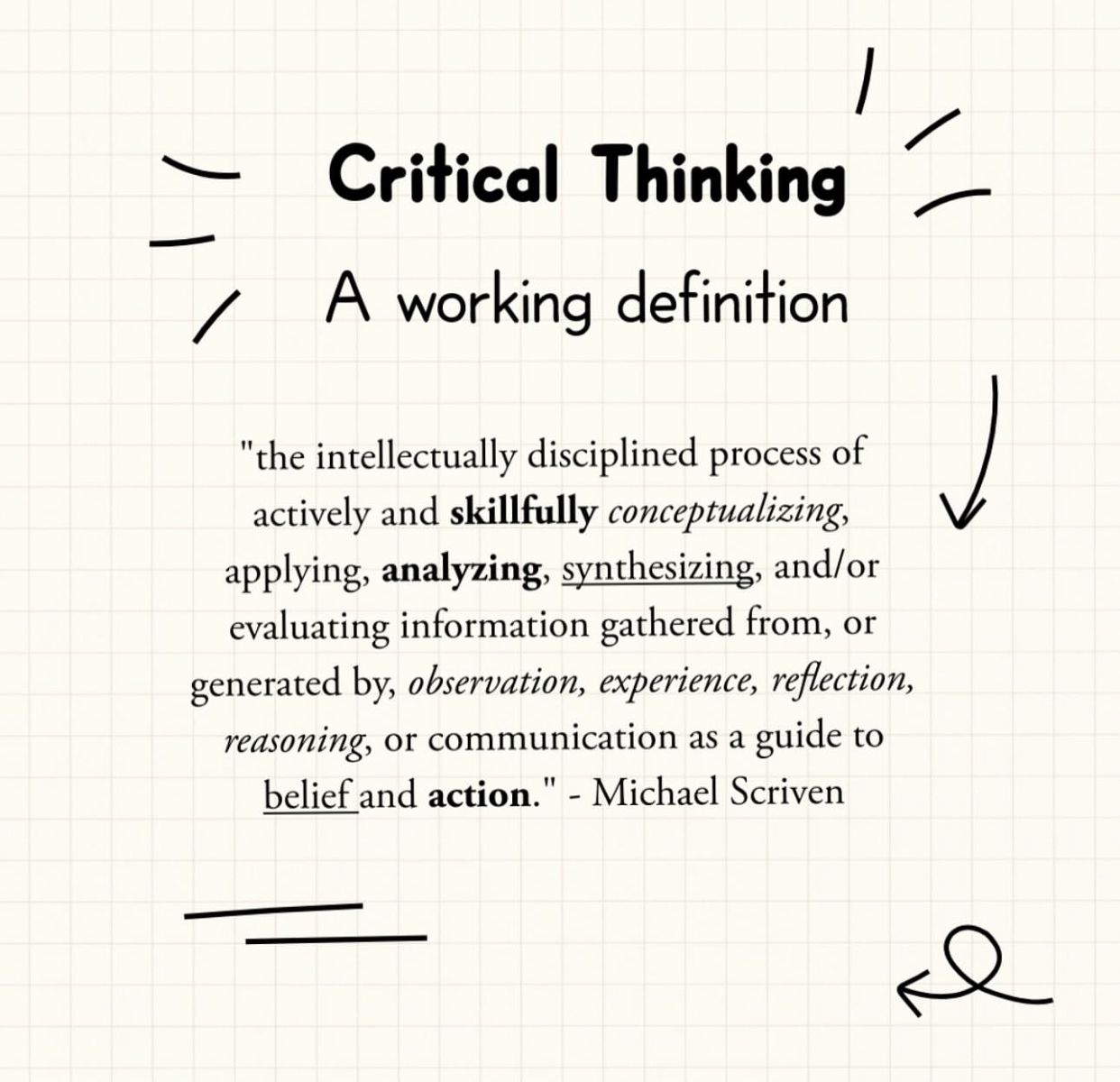
Clear reasoning demands more than intelligence or a polished analysis. Critical thinking is the deliberate practice of checking evidence, surfacing assumptions, comparing explanations, and applying standards of clarity, accuracy, relevance, logic, and fairness. It also requires intellectual humility: the willingness to subject one's own beliefs to the same scrutiny used for other people's claims.
"The whole problem with the world is that fools and fanatics are always so certain of themselves, and wiser people so full of doubts.", Bertrand Russell
In 2011, a major investment bank's equity research team published a 50-page analysis concluding that a technology company's new product line would be a "transformative market entry" and recommended the stock as a strong buy.
The analysis was meticulous in appearance: financial models ran to dozens of tabs, growth projections were elaborately sourced, and the writing was authoritative.
Twelve months later, the product had failed to gain meaningful adoption, the stock had lost 40 percent of its value, and a post-mortem revealed that every major assumption in the analysis had been derived not from independent evidence but from company management presentations.
The analysts had not questioned whether management's own projections were credible. They had not asked what the historical base rate was for new product lines in this category. They had not stress-tested the assumptions against a bear case.
They had produced an intellectually impressive document that was, at its foundation, an elaborate reconstruction of what the company's management wanted them to believe.
This is a failure of critical thinking, not a failure of intelligence. The analysts were credentialed and experienced. Their spreadsheets were technically correct.
What they lacked was the disciplined habit of examining their own assumptions, questioning the quality of their evidence, and considering alternative explanations for what they were observing.
Critical thinking is the skill that distinguishes people who reason well from people who reason impressively. It is not the same as intelligence, and it is not the same as skepticism.
It is a specific set of habits and dispositions that, when applied consistently, produces better judgments, fewer costly errors, and more honest assessments of what is actually known versus what is being assumed.
What Critical Thinking Actually Is
Critical thinking is the disciplined practice of evaluating claims, identifying assumptions, assessing evidence, and constructing well-reasoned arguments. It is active and deliberate rather than passive and automatic.
Most human cognition operates on pattern-matching shortcuts: fast, intuitive, automatic processes that work well in familiar situations but produce systematic errors in novel or complex ones.
Critical thinking applies slower, more deliberate analysis to claims that matter, overriding the automatic response in order to examine it.
The word "critical" does not mean negative or adversarial. It derives from the Greek kritikos, meaning to discern or judge.
Critical thinking is the practice of discernment: separating well-supported claims from poorly-supported ones, sound arguments from fallacious ones, genuine expertise from credentialed assertion. It is applied equally to your own beliefs and to those of others.
A useful working definition comes from the Paul-Elder Critical Thinking Framework, developed by philosophers Richard Paul and Linda Elder over decades of research into teaching and measuring critical thinking.
Their framework identifies three components: first, the intellectual standards that thinking should meet (clarity, accuracy, precision, relevance, depth, breadth, logic, significance, fairness); second, the elements of reasoning that make up any argument (purpose, question, information, inference, concepts, assumptions, implications, point of view).
And third, the intellectual traits that characterize the habitual critical thinker (intellectual humility, autonomy, integrity, perseverance, empathy, courage, and fair-mindedness).
This three-part structure reveals something important: critical thinking is as much a character disposition as it is a technical skill. You can know every logical fallacy by name and still reason poorly if you are unwilling to apply the same standards to your own arguments that you apply to others'.
"The first principle is that you must not fool yourself, and you are the easiest person to fool." Richard Feynman
A Brief History of the Idea
The Socratic method (Socrates' practice of persistent, systematic questioning designed to surface hidden assumptions and test the coherence of beliefs) is the oldest formal tradition of what we now call critical thinking.
Socrates made his fellow Athenians uncomfortable in the agora by asking the simplest and most devastating of questions: "But how do you know that?" and "What do you mean by that exactly?" The practice was effective enough that the city of Athens eventually sentenced him to death for it.
The philosophical tradition Socrates founded runs through Plato, Aristotle's formal logic, the medieval scholastic tradition of disputation, Francis Bacon's critique of the "idols of the mind" (his term for the systematic biases that distort human reasoning), and Descartes' method of systematic doubt.
By the 18th century, the Enlightenment had established critical examination of received authority, religious, monarchical, and traditional, as an intellectual and political program.
John Dewey, the American philosopher and educational reformer, introduced the concept of "reflective thinking" in his 1910 book How We Think, arguing that education should cultivate the disposition to think through problems carefully rather than to accept given solutions.
Dewey's work directly influenced the progressive education movement's emphasis on inquiry-based learning over memorization and recitation.
"We do not learn from experience. We learn from reflecting on experience." John Dewey
The term "critical thinking" in its modern sense was formalized through the work of Edward Glaser, who in 1941 developed the Watson-Glaser Critical Thinking Appraisal, still one of the most widely used assessments of critical thinking in educational and organizational contexts.
The contemporary research literature on critical thinking is large, spanning cognitive psychology, educational research, philosophy, and organizational behavior, and while researchers continue to debate the precise definition and structure of the construct, the core practical content is relatively stable.
Core Skills
Analysis
Analysis means breaking complex claims or arguments into their component parts and examining how those parts relate. An argument consists of a conclusion (the claim being made) and premises (the reasons offered in support of the conclusion).
Analyzing an argument means identifying these components explicitly, clarifying what each part means, and asking whether the premises, if true, actually support the conclusion.
Many arguments that appear strong in casual conversation become visibly weak when analyzed. A common form of weak analysis involves treating a correlation as evidence of causation, an argument's most common structural flaw. "Every time we increase our advertising spend, our sales go up" is an observation of correlation.
It becomes an argument for causation only if other explanations (seasonality, product improvements, competitor changes, general market growth) have been examined and ruled out. The analysis step asks: what would have to be true for this conclusion to follow from this evidence?
Evaluation
Evaluation asks whether premises are actually true and whether evidence is actually credible. It involves assessing the quality of sources, the methodology behind claims, and whether the evidence cited actually establishes what it purports to establish.
Evaluating evidence quality requires domain knowledge about what constitutes good evidence in a given field. A single case study does not establish a general principle.
An expert's assertion does not constitute evidence unless the expert's credentials are relevant to the specific claim, their track record in similar predictions is known, and they are not subject to conflicts of interest that might bias their assessment.
A study without a control group cannot establish a causal effect. A survey of self-selected respondents cannot represent a population.
The critical thinker's instinct is to ask "how do we know this?" and to apply different standards depending on the stakes of the claim. A low-stakes claim might be accepted on reasonable authority; a high-stakes decision should be subjected to scrutiny proportional to its consequences.
Inference
Inference means drawing well-supported conclusions from available evidence rather than jumping to convenient or emotionally resonant ones. It involves recognizing the gap between what is established and what is concluded, and acknowledging that gap honestly.
Premature closure, reaching a conclusion before all relevant evidence has been considered, is one of the most common inference failures. It is particularly common under time pressure, when the cost of not having an answer feels higher than the cost of having a wrong one.
Premature closure is also driven by confirmation bias, discussed below: once a conclusion is reached, the mind tends to stop looking for disconfirming evidence.
A related inference failure is overgeneralization: drawing a broad conclusion from an insufficient number of cases. Vivid examples feel more evidential than they are, and one dramatic instance can overwhelm statistical reasoning about what is typical.
Synthesis
Synthesis involves combining information from multiple sources, integrating information that points in different directions, and constructing a coherent picture that acknowledges complexity. Where analysis breaks things apart, synthesis puts them together in a new way.
Strong synthesis requires the ability to hold competing hypotheses simultaneously without premature resolution. This is cognitively uncomfortable (the mind prefers resolution to ambiguity) but it is a prerequisite for honest reasoning when evidence is mixed, as it often is in real-world decisions.
Logical Fallacies Everyone Encounters
A logical fallacy is a pattern of reasoning that appears valid but is not: it seems to provide evidence or support for a conclusion but does not actually do so. Recognizing fallacies in your own thinking and in arguments you encounter dramatically reduces the number of times you are persuaded by defective reasoning.
"The demon-haunted world... needs us to apply the baloney detection kit." Carl Sagan
| Fallacy Name | Description | Example |
|---|---|---|
| Straw Man | Misrepresenting an opponent's argument to attack an easier version of it | "She wants higher taxes, she wants to destroy the economy" |
| Ad Hominem | Attacking the person making the argument rather than the argument itself | "Don't trust his analysis, he's never run a business" |
| Appeal to Authority | Accepting a claim simply because an authority figure asserted it, without independent evidence | "A Nobel laureate says vaccines are harmful, so they must be" |
| False Dichotomy | Presenting only two options when more exist | "You're either with us or against us" |
| Slippery Slope | Arguing a small action will inevitably lead to extreme outcomes without establishing the chain is likely | "If we allow remote work, all discipline will collapse" |
| Circular Reasoning | Using the conclusion as a premise to support itself | "This is the best policy because it is clearly superior to alternatives" |
| Appeal to Popularity | Claiming something is true because many people believe it | "Millions of people believe it, so it must have some truth to it" |
The straw man fallacy misrepresents an opponent's argument in order to attack an easier version of it.
In its clearest form: someone argues for a carbon tax; a critic responds that "my opponent wants to destroy the economy and put millions of people out of work." The critic is responding to an exaggerated, distorted version of the argument rather than the argument itself.
The straw man is pervasive in political discourse and in any context where participants are more interested in winning than in understanding.
The ad hominem fallacy attacks the person making an argument rather than the argument itself. "You shouldn't take her analysis seriously, she's never run a business." This might be relevant context, but it does not tell us whether her analysis is correct.
The merits of an argument are logically independent of the personal characteristics of the person making it. Ad hominem attacks are seductive because they are easy to produce and because audiences often accept personal credibility as a substitute for evaluating evidence.
The appeal to authority accepts a claim simply because an authority figure asserted it, without evaluating whether the authority's expertise is relevant to the specific claim or whether the claim has independent evidence behind it.
This fallacy is subtle because authority is genuinely relevant to evidence quality, we are right to give more weight to a physicist's claims about quantum mechanics than to a celebrity's. The error is treating authority as conclusive rather than as one factor among others.
The false dichotomy presents only two options when more exist. "You're either with us or against us." "Either we cut costs aggressively or the company will fail." Real situations almost always have more than two options, and false dichotomies are typically constructed to eliminate the middle ground where genuine solutions often live.
The slippery slope fallacy argues that a particular action will inevitably lead to a chain of increasingly extreme outcomes, without establishing that the intermediate steps are likely.
"If we allow remote work, employees will lose all discipline and productivity will collapse." The chain of causation may be psychologically compelling, but each link requires evidence.
Slippery slope arguments often rely on the vividness of the end state rather than the probability of reaching it.
Cognitive Biases That Block Critical Thinking
Cognitive biases are systematic errors in thinking that arise from the shortcuts the human mind uses to process information quickly. They are not signs of stupidity: they are features of a cognitive system optimized for speed over accuracy, and they affect everyone, including people with high intelligence and domain expertise.
Confirmation bias is the tendency to seek, interpret, and remember information in ways that confirm what we already believe, while giving less attention to information that challenges existing beliefs.
The investment analysts described at the opening of this article were exhibiting confirmation bias: they sought information that supported the company's narrative and paid insufficient attention to information that contradicted it.
Confirmation bias is particularly powerful when beliefs are emotionally significant or tied to identity and group membership.
The availability heuristic causes us to estimate the probability of events based on how easily examples come to mind rather than on actual frequency data.
Dramatic, emotionally vivid events, plane crashes, shark attacks, rare diseases that received news coverage, are more memorable than statistically much more common events and are systematically overestimated as a result.
This bias makes risk assessment unreliable when conducted informally, which is why actuarial tables and statistical base rates exist.
Anchoring describes the tendency to over-rely on the first piece of information encountered when making subsequent judgments. In salary negotiations, the first number mentioned becomes an anchor around which both parties' expectations cluster.
In project planning, the initial time estimate becomes an anchor that later revisions are insufficiently adjusted from, even when new information clearly warrants a larger adjustment. Anchoring operates largely unconsciously and is resistant to awareness: knowing about anchoring does not reliably eliminate its influence.
The Dunning-Kruger effect, documented in research by David Dunning and Justin Kruger at Cornell University in 1999, describes the finding that people with low competence in a given domain tend to overestimate their competence, while highly competent people often underestimate theirs.
The mechanism is that competence and the ability to recognize competence develop together: the knowledge required to do something well is largely the same knowledge required to know when it is being done poorly.
Novices lack the reference points to accurately assess their own performance. This effect makes the least informed people the most confidently wrong, which has obvious implications for how expertise should be evaluated in discussions.
How to Question Assumptions Systematically
Assumptions are the claims an argument takes for granted without stating or defending them. Every argument rests on assumptions, and identifying them is one of the most valuable critical thinking skills because false assumptions silently invalidate conclusions that are logically derived from them.
The analyst who concluded "strong buy" on the technology company was not reasoning incorrectly from his premises; his premises were wrong because his assumptions about the reliability of management projections were wrong.
The most useful question for surfacing assumptions is: "What would have to be true for this conclusion to follow?" Applied to any plan, proposal, or argument, this question surfaces the often-unstated conditions on which the conclusion depends.
Once those conditions are visible, they can be evaluated: are they actually likely to be true? What evidence supports them? What would happen to the conclusion if they were false?
A second useful practice is considering the opposite conclusion and asking what would explain it. If someone concludes that a product launch will succeed, asking "what would explain the launch failing?" forces engagement with disconfirming scenarios and evidence that is typically underweighted.
The pre-mortem, a technique developed by psychologist Gary Klein, formalizes this process. Before committing to a decision, a team imagines that the decision has been implemented and the outcome was a failure. They then work backward to identify the most plausible reasons it failed.
This exercise reliably surfaces risks and assumptions that forward-looking analysis misses, because it changes the cognitive frame from defending the plan to explaining its failure.
Critical Thinking vs. Intelligence
The distinction between critical thinking and raw intelligence is practically important. Intelligence, processing speed, working memory capacity, verbal fluency, provides cognitive resources that can be used for critical thinking, but they can equally be used for sophisticated rationalization of pre-existing beliefs.
Psychologist Jonathan Haidt's "social intuitionist model" of moral reasoning suggests that people typically form conclusions quickly and intuitively and then use their reasoning capacity to justify those conclusions after the fact.
This pattern, conclusion first, argument second, is not limited to moral reasoning. It describes a great deal of ordinary human thinking across domains.
The implication is that more intelligent people are sometimes worse critical thinkers in specific ways: their superior verbal fluency allows them to construct more elaborate rationalizations, their confidence in their own intellect makes them less likely to doubt their conclusions, and their social status often protects them from the kind of direct challenge that might expose errors in their reasoning.
Research by Keith Stanovich at the University of Toronto on what he calls "dysrationalia" (the tendency of cognitively capable people to reason poorly) documents this pattern in detail. Stanovich finds that measures of intelligence and measures of critical thinking are positively correlated but far from identical.
A large number of high-IQ individuals score poorly on tests of critical thinking habits, and these scores predict real-world judgment quality independently of IQ.
Critical Thinking in Professional Contexts
Business Decisions
In business settings, critical thinking looks like asking "what assumptions does this strategy require to be true?" before endorsing it, and then evaluating those assumptions against available evidence rather than optimism.
It looks like commissioning a serious analysis of the most likely ways a plan will fail before committing resources.
It looks like distinguishing between correlation and causation in performance data before attributing results to specific interventions.
Amazon uses a structured decision-making practice that requires proposals to be written as six-page memos and read silently at the beginning of meetings before discussion begins. This practice forces the proposer to make assumptions explicit, construct a coherent argument, and anticipate objections: all acts of critical thinking.
It forces reviewers to read carefully and form independent assessments before group dynamics can anchor them to the presenter's framing.
Intelligence agencies use a formal practice called "Analysis of Competing Hypotheses" (ACH), developed by CIA analyst Richards Heuer, which explicitly lists all hypotheses consistent with the available evidence and evaluates evidence item by item against each hypothesis.
The technique was designed specifically to combat confirmation bias: the tendency of analysts to reach a conclusion early and then collect supporting evidence rather than evaluating all available evidence against all plausible explanations.
Evaluating Research
The research literature in many fields is less reliable than its formal appearance suggests.
John Ioannidis published a landmark paper in 2005 titled "Why Most Published Research Findings Are False," demonstrating mathematically how statistical conventions, small sample sizes, publication bias (which favors positive findings over null results), and the structure of academic incentives combine to make a substantial proportion of published findings unreplicable.
Subsequent replication crises in psychology, nutrition science, and medicine have borne this out empirically: many well-publicized findings, when subjected to preregistered replications with larger samples, have failed to hold. The critical reader of research asks: Was this study preregistered?
What was the sample size and statistical power? Has it been independently replicated? What are the conflicts of interest of the researchers and funders? Does the reported effect size matter practically, not just statistically?
These questions are not exotic. They are the baseline of critical engagement with empirical claims, and asking them routinely would prevent the repeated pattern of behaviors and policies built around findings that later fail to replicate.
Media Literacy
Information environments that reward outrage, confirmation of existing beliefs, and emotional engagement over accuracy have made media literacy (the ability to critically evaluate news and information sources) a practical critical thinking requirement for anyone who makes decisions based on information they did not personally observe.
Critical evaluation of media sources asks: What is the source's track record of accuracy? What is its evident perspective and who funds it? What evidence is actually cited, and where does the evidence come from?
What would the story look like from the perspective of someone with the opposite political or institutional perspective? Is the claim presented as established fact or as the more accurate "X claims" or "X has alleged"?
This is not a counsel of paralyzing skepticism but of calibrated trust. Treating all sources as equally unreliable is no more accurate than treating all sources as equally reliable.
The goal is to allocate trust according to track record, rigor, and transparency, and to hold that trust provisionally, subject to revision as new information arrives.
How to Develop Critical Thinking
Critical thinking is a skill, not a trait, which means it develops through deliberate practice rather than being simply present or absent. Several practices have strong evidence for developing it.
Formal logic instruction builds the foundational understanding of argument structure, validity, and soundness. Even a single course in informal logic or argumentation produces measurable improvement in reasoning quality, particularly in identifying logical fallacies and distinguishing evidence from interpretation.
Writing analytical essays, not to express opinions but to construct and defend arguments, is one of the most effective developmental practices because it forces reasoning into explicit form where it can be examined and critiqued.
The feedback that improves critical thinking evaluates the quality of reasoning, not just the correctness of conclusions.
The practice of steel-manning (attempting to construct the strongest possible version of an argument you disagree with before responding to it) builds the intellectual empathy that distinguishes critical thinking from mere argumentation.
It is the cognitive opposite of the straw man fallacy, and practicing it regularly makes confirmation bias more visible and easier to counteract.
Engaging seriously with views you find wrong or even objectionable, attending to the best versions of opposing arguments rather than the weakest, and regularly asking "what would change my mind about this?" all build the cognitive flexibility and intellectual humility that underlie good critical thinking.
Why Critical Thinking Is Rare
If critical thinking produces better decisions and is learnable, why is it so uncommon? The answer involves cognitive, social, and institutional factors that create consistent pressure against it.
Critical thinking is cognitively effortful. The automatic, intuitive system that drives most human cognition is fast, efficient, and low-energy. The deliberate, analytical system that critical thinking requires is slow, effortful, and demanding.
Under conditions of stress, time pressure, cognitive load, or emotional activation, conditions that characterize most high-stakes decisions, people default to intuitive processing, not deliberate analysis. The analytical capacity is there; the conditions that support its use are often not.
Critical thinking is socially costly in many environments. Questioning a senior colleague's assumption in a meeting, challenging an established consensus, or persistently asking for evidence behind a confident assertion requires social courage.
In hierarchical organizations, such questioning is often received as disrespect or troublemaking regardless of its intellectual merit.
Schools that grade primarily on memorization and correctness of conclusions rather than quality of reasoning send the message early that thinking independently is less important than thinking correctly, where "correctly" means in alignment with the expected answer.
The information environment of the contemporary internet actively works against critical thinking. Algorithmic feeds optimized for engagement serve content that activates emotional responses, outrage, fear, tribal affirmation, over content that develops careful understanding.
Speed is rewarded; hedging and acknowledging uncertainty are penalized. The habit of sharing before evaluating, which social media architectures encourage, is the practical opposite of the critical thinker's habit of evaluating before accepting.
None of this makes critical thinking impossible. It makes it something that requires cultivation against the current rather than with it, a practice that has to be deliberately built because the environment does not build it automatically.
The people and organizations that develop it consistently perform better on the dimensions that matter: they make fewer expensive errors, build strategies on more accurate assessments of reality, and respond more effectively when the unexpected happens.
Practical Takeaways
Identify the assumption when evaluating any plan, proposal, or argument, the premise that is being taken for granted without examination. Ask whether that assumption is actually well-supported. This single habit, applied consistently, catches more reasoning failures than any other.
Distinguish between evidence and assertion. When someone presents a claim, ask what the evidence is, where it comes from, whether the source has a track record of accuracy and an absence of conflicting interests, and whether the evidence actually establishes what it is claimed to establish.
The habit of asking "how do we know this?" is the foundational critical thinking question.
Run pre-mortems before major commitments. Assume the decision will fail and generate the three most plausible explanations for why. The exercise surfaces risks and false assumptions that forward-looking enthusiasm systematically obscures.
Seek out the strongest version of views you disagree with before forming your final assessment. The quality of the alternative view you engage with sets the ceiling on the quality of your own conclusion.
Notice when you are reasoning fluently toward a conclusion you already held. Fluency is not evidence of accuracy. The most dangerous reasoning is the kind that feels most natural, because it is the kind most likely to be serving a prior conclusion rather than following the evidence.
Research Evidence on Critical Thinking: What the Studies Show
The scientific study of critical thinking has produced a body of empirical findings that clarify what critical thinking is, how it develops, and why it is so unevenly distributed-even among highly educated and credentialed populations.
Keith Stanovich and the Dysrationalia Research Program (1993-present). Keith Stanovich, a cognitive psychologist at the University of Toronto, has spent three decades building the empirical case for what he calls "dysrationalia"-the systematic tendency of cognitively capable people to reason poorly on specific classes of problems.
His research, synthesized in What Intelligence Tests Miss (Yale University Press, 2009) and The Rationality Quotient (MIT Press, 2016, with Richard West and Maggie Toplak), established through large-sample studies that IQ scores and measures of rational thinking are only modestly correlated (r typically around 0.30-0.40) and that the gap between them is systematic rather than random.
High-IQ individuals are not substantially less susceptible to confirmation bias, base rate neglect, framing effects, or myside bias than lower-IQ individuals.
Stanovich's studies found that a measure he called the "Comprehensive Assessment of Rational Thinking" (CART) predicted real-world outcomes-financial decision quality, medical decision quality, susceptibility to conspiracy theories-independently of IQ, and sometimes better than IQ on these practical judgment dimensions.
The implication is significant: the selection criteria used by elite universities, professional schools, and employers which correlate heavily with IQ and academic performance-do not select for the critical thinking dispositions that predict good judgment in complex real-world situations.
Stanovich's work provides the quantitative foundation for the claim that critical thinking must be explicitly taught and assessed, not assumed to develop as a byproduct of intelligence or education.
Patricia King and Karen Kitchener's Reflective Judgment Research (1977-2002). Patricia King (University of Michigan) and Karen Kitchener (University of Denver) conducted a 10-year longitudinal study, beginning in 1977, tracking how individuals' ability to reason about ill-structured problems changed over time.
Their study, which followed 80 college and graduate students through repeated interviews over a decade, identified seven stages of epistemic development that they called the "Reflective Judgment Model," published in their 1994 book Developing Reflective Judgment (Jossey-Bass).
The most important empirical finding was that advancement through the stages did not happen automatically with age or education: students who went through college without exposure to instruction that directly challenged their epistemological assumptions remained at lower stages-believing, for example, that all problems have correct answers that authorities possess, and that the task of learning is to identify what the authority believes.
Only students who encountered sustained instruction designed to develop epistemic complexity showed advancement to stages where they could reason well about genuinely ill-structured problems-recognizing uncertainty, constructing justified positions, and acknowledging the limitations of their own perspective.
A 2002 meta-analysis by King and Kitchener across multiple studies found that the most significant predictor of reflective judgment development was not the prestige of the institution attended but the quality of educational experiences that actively prompted students to wrestle with uncertainty, evidence, and alternative perspectives.
The 1990 Delphi Report on Critical Thinking and the APA Consensus Definition. In 1987, the American Philosophical Association commissioned a large-scale Delphi study to develop a consensus definition of critical thinking and its components, recognizing that the field lacked a shared empirical reference point.
The study, led by Peter Facione of Santa Clara University, engaged 46 experts from education, philosophy, psychology, and the social sciences over two years of structured expert elicitation.
The resulting 1990 report, "Critical Thinking: A Statement of Expert Consensus for Purposes of Educational Assessment and Instruction," established both a cognitive components framework (analysis, evaluation, inference, explanation, interpretation, and self-regulation) and an affective disposition framework (inquisitiveness, truth-seeking, open-mindedness, analyticity, systematicity, self-confidence in one's reasoning, and maturity of judgment).
The consensus definition has been adopted across assessment instruments, curriculum frameworks, and employer competency models.
Subsequent validation research using the California Critical Thinking Skills Test (CCTST) and the California Critical Thinking Dispositions Inventory (CCTDI)-both developed from the Delphi framework-has shown that the cognitive and dispositional components predict different outcomes: the cognitive skills predict performance on analytical tasks, while the dispositional inventory predicts behavior in situations where critical thinking is optional but beneficial.
This finding-that knowing how to think critically is different from habitually doing so-is the empirical basis for the claim that critical thinking education must address disposition, not just skill.
How Organizations That Invest in Critical Thinking Perform Differently
IBM's Critical Thinking Integration and Consulting Quality (2005-2012). IBM Global Business Services undertook a structured effort beginning around 2005 to integrate explicit critical thinking training into its consulting workforce development, driven by a pattern of client engagement failures that post-mortems consistently attributed to premature problem closure.
The program, described in internal publications and reported by IBM's Institute for Business Value, trained consultants in structured argument analysis, assumption identification, and the "Analysis of Competing Hypotheses" framework developed by CIA analyst Richards Heuer.
IBM tracked engagement outcomes before and after training using client satisfaction scores and a proprietary measure of engagement quality reviewed by senior partners.
In the three years following training, the 2012 IBM report found that consultants who had completed the critical thinking curriculum showed 15% higher client satisfaction scores on engagements than matched peers who had not received the training, and 24% fewer engagements required costly scope corrections due to initial problem misdiagnosis.
The firm estimated that reduced scope corrections alone recovered training costs within 18 months across the trained population. The IBM program's success contributed to the broader adoption of structured analytical training in management consulting, legal practice, and financial services during the 2010s.
The United States Intelligence Community's Critical Thinking Reforms After WMD Failure (2004-2008). The failure of US intelligence agencies to correctly assess Iraq's weapons of mass destruction program in 2002-2003-ultimately concluding with high confidence that WMD programs existed when they did not-led to a systematic review of analytical methodology.
The Commission on the Intelligence Capabilities of the United States Regarding Weapons of Mass Destruction (the Silberman-Robb Commission), reporting in 2005, identified failures in critical thinking practices as central to the intelligence failure: analysts had anchored on a working hypothesis and treated evidence as confirming it rather than testing competing hypotheses.
They had not surfaced and challenged key assumptions, and institutional incentives rewarded confident assessments over accurately calibrated uncertainty.
The commission's recommendations led to mandatory "tradecraft" training across the intelligence community, including explicit instruction in structured analytic techniques (SATs): team A/B analysis, red team analysis, key assumptions checks, and analysis of competing hypotheses.
A 2008 study by the National Intelligence Council, assessing the impact of SAT adoption, found that SAT-trained analysts produced assessments that were rated as "better-reasoned" and "more accurately calibrated about uncertainty" by senior reviewers blind to training status, and that analytic products using SATs were less frequently revised following new evidence-suggesting they had been more comprehensive in anticipating alternative explanations from the start.
Decision Research's Studies on Critical Thinking and Financial Outcomes. Decision Research, a nonprofit research organization in Eugene, Oregon associated with psychologist Paul Slovic, has produced a body of work connecting individual critical thinking dispositions to financial decision outcomes.
A 2011 study by Slovic and colleagues, published in Psychological Science, administered the Cognitive Reflection Test (CRT)-a three-question instrument developed by Shane Frederick at Yale in 2005 to measure the tendency to override an intuitive but incorrect response with deliberate reasoning-to 500 adults and tracked their financial decision-making over 18 months.
High CRT scorers were significantly less likely to fall for investment scams, less likely to over-weight vivid anecdotal information about investment performance, and showed better-calibrated predictions about their own financial outcomes.
The effect sizes were substantial: participants in the top quartile of CRT performance were 40% less likely to report having made a financial decision they later considered a serious error than participants in the bottom quartile, controlling for income, education, and financial literacy.
Frederick's CRT has since been used in hundreds of studies as a practical measure of reflective thinking capacity, and the consistent finding-that CRT performance predicts judgment quality in consequential domains beyond its three financial-math questions-supports Stanovich's argument that there is a generalizable capacity for critical override of intuitive responses that can be measured and that matters for real-world decisions. 2.
Kahneman, D.
(2011). Thinking, Fast and Slow. Farrar, Straus and Giroux. 3. Haidt, J. (2012). The Righteous Mind: Why Good People Are Divided by Politics and Religion. Pantheon Books. 4. Stanovich, K. (2009). What Intelligence Tests Miss: The Psychology of Rational Thought.
Yale University Press. 5. Klein, G. (2007). "Performing a project premortem." Harvard Business Review, 85(9), 18-19. 6. Ennis, R. H. (1987). "A taxonomy of critical thinking dispositions and abilities." In J.
B. Baron & R. J. Sternberg (Eds.), Teaching Thinking Skills: Theory and Practice. W. H. Freeman. 7. Ioannidis, J. P. A. (2005). "Why most published research findings are false." PLoS Medicine, 2(8), e124.