
What Is a Pre-Mortem?
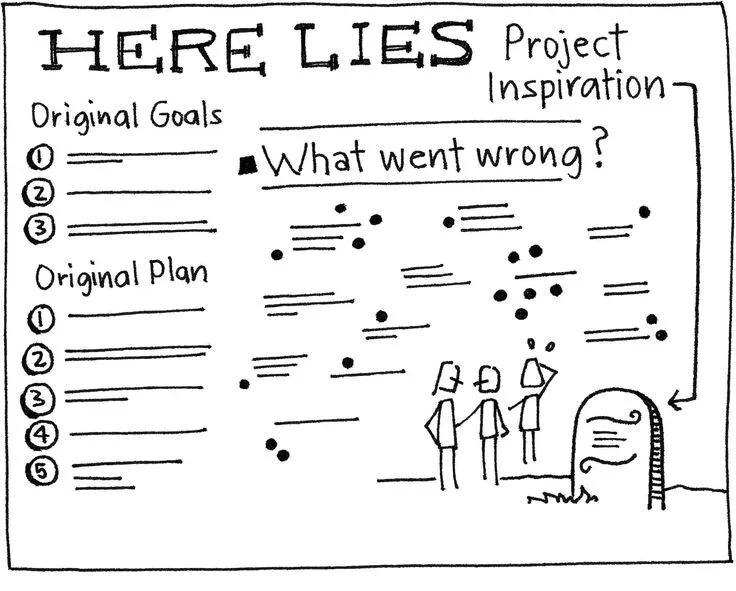
A pre-mortem is a structured planning technique in which a team, before committing to a plan, imagines that the plan has already failed and then works backward to identify every plausible cause of that failure.
Developed by cognitive psychologist Gary Klein, who popularized it in a 2007 Harvard Business Review article, the method exploits "prospective hindsight" - the brain's tendency to generate more specific and numerous causal explanations when it treats an outcome as already decided rather than merely possible.[6]
Unlike traditional risk assessment, the pre-mortem makes it socially acceptable to voice concerns by framing failure-finding as the explicit goal, thereby countering both optimism bias and groupthink simultaneously.
In 1989, cognitive psychologist Gary Klein was studying how firefighters and military commanders made decisions under pressure.[1] He had noticed something that standard decision theory could not explain: experienced practitioners regularly anticipated problems that formal risk assessments missed.
They seemed to know, before anything went wrong, what was likely to go wrong.
Klein traced this capacity to a cognitive mechanism he called prospective hindsight - the ability to reason as if an event had already occurred.[5] When you know something happened, your brain constructs causal explanations fluently and specifically.
When you merely imagine that it might happen, your brain engages much more vaguely. Prospective hindsight exploits this asymmetry: by treating a future failure as if it were already history, you activate the same fluent causal reasoning that makes post-mortems so productive - before the failure, not after it.
From this insight, Klein developed the pre-mortem: a structured meeting technique in which a team, before committing to a plan, imagines that the plan has already failed catastrophically.[2] Each person writes down every reason they can think of for why the failure occurred.
The reasons are then shared, catalogued, and used to strengthen the plan or identify whether the plan should be abandoned.
Daniel Kahneman, who spent decades studying the systematic errors in human judgment, called the pre-mortem "the best remedy I know for overcoming the illusion of certainty."[4]
"The pre-mortem has an advantage over a naked attempt to think negatively. It is a license to search for problems rather than a defense of the plan, which changes the social dynamic of a group that would otherwise be reluctant to identify problems." - Daniel Kahneman, Thinking, Fast and Slow (2011)
The technique is elegant because it addresses two of the hardest problems in planning simultaneously: the cognitive problem of optimism bias and the social problem of groupthink.
Key Definitions
Pre-mortem - A prospective planning technique in which a team imagines a project has already failed and then works backward to identify the most plausible causes of that failure. Developed by Gary Klein (1989). The goal is to identify risks before they become problems while there is still time to act on them.
Prospective hindsight - The cognitive mechanism underlying pre-mortems: reasoning about a future event as if it has already occurred.
Because the brain generates causal explanations more fluently for events it treats as known outcomes than for events it treats as possibilities, prospective hindsight produces more specific and numerous failure scenarios than forward-looking risk assessment.
Post-mortem - An analysis conducted after a project has ended, examining what went wrong and why. Post-mortems are valuable but come too late to prevent the failure being analyzed. The pre-mortem attempts to capture the analytical value of a post-mortem before the project begins.
Optimism bias - The systematic tendency to believe that one's plans will succeed at rates higher than base rates warrant. In project planning, manifests as underestimating time, costs, complications, and obstacles. Both pre-mortems and reference class forecasting are designed to counteract optimism bias, through different mechanisms.
Groupthink - The tendency of cohesive groups to suppress individual dissent and converge on consensus, particularly when the group is led by someone with strong views. Pre-mortems counteract groupthink by making it socially expected - not threatening - to identify problems.
Planning fallacy - Kahneman and Tversky's term for the systematic tendency to produce optimistic estimates of time, cost, and risk for future projects. The planning fallacy operates because inside-view planning focuses on the intended sequence of events rather than the distribution of historical outcomes.
Pre-mortems address the planning fallacy from the inside view: they force explicit consideration of the failure scenarios that inside-view planning ignores.
Red team - An adversarial analysis technique in which a designated team plays the role of opponent or critic, attacking a plan to identify its weaknesses.
Related to pre-mortems, but distinct: red teams take an explicitly adversarial role, while pre-mortems are conducted by the same team building the plan, using the assumption of failure to lower the social cost of criticism.
Black swan - Nassim Taleb's term for rare, high-impact events that are difficult to predict and lie outside normal expectations. Pre-mortems are not designed to identify black swans - genuinely unknown unknowns - but to surface the known unknowns that team members are aware of but reluctant to voice.
The Research: Why Pre-Mortems Work
The Prospective Hindsight Effect
The empirical foundation for pre-mortems was established by Deborah Mitchell, Jay Russo, and Nancy Pennington in a 1989 study that directly tested Klein's prospective hindsight hypothesis.[3] The researchers presented participants with scenarios about future events and asked them to generate explanations either:
- In the standard way: "If this event occurs, why might it occur?"
- In the prospective hindsight way: "This event has occurred. Why did it occur?"
The results were clear: prospective hindsight conditions produced 30% more reasons, and those reasons were substantially more specific and actionable.[7] The effect held across different domains - financial planning, personal decisions, organizational scenarios.
The mechanism is well understood. The brain's causal reasoning system operates more powerfully on known outcomes than on hypothetical ones. When an outcome is treated as certain, the brain engages in directed backward reasoning: it constructs a causal chain from the present state back to the outcome.
When an outcome is treated as possible, the brain's reasoning is less directed - it may generate generic possibilities rather than specific causes.
Pre-mortems exploit this by taking the certain-outcome condition - the one that produces more and better reasons - and applying it to future plans.
Overcoming Social Suppression
The second mechanism that makes pre-mortems effective is social rather than cognitive. In standard planning meetings, raising concerns about a plan carries social costs: you may appear negative, disloyal, or insufficiently committed to the team's goals.
If the leader is visibly invested in the plan, the cost of criticism rises further.
Pre-mortems eliminate this barrier. The entire team is asked to generate failure reasons simultaneously, which means participation means identifying problems. There is no negative signal in finding risks - that is what everyone is supposed to be doing.
People who privately harbor doubts about the plan have structured permission to voice them.
"When a pre-mortem is done well, it creates a group norm where raising concerns is a sign of engagement, not disloyalty. That norm is harder to establish than the technique itself." - Gary Klein, Harvard Business Review (2007)
Klein's fieldwork showed that in many project failures, multiple team members had recognized warning signs in advance and said nothing - not because they lacked knowledge, but because they lacked a social format that made speaking up safe and expected. Pre-mortems create that format.
The Method: Running a Pre-Mortem
The standard pre-mortem format, adapted from Klein's original description and refined through subsequent practice:
Step 1: Brief the Team on the Plan
Before imagining failure, everyone needs a shared understanding of what is being planned. Walk through the key elements: the goal, the timeline, the budget, the approach, the key assumptions. The briefing should be complete enough that team members can think concretely about what failure would look like.
Step 2: Announce the Failure
The facilitator announces the hypothetical: "It is one year from now - or whatever the relevant timeframe is. The project has failed completely. It did not achieve its goals. It ran significantly over budget and schedule. Key stakeholders are disappointed. What happened?"
The framing should be definitive: the project has failed, not might fail. This is essential for activating prospective hindsight. "What could go wrong?" produces a different and weaker cognitive process than "It went wrong - why?"
Step 3: Silent Individual Writing
Give each team member two to four minutes to write down, individually and silently, every reason they can think of for why the failure occurred.
Silence is important: it prevents early responses from anchoring everyone else's thinking, and it ensures that each person's actual knowledge and concerns are captured before group dynamics take over.
The prompt should encourage volume, not quality screening: "Write down everything you can think of, no matter how obvious or how unlikely." People often self-censor their best insights because they seem embarrassingly obvious or seem like they are criticizing someone.
Step 4: Round-Robin Sharing
Go around the table, asking each person to share one item from their list. Record all items publicly - on a whiteboard, shared document, or projected screen. Continue until the list is exhausted. This structure ensures that quieter team members' insights are captured, not just the ideas of the most vocal participants.
The facilitator should not evaluate or respond to items as they are shared - this is not yet a discussion, it is a survey.
Step 5: Clustering and Prioritization
With all failure reasons collected, the group works together to cluster related items, identify the most plausible risks, and assess which deserve the most attention.
Not all identified risks are equally important: some are highly probable, some are low probability but catastrophic, some are already mitigated, and some represent genuine blind spots.
The output of this step is a short list of risks that deserve explicit response in the plan - additional safeguards, monitoring mechanisms, contingency actions, or in some cases, reconsideration of whether the project should proceed at all.
Step 6: Update the Plan
The pre-mortem is not complete until the identified risks have been addressed. The value of the technique lies entirely in this step: using the failure scenarios to change something about the project - its timeline, its approach, its risk monitoring, its contingency plans, or its go/no-go criteria.
A pre-mortem that generates a list of risks and files them without acting on them is worse than no pre-mortem at all: it has created the illusion of risk management without the substance.
Pre-Mortem vs. Related Techniques
| Technique | Timing | Who Conducts It | Primary Goal |
|---|---|---|---|
| Pre-mortem | Before the project | The project team | Identify unknown risks while there is still time to act |
| Post-mortem | After the project | The project team | Learn from actual failure to improve future projects |
| Risk assessment | Before the project | Risk specialists or team | Identify and quantify known risks |
| Red team | Before or during | Adversarial sub-team | Challenge the plan from an opposing perspective |
| Devil's advocate | Any time | Designated individual | Provide structured opposition to a proposed decision |
Pre-mortems occupy a distinct niche: they are conducted by the people who built the plan, which means they draw on deep insider knowledge. They use failure framing to surface knowledge that standard risk assessment misses.
And they occur before commitment, which is the only time identification of problems translates into prevention rather than blame.
Where Pre-Mortems Are Most Valuable
High-Stakes, Hard-to-Reverse Decisions
Pre-mortems are most valuable when the cost of failure is high and reversing course after commitment is difficult or expensive. Capital investment decisions, product launch commitments, strategic partnerships, and major organizational changes all fit this profile.
The cost of spending two hours on a pre-mortem is negligible compared to the cost of discovering major flaws after significant resources have been committed.
Plans Built on Optimistic Assumptions
Many project plans rest on a chain of optimistic assumptions - each plausible individually, but unlikely to all materialize simultaneously. A pre-mortem is particularly valuable for identifying which assumptions are doing the most work.
When teams are asked "it failed - why?", they consistently identify the assumptions they privately doubted but did not challenge explicitly.
Innovative or Novel Projects
For projects that are similar to previous work, experience provides a natural check on overconfidence. For novel projects - new products, new markets, new technologies, new organizational forms - experience is limited and inside-view optimism is most unconstrained.
Pre-mortems are especially valuable when the reference class is thin and the team is largely extrapolating from analogy.
"In novel domains, people's ability to project failure is often better than their ability to project success. They have not done this before, but they have seen other things fail before. Pre-mortems leverage that asymmetric experience." - Gary Klein, interview, Naturalistic Decision Making (2015)
Teams with Hierarchical Dynamics
In teams where status differences are pronounced - where junior members are reluctant to challenge senior members' plans - pre-mortems create a structural intervention. The simultaneous silent writing phase captures junior members' knowledge before the social hierarchy can suppress it.
The facilitator can draw out quieter participants explicitly during the round-robin phase.
Common Mistakes in Application
Too Early in the Process
A pre-mortem conducted before the plan is fully developed will generate generic concerns rather than specific, addressable ones. Team members need to understand the plan in sufficient detail to reason about its specific failure modes. Conducting a pre-mortem on a vague plan produces a vague list of risks.
Too Late in the Process
A pre-mortem conducted after the team is deeply committed to a plan will be psychologically compromised by sunk cost and identity investment. Members who have spent weeks building a plan have a psychological stake in it succeeding that makes it harder to imagine its failure credibly.
The technique works best when commitment is present but not yet total.
Skipping the Silent Writing Phase
The most common facilitation error is asking the group to generate failure reasons as a discussion rather than as individual silent writing.
Discussion allows the first responses to anchor everyone else's thinking, it allows social dynamics to suppress minority views, and it misses the cognitive benefit of individual prospective hindsight. The silent phase is the mechanism - it is not optional.
Not Updating the Plan
A pre-mortem that produces a risk list without changing anything is a form of organizational theater. The identified risks need to become specific plan modifications, monitoring commitments, or contingency triggers.
If the pre-mortem reveals risks that cannot be addressed within the current plan and budget, that is important information that should affect the go/no-go decision.
Treating the Pre-Mortem as One-Time
For long or complex projects, a single pre-mortem at the beginning is insufficient. As projects evolve, new risks emerge and the team's understanding deepens. Periodic pre-mortems at major milestones - particularly before significant new phases of work begin - apply the technique iteratively, where it can do the most good.
The Pre-Mortem and Organizational Culture
The pre-mortem is technically simple but organizationally demanding. Its effectiveness depends on a culture where:
- Raising problems is valued, not penalized
- Leadership genuinely wants to hear bad news
- Failure is treated as information, not as evidence of insufficient commitment
In organizations that punish bearers of bad news, pre-mortems will be performed but not honestly. Team members will go through the motions, identify only safe and obvious risks, and preserve the plan essentially unchanged. The technique requires a culture where critical thinking is rewarded at the planning stage.
When the cultural conditions are met, pre-mortems have effects beyond the specific project. They establish a norm that planning includes adversarial thinking - that it is expected, not exceptional, to ask "how will this fail?" before committing.
That norm, applied consistently, is one of the most powerful tools available for improving an organization's decision-making quality over time.
For related concepts, see reference class forecasting, the planning fallacy, and probabilistic thinking.
Sources & Further Reading
- Klein, G. (1989). Strategies of Decision Making. Military Review, May 1989.
- Klein, G. (2007). Performing a Project Premortem. Harvard Business Review, September 2007. View source
- Mitchell, D. J., Russo, J. E., & Pennington, N. (1989). Back to the Future: Temporal Perspective in the Explanation of Events. Journal of Behavioral Decision Making, 2(1), 25-38. DOI: 10.1002/bdm.3960020103
- Kahneman, D. (2011). Thinking, Fast and Slow. Farrar, Straus and Giroux.
- Klein, G. (1998). Sources of Power: How People Make Decisions. MIT Press.
- Klein, G. (2013). Seeing What Others Don't: The Remarkable Ways We Gain Insights. PublicAffairs.
- Russo, J. E., & Schoemaker, P. J. H. (2002). Winning Decisions: Getting It Right the First Time. Currency/Doubleday.
Further Reading
- Tetlock, P. E., & Gardner, D. (2015). Superforecasting: The Art and Science of Prediction. Crown Publishers.
This article is part of Better Decisions Under Uncertainty - our practical guide and toolkit for making better choices with incomplete information.