
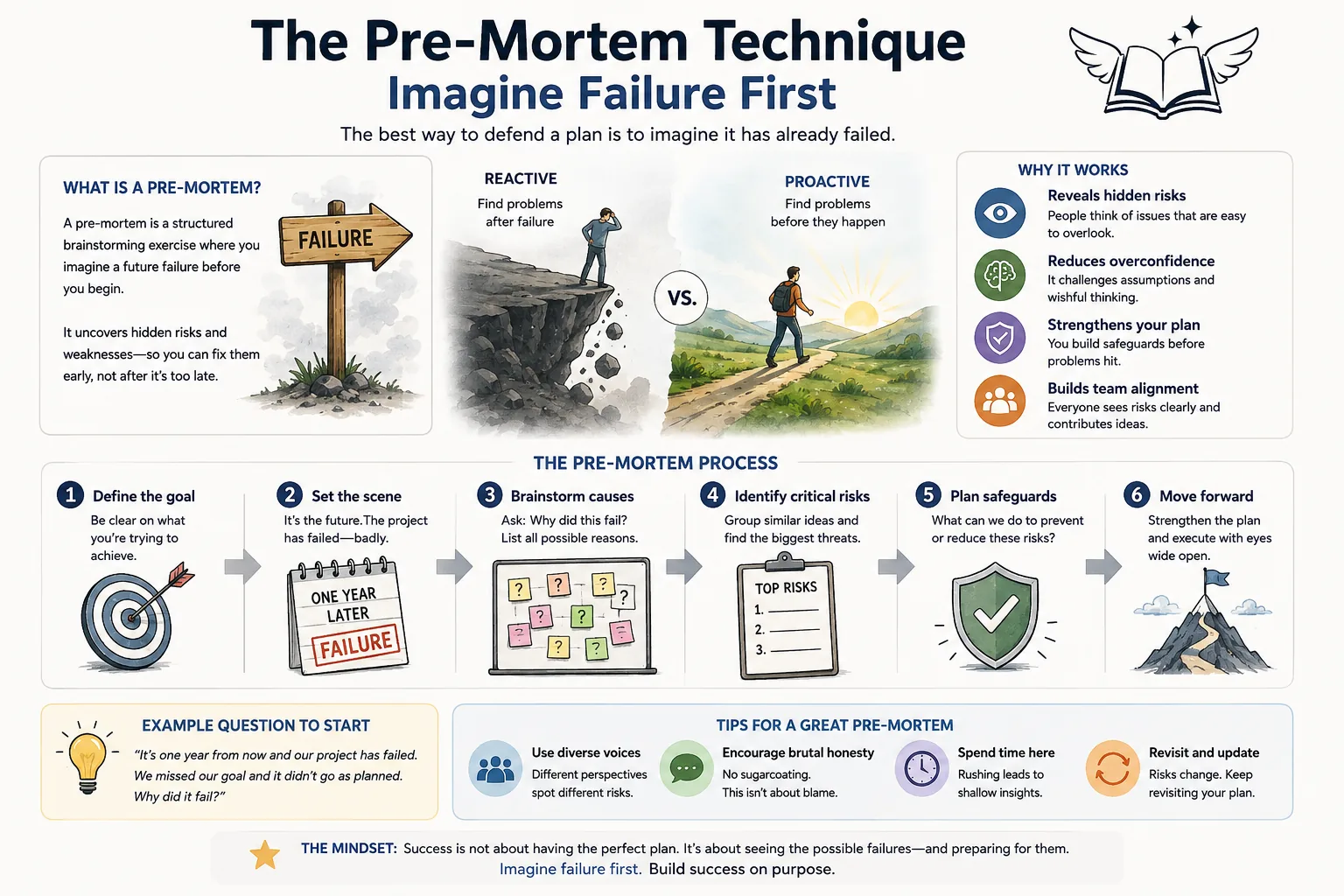
Premortem: Most teams plan as if success were the default and failure an unfortunate accident. They build the roadmap, assign the owners, set the launch date, and proceed with a quiet, shared optimism that the thing will work. Then, months later, when it has not worked, they gather for a postmortem to ask what went wrong. By then the answer is expensive.
The premortem inverts this ritual. Before a single resource is committed, the team imagines that the project has already failed, completely and visibly, and then works backward to explain why. It is one of the simplest and most powerful debiasing techniques ever devised, and it owes its strange effectiveness to a quirk in how the mind generates explanations.
The technique was popularized by the research psychologist Gary Klein, who studies how experts make decisions under pressure.[1] Its logic, however, rests on a body of work in cognitive science about a phenomenon called prospective hindsight: the curious finding that asking people to assume an outcome has already happened makes them dramatically better at imagining how it came to be. A premortem is prospective hindsight turned into a meeting.
“A premortem is the hypothetical opposite of a postmortem. A postmortem in a medical setting allows health professionals and the family to learn what caused a patient’s death. Everyone benefits except, of course, the patient. A premortem in a business setting comes at the beginning of a project rather than the end, so that the project can be improved rather than autopsied.” - Gary Klein, Performing a Project Premortem, Harvard Business Review (2007)
What a Premortem Actually Is
A premortem is a structured exercise conducted just before a team commits to a plan. The leader gathers everyone who will work on the project, presents the plan as if it were final, and then delivers a deliberately jarring instruction: imagine it is some months in the future and the project has failed outright.
Not stumbled, but failed in a way everyone can see. The task is then to write down, individually and privately, every plausible reason that failure occurred.
The crucial mechanics are the assumed certainty of failure and the private writing. Participants do not debate whether the project might fail; they are told it has, and asked only to explain why. This small shift in framing does most of the work.
After the silent writing, each person reads one reason aloud in turn, the facilitator records them all, and the team uses the list to strengthen the plan before launch. The whole exercise can run in about an hour.
It helps to be concrete about scale. Failure here does not mean a slipped deadline. The instruction is to imagine total, unambiguous failure: the project was cancelled, the customers revolted, the budget evaporated.
The extremity is load-bearing. A mild failure invites mild, hedged explanations, while a catastrophic one licenses the imagination to reach for the structural weaknesses that a polite risk review would never name aloud.
The Engine: Prospective Hindsight
The premortem is not folk wisdom dressed up as method. It runs on a specific experimental finding. In 1989, Deborah J. Mitchell, J. Edward Russo, and Nancy Pennington published a study on what they called prospective hindsight. They asked participants to imagine a future event and to generate explanations for it.
The key manipulation was the certainty of the outcome. One group was asked to imagine that an outcome might occur and to explain why it could; another was told the outcome had occurred and to explain why it did.
The difference was substantial. When people assumed an event had already happened, the certainty of the framing freed their imagination, and the explanations they produced grew longer, more concrete, and richer in specific causal reasons. That gain in the ability to identify plausible reasons for an outcome is the empirical foundation of the entire technique, and it is the source of the figure most often quoted alongside the premortem.
Mitchell, Russo, and Pennington found that participants using prospective hindsight generated roughly 30% more possible reasons for a future outcome than participants using ordinary foresight.[2]
The study measured the quantity and richness of reasons generated, not whether those reasons were more accurate: prospective hindsight is a tool for surfacing a wider set of candidate explanations, not a guarantee that any one of them is correct. (Mitchell, Russo, and Pennington, Back to the future: Temporal perspective in the explanation of events, Journal of Behavioral Decision Making, 1989.)
Why should certainty matter so much? Because uncertainty suppresses search. When a failure is merely possible, the mind hedges, treats each potential cause as low-probability, and stops looking early. When the failure is treated as a settled fact, the mind switches into explanation mode, which is a far more productive cognitive stance.
We are extraordinarily good at constructing coherent narratives for things that have happened and oddly poor at it for things that merely might. The premortem hijacks the storytelling machinery we use for the past and points it at the future.
There is a subtle second benefit hiding in the same mechanism. Explanations of settled events tend to be specific and episodic rather than abstract. A team asked what might go wrong produces categories: scope creep, technical debt, vendor risk. A team told the project did go wrong produces stories: the vendor missed the integration deadline in week six, the one engineer who understood the legacy system left.
Specific stories are actionable in a way that abstract categories are not, because each one points at a particular decision someone could make differently today.
Why Ordinary Risk Assessment Fails
Organizations already have a tool for this, in theory. It is called risk assessment, and it usually produces a register of generic hazards that nobody truly believes in. The reason it underperforms is social and psychological, not procedural.
By the time a plan reaches the point of execution, the group has converged on it. Doubt has become disloyalty. Raising concerns feels like obstruction, or worse, like a lack of faith in the team. The result is a phenomenon Daniel Kahneman, drawing directly on Klein’s work, described in Thinking, Fast and Slow.
“The main virtue of the premortem is that it legitimizes doubts. Furthermore, it encourages even supporters of the decision to search for possible threats that they had not considered earlier.” - Daniel Kahneman, Thinking, Fast and Slow (2011)
This is the second engine of the technique, separate from prospective hindsight. A premortem reframes dissent as a contribution. The person who finds the most damning reason for failure is no longer the team’s pessimist; they have won the game. Status that normally flows to the most enthusiastic voice flows instead to the most penetrating critic. The technique converts a social pressure that suppresses warnings into one that rewards them.[3]
| Standard risk meeting | Premortem |
|---|---|
| “What could go wrong?” | “It went wrong. Why?” |
| Raising doubts signals disloyalty | Raising doubts wins the exercise |
| Loudest optimist sets the tone | Sharpest critic earns the status |
| Vague, generic hazards | Concrete, specific failure stories |
| Often skipped under time pressure | Takes one structured hour |
Premortem versus Postmortem
The naming is deliberate and instructive. A postmortem, borrowed from medicine, examines a project after it has died to learn what killed it. The knowledge is real but arrives too late to help the project that generated it. A premortem captures the same diagnostic clarity while the patient is still healthy and the prescription can still be filled.
| Dimension | Postmortem | Premortem |
|---|---|---|
| Timing | After completion or failure | Before commitment |
| Question | What did go wrong? | What will have gone wrong? |
| Cost of lessons | Already paid in full | Still avoidable |
| Emotional tone | Blame, defensiveness | Curiosity, play |
| Who benefits | Future projects | This project |
The emotional difference is underrated. Postmortems are tense because real failure has occurred and real people may be responsible; defensiveness is rational. A premortem carries no such weight. The failure is hypothetical, so nobody owns it, and people are free to be ruthlessly honest about a disaster that has not actually embarrassed anyone. The same person who would never admit a weakness in their own component will happily narrate, with relish, the imaginary catastrophe it caused.
How to Run One
The procedure is simple enough to learn in a single sitting, which is part of its appeal. The steps below reflect Klein’s original formulation with the practical refinements teams have added since.
First, assemble the full team once the plan is essentially complete but before resources are locked. Everyone with a stake should be present, including skeptics, who are assets here rather than liabilities. Second, set the scene precisely: state that it is, say, a year from now, and the project has failed completely. Use concrete language and a vivid sense of certainty; vagueness weakens the effect.
Third, give people a few minutes of silent, individual writing to list reasons for the failure. The silence matters because it prevents the first voice from anchoring everyone else and protects independent thinking. Fourth, go around the room and have each person contribute one reason at a time, recording every item without debate or ranking until the list is exhausted.
Fifth, review the assembled reasons, identify the ones that are both plausible and serious, and convert them into changes to the plan, owners, and monitoring. Finally, keep the list. Revisiting it midway through the project turns a one-time exercise into an early-warning system.
A small facilitation detail decides much of the outcome: the project’s most senior champion should write and contribute last. Authority leaks. The moment a director offers the first reason for failure, every subsequent contribution quietly tilts toward agreeing with the director. The silent-writing step is the structural defense against this, but a self-aware facilitator reinforces it by speaking least and recording most.
Common Failure Modes of the Technique Itself
A premortem can be run badly, and a bad one is worse than none because it manufactures false confidence. The most frequent error is treating it as theater, a box-ticking ritual whose conclusions are ignored. If the reasons surfaced do not change the plan, the team has merely rehearsed its anxieties. The exercise is only as valuable as the modifications it produces.
A second error is conducting it too late, after resources are committed and momentum makes reversal impossible. By then the honest conclusion may be that the project should not proceed, and a team that cannot act on that conclusion will quietly suppress it.
A third is allowing the loudest or most senior person to speak first, which collapses the independence that gives the technique its power. The silent-writing step exists to prevent this and should never be skipped. A fourth is stopping at the list. Naming a failure is diagnosis, not treatment; each serious reason needs an owner, a mitigation, and a tripwire that will reveal whether it is starting to come true.
A fifth, subtler error is running the premortem only once, at the kickoff, and never returning to it. Plans drift. The risk that seemed remote in month one becomes the live threat of month four, and a list filed away after the launch meeting protects no one. The teams that get the most from the technique treat the premortem document as a living register, reread at each major milestone, with each tripwire checked rather than admired once and forgotten.
The Premortem and the Planning Fallacy
The technique is best understood as a targeted antidote to one of the most robust findings in decision research: the planning fallacy. People systematically underestimate the time, cost, and risk of their own projects while knowing perfectly well that similar projects routinely run over. Kahneman and Amos Tversky introduced the idea, and it has since been documented everywhere from student essays to government megaprojects.
The planning fallacy persists because we plan from the inside, constructing a best-case scenario step by step and treating it as the expected case.[4] We imagine the project unfolding as intended and rarely populate that imagined future with the ordinary frictions that always arrive.
A premortem forces what researchers call the outside view: instead of building up an optimistic forecast, it starts from a realistic destination, failure, and reverse-engineers the path. It is a deliberate corrective to a bias that optimism alone cannot fix, because the bias is invisible from inside the plan that produced it.
The connection is not incidental. Buehler, Griffin, and Ross showed that people generate predictions by focusing on plan-based scenarios of how a task will unfold rather than on how similar tasks have actually gone in the past.[7] The premortem attacks exactly that habit. By forcing the team to inhabit a finished, failed version of the project, it drags attention toward the messy reference class of things that go wrong, which is where the realistic information lives.
The Limits of Imagining Failure
Honesty requires noting what a premortem cannot do. It surfaces failures the team is capable of imagining; it is silent about the ones nobody can conceive. Genuine black-swan events, by definition, will not appear on the list. The technique also depends on a culture safe enough for candor; in an organization where the imagined catastrophe is read as a real accusation, people will pull their punches and the exercise will produce a sanitized list of acceptable worries.
There is also the matter of acting on what it reveals. A premortem that uncovers a fatal flaw is only useful if the team is willing to delay, redesign, or cancel in response. Many are not, especially once public commitments have been made. The technique can illuminate the cliff edge with perfect clarity and still fail to stop a team that has already decided to drive over it. As a generator of foresight it is excellent; as a source of courage, neutral.
The Animal Dimension
The deep machinery behind the premortem is the human capacity to mentally simulate events that have not occurred, and this is where comparing ourselves to other animals becomes illuminating. The premortem works by running a vivid forward simulation, imagining a detailed future and treating it as real enough to learn from. This kind of episodic future thinking, mentally projecting oneself into a specific future scenario, was long thought to be uniquely human.
The picture is more interesting than that. Research by Caroline Raby, Nicola Clayton, and colleagues on western scrub-jays showed that the birds will cache food in locations where they have learned breakfast will not be provided, planning for a future state of hunger they are not currently experiencing, which suggests a form of future-oriented action that does not depend on present drive.[5]
Studies of great apes by Nicholas Mulcahy and Josep Call have found that bonobos and orangutans will select and save the right tool for use up to fourteen hours later, anticipating a need that does not yet exist.[6] Yet there is a clear gap. No animal appears able to construct the rich, counterfactual, narrative simulation of a complex failure that a premortem demands, populated with imagined colleagues, decisions, and consequences that never happened.
The human gift is not merely planning for the future but inhabiting an imagined future in enough detail to mine it for warnings. The premortem is a domestication of that gift, a way of pointing our unusually powerful simulation engine at the one future we most want to avoid.
Why It Works When Willpower Does Not
The reason the premortem outperforms simply telling people to “think harder about risks” is that it does not rely on individual virtue. It changes the structure of the task rather than exhorting the participants. Prospective hindsight does the cognitive work, lifting the quantity and quality of reasons regardless of how careful any one person tries to be.
The reframing of dissent as a winning move does the social work, so that the warnings people privately hold no longer have to fight an uphill battle to be spoken. Neither effect depends on anyone being braver, smarter, or more pessimistic than they naturally are. The technique recruits ordinary minds in an unusual configuration and lets the configuration do the lifting.
This is the general lesson behind the specific tool. The most reliable way to improve a judgment is rarely to ask people to be better; it is to redesign the moment in which the judgment is made. A premortem is a small piece of cognitive architecture, an hour of structured imagination placed at exactly the point where a plan is most confident and least examined.
It costs almost nothing and routinely surfaces the one objection that, voiced too late, would have shown up in the postmortem instead. The difference between the two meetings is the difference between learning a lesson and using it.
Related Resources
- The Planning Fallacy: Why Everything Takes Longer Than You Think
- Groupthink: How Smart Teams Make Bad Decisions
- Hindsight Bias: The I-Knew-It-All-Along Effect
- The Outside View: Forecasting From Reference Classes
References
- Klein, G. (2007). Performing a project premortem. Harvard Business Review, 85(9), 18-19. https://hbr.org/2007/09/performing-a-project-premortem
- Mitchell, D. J., Russo, J. E., & Pennington, N. (1989). Back to the future: Temporal perspective in the explanation of events. Journal of Behavioral Decision Making, 2(1), 25-38. https://doi.org/10.1002/bdm.3960020103
- Kahneman, D. (2011). Thinking, Fast and Slow. Farrar, Straus and Giroux.
- Kahneman, D., & Tversky, A. (1979). Intuitive prediction: Biases and corrective procedures. TIMS Studies in Management Science, 12, 313-327.
- Raby, C. R., Alexis, D. M., Dickinson, A., & Clayton, N. S. (2007). Planning for the future by western scrub-jays. Nature, 445(7130), 919-921. https://doi.org/10.1038/nature05575
- Mulcahy, N. J., & Call, J. (2006). Apes save tools for future use. Science, 312(5776), 1038-1040. https://doi.org/10.1126/science.1125456
- Buehler, R., Griffin, D., & Ross, M. (1994). Exploring the “planning fallacy”: Why people underestimate their task completion times. Journal of Personality and Social Psychology, 67(3), 366-381. https://doi.org/10.1037/0022-3514.67.3.366