
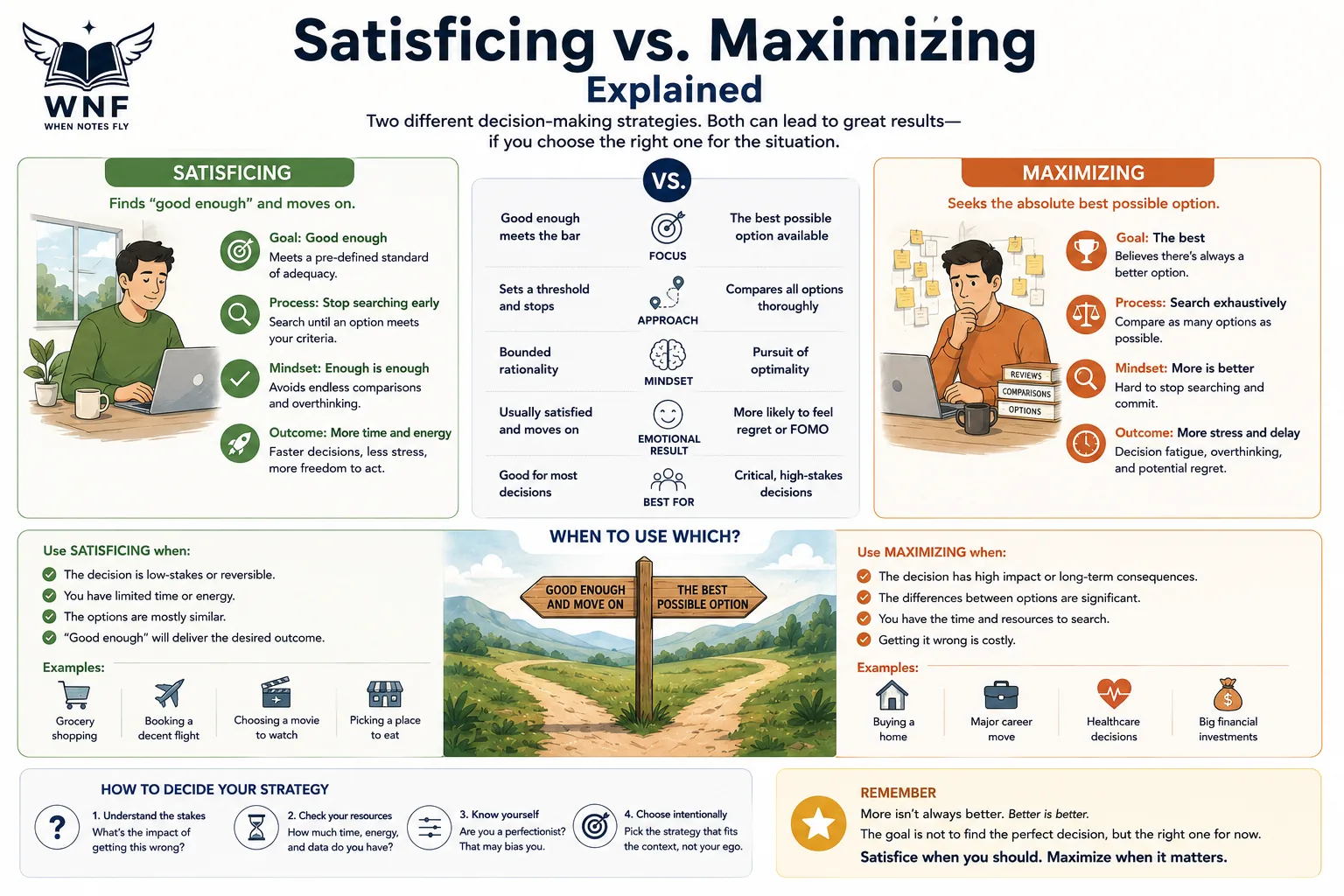
Satisficing: Every decision, from choosing a restaurant to accepting a job offer, forces a quiet choice about how to decide. Do you search until you find the single best option, or do you settle for the first option that clears a bar you consider good enough? These two strategies have names.
Aiming for the best is maximizing. Settling for good enough is satisficing. The distinction sounds trivial, but it shapes how much time we spend deciding, how confident we feel afterward, and how satisfied we end up with what we chose.
The word satisficing blends satisfy and suffice. It was introduced to describe how real people and organizations actually make decisions when they cannot examine every possibility. Rather than optimizing across all options, which is often impossible, they set a threshold of acceptability and take the first choice that meets it. Understanding when to satisfice and when to maximize is one of the most practical skills in everyday decision making.
The Two Strategies Defined
A maximizer treats a decision as a search for the optimal answer. Before committing, a maximizer wants to survey the field, compare alternatives, and be confident that nothing better was missed. The goal is the best possible outcome.
A satisficer treats a decision as a search for a sufficient answer. A satisficer decides in advance what would count as good enough, then chooses the first option that meets those criteria and stops looking. The goal is an outcome that is genuinely good, not necessarily the best.
Neither strategy is about the quality of a person’s standards. A satisficer can have very high standards. The difference is the stopping rule. A maximizer stops when convinced no better option exists. A satisficer stops when an option clears the threshold, whether or not something better might be out there.
Why Maximizing Has Hidden Costs
Maximizing sounds obviously superior. If you want the best, why would you settle for less? The catch is that searching for the best carries costs that the strategy tends to ignore.
The Search Never Cleanly Ends
In most real situations, the full set of options is unknown or unbounded. There is always one more listing to check, one more review to read, one more candidate to interview. A maximizer has no natural stopping point because you can never be certain you have seen the best. This can turn a decision into an open ended search that consumes time and mental energy out of proportion to what is at stake.
More Options Can Mean Less Satisfaction
A well documented pattern is that maximizers often end up less satisfied with their choices than satisficers, even when their choices are objectively as good or better. Because a maximizer measures every outcome against the unknown ideal that might have been, there is always a lingering doubt that a better option was missed. Satisficers, having defined good enough in advance, are more likely to feel content once the threshold is met.
Decision Fatigue and Regret
Extended searching drains cognitive resources, a phenomenon related to decision fatigue. It also invites regret, because the more alternatives you considered, the more you can imagine having chosen differently. The mental effort spent maximizing a minor decision is effort not available for decisions that matter more.
Why Satisficing Is Often the Smarter Default
Satisficing is not laziness or lowering standards. It is a recognition that time, attention, and comparison are themselves scarce resources. Spending them wisely is part of a good decision.
Setting a threshold before you start turns an open ended search into a bounded one. Instead of asking is this the best, you ask does this meet my criteria. That question has a clear answer, so the decision ends cleanly. For the large majority of choices we face, which are low stakes and reversible, the first good enough option is not measurably worse than the theoretical best, and it arrives far sooner with far less strain.
Satisficing also protects satisfaction. By committing to a standard rather than an unreachable ideal, you avoid the trap of comparing your real choice to an imagined perfect one. You judge the outcome by whether it is good, which it is, rather than by whether it is the best, which you can never confirm.
When Maximizing Is Worth the Effort
Satisficing as a default does not mean never maximizing. Some decisions genuinely deserve an exhaustive search. The question is whether the stakes justify the cost.
Maximizing tends to pay off when a decision is high stakes, hard to reverse, and made rarely. Choosing where to live for the next decade, making a major and irreversible financial commitment, or a hiring decision with large consequences can justify a thorough search, because the difference between a good outcome and the best outcome is large and durable. In these cases the extra time spent comparing is a reasonable investment.
Maximizing wastes effort when a decision is low stakes, easily reversed, or frequently repeated. Choosing which coffee to order, which of several adequate products to buy, or where to eat lunch does not reward an exhaustive search, because the gap between good enough and best is tiny and short lived.
| Factor | Favors satisficing | Favors maximizing |
|---|---|---|
| Stakes | Low | High |
| Reversibility | Easy to undo | Hard to undo |
| Frequency | Made often | Made rarely |
| Number of options | Overwhelming | Manageable |
| Value gap between good and best | Small | Large |
How to Apply the Distinction in Practice
The goal is not to become a pure satisficer or a pure maximizer but to match the strategy to the decision.
Sort the Decision First
Before deciding, spend a moment classifying the decision. Is it high stakes and irreversible, or low stakes and routine? This quick triage tells you which strategy fits. Reserving your maximizing energy for the small number of decisions that deserve it is itself a powerful habit.
Define Good Enough in Advance
For satisficing to work, set your threshold before you begin searching, not after. Decide what criteria an option must meet, then commit to taking the first option that meets them. Setting the bar afterward invites the option you found to drift your standards around.
Bound Your Search
For decisions where you lean toward maximizing, put explicit limits on the search: a number of options to compare, or a deadline to decide. Bounding the search captures most of the benefit of maximizing while preventing it from turning into an endless loop.
Notice Your Own Tendency
Some people lean strongly toward maximizing across the board and pay for it in stress and second guessing. If you recognize this pattern in yourself, deliberately practicing satisficing on small decisions can free up energy and reduce regret without meaningfully worsening outcomes.
Satisficing as a Response to Limits
At its root, satisficing is an honest response to the fact that human attention and information are limited. We can never fully know all our options or perfectly predict outcomes, so a strategy that demands the provable best is chasing something unattainable. Satisficing accepts these limits and works within them, aiming for outcomes that are reliably good rather than theoretically optimal.
This is why the distinction matters beyond individual choices. Organizations, like people, cannot optimize across every possibility. They set thresholds, adopt the first workable solution, and move on. Recognizing this helps explain why real decisions rarely look like the clean optimization of textbook models, and why that is often reasonable rather than a failure.
Conclusion
Satisficing and maximizing are two answers to the same underlying question: when do I stop searching and decide? Maximizing pursues the best and pays for it in time, effort, and lingering doubt. Satisficing pursues good enough and, for most decisions, delivers outcomes nearly as good at a fraction of the cost while leaving you more content.
The skill is not to pick one strategy for life but to sort your decisions, reserve maximizing for the few that are high stakes and irreversible, and satisfice the rest. Deciding how to decide is often more valuable than the decision itself.