
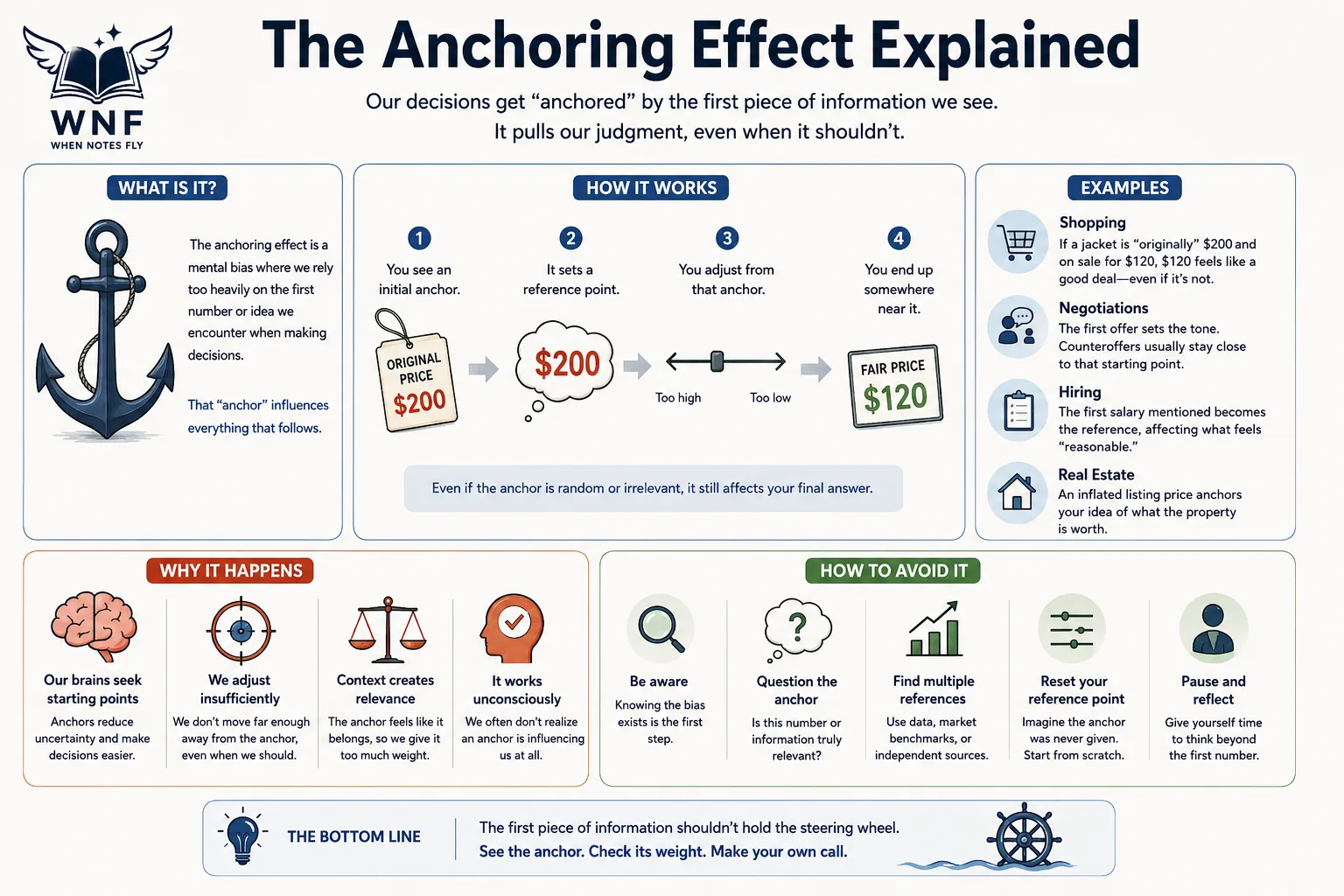
The anchoring effect is the tendency for an initial number to pull later estimates toward it, even when that number is arbitrary or clearly irrelevant. People adjust away from a starting point too little, affecting judgments about prices, salaries, sentencing, property, and factual quantities. Because the influence persists despite expertise and warnings, separating a decision from the first figure encountered is a practical safeguard.
Imagine you are asked whether the population of Turkey is more or less than five million, and then asked to give your best estimate. Now imagine a different person is asked whether it is more or less than ninety million, and then asked the same estimating question.
Decades of research predict that the second person will give a substantially higher final estimate than the first, even though both people know the initial figure was arbitrary and uninformative. The first number, plucked from nowhere, has quietly tilted the answer.
This is the anchoring effect, and it is one of the most robust, well-replicated, and unsettling findings in the study of human judgment.
What makes anchoring so striking is not that it exists but how stubborn it is. It survives warnings. It survives expertise. It survives being told outright that the anchor is random.
Once a number is on the table, the mind treats it as a gravitational center and adjusts away from it too little.
Understanding this single mechanism changes how you read a price tag, a salary offer, a sentencing recommendation, and a real estate listing. It is, in a real sense, the hidden architecture of how the first number shapes the rest.
“Many decisions are based on beliefs concerning the likelihood of uncertain events… In making estimates, people start from an initial value that is adjusted to yield the final answer. Different starting points yield different estimates, which are biased toward the initial values. We call this phenomenon anchoring.” - Amos Tversky and Daniel Kahneman, Science (1974)
Key Definitions
The anchoring effect, also called anchoring bias or anchoring-and-adjustment, is a cognitive bias in which an initial piece of numerical information, the anchor, exerts a disproportionate pull on a subsequent quantitative judgment. People adjust their estimate away from the anchor but insufficiently, so the final judgment ends up biased toward the starting point.
The anchor need not be relevant, accurate, or even chosen by anyone with information. It can be a random number, an opening offer in a negotiation, a manufacturer’s suggested price, or a figure the judge encountered moments earlier in an unrelated context. The defining feature is that the number arrives first and then contaminates everything that follows.
It is worth separating two ideas that often get blurred. Adjustment is the deliberate process of moving away from a starting value you generated yourself. Anchoring is the broader phenomenon in which an externally supplied number distorts judgment, and much of that distortion appears to happen through automatic mechanisms rather than effortful adjustment.
The Founding Experiment
The anchoring effect was named and demonstrated in the same landmark 1974 paper by Amos Tversky and Daniel Kahneman, the work that launched the modern study of heuristics and biases.[1] Their demonstration was almost theatrically simple, which is part of why it became famous.
Participants were shown a wheel of fortune marked from 0 to 100. Unknown to them, the wheel was rigged to stop only on either 10 or 65. After the wheel stopped, each participant was asked two questions: first, whether the percentage of African nations in the United Nations was higher or lower than the number on the wheel; second, what they thought the actual percentage was.
The result is the foundation of the entire field. Participants who saw the wheel land on 10 gave a median estimate of 25 percent. Those who saw it land on 65 gave a median estimate of 45 percent. A spin of a transparently random wheel, a number the participants had just watched be generated by chance, moved their factual estimates by twenty percentage points.
“It occurs because… the initial value, or starting point, may be suggested by the formulation of the problem, or it may be the result of a partial computation. In either case, adjustments are typically insufficient.” - Daniel Kahneman, Thinking, Fast and Slow (2011)
The genius of the wheel was that it removed every rational reason to use the number. Nobody believes a roulette wheel knows geography. And yet the number stuck. That is the signature of a bias operating below the level of conscious reasoning. The wheel proved that the pull does not depend on the anchor deserving any trust at all.
How Strong Is the Pull?
A useful way to think about anchoring is the anchoring index, a measure of how much of the gap between a high anchor and a low anchor carries through into people’s final answers. If two anchors are far apart and people’s answers are equally far apart, the index approaches 100 percent, meaning total capture by the anchor. If the anchors make no difference, the index is zero.
In practice, the index is alarmingly high across many tasks. The table below summarizes several well-documented anchoring demonstrations and the kind of effect they produce.
| Study or domain | The anchor | What it shifted |
|---|---|---|
| Tversky & Kahneman (1974) UN wheel | Random 10 vs 65 | Estimates of UN nations: 25% vs 45% |
| Strack & Mussweiler (1997) | Gandhi died before/after age 9 vs 140 | Age-at-death estimates pulled toward extreme anchors |
| Englich et al. (2006) sentencing | Prosecutor demand / dice roll | Judges’ prison sentences moved by months |
| Northcraft & Neale (1987) real estate | Listing price of a house | Expert appraisals tracked the list price |
Kahneman gives a concrete illustration in Thinking, Fast and Slow.[2] In a study where people estimated the height of a redwood, one group was anchored with a high figure of 1,200 feet and another with a low figure of 180 feet, a gap of 1,020 feet.
The two groups produced mean estimates of 844 and 282 feet, a difference of 562 feet. Dividing one by the other gives an anchoring index of about 55 percent: more than half the distance between the low and high anchors passed straight into the final answer.
Kahneman notes that a value near 55 percent is typical across many such problems. That is an enormous, reliable distortion for something most people insist does not affect them.
Why It Happens: Two Mechanisms
Researchers have proposed two complementary explanations, and the evidence suggests both operate depending on circumstances.
The first is the original anchoring-and-adjustment account. When you generate an estimate, you start from an available number and adjust until you reach a value that seems plausible.
Adjustment is effortful, so you stop at the near edge of the range of plausible answers rather than its center, landing too close to the anchor.
This account fits cases where the anchor is self-generated, such as estimating the boiling point of water on a high mountain by starting from the familiar 100 degrees Celsius and adjusting downward.
Nicholas Epley and Thomas Gilovich provided direct evidence for this terminate-at-plausibility pattern, showing that adjustments from self-generated anchors stop as soon as a barely acceptable answer is reached.[6]
The second is selective accessibility, developed by Thomas Mussweiler and Fritz Strack.[3] On this view, considering whether the answer might be as high as the anchor causes your mind to retrieve information consistent with that high value.
By the time you produce an estimate, your memory is saturated with anchor-consistent evidence, which biases the answer upward.
This mechanism explains why anchoring occurs even when the anchor is supplied externally and no deliberate adjustment takes place.
It also explains the Gandhi result: asked whether Gandhi died before or after age 140, people who know nobody lives that long still nudge their estimate upward, because entertaining the question primes thoughts of old age.
| Mechanism | Core idea | When it dominates |
|---|---|---|
| Anchoring-and-adjustment | Start at a value, adjust too little | Self-generated anchors |
| Selective accessibility | Anchor primes consistent evidence | Externally provided anchors |
The practical upshot is the same under either account: the first number reshapes the search for the answer, and the answer comes back wearing the anchor’s color.
The Disturbing Robustness of the Effect
What elevates anchoring from a laboratory curiosity to a serious concern is how resistant it is to the defenses people assume will protect them.
It resists expertise. In a classic 1987 study by Gregory Northcraft and Margaret Neale, professional real estate agents toured an actual house and were given a packet that included a listing price.[4]
The listing price was manipulated across groups. The agents’ appraisals, supposedly grounded in comparable sales and professional judgment, tracked the listing price closely. Tellingly, the agents denied that the listing price had influenced them at all, even as their own numbers betrayed the influence.
It resists warning. Telling people about the anchoring effect, or instructing them to correct for it, produces only modest reductions. The bias does not announce itself in consciousness, so there is no obvious thing for the warning to switch off. You cannot consciously decline to be influenced by a process you cannot feel happening.
It resists incentives. Offering money for accurate answers does not reliably eliminate anchoring, which is hard to square with the idea that it is merely laziness. If the bias were simply a failure to try, paying people to try harder would fix it. It largely does not.
Perhaps most disturbingly, it operates in courtrooms. Birte Englich and colleagues showed that experienced criminal judges, asked to roll a pair of dice and then recommend a sentence, gave longer sentences after rolling high numbers than after rolling low ones.[5]
The dice were openly random and irrelevant to the case. The judges still anchored on them. When the number that decides a prison term can be nudged by a die, the stakes of this bias stop being academic and start being a matter of justice.
Anchoring in the Marketplace
Nowhere is anchoring exploited more deliberately than in pricing and sales. The entire apparatus of “compare at” prices, slashed-out original prices, and manufacturer’s suggested retail prices is anchoring engineered into commerce. A jacket marked down from a fictional 400 dollars to 160 feels like a bargain; the same jacket priced simply at 160 does not. The first number does the persuading.
Restaurant menus use a similar trick. Placing one extravagantly expensive dish at the top of a section raises the anchor against which every other dish is judged, making mid-priced options look reasonable by comparison. The expensive item need not sell; it only needs to be seen.
“It is a poor sort of memory that only works backwards.” - Lewis Carroll, Through the Looking-Glass (1871)
Carroll’s line is a useful warning in reverse: our judgments work forward from whatever number we encounter first, and that forward pull is precisely what marketers harvest. The defense is not to feel clever about spotting the trick, because feeling clever does not neutralize the bias. The defense is to generate your own independent reference point, ideally before you ever see the seller’s number, so that your judgment has an anchor of its own to compete with theirs.
Anchoring in Negotiation
Negotiation is anchoring’s natural habitat, and the research here is unusually actionable. A large body of evidence indicates that the party who makes the first offer tends to achieve a better outcome, because that offer becomes the anchor around which the rest of the bargaining orbits. The conventional folk wisdom that you should let the other side “show their hand” first is, in many structured negotiations, exactly backwards.
The reason is selective accessibility again. An aggressive but not absurd opening offer floods both parties’ attention with reasons that figure might be justified. The counteroffer then moves away from the anchor but insufficiently, settling closer to the opener’s preferred range than to the responder’s.
This does not mean first offers always win, and it comes with caveats. An anchor that is so extreme it seems insulting can backfire and damage the relationship or end the talks. And a well-prepared counterpart can blunt the anchor by refusing to engage with it and re-anchoring with their own well-justified number. But the core lesson stands: in a negotiation, the first credible number on the table has disproportionate power, and surrendering that power without thinking is a costly habit.
What Reduces Anchoring
Because anchoring runs largely on automatic processes, the interventions that work are not exhortations to “try harder” but structural moves that change what information your mind retrieves.
The most effective single strategy is to consider the opposite: deliberately generate reasons the anchor might be wrong, or arguments for a value far from it. This counteracts selective accessibility by forcing retrieval of anchor-inconsistent evidence. Research by Mussweiler, Strack, and Pfeiffer found that prompting people to think of arguments against an anchor measurably reduced its influence, one of the few interventions with a reliable track record.
A second strategy is to anchor yourself first. Before exposure to someone else’s number, commit to your own estimate from independent information. Your self-generated anchor then competes with theirs rather than ceding the field.
A third is to seek multiple independent anchors from unrelated sources, since the bias is strongest when a single number dominates the informational landscape. A fourth, in high-stakes settings, is to build decision procedures that delay or hide irrelevant numbers, the way blind auditions and structured appraisal forms try to keep the wrong anchor out of the room.
| Countermeasure | What it changes | Why it works |
|---|---|---|
| Consider the opposite | Retrieved evidence | Counters selective accessibility |
| Anchor yourself first | Order of exposure | Your number competes with theirs |
| Seek independent estimates | Number of anchors | No single value dominates |
| Hide irrelevant figures | The choice environment | Keeps bad anchors out of judgment |
None of these eliminate anchoring entirely. The honest summary of the literature is that the effect can be reduced but rarely abolished, which is itself the most important practical fact about it.
The Animal Dimension
Anchoring belongs to a broader family of phenomena in which judgment depends not on absolute values but on comparison to a reference point, and that reliance on relative rather than absolute evaluation is deeply rooted in biology.
Animals overwhelmingly judge quantities by contrast rather than by absolute measurement, because relative comparison is computationally cheaper and usually good enough for survival. A foraging bird does not compute the caloric content of a patch in absolute terms; it compares it to the patches it has recently sampled, a reference point set by recent experience.
This shows up in studies of relative reward. In a well-known line of research building on Leo Crespi’s 1942 work on rats running for food rewards, animals shifted from a large reward to a smaller one perform worse than animals that only ever received the small reward, a “successive negative contrast” effect: the earlier large reward acts as an anchor that makes the later smaller one feel disappointing.
Primate studies on inequity aversion, including work by Sarah Brosnan and Frans de Waal, show capuchin monkeys rejecting a cucumber slice they had happily accepted moments before, once they see a neighbor receive a grape.[7]
The grape becomes the reference point against which the cucumber is now judged inadequate.
The lesson is that reference-dependent evaluation is not a quirk of sophisticated human reasoning layered on top of rational calculation. It is an ancient, broadly shared strategy for making fast decisions in an uncertain world.
Human anchoring is the numerical, language-equipped descendant of a comparison-based cognition that long predates us. We anchor on numbers for the same reason a monkey anchors on the grape: minds are built to ask “compared to what?” before they ask “how much?”
Practical Implications
The anchoring effect reframes a quiet assumption most of us carry: that our quantitative judgments come from the evidence. In reality they come from the evidence as filtered through whatever number happened to arrive first. The implication is not paralysis but vigilance about sequence and source. Before you accept a figure, it is worth asking where the first number in your reasoning came from, and whether it had any business being there.
The deepest practical lesson concerns the limits of self-correction. The agents in the real estate study insisted the listing price had not swayed them, and they were wrong.
The feeling of having reasoned independently is generated by the same mind the anchor has already captured, which makes that feeling an unreliable witness. This is why the durable defenses are external and procedural: write down your estimate before you see theirs, build forms that withhold irrelevant numbers, and make “consider the opposite” a habit rather than a hope.
There is also a broader cultural cost when anchoring goes unmanaged in institutions. Budgets anchor on last year’s figure rather than this year’s need. Sentences anchor on a prosecutor’s demand rather than the facts.
Salaries anchor on a candidate’s previous pay, perpetuating old inequities into new jobs, which is part of why a growing number of jurisdictions have banned employers from asking about salary history.
In each case the remedy is the same: recognize that the first number is doing work it has not earned, and design the decision so that work is done by evidence instead.
The people who judge best are not the ones who believe they are immune to anchoring. They are the ones who assume they are not, and arrange their decisions accordingly.
Related Resources
- The Framing Effect: Why How You Say It Changes What We Choose
- Loss Aversion: Why Losses Hurt More Than Gains Feel Good
- Confirmation Bias: Why We See What We Expect to See
- The Availability Heuristic: When Easy to Recall Means Easy to Believe
References
- Tversky, A., & Kahneman, D. (1974). Judgment under uncertainty: Heuristics and biases. Science, 185(4157), 1124-1131. https://doi.org/10.1126/science.185.4157.1124
- Kahneman, D. (2011). Thinking, Fast and Slow. Farrar, Straus and Giroux.
- Strack, F., & Mussweiler, T. (1997). Explaining the enigmatic anchoring effect: Mechanisms of selective accessibility. Journal of Personality and Social Psychology, 73(3), 437-446. https://doi.org/10.1037/0022-3514.73.3.437
- Northcraft, G. B., & Neale, M. A. (1987). Experts, amateurs, and real estate: An anchoring-and-adjustment perspective on property pricing decisions. Organizational Behavior and Human Decision Processes, 39(1), 84-97. https://doi.org/10.1016/0749-5978(87)90046-X
- Englich, B., Mussweiler, T., & Strack, F. (2006). Playing dice with criminal sentences: The influence of irrelevant anchors on experts’ judicial decision making. Personality and Social Psychology Bulletin, 32(2), 188-200. https://doi.org/10.1177/0146167205282152
- Epley, N., & Gilovich, T. (2006). The anchoring-and-adjustment heuristic: Why the adjustments are insufficient. Psychological Science, 17(4), 311-318. https://doi.org/10.1111/j.1467-9280.2006.01704.x
- Brosnan, S. F., & de Waal, F. B. M. (2003). Monkeys reject unequal pay. Nature, 425(6955), 297-299. https://doi.org/10.1038/nature01963