
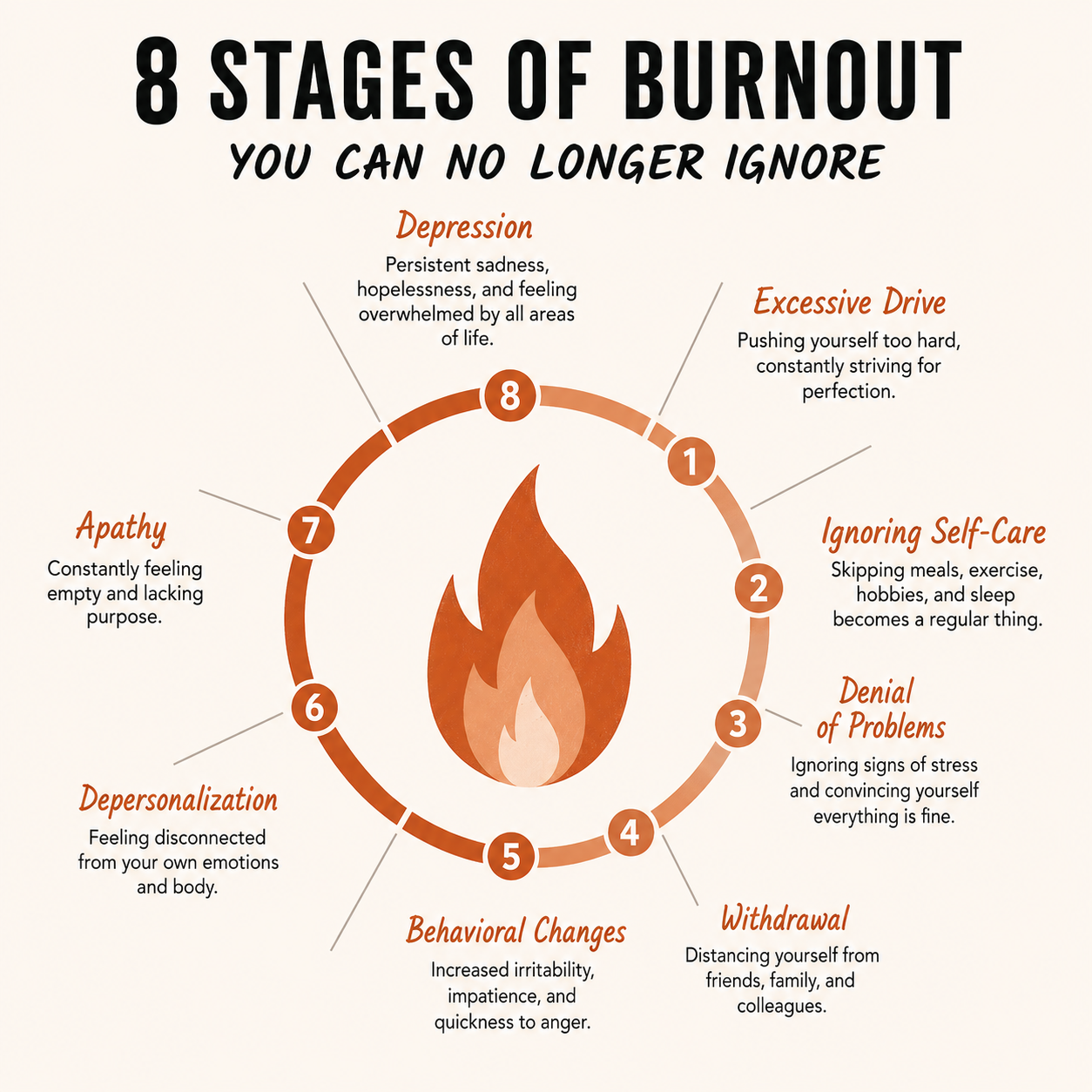
What is burnout? It is a syndrome arising from chronic occupational stress, marked by exhaustion, cynicism or depersonalization, and reduced professional efficacy. It differs from ordinary fatigue because depletion persists and can prompt psychological distance from work, colleagues, or clients. The Maslach framework treats these dimensions as measurable, while research examines workplace causes, occupational risk, and interventions that address the conditions sustaining strain.
Burnout has become one of the most discussed workplace topics of the past decade - and one of the most overused terms in the process. The word is applied to everything from mild tiredness on a Tuesday to severe, months-long incapacitation that requires medical leave.
This range of usage obscures an important reality: clinical burnout, as defined and researched by psychologists, is a specific, serious condition with identifiable causes, measurable dimensions, and evidence-based treatments. It is distinct from ordinary fatigue, stress, or even most forms of depression.
Understanding what burnout actually is - according to the research that defined it - is the first step toward addressing it effectively, whether you are experiencing it yourself, managing someone who might be, or designing work environments that prevent it.
What Burnout Is: The Maslach Framework
The scientific understanding of burnout was established primarily by psychologist Christina Maslach, whose research beginning in the 1970s produced both the dominant conceptual framework and the most widely used measurement instrument.
Maslach defined burnout as a three-dimensional syndrome arising from chronic occupational stress:
1. Exhaustion
Emotional and physical exhaustion is the central and most recognized dimension. It is not ordinary tiredness that resolves with a night's sleep. It is a profound depletion of energy reserves - the sense of having nothing left to give, of being empty.
Workers experiencing burnout exhaustion report feeling emotionally drained by interactions with colleagues and clients, physically depleted by work demands, and unable to engage with even routine tasks without significant effort.
Exhaustion functions as the entry point to burnout. Research consistently identifies it as the first dimension to develop, with the other two following as adaptations to prolonged exhaustion.
Maslach and Jackson (1981) established this temporal ordering through their foundational validation studies of the Maslach Burnout Inventory, finding that exhaustion predicted subsequent cynicism in longitudinal samples far more consistently than the reverse.
2. Cynicism and Depersonalization
In response to exhaustion, workers develop psychological distance from their work - a detached, callous, or cynical attitude toward colleagues, clients, and the organization. This is not a character flaw; it is a psychological defense mechanism. When emotional engagement with work is painful or costly, the mind reduces that engagement.
In human services professions (healthcare, social work, education), this manifests as depersonalization - treating patients, clients, or students as objects rather than individuals.
In other work contexts, it appears as cynicism about organizational goals, disengagement from team effort, and a "what's the point?" orientation toward work.
Schaufeli and Enzmann (1998) documented depersonalization across 16 different occupational groups in their comprehensive review, confirming that psychological distancing is not confined to the caring professions but is a universal adaptive response to depletion.
3. Reduced Professional Efficacy
The third dimension is a declining sense of competence and accomplishment at work - the feeling that despite effort, work is not producing meaningful results and personal capabilities are inadequate to the demands.
Where once a worker felt skilled and effective, burnout produces doubt, imposter syndrome-like feelings, and a sense that prior accomplishments are no longer achievable.
This dimension is somewhat more contested in the research than exhaustion and cynicism. Some researchers argue that reduced efficacy sometimes precedes rather than follows burnout, and that it may have a different causal structure than the other two dimensions (Taris, 2006).
The Maslach Burnout Inventory (MBI), developed in 1981, operationalizes these three dimensions through a validated questionnaire that has been used in thousands of research studies across dozens of countries and professions.
Its 22-item scale has been translated into more than 30 languages, making it arguably the most globally consistent instrument in occupational health research.
The Scope of the Problem: Burnout by the Numbers
Before examining causes and remedies, it is worth understanding just how widespread burnout has become. The scale of the data reveals that this is not a peripheral problem affecting a small minority of unusually fragile workers.
- A 2022 Gallup State of the Global Workplace report found that 60% of workers worldwide reported being emotionally detached at work - a central indicator of burnout - and that 19% described themselves as actively miserable.
- A 2023 Deloitte survey of 2,100 workers across four countries found that 77% of respondents had experienced burnout at their current job, and 42% had left a position specifically because of it.
- The American Institute of Stress estimates that 83% of US workers suffer from work-related stress, with burnout-level symptoms reported by roughly one-third.
- Healthcare is among the highest-risk professions. A 2022 American Medical Association study found that 63% of US physicians reported at least one symptom of burnout - up from 38% in 2020, a pandemic-era surge that has not fully receded.
- The economic cost is measurable. Burnout-related absenteeism, presenteeism, and turnover cost US employers an estimated $125-190 billion annually in healthcare spending alone, according to a Harvard Business Review analysis (Goh, Pfeffer, and Zenios, 2016).
| Metric | Finding | Source |
|---|---|---|
| Global emotional detachment at work | 60% of workers | Gallup, 2022 |
| Workers who have experienced burnout at current job | 77% | Deloitte, 2023 |
| US physicians with burnout symptoms | 63% | American Medical Association, 2022 |
| Annual US employer cost of burnout | $125-190 billion | Goh, Pfeffer, Zenios (2016) |
| Workers who left a job due to burnout | 42% | Deloitte, 2023 |
| Productivity loss from burnout | Up to 23% lower output | Gallup, 2022 |
The WHO Recognition: Burnout in ICD-11
In 2019, the World Health Organization included burnout in the International Classification of Diseases, 11th revision (ICD-11), as an occupational phenomenon - specifically code QD85. This was significant both for research and for policy, as ICD coding influences insurance coverage, medical practice, and organizational accountability.
The WHO definition describes burnout as resulting from "chronic workplace stress that has not been successfully managed," characterized by feelings of energy depletion or exhaustion, increased mental distance from one's job, and reduced professional efficacy.
Critically, the WHO classification specifies that burnout "refers specifically to phenomena in the occupational context and should not be applied to describe experiences in other areas of life." This means burnout is not a diagnosis - it is an occupational phenomenon, a health outcome associated with workplace conditions.
The classification's inclusion in ICD-11 has had concrete policy implications. Several European countries, including Sweden and the Netherlands, have introduced formal burnout treatment protocols in their national healthcare systems.
The Netherlands was among the first to formally recognize burnout-related sick leave as a compensable occupational condition in employer liability frameworks (Schaufeli and Taris, 2005).
"Burnout is the result of a mismatch between the person and the job across one or more of six areas of work life: workload, control, reward, community, fairness, and values. The greater and the more numerous the mismatches, the greater the risk for burnout." - Christina Maslach and Michael Leiter, The Truth About Burnout (1997)
Burnout vs. Depression: An Important Distinction
Burnout and clinical depression overlap in symptoms and are often confused, but distinguishing them matters for treatment.
| Dimension | Burnout | Depression |
|---|---|---|
| Domain | Primarily occupational | Pervasive across all life domains |
| Situational relief | Symptoms improve away from work | Symptoms persist regardless of context |
| Primary emotion | Exhaustion, cynicism | Hopelessness, worthlessness |
| Physical symptoms | Work-related fatigue | Appetite, sleep, psychomotor changes |
| Cause | Workplace conditions | Biological, psychological, situational factors |
| Treatment | Organizational and behavioral change | Psychotherapy, medication, lifestyle |
| Onset | Gradual, linked to work intensification | Can be sudden or gradual, often not work-linked |
A person with burnout typically feels better during vacations, weekends away from work, and periods of reduced professional responsibility. A person with depression typically does not.
If symptoms are pervasive - affecting enjoyment of previously loved activities outside work, relationships, and basic self-care - professional evaluation for depression is warranted, because the treatment protocols are different.
Burnout and depression can co-occur, and untreated severe burnout can contribute to the development of depression.
A 2019 meta-analysis by Bianchi, Schonfeld, and Laurent reviewed 92 studies and concluded that while burnout and depression share overlapping symptom clusters, they are empirically distinguishable in most cases, with burnout showing stronger work-situational specificity.
Some researchers also argue that severe burnout may itself meet diagnostic criteria for depression in many individuals, creating ongoing definitional debate. When in doubt, mental health professional evaluation is the appropriate step.
What Causes Burnout: The Job Demands-Resources Model
The Job Demands-Resources (JD-R) model, developed by Evangelia Demerouti and Arnold Bakker (2001), provides the most comprehensive theoretical framework for understanding what workplace conditions produce burnout.
The model emerged from a study of Dutch employees across four organizations in different sectors and has since been validated across hundreds of studies in more than 30 countries.
The model holds that burnout results from an imbalance between the demands placed on workers and the resources available to meet those demands.
Job Demands
Job demands are aspects of work that require sustained physical or mental effort and are therefore associated with costs:
- Workload: Excessive work volume relative to available time and energy. Bakker and Demerouti (2017) found workload to be the single strongest predictor of exhaustion across their multi-sector studies.
- Time pressure: Deadlines that create urgency and eliminate recovery periods
- Role ambiguity: Unclear expectations, conflicting responsibilities, or undefined objectives
- Interpersonal conflict: Hostile relationships with supervisors, peers, or clients. Research by Hershcovis and Barling (2010) found that supervisor conflict predicts burnout more strongly than coworker conflict, with a path that runs directly through reduced autonomy.
- Emotional demands: Work requiring suppression of authentic emotions or constant emotional regulation - "surface acting" as it is known in the research, which Grandey (2003) found to be significantly associated with emotional exhaustion over time
- Cognitive demands: Complex decisions under pressure, information overload
Job Resources
Job resources are aspects of work that help achieve goals, reduce demands, or satisfy basic psychological needs. They buffer against burnout when present and amplify it when absent:
- Autonomy: Control over how, when, and where work is performed. Karasek's (1979) demand-control model, a precursor to the JD-R framework, identified autonomy as the central buffering variable in occupational stress.
- Social support: Quality relationships with supervisors and colleagues who provide assistance and validation
- Feedback: Clear, regular information about how performance compares to expectations
- Development opportunities: Learning, advancement, and growth possibilities
- Recognition: Acknowledgment that contributions are valued
- Job security: Confidence that employment will continue
The JD-R model explains why identical job demands affect workers differently: a worker with high autonomy, strong social support, and clear feedback can absorb substantial demands without burnout, while a worker facing the same demands without those resources is at high risk.
A 2016 meta-analysis by Crawford, LePine, and Rich analyzed 157 samples from the JD-R literature and found that the demand-resource imbalance explains approximately 40% of variance in burnout outcomes - a remarkably strong predictive relationship for a behavioral construct.
Maslach's Six Areas of Work Life
Maslach and Leiter refined the framework further into six specific areas where person-job mismatch produces burnout risk. These are particularly useful diagnostically, because different types of mismatch call for different interventions:
- Workload mismatch: Too much work, too little time, or both
- Control mismatch: Insufficient autonomy to accomplish work the way you see fit
- Reward mismatch: Insufficient recognition, financial, or intrinsic reward for effort
- Community mismatch: Breakdown in relationships and belonging at work
- Fairness mismatch: Perceived inequity in how decisions, rewards, or workloads are distributed
- Values mismatch: Conflict between personal ethics or priorities and organizational requirements
The last of these - values mismatch - may be the least discussed but deserves attention.
Leiter and Maslach (2004) found that workers who perceived a significant gap between their own values and those of their organization showed elevated burnout risk even when workload and other factors were controlled.
Work that feels meaningless or ethically compromised is not simply unpleasant; it is physiologically costly.
Organizational Culture as a Multiplier
Individual job demands and resources exist within an organizational culture that amplifies or mitigates burnout risk. Cultures that:
- Normalize and reward overwork
- Stigmatize rest, boundaries, and personal limits
- Punish admissions of overwhelm or requests for support
- Distribute recognition inequitably or rarely
- Tolerate abusive management behavior
...create systemic burnout risk independent of individual workload levels. The social comparison pressure in high-performing teams where everyone is visibly working 60+ hours exerts normative influence on members to do the same, even when individual managers have no explicit policy demanding it.
Psychological safety research by Amy Edmondson (Harvard Business School) has shown that teams with higher psychological safety - where members feel comfortable admitting mistakes and limitations - show lower burnout prevalence even under equivalent demand conditions.
The mechanism appears to be reduced fear-related emotional labor: when workers do not have to perform competence they do not feel, the energy cost of the work itself is lower.
Recognizing Burnout: Signs and Stages
Burnout develops gradually rather than appearing suddenly. Herbert Freudenberger, who coined the term in his 1974 paper "Staff burnout" published in the Journal of Social Issues, described a progression from initial high enthusiasm and over-commitment through increasing cynicism, physical and emotional exhaustion, and ultimately to a state of emptiness and disconnection.
He had observed this pattern in volunteers and staff at free clinics, noting that the very dedication that drew people to helping work became the engine of their depletion.
Psychologists Dirk Enzmann and Dieter Kleiber (1989) later elaborated this into a 12-stage model, though for practical purposes the key recognition cues cluster into four categories:
Physical signals: Chronic fatigue not resolved by sleep; frequent illness as immune function declines; headaches; muscle tension; disrupted sleep; cardiovascular symptoms including elevated resting heart rate and blood pressure. Research by Melamed et al. (2006) found that burned-out individuals showed measurably elevated cortisol levels and suppressed natural killer cell activity - a direct link between burnout and immune compromise.
Emotional signals: Dread of going to work; emotional numbness or flatness; irritability disproportionate to provocation; anxiety particularly on Sunday evenings ("Sunday dread" is documented in burnout literature as a reliable early indicator); detachment from work relationships; declining empathy in roles that previously felt rewarding.
Cognitive signals: Difficulty concentrating; forgetting tasks or commitments; reduced creativity and difficulty generating new ideas; catastrophizing about work situations; an increasingly cynical or sarcastic internal monologue about work and colleagues.
Behavioral signals: Increasing difficulty meeting deadlines; presenteeism (being physically present but mentally absent - research suggests this is more economically costly than absenteeism in many sectors); withdrawal from team interactions; increasing cynical comments about work and colleagues; difficulty "switching off" outside of work hours; substance use increases.
The difficulty with recognizing burnout in yourself is that the gradual progression normalizes each stage. By the time someone recognizes their state as burnout rather than a particularly stressful period, they are often well advanced.
This is compounded by what Maslach calls the "invisible workload" effect: the psychological effort of managing burnout itself - monitoring one's reactions, maintaining a professional facade, suppressing cynicism - adds to the depletion it is trying to conceal.
Who Is Most Vulnerable
While burnout can affect workers at any level, several populations show elevated risk:
- High-commitment workers: Those who are most dedicated, most motivated, and most identified with their work are paradoxically most at risk. Freudenberger described this as "the price of idealism."
- Workers in high-demand, low-control roles: The classic Karasek demand-control profile predicts burnout more consistently than high demand alone.
- Healthcare workers: Consistently the highest-burnout professional group in virtually every national study
- Remote workers without strong social networks: A post-pandemic addition to the literature, with particular evidence from studies of isolated remote workers during 2020-2022 (Kniffin et al., 2021)
- Workers experiencing organizational change: Mergers, restructurings, and leadership transitions create uncertainty and fairness concerns that are strongly associated with burnout onset
Evidence-Based Approaches to Recovery
Recovery from burnout is possible but requires addressing both the immediate symptoms and the structural conditions that produced them. Research identifies both individual-level and organizational-level interventions.
Individual Recovery Strategies
Recovery experiences are activities that restore psychological resources depleted by work demands. Research by Sabine Sonnentag (University of Mannheim) identifies four recovery experiences that most effectively reduce exhaustion:
Psychological detachment: Mentally disengaging from work-related thinking during off-work time. The research is clear that ruminating about work problems during evenings and weekends prevents recovery, even if physically away from the workplace.
Sonnentag and Fritz (2007) found that psychological detachment during evenings predicted next-morning energy and mood independently of sleep duration.
Relaxation: Activities that produce low activation and positive affect - walks, reading, gentle exercise, meditation.
Research on nature exposure by Kaplan and Kaplan (1989) and subsequent studies found that time in natural environments reliably reduces cognitive fatigue and emotional depletion, with effects measurable after as little as 20 minutes.
Mastery experiences: Activities outside work that provide a sense of competence and accomplishment. Hobbies, sports, and skill development provide efficacy restoration that counteracts reduced professional efficacy.
Sonnentag's longitudinal studies found mastery experiences to be particularly effective for workers showing the reduced-efficacy dimension of burnout.
Control: Having choice over how non-work time is spent, rather than obligations that create different but still draining demands.
Boundary-setting is consistently identified as both prevention and recovery strategy, but is easier to recommend than to implement in cultures that stigmatize it.
Effective boundary approaches include clear communication to managers and colleagues about availability hours, automatic email responses outside work hours, and physical or digital separation between work and non-work contexts.
Research by Park, Fritz, and Jex (2011) found that employees who established clearer work-home boundaries showed less next-morning exhaustion even when controlling for total hours worked.
Social support from peers who understand occupational demands provides validation, normalization, and practical help. Peer support networks, both formal (employee assistance programs, peer support groups) and informal, reduce the isolation that amplifies burnout.
A meta-analysis by Viswesvaran, Sanchez, and Fisher (1999) across 68 studies found social support to be among the strongest moderators of the demand-strain relationship.
Professional help: When burnout is advanced, self-directed strategies are often insufficient. Cognitive behavioral therapy (CBT) adapted for burnout has a growing evidence base. A systematic review by Ahola et al. (2017) found that CBT-based interventions produced significant reductions in burnout scores with moderate effect sizes, particularly for the exhaustion and depersonalization dimensions.
In cases where burnout has triggered clinical depression or anxiety disorder, pharmacological treatment alongside psychotherapy may be appropriate.
What Does Not Work
Vacation alone without structural change produces temporary symptom relief that reverses within two to four weeks of return.
The "recovery paradox" - a phenomenon where people who most need vacation get the least psychological benefit from it because they cannot detach from work during it - means that those with highest burnout often gain least from time off alone.
Fritz and Sonnentag (2006) documented this effect in a longitudinal study, finding that return-to-work burnout trajectories were steep when underlying job conditions had not changed.
Resilience training that focuses on individual coping skills without addressing organizational demands is the subject of significant criticism. When organizations provide mindfulness apps to overloaded workers, it addresses symptom management while leaving causes untouched.
Christina Maslach has argued explicitly that the burnout crisis is primarily an organizational problem requiring organizational solutions, not an individual resilience problem.
In a 2022 interview with the Harvard Business Review, she stated: "Organizations should stop blaming people for not being resilient enough when they are burning out - and start fixing the conditions that make people burn out."
Organizational Interventions
Research on effective organizational interventions shows that sustainable reduction in burnout requires:
- Workload management: Real reductions in task volume through prioritization, role redesign, or adequate staffing - not exhortations to be more efficient. Awa, Plaumann, and Walter (2010) meta-analyzed 25 burnout intervention studies and found that combined person-directed and organization-directed interventions produced longer-lasting effects than either type alone.
- Autonomy increases: Giving workers more control over how and when they accomplish objectives
- Fairness and recognition: Equitable distribution of rewards and workload, and genuine recognition of contributions. Spreitzer and Porath (2012) found that "thriving" - the opposite state from burnout - was significantly predicted by learning and vitality, both of which are supported by recognition and development opportunities.
- Psychological safety: Creating environments where workers can admit overwhelm, ask for help, and decline unreasonable demands without fear of career consequences
- Manager training: Research consistently shows that manager behavior is a primary driver of team-level burnout risk. A 2020 Gallup analysis of 80,000 managers found that manager quality accounted for 70% of variance in team engagement levels - arguably the single most influential organizational variable in burnout prevention. Training managers in recognition, support, workload management, and respectful conflict resolution produces measurable reduction.
The Role of Organizational Policy
Some of the most compelling evidence for the systemic nature of burnout comes from policy experiments:
- A Microsoft Japan experiment with a four-day work week (2019) produced a 40% increase in productivity while substantially reducing stress measures.
- Iceland's national trial of a 35-36 hour work week across public sector workers (2015-2019) found equivalent or improved productivity, substantially reduced burnout symptoms, and high enough satisfaction that 86% of Iceland's workforce has since shifted to shorter hours or gained the right to.
- Research by Pencavel (2016) analyzing the historical record found that output does not increase linearly with hours - beyond 50 hours per week, marginal output drops sharply, suggesting that many "high-commitment" cultures are not producing the output they think they are purchasing with long hours.
The evidence points toward a clear conclusion: burnout is fundamentally a systems problem. Individual recovery strategies matter and should be used, but they are insufficient when the system producing the burnout remains unchanged.
Recovery Timelines: What to Expect
A question that matters practically is how long burnout recovery takes. The honest answer is that it varies significantly based on severity, the degree of structural change in underlying conditions, and individual factors - but research provides some useful benchmarks.
Sonnentag and colleagues' longitudinal studies suggest that burnout symptoms begin to decline measurably within four to six weeks of significant workload reduction combined with active recovery practices.
However, full recovery - returning to pre-burnout energy levels, engagement, and confidence - typically takes six months to two years for moderate-to-severe cases.
Leiter and Maslach's "burnout to engagement" research found that the path from burnout to full engagement requires addressing mismatches in the same six areas that created it.
Workers who addressed only the exhaustion dimension (through rest) without addressing cynicism-producing conditions (fairness, values, community) tended to relapse within months of returning to work.
This is why return-to-work planning that includes structural changes - not just medical clearance - produces better long-term outcomes.
The implication for both individuals and organizations is that burnout recovery is an investment requiring sustained attention, not a reset achieved by a two-week holiday.
The Burnout-Engagement Continuum
It is worth understanding that burnout and engagement are not simply opposites - they exist on the same continuum but are not a single dimension.
Schaufeli and colleagues' work on the Utrecht Work Engagement Scale (UWES) established that engagement has its own positive dimensions - vigor, dedication, and absorption - that are influenced by the same JD-R factors but respond differently to interventions.
This matters because it suggests that recovery is not simply the removal of burnout. Rebuilding work engagement - the energized, meaningful, absorbed state that is the full opposite of burnout - requires positive conditions, not just the absence of negative ones.
Organizations focused only on reducing burnout may find they have produced disengaged but no longer burned-out workers. The goal is the full continuum.
Conclusion
Burnout is a specific, measurable, and treatable occupational phenomenon with well-established causes in the mismatch between job demands and resources. It is widespread, costly, and - critically - not inevitable.
The research is consistent: organizations that invest in workload management, autonomy, fairness, and manager quality prevent most burnout before it requires treatment.
Individuals who understand their own warning signs, protect recovery time, and address mismatches before they become crises can substantially reduce their lifetime burnout burden.
The most important single insight from three decades of burnout research is this: if you are burning out, the problem is almost certainly not that you are insufficiently resilient. It is that the conditions of your work are demanding more than they are providing.
That is a structural problem requiring structural solutions - and recognizing that distinction is where effective action begins.
Health note: This article is general educational information about how a topic works, not medical, psychological, or mental-health advice, diagnosis, or treatment. Everyone's situation is different, and research findings describe groups, not individuals.
If you are struggling or have concerns about your health, please talk to a qualified professional such as a doctor or licensed therapist.
If you are in crisis or thinking about harming yourself, contact your local emergency services or a crisis line right away, in the US you can call or text 988 (Suicide & Crisis Lifeline); elsewhere, find local lines at findahelpline.com.