Understanding: The first thing to understand about Cal Newport's framework is that it is not a productivity system in the conventional sense. It does not organize tasks, manage inboxes, or optimize calendars.
It draws a categorical line through the work most professionals do and argues that the line predicts, better than any other single variable, who will produce valuable work and who will produce activity. The line runs between work that demands full cognitive engagement and work that does not.
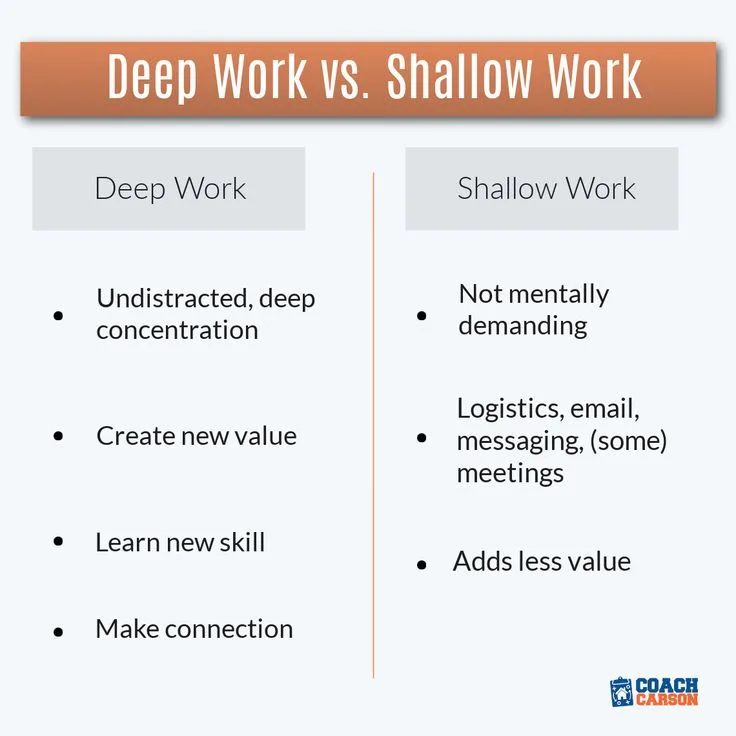
Newport, a computer science professor at Georgetown University and author of Deep Work (2016), introduced the terms deep work and shallow work to name this distinction. Deep work is professional activity performed in a state of distraction-free concentration that pushes cognitive capabilities to their limit.
It creates new value. It improves skill. It is hard to replicate. Shallow work is non-cognitively-demanding logistical work often performed while distracted.
It does not create much new value and it is easy to replicate. The definitions are deliberately austere. They are meant to cut across the superficial classification of work by topic or title and classify by cognitive character.
The claim that makes the framework controversial is empirical rather than moral. Newport's argument is that deep work is increasingly rare in the modern professional environment, and precisely for that reason, it is increasingly valuable.
People who cultivate the ability to do deep work reliably will capture disproportionate economic and creative returns in the next decades, because most of their competitors will be unable to sustain the concentration required to produce the most valuable outputs.
This is not a motivational claim. It is a claim about the distribution of a scarce resource in a specific labor market.
The research support for the claim has strengthened since the book's publication, as ambient distraction infrastructure has intensified and the cognitive economy has shifted further toward outputs that only sustained concentration can produce.
"Deep work is necessary to wring every last drop of value out of your current intellectual capacity. We now know from decades of research in both psychology and neuroscience that the state of mental strain that accompanies deep work is also necessary to improve your abilities.
Deep work, in other words, was exactly the type of effort needed to stand out in a cognitively demanding field like academic computer science in the early twenty-first century." - Cal Newport, Deep Work (2016)
Key Definitions
Deep work: Professional activities performed in a state of distraction-free concentration that push cognitive capabilities to their limit. Create new value. Improve skill. Hard to replicate.
Shallow work: Non-cognitively-demanding logistical tasks often performed while distracted. Do not create much new value. Easy to replicate.
Attention residue: Sophie Leroy's 2009 term for the portion of attention that remains on a previous task after a switch, particularly when the previous task was incomplete. Measurable performance cost on the next task.
Deliberate practice: Anders Ericsson's term for a specific form of skill-building characterized by clearly defined goals, full attention, immediate feedback, and work at the edge of current ability. The empirical foundation for what deep work looks like when directed at skill growth.
Concentration capacity: The duration and intensity of focused attention a person can sustain. Trainable. Degrades with chronic distraction exposure.
Shallow work fraction: Newport's operational metric, defined as the percentage of your total work hours consumed by shallow activities. Most knowledge workers overestimate their deep work fraction substantially when they measure honestly.
Why the Distinction Matters Economically
Newport's argument rests on a macroeconomic claim about the labor market. He identifies three groups of workers who will thrive in the next decades: high-skilled workers who can work creatively with intelligent machines, superstar performers in their fields, and owners of capital.
The common thread across the first two categories is the ability to produce outputs that require sustained cognitive effort to create and that cannot be commoditized.
The thesis parallels the work of labor economists including David Autor at MIT, whose research on skill-biased technical change has documented the hollowing-out of middle-skill jobs while returns to high-skill work have increased. The jobs that have fared worst are routine cognitive jobs that computers can automate.
The jobs that have fared best are either manual jobs that are difficult to automate or cognitive jobs that require complex judgment, creativity, and extended problem-solving.
The latter category is essentially the deep work category. Work that demands the full attention of a capable human and produces outputs that cannot be produced without that attention.
AI tools developed since Newport's book have accelerated the trend. Shallow work is increasingly automatable. Email drafting, document formatting, simple analytical tasks, and routine coordination are increasingly handled by systems that did not exist a decade ago.
The portion of professional work left for humans to do is the portion that requires sustained attention, complex judgment, creative synthesis, and embodied expertise. Deep work, in other words.
For professionals adjusting to this shift and considering which certifications and skill investments will compound in the new landscape.
The Research Base
Newport's synthesis draws from multiple research traditions that were not previously connected in popular productivity writing.
Anders Ericsson's deliberate practice research, running from the 1980s through his 2016 book Peak, documented that world-class performers in cognitively demanding fields practice in a specific way: clearly defined goals, full attention, immediate feedback, and work at the edge of current ability.
The daily volume of this practice, remarkably consistent across domains from music to chess to athletics, tops out at about four hours. Beyond four hours of maximum-intensity deliberate practice, quality degrades faster than additional hours can compensate.
The four-hour ceiling is a crucial empirical constraint on what deep work can actually achieve in a single day.
Sophie Leroy's 2009 paper, "Why Is It So Hard to Do My Work?", introduced the term attention residue. In controlled experiments, Leroy showed that when people switch from one task to another, a measurable portion of their attentional capacity remains on the previous task.
The residue is worse when the previous task was incomplete. People performed worse on subsequent tasks after switching than they did when they completed one task before starting another.
The practical implication for knowledge work is severe: constantly context-switching between tasks, which is the default pattern of modern knowledge work, imposes a continuous attention residue tax.
Gloria Mark at UC Irvine has spent two decades studying attention in real office environments. Her studies, using observation and physiological measurement, found that the average office worker switches tasks every three minutes and recovers full focus after an interruption in approximately 23 minutes.
The recovery time depends on the interruption type and the worker's task, but the baseline number is striking. Most knowledge workers do not spend a full 23 uninterrupted minutes on any cognitively demanding task during a typical day.
| Research Finding | Implication for Deep Work |
|---|---|
| Average task switch: every 3 minutes (Mark) | Spontaneous deep work is impossible in unstructured environments |
| Full focus recovery after interruption: 23 min (Mark) | Even brief check-ins cost substantial cognitive capacity |
| Attention residue from incomplete switches (Leroy) | Task completion boundaries matter more than duration |
| Deliberate practice ceiling: ~4 hours/day (Ericsson) | Aim for four hours max of true deep work daily |
| Mere phone presence reduces WM performance (Ward) | Phone must be physically absent, not just silent |
| Multitasking performance drop: 40% (Meyer/Rubinstein) | Single-task periods produce more total output |
The Four Philosophies
Newport identifies four approaches to integrating deep work into a professional life. Each suits different roles and temperaments.
The monastic philosophy minimizes shallow work to near zero. The practitioner eliminates or radically restricts email, meetings, and coordination duties to protect deep work almost entirely. Donald Knuth, the computer scientist who wrote The Art of Computer Programming, is a classic example.
He famously does not use email and requires all correspondence to go through his administrative assistant in physical mail. This philosophy works only when the professional value generated by deep work is sufficient to justify offloading or refusing most shallow responsibilities. It is impractical for most employed professionals.
The bimodal philosophy divides time at the scale of weeks or months between deep work and everything else. The practitioner might take a writing retreat for a month, followed by a period of teaching and administrative work.
Adam Grant, the Wharton professor, has described a version of this at a semester scale: concentrated writing periods alternating with teaching-heavy periods.
The philosophy works well for academics, writers, and some consultants whose schedules have natural cycles. It does not work well for roles requiring constant availability.
The rhythmic philosophy creates daily blocks of deep work at consistent times. The practitioner might reserve 7 am to 10 am every weekday for deep work, with the rest of the day available for meetings and coordination. This is the philosophy most knowledge workers can actually execute.
It requires less schedule disruption than the bimodal approach and less environmental control than the monastic one. Most of Newport's specific practical advice is oriented toward rhythmic practitioners.
The journalistic philosophy drops into deep work opportunistically whenever time permits. Walter Isaacson, the biographer and journalist, has described writing books this way: grabbing twenty or thirty minutes between other obligations and diving immediately into deep work.
This requires exceptional trained concentration capacity. For people whose schedules are too fragmented for the rhythmic approach, it is sometimes the only option, but it should not be the first choice for anyone who has flexibility because the start-up cost and attention residue costs are higher per unit of output.
The Protocols That Matter
Newport's book contains dozens of specific tactics. Four are worth singling out because the research support is strongest and the impact per unit of effort is highest.
Schedule every minute of your workday. Block time on a calendar for all activities, including deep work, shallow work, meetings, breaks, and transitions. Do not leave unstructured time. When plans change, reschedule the block rather than abandoning structure.
The mechanism is twofold. First, scheduling forces explicit choice about what will be done, which is usually more deliberate than the default of reacting to the most recent email. Second, the pre-commitment reduces decision fatigue during the day.
Set a shallow work budget. Calculate the percentage of work hours consumed by shallow activities. Set a target ratio and actively cut shallow work that exceeds it. Most knowledge workers operate at 60 to 80 percent shallow work, often unknowingly. Driving this down to 40 to 50 percent produces substantial output gain.
Embrace boredom. Build tolerance for unstimulated attention. The habit of checking a phone whenever a queue forms or a conversation pauses trains the brain to expect novelty constantly, which degrades the capacity to sustain attention on boring but important work.
The specific intervention is to deliberately not check devices during routine waiting periods.
Shut down completely at the end of the workday. Have a defined ending routine. After the ending, work thoughts are off-limits until the next day. The mechanism is partly about recovery and partly about the paradoxical finding that strict end times increase productivity because they force prioritization during the workday.
Parkinson's Law in reverse: work expands to fill the time available, so constraining the time available compresses the work into higher-density effort.
For professionals whose deep work is writing, the craft dimensions of the work matter as much as the time protection. Deep work time applied to poor writing technique produces lots of bad writing. clarity, voice, and the specific practices that make writing time produce publishable output rather than just words.
The Attention Residue Problem in Depth
Leroy's finding, though named specifically for the research paper in 2009, extends a broader phenomenon that has been documented for decades: context switching has costs that are larger than intuition suggests.
The mechanism is that executive function resources, including working memory and goal-directed attention, do not transfer instantly between tasks.
When you stop working on a difficult report to answer an email, the executive function processes that were holding the report's structure and goals in mind do not shut off when you open the email.
They continue to consume capacity for minutes or longer, leaving less capacity available for the email task. When you return to the report, a similar residue problem occurs in reverse.
The research on this cost is unsettling because the magnitude is larger than people assume. David Meyer and Jeffrey Rubinstein's work on executive control suggests that for complex tasks, the performance penalty of multitasking can approach 40 percent relative to single-tasking.
For simple tasks, the cost is smaller but still measurable. The implication is that the default pattern of modern knowledge work, characterized by constant small switches among email, chat, meetings, and tasks, leaves workers operating at a fraction of their capability nearly all the time.
The practical response follows directly. Reduce switches. Batch similar tasks together. Use task-completion boundaries, finishing something before starting the next, rather than duration boundaries, working on something for a set period.
When genuine interruption is unavoidable, perform a brief cognitive closure ritual, such as writing a one-sentence note about where you were and what comes next, which reduces but does not eliminate residue.
The Phone Problem
Adrian Ward and colleagues at the University of Texas published a 2017 study that has become a touchstone for the phone-in-workspace issue. Participants performed cognitive tasks with their phones in one of three conditions: on the desk face down, in a pocket or bag, or in another room.
Working memory and fluid intelligence measures were higher when the phone was in another room, even though participants in all conditions were instructed not to interact with the phone.
The mechanism Ward proposed is that suppressing the impulse to attend to the phone consumes cognitive resources, even when the suppression is successful. The mere presence of the phone acts as an attractor that the executive system must actively inhibit, and the inhibition is not free.
Removing the phone to another room eliminates the attractor and frees capacity for the task.
This finding has particular relevance for remote workers and those studying for high-stakes exams. For certification candidates preparing for demanding technical assessments, the physical separation of phone from study environment produces larger measurable gains than most study technique interventions.
For professionals doing deep knowledge work, the simple intervention of leaving the phone in another room during deep work blocks produces measurable output gains that exceed most other productivity tactics.
For workers in coworking spaces, cafes, and flexible environments where phone separation is harder.
Sample Deep Work Schedule Table
| Time | Activity | Type |
|---|---|---|
| 6:30 to 7:00 | Wake, coffee, review day | Prep |
| 7:00 to 9:30 | Deep work block 1 (highest value task) | Deep |
| 9:30 to 10:00 | Email triage, meeting prep | Shallow |
| 10:00 to 12:00 | Deep work block 2 (continued or new) | Deep |
| 12:00 to 13:00 | Lunch, break, genuine disconnect | Recovery |
| 13:00 to 14:30 | Meetings batched | Shallow |
| 14:30 to 16:30 | Deep work block 3 (if capacity remains) | Deep |
| 16:30 to 17:30 | Admin, followups, tomorrow's plan | Shallow |
| 17:30 | Shutdown ritual, close laptop | Boundary |
A rhythmic pattern with approximately four hours of deep work across three blocks, shallow work batched into defined windows, and a hard stop. Not every day will hit this ideal, but the scaffold provides structure that the default reactive pattern lacks.
Newport vs Csikszentmihalyi: Deep Work vs Flow
Mihaly Csikszentmihalyi's flow state, introduced in his 1990 book and developed over decades of research, describes a subjective state of effortless absorption in a task where challenge and skill are well-matched. Flow feels good. It is intrinsically rewarding. It is correlated with peak performance in many domains.
Deep work and flow are related but not identical. Deep work is a structural category defined by cognitive demand and value, regardless of subjective experience. Flow is a subjective state that can occur in various activities, not all of them deep work.
Some deep work feels like flow. Some deep work is grinding, unpleasant, effortful sustained attention on difficult material that never produces the flow experience. Writing a technical paper on an unfamiliar subject often involves hours of grinding deep work with no flow at all.
The paper is better for the grinding, but the subjective state is closer to struggle than to absorption.
Conversely, flow can occur in activities that do not qualify as deep work. Skilled typists often report flow during fluent typing. Expert email writers experience a kind of flow during well-paced correspondence. The flow is pleasurable but the work is not deep in Newport's structural sense.
The practical implication is that you cannot reliably judge whether you are doing deep work by whether it feels good. Some of the most valuable deep work feels bad. The criterion is the cognitive demand and economic character of the output, not the subjective experience.
Chasing flow can lead people toward comfortable skilled activities and away from the harder frontier work where the highest returns live.
"The best moments in our lives are not the passive, receptive, relaxing times. The best moments usually occur when a person's body or mind is stretched to its limits in a voluntary effort to accomplish something difficult and worthwhile.
Optimal experience is thus something we make happen." - Mihaly Csikszentmihalyi, Flow: The Psychology of Optimal Experience (1990)
The Cognitive Capacity Question
A common concern is whether some people are simply incapable of sustained deep work. The research suggests that concentration capacity is largely trainable rather than fixed. Chronic distraction exposure degrades the capacity. Deliberate training rebuilds it.
The baseline varies among individuals but the trajectory is shaped heavily by behavior.
For people coming from years of high-distraction work environments, the rebuild is slow. A typical pattern is: early attempts at deep work feel torturous, with frequent impulses to check devices and an inability to sustain concentration past twenty or thirty minutes.
Over weeks of deliberate practice, the sustainable block extends to forty-five minutes, then to sixty, and eventually to the two-hour maximum-intensity blocks that the deliberate-practice research identifies as a typical ceiling.
The environmental factors matter enormously. Deep work in a silent, phone-free, single-task environment extends faster and further than deep work in a noisy, interruption-prone setting. Some of the capacity differences people attribute to personal variation are actually differences in environmental support.
For those assessing their baseline cognitive capacity and attention span. sustained attention, and processing speed measures that help establish where concentration capacity currently sits and how much is trainable versus environmentally constrained.
The Meeting Problem
Most knowledge workers cannot realistically hit four hours of daily deep work because meetings consume too much of the schedule. The typical professional calendar has fifteen to thirty hours of meetings per week, often distributed across the day in ways that prevent any two-hour uninterrupted block.
The structural solutions that work include meeting-free days or half-days at the team level, meeting batching onto specific days, and default-decline policies for meetings without clear agendas. At the individual level, the most robust technique is to protect one to two hours each morning before the meeting day starts.
Morning deep work has the advantages of a rested brain, fewer email obligations that have accumulated, and a calendar that is not yet reactive to other people's urgency.
For organizations where meeting culture has become structural toxic, reversing it is a leadership-level change that rarely succeeds from below.
The conversations about meeting hygiene map onto larger cultural dynamics documented in research on organizational health, and the tools available to individual contributors are mostly protective rather than transformative at organizational scale.
Deep Work in the AI Era
The framework was written before the current generation of AI tools. The update that Newport and others have offered is that AI increases the value of deep work rather than decreases it, for reasons mentioned earlier. Shallow work is increasingly automatable.
Deep work, defined as the irreducible human contribution of sustained judgment and creative synthesis, is harder to automate.
The risk is that AI tools integrated into deep work flows reintroduce shallow-work patterns inside what should be deep sessions.
Checking with an AI every few minutes, switching between a chat window and the main work, and consuming AI-generated summaries in place of primary source engagement can all fragment attention in ways that undercut the deep work intent.
The technology is genuinely useful when integrated into deep work intentionally and genuinely harmful when it substitutes for the sustained cognitive engagement that deep work requires.
The Business Application
For founders and executives, the framework shifts from personal practice to organizational design. A company whose senior leaders spend most of their time on shallow coordination produces less strategic output than a company whose leaders protect deep work for strategic thinking.
The design choices include meeting cadence, reporting structure, and the question of which decisions require deliberation versus quick answers.
Early-stage founders often underestimate how much of their time will be consumed by shallow operational work that drowns out the strategic thinking that should be their primary contribution. The formation stage decisions about structure, advisors.
The Animal Dimension
Sustained attention is unevenly distributed across species. Predator species that require long stalking times often have remarkable capacity for motionless attention. Social species with complex hierarchies have evolved specialized attention allocation for monitoring status cues.
Migratory species navigating over continental distances appear to sustain forms of attention that humans cannot approximate. The comparative work on attention and cognition in different species.
includes examples of octopus problem-solving, corvid tool-use, and elephant multi-day memory tasks that suggest sustained cognitive engagement is an old evolutionary capability expressed differently across taxa.
Practical Implications
For individuals: Identify your deep work target tasks. Protect at least two hours most weekdays. Batch shallow work. Leave the phone in another room during deep blocks. Expect the capacity to build over weeks, not days.
For managers: Build team structures that protect deep work. Default no on meetings. Communicate that asynchronous is preferred for most coordination. Model the behavior yourself; your team will not protect deep work if you do not.
For organizations: Calculate the shallow work fraction across roles. Cultures with 80 percent shallow work are throwing away most of the cognitive capacity they hire for. Structural changes to meeting norms, collaboration tools, and performance expectations can recover significant deep-work capacity.
For parents and educators: The attention capacity children develop is substantially shaped by their exposure environment. Children raised in constant-distraction environments have measurably shorter sustained attention spans at school entry.
The intervention is not more instructional pressure; it is protected time for single-task engagement with sustained materials.
Related Resources
See also: Flow State: How to Enter Deep Focus on Demand | Habit Stacking: How to Build Routines That Stick | The Eisenhower Matrix
For blocking out deep work sessions across time zones when collaborating with distributed teams. Deep-work announcements to teammates, including signaling availability windows.
Sources & Further Reading
- Leroy, S. (2009). "Why Is It So Hard to Do My Work? The Challenge of Attention Residue When Switching Between Work Tasks." Organizational Behavior and Human Decision Processes, 109(2), 168-181. DOI: 10.1016/j.obhdp.2009.04.002
- Mark, G. Gudith, D. & Klocke, U. (2008). "The Cost of Interrupted Work: More Speed and Stress." Proceedings of the SIGCHI Conference on Human Factors in Computing Systems, 107-110. DOI: 10.1145/1357054.1357072
- Ericsson, K. A. Krampe, R. T. & Tesch-Romer, C. (1993). "The Role of Deliberate Practice in the Acquisition of Expert Performance." Psychological Review, 100(3), 363-406. DOI: 10.1037/0033-295X.100.3.363
- Ward, A. F. Duke, K. Gneezy, A. & Bos, M. W. (2017). "Brain Drain: The Mere Presence of One's Own Smartphone Reduces Available Cognitive Capacity." Journal of the Association for Consumer Research, 2(2), 140-154. DOI: 10.1086/691462
- Rubinstein, J. S. Meyer, D. E. & Evans, J. E. (2001). "Executive Control of Cognitive Processes in Task Switching." Journal of Experimental Psychology: Human Perception and Performance, 27(4), 763-797. DOI: 10.1037/0096-1523.27.4.763
- Csikszentmihalyi, M. (1990). Flow: The Psychology of Optimal Experience. Harper & Row.
- Newport, C. (2016). Deep Work: Rules for Focused Success in a Distracted World. Grand Central Publishing.
- Autor, D. H. (2015). "Why Are There Still So Many Jobs? The History and Future of Workplace Automation." Journal of Economic Perspectives, 29(3), 3-30. DOI: 10.1257/jep.29.3.3
Frequently Asked Questions
What is the difference between deep work and shallow work?
Cal Newport defines deep work as professional activities performed in a state of distraction-free concentration that push cognitive capabilities to their limit, create new value, improve skill, and are hard to replicate. Shallow work, by contrast, is non-cognitively-demanding logistical work often performed while distracted, not creating much new value, and easy to replicate. The distinction is about the cognitive character of the work, not the importance. Answering email is shallow even when important. Designing a system architecture or writing a difficult chapter is deep even when it feels unpleasant.
Is deep work just flow state?
Related but distinct. Flow, described by Mihaly Csikszentmihalyi, is a subjective state of effortless absorption where challenge and skill are well-matched. Deep work is a structural category of work defined by its cognitive demands and economic value, not by the subjective experience. Deep work often produces flow, but not always. Some deep work involves grinding through difficult material that never feels flow-like. Flow can also occur in shallow tasks like a well-paced email session. The two concepts overlap substantially but are not interchangeable.
Can everyone do deep work?
Most knowledge workers can do more deep work than they currently do, but the capacity varies with training, environment, and role. Deep work is a trainable skill. Sustained concentration degrades with chronic distraction exposure and improves with deliberate practice. Some roles are structurally shallow, such as reception or live support, and should not be forced into a deep-work mold. Most professional roles contain a mix, and the productivity gain comes from increasing the deep portion and protecting it from shallow fragmentation rather than eliminating shallow work entirely.
How many hours of deep work per day is realistic?
The research-based cap is approximately four hours per day for most sustained practitioners. Anders Ericsson’s deliberate practice research across multiple domains consistently shows that world-class performers practice at maximum intensity for about four hours daily, often in two or three blocks, with substantial recovery between blocks. Novices typically cannot sustain even one hour initially. The capacity builds over months. Aiming for more than four hours per day of true deep work is usually counterproductive because fatigue compounds and the output quality falls.
What is attention residue and why does it matter?
Sophie Leroy’s 2009 research at the University of Washington documented that when people switch from one task to another, a portion of their attention remains on the previous task, particularly when the previous task was incomplete or had an unresolved element. This residue degrades performance on the new task measurably. The implication for deep work is that even brief interruptions, including quickly checking email between work blocks, impose a cognitive cost that persists after the interruption ends. Gloria Mark’s related research found that recovering full focus after an interruption takes on average 23 minutes in office settings.
What are the four types of deep work schedules?
Newport describes four approaches. The monastic philosophy eliminates or radically minimizes shallow work, suitable for those whose professional value is almost entirely generated by a single type of deep work. The bimodal philosophy divides time at the scale of weeks or months between deep work and other activities, used by academics and some writers. The rhythmic philosophy creates daily blocks of deep work, typically the most practical for most professionals. The journalistic philosophy drops into deep work opportunistically whenever time permits, which requires exceptional trained capacity and is hardest for most people to execute reliably.
Is deep work relevant in the age of AI tools?
Yes, arguably more so. AI tools automate or accelerate much shallow work, shifting the economic value of human work toward the deep tasks AI cannot yet perform well: judgment under uncertainty, original strategic thinking, complex interpersonal work, creative synthesis that requires embodied experience. The fraction of valuable work that is deep has increased. At the same time, the ambient distraction environment has intensified with additional notification streams and collaboration tools. The ability to do deep work has become both more valuable and harder to protect, which is the central productivity challenge of the current era.