
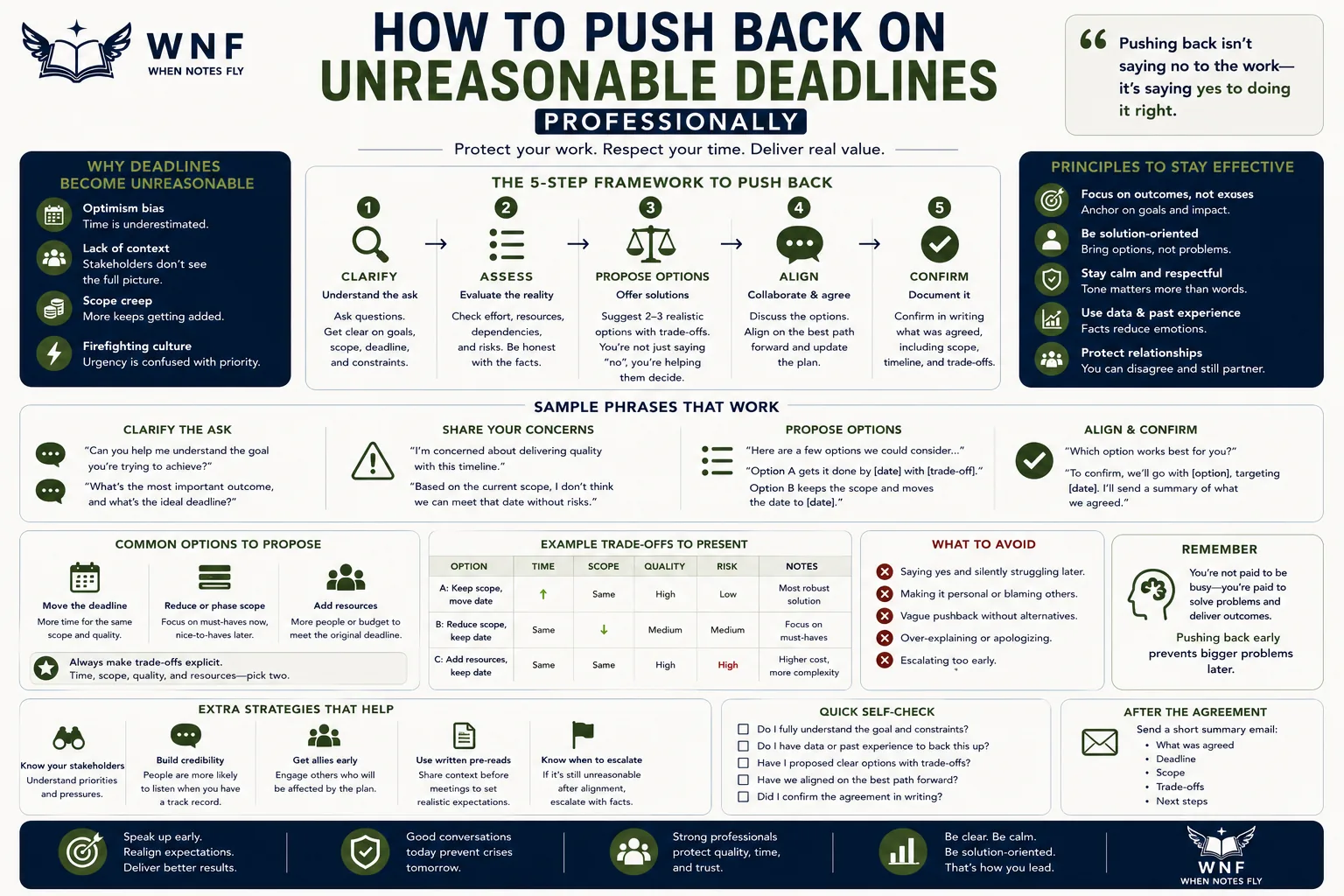
The deadline lands in your inbox with the confidence of something already decided. Three weeks for work that needs six. Friday end-of-day for something that would normally take a month of good runs. The work is real, the stakes are real, and the person assigning the deadline is not unreasonable in person.
They just do not have a clear picture of what the work actually requires, and the calendar they are working against was set by pressures upstream that your team did not shape.
The wrong responses are predictable. Silent acceptance, which sets up the failure. Dramatic pushback, which gets filed as drama. Complaining to peers, which drains energy without changing anything.
The right response is a specific kind of conversation, held early, framed around scope rather than effort, and focused on forcing the tradeoff decision onto the person who actually owns it.
The research on this kind of upward communication is consistent. The framing matters more than the content. The timing matters more than the delivery. The willingness to ask a specific question that requires a specific answer matters more than the eloquence of the objection.
"The person who can reliably surface the real tradeoff before work begins is more valuable to an organization than the person who executes heroically against unrealistic commitments. Heroics are expensive and do not scale.
Clear tradeoff conversations are the infrastructure that functioning teams run on." - Cal Newport, Deep Work (2016)[1]
The First Question: What Is the Deadline Actually Anchored To
Before pushing back, understand what the deadline represents. Deadlines come in several flavors and the response strategy differs for each.
Externally anchored deadlines. A client commitment, regulatory filing, contractual obligation, or publicly announced date. These deadlines have genuine external consequences if missed and are the least negotiable. The negotiation space is usually around scope rather than date.
Executive commitments. Leadership promised a board, investor, or external stakeholder that something would land by a specific date. These feel externally anchored but often have more flexibility than they appear, particularly if the executive understands the tradeoffs.
Planning artifacts. Dates that came from a planning spreadsheet, a quarterly OKR document, or a strategic roadmap. These dates are often treated as commitments but are frequently negotiable because the planning process itself was rough.
Arbitrary round numbers. End of the quarter, end of the month, beginning of the next year. These dates were chosen for calendar convenience, not for specific business reasons, and are usually the most negotiable.
Cascaded internal deadlines. A date set because it is two weeks before the real deadline, giving buffer to someone further downstream. These deadlines sometimes look arbitrary but may be holding up other work that has real constraints.
Understanding which category applies determines your strategy. Script for investigation: "I want to make sure I understand the timing. What is driving the specific date? Is there an external commitment, or is this internal planning that has some room?" The answer tells you how much negotiation space exists.
| Deadline Type | Flexibility | Primary Negotiation Axis |
|---|---|---|
| External client commitment | Low on date, higher on scope | Scope and phasing |
| Executive commitment | Moderate | Scope, date slippage with communication |
| Planning roadmap | Moderate to high | Date, scope, sequencing |
| Arbitrary round number | High | Date |
| Cascaded internal buffer | Moderate | Depends on downstream constraint |
The Timing of the Conversation
The window for productive deadline pushback is narrow and front-loaded. Pushback raised within the first 24 to 72 hours of the commitment is treated as planning input. Pushback raised after execution has begun is often treated as performance failure, regardless of whether the concern is equally valid.
This means the most important habit for deadline management is reading new commitments carefully as they land and responding quickly if the math does not work. Delayed pushback creates several compounding problems. The manager has already planned around the original commitment, so reversing it is more disruptive.
Other people have started making dependent commitments. Your own credibility suffers because the signal of a mid-flight deadline concern reads as execution trouble rather than planning clarity.
The specific practice that works: when a new commitment lands, block 30 minutes within the same day to sketch the actual work required, identify the critical path, and estimate honestly. If the estimate exceeds the deadline by more than 20 percent, the conversation happens the next day, not at the end of the week.
The Scope-Based Framing
The single most important framing choice in deadline pushback is to talk about scope, not effort. Effort-based pushback sounds like "this is too much work for the time." Scope-based pushback sounds like "the work as scoped does not fit the time, and here is what adjusting the scope could look like."
The difference is not just linguistic. Effort framing invites the manager to question your capability, motivation, or work ethic. Scope framing invites the manager to make a specific decision about priorities, which is their job. The first framing positions you as a problem.
The second framing positions you as a partner who is helping them make better decisions.
Effort version (avoid): "I don't think I can get this done in three weeks."
Scope version: "Three weeks is feasible if we drop the secondary analysis and reduce the scope of the integration testing. With the original scope, I'd estimate five to six weeks. Which would you prefer?"
The scope version does several things. It provides a specific, defensible estimate. It identifies the specific components that are creating the time pressure. It gives the manager a concrete tradeoff to decide on rather than a problem to solve.
It signals that you have thought carefully about the work rather than reacting emotionally to the timeline.
The estimate needs to be honest. Padded estimates that are obviously inflated lose credibility. Under-estimates that produce later slippage destroy credibility even faster. The estimate should reflect what the work actually requires with reasonable effort from a capable person.
The Tradeoff Conversation in Practice
The conversation has a specific structure that works across contexts.
Open with context. "I wanted to talk about the timeline for the project. I have sketched out what the work looks like and I want to walk through a few things with you."
Present the work required. "Here is what I see as the core work, broken into pieces. The critical path is [specific components]. My estimate for each piece is [specific numbers]."
Surface the gap. "Based on these estimates, the full scope lands at [date], which is [specific period] after the target. The gap is not small, so I want to discuss options."
Present specific tradeoff options. "I see three ways to close the gap. One, we reduce scope by [specific items], which gets us to [date]. Two, we extend the deadline to [date], which accommodates the full scope.
Three, we bring in additional resource for [specific components], which would require [specific people] for [specific duration]. Which approach works best?"
Listen to the response. The manager now has a specific decision to make with specific information. Their response reveals whether they will accept a tradeoff, push back on the estimates, or escalate to someone with broader decision authority.
Document the agreement. After the conversation, a brief written summary confirms the scope, date, and approach. The documentation prevents later drift and creates a reference point.
"The conversation that produces a real decision about tradeoffs is not the conversation where you complain about a deadline. It is the conversation where you present the specific choices that need to be made and ask the decision-maker to make them.
Managers respond to choices. They rarely respond to generalized pushback." - Julie Zhuo, The Making of a Manager (2019)[2]
When the Manager Disputes Your Estimates
A common response is the manager pushing back on your estimates, either directly or indirectly. The pattern is often "that should only take a few days, not two weeks."
If the pushback is reasonable, engage it seriously. Script: "Help me understand what you are seeing.
Is there a piece of the work you think is faster than I have estimated, or are we thinking about different scopes?" This opens the conversation to either correcting your estimate if it is wrong, or identifying scope misalignment that needs resolution.
If the pushback is unreasonable, defend the estimate with specifics. Script: "I want to walk through my estimate for [specific component]. The work involves [specific steps]. Each of those typically takes [specific time] for reasons of [specific constraint].
Where do you think we can compress?" Forcing the discussion to specifics usually reveals that the optimistic estimate was based on an incomplete picture of the work.
If the pushback persists without specifics, the conversation often shifts to a more structural question. "I understand we have different estimates. Given that, how would you like to proceed?
Should we commit to the more optimistic estimate and see what happens, or do we want to scope more conservatively?" This forces the manager to own the optimism rather than push it onto you.
The discipline is to not accept optimistic estimates you do not believe. Committing to a deadline you know is unrealistic creates the worst of both worlds: you still fail the deadline, and you lose credibility for not having raised the concern earlier.
The Client-Facing Deadline Case
When the deadline is anchored to an external client or stakeholder commitment, the flexibility on the date is typically lower. The negotiation space shifts to scope and phasing.
Script for client-anchored deadlines: "I understand the client date is fixed. Let me propose a phased approach. Phase one by the client date includes [specific deliverables], which we can commit to. Phase two, which includes [additional deliverables], would follow at [specific date].
This lets us hit the commitment without compromising quality on the core deliverables."
Most client relationships accommodate phased delivery when it is framed proactively and clearly. Clients typically prefer phased delivery of the most important components over rushed delivery of everything.
The professional who proposes this framing, rather than scrambling to deliver unrealistic commitments, often becomes trusted as a reliable partner precisely because they are honest about capacity.
The "Everything Is Priority One" Problem
When a manager's response to a tradeoff conversation is that all the work is priority one and nothing can be dropped, the response has a specific pattern that usually works.
Force the specificity. Script: "I hear that all of it is critical. To help me plan, can we rank-order the list? If we could only ship three items by the deadline, which three would be most important? I want to make sure I am putting energy in the right places."
The ranking exercise usually produces clearer prioritization because forcing a choice is different from soliciting a priority. Managers who resist ranking are often deferring prioritization work that should be theirs, and the question makes that dynamic visible.
If the manager cannot or will not rank the work, the situation becomes a higher-order problem that may need to be escalated. Script: "If all of these are truly priority one and cannot be sequenced, I want to flag that we are likely to deliver some of them poorly or miss some entirely. Given that, how would you like to proceed?"
Scope Creep During Execution
Separate from initial deadline setting, a distinct pattern is the deadline that stays the same while scope grows. New requirements, new stakeholders, new edge cases appearing as the project progresses, with no adjustment to the timeline.
The professional response is to make each addition visible as a tradeoff. Script when new work is added: "Happy to take that on. Adding it to the scope for the current deadline means [specific existing item] will shift or drop. Which would you prefer?"
The conversation forces the tradeoff at each addition. The alternative, absorbing the additions silently, creates compounding pressure that eventually produces either missed deadlines or degraded quality.
Making each addition cost a specific existing item keeps the overall workload within bounds and makes the total picture visible to the manager.
The Documentation Habit
For projects with real stakes, written documentation of the scope and deadline matters. The documentation does not need to be formal. A brief email after the conversation is usually sufficient.
Template: "Hi [manager], confirming what we discussed. For [project], we are targeting [date] with scope including [specific items]. We agreed to exclude [specific items] from the initial delivery. Let me know if I have anything wrong. Happy to adjust."
The email tone is neutral and operational. It creates a record, allows the manager to correct any misunderstanding, and provides a reference point if later conversations reveal drift.
The documentation also protects against the pattern where verbal agreements drift over time. Managers under pressure sometimes remember commitments differently than they were made. A short written record prevents the drift and preserves the original understanding.
Clear written communication compounds over time into professional reputation that makes future deadline conversations easier.The Emotional Management Component
Deadline conversations are more emotionally charged than they need to be, partly because the deadline pressure the manager is feeling is being passed to you, and your pushback is returning some of it. Managing the emotional register of the conversation matters.
Acknowledge the pressure without absorbing it. "I understand this deadline matters and the pressure is real. I want to help us land it well, which is why I am flagging what we might need to adjust."
Maintain professional composure. The manager may get frustrated. Your job is to remain calm and keep the conversation focused on specifics. Emotional escalation rarely produces better outcomes and often damages the relationship beyond the immediate conversation.
Avoid complaining as a substitute for specifics. Phrases like "this is impossible" or "there is no way" usually make the situation worse. Specific estimates and specific tradeoff options make it better.
Give the manager space to process. Sometimes the best move is to present the tradeoffs and let the manager think about them overnight before expecting a response. Forcing decisions in the moment can produce worse outcomes than letting the conversation breathe.
"The best negotiators are the ones who can stay calm when the other side is not. Your regulation is contagious. If you stay specific and professional while the manager is frustrated, they often regulate to match your state. This is not a trick.
It is a well-documented feature of how mirror systems work in social interaction." - Chris Voss, Never Split the Difference (2016)[3]
The Pattern Over Time
Deadline management is not a single conversation. It is a practice that compounds over dozens of interactions with a manager. Professionals who handle deadlines well develop reputations for reliability precisely because they are honest about capacity and specific about tradeoffs.
The pattern develops in stages. Early in a relationship with a manager, the honesty can feel risky. Over time, the pattern becomes credibility. Managers learn that when you commit to a deadline, you will hit it, and when you flag concerns, the concerns are usually valid.
This reputation is more valuable than the ability to execute under any pressure, because it means the manager can actually plan around your work.
The cognitive-skill assessment tools atWhen the Environment Does Not Accept Pushback
Some environments systematically reject deadline pushback regardless of framing. The manager insists all work must be delivered on the original timeline. Scope adjustments are rejected. Written documentation is treated as insubordination. Effort-based working evenings and weekends is the expected response.
When the pattern is clear, the calculation shifts. The professional can either conform to the environment and accept its consequences, including burnout and degraded quality, or plan for transition to a different environment where tradeoff conversations are accepted.
Fighting the environment rarely produces change and typically damages the individual without benefiting the organization.
For readers planning career moves out of environments that systematically reject professional deadline management, building entrepreneurial or consulting alternatives is one option. Clear communication with clients and stakeholders in independent arrangements is even more important than in employment, and the templates at
The Long-Term Skill
The deeper skill being built through deadline conversations is scope judgment. The capacity to look at a piece of work, estimate what it actually requires, and communicate the tradeoffs clearly. This skill transfers across roles, companies, and industries.
It is one of the highest-leverage professional skills because it touches almost every significant decision in knowledge work.
The practice that builds the skill is the iterative honesty of each deadline conversation. Honest estimates, clear tradeoffs, professional delivery, written documentation, post-hoc reflection on what was learned. Each cycle improves calibration.
Over years, the calibration becomes a professional asset that compounds into seniority and autonomy.
The reader who finishes this and wants to start practicing should pick the next commitment that lands on their calendar. Do the sketch. Run the estimate. Have the conversation if the math does not work. The specific outcome of the first conversation matters less than the habit of having it.
See also: How to Disagree With Your Boss Without Getting Fired | Conflict Communication Explained
Sources & Further Reading
- Newport, C. (2016). Deep Work: Rules for Focused Success in a Distracted World. Grand Central Publishing.
- Zhuo, J. (2019). The Making of a Manager: What to Do When Everyone Looks to You. Portfolio.
- Voss, C. (2016). Never Split the Difference. Harper Business.
- Patterson, K., Grenny, J., McMillan, R., & Switzler, A. (2012). Crucial Conversations (2nd ed.). McGraw-Hill.
- Harvard Business Review. (2019). "How to Push Back Against an Unreasonable Deadline."
- DeMarco, T., & Lister, T. (2013). Peopleware: Productive Projects and Teams (3rd ed.). Addison-Wesley.
- Cappelli, P., & Tavis, A. (2016). "The Performance Management Revolution." Harvard Business Review, 94(10), 58-67. View source
- Grant, A. (2013). Give and Take. Viking.