
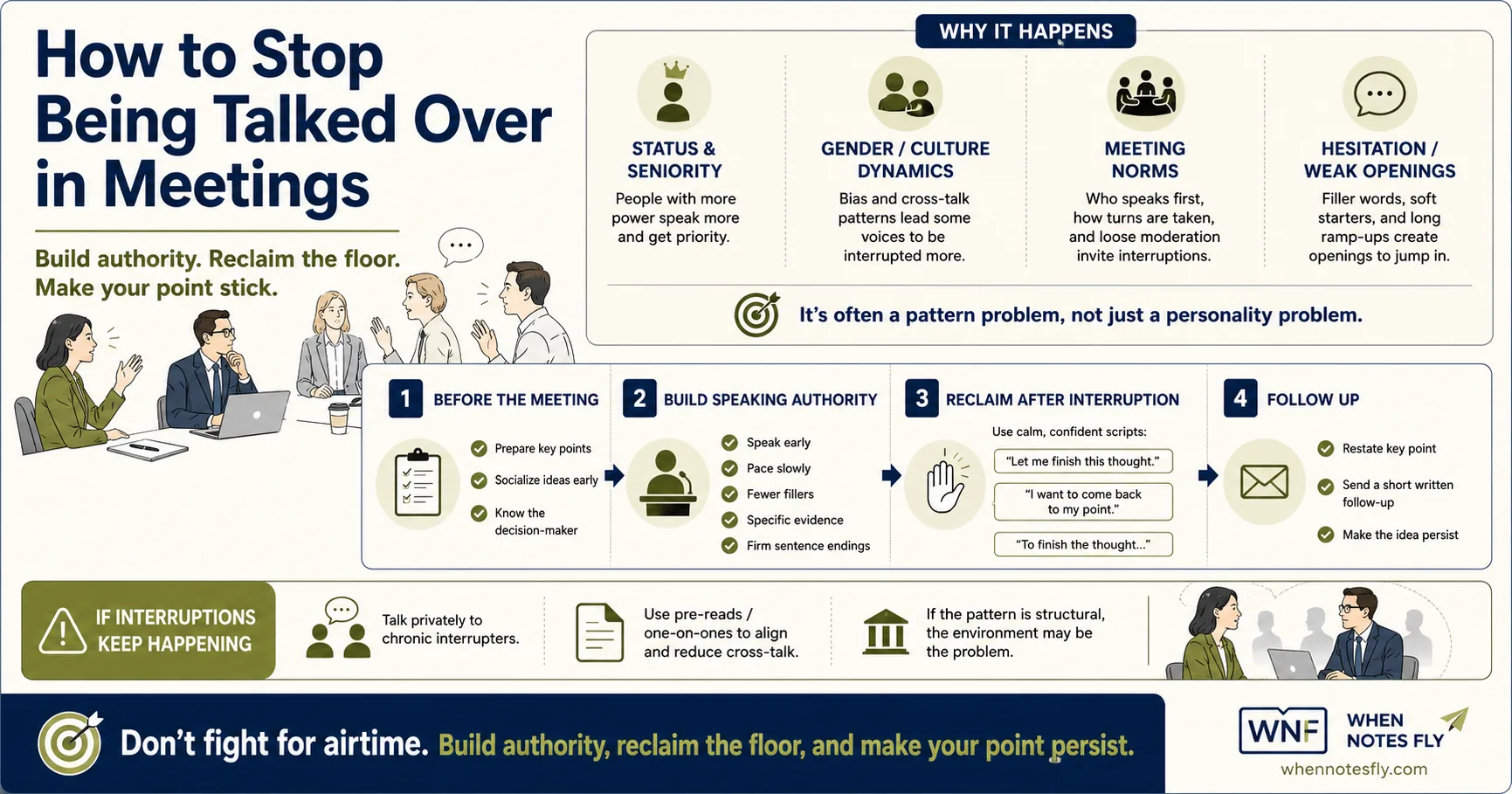
Being: The meeting ends and you walk back to your desk knowing three things. You had a good point. You tried to make it. Someone cut you off mid-sentence, and by the time you tried to return to the thread, the conversation had moved on. This happens routinely, not rarely.
The specific people who interrupt you are sometimes consistent and sometimes not. The cumulative effect is that your ideas get less airtime than they deserve and your influence is less than your actual contribution warrants.
The research on meeting dynamics is substantial and consistent. Interruption patterns are not random. They correlate with gender, seniority, cultural background, and specific behavioral signals that can be identified and modified.
The good news is that the signals are largely learnable and the techniques for reclaiming speaking authority are well documented.
The frustrating news is that individual technique cannot fully compensate for environments where interruption is culturally normalized.
"Voice is not a personality trait. It is a learned set of behaviors that can be developed with deliberate practice. People who seem naturally authoritative in meetings are usually people who learned specific techniques, often without being aware they were learning them.
Making those techniques explicit accelerates the learning for everyone else." - Susan Cain, Quiet: The Power of Introverts in a World That Can't Stop Talking (2012)[1]
The Documented Patterns
Research on interruption frequency in professional settings is remarkably consistent across studies. Adrienne Hancock's work at George Washington University found women are interrupted roughly three times more often than men in mixed-gender professional settings.[2]
Kieran Snyder's analysis of technology company meetings found similar patterns.[3] Race, cultural background, and age add additional layers of differential interruption rates.
The implications for individuals are important. The pattern of being interrupted more frequently than peers is often not a reflection of poor communication skills but of systemic behavioral patterns in the environment.
Recognizing this is useful because it reframes the situation from "I am not good enough at meetings" to "the environment has specific patterns I can learn to navigate."
The patterns also vary by meeting type. Brainstorming meetings have higher interruption rates than decision meetings. Large meetings have different dynamics than small meetings. Video meetings produce different interruption patterns than in-person.
Specific cultures within companies, particularly in sales and some engineering environments, have normative interruption rates that are higher than others.
| Setting | Typical Interruption Pattern | Common Response Effectiveness |
|---|---|---|
| 1-on-1 | Low, usually recoverable | High - direct request usually works |
| Small team meeting (3-6 people) | Moderate | High - structured turn-taking possible |
| Large meeting (7+ people) | Higher, often status-driven | Moderate - requires pre-meeting work |
| Video with large group | High, technology amplifies | Variable - chat and hand-raise help |
| Brainstorming | High, often encouraged | Low - requires post-meeting follow-up |
| External client meeting | Variable, status-sensitive | Depends on role and seniority |
The Speaking Authority Elements
Before focusing on interruption recovery, it is worth focusing on the underlying signals of speaking authority. People with high speaking authority are interrupted less often in the first place. The signals that produce this perception are learnable and work together.
Pace. Speakers with high authority typically speak slightly slower than their conversational pace in meetings. Rushed speech signals anxiety and invites interruption. Deliberate pace, with natural pauses, signals that the speaker expects attention and is not in competition for it.
Pauses. Silent pauses are more authoritative than filler words. "Um," "like," "you know," and similar filler signal uncertainty. Silent pauses, where the speaker is clearly gathering thought, signal control.
The research on vocal authority consistently identifies pause usage as one of the strongest predictors of perceived competence.
Concrete specificity. Abstract language invites challenges. Specific numbers, dates, examples, and concrete evidence are harder to interrupt productively. "We saw a 23 percent improvement in conversion last quarter" is a sentence that commands completion in a way that "conversion improved a lot" does not.
Eye contact targeting. Looking at the decision-maker or the specific person the comment is intended for, rather than scanning the room, increases the stakes of interruption. The interrupter is visibly breaking a direct communication channel rather than a diffuse one.
Pitch and terminal inflection. Rising inflection at the end of sentences, which can make statements sound like questions, reduces perceived authority. Slight downward inflection at sentence ends signals completeness and conviction. This is a small technical adjustment with substantial effects.
Posture and physical presence. For in-person meetings, upright posture, hands visible rather than hidden, and gesture that emphasizes key points all contribute to the authority signal. For video meetings, camera positioning at eye level, good lighting, and deliberate framing serve the same function.
The Pre-Meeting Work
Much of what determines meeting outcomes is decided before the meeting starts. Preparation changes the dynamic in several specific ways.
Socialize your main points before the meeting. For significant proposals or concerns, conversations with one or two key attendees before the meeting often produce better outcomes than introducing the idea fresh in the room. Allies who heard the idea in advance can reinforce it during the meeting, which makes interruption harder.
Bring written materials. A brief document, presented at the start of your remarks, creates a reference point that cannot be interrupted away. If you are interrupted mid-speech, you can return to the document and continue. The document also persists after the meeting, extending your influence beyond the live conversation.
Identify your one key point. Many meeting contributions are too long because they cover multiple points. The single most important idea, stated clearly and concisely, is harder to lose to interruption than a meandering five-minute articulation. Brevity is authority.
Time your entry. In meetings with significant discussion, the first three to five minutes of a topic often determine how it is framed. Entering early with your key framing is often more effective than waiting to react to others' framing.
Know who the decision-maker is. Addressing your remarks to the person with decision authority, rather than to the room generally, tightens the stakes. Interrupters have to weigh whether they are willing to interrupt a direct exchange with the decision-maker, which is a higher cost than interrupting a general comment.
"The person who shapes how a decision is framed usually wins the meeting. Framing is decided in the first minutes of discussion and is hard to reverse later. Preparation to control the framing is one of the highest-leverage meeting activities and one of the most underused." - Kim Scott, Radical Candor (2017)[5]
The Interruption Recovery Techniques
When you are interrupted mid-sentence, the recovery move determines whether you lose the floor permanently or reclaim it. Specific techniques work across contexts.
Calm continuation. Simply keep speaking, slightly louder, without acknowledging the interruption. The interrupter usually stops when they realize you have not yielded. This works when the interruption was fast and not persistent.
Explicit hold. "Let me finish this thought and then I want to hear yours." This acknowledges the interrupter's desire to speak while asserting your right to complete your point. The phrasing is collegial and works even with senior interrupters.
Physical signal. A small hand gesture, palm up, toward the interrupter while you continue speaking. This is a nonverbal hold that works especially well in person and is often less awkward than a verbal assertion.
Explicit callback. "I want to come back to the point I was making about X, which was Y." This is appropriate when the interruption has fully derailed the conversation and you need to re-enter. It works best when preceded by some contribution to the current thread so it does not feel like an abrupt return.
Meta-comment on pattern. "I notice we have been cutting across each other a lot. Can we make sure everyone gets to finish their points?" This is appropriate when interruptions are widespread and affecting multiple people. It reframes the issue at the group level rather than personalizing it.
Post-meeting written follow-up. When live reclamation fails or is not possible, a written follow-up captures your full contribution. An email or channel post with the point you were making, addressed to the group, preserves your contribution to the record.
Each technique has a context where it works best. The choice depends on the specific situation, your relationship with the interrupter, and the overall meeting dynamics.
The Private Conversation
Chronic interrupters, particularly peers, often do not know they are interrupting. A brief private conversation produces awareness that changes the behavior in many cases.
Script for the private conversation: "I wanted to flag something for your awareness. In meetings, you and I sometimes talk over each other. I have noticed it especially on [specific topics]. I think we both have good ideas and I want to make sure neither of us is losing out on airtime.
Any thoughts on how we can handle it better in the moment?"
The framing is crucial. "You and I" rather than "you." "Both of us" rather than "you." Collaborative problem-solving rather than accusation. Most peer interrupters respond well to this framing because it does not trigger defensiveness and it acknowledges their autonomy.
The conversation has a reasonable success rate for peer interrupters, perhaps 60 to 70 percent in my observation of coaching contexts.
Chronic interrupters who do not adjust after awareness has been raised are typically demonstrating a pattern that is unlikely to change regardless of approach, and the response strategy shifts to protective techniques rather than relationship repair.
The Manager Who Interrupts
When the interrupter is your manager, the options narrow. Direct callouts in the moment carry more risk, and private conversations have different dynamics.
In-moment techniques that work with managers. Brief pauses before responding rather than rushing in. Written materials that persist regardless of verbal interruption. Specific hand gestures that signal you have something to add when the manager pauses. These are protective rather than assertive.
Preparation that works with managers. Pre-meeting one-on-ones to socialize your points. Written pre-reads that make your position visible before the meeting starts. Post-meeting written summaries that capture your perspective. These shift influence to channels where interruption is less available.
Private conversations with managers. A calm, non-complaining conversation about meeting dynamics can sometimes help. Script: "I want to make sure I am being useful to you in meetings.
I have noticed sometimes I don't quite complete my thoughts before we move on, and I want to check whether you'd prefer I shorten my comments, wait for different moments, or work differently.
What would be most useful?" This frames the conversation around helping the manager, which is more likely to produce constructive response than a complaint.
When the manager does not change. If the pattern is consistent across reports and persists regardless of approach, the environment is telling you something. Transfer or external move often produces better outcomes than indefinitely working under a manager who systematically prevents you from being heard.
The Video Meeting Specifics
Remote and video meetings have specific dynamics that require adjusted techniques.
Technology-enabled turn-taking. Hand-raise features, chat channels, and reaction icons all provide parallel paths to indicate you want to speak. Using them consistently, not just in rare cases, builds a pattern that others come to respect.
The audio delay problem. The half-second delay in most video platforms creates more accidental collision than in-person meetings.
Specific techniques: brief unmute just before intending to speak to reserve the channel, slight pause after another speaker finishes before starting, explicit "go ahead" when two people start simultaneously.
Chat as parallel channel. Contributing to chat allows your ideas to be recorded even when you cannot get verbal floor time. Some meeting cultures treat chat as primary, some as secondary. Using it effectively requires understanding your environment.
Camera framing and lighting. Authority signals over video are heavily influenced by how you appear. Eye-level camera positioning, good lighting from the front, and minimized distractions in the background all contribute to perceived authority. These are one-time setup investments that pay off across every meeting.
Explicit moderation request. For important meetings where interruption is a concern, asking the organizer to moderate turn-taking can reset the dynamic. "Can we use the hand-raise for this discussion so everyone gets a turn?" is a reasonable request that usually gets accepted.
"Remote meetings amplified some dysfunctional meeting patterns and reduced others. The specific technologies for turn-taking are under-used in most teams.
Deliberate norms about how to participate in video meetings produce substantial improvements in participation equity with almost no additional cost." - Julie Zhuo, The Making of a Manager (2019)[6]
The Environment Signal
When interruption patterns persist despite deliberate individual effort, the environment itself is sending a signal worth reading.
The research on organizational voice, extensively summarized by Elizabeth Morrison and others, consistently shows that environments with poor voice dynamics also have poor retention, innovation, and performance outcomes.[4]
The signals that suggest the environment is the primary problem:
Interruption patterns are systemic, not individual. Multiple people are being talked over, not just you. Some are being heard, others are not. The pattern correlates with demographic factors rather than with specific communication styles.
Leadership does not model productive discussion. Senior leaders interrupt each other, interrupt reports, and do not call out the pattern. The norm is set at the top.
Performance recognition correlates with who talks most, not what is said. People who dominate meetings are promoted. People who contribute thoughtfully but briefly are overlooked. This is a culture signal about what the organization values.
Individual techniques produce only short-term improvement. You apply the techniques, the dynamic shifts briefly, and within weeks the old patterns return. The environment is stronger than individual practice.
When these signals accumulate, the rational response is to consider whether this environment is one where your career can develop well. Environments with bad voice dynamics usually have correlated problems in other areas, and the compounding effect over years is substantial.
The cognitive and analytical assessments atThe Written Communication Compensating Channel
Many people who are talked over in meetings are effective writers. For those people, the written channel can partially compensate for the meeting channel, though not fully.
Circulate pre-reads before important meetings. A one-page document that presents your position in writing gives you a secondary channel that is harder to interrupt. Even people who did not read it carefully have seen it, which shapes the meeting indirectly.
Send detailed follow-ups after meetings. A written summary that captures your perspective on the decisions, risks, and open questions extends your influence beyond the live conversation. This is especially valuable when you feel your contribution in the meeting was truncated.
Contribute substantively in written channels. Slack, email, and team documents are all places where ideas can be developed at length without interruption. Being visibly thoughtful in writing compounds into professional reputation even when meeting dynamics are unfavorable.
Use asynchronous decision processes when available. Some teams support written decision processes where options are documented, positions are staked out in text, and decisions emerge from structured review. These processes often produce more equitable participation than live meetings.
Strong written communication partially offsets poor meeting dynamics and compounds into influence over time.The Long Arc of Voice Development
Voice in professional settings is a skill that develops over years, not weeks. The specific techniques in this piece produce measurable improvements in the short term. The deeper development of authority, presence, and confident contribution happens through sustained practice across hundreds of meetings over years.
The investments that compound most: deliberate practice of the techniques in low-stakes settings before deploying them in high-stakes ones. Feedback from trusted peers on how you come across in meetings. Attention to what works for others you respect and why.
Patience with the learning curve, including the inevitable moments where the technique does not work and the floor is lost anyway.
People who started with low meeting authority and developed high meeting authority over years describe a pattern of small, deliberate changes that accumulated into something that looked like natural ability but was actually learned behavior. The pattern is available to anyone who works at it.
Independent practice requires different voice skills than employment, and the communication resources atSee also: How to Disagree With Your Boss Without Getting Fired | How to Push Back on Unreasonable Deadlines Professionally
Sources & Further Reading
- Cain, S. (2012). Quiet: The Power of Introverts in a World That Can't Stop Talking. Crown.
- Hancock, A. B., & Rubin, B. A. (2015). "Influence of Communication Partner's Gender on Language." Journal of Language and Social Psychology, 34(1), 46-64. DOI: 10.1177/0261927X14533197
- Snyder, K. (2014). "How to Get Ahead as a Woman in Tech: Interrupt Men." Fortune.
- Morrison, E. W. (2014). "Employee Voice and Silence." Annual Review of Organizational Psychology and Organizational Behavior, 1, 173-197. DOI: 10.1146/annurev-orgpsych-031413-091328
- Scott, K. (2017). Radical Candor. St. Martin's Press.
- Zhuo, J. (2019). The Making of a Manager. Portfolio.
- Harvard Business Review. (2017). "How to Speak Up in a Meeting and When to Hold Back."
- Edmondson, A. (2019). The Fearless Organization. Wiley.