
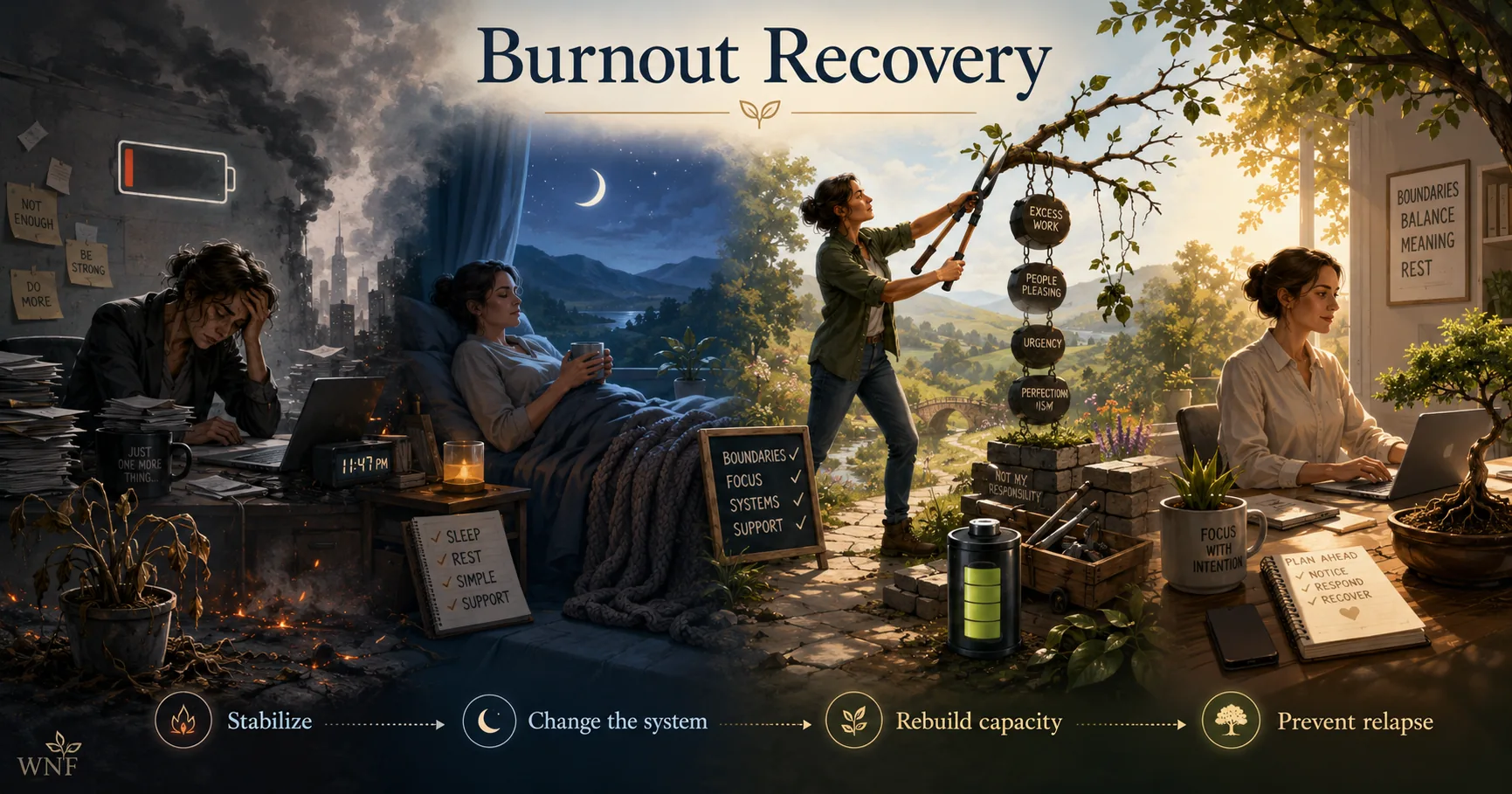
Burnout is not tiredness. It is not a bad week, a demanding quarter, or the feeling of being overwhelmed by deadlines. Those states recover with sleep, a weekend, or the completion of the project.
Burnout is what happens when those recoveries stop working, when the usual interventions fail, and when the state of exhaustion becomes the default rather than the exception.
The research literature, particularly Christina Maslachs four decades of work at UC Berkeley, has consistently described burnout as a syndrome with three specific dimensions: emotional exhaustion, depersonalization or cynicism toward work, and reduced professional efficacy.[1]
Each dimension has a measurable trajectory. Each requires a different intervention.
The World Health Organization added burnout to ICD-11 in 2019 as an occupational phenomenon, which both elevated its recognition and constrained its definition. It is not a medical diagnosis in the formal sense. It is a categorization of a pattern of dysfunction tied specifically to chronic workplace stress.[3]
The distinction matters because the interventions that work for burnout differ from the interventions that work for clinical depression, even though the symptoms overlap substantially.
Treating burnout as depression often misses the structural causes. Treating depression as burnout often misses a condition that needs professional treatment.
This piece walks through the recovery plan the research supports, with an honest timeline, specific interventions ordered by evidence strength, and realistic expectations about how long each phase takes.
"Burnout is not about the individual failing to cope. It is about a mismatch between the person and the work environment, sustained long enough that the persons capacity to respond is depleted. Recovery requires addressing the mismatch, not just the exhaustion." - Christina Maslach, The Truth About Burnout (1997)
The Three Dimensions: What Burnout Actually Is
Maslachs Burnout Inventory, the most validated assessment tool, measures three dimensions.
Exhaustion is the energy dimension. Physical and emotional depletion, feeling used up, dreading another day of the demands, waking up already tired. This is usually the earliest and most visible dimension, and the one people mean when they casually say they are burned out.
Depersonalization or cynicism is the attitudinal dimension. Growing distance from the work and from the people the work involves. Colleagues become annoying. Customers or patients become cases. The work becomes a chore to complete rather than a domain of meaning.
This dimension, particularly in helping professions, is where burnout crosses into something that affects other people.
Reduced professional efficacy is the achievement dimension. The sense that the work is no longer producing value, that the person is no longer effective, that the accumulated effort is not translating into outcomes that matter. This dimension often feeds the other two, as the sense of ineffectiveness increases exhaustion and cynicism.
The three dimensions do not always appear in the same order. Exhaustion often comes first, but some people experience cynicism rising before exhaustion peaks. Reduced efficacy can be the last to collapse or the first warning sign, depending on the work context and the individuals tolerance for each dimension.
| Burnout Dimension | Early Warning Signs | Advanced Signs |
|---|---|---|
| Exhaustion | Dreading Monday, weekend recovery fails, caffeine dependence rising | Persistent tiredness regardless of sleep, physical symptoms (headaches, GI issues), crying episodes |
| Depersonalization/Cynicism | Irritation with colleagues or clients, reduced engagement in meetings | Contempt or hostility toward the work, detachment, sarcasm as default mode |
| Reduced Efficacy | Feeling behind despite effort, reduced creative output, missed deadlines increasing | Inability to complete ordinary tasks, sense of being an imposter despite credentials, avoidance of work |
Diagnosing Severity: Three Rough Categories
Before the recovery plan, the severity assessment shapes the response. The categories are clinical judgments, not formal diagnostic criteria, but they map usefully to the intervention needed.
Mild burnout: Exhaustion is present and weekend recovery is partial rather than complete. Work still produces outputs, but the quality is declining and the effort required is increasing. Cynicism is episodic rather than dominant. Often self-correctable with 4 to 12 weeks of deliberate structural change.
Moderate burnout: Exhaustion is chronic and not relieved by normal rest. Cynicism is frequent and visible. Work outputs are clearly degraded. Sleep is typically disrupted. Physical symptoms (headaches, GI issues, muscle tension) are present.
Typically requires 3 to 9 months of structural change, often including significant work adjustment.
Severe burnout: All three dimensions are acute. Cognitive function is affected (difficulty concentrating, memory issues, decision paralysis). Physical symptoms are substantial. Depression symptoms may be present (anhedonia, persistent low mood, sleep disruption, appetite changes).
Often requires medical leave, professional treatment, and fundamental work change. Recovery typically takes 6 months to 2 years, sometimes longer.
A 2017 meta-analysis by Salvagioni and colleagues in PLOS ONE found that severe burnout has consequences that persist well beyond the initial episode: increased risk of cardiovascular disease, type 2 diabetes, musculoskeletal pain, and depression.[2]
These findings underscore that severe burnout is not just a productivity concern. It is a health concern with documented long-term consequences.
For readers who want to self-assess, the Maslach Burnout Inventory is available through academic licensing. The Oldenburg Burnout Inventory (OLBI) developed by Evangelia Demerouti is another validated option. Both are better tools than generic online quizzes.
If the assessment places you in the moderate or severe range, professional evaluation is warranted before self-directed recovery.
Phase 1: Triage and Stabilization (Weeks 1-4)
The first phase is not recovery. It is stopping the descent. The goal is to stabilize the acute symptoms, restore sleep, and create cognitive space to make decisions that longer recovery will depend on.
Sleep is first. Not because it is the full answer, but because nothing else works while sleep is broken. Target 7 to 9 hours nightly, with consistent bedtime and wake times, and minimal screen exposure in the final hour before sleep.
The research on sleep and cognitive recovery is unambiguous: sleep deprivation impairs emotional regulation, executive function, and immune response in ways that make every other intervention harder.
If insomnia is severe, CBT-I (Cognitive Behavioral Therapy for Insomnia) is the strongest non-pharmacological intervention and has a large evidence base.
Reduce discretionary commitments. Every optional meeting, volunteer responsibility, social obligation, and side project that can be paused, should be paused. This is not permanent. It is creating the space to recover.
The guilt about pausing is a symptom of the same pattern that produced the burnout, and it should be treated as a symptom, not as a reason to keep doing the things.
Identify one person who knows the full picture. A spouse, close friend, therapist, or trusted colleague. Burnout thrives on isolation. Even one person with an accurate view of what is happening provides reality-checking and support that matters substantially for recovery trajectory.
If severe, seek medical evaluation. Physical symptoms from chronic stress mimic and sometimes cause other conditions. A baseline evaluation rules out thyroid dysfunction, vitamin deficiencies, cardiac issues, and other treatable contributors.
If depression symptoms are present, a mental health evaluation is essential. Medical leave under FMLA (US) or equivalent legal frameworks provides protected time for recovery and is often underutilized because people fear career consequences that in practice are smaller than the cost of continued deterioration.
Phase 2: Structural Change (Months 2-4)
Phase 1 stabilizes. Phase 2 addresses the conditions that produced the burnout. Without phase 2, phase 1 recoveries relapse on return to the same environment.
Maslach and Leiters research on organizational contributors to burnout identifies six areas where mismatches between person and job predict burnout:
- Workload: Demands exceed capacity over sustained periods.
- Control: Low autonomy over how work is done or which tasks to prioritize.
- Reward: Recognition and compensation insufficient for the effort required.
- Community: Supportive workplace relationships absent or degraded.
- Fairness: Perceived unfairness in decisions, allocation, or treatment.
- Values: Core work conflicts with personal values.
Recovery requires identifying which of these areas are the primary contributors and changing them.[5] Often one or two dominate. The change strategy depends on which.
For workload mismatches: The conversation is with the manager, explicitly about scope. What can be dropped, delayed, delegated, or restructured. The Eisenhower urgent/important matrix helps categorize current work.
A 20 to 30 percent reduction in scope is often achievable without structural catastrophe and produces substantial recovery. If the reduction cannot be negotiated, this signals a deeper mismatch that may require role change.
For control mismatches: Negotiating specific autonomy in specific domains is often more feasible than broad autonomy. Asking for control over schedule, method, or which projects to prioritize within assigned responsibilities. Managers usually have more flexibility on method than on deliverables.
For reward mismatches: The salary negotiation conversation is a separate track but part of the same recovery. Undercompensation relative to contribution accelerates burnout because the effort-to-return ratio worsens over time.
For community mismatches: Rebuilding connection with at least 2 to 3 colleagues who are supportive matters for daily functioning. If the team culture is fundamentally toxic, this may not be achievable in place and contributes to the case for role change.
For fairness mismatches: These are often the hardest to change in place because they reflect organizational culture. Documentation, HR escalation, or exit may all be necessary depending on specifics.
For values mismatches: Often the deepest and least fixable in place. If the work fundamentally conflicts with what you believe matters, no amount of workload or autonomy adjustment produces sustainable recovery. This is the clearest case for role or employer change.
"Burnout is not a badge of honor or a personal failing. It is an occupational diagnosis that points to an organizational problem. Individual resilience has limits.
When the environment is structurally hostile to human well-being, the answer is changing the environment, not recruiting tougher humans." - Emily Nagoski and Amelia Nagoski, Burnout: The Secret to Unlocking the Stress Cycle (2019)
Phase 3: Rebuilding Capacity (Months 4-9)
Phase 3 is the sustained work of rebuilding the psychological and physical capacity that burnout depleted.[4] This is slower than most people expect and requires patience with partial recovery.
Physical conditioning. Moderate aerobic exercise, 150 minutes per week or more, improves mood, sleep, and cognitive function with effect sizes comparable to antidepressant medication for mild to moderate depression. The meta-analysis literature is consistent on this.
Strength training adds additional benefits. For severely burned-out individuals, starting small (walking, short sessions) matters more than intensity. The first weeks are hard; by 6 to 8 weeks the positive effects become self-reinforcing.
Cognitive load reduction. Continuing from phase 1, the deliberate reduction of cognitive inputs (notifications, media, decisions) allows the overloaded systems to recover. This is not permanent. It is the equivalent of resting an injured joint. Full load returns gradually as capacity rebuilds.
Identity rebuilding. Severe burnout often produces an identity collapse, particularly in people whose self-concept was tightly bound to their professional role. Rebuilding non-work identity, through relationships, activities, and interests outside the role, provides psychological ground to stand on independent of how the work is going.
The research on identity complexity by Patricia Linville and others suggests that diverse self-identities buffer against stress-related mood disruption.
Relationship reinvestment. The social connections that atrophied during burnout require deliberate rebuilding. This is slow work and has to accommodate limited capacity. Starting with the easiest relationships (family, long-term friends) before attempting to rebuild harder ones.
Professional support where indicated. Therapy for burnout with co-occurring depression or anxiety has strong evidence. Cognitive-behavioral approaches are well-studied. Acceptance and Commitment Therapy (ACT) is particularly relevant for values-clarification work that often matters in burnout recovery.
EMDR or trauma-focused therapy is relevant when burnout is linked to workplace trauma (harassment, abuse, severe moral injury).
Phase 4: Reintegration and Relapse Prevention (Months 6-12+)
Phase 4 is the longer-horizon work of returning to full engagement with structural changes in place that prevent relapse. The research on burnout relapse is sobering: people who return to unchanged conditions often relapse within 6 to 18 months of initial recovery.
| Recovery Component | Evidence Strength | Typical Timeline |
|---|---|---|
| Sleep restoration | Strong; prerequisite for other components | 2-8 weeks if no sleep disorder |
| Workload reduction | Strong | Immediate once negotiated |
| Exercise (moderate aerobic) | Strong; robust meta-analysis support | Benefits visible in 4-8 weeks |
| Professional therapy | Strong for co-occurring depression/anxiety | 3-6 months for meaningful effect |
| Mindfulness programs | Moderate; MBSR has reasonable evidence | 8 weeks standard program |
| Vacation/sabbatical | Temporary effects without structural change | Decays within 2-4 weeks |
| Role or employer change | Strong when mismatch is structural | Effects accrue over 3-12 months post-change |
| Medication (SSRIs for depression) | Strong for clinical depression, less specific for burnout | 4-8 weeks to full effect |
The warning signs that matter for relapse prevention: returning exhaustion, rising cynicism, sleep disruption, irritability increase, loss of meaning in work that had regained meaning, and physical symptoms (headaches, GI issues, muscle tension).
Any of these returning within 6 months of apparent recovery is a signal to adjust before further decline.
Ongoing structural protections: firm work-life limits that are practiced, not just stated. No email outside working hours. Protected recovery time on weekends. Vacation actually taken. Delegating rather than absorbing scope creep.
These practices are boring to describe and hard to maintain in demanding environments. They are also what distinguishes sustainable performance from cycles of burnout and recovery.
The Sabbatical Question
For severe cases, an extended sabbatical (6 to 12 weeks or more) produces larger and more durable recovery effects than shorter vacations.[6]
The research by Cheryl Travers and others on extended leave suggests that 6 weeks is a practical minimum for substantial recovery of psychological capacity, with some evidence that 12 weeks produces more durable effects.
The logistical barriers are real. Unpaid leave is financially difficult. Paid sabbaticals exist at some organizations but are uncommon in most industries.
FMLA in the US provides 12 weeks of unpaid leave with job protection for qualifying medical conditions (which burnout with clinical co-occurring conditions often qualifies as). Short-term disability insurance sometimes covers mental health leave.
The risk of not taking extended leave in severe cases is that partial recovery plateaus at a level that leaves the person functional but impaired, sometimes for years. The short-term financial and career costs of a sabbatical are often smaller than the longer-term costs of sustained impaired functioning.
"The body keeps the score. Chronic stress accumulates in tissues, circuits, and behaviors long after the conscious mind has decided to override the warning signals.[8] Recovery requires listening to signals that the culture of productivity trained you to ignore." - Bessel van der Kolk, The Body Keeps the Score (2014)
When Changing Jobs Is the Right Answer
The research does not recommend job change as the default intervention, but it does recommend it clearly when certain conditions apply. Those conditions are:
Structural mismatches that cannot be negotiated in place. When workload, autonomy, reward, or values conflicts are built into the role and the organization has no capacity or willingness to change them, the mismatch is not a personal failure to cope.
Toxic leadership that cannot be avoided. When a direct manager or senior leadership is the primary contributor, HR escalation sometimes helps and often does not. The career costs of persistent conflict with leadership are typically larger than the costs of a managed exit.
Industries with structural burnout patterns. Some industries have burnout baked into the model (certain medical specialties, investment banking analyst programs, management consulting at senior levels, many founder-led startups during funding crises). Recovery within the same industry role may not be possible.
Values conflicts that cannot be bridged. When the work serves ends you find unacceptable, sustained engagement is incompatible with recovery.
The decision to change jobs during recovery carries risk. Major decisions made while severely burned out tend to be worse than decisions made after partial stabilization.
The commonly recommended sequence is to stabilize first (phase 1 and early phase 2), evaluate the structural options, then make the change from a recovered-enough state to choose well.
Financial preparation matters. Six months of expenses in accessible savings provides the runway to choose rather than to accept the first available option. This is not always possible, but to the extent it is, it transforms the decision quality substantially.
A Note on Remote and Hybrid Work Burnout
The post-2020 research on remote work and burnout is still developing, but several patterns are visible.
Remote work can reduce some burnout contributors (commute stress, in-person micromanagement, context switching from open-plan offices) and increase others (always-on availability, reduced boundary between work and home, social isolation).[7] The net effect varies by individual and organization.
The specific patterns that predict remote-work burnout include: unclear working hours, video call density above 4 hours daily, reduced informal connection with colleagues, and physical work environments that do not separate from living environments.
The interventions that help are structural: defined working hours, camera-off default for non-decision meetings, deliberate social connection practices, and physical or time-based separation between work and non-work.
See also: Flow State: How to Enter Deep Focus on Demand | Compassion Fatigue Explained
Sources & Further Reading
- Maslach, C., & Leiter, M. P. (2016). "Understanding the Burnout Experience: Recent Research and Its Implications for Psychiatry." World Psychiatry, 15(2), 103-111. DOI: 10.1002/wps.20311
- Salvagioni, D. A. J., Melanda, F. N., Mesas, A. E., Gonzalez, A. D., Gabani, F. L., & Andrade, S. M. (2017). "Physical, Psychological and Occupational Consequences of Job Burnout: A Systematic Review of Prospective Studies." PLOS ONE, 12(10), e0185781. DOI: 10.1371/journal.pone.0185781
- World Health Organization. (2019). "Burn-out an Occupational Phenomenon: International Classification of Diseases (ICD-11)." View source
- Nagoski, E., & Nagoski, A. (2019). Burnout: The Secret to Unlocking the Stress Cycle. Ballantine Books.
- Schaufeli, W. B., & Bakker, A. B. (2004). "Job Demands, Job Resources, and Their Relationship with Burnout and Engagement." Journal of Organizational Behavior, 25(3), 293-315. DOI: 10.1002/job.248
- de Bloom, J., Geurts, S. A. E., & Kompier, M. A. J. (2012). "Effects of Short Vacations, Vacation Activities and Experiences on Employee Health and Well-Being." Stress and Health, 28(4), 305-318. DOI: 10.1002/smi.1434
- Demerouti, E., Bakker, A. B., Nachreiner, F., & Schaufeli, W. B. (2001). "The Job Demands-Resources Model of Burnout." Journal of Applied Psychology, 86(3), 499-512. DOI: 10.1037/0021-9010.86.3.499
- van der Kolk, B. A. (2014). The Body Keeps the Score: Brain, Mind, and Body in the Healing of Trauma. Viking.
Health note: This article is general educational information about how a topic works, not medical, psychological, or mental-health advice, diagnosis, or treatment. Everyone's situation is different, and research findings describe groups, not individuals.
If you are struggling or have concerns about your health, please talk to a qualified professional such as a doctor or licensed therapist.
If you are in crisis or thinking about harming yourself, contact your local emergency services or a crisis line right away, in the US you can call or text 988 (Suicide & Crisis Lifeline); elsewhere, find local lines at findahelpline.com.