
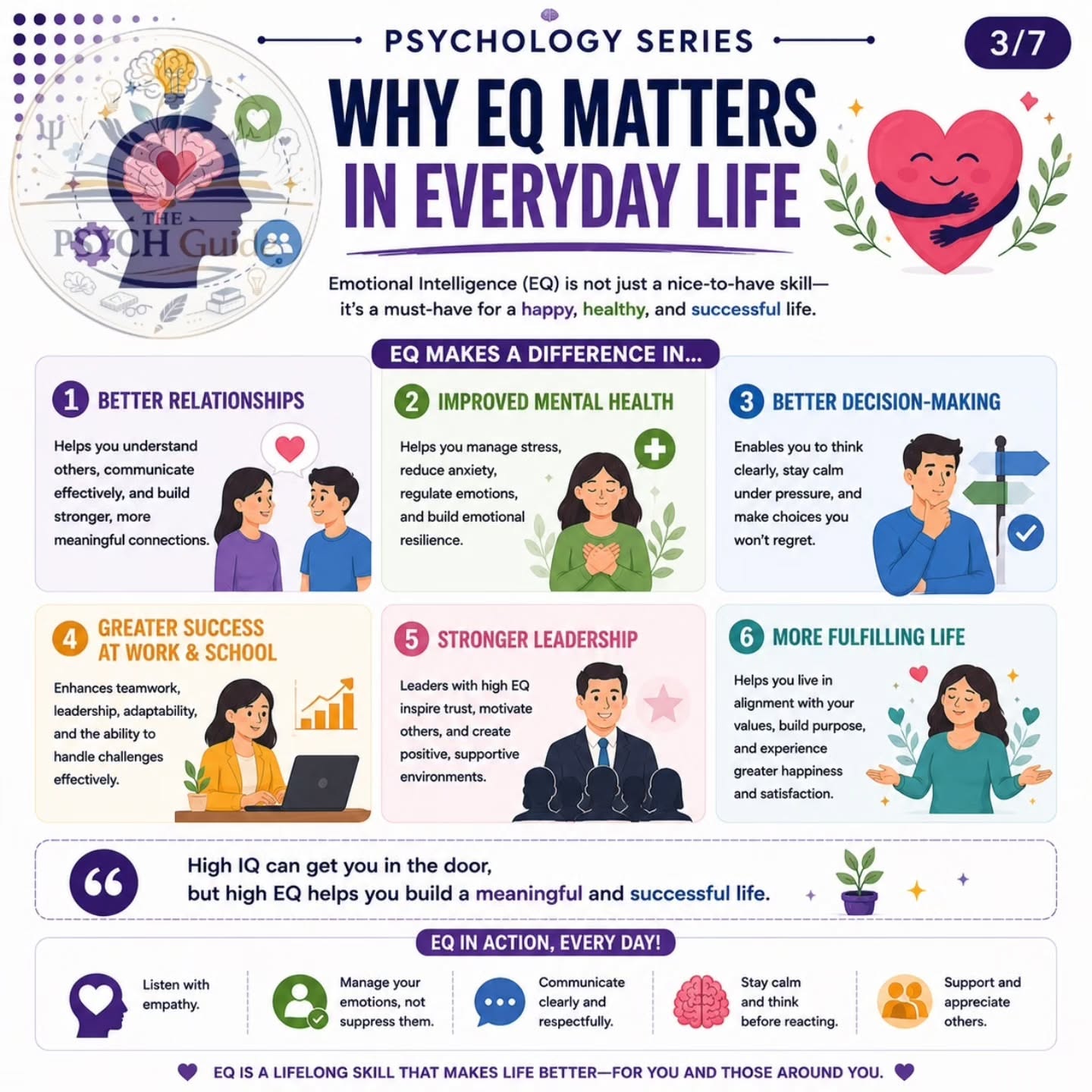
What is emotional intelligence? In the ability model, it is the capacity to perceive, use, understand, and manage emotion-relevant information. This narrower scientific concept differs from broader self-report models that fold in personality, motivation, and social skills. Research supports meaningful differences in emotional processing, but it does not support sweeping claims that EQ outweighs IQ in determining adult success.
In 1995, Daniel Goleman published a book with a claim so sweeping it could have been dismissed as marketing.[3]
Emotional Intelligence: Why It Can Matter More Than IQ argued that the conventional understanding of intelligence was radically incomplete - that the ability to navigate emotions, to understand other people, to regulate one's own responses under pressure, predicted life outcomes more powerfully than anything measured by an IQ test.
The book became one of the bestselling psychology books of the decade, made Goleman a fixture on the corporate speaking circuit, and launched a global industry of EQ assessments, training programs, and leadership development curricula.
It also generated a scientific backlash that is, twenty years later, still working through the implications of what was overstated and what was genuinely important.
The concept that Goleman popularized had serious intellectual origins. In 1990, Peter Salovey at Yale and John Mayer at the University of New Hampshire published a paper in the journal Imagination, Cognition and Personality titled "Emotional Intelligence," which proposed a formal model of a genuine cognitive ability - the capacity to process emotion-relevant information accurately and effectively.[1]
This was a carefully bounded scientific hypothesis, not a claim about the primacy of feeling over thinking.
Salovey and Mayer were proposing that emotions carry information, that people differ in their ability to process that information, and that these differences have consequences.
Goleman took this framework and expanded it substantially, folding in motivation, empathy, social skills, and self-awareness into what he called EQ, and then making quantitative claims ("EQ accounts for 80% of adult success") that far outstripped the available data.
The result is a field that sits in an unusual position: the popular conception of emotional intelligence is substantially overstated, but the underlying scientific concept - that people differ meaningfully in their ability to perceive, use, understand, and manage emotional information - is well-supported.
Disentangling these two realities is the project of this article. What does the research actually show about emotional intelligence? What does it predict, and for whom? Can it be developed? And what is the honest account of what it is and is not?
"Emotional intelligence is the ability to monitor one's own and others' feelings and emotions, to discriminate among them, and to use this information to guide one's thinking and actions." - Peter Salovey and John Mayer, 1990
Key Definitions
Emotional intelligence (EQ): In the ability model of Salovey and Mayer, a set of four interrelated abilities: perceiving emotions accurately in faces, voices, and other cues; using emotions to facilitate thinking and creativity; understanding how emotions work, develop, and interact; and managing emotions in oneself and others.
Ability EQ: The conception of emotional intelligence as a genuine cognitive ability, measured through performance tasks (correctly identifying emotions in faces, predicting emotional sequences, managing described scenarios). Measured primarily by the Mayer-Salovey-Caruso Emotional Intelligence Test (MSCEIT).
| EI Component | Definition | Associated Outcomes |
|---|---|---|
| Perceiving emotions | Accurately reading emotions in faces, voices, and contexts | Better social accuracy; improved interpersonal trust |
| Using emotions | Harnessing emotional states to facilitate thought | More adaptive problem-solving in relevant domains |
| Understanding emotions | Knowledge of how emotions work, develop, and interact | Better conflict resolution and empathy |
| Managing emotions | Regulating one's own emotions and influencing others' | Reduced anxiety, better leadership, improved relationships |
Self-report EQ (mixed models): Broader conceptions of EQ that include personality traits, motivation, and social competencies, measured through self-report scales. The EQ-i (Bar-On) and the EQ measures associated with Goleman's model are in this category. Substantially overlaps with Big Five personality traits.
Alexithymia: The difficulty or inability to identify and describe one's own emotional states. Represents, in some sense, the lower end of the EQ spectrum - and is associated with psychosomatic symptoms, difficulty in close relationships, and increased vulnerability to certain mental health conditions.
Social-emotional learning (SEL): Structured educational programs designed to develop the emotional and social competencies associated with EQ in children and adolescents. The evidence base for SEL programs is among the strongest in education research.
The Salovey-Mayer Model: Four Branches
The original 1990 paper and its subsequent elaborations (Mayer & Salovey, 1997) organized emotional intelligence into four branches, arranged hierarchically from basic to complex:[2]
Branch 1: Perceiving Emotions
The foundational ability: accurately reading emotional information from faces, voices, posture, music, and artwork. This includes recognizing one's own emotional states as well as others'.
Research shows consistent individual differences in emotional perception accuracy, with the ability developing across childhood and adolescence.
People higher in this ability are better calibrated to their own physiological states, make more accurate judgments of others' emotions, and are rated as more socially skilled by observers.
This branch is the one most people identify as empathy - the ability to read the emotional room. But Salovey and Mayer's model distinguishes it sharply from empathic concern (caring about others' emotional states) and identifies it as a cognitive ability distinct from motivation to attend to others.
Branch 2: Using Emotions to Facilitate Thought
The ability to harness emotional states to enhance cognitive performance - using mild positive affect to facilitate creative thinking, using anxiety to focus attention on details, using enthusiasm to sustain effort.
Barbara Fredrickson's broaden-and-build theory (2001) is relevant here: positive emotional states expand the range of thoughts and actions that come to mind (the "broadening" effect), while also building lasting psychological resources over time (the "building" effect).[7]
People who can flexibly move between emotional states have a richer set of cognitive tools available for different tasks.
This is the branch most explicitly about the information value of emotion - the idea that emotional states are not just noise in the cognitive system but signals with functional utility, if one can deploy them appropriately.
Branch 3: Understanding Emotions
The ability to understand emotional vocabulary, to know how emotions interact (how guilt differs from shame, how jealousy relates to envy, how anger can transition to contempt), to predict emotional trajectories, and to understand the social and personal factors that elicit different emotional responses.
This is emotion knowledge - the cognitive map of the emotional landscape.
Research on Branch 3 shows strong development through childhood and adolescence, driven largely by emotional vocabulary acquisition. Children who have more emotion words available show better understanding of emotional situations and better social outcomes.
John Gottman's work on parental emotion coaching (1997) documented that parents who actively label and discuss emotions with children produce children with substantially richer emotion knowledge by middle childhood.
Branch 4: Managing Emotions
The most complex ability: staying open to emotional information while regulating emotional experience and expression in oneself and relationships with others.
This includes knowing when to trust an emotional response and act on it, when to downregulate a disruptive emotional state, and how to influence others' emotional states in ways that facilitate shared goals.
This branch corresponds most closely to what popular accounts call emotional regulation or emotional maturity.
Research by James Gross (1998) at Stanford identified a set of emotion regulation strategies - from situation selection and modification through cognitive reappraisal to response suppression - with systematic differences in their psychological costs and benefits.[8]
Cognitive reappraisal (changing how you think about a situation to change its emotional impact) is associated with better psychological health than suppression (inhibiting emotional expression while the experience continues), which consumes cognitive resources and paradoxically amplifies the suppressed emotion.
The Goleman Divergence: What Popularization Changed
Goleman's 1995 book took Salovey and Mayer's four-branch ability model and expanded it into a "mixed model" that included self-awareness, self-regulation, motivation, empathy, and social skills as components of EQ.
This expansion had practical appeal - these are genuinely important human qualities - but it created a scientific problem: these qualities overlap heavily with existing personality constructs, particularly the Big Five.
Agreeableness, emotional stability (low neuroticism), and extraversion together predict most of what Goleman's mixed-model EQ measures. When researchers statistically control for Big Five personality traits, the incremental predictive validity of self-report EQ measures often approaches zero.
This does not mean the qualities Goleman describes are unimportant - they clearly are important. It means that calling them "emotional intelligence" may be adding a new label to existing constructs rather than identifying something genuinely new.
The ability-based MSCEIT, by contrast, shows only modest correlations with Big Five traits (typically r=0.10-0.30), suggesting it captures something distinct. The tradeoff is predictive validity: the MSCEIT predicts fewer outcomes, but more cleanly.
Goleman's broader EQ predicts more outcomes, but its incremental contribution over personality is less clear.
Edwin Locke's 2005 critique in the Academy of Management Learning and Education made this point sharply: if EQ includes personality traits and general cognitive ability, calling it "intelligence" is a category error.[5] Intelligence, in the psychometric tradition, refers to a specific class of cognitive ability.
Bundling motivation, social charm, and self-discipline into it does not expand the concept of intelligence - it dissolves it.
What EQ Actually Predicts
Job Performance
The most comprehensive meta-analysis of EQ and job performance is Joseph and Newman's 2010 work in the Journal of Applied Psychology, which reanalyzed 65 studies (N=7,898) with careful attention to moderating variables.[4]
Their key finding: EQ predicts job performance most strongly in emotionally demanding jobs - roles requiring frequent interpersonal contact, emotional labor, or emotional regulation under sustained pressure.
In these roles, ability EQ showed validity estimates of r=0.45-0.59, which is practically significant.
In jobs with low emotional demands, the validity was substantially weaker. This is a theoretically coherent pattern: in a job where emotion processing is not task-relevant, better emotion processing does not predict better performance. Where it is relevant, it does.
The implication for EQ in leadership is important: leadership roles are high in emotional demands by definition - managing diverse people, building coalitions, maintaining motivation, navigating conflict.
Jing George's 2000 study of retail managers found that managers' positive emotional expression predicted store performance independently of cognitive ability and personality.
Academic and Social Outcomes
Brackett and Mayer (2003) found that college students with higher MSCEIT scores showed better social functioning, better mood regulation, and lower rates of problem behaviors (drug and alcohol use, interpersonal aggression) after controlling for personality.[9] The effect sizes were modest but consistent across multiple outcome domains.
The most robust evidence for EQ development and its outcomes comes from school-based SEL research.
Durlak and colleagues' 2011 meta-analysis of 213 SEL programs found that students in SEL programs showed an average gain of 11 percentile points in academic achievement, alongside improvements in social skills, emotional competencies, and reductions in conduct problems and emotional distress.[6]
These are large effects by educational research standards.
Mental Health
The relationship between EQ and mental health runs in both directions. Higher emotional intelligence is associated with lower depression, anxiety, and stress reactivity.
The mechanism appears to involve regulation strategies: people with higher EQ are more likely to use adaptive regulation (reappraisal, problem-solving) and less likely to rely on maladaptive strategies (suppression, rumination).
Alexithymia - the inability to identify one's own emotional states - is associated with elevated rates of depression, somatization, and eating disorders.
The Alexithymia Connection
Alexithymia, a term coined by Peter Sifneos in 1973, describes a difficulty identifying and describing one's own feelings, a limited imaginative life, and a concrete, externally oriented cognitive style.[12]
It appears in approximately 10% of the general population and at elevated rates in psychiatric populations and people with psychosomatic conditions.
Alexithymia can be understood as occupying one end of the EQ spectrum: people with high alexithymia have impaired access to the emotional information that EQ involves processing.
Research by Taylor and colleagues (1997) documented the clinical consequences: people with alexithymia are more prone to somatic complaints (physical symptoms without identifiable organic cause), have less satisfying social relationships, and are less responsive to insight-oriented therapies that depend on emotional awareness.
Alexithymia is not the same as low EQ - it is specifically about the ability to identify one's own emotional states, which maps onto Branches 1 and 3 of Salovey and Mayer's model as applied to the self. But it represents a vivid demonstration of what happens at the far end of impaired emotional information processing.
Developing Emotional Intelligence
The evidence that EQ can be developed is clearest for specific components and in structured contexts.
Emotion Labeling and Vocabulary
Simply learning more words for emotional states - developing what psychologist Lisa Feldman Barrett calls "emotional granularity" - improves the ability to identify and differentiate one's own emotional experiences.
People with more differentiated emotional vocabularies are better at regulating their responses (because they can distinguish fear from disgust, or disappointment from shame, and respond accordingly) and report lower emotional reactivity.
Perspective-Taking Training
Structured exercises in taking others' perspectives, including exposure to others' first-person accounts of emotional experiences, improve empathic accuracy.
This can be done through reading literary fiction (Kidd and Castano, 2013, published in Science, found that reading literary fiction improved theory of mind scores in experiments), through dialogue with people from different backgrounds, or through guided perspective-taking exercises.[11]
Mindfulness and Interoceptive Awareness
Mindfulness training increases awareness of one's own physical and emotional states - improving the ability to identify what one is actually feeling before responding.
The evidence for mindfulness as an EQ intervention is not as clean as popular accounts suggest, but there is consistent evidence that it improves emotion awareness and reduces habitual reactivity.
Regulation Strategy Training
Teaching specific emotion regulation strategies - particularly cognitive reappraisal - has clear evidence from Gross's laboratory and clinical trials of cognitive-behavioral interventions.
People who learn to reappraise emotional situations show reduced physiological arousal, reduced subjective negative affect, and better performance on cognitively demanding tasks following emotional disturbance.
EQ in Leadership
The evidence for EQ in leadership is among the most consistent in the field, though the mechanisms are worth specifying carefully. Leaders with higher EQ are better at:
- Accurately reading the emotional climate of their team and responding appropriately
- Regulating their own emotional responses under pressure, particularly avoiding reactive aggression when challenged
- Communicating in ways that are emotionally resonant and motivating
- Navigating conflict without escalation
- Recognizing when team members are in distress and responding effectively
George (2000) proposed that these capacities operate through leaders' effects on team mood: leaders with higher EQ are better at creating and sustaining positive collective emotional states, which predict team creativity, cooperation, and performance.[10]
This is the "emotional labor" of leadership - maintaining an emotionally functional environment through deliberate management of one's own and others' emotional states.
Practical Takeaways
Expand your emotional vocabulary. Learning to distinguish between closely related emotional states (frustration vs. disappointment vs. resentment, for instance) gives you more precise information about what you are experiencing and more options for responding.
Keep a brief emotion journal noting not just what happened but what you felt and how you identified the feeling.
Practice labeling, not fixing. When someone shares an emotional experience, the first step is accurate identification - "It sounds like you are feeling..." - before any attempt at problem-solving. Premature solutions often land as dismissals.
Use emotions as information before acting on them. Ask: what is this emotional response telling me about the situation? Is it tracking something real, or is it being driven by a past pattern? The goal is not to suppress emotional responses but to be curious about what they are signaling.
Develop situational awareness. Before entering high-stakes interpersonal situations, take a moment to note your current emotional state and how it might affect your perception and behavior. Emotions bleed across contexts; what you are carrying from a difficult morning may affect how you read a neutral email.
Seek feedback on your emotional impact. Ask trusted colleagues how you come across in difficult conversations. This is among the hardest data to obtain and among the most useful.
Sources & Further Reading
- Salovey, P., & Mayer, J. D. (1990). Emotional intelligence. Imagination, Cognition and Personality, 9(3), 185-211.
- Mayer, J. D., & Salovey, P. (1997). What is emotional intelligence? In P. Salovey & D. Sluyter (Eds.), Emotional Development and Emotional Intelligence: Educational Implications. Basic Books.
- Goleman, D. (1995). Emotional Intelligence: Why It Can Matter More Than IQ. Bantam Books.
- Joseph, D. L., & Newman, D. A. (2010). Emotional intelligence: An integrative meta-analysis and cascading model. Journal of Applied Psychology, 95(1), 54-78.
- Locke, E. A. (2005). Why emotional intelligence is an invalid concept. Journal of Organizational Behavior, 26(4), 425-431.
- Durlak, J. A., Weissberg, R. P., Dymnicki, A. B., Taylor, R. D., & Schellinger, K. B. (2011). The impact of enhancing students' social and emotional learning. Child Development, 82(1), 405-432.
- Fredrickson, B. L. (2001). The role of positive emotions in positive psychology: The broaden-and-build theory of positive emotions. American Psychologist, 56(3), 218-226.
- Gross, J. J. (1998). Antecedent- and response-focused emotion regulation: Divergent consequences for experience, expression, and physiology. Journal of Personality and Social Psychology, 74(1), 224-237.
- Brackett, M. A., & Mayer, J. D. (2003). Convergent, discriminant, and incremental validity of competing measures of emotional intelligence. Personality and Social Psychology Bulletin, 29(9), 1147-1158.
- George, J. M. (2000). Emotions and leadership: The role of emotional intelligence. Human Relations, 53(8), 1027-1055.
- Kidd, D. C., & Castano, E. (2013). Reading literary fiction improves theory of mind. Science, 342(6156), 377-380.
- Sifneos, P. E. (1973). The prevalence of 'alexithymic' characteristics in psychosomatic patients. Psychotherapy and Psychosomatics, 22(2-6), 255-262.
Related reading: What Is Emotional Intelligence Explained - a broader introduction to the concept. What Is Empathy - the role of perspective-taking within EQ. Emotion Regulation Explained - the specific strategies for managing emotional states. What Is Impostor Syndrome - how emotional self-awareness shapes response to achievement.