
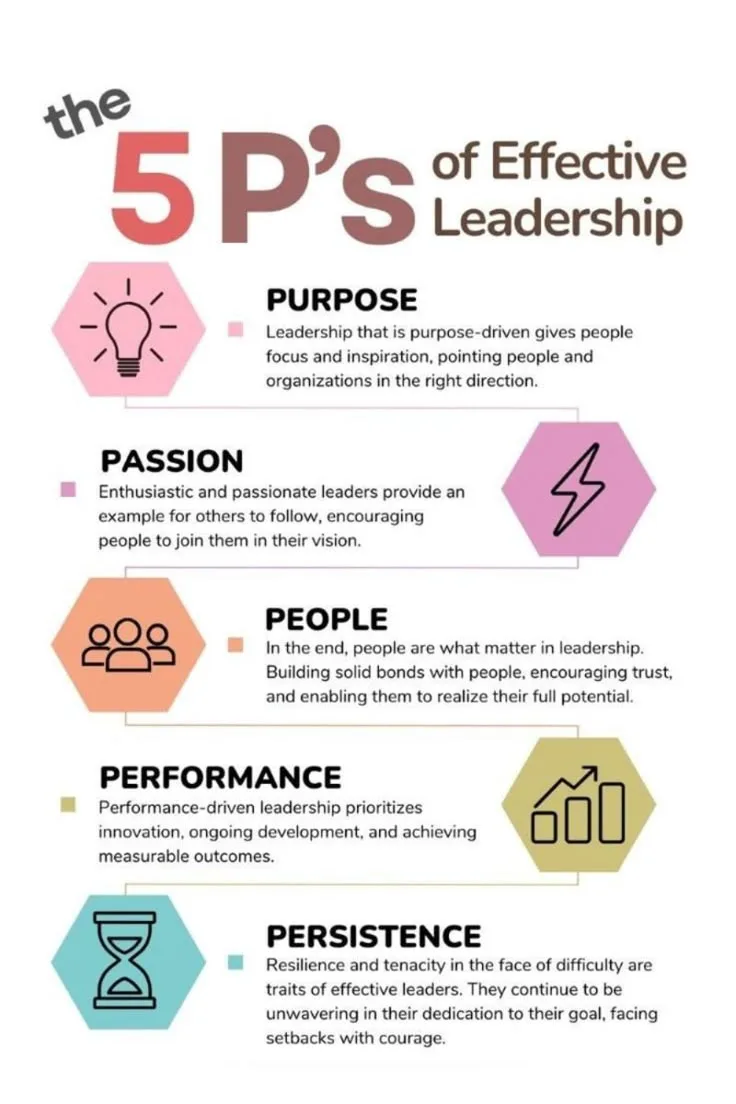
The qualities of effective leaders center on earned trust rather than a title: sound judgment, consistency, humility, clear communication, investment in others, and willingness to address difficult realities. Management ensures reliable execution, while leadership sets direction amid uncertainty and builds voluntary commitment. Research on high-performing organizations highlights psychological safety and transparent problem-solving over charisma, status, or individual technical brilliance.
What Makes a Good Leader?
A good leader is someone who earns the voluntary commitment of others toward a shared goal by combining trustworthy character with the practical competencies required to make sound decisions, develop people, and communicate clearly.
Effective leadership is distinct from positional authority: a manager can compel compliance through organizational hierarchy, but a leader influences behavior because people choose to follow based on earned trust and demonstrated judgment.
Research from Jim Collins's Good to Great study, Google's Project Aristotle, and Amy Edmondson's work on psychological safety consistently identifies the same core qualities - not charisma or confidence, but consistency, intellectual humility, genuine investment in others' growth, and the courage to address difficult realities directly.
A 61-Year-Old's First Day Running a Failing Company
When Alan Mulally took over as CEO of Ford Motor Company in September 2006, the automaker was on track to lose $12.7 billion that year - the worst financial loss in its 103-year history.[11] Market share had been declining for two decades. The company's credit rating was approaching junk status.
Morale across 300,000 employees had cratered.
Mulally was not a car guy. He came from Boeing, where he had led the development of the 777 aircraft. Industry analysts questioned whether an aerospace executive could save an American automotive icon. Board members were skeptical. Ford's entrenched management team viewed him as an outsider who did not understand their business.
What Mulally did in his first weeks revealed something fundamental about what separates genuine leadership from mere authority. He did not arrive with a restructuring plan or a layoff announcement. Instead, he introduced a deceptively simple weekly meeting called the Business Plan Review (BPR).
Every Thursday morning at 7:00 AM, every senior leader would present their area's status using a color-coded system: green for on track, yellow for concern, red for serious problem.
For the first several weeks, every slide was green. The company was losing billions of dollars, and every executive reported that everything was fine.
Then Mark Fields, head of the Americas division, coded one of his slides red. The Ford Edge launch had a technical problem. The room went silent. Executives expected Mulally to explode, to assign blame, to punish the honesty. That was how Ford's culture had worked for decades - bad news was career poison.
Mulally started clapping. "Mark, that is great visibility," he said. "Who can help Mark with this?"
That single moment transformed Ford's leadership culture. Within weeks, the BPR meetings were filled with yellows and reds. Problems that had been hidden for years surfaced. Cross-functional collaboration replaced territorial protectionism.
By 2009, Ford was the only major American automaker to avoid bankruptcy, returning to profitability without a government bailout.
Mulally did not save Ford through brilliance, charisma, or technical knowledge of automobiles.
He saved it through trust-building, psychological safety, transparent communication, and relentless focus on developing his people. These are the qualities that define genuine leadership - and they are strikingly different from what most people assume leadership looks like.
Title Versus Leadership: The Fundamental Distinction
Authority Is Granted; Leadership Is Earned
Every organization has people with titles who are not leaders and people without titles who are. The distinction is straightforward but frequently ignored:
Positional authority comes from the org chart. A manager can assign tasks, approve time off, conduct performance reviews, and make decisions within their scope. This authority exists because the organization grants it. It produces compliance - people do what they are told because the authority structure requires it.
Leadership comes from earned trust and demonstrated competence. A leader influences behavior because people choose to follow. They trust the leader's judgment, believe in the direction, and invest discretionary effort because they want to, not because they must.
Jim Collins, in his landmark research published in Good to Great (2001), studied companies that made the transition from average performance to sustained excellence.[1] He found that the leaders of these transformations were not the charismatic, larger-than-life figures popular culture celebrates.
They were what Collins called Level 5 Leaders - individuals who combined deep personal humility with intense professional will. They deflected credit to their teams and accepted responsibility for failures. They were ambitious, but their ambition was for the organization, not themselves.
The Manager-Leader Spectrum
The distinction between management and leadership is not binary. Most roles require both:
Management is about executing established processes reliably. Scheduling, budgeting, staffing, problem-solving within known parameters. Good management keeps the machine running.
Leadership is about setting direction through ambiguity. Making decisions when the answer is unclear. Inspiring effort when motivation flags. Building culture that sustains performance beyond any single initiative.
Peter Drucker captured this with his observation: "Management is doing things right; leadership is doing the right things." The best organizational leaders do both - they have the discipline to manage execution and the vision to set direction.[10]
A front-line manager who ensures their team ships on time every sprint is managing well. When that same manager identifies that the team is building the wrong product and convinces the organization to change direction despite resistance, they are leading.
"The function of leadership is to produce more leaders, not more followers." - Ralph Nader
Core Leadership Qualities and Their Behavioral Signatures
| Quality | What It Looks Like in Practice | What Its Absence Produces |
|---|---|---|
| Trust-building | Consistent follow-through; honesty about bad news; psychological safety | Compliance without commitment; hidden problems |
| Decisiveness | Makes calls with incomplete information; owns outcomes | Organizational paralysis; morale erosion |
| Developing people | Invests in growth of reports; coaches rather than directs | Talent stagnation; high turnover of best performers |
| Clear communication | Explains the why; adjusts to audience; repeats key messages | Misalignment; wasted effort; rumor-filling the vacuum |
| Accountability | Accepts responsibility for failures; credits team for wins | Blame culture; learned helplessness |
Trust: The Non-Negotiable Foundation
Why Trust Precedes Everything
Without trust, no other leadership quality matters. A leader with brilliant vision but no trust is an ignored visionary. A leader with perfect communication skills but no trust is a smooth talker. A leader with deep technical expertise but no trust is a know-it-all nobody listens to.
Patrick Lencioni's model in The Five Dysfunctions of a Team places trust as the literal foundation.[2]
Without it, teams cannot engage in productive conflict, which means they cannot achieve genuine commitment, which means they cannot hold each other accountable, which means they cannot focus on collective results. Every dysfunction cascades from the absence of trust.
Google's Project Aristotle (2012-2015), which studied 180 Google teams to determine what made some effective and others dysfunctional, found that psychological safety - the belief that you will not be punished for making mistakes or speaking up - was the single most important factor in team effectiveness.[12]
Psychological safety is the team-level expression of trust in leadership.
How Trust Is Built
Trust is not built through declarations or mission statements. It is built through consistent behavior over time:
Consistency between words and actions. When a leader says "I value work-life balance" but sends emails at midnight expecting immediate responses, trust erodes.
When a leader says "I want honest feedback" but becomes defensive when receiving criticism, the message is clear: honesty is not actually welcome. Trust requires that stated values and observed behavior match.
Vulnerability and admission of mistakes. Leaders who never admit error or uncertainty project an image of infallibility that nobody believes.
When Satya Nadella acknowledged during a 2014 interview that his comment about women not asking for raises was wrong, and publicly committed to changing his perspective, his willingness to be corrected actually increased trust rather than diminishing it.
Following through on commitments. If you say you will do something, do it. If circumstances change and you cannot, explain why proactively rather than hoping nobody notices. Reliability is the most basic building block of trust, and it is violated constantly in organizations where leaders over-promise and under-deliver.
Protecting your team. When upper management questions a team's decision, a trustworthy leader advocates for their team's reasoning rather than immediately capitulating.
When mistakes happen, a trustworthy leader shields the team from disproportionate blame while privately coaching improvement. People must know that their leader has their back.
Sharing information transparently. Hoarding information creates suspicion. Sharing context - even uncomfortable context like budget constraints, organizational politics, or uncertain strategic direction - demonstrates respect for the team's maturity and intelligence.
People handle difficult truths far better than they handle feeling deceived.
How Trust Is Destroyed
Trust takes months or years to build and can be destroyed in a single moment:
- Taking credit for others' work - perhaps the fastest trust-killer in any organization
- Making promises you do not intend to keep - particularly around compensation, promotion, or role changes
- Treating people differently in public versus private - praising in meetings then criticizing behind closed doors
- Playing favorites - applying different standards to different team members without transparent reasoning
- Lying or withholding critical information - even once, if consequential enough
Frances Hesselbein, former CEO of the Girl Scouts of the USA and recipient of the Presidential Medal of Freedom, observed: "Leadership is a matter of how to be, not how to do.
We spend most of our time on the how-to-do, and neglect the how-to-be." Trust is entirely about how a leader is - their character expressed through daily behavior.
Decision-Making: The Courage to Choose
Why Indecision Fails Worse Than Wrong Decisions
New leaders frequently believe that avoiding decisions until they have complete information is prudent. In practice, indecision is itself a decision - a decision to let circumstances, competitors, or entropy determine outcomes.
Jeff Bezos formalized this insight at Amazon with his distinction between Type 1 and Type 2 decisions:
- Type 1 decisions are irreversible or nearly so. They deserve extensive analysis, consultation, and deliberation. Acquiring a company, entering a new market, or fundamentally changing the product architecture.
- Type 2 decisions are reversible. They should be made quickly by individuals or small groups. Choosing a vendor, designing a feature, hiring for a specific role.
Bezos argues that most organizational decisions are Type 2 but are treated as Type 1.[7] Organizations slow themselves by applying maximum deliberation to decisions that could be easily reversed if wrong.
"Most decisions should probably be made with somewhere around 70% of the information you wish you had," he wrote in his 2016 letter to shareholders. "If you wait for 90%, in most cases, you are probably being slow."
Making Hard Decisions
The decisions that test leadership are not the ones where the data clearly points to an answer. They are the decisions where reasonable people disagree, where the data is ambiguous, and where every option involves trade-offs:
Laying off team members. In January 2023, when Sundar Pichai announced that Google would lay off 12,000 employees (approximately 6% of the workforce), his communication acknowledged the human cost directly: "I take full responsibility for the decisions that led us here."
The decision was painful regardless, but taking personal responsibility rather than hiding behind euphemisms like "right-sizing" or "organizational efficiency" demonstrated the kind of ownership that leadership demands.
Choosing between competing priorities. When Reed Hastings decided in 2011 to split Netflix's DVD and streaming businesses (the infamous Qwikster debacle), the decision was strategically correct but tactically botched.
Hastings made the harder and better decision - acknowledging the mistake publicly, reversing the structural change, but continuing the strategic pivot to streaming. The willingness to admit error while maintaining strategic conviction is a hallmark of strong decision-making.
Saying no to stakeholders. Good leaders protect their teams from every-priority-is-critical thinking. When a product leader accepts every feature request from sales, marketing, and executives, the result is a scattered roadmap that delivers nothing well.
Effective delegation requires the courage to say: "We will not do that this quarter, and here is why."
Decision-Making Frameworks
The disagree-and-commit model. Debate vigorously during the decision process. Once a decision is made, every participant commits fully to execution regardless of their original position. Andy Grove at Intel and Jeff Bezos at Amazon both championed this approach.
It prevents two dysfunctions: premature consensus (agreeing too quickly to avoid conflict) and ongoing sabotage (undermining decisions you disagreed with).
Reversibility assessment. Before deliberating extensively, ask: "If this decision turns out wrong, how hard is it to reverse?" If easily reversible, decide fast. If irreversible, invest in thorough analysis.
Stakeholder mapping. Before major decisions, identify who is affected, who has relevant expertise, and who needs to be consulted versus informed. Not every stakeholder needs a vote, but every affected party deserves consideration.
Developing People: The Multiplier Effect
Leaders Who Build Leaders
The ultimate test of leadership is not personal achievement but the growth of the people around you. A leader who delivers extraordinary results through personal heroics but leaves behind a team no more capable than when they started has not truly led.
A leader who develops five people who each go on to lead their own teams has created a multiplier effect that compounds for years.
Bill Campbell, the legendary Silicon Valley coach who mentored Steve Jobs, Eric Schmidt, Larry Page, Sergey Brin, Sheryl Sandberg, and dozens of other technology leaders, never ran a successful technology company himself. The company he led, Intuit, became highly successful, but his impact came through the leaders he developed.
The collective market capitalization created by people he coached exceeds $2 trillion. His approach was not about teaching strategy or technology - it was about helping leaders develop self-awareness, courage, and genuine care for their people.
How to Develop People Effectively
Stretch assignments with support. Growth happens at the edge of capability - assignments challenging enough to require learning but achievable enough to succeed with effort. The key is pairing the stretch with appropriate support: coaching, resources, and the explicit permission to struggle without penalty.
A senior engineer ready for staff-level responsibilities might be asked to lead the technical design of a cross-team initiative.
But the leader must also provide: regular check-ins to discuss challenges, access to mentors who have done similar work, and clear communication that learning is expected and mistakes during growth are acceptable.
Coaching over directing. When a team member brings a problem, the instinct of many managers is to solve it. This is efficient in the short term and devastating in the long term. Every problem you solve for someone is a development opportunity stolen.
Instead, ask questions: "What options have you considered? What are the trade-offs? What would you recommend?" This takes longer for the immediate problem but builds judgment that makes future problems solvable without you.
Michael Bungay Stanier, author of The Coaching Habit, advocates for "staying curious a little longer" before jumping to advice.[8]
Honest, specific feedback. Vague praise ("great job") and vague criticism ("you need to step up") are equally useless for development. Effective feedback is:
- Specific: "Your presentation to the executive team was effective because you led with the business impact data before diving into technical details."
- Timely: Delivered within days, not saved for quarterly reviews.
- Actionable: "Next time, try preparing for the three most likely objections in advance. That will strengthen your Q&A performance."
- Balanced: Both reinforcing strengths and identifying growth areas, without the artificial "compliment sandwich" that everyone sees through.
Career development conversations. Quarterly discussions focused not on current performance but on long-term trajectory: "Where do you want to be in three years? What skills or experiences would you need? How can I create those opportunities here?"
These conversations serve dual purposes: they demonstrate that the leader cares about the person's growth beyond their current role, and they provide information for organizational alignment between individual ambitions and team needs.
The Multiplier Versus Diminisher Framework
Liz Wiseman's research, published in Multipliers (2010), identified two leadership archetypes:[3]
Multipliers access and amplify the intelligence around them. They create environments where people think more deeply, learn more rapidly, and contribute more fully. Their teams produce twice the output of teams led by Diminishers, using the same people.
Multiplier behaviors include:
- Asking questions rather than providing answers
- Creating debate rather than dictating conclusions
- Setting challenges rather than assigning tasks
- Giving ownership rather than micromanaging
- Expecting best work while tolerating honest mistakes
Diminishers drain intelligence from their teams. They dominate meetings, make all decisions, and create environments where people offer only a fraction of their capability. Diminishers are often highly intelligent individuals who assume their job is to be the smartest person in the room.
The uncomfortable finding from Wiseman's research: most Diminishers do not realize they are Diminishers. They often believe they are empowering their teams while unconsciously suppressing contribution through dominating behavior.
Communication: Clarity as a Leadership Discipline
The Communication Asymmetry
Leaders systematically overestimate how well their messages are received. Chip Heath and Dan Heath, in Made to Stick, describe the Curse of Knowledge: once you know something, you cannot remember what it was like not to know it.
A CEO who has spent months developing a strategic direction assumes the rationale is obvious. An engineer who deeply understands a technical decision assumes the reasoning needs no explanation.
The practical consequence: leaders must communicate important messages far more often and through far more channels than feels necessary. Andy Grove believed strategic messages required at least six repetitions before organizational internalization. If you are not tired of saying it, you have not said it enough.
What Clear Communication Looks Like
Direction-setting communication answers three questions: Where are we going? Why are we going there? How will we get there? If any of these is unclear, confusion fills the gap with assumptions, rumors, and anxiety.
When Howard Schultz returned to Starbucks as CEO in 2008 during the financial crisis, he closed all 7,100 US stores for a single evening to retrain baristas on espresso technique. The operational disruption was enormous.
The communication was clear: quality had slipped, it mattered deeply, and the company was willing to sacrifice short-term revenue to fix it. Every employee understood the message because the action matched the words.
Difficult conversation communication requires directness tempered with empathy. A leader delivering negative feedback, communicating a difficult decision, or addressing poor performance must be honest without being cruel. The framework: state the facts clearly, explain the impact, express your perspective, and invite dialogue.
"Your last three project deliveries were late by an average of two weeks. This is affecting the team's ability to plan dependent work, and it is creating frustration among your colleagues. I want to understand what is happening and how we can address it together."
This is clear, specific, non-personal, and opens dialogue. Compare it to the alternatives most leaders default to: either avoiding the conversation entirely (allowing the problem to compound) or delivering it as an attack ("You keep missing deadlines and the team is fed up with you").
Transparent communication during uncertainty requires acknowledging what you know, what you do not know, and what you are doing about the gap.
During organizational changes, leaders who say "I do not have all the answers yet, but here is what I know and here is when I expect to know more" maintain far more trust than leaders who either go silent or manufacture false certainty.
Listening as Communication
The most undervalued leadership communication skill is listening - genuinely hearing what people say, reading what they do not say, and responding in ways that demonstrate understanding.
Ed Catmull, co-founder of Pixar and author of Creativity, Inc., built Pixar's creative culture partly through what he called Braintrust meetings - sessions where directors received candid feedback on their films in progress.[5] The critical rule: the feedback was diagnostic, not prescriptive.
The Braintrust would identify what was not working, but the director retained full authority over how to fix it.
This required extraordinary listening discipline. Directors had to hear criticism of work they had invested years in, resist defensive reactions, and extract the useful signal from the noise. Catmull observed that the quality of listening in these sessions directly predicted the quality of the final films.
Adaptability: Leading Through Change and Ambiguity
The Static Leader Problem
Leadership approaches that work in one context fail in another. A directive, command-and-control style may be effective during a genuine crisis but suffocating during stable operations. A collaborative, consensus-building style may be ideal for strategic planning but paralyzing when rapid action is needed.
Daniel Goleman's research on leadership styles (rooted in his work on emotional intelligence), published in the Harvard Business Review in 2000, identified six distinct approaches:[6]
- Coercive: "Do what I tell you." Effective only in genuine emergencies.
- Authoritative: "Come with me." Most effective when a new vision is needed.
- Affiliative: "People come first." Best for healing team rifts or building morale.
- Democratic: "What do you think?" Strong when buy-in is needed or the leader lacks expertise.
- Pacesetting: "Do as I do, now." Works with highly competent, self-motivated teams.
- Coaching: "Try this." Best for long-term capability development.
Goleman found that the most effective leaders did not rely on one style. They moved fluidly between styles based on the situation, the team, and the moment. He called this "resonant leadership" - the ability to attune to the emotional reality of the situation and respond appropriately.
Leading Through Crisis
Crisis reveals leadership character because it strips away the comfortable routines and pre-planned responses that structure normal operations. Under pressure, leaders default to their authentic tendencies - for better or worse.
Ernest Shackleton's 1914-1916 Antarctic expedition is perhaps the most studied leadership case in history. When the Endurance became trapped and eventually crushed by ice, Shackleton's 28-member crew was stranded on floating ice in the most inhospitable environment on Earth for nearly two years. Every single crew member survived.
Shackleton's leadership during the ordeal demonstrated principles that modern leadership research has since validated:
- He maintained morale through small rituals - celebrations, games, and routines that provided normalcy in extraordinary circumstances
- He made decisions quickly when delay was dangerous, even without complete information
- He distributed discomfort equitably - sleeping in the same conditions as his crew, eating the same rations
- He kept the team focused on what they could control rather than what they could not
- He adjusted plans continuously as conditions changed, without losing sight of the ultimate objective: everyone getting home alive
Intellectual Humility
The best leaders know what they do not know. Ray Dalio, founder of Bridgewater Associates, built the world's largest hedge fund partly through a culture of "radical transparency" where anyone could challenge anyone's ideas, including the CEO's.
The principle: the best ideas should win, regardless of who proposed them.
This requires intellectual humility - the willingness to hold your own views provisionally, to genuinely consider contradictory evidence, and to change your mind publicly when the evidence warrants it.
Leaders who confuse conviction with certainty make worse decisions because they close themselves off from information that challenges their assumptions.
Integrity: The Quality That Cannot Be Faked
The Long Game of Character
Every leadership quality discussed in this article - trust, decision-making, people development, communication, adaptability - rests on a foundation of integrity. Integrity means behaving consistently with your stated values, especially when nobody is watching and when doing the right thing is costly.
Warren Buffett's advice to Berkshire Hathaway managers captures this: "Lose money and I will be understanding. Lose a shred of reputation for the firm, and I will be ruthless." Buffett understood that financial losses are recoverable but integrity losses are permanent.
In practice, integrity manifests as:
Consistency across audiences. Saying the same thing to your team that you say to your boss. Expressing the same priorities in the all-hands meeting that you express in the executive review. People quickly detect leaders who tailor their message based on political convenience rather than truth.
Accepting consequences for your decisions. When a leader makes a call that turns out wrong, integrity means owning the outcome rather than revising history. "I made that decision based on the information we had. It was wrong, and here is what I have learned."
Treating people with dignity regardless of their organizational status. How a leader treats the intern, the janitor, and the receptionist reveals more about their character than how they treat their peers or superiors.
Indra Nooyi, former CEO of PepsiCo, was known for writing personal letters to the parents of her direct reports, thanking them for raising such capable children. This was not a management technique - it was an expression of genuine care that reflected her character.
Making the harder right choice over the easier wrong one. When a top-performing engineer creates a toxic team environment, integrity means addressing the behavior even though losing the engineer would create a short-term productivity gap. When a profitable client demands unethical practices, integrity means walking away from the revenue.
Common Leadership Failures and Their Corrections
The Brilliant Jerk Problem
High-performing individuals whose interpersonal behavior damages team effectiveness present one of leadership's most difficult challenges. The temptation is to tolerate the toxicity because of the individual output. This is almost always a mistake.
Reed Hastings at Netflix addressed this directly in the Netflix Culture Deck, stating: "Brilliant jerks: Some companies tolerate them.
For us, the cost to effective teamwork is too high." Research consistently shows that the damage a toxic high performer inflicts on team morale, collaboration, and the retention of other talented people exceeds their individual contribution.
The correction: address the behavior directly and specifically. "Your technical contributions are outstanding. Your dismissive behavior in code reviews is causing three team members to avoid submitting work for review, which creates quality and velocity problems. Both things are true and both need attention."
The Conflict-Avoidant Leader
Leaders who avoid difficult conversations create an illusion of harmony that masks festering problems. Unaddressed performance issues grow worse. Interpersonal conflicts metastasize. Strategic disagreements remain unresolved, producing the kind of parallel execution that destroyed Nokia.
Kim Scott's framework of Radical Candor provides a useful lens.[4] Candor requires two simultaneous behaviors: caring personally (genuine concern for the person) and challenging directly (willingness to say uncomfortable truths). Most leaders default to one without the other:
- Ruinous empathy: Caring personally without challenging directly. Being "nice" rather than helpful. Avoiding feedback to spare feelings. This feels kind but is ultimately cruel - it denies people the information they need to grow.
- Obnoxious aggression: Challenging directly without caring personally. Blunt criticism without empathy. This produces short-term results but destroys trust and retention.
- Manipulative insincerity: Neither caring nor challenging. Saying what people want to hear. Political behavior without genuine investment in people or outcomes.
The Micromanager
Micromanagement is the most reliable way to destroy both team motivation and leadership credibility simultaneously. It communicates: "I do not trust your competence or judgment."
The correction is not abandoning oversight but calibrating involvement to the person and situation:
- New team members or new domains: More guidance, more check-ins, explicit expectations
- Experienced team members in familiar domains: Define outcomes, provide resources, get out of the way
- High-stakes situations: Increase visibility without increasing control - ask for updates, do not dictate methods
The test: if you could not take a week off without your team's work quality declining, you are managing too closely.
The Development Path: Becoming a Better Leader
Self-Awareness as the Starting Point
Every leadership development journey begins with honest self-assessment. Tasha Eurich's research, published in Insight (2017), found that while 95% of people believe they are self-aware, only about 10-15% actually are.[9] The gap between self-perception and reality is where most leadership failures originate.
Practical self-awareness tools:
- 360-degree feedback: Anonymous input from managers, peers, and direct reports reveals patterns that self-assessment misses
- Trusted advisors: One or two people who will tell you uncomfortable truths without political filtering
- Reflection practice: Regular review of decisions, interactions, and outcomes with genuine curiosity about what could improve
- Behavioral data: Track your calendar, meeting behavior, and communication patterns for evidence of your actual priorities versus your stated ones
Deliberate Practice
Leadership skills, like any skills, improve through deliberate practice - focused effort on specific areas with feedback and adjustment:
If you struggle with communication clarity: Write your key messages before meetings. After important conversations, ask: "Can you tell me what you heard?" Use the gap between intent and reception to calibrate.
If you struggle with delegation: Start with small, reversible decisions. Notice the discomfort of not controlling the outcome. Observe whether the results are acceptable even if they differ from what you would have done.
If you struggle with difficult conversations: Practice with low-stakes situations first. Give specific, behavioral feedback on small issues before attempting high-stakes performance conversations. Build the muscle gradually.
If you struggle with strategic thinking: Block time for thinking without screens or meetings. Read broadly outside your domain. Practice writing one-page memos that articulate your perspective on strategic questions, even if nobody asks for them. The discipline of writing clarifies thinking.
The Lifetime Horizon
Leadership development is not a phase or a training program. It is a lifelong practice.
The challenges evolve - leading a team of five is fundamentally different from leading an organization of five thousand - but the foundational qualities remain consistent: trust, judgment, people development, clear communication, adaptability, and integrity.
Peter Drucker, who studied and advised leaders for over six decades, summarized it simply near the end of his career: "The leader of the past knew how to tell.
The leader of the future will know how to ask." The evolution from directing to developing, from commanding to coaching, from knowing to learning - that is the trajectory of leadership growth.
The most important truth about leadership is also the most uncomfortable: there is no finish line. The leaders who believe they have mastered leadership have stopped growing. The leaders who recognize how much they still have to learn are the ones worth following.
Research on What Makes a Good Leader: The Evidence Base
The scientific study of leadership has moved considerably beyond folk wisdom about "natural leaders." Several landmark research programs have produced findings that challenge popular assumptions.
Jim Collins's Good to Great study (2001) remains the most rigorous large-scale investigation of what separates sustained excellence from average performance.
Collins and his team of 21 researchers analyzed data on 1,435 companies that appeared on the Fortune 500 lists over 40 years, eventually isolating 11 companies that made the transition from good to great and sustained it for at least 15 years.
The leadership finding was the study's most surprising: the transformative leaders were not the celebrity executives Harvard Business School case studies celebrate.
They were modest, self-effacing individuals who consistently attributed success to their teams and accepted personal responsibility for setbacks. Collins called this Level 5 Leadership - the combination of fierce professional will with personal humility.
Critically, companies with high-profile, charismatic CEOs brought in from outside typically did worse than the comparison companies, not better.
Amy Edmondson's psychological safety research at Harvard Business School has produced one of the most replicated findings in organizational behavior.
In her original 1999 study, Edmondson examined nursing teams in hospitals and discovered that the teams reporting the most medication errors were not the worst teams - they were the best ones.
The higher-performing teams had psychological safety that made it possible for members to report errors; lower-performing teams hid errors out of fear of punishment.
The finding inverted the expected relationship: more reported errors indicated better team health, not worse.
Edmondson's subsequent research across diverse industries confirmed that psychological safety - the belief that one will not be punished for speaking up, making mistakes, or asking questions - is the foundational condition for team learning and performance.
Google's Project Aristotle, a two-year study of 180 Google teams completed in 2015, independently confirmed Edmondson's findings: psychological safety was the single strongest predictor of team effectiveness, outperforming factors like average IQ, team composition, and management structure.
Tasha Eurich's self-awareness research (2017) produced a finding that should trouble confident leaders: while 95% of people believe they are self-aware, Eurich's research identified only 10-15% who actually are by behavioral measures.
More troubling, she found that seniority and experience were negatively correlated with self-awareness - the more senior the executive, the less accurate their self-assessment tended to be.
The mechanism is straightforward: senior leaders receive less honest feedback, have fewer peers willing to challenge them, and are surrounded by staff who have career incentives to affirm rather than correct.
The practical implication is that the leaders who most need honest feedback are least likely to receive it through normal organizational channels.
Case Studies: Leaders Who Transformed Organizations
Satya Nadella at Microsoft (2014-present) provides perhaps the most documented leadership transformation in recent corporate history. When Nadella became CEO in February 2014, Microsoft's market capitalization was approximately $300 billion.
The company was widely perceived as having lost its innovative edge - its mobile strategy had failed, it had missed the cloud transition, and its internal culture, characterized by competitive stack ranking that pitted employees against each other, had produced a decade of stagnation.
Nadella's central intervention was cultural rather than strategic. He replaced what he called the "know-it-all" culture with a "learn-it-all" culture, drawing explicitly on Carol Dweck's growth mindset research.
He eliminated the stack-ranking performance system that had created zero-sum competition among colleagues.
He reoriented Microsoft around empathy - toward customers, toward employees, toward the ecosystem - a value he had developed partly through the experience of raising a son with cerebral palsy.
The results were quantitative: Microsoft's market capitalization exceeded $2 trillion by 2021, making it one of the most valuable companies in the world.
But Nadella himself consistently attributed the transformation not to strategy but to culture change, and culture change not to top-down mandate but to his own genuine change in orientation.
Frances Hesselbein at the Girl Scouts (1976-1990) demonstrates that transformational leadership is not limited to corporate contexts. When Hesselbein became CEO, the organization had declining membership, outdated programs, and a bureaucratic structure that had accumulated over decades.
She restructured the organization from a hierarchical pyramid to what she called a "circular" model - a series of concentric circles rather than a top-down chain of command.
This structural change reflected her genuine belief in the value of every person in the organization, from national executive to local troop leader. Membership grew from 2.25 million to 2.25 million during her tenure.
Peter Drucker, who advised her, later said she was "the best leader I have ever met." She received the Presidential Medal of Freedom in 1998.
Her approach exemplified what researchers call servant leadership - a leadership orientation in which the primary purpose of leadership is to serve and develop others rather than to exercise authority.
Ed Catmull at Pixar (1986-2019) offers a case study in building creative leadership structures.
Catmull's central innovation was the Braintrust - a group of experienced directors and storytellers who reviewed films in development and provided candid feedback, operating under a critical rule: the Braintrust had no authority over the director.
It could identify problems but could not mandate solutions. This structural choice - decoupling feedback authority from decision authority - was deliberate.
Catmull recognized that creative judgment cannot be commanded; it must be cultivated. Directors who received feedback they could choose how to use produced better films than directors who received orders they had to follow.
The Braintrust's outputs - films including Toy Story, Finding Nemo, WALL-E, and Up - earned combined worldwide gross revenues exceeding $10 billion and multiple Academy Awards.
Catmull's documentation of the system in Creativity, Inc. (2014) provides the most granular case study available of how psychological safety, creative autonomy, and honest feedback can be institutionalized at scale.
What the Evidence Says: Popular Belief vs. Research Findings
Several widely held beliefs about leadership contradict what the research actually shows.
Popular belief: Charismatic, confident leaders outperform quiet, humble ones. The evidence: Collins's Good to Great research found the opposite.
His Level 5 leaders were notable for their lack of personal ego investment in being right, their willingness to attribute success externally and failure internally, and their discomfort with attention.
The charismatic, high-profile CEOs his research found to be associated with declining performance - not improving it - fit the popular leadership image far better.
Popular belief: Leaders need to project certainty to be effective. The evidence: Edmondson's research demonstrates that the most effective team environments are those where leaders openly acknowledge uncertainty and mistakes.
Leaders who project infallibility create cultures where no one else admits fallibility either - which means problems surface late, when they are harder to solve.
Eurich's research found that the leaders most willing to acknowledge what they did not know were the ones most accurately perceived by their teams as competent.
Popular belief: The best individual contributor makes the best leader. The evidence: The competence trap documented by McCall and Lombardo at the Center for Creative Leadership represents one of the most reliably predictive derailment patterns.
The skills that make someone an excellent individual contributor - technical depth, personal output, functional expertise - are different skills from those that make someone an effective leader of others.
Organizations that automatically promote top individual performers into leadership roles, without examining whether they have or can develop the necessary interpersonal and strategic competencies, reliably produce the specific failure mode the research predicts.
Popular belief: Leadership development programs make leaders. The evidence is more nuanced. Research by Morgan McCall suggests that roughly 70% of leadership development occurs through challenging experiences on the job, 20% through coaching and feedback from others, and only 10% through formal training programs.
This "70-20-10" framework, developed through CCL research, indicates that the most important thing organizations can do to develop leaders is to give high-potential people experiences that stretch their capabilities - not to put them through programs.
The implication for aspiring leaders is equally direct: the development work happens through taking on difficult assignments and extracting learning from them, not primarily through coursework.
Sources & Further Reading
- Collins, Jim. Good to Great: Why Some Companies Make the Leap and Others Don't. Harper Business, 2001. View source
- Lencioni, Patrick. The Five Dysfunctions of a Team. Jossey-Bass, 2002. View source
- Wiseman, Liz. Multipliers: How the Best Leaders Make Everyone Smarter. Harper Business, 2010. View source
- Scott, Kim. Radical Candor: Be a Kick-Ass Boss Without Losing Your Humanity. St. Martin's Press, 2017. View source
- Catmull, Ed. Creativity, Inc.: Overcoming the Unseen Forces That Stand in the Way of True Inspiration. Random House, 2014. View source
- Goleman, Daniel. "Leadership That Gets Results." Harvard Business Review, March 2000. View source
- Bezos, Jeff. "2016 Letter to Shareholders." Amazon, 2017. View source
- Bungay Stanier, Michael. The Coaching Habit: Say Less, Ask More. Box of Crayons Press, 2016. View source
- Eurich, Tasha. Insight: The Surprising Truth About How Others See Us, How We See Ourselves, and Why the Answers Matter. Currency, 2017. View source
- Drucker, Peter F. The Effective Executive. Harper Business, 2006.
- Hoffman, Bryce G. American Icon: Alan Mulally and the Fight to Save Ford Motor Company. Crown Business, 2012.
- Google. "Guide: Understand Team Effectiveness." re:Work. View source