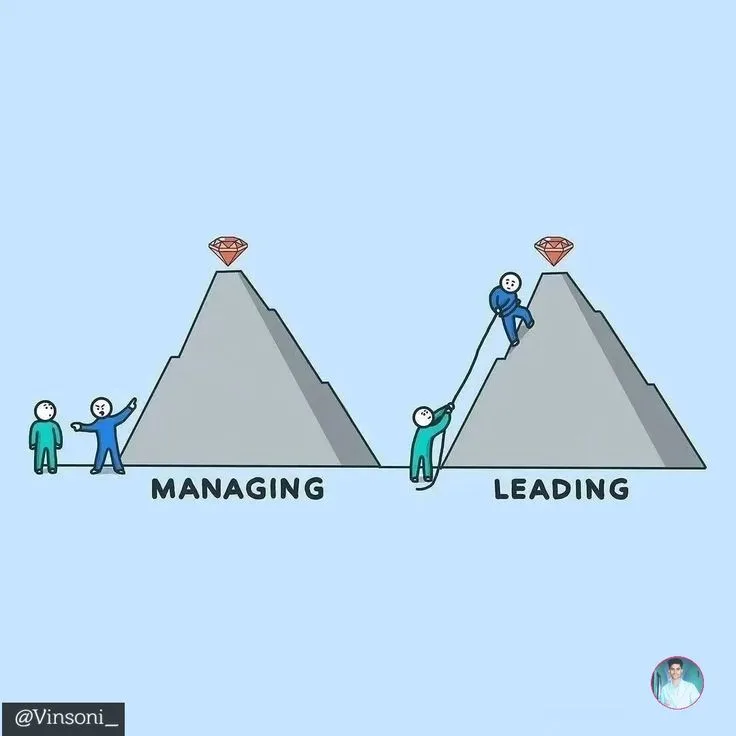
Management: In the late 1990s, Apple was weeks from bankruptcy. The company had excellent managers running efficient operations - supply chains were optimized, budgets were controlled, production schedules were maintained.
What Apple lacked was leadership: a clear vision of where the company should go, an inspiring purpose that could rally a demoralized workforce, and the courage to make painful strategic choices about which products to kill.
When Steve Jobs returned in 1997, he did not fix Apple's management - he provided the leadership the company desperately needed.[4]
He cut the product line from over 350 items to 10, articulated a vision of technology that serves human creativity, and inspired a culture of design excellence that transformed Apple from the brink of bankruptcy to the most valuable company in the world.
But Jobs also needed world-class management - provided by Tim Cook, who built the operational systems that turned visionary products into manufacturing and logistics reality.
Cook's management of Apple's supply chain has been described as one of the most sophisticated operational achievements in business history: hundreds of suppliers across dozens of countries, coordinated to deliver tens of millions of products in precise configurations on tight timelines.
Neither management nor leadership alone could have saved Apple. The combination of both transformed it. This example illustrates the central insight that most conversations about management versus leadership miss: they are not competing approaches, and one is not superior to the other.
They are distinct and complementary capabilities that organizations need simultaneously.
Understanding how they differ - and what the empirical research says about the consequences of confusing or imbalancing them - is one of the highest-leverage things a person in any organizational role can do.
Whether you are trying to become a more effective leader, develop stronger management capability, or build a team that executes on an ambitious vision, getting this distinction right shapes nearly every decision about how to spend your time, develop your skills, and structure your relationships.
What Management Actually Is
Management is the discipline of making existing systems work reliably. It encompasses:
Planning: Translating objectives into specific tasks, timelines, and resource allocations. Planning converts goals into actionable work.
Organizing: Structuring resources - people, budget, tools, time - to accomplish defined objectives. Organizing makes capabilities available where and when they are needed.
Staffing: Acquiring, developing, and retaining the talent required for current organizational functions. Staffing ensures the organization has the human capabilities its work requires.
Directing: Assigning work, providing guidance, resolving conflicts, and ensuring that people have what they need to execute. Directing translates plans and organization into action.
Controlling: Measuring progress against plans, identifying deviations, and making corrections. Controlling ensures that execution remains aligned with intention.
Peter Drucker, widely regarded as the founder of modern management theory, described the manager's role as: "doing things right" - ensuring that the organization's existing activities are executed with maximum efficiency and reliability (Drucker, 1954).[2]
Management is fundamentally conservative (small-c) in the best sense: it preserves and optimizes what exists. A well-managed organization operates reliably, produces consistent outcomes, and deploys its resources efficiently. These are genuinely valuable capabilities, not lesser accomplishments.
It is important to resist the cultural tendency to treat management as the lesser of the two disciplines.
Henry Mintzberg of McGill University, whose research on the actual work of managing involved direct observation of managers across multiple organizations and industries, pushed back vigorously against the idea that management is merely the administrative residue of leadership.
In his 2009 book 'Managing,' Mintzberg argued that effective management - responsive, grounded in real-time information, relational, adept at navigating ambiguity within defined organizational systems - is sophisticated, demanding work that most academic models and popular commentaries systematically underestimate.[6]
What Leadership Actually Is
Leadership is the discipline of creating change in existing systems. It encompasses:
Direction-Setting: Defining where the organization needs to go - not just optimizing the current path but determining whether the current path is the right one and what a better path would look like.
Alignment-Building: Creating shared understanding and commitment to the chosen direction across a diverse group of people with different roles, priorities, and perspectives.
Motivation and Inspiration: Enabling people to pursue the direction with genuine engagement and discretionary effort - not because they were told to but because they believe in it.[9]
Coping with Uncertainty: Leading through the ambiguity and complexity of significant change, where the right answers are not yet known and cannot be derived from existing procedures.
John Kotter, who has studied leadership and organizational change extensively, described leadership as: "doing the right things" - determining what the organization should be doing and inspiring the organization to pursue it (Kotter, 1990).
Leadership is fundamentally transformational: it changes what exists. This is neither easy nor comfortable - change generates resistance, uncertainty, and loss even when it is necessary and ultimately beneficial.
Ronald Heifetz of Harvard Kennedy School introduced an important distinction in his 1994 book 'Leadership Without Easy Answers' between technical problems (which can be solved by applying existing expertise, the domain of management) and adaptive challenges (which require people to learn new ways of thinking and operating, the domain of leadership).[7]
Much of what organizations experience as management problems are, on inspection, adaptive challenges that management tools cannot solve - not because the managers are incompetent but because they are applying the wrong kind of response to the problem.
Management vs. Leadership: Core Differences
Dimension
Management
Leadership
Core purpose
Make existing systems work reliably
Create change in existing systems
Time orientation
Present and near-term
Future direction
Key question
"Are we doing things right?"
"Are we doing the right things?"
Relationship to uncertainty
Reduces and controls uncertainty
Navigates and tolerates uncertainty
Motivation mechanism
Formal authority, processes, incentives
Inspiration, vision, trust
Success metric
Efficiency, consistency, reliability
Alignment, commitment, transformation
Associated thinker
Peter Drucker ("doing things right")
John Kotter ("doing the right things")
Problem type addressed
Technical: solved by applying existing expertise
Adaptive: requires new thinking and behavior
Primary risk of excess
Over-managed organization cannot adapt
Under-managed organization cannot execute
"Management is efficiency in climbing the ladder of success; leadership determines whether the ladder is leaning against the right wall." - Stephen Covey, The 7 Habits of Highly Effective People, 1989
Why the Two Are So Often Confused
The Promotion Pattern
The most common path to managerial roles in organizations is promotion from individual contributor roles. The individual contributor who excels at their functional work - the engineer, the analyst, the salesperson - is promoted to manage others doing similar work.
But this promotion pattern does not select for leadership. It selects for functional excellence and sometimes for political success within the organization.
Many excellent managers have never developed leadership capabilities; many excellent individual contributors with genuine leadership capability have never been in roles where leadership was required or rewarded.
The Center for Creative Leadership's research on manager derailment (McCall & Lombardo, 1983) found that promotion decisions routinely overweight technical performance and underweight the interpersonal and strategic competencies that distinguish effective managers and leaders - creating a systematic selection problem that affects entire organizational hierarchies.
The Title Conflation
Organizational hierarchies use the word "manager" or "leader" for roles that actually involve widely varying mixes of management and leadership activity. A "team manager" with three direct reports and a defined scope primarily manages.
A "VP of Marketing" with strategic responsibility primarily leads. A "department director" may be equally split between the two.
When "management" and "leadership" are used interchangeably as titles, the distinct skill requirements of each get conflated in ways that produce career advice confusion, training investment misallocation, and role-fit problems.
A concrete consequence: organizations that send managers to "leadership development programs" and leaders to "management training" - or, more commonly, who treat all management development as interchangeable - consistently underinvest in the specific capabilities each role actually requires.
The Chartered Institute of Personnel and Development (CIPD) in the UK has estimated that the majority of management development spending by large UK organizations has minimal measurable impact on management effectiveness - partly because the programs are poorly designed, but partly because they often address the wrong capability gaps for the roles they are intended for.
The Hero Leader Narrative
Business media, biographies, and leadership education overemphasize leadership relative to management. The narratives that get written about transformational leaders - Jobs, Bezos, Musk, Branson - focus on their vision, their inspiration, their bold choices.
The management systems that made those visions executable are less dramatic and receive less attention.
This creates a cultural bias in which leadership is glamorous and management is prosaic - which is both wrong and harmful. Organizations that over-invest in leadership capability while under-investing in management capability cannot execute. Organizations that over-invest in management while under-investing in leadership cannot adapt.
Warren Bennis and Burt Nanus, in their influential 1985 book 'Leaders: The Strategies for Taking Charge,' drew on interviews with 90 leaders across business, government, and the arts and found that effective leaders shared an unusual clarity about what they were responsible for and what they were not.[12]
That clarity included genuine respect for the management capabilities they needed to complement their own, even when they personally lacked them.
The leaders Bennis and Nanus studied who had failed had often done so not from inadequate leadership but from inadequate management around them, or from attempting to do management work that required different skills than they possessed.
The Practical Differences
Time Horizon
Management operates primarily on short to medium time horizons: this quarter, this year, the next planning cycle. The manager's primary question is "Are we executing our current plan effectively?"
Leadership operates on medium to long time horizons: where will the market be in three years, what capabilities will we need, what should we be building toward? The leader's primary question is "Is our current plan still the right one?"
The practical consequence of confusing these time horizons is one of the most common organizational failure modes: leaders become absorbed in short-term execution problems, neglecting the longer-term strategic questions that only they are positioned to work on, while the organization drifts strategically even as it executes its current plan competently.
A 2019 McKinsey survey of senior executives found that only 31% of respondents felt their organizations had a clear, compelling long-term strategy that was well-understood throughout the organization.
The rest reported either unclear strategy, strategy that was well-formulated but poorly communicated, or strategy that had been supplanted by short-term operational demands.
In nearly all cases, the diagnosis pointed to insufficient leader attention to the direction-setting and alignment-building functions - not to inadequate management of current operations.
Certainty Tolerance
Management is most effective in conditions of relative certainty: defined processes, known techniques, established success criteria. The manager's toolkit - planning, organizing, monitoring, correcting - is well-suited to optimizing execution against clear objectives.
Leadership is most needed in conditions of uncertainty: when the way forward is unclear, when existing approaches are insufficient, when significant change is required. The leader's toolkit - sense-making, direction-setting, alignment-building - is most valuable when the path is uncertain.
Heifetz's adaptive-technical distinction maps directly onto this: applying a management toolkit to an adaptive challenge (one that requires people to learn and change, not just execute better) is one of the most common and costly organizational errors.[8]
It is the equivalent of trying to use a hammer on a screw - the tool is not wrong, it is simply the wrong tool for this problem.
Source of Authority
Managers typically derive their authority from organizational position: the title grants them the authority to direct the work of their reports, approve expenditures within their budget, and make decisions within their scope.
Leaders often operate without formal position authority - or beyond the boundaries of their formal authority. The influence of a leader comes from expertise, relationship, demonstrated track record, and the quality of the vision they articulate.
John Kotter describes this as a critical distinction: management is fundamentally about formal authority; leadership is fundamentally about informal influence (Kotter, 1990).[1]
This has implications for how each capability is developed. Management capability can be developed through role exposure, process knowledge, and feedback. Leadership capability requires something different: the development of the ability to influence without authority, to navigate conflict, to inspire when you cannot direct.
Research by the Center for Creative Leadership on leadership development (McCauley, Van Velsor & Ruderman, 2010) consistently finds that the most powerful leadership development experiences are those that require leaders to produce results through people who do not report to them.
Cross-functional project leadership, managing upward, and external stakeholder relationships develop leadership precisely because these situations strip away positional authority and require genuine influence.[14]
The Spectrum: Pure Management to Pure Leadership
Few roles are purely management or purely leadership. Most involve a blend that shifts based on circumstances, organizational level, and the specific challenge being addressed.
Toward pure management:
Front-line supervisor in a stable, well-defined operation
Project manager on a well-scoped initiative
Quality assurance manager in a regulated environment
More balanced blend:
Department director in a growing organization
Product manager at a scaling startup
VP of Engineering navigating organizational growth
Toward pure leadership:
CEO during a strategic pivot
General manager of a new market entry
Founder building a company from zero
As individuals move to more senior organizational levels, the leadership component of their role typically increases. The most senior roles in most organizations are primarily leadership roles - they are about direction, alignment, and change, not about operational execution.
Research by Charan, Drotter, and Noel (2001) in 'The Leadership Pipeline' describes this shift in terms of what they call 'leadership passages': the transitions from managing oneself, to managing others, to managing managers, to managing functions, to managing a business, to managing an enterprise.[13]
Each passage requires not just different skills but a different use of time and a different set of values about what work is most important.
The failure to make each passage fully - to continue applying the skills and value systems of the previous level at the new level - is one of the most common and costly career derailment patterns in organizational life.[11]
Warning Signs That You Are Confusing the Two
The Manager Who Is Actually Leading (Without Authority)
A manager who is trying to define strategy for the organization - setting direction for areas outside their formal authority, advocating for organizational changes they cannot implement - is doing leadership work in a management context. This creates friction because the authority structure does not support the activity.
If the leadership contribution is genuine, the right solution is either to formalize the authority or to find leadership channels that do not require position authority.
The Leader Who Is Actually Managing (And Losing the Strategic Thread)
A senior leader who is spending the majority of their time on operational details - reviewing individual deliverables, attending execution-level meetings, making decisions that should be delegated - is doing management work in a leadership role.
The cost is the strategic and alignment work that only the leader's position enables. The organization loses direction while being efficiently managed.
Example: Marissa Mayer's tenure at Yahoo (2012-2017) is often analyzed as a case study in this confusion.
Mayer brought exceptional product management capability to the CEO role - she was deeply involved in product details, user experience decisions, and tactical choices at a level of granularity appropriate for a product manager but not for a company CEO facing existential strategic challenges.
The management-level engagement came at the cost of the leadership-level strategic work Yahoo needed: a clear, committed direction and the organizational alignment to pursue it.
The Collaboration That Is Actually Missing
The most common practical failure is not confusion about the definitions but failure to build complementary teams. Visionary leaders without strong management partners fail to execute. Efficient managers without strategic leadership pursue efficiency in the wrong direction.
The resolution is not for leaders to become better managers or for managers to become better leaders - it is to build leadership teams where both capabilities are genuinely represented and where the relationship between the leadership and management functions is healthy enough to produce real collaboration.[10]
What the Research Says About Management-Leadership Balance
The distinction between management and leadership is not merely conceptual. A significant body of empirical research has examined the organizational consequences of misaligning these capabilities, and the findings are consistent enough to inform practical decisions about hiring, development, and organizational design.
John Kotter of Harvard Business School, whose 1990 Harvard Business Review article "What Leaders Really Do" established much of the modern framework for distinguishing the two roles, followed up that theoretical contribution with a large-scale study of 200 companies published in A Force for Change (1990).
His core finding: most large organizations were systematically over-managed and under-led.
The typical large organization invested heavily in systems for maintaining and optimizing current activities - budget cycles, performance management, process documentation, quality controls - while investing minimally in leadership capacity for generating and navigating meaningful change.
Kotter estimated that organizations needed to increase their leadership investment "by a factor of three to five times" to meet the demands of increasingly fast-moving competitive environments.
When he revisited these organizations in the mid-1990s, the correlation between leadership capacity (measured through executive interviews and organizational assessment) and successful strategic adaptation was among the strongest effects his research team had observed.
Abraham Zaleznik of Harvard Business School produced a parallel stream of research with different methodological foundations.
His 1977 Harvard Business Review piece "Managers and Leaders: Are They Different?" - based on clinical psychological observation of executives over two decades - argued that managers and leaders differ not just in skill set but in fundamental personality orientation: managers are comfort-seeking, focused on process and equilibrium, while leaders are inherently tolerant of disorder and oriented toward possibilities.
The article remained one of the most requested HBR reprints for 30 years. Zaleznik's 1989 follow-up, The Managerial Mystique, presented longitudinal case data from organizations where a predominance of managerial thinking had produced what he called "managerial mystique" - the illusion of organizational effectiveness through procedural compliance, with actual adaptation capacity steadily eroding.[3]
James Collins's research on companies that made the transition from good to great, published in Good to Great (2001) after a five-year study of 11 companies that made the leap from 28 candidate comparisons, identified what he termed "Level 5 Leadership" as the factor distinguishing the companies that sustained breakthrough performance from those that did not.
Level 5 leaders combined fierce professional will (the leadership orientation toward outcomes and change) with personal humility (the operational discipline that kept ego from distorting decision-making).
Collins found that companies led by highly charismatic, publicly celebrated executives - leaders in the popular sense without the management discipline Collins's framework required - underperformed companies led by Level 5 leaders by a substantial margin over the 15-year analysis period.[5]
The implication for the management-leadership distinction: the integration of both orientations in individual leaders and leadership teams, rather than the dominance of either, characterized the highest-performing organizations.
The quantitative evidence on consequences of imbalance is also available. Research by Tomas Chamorro-Premuzic of University College London has examined leadership assessment data and the gap between leadership and management behaviors.
Leaders rated highest on visionary, strategic, and inspirational behaviors (leadership orientation) but lowest on follow-through, execution discipline, and consistency (management orientation) tend to produce weaker team outcomes than leaders who score well on both dimensions.[16]
The combination produced better outcomes than either alone, consistent across industries and organizational sizes.
Real-World Case Studies: When the Balance Shifts
The theoretical distinctions between management and leadership become most vivid in organizations where the balance tilted decisively in one direction or the other, with documented consequences.
The over-managed organization: Kodak's systematic failure is among the most extensively analyzed cases of management excellence combined with leadership absence.
Kodak's management systems in the 1980s and 1990s were genuinely sophisticated - it maintained dominant market share in film, achieved industry-leading manufacturing efficiency, and ran one of the most effective distribution networks in consumer products.
Kodak engineers, in fact, invented the digital camera in 1975.
But the leadership challenge - defining a new direction, building alignment around a fundamentally different future, inspiring the organization to move toward that future even though doing so would cannibalize its most profitable current businesses - was not met.
By 2012, Kodak had filed for bankruptcy protection. The management capability that made it dominant in film could not substitute for the leadership that the transition to digital required.
Harvard Business School professor Clayton Christensen, whose research on disruptive innovation examined Kodak's failure in The Innovator's Dilemma (1997), attributed the failure to management processes that were precisely optimized to protect current business - which made the leadership task of reorienting toward a disruptive future structurally harder, not easier.[15]
The under-managed organization: WeWork's execution collapse provides the inverse case study. Adam Neumann's leadership at WeWork from 2010 to 2019 generated extraordinary alignment energy - investors, employees, and potential tenants were inspired by a vision of physical spaces as a service layer and community platform.
The company grew from a single New York location to 528 locations in 111 cities.
But management fundamentals were absent: unit economics were never validated at scale, financial controls were insufficient to track spending across hundreds of locations, and governance structures that would normally constrain a CEO's more idiosyncratic decisions did not function.
When WeWork filed its IPO prospectus in 2019, the management problems that had been obscured by growth and private-market enthusiasm became visible. The company, which had been valued at $47 billion in January 2019, saw its IPO abandoned and its valuation collapse to approximately $8 billion by October 2019.
Neumann resigned under pressure. The leadership had been genuine and effective at generating alignment and growth; the management had been absent in ways that ultimately destroyed the value the leadership had created.
The partnership model: Berkshire Hathaway's institutional design represents a deliberate architectural solution to the complementarity problem. Warren Buffett, primarily a leadership and strategic capital allocation figure, paired for decades with Charlie Munger, whose role was substantially more analytical and operationally rigorous.
Each subsidiary company in Berkshire's portfolio was assigned to managers who were given extreme operational autonomy - in effect, the organization's management layer was distributed to subsidiary CEOs rather than centralized at the holding company.
This structure allowed Buffett to focus almost entirely on capital allocation decisions (a leadership function) while management excellence was maintained through careful selection of subsidiary leaders and incentive alignment.
From 1965 to 2022, Berkshire's compound annual gain was 19.8% per year, versus 9.9% for the S&P 500 - a performance differential sustained over 57 years that represents arguably the strongest long-run case study of deliberately designed management-leadership complementarity in corporate history.
Developing Both Capabilities
The research on what develops each capability is reasonably consistent, though the development paths differ.
For those currently strong in management, building leadership capability requires:
Developing comfort with ambiguity and uncertainty - taking on assignments with unclear objectives and figuring out the direction
Practicing the ability to inspire and motivate without relying on authority - leading cross-functional teams, volunteer organizations, or project work with people who don't report to you
Building the strategic thinking that envisions futures beyond the current operating model - reading broadly outside your functional area, engaging with competitive and market dynamics
Learning to build alignment across diverse stakeholders - practicing the work of building shared understanding rather than directing compliance
For those currently strong in leadership, building management capability requires:
Building the patience for execution detail that optimization requires - spending time understanding how the work actually gets done at the front line
Learning the financial and operational mechanics of running a business unit - understanding unit economics, operational leverage, and the relationship between activity and outcome
Practicing the follow-through that execution requires - committing to specific timelines and holding yourself accountable for them
The most effective development in both areas, consistent with the broader adult learning research, comes from experience rather than training.
Kotter's research suggests that leadership is developed primarily through challenge - through assignments that require leading through ambiguity, building alignment across adversarial stakeholders, and making consequential decisions with incomplete information.
Management capability develops through progressively larger operational responsibility, exposure to strong management models, and rigorous feedback on management behaviors.
Management is about systems and execution, organizing resources and processes to deliver results. Leadership is about people and direction, inspiring action toward goals and navigating change. Core distinction: Management = Maintaining and optimizing: Working within existing system. Making it run efficiently. Controlling quality and progress. Organizing and coordinating. Solving operational problems. Leadership = Creating and changing: Setting new direction.
Inspiring people to follow. Navigating uncertainty. Challenging status quo. Developing people. The classic definitions: Peter Drucker: ‘Management is doing things right; leadership is doing the right things.’ Management: efficiency. Leadership: effectiveness. Warren Bennis: ‘Managers are people who do things right. Leaders are people who do the right thing.’ Similar framing. John Kotter: ‘Management is a set of processes that keep an organization functioning.
Leadership is about setting a direction.’ Why the distinction matters: Different skill sets: Management skills: Planning, organizing, budgeting, staffing, measuring, problem-solving. Leadership skills: Visioning, inspiring, influencing, developing people, strategic thinking, change management. Someone can be great manager, poor leader (or vice versa). Different situations require different emphasis: Stable environment with clear processes → Management dominant.
Change, uncertainty, or transformation needed → Leadership dominant. Most situations need both, but in different proportions. Career progression requires both: Early career: More management (organizing work, delivering reliably). Senior roles: More leadership (setting direction, developing organization). But need both at all levels. Management focus areas: Area 1: Planning and organizing: Breaking down work. Creating schedules and milestones. Allocating resources.
Defining processes and workflows. Example: Project manager: Creates work breakdown structure. Assigns tasks to team members. Tracks dependencies. Manages timeline. Managing the execution machine. Area 2: Measuring and controlling: Defining metrics. Tracking progress. Identifying deviations. Taking corrective action. Example: Sales manager: Tracks pipeline metrics. Identifies deals at risk. Adjusts forecasts. Implements process improvements. Managing to targets.
Area 3: Process and efficiency: Documenting procedures. Eliminating waste. Optimizing workflows. Standardizing approaches. Example: Operations manager: Maps current processes. Identifies bottlenecks. Redesigns for efficiency. Reduces cycle time by 30%. Managing the system. Area 4: Problem-solving and troubleshooting: Identifying issues. Analyzing root causes. Implementing fixes. Preventing recurrence. Example: Engineering manager: Bug in production. Coordinates fix.
Implements additional testing to prevent similar bugs. Manages quality. Leadership focus areas: Area 1: Vision and direction: Defining where we’re going. Explaining why it matters. Setting strategy. Making sense of complexity. Example: CEO: Articulates 3-year vision for company. Explains market opportunity and competitive positioning. Sets strategic priorities. Leading toward future. Area 2: Inspiring and influencing: Motivating people. Building commitment.
Creating shared purpose. Influencing without authority. Example: Product leader: Inspires team around customer impact. Creates excitement about product vision. Builds alignment across functions. Leading through inspiration. Area 3: Change and transformation: Recognizing need for change. Overcoming resistance. Guiding through transition. Adapting to new realities. Example: CTO: Recognizes technology stack becoming obsolete. Champions modernization despite resistance.
Helps team navigate technical transformation. Leading through change. Area 4: People development: Coaching and mentoring. Creating growth opportunities. Building capabilities. Developing future leaders. Example: Director: Invests in team member development. Provides stretch assignments. Offers coaching. Builds bench strength. Leading people growth. The overlaps: Not completely separate. Good management requires some leadership. Good leadership requires some management.
Management requires leadership elements: Influencing team to follow processes. Creating buy-in for standards. Adapting processes when needed. Leadership requires management elements: Organizing resources to execute vision. Tracking progress toward goals. Solving operational problems that arise. The integration: Best professionals excel at both. Use management skills to execute. Use leadership skills to set direction and inspire.
Situational examples showing the difference: Example 1: Cost reduction initiative: Management approach: Analyze spending data. Identify cost categories. Implement budget controls. Track savings. Leadership approach: Explain why cost discipline matters (survival, investment in growth). Inspire ownership of financial responsibility. Navigate anxiety about cuts. Develop culture of efficiency. Both needed: Management for execution. Leadership for adoption and culture change.
Example 2: Team missing deadlines: Management response: Review project plan. Identify bottlenecks. Reallocate resources. Implement better tracking. Leadership response: Understand underlying issues (motivation? Skills? Clarity?). Address team morale. Reset expectations. Develop team capabilities. Both needed: Management fixes process. Leadership addresses people and motivation issues. Example 3: Entering new market: Management tasks: Market research and analysis.
Competitive positioning. Resource planning. Go-to-market execution. Leadership tasks: Articulate strategic rationale. Build organizational commitment. Navigate uncertainty. Inspire team through challenge. Both needed: Leadership sets direction and builds commitment. Management executes entry plan. When management dominates: Stable, predictable environment: Known processes work. Need efficient execution. Management ensures quality, on-time, on-budget delivery.
Example: Manufacturing plant with established processes. Manager focuses on: uptime, quality metrics, efficiency improvements, problem-solving. Less need for visionary leadership, execution excellence matters most. When leadership dominates: High uncertainty or transformation: Unknown territory. Old approaches don’t work. Need direction-setting and change navigation. Example: Startup pivoting business model.
Founder needs to: articulate new vision, inspire team through uncertainty, make strategic bets, build new capabilities. Less established process to manage, leadership critical. Why both matter at all levels: Individual contributors need both: Management: Organizing own work, meeting commitments, process discipline. Leadership: Influencing peers, championing ideas, adapting to change. Mid-level managers need both: Management: Team execution, resource allocation, metrics.
Leadership: Department vision, people development, cross-functional influence. Executives need both: Management: Organizational systems, resource optimization, operational oversight. Leadership: Company direction, culture, transformation, strategic decisions. Lesson: Management and leadership are distinct but complementary. Management focuses on systems, execution, efficiency, processes, and control, maintaining and optimizing what exists.
Leadership focuses on direction, people, change, inspiration, and development, creating and transforming. Both matter. Context determines emphasis. Great professionals develop both skill sets. Early focus on management (organize and deliver). Add leadership as rise (vision and transformation). Integration of both drives success.
Stable operational contexts require more management focus (execution, processes, quality control) while uncertain or transformational contexts require more leadership (vision, change navigation, inspiration), though most situations benefit from both in different proportions. Situations favoring management emphasis: Stable environment with proven processes: Manufacturing plant with established workflows. Routine operations requiring consistent quality. Scaling execution of known model.
What’s needed: Process discipline ensures quality. Metrics track efficiency. Troubleshooting maintains performance. Clear procedures enable coordination. Example: Restaurant chain expanding. Needs: Standardizing operations across locations. Training consistency. Supply chain efficiency. Quality control systems. Management excellence is primary driver of success. Crisis requiring immediate execution: System outage. Customer emergency. Regulatory deadline.
What’s needed: Clear command and control. Rapid coordinated action. Resource mobilization. Problem-solving under pressure. Example: Production down, customers affected. Need crisis management: Coordinate fix teams, communicate status, prioritize actions, track resolution. No time for inspirational speeches, need execution. Situations favoring leadership emphasis: High uncertainty or change: Market disruption. Technology transformation. Strategic pivot.
Startup in discovery phase. What’s needed: Making sense of ambiguity. Setting direction when path unclear. Inspiring confidence during uncertainty. Adapting strategy as you learn. Example: COVID-19 forcing sudden remote work. Needed leadership: Reimagine how work happens, inspire through disruption, navigate anxiety, build new culture. Management followed but leadership had to lead. Transformation and major change: Merger integration. Organizational restructuring. Culture shift.
New business model. What’s needed: Articulate vision for future state. Overcome resistance to change. Navigate messy transition. Develop new capabilities. Example: Traditional bank going digital-first. Needs leadership: Communicate why change essential, inspire embrace of technology, navigate fear of obsolescence, model new behaviors. Management supports but can’t drive transformation alone.
Situations requiring balance: Most management roles: Mix of routine operations and periodic changes. Delivering today while building tomorrow. What’s needed: Management for execution and delivery. Leadership for direction and development. Both integrated continuously. Example: Engineering manager runs team. Needs management: Sprint planning, capacity allocation, quality metrics, delivery tracking.
Needs leadership: Technical vision, team growth, cross-team influence, navigating org changes. Growing organizations: Startup scaling to mid-size. Established company entering growth phase. What’s needed: Leadership sets direction and raises ambitions. Management builds systems to deliver at scale. Tension between preserving culture and adding structure. Example: 50-person startup reaching 200. Needs both: Leadership maintains culture and vision as grow.
Management implements processes, systems, metrics to coordinate at scale. Too much of either creates problems. The decision framework: Ask these diagnostic questions: 1. Is the path forward clear? Yes → Management focus (execute efficiently). No → Leadership focus (figure out direction). 2. Are we doing the right things? Yes → Management (optimize how we do it). Uncertain → Leadership (determine what to do). 3.
Is the team motivated and aligned? Yes → Management (coordinate execution). No → Leadership (inspire and align). 4. Do our processes work? Yes → Management (maintain and improve). No/don’t exist → Leadership (create or transform). 5. What’s the nature of the challenge? Execution → Management. Change → Leadership. Example application: Company missing quarterly targets. Diagnosis: Path forward: Clear (existing strategy still valid).
Right things: Mostly yes (strategy sound, execution lagging). Team motivation: Low (repeated misses hurting morale). Processes: Have them but not followed consistently. Challenge: Execution discipline + morale. Conclusion: 60% management (improve execution, accountability, process adherence), 40% leadership (rebuild confidence, address morale, clarify expectations).
Common mistakes in prioritization: Mistake 1: Pure management during transformation: Try to execute your way through strategic crisis. Optimize a failing model. Measure and track without changing direction. Why it fails: Managing decline efficiently is still decline. Need new direction first. Example: Blockbuster focused on optimizing store operations while Netflix changed the game. Excellent store management couldn’t save business model.
Mistake 2: Pure leadership without management foundation: All vision and inspiration but no execution systems. Constantly changing strategy without operational follow-through. Why it fails: Can’t inspire your way to results. Need systems to deliver. Example: Charismatic CEO with monthly strategy pivots. Team inspired but confused. Nothing ships because no execution discipline.
Mistake 3: Wrong emphasis for career stage: Junior person trying to lead transformation (influence doesn’t match ambition). Senior leader micromanaging execution (should be delegating). Why it fails: Mismatch between role, authority, and approach. Example: New associate trying to change company strategy. Lacks context and authority. Should focus on excellent management of own work first, build credibility, then expand influence.
How emphasis shifts by context: Startup stages: Pre-product-market fit: 80% leadership (figuring out what to build), 20% management (some process to learn). Post-product-market fit, scaling: 40% leadership (vision and culture), 60% management (build systems to scale). Mature stage: 30% leadership (maintain culture, periodic strategy updates), 70% management (operational excellence).
Industry type: Fast-changing industries (tech, media): Higher leadership emphasis (constant adaptation). Stable industries (utilities, manufacturing): Higher management emphasis (execution excellence). Crisis vs steady state: Crisis or major change: 70% leadership, 30% management. Steady state operations: 30% leadership, 70% management. The integration principle: Even when one dominates, need both.
Management-dominant situations still need leadership for: Setting goals and priorities. Maintaining team motivation. Developing people. Adapting to changes as they arise. Leadership-dominant situations still need management for: Organizing resources to execute vision. Tracking progress toward goals. Solving operational problems. Maintaining accountability. The career development path: Early career (0-5 years): 80% management skills (learn to deliver reliably).
20% leadership skills (influence peers, some initiative). Mid career (5-15 years): 50% management (run teams and projects well). 50% leadership (vision for area, develop people, strategic influence). Senior leadership (15+ years): 30% management (delegate execution, oversee systems). 70% leadership (vision, culture, transformation, strategic decisions).
Lesson: Prioritize management in stable contexts (proven processes, crisis execution, routine operations) and leadership in uncertain contexts (transformation, ambiguity, change). Most situations need both in different proportions. Diagnose by asking: Is path clear? Doing right things? Team motivated? Processes work? What’s the challenge? Common mistakes: pure management during transformation, pure leadership without execution foundation, wrong emphasis for role.
Emphasis shifts by: startup stage, industry dynamism, crisis vs steady state. Even when one dominates, integrate both. Career progression: build management foundation early, balance mid-career, shift toward leadership at senior levels while maintaining management.
Develop management through deliberate practice of systems, processes, planning, and coordination, while developing leadership through people experiences like influencing, mentoring, navigating change, and setting vision. Both require different learning approaches and progressive challenges. Management capability development: Foundation: Self-management: Before managing others, manage yourself well. Core skills: Personal planning and organization. Meeting commitments reliably.
Tracking your own work. Problem-solving independently. How to develop: Take full ownership of projects. Build reputation for reliability. Document your work. Show you can deliver. Example: As IC, volunteer to own complete project end-to-end. Plan it, track it, deliver it on time with quality. Demonstrates management fundamentals. Level 2: Project management: Coordinating work across multiple people or workstreams. Core skills: Breaking down complex work.
Creating plans and timelines. Identifying dependencies. Tracking progress across people. Managing risks. How to develop: Lead cross-functional initiatives. Take formal PM training. Learn PM tools and frameworks. Study how good PMs work. Example: Lead product launch involving engineering, design, marketing. Must coordinate schedules, track deliverables, manage timeline. Real project management experience. Level 3: Process optimization: Improving how work gets done.
Core skills: Documenting processes. Analyzing workflows for inefficiency. Designing improvements. Measuring impact. How to develop: Look for broken processes around you. Propose and implement fixes. Document standard procedures. Run post-mortems and improvement cycles. Example: Notice onboarding takes 3 months when should be 2 weeks. Map current process, identify bottlenecks, redesign, implement, measure improvement. Process management in action.
Level 4: People management: Direct management of team members. Core skills: Delegating effectively. Setting goals and expectations. Performance management. Resource allocation. Hiring. Difficult conversations. How to develop: Become a manager (IC to manager transition). Get formal management training. Find experienced manager mentor. Learn through trial and feedback. Example: First management role with 3-5 reports.
Learn to delegate, give feedback, run 1-on-1s, manage performance. Foundation of people management. Level 5: Management at scale: Systems spanning multiple teams. Core skills: Organization design. Operating rhythms. Cross-team coordination. Strategic resource allocation. Building management team. How to develop: Senior manager/director roles. Study organizational design. Learn from leaders managing at scale. Example: Director of 50-person organization.
Must design team structure, coordination mechanisms, planning processes, metrics systems. Management of managers. Leadership capability development: Foundation: Self-leadership: Leading yourself before leading others. Core skills: Self-awareness (knowing your values, triggers, patterns). Self-regulation (managing emotions, stress). Growth mindset (embracing learning and feedback). Purpose clarity (understanding your ‘why’). How to develop: Regular reflection and journaling.
Actively seek and act on feedback. Therapy or coaching. Read widely. Practice mindfulness. Example: Monthly reflection: What energized me? What drained me? Where did I show up well/poorly? What patterns do I notice? What do I want to develop? Level 2: Influence without authority: Leading laterally across the organization. Core skills: Persuasion and influence. Building trusting relationships. Collaborative problem-solving. Political navigation.
How to develop: Volunteer for cross-functional projects. Champion initiatives beyond your scope. Build network across company. Practice stakeholder management. Example: IC who wants new tool adopted company-wide. No authority but must influence: Build coalition, demonstrate value, address concerns, gain executive sponsorship. Influence leadership. Level 3: Developing others: Multiplying impact through people growth. Core skills: Coaching and mentoring.
Giving developmental feedback. Creating growth opportunities. Believing in people’s potential. How to develop: Mentor junior colleagues formally. Coach team members regularly. Focus on team success over personal heroics. Study coaching techniques. Example: Senior engineer mentoring 3 junior engineers. Having coaching conversations (not giving answers), providing stretch projects, offering feedback, celebrating their growth.
Level 4: Leading through change: Navigating uncertainty and transformation. Core skills: Making sense of ambiguity. Setting direction without complete information. Managing anxiety (yours and others’). Resilience and adaptability. Overcoming resistance. How to develop: Lead during crises or major changes. Volunteer for turnaround projects. Study change management. Take on situations with high uncertainty. Example: Leading team through company reorganization.
Must: Make sense of chaos, maintain team confidence, adapt plans, navigate politics, help team through transition. Change leadership. Level 5: Organizational leadership: Shaping culture, vision, strategy at scale. Core skills: Vision articulation. Culture building. Strategic decision-making. Executive presence. Managing complexity. How to develop: VP/C-level roles. Executive coaching. Study great organizational leaders. Lead through major transformations.
Example: CTO setting technical vision for 500-person engineering org. Must: Articulate where technology is going, build engineering culture, make strategic technology bets, influence at board level. Integrative development strategies: Strategy 1: Seek complementary experiences: For management development: Projects with clear deliverables. Operational roles with metrics. Process improvement initiatives. Scale challenges (growing systems).
For leadership development: Ambiguous, unstructured challenges. Change and transformation projects. Influence across boundaries. People development opportunities. Example progression: Year 1-2: Master project execution (management). Year 3-4: Lead cross-functional initiative (influence/leadership). Year 5-6: First management role (people management). Year 7-8: Navigate team through major change (change leadership). Year 9-10: Build new function from scratch (vision + systems).
Strategy 2: Learn from multiple sources simultaneously: Formal learning: Management courses and certifications. Leadership programs and workshops. Books and frameworks. Experiential learning: Stretch assignments that scare you. Failures and post-mortems. Taking on increasing complexity. Social learning: Managers and leaders you admire. Mentors and coaches. Peer learning groups. Reflective learning: After-action reviews. Regular journaling. Processing experiences.
Example weekly practice: Read management/leadership content (1-2 hours). Apply one concept from current role (daily). Meet with mentor (bi-weekly). Reflect on week’s leadership moments (30 min Friday). Strategy 3: Build feedback loops: Regular feedback seeking: ‘What’s one thing I could improve as a manager/leader?’ Ask manager, peers, reports monthly. Request formal 360 feedback annually. Coaching relationship: Manager as coach (regular 1-on-1s focused on development).
External executive coach (at senior levels). Peer coaching partnerships. Self-assessment: Rate yourself on key competencies. Track progress over time. Notice patterns. Example: After tough conversation or decision, ask someone who observed: ‘What did I do well? What could I have done better?’ Learn from each rep. Strategy 4: Practice deliberately: Not just experience, but intentional practice with feedback. For management skills: Set specific goals (e.g., improve delegation).
Get feedback on performance. Adjust approach. Try again. For leadership skills: Practice difficult conversations with coach. Record presentations, analyze, improve. Try different influence approaches, observe results. Example: Goal: Give better feedback. Practice: Write out feedback. Review with mentor. Deliver to team member. Debrief: What landed well? What didn’t? Adjust for next time. Iterate. Strategy 5: Create teaching opportunities: Best way to master something: teach it.
For management: Train new managers on delegation, 1-on-1s, performance management. Document your processes. For leadership: Mentor others on influence, career navigation, leadership presence. Write about leadership lessons. Why it works: Teaching forces clarity. Explaining deepens understanding. Questions reveal gaps. Common development pitfalls: Pitfall 1: Theory without practice: Reading about management/leadership without actually doing it.
Fix: Apply one thing from each book/course immediately. Pitfall 2: Experience without reflection: Lots of experience but no learning from it. Fix: Build reflection habit. Extract lessons. Pitfall 3: Comfort zone only: Only doing what you’re already good at. Fix: Deliberately seek uncomfortable stretch assignments. Pitfall 4: No feedback: Operating on assumptions without checking them. Fix: Build feedback-seeking into routine.
Development timeline expectations: Years 0-5: Foundation. Self-management and project management. Some influence practice. Years 5-10: First management roles. Building management fundamentals while developing leadership skills. Years 10-20: Management at scale. Strong leadership presence. Both integrated. Years 20+: Senior leadership. Organizational impact. Natural integration of both. The compounding effect: Early investment in both creates foundation.
Skills at each level enable next level. Capabilities compound over decades. Lesson: Develop management through: self-management, project management, process optimization, people management, management at scale, using formal training, project experiences, and deliberate practice. Develop leadership through: self-leadership, influence without authority, developing others, leading through change, organizational leadership, using mentoring, challenging experiences, coaching.
Key strategies: seek complementary experiences, learn from multiple sources, build feedback loops, practice deliberately, teach others. Avoid: theory without practice, experience without reflection, comfort zone only, no feedback. Development spans decades with compounding growth. Both skillsets develop in parallel, inform each other, and integrate naturally with mastery.
Over-indexing on management manifests as micromanagement, processes without purpose, hitting metrics but losing people, while over-indexing on leadership shows as vision without execution, constant change, inspiring ideas that never ship. Signs of over-management: Sign 1: Micromanagement and control: Every decision needs your approval. Team can’t move without you. Reviewing trivial details. What it looks like: Editing every email before it sends.
Requiring approval for routine decisions. Being in every conversation. Impact: Team disempowered and disengaged. Bottleneck to progress. High performers leave for autonomy. Root cause: Pure management mindset without leadership trust. Sign 2: Process bureaucracy: Process for everything. Forms, approvals, procedures dominating. Means becoming ends. What it looks like: Can’t make simple change without 6-step approval. Everyone complains about red tape. Speed killed by procedure.
Impact: Organization slow and rigid. Can’t adapt or innovate. Talent frustrated. Root cause: Management structure without leadership judgment about what actually needs process. Sign 3: Hitting numbers, losing people: Metrics look good. Productivity up. But morale tanking, attrition rising, people burned out. What it looks like: Dashboard is green. Employee survey is red. Exit interviews mention feeling like cogs. Impact: Short-term success, long-term organizational decline.
Best people leave. Root cause: Optimizing for measurable outputs without leadership’s attention to people and purpose. Sign 4: No vision or meaning: Team executes tasks well but doesn’t understand why. Can’t articulate purpose. ‘Just tell me what to do’ mentality. What it looks like: Team can describe how work gets done but not why it matters. No initiative. Waiting for instructions. Impact: Efficient at potentially wrong things. No strategic thinking.
Dependent on you for direction. Root cause: Management coordination without leadership vision and context. Sign 5: Resistance to change: When something new comes up, team paralyzed. Need detailed plan for everything. Can’t handle ambiguity. What it looks like: ‘But that’s not in the process.’ Panic when faced with new situations. Rigid adherence to known procedures. Impact: Fragile in face of change. Can’t innovate or adapt. Falling behind.
Root cause: Management stability without leadership adaptability. Sign 6: Meetings about how, never why: All discussions about execution mechanics. Timeline, status, resources. Never about impact, purpose, or strategy. What it looks like: Sprint planning, status updates, coordination. No strategy sessions, vision discussions, or reflection on purpose. Impact: Team loses motivation. Work feels meaningless. Going through motions.
Root cause: Management logistics without leadership meaning. Signs of over-leadership: Sign 1: Vision without delivery: Inspiring strategy discussions. Big ambitious plans. But nothing actually ships or gets implemented. What it looks like: Quarterly all-hands with exciting vision. But looking at actual deliveries: very little. Gap between talk and reality. Impact: Team inspired but frustrated. Stakeholders lose confidence. Credibility erodes.
Root cause: Leadership vision without management execution discipline. Sign 2: Operational chaos: Team motivated and believes in mission. But processes broken, quality suffering, deadlines missed constantly. What it looks like: High energy but low delivery. Mistakes and rework common. Coordination problems. But team still excited about vision. Impact: Unsustainable. Can’t deliver on promises. Burning credibility.
Root cause: Leadership inspiration without management systems and discipline. Sign 3: Strategy flavor of the week: New priorities constantly. Last month’s strategy abandoned. Direction changes frequently. What it looks like: ‘New priority!’ every week. Starting many things, finishing none. Team whiplashed. Impact: Team stops taking new initiatives seriously. Nothing gets completed. Cynicism. Root cause: Leadership vision without management follow-through and commitment.
Sign 4: Allergic to process: Resist any systematization. ‘We don’t need process, we need to be agile.’ Everything ad-hoc. What it looks like: Same mistakes repeatedly (nothing documented). No coordination mechanisms. Tribal knowledge. Chaos as scale. Impact: Can’t scale. Every coordination requires heroics. Dependent on specific people. Root cause: Leadership flexibility taken too far without management foundation.
Sign 5: No metrics or tracking: Don’t know if making progress. Can’t answer basic performance questions. Flying blind operationally. What it looks like: ‘How are we doing on X?’ ‘I think good?’ (No data). Opinions, not facts. Impact: Can’t identify problems until crisis. Can’t course-correct. Miss opportunities. Root cause: Leadership inspiration without management measurement.
Sign 6: All strategy, no tactics: Big picture discussions but no practical implementation guidance. What it looks like: Hours on vision and values. Five minutes on how to actually do anything. ‘Figure it out’ as only direction. Impact: Gap between aspiration and action. Team doesn’t know how to translate vision to execution. Root cause: Leadership direction without management translation. Diagnostic questions: For potential over-management: 1.
Team autonomy: Can team make routine decisions without you? (If no: over-managing). 2. Innovation: Is team bringing new ideas? (If no: may be over-controlled). 3. Morale: How’s team energy and motivation? (If low despite hitting numbers: red flag). 4. Adaptability: Can team handle new situations? (If paralyzed by novelty: too rigid). For potential over-leadership: 1. Delivery: Are we actually shipping? (If no: need more management). 2.
Quality: Are we maintaining standards? (If problems: need better systems). 3. Coordination: Does left hand know what right hand doing? (If chaos: need processes). 4. Follow-through: Do initiatives get completed? (If many starts, few finishes: need discipline). Getting feedback: Ask team: ‘Do you understand why our work matters?’ (Tests leadership). ‘Do you have clarity on how to execute?’ (Tests management). ‘What’s frustrating about how we work?’ (Reveals imbalance).
Ask peers: ‘Can you count on us to deliver?’ (Tests management). ‘Are we working on the right things strategically?’ (Tests leadership). Ask manager: ‘Where should I focus development, execution or vision?’ (Surfaces perceived gaps). Course-correcting imbalance: If over-managing, add leadership: Share more context and ‘why.’ Give team more autonomy and ownership. Discuss purpose and impact regularly. Invest in people development. Focus on outcomes over process.
Inspire and motivate, not just coordinate. If over-leading, add management: Implement basic tracking and metrics. Create accountability systems. Document key processes and decisions. Focus on delivery and follow-through. Measure progress regularly. Pay attention to operational excellence. The balanced indicators: Enough management: Things get done reliably. Coordination works smoothly. Quality maintained consistently. Progress tracked and visible.
Enough leadership: Team inspired and motivated. Clear sense of direction and purpose. Adaptable to change. Feeling of meaningful contribution. Both present: Executing on inspiring vision. Systems enable rather than constrain. Team empowered and delivering. Strategy translates to action. Lesson: Over-management shows as: micromanagement, process bureaucracy, hitting numbers but losing people, no vision, resistance to change, meetings about how not why.
Over-leadership shows as: vision without delivery, operational chaos, constant strategy changes, allergy to process, no tracking, all strategy no tactics. Diagnose through: team autonomy and innovation, morale, delivery and quality, coordination and follow-through. Get feedback from team (understand why? clarity on how?), peers (can they count on delivery? right strategy?), manager (development gaps).
Course-correct by adding missing element: over-managing needs more leadership (context, autonomy, purpose, development), over-leading needs more management (tracking, processes, accountability, operational excellence). Balance shows as: reliable delivery plus inspired motivation, systems enabling rather than constraining, strategy translating to action.
Management and leadership integrate seamlessly in real situations, the same action involves both, most challenges require both simultaneously, and skilled leaders blend them unconsciously rather than switching between modes. The integration reality: Rarely pure management OR pure leadership: Most leadership work requires some management. Most management work benefits from leadership. Attempting to separate creates artificial distinctions.
Example: Running team meeting: Management elements: Prepared agenda. Time-boxed discussions. Documented decisions and action items. Clear next steps and owners. Leadership elements: Creating psychological safety. Drawing out diverse perspectives. Connecting discussion to bigger purpose. Energizing team around commitments. Reality: These happen simultaneously in same meeting. Not switching between ‘management mode’ and ‘leadership mode.’ Integrated naturally.
Example: Performance conversation: Management aspects: Documenting performance against objectives. Following performance review process. Making calibration and compensation decisions. Leadership aspects: Coaching for growth. Building trust through difficult feedback. Inspiring better performance. Demonstrating care for person’s development. Integration: Can’t separate them cleanly. Conversation needs both. Process without care fails. Care without clarity also fails.
Example: Strategic planning: Management work: Analyzing data and market trends. Financial modeling and resource allocation. Breaking strategy into concrete plans. Creating measurement framework. Leadership work: Articulating compelling vision. Building stakeholder alignment. Making strategic choices about direction. Inspiring confidence in strategy. Reality: These inform each other continuously. Data shapes vision. Vision guides what data to analyze. Seamless back-and-forth.
How integration happens: Technique 1: Management structures enable leadership goals: Systems and processes serve leadership objectives rather than existing for own sake. Example: Want culture of ownership (leadership goal). Implement OKR system giving teams autonomy within clear boundaries (management system). System reinforces culture. Not ‘choose process OR culture’, use process to build culture.
Technique 2: Infuse leadership into management activities: Even routine management actions done with leadership mindset. Example: Weekly status meeting: Pure management: Dry recitation of metrics and blockers. Integrated: Review metrics with context (why numbers matter). Celebrate wins (recognition and motivation). Problem-solve collaboratively (development). Connect to mission (purpose). Same meeting, both elements present.
Technique 3: Context determines the blend: Fluid adjustment based on situation needs. Some situations need more management. Others need more leadership. Constantly recalibrating. Example: Crisis response: Hour 1-24: Heavy management (coordinate response, make rapid decisions, organize resources, execute fixes). Week 1: Add leadership (communicate what happened, maintain confidence, support team through stress).
Week 2-4: More leadership (learn from crisis, adapt processes, rebuild trust, inspire recovery). Month 2+: Balance (improved systems from learning, sustained cultural changes). Blend evolves naturally with needs. Technique 4: Build systems reflecting values: Management systems designed to embody leadership values. Example: Value: Transparency and trust. Management systems: Public dashboards showing all metrics. Open doc culture with accessible information.
Documented decision-making frameworks. Systems make values real, not just words. Real situations showing integration: Situation 1: Hiring decision: Management elements: Define role requirements clearly. Structured interview process. Assessment rubrics and scoring. Compensation benchmarking and offer. Leadership elements: Assess culture and values fit. Evaluate growth potential beyond current skills. Make judgment on ambiguous tradeoffs. Inspire candidate to choose you.
Reality: Every hiring decision requires both. Can’t separate ‘management part’ from ‘leadership part.’ Integrated judgment. Situation 2: Project behind schedule: Management response: Analyze schedule slippage. Identify specific bottlenecks. Adjust timeline or cut scope. Reallocate resources or add capacity. Leadership response: Understand team morale and pressure. Have honest conversations about sustainability. Navigate stakeholder expectations and politics.
Maintain confidence in recovery. What actually happens: Do both simultaneously. Adjust plan (management) while managing team energy (leadership). Address stakeholder concerns (leadership) while fixing execution issues (management). Situation 3: Quarterly planning: Management activities: Analyze previous quarter metrics. Set next quarter numerical targets. Allocate budget across initiatives. Create project plans and timelines.
Leadership activities: Set strategic priorities (what matters most). Align team on direction and tradeoffs. Inspire ambition appropriately. Navigate disagreements about focus. Integration: Can’t do planning with only one. Numbers without strategy is random. Strategy without plans is fantasy. Planning requires both integrated. Why separation fails: Failure 1: Switching hats consciously: Some try: ‘Now I’m in management mode.
Now leadership mode.’ Problem: Feels forced and unnatural. Team experiences inconsistency. Misses integration opportunities. Creates false dichotomy. Better: Natural integration. Leadership present in management actions. Management supports leadership goals. Failure 2: Segregating by time: ‘Monday is leadership day (vision, strategy). Tuesday-Friday is management (execution, operations).’ Problem: Leadership isn’t scheduled activity. Happens in everyday moments.
Opportunity missed throughout week. Better: Leadership woven through all work. Vision reinforced in daily interactions. Failure 3: Identity rigidity: ‘I’m a manager, not a leader’ or ‘I’m a visionary, not an operator.’ Problem: Role requires both. Identity limits effectiveness. Self-fulfilling limitation.
Better: ‘I lead through both inspiration and systems.’ ‘I’m effective because I integrate both.’ The natural integration in experienced leaders: Unconscious competence stage: Beginners: Consciously think about management vs leadership. Which is needed now? Veterans: Natural integration. Don’t think about distinction. Just do what situation requires.
Like skilled athlete: Basketball player doesn’t think ‘Now I’m dribbling, now I’m defending, now I’m communicating.’ Integrated response to game flow. What observers see: Clear direction and follow-through. Inspiration with accountability. Vision with execution. People-focus with results-focus. Can’t easily point to ‘that was management, that was leadership.’ Seamlessly integrated.
The development journey: Stage 1: Learning separately (Years 0-5): First understand each domain independently. Study management techniques. Study leadership principles. Some separation necessary for learning. Stage 2: Conscious integration (Years 5-15): Deliberately combining both. ‘How can I bring leadership into this management process?’ ‘What management system would support this leadership goal?’ Active effort to integrate.
Stage 3: Natural mastery (Years 15+): Unconscious integration. Don’t think about distinction. Fluidly respond to situations. Both present without thinking. Timeline varies: Some progress faster through deliberate practice. Experience alone doesn’t guarantee integration. Need reflection and learning. Integration indicators: Well-integrated leader delivers: Strategic vision AND execution plans. Inspiring purpose AND accountability systems.
People development AND performance management. Adaptability AND operational excellence. Not either/or but both/and. Practical integration examples: Example: New team member onboarding: Management components: Onboarding checklist and timeline. Training on tools and processes. Clear role expectations and first 90 days goals. Leadership components: Welcoming and inclusion. Sharing team purpose and culture. Inspiring confidence in their potential.
Building relationship and trust. Integration: Onboarding needs both. Process without welcome is cold. Welcome without structure is chaotic. Example: Bad news delivery: Management aspects: Clear facts and data. Specific implications and next steps. Timeline and action plan. Leadership aspects: Appropriate emotional tone. Acknowledging impact on people. Maintaining confidence despite setback. Taking responsibility.
Integration: Message must be clear (management) and compassionate (leadership). Facts without empathy is harsh. Empathy without clarity is confusing. Lesson: Management and leadership integrate seamlessly in practice, same actions involve both (meetings need agenda and inspiration), same situations require both (strategy needs analysis and vision), skilled leaders blend unconsciously.
Integration techniques: management structures enable leadership goals, infuse leadership into management activities, adjust blend to context, build systems reflecting values. Real situations are integrated: hiring (process and judgment), projects at risk (planning and morale), planning (targets and strategy). Separation fails: switching hats feels forced, time segregation misses opportunities, rigid identity limits effectiveness.
Journey: learning separately (years 0-5), conscious integration (5-15), natural mastery (15+). Well-integrated leaders deliver vision AND execution, inspiration AND systems, development AND performance, adaptability AND excellence. Not either/or but both/and.
Want to write for us?
Pitch a guide to When Notes Fly
Evergreen subjects, primary sources, and a four-stage review. Contributors are chosen for knowledge of the specific topic.
Tools change, benchmarks move, and research gets superseded. We would rather be corrected than be wrong, so every When Notes Fly guide is open to public correction through CitePep.
Create a free CitePep account and you can file a correction against this page directly. Accepted corrections are published here with your name and a permanent link to your contribution.
CitePep accounts are free and take under a minute.
02
Open this page on CitePep
Every guide has a matching verification page.
03
File the correction
Point at the claim and attach the source that contradicts it.
04
We review against sources
Accepted corrections are published here with your name.
CitePep is an independent verification platform. When Notes Fly does not control which corrections are filed, and contributors are credited under their own names.
New guides and revisions from across six sections. One email, no pitches.
We Value Your Privacy
We use cookies to enhance your experience, analyze site traffic, and provide personalized content. By clicking 'Accept All', you consent to our use of cookies. View our cookie policy
Cookie Preferences
Choose which cookies you want to allow. Essential cookies are required for the website to function properly.
Essential Cookies
These cookies are necessary for the website to function and cannot be disabled. They are usually set in response to actions you take, such as setting privacy preferences or logging in.
Always Active
Analytics & Performance Cookies
These cookies help us understand how visitors interact with our website, allowing us to improve our services and user experience.
Advertising & Marketing Cookies
These cookies are used by Google AdSense to display personalized ads. They help us provide free services by generating revenue from advertisements.