
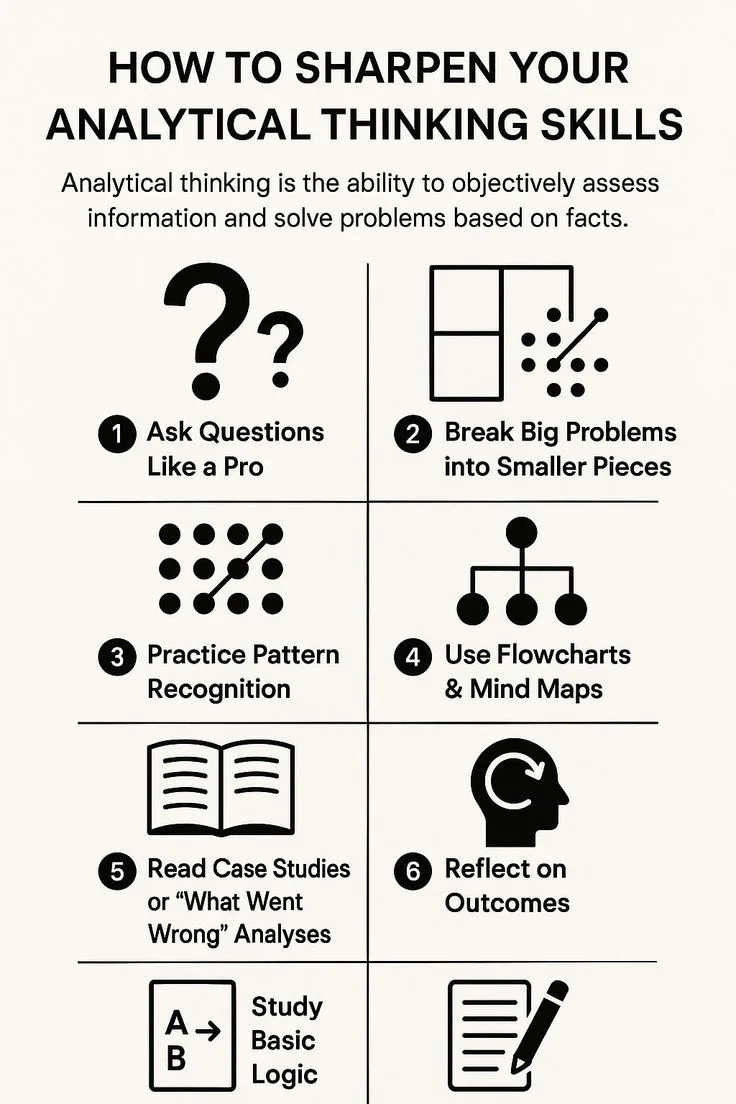
What Is Analytical Thinking?
Analytical thinking is the systematic cognitive process of breaking down complex information or problems into component parts, examining relationships between those parts, identifying patterns and causal mechanisms, and synthesizing conclusions that are grounded in evidence rather than intuition.
It is distinct from general intelligence or creativity in that it is an explicit, reproducible method: two practitioners applying the same analytical framework to the same data should reach similar conclusions, a property that distinguishes analysis from guesswork or impression.
In professional contexts, analytical thinking underpins effective diagnosis, structured problem-solving, data interpretation, and evidence-based decision-making across every function and industry.
In 2009, when Netflix faced a seemingly impossible challenge - improving its recommendation algorithm by 10% - the company did not throw more engineers at the problem or rely on gut instinct about what viewers wanted.
Instead, the winning team in the Netflix Prize competition, BellKor's Pragmatic Chaos, applied rigorous analytical thinking: they decomposed the massive dataset into component signals, identified hidden patterns in viewing behavior, evaluated the statistical evidence behind each predictive factor, and synthesized their findings into a model that outperformed every intuitive approach.
The result was not just a better algorithm but a demonstration that systematic decomposition of complexity consistently outperforms brilliant guesswork.
The stakes of analytical thinking extend far beyond data science competitions. Every professional faces situations where complexity threatens to overwhelm: a marketing team trying to understand why campaign performance dropped, an operations manager diagnosing supply chain disruptions, or a product leader deciding which features to prioritize from hundreds of requests.
In each case, the difference between those who flounder and those who find clarity lies not in raw intelligence but in the disciplined ability to break problems apart, examine the pieces, and reassemble understanding.
Research from McKinsey & Company has found that executives who demonstrate strong analytical skills are 50% more likely to be promoted to senior leadership positions, not because analysis is the only skill that matters, but because it underpins nearly every other professional competence.
This article provides a comprehensive exploration of analytical thinking - what it actually is, how it differs from related cognitive skills, the core techniques that make it practical, and how to develop it as a daily professional habit.
Whether you are diagnosing a business problem, evaluating a strategic proposal, or simply trying to make sense of conflicting information, the principles here will sharpen your ability to think with precision and depth.
What Analytical Thinking Really Means
Defining Analytical Thinking Precisely
Analytical thinking is the systematic process of breaking down complex information into components, examining relationships between those components, identifying patterns, and synthesizing insights that lead to informed conclusions. Unlike intuition, which operates below conscious awareness, analytical thinking makes reasoning explicit and reproducible.
Two analysts applying the same analytical framework to the same data should arrive at similar conclusions - a property that intuition fundamentally lacks.
1. At its core, analytical thinking involves decomposition - taking a large, complex problem and dividing it into smaller, manageable parts.
Example: When Amazon noticed its warehouse fulfillment times increasing, analysts did not simply label it a "speed problem." They decomposed it into receiving times, shelving efficiency, pick-path optimization, packing station throughput, and shipping dock scheduling.
Each component could then be measured and improved independently.
2. The second essential element is pattern recognition - identifying regularities, trends, anomalies, and relationships within data or situations. This is not the same as seeing patterns that are not there (a common cognitive bias); true analytical pattern recognition requires evidence and verification.
3. The third component is evidence evaluation - assessing the quality, relevance, and sufficiency of information before drawing conclusions. Strong analytical thinkers distinguish between anecdotes and data, between correlation and causation, and between representative samples and outliers.
4. Finally, analytical thinking requires synthesis - reassembling the decomposed parts into a coherent understanding that is greater than the sum of individual observations.
How Analytical Thinking Differs from Related Skills
Analytical thinking is often confused with critical thinking, creative thinking, and strategic thinking, but each serves a distinct cognitive purpose. Understanding the differences helps you know which mode of thinking a situation demands.
1.Analytical vs. critical thinking: Analytical thinking asks "What is happening and why?" while critical thinking asks "Is this reasoning sound?" Analysis describes the structure of a problem; critical thinking evaluates the quality of the analysis itself.
You might analytically decompose a market trend and then critically examine whether your decomposition missed important variables.
2.Analytical vs. creative thinking: Creative thinking generates new possibilities and ideas, while analytical thinking examines what already exists. They work best in sequence - generate options creatively, then evaluate them analytically.[9]
Example: Brainstorming sessions at IDEO generate hundreds of product ideas (creative thinking), which are then evaluated against feasibility, viability, and desirability criteria (analytical thinking).
3.Analytical vs. strategic thinking: Strategic thinking focuses on long-term positioning and competitive advantage, while analytical thinking provides the evidence base that informs strategy. Strategy without analysis is guessing; analysis without strategy is academic.
4.Analytical vs. intuitive thinking: Intuition relies on rapid, unconscious pattern-matching built from experience. It is fast but unreliable in novel situations. Analytical thinking is slower but more reliable when dealing with unfamiliar problems or when the cost of being wrong is high.
"If you can't describe what you are doing as a process, you don't know what you're doing." - W. Edwards Deming
Why Analytical Thinking Matters at Every Level
Analytical skills are not just for data scientists or consultants. Every professional role involves decisions that benefit from structured analysis, from the entry-level employee prioritizing their task list to the CEO allocating billions in capital.
1. At the individual contributor level, analytical thinking helps you diagnose why a process is not working, identify which tasks will have the highest impact, and present evidence-based recommendations instead of opinions.
2. At the management level, it enables you to identify root causes rather than treating symptoms, allocate resources based on data rather than politics, and set meaningful goals with measurable success criteria.
3. At the executive level, analytical thinking supports strategic decision-making under uncertainty, competitive analysis, portfolio management, and organizational design.
Example: When Satya Nadella became CEO of Microsoft in 2014, he applied analytical thinking to the company's declining position.
Rather than making sweeping intuitive bets, he decomposed Microsoft's business into segments, analyzed where growth was occurring in the industry, identified cloud computing as the highest-leverage opportunity, and systematically redirected resources.
The result was a transformation from a $300 billion company to a $3 trillion one.
Core Techniques of Analytical Thinking
Decomposition: Breaking Problems into Parts
Decomposition is the foundational analytical technique - the act of taking something large and complex and dividing it into smaller, more understandable components. Without decomposition, complexity remains a fog; with it, complexity becomes a set of tractable problems.
1.Structural decomposition divides a problem by its natural components or categories. Example: Revenue can be decomposed into number of customers multiplied by average revenue per customer. Customer count can be further decomposed into new customer acquisition and existing customer retention.
Each layer reveals different levers for improvement.
2.Process decomposition breaks a workflow or system into sequential steps. Example: Toyota's production system decomposes manufacturing into individual operations, each measured for cycle time, defect rate, and resource utilization.
This process-level analysis enabled Toyota to identify and eliminate waste systematically, a practice that became the foundation of lean manufacturing.[8]
3.MECE decomposition (Mutually Exclusive, Collectively Exhaustive) ensures that the parts do not overlap and that together they cover the entire problem. This framework, popularized by McKinsey & Company, prevents both double-counting and blind spots.[3]
4.Hierarchical decomposition creates issue trees that break a top-level question into sub-questions, each of which can be further subdivided. Example: "Why are profits declining?" breaks into "Are revenues declining?" and "Are costs increasing?" Each branch can be explored independently.
"The art of being wise is the art of knowing what to overlook." - William James
Pattern Recognition: Finding Signal in Noise
Pattern recognition transforms raw data into meaningful insights by identifying regularities, trends, correlations, and anomalies that would be invisible without systematic examination.
1.Trend analysis examines how variables change over time. The key is distinguishing genuine trends from random fluctuation.
Example: Spotify's analysts noticed that listener engagement with podcast content was growing 3x faster than music engagement across all age demographics - not just a seasonal spike but a sustained multi-quarter trend.
This pattern recognition informed the company's multi-billion-dollar investment in podcast acquisitions.
2.Comparative analysis identifies patterns by examining differences between groups, time periods, or conditions.
Example: When Starbucks noticed that some stores consistently outperformed others in comparable locations, comparative analysis revealed that the top-performing stores had one common factor: managers who spent 60% or more of their time on the floor rather than in the back office.
3.Anomaly detection identifies data points that deviate significantly from expected patterns. Anomalies can signal either problems or opportunities.
Example: A financial analyst at JPMorgan noticed that a particular trading desk's returns were unusually consistent - not unusually high, but unusually consistent. This anomaly detection led to the discovery of the "London Whale" trading scandal.
4.Correlation analysis examines whether two or more variables tend to move together. The critical analytical skill here is resisting the temptation to assume that correlation implies causation.
Evidence Evaluation: Assessing Information Quality
Not all information is created equal, and analytical thinking requires rigorous assessment of evidence quality before drawing conclusions.
1.Source credibility: Consider who produced the information, their expertise, potential biases, and track record. Example: A study funded by the sugar industry concluding that sugar has no health risks should be evaluated differently from an independent meta-analysis published in a peer-reviewed journal.
2.Sample size and representativeness: Small or unrepresentative samples can produce wildly misleading conclusions. Three customer complaints does not mean "customers hate the product" when you have 50,000 users.
3.Methodology rigor: How was the data collected? Was there a control group? Could confounding variables explain the results?
Example: When Google tested whether remote work affected productivity, they used controlled experiments with matched groups rather than simply comparing remote and in-office workers (who might differ in seniority, role type, or self-selection).
4.Consistency with other evidence: Does this finding align with or contradict other reliable sources? Extraordinary claims require extraordinary evidence. A single study showing a surprising result should be weighed less heavily than a consensus from multiple independent studies.
5.Recency and relevance: Data from five years ago may not reflect current conditions. Evidence from a different industry or context may not transfer.
| Evidence Type | Reliability | When to Use | Limitations |
|---|---|---|---|
| Randomized controlled experiments | Very high | Causal claims | Expensive, slow, sometimes unethical |
| Large-scale observational data | High | Trend identification | Cannot establish causation alone |
| Expert judgment | Moderate | Novel situations, rapid assessment | Subject to individual biases |
| Case studies | Moderate | Generating hypotheses, illustration | Not generalizable |
| Anecdotes | Low | Hypothesis generation only | Highly subject to selection bias |
| Gut feeling | Very low | Last resort when no data available | Unreliable in novel domains |
Analytical Frameworks for Professional Use
The Five Whys and Root Cause Analysis
The Five Whys technique is one of the simplest yet most powerful analytical tools for moving from surface symptoms to underlying causes. Developed at Toyota by Sakichi Toyoda, it involves repeatedly asking "Why?" until you reach a systemic root cause.
1. Start with the observable problem. Why did it happen? The first answer is usually a proximate cause. Why did that happen? You move deeper. Continue until you reach a systemic or structural cause that, if addressed, would prevent the problem from recurring.
Example: A software company's deployment failed. Why? A configuration error. Why? The engineer used the wrong settings. Why? The settings were not documented. Why? No one owned the documentation process. Why? The team had no onboarding standards for new tools. Root cause: process gap in tool adoption, not an individual mistake.
2. The technique works best when you explore multiple branches at each level rather than following a single causal chain. Real problems usually have multiple contributing factors.
3. A critical rule: focus on systems and processes, not individuals. "Why? Because John made a mistake" is not a useful root cause. "Why? Because the system allowed a single person to make an unchecked change to production" identifies something fixable.
Issue Trees and MECE Thinking
Issue trees provide a visual framework for decomposing complex problems into mutually exclusive, collectively exhaustive components. They are the backbone of consulting-style analysis.
1. Start with the core question at the top. Branch into major sub-questions that are logically distinct (mutually exclusive) and together cover the entire problem space (collectively exhaustive).
Example: "Why is our customer acquisition cost increasing?" branches into: (a) Are we spending more per channel? (b) Are our conversion rates declining? (c) Has our channel mix shifted to more expensive channels?
These three branches are mutually exclusive and collectively exhaustive - any increase in acquisition cost must be explained by one or more of these factors.
2. Continue branching until you reach questions that can be answered with data. These "leaves" of the tree become your analytical work plan.
3. Issue trees prevent the common analytical mistake of focusing on one hypothesis while ignoring others. By mapping the entire problem space, you ensure completeness.
First Principles Thinking
First principles thinking, famously practiced by Elon Musk, strips away assumptions and conventions to analyze problems from their most fundamental truths.
1. Identify the conventional wisdom or common assumption about the problem. 2. Challenge that assumption by asking: "What do we know to be fundamentally true?" 3. Rebuild your understanding from those foundational truths.
Example: When SpaceX was founded, the conventional wisdom was that rockets cost $65 million because that is what aerospace companies charged. Musk applied first principles: What are rockets made of? Aluminum, titanium, copper, carbon fiber.
What do those raw materials cost? About 2% of the rocket price. The analytical conclusion: the cost was in manufacturing processes and supply chain markups, not in fundamental material constraints. This analysis led SpaceX to vertically integrate manufacturing and reduce launch costs by 90%.[12]
Hypothesis-Driven Analysis
Hypothesis-driven analysis applies the scientific method to business and professional problems, replacing unfocused data exploration with targeted investigation.
1. Form a specific, testable hypothesis about what is causing the problem or what the answer might be. 2. Identify what data or evidence would confirm or refute the hypothesis. 3. Gather and analyze that specific evidence. 4. Refine or reject the hypothesis based on findings. 5. Repeat with alternative hypotheses.
Example: A SaaS company noticed declining renewal rates. Rather than analyzing everything, they formed three hypotheses: (H1) Product quality has declined, (H2) Competitor offerings have improved, (H3) Customer success team is understaffed.
For each hypothesis, they identified specific evidence to gather. H1 was refuted (product NPS was stable). H2 was partially confirmed (one competitor had launched a superior feature). H3 was strongly confirmed (response times had tripled as the customer base grew without proportional staffing).
Developing Analytical Skills Through Practice
Building Daily Analytical Habits
Analytical thinking is a skill that improves with deliberate practice, not an innate talent that you either have or lack. Research on deliberate practice shows that structured, feedback-rich repetition is the path to expertise.
1.Daily decomposition practice: Take one complex situation you encounter each day and force yourself to decompose it into components. Write them down - the act of writing makes the analysis explicit and reveals gaps in your thinking.
2.Question-asking discipline: Before accepting any claim or conclusion, practice asking five clarifying questions: What is the evidence? How was it gathered? What could explain it alternatively? What is the sample size? What assumptions does this rely on?
3.Data pattern practice: Analyze one dataset per week, even a simple one. Look for trends, outliers, and unexpected correlations. Spreadsheet skills are a practical enabler of analytical thinking.
4.Decision retrospectives: After important decisions, review what happened. What did your analysis predict? What actually occurred? Where were the gaps? This feedback loop calibrates your analytical judgment over time.
Example: Ray Dalio, founder of Bridgewater Associates, built what he calls an "idea meritocracy" where every investment decision is documented with its analytical rationale, tracked against outcomes, and systematically reviewed.
This practice of closing the feedback loop on analysis is what separates analysts who improve from those who simply accumulate experience without learning.
Avoiding Analytical Pitfalls
Even skilled analysts fall into predictable traps that undermine the quality of their thinking.
1.Analysis paralysis occurs when the pursuit of perfect information prevents timely action. The antidote is setting analysis time limits and defining "good enough" thresholds matched to decision stakes. A $500 decision does not warrant the same analytical depth as a $5 million one.
2.Confirmation bias in analysis leads you to seek evidence supporting your preferred conclusion while ignoring contradictory data. Combat this by deliberately trying to disprove your hypothesis before accepting it. Ask: "What evidence would change my mind?"
3.Precision without accuracy happens when analysis produces exact-looking numbers that are based on flawed assumptions. A model that predicts revenue to the dollar is useless if the underlying growth assumptions are wrong. Focus on being directionally correct rather than precisely wrong.
4.Over-decomposition occurs when you break a problem into so many pieces that you lose sight of how they interact. Systems often have emergent properties that disappear when you analyze components in isolation.[11]
Example: Analyzing each department's efficiency individually might show all departments performing well, while the organization as a whole struggles because of poor cross-departmental coordination - an emergent property that component analysis misses.
5.Data without context produces misleading conclusions. A 20% increase in support tickets might seem alarming until you learn that the user base grew 50% in the same period, meaning the rate of tickets per user actually decreased.
Balancing Analysis with Intuition
The most effective professionals combine analytical thinking with calibrated intuition, using each where it is most appropriate.
1.Use analysis when: The problem is novel or unfamiliar, the stakes are high, you need to communicate reasoning to others, you have data available, or the decision is irreversible.
2.Use intuition when: You have deep domain expertise, the decision is low-stakes and reversible, time pressure demands rapid response, or the situation matches patterns you have extensive experience with.
3.Use both in sequence: Let intuition generate hypotheses about what might be happening, then use analysis to test those hypotheses rigorously. This combination leverages the speed of intuition with the reliability of analysis.
Example: Warren Buffett describes his investment process as starting with intuition - he reads about a company and gets a "feeling" about whether it is worth investigating. But he never invests based on feeling alone.
The intuitive signal triggers rigorous analytical work: examining financial statements, competitive positioning, management quality, and intrinsic value calculations. Only when analysis confirms intuition does he act.
"In God we trust. All others must bring data." - W. Edwards Deming
Analytical Thinking in Team Settings
Building Analytical Culture
Organizations benefit most when analytical thinking becomes a shared practice rather than an individual skill. Teams that analyze together make better decisions and build collective intelligence.
1.Establish shared analytical language: When everyone on the team understands frameworks like MECE decomposition, hypothesis-driven analysis, and the difference between correlation and causation, discussions become more productive.
Example: At Amazon, the practice of writing six-page memos before meetings forces analytical rigor into every proposal. The memo format requires structured arguments with evidence, not bullet-point opinions.[2]
2.Create "show your work" norms: Require that recommendations come with visible reasoning, not just conclusions. When someone proposes a course of action, the team should be able to see the analytical path that led there.
3.Reward analytical quality, not just outcomes: Good analysis can lead to bad outcomes due to factors outside your control, and bad analysis can occasionally produce good outcomes through luck. Evaluate the quality of the thinking process, not just the result.
Collaborative Analysis Techniques
1.Red team exercises assign one group to argue against a proposal while another defends it. This structured adversarial analysis surfaces weaknesses that unanimous teams miss.
2.Assumption-storming asks teams to list every assumption embedded in a plan or analysis. Each assumption is then rated by likelihood and impact. This technique, used by intelligence analysts at the CIA, prevents groups from building plans on unexamined foundations.[6]
3.Pre-mortem analysis, developed by psychologist Gary Klein, asks teams to imagine that a project has failed catastrophically and then work backward to identify what went wrong. This leverages analytical thinking to identify risks that optimism bias obscures.
Example: Before launching its disastrous Fire Phone, Amazon reportedly did not conduct a rigorous pre-mortem analysis.
Had teams been asked to analytically decompose all the ways the product could fail in a competitive smartphone market - screen technology limitations, app ecosystem gap, price positioning against subsidized iPhones - the outcome might have been different.
The lesson: even analytically sophisticated companies can fail when they skip analytical discipline on specific decisions.
Concise Synthesis
Analytical thinking is the disciplined practice of decomposing complexity into components, recognizing patterns within data, evaluating evidence rigorously, and synthesizing findings into actionable insights.
It differs from intuition by making reasoning explicit and reproducible, and it differs from critical thinking by focusing on structure and description rather than evaluation of reasoning quality.
The core techniques - decomposition (including MECE and issue trees), pattern recognition, evidence evaluation, hypothesis-driven analysis, and first principles thinking - are learnable skills that improve with deliberate practice, not innate talents reserved for data scientists or consultants.
The professionals who develop strong analytical skills gain a compounding advantage: better problem diagnosis leads to better solutions, which builds credibility, which creates opportunities for higher-stakes analysis.
The key is building daily habits - decomposing problems, questioning evidence, tracking decisions against outcomes - and combining analytical rigor with the speed of calibrated intuition.
In a world drowning in data but starving for insight, the ability to think analytically is not merely useful; it is the foundation upon which every other professional competence rests.
How Organizations Build Analytical Capacity: Evidence from Practice
The gap between individual analytical skill and organizational analytical performance is substantial. Research on how high-performing organizations systematically develop analytical capacity reveals practices that go beyond hiring analytically talented individuals.
Roger Martin at the Rotman School of Management studied 50 companies that he identified as "analytically mature" (from The Opposable Mind, 2007, and subsequent research for Playing to Win, 2013, co-authored with A.G. Lafley).
Martin found that analytically mature organizations shared three structural features that average organizations lacked: they maintained explicit records of the reasoning behind major decisions (not just the decisions themselves), they conducted systematic retrospectives that evaluated the quality of reasoning rather than just the quality of outcomes, and they had developed shared vocabulary for analytical concepts that enabled faster, more precise diagnostic conversations.
Martin estimated that analytically mature organizations resolved major strategic questions 40% faster than comparable organizations operating without these structural features - not because their people were smarter but because shared analytical language and process reduced the coordination overhead of getting from problem observation to root cause understanding.
Tom Davenport at Babson College and Jeanne Harris at Accenture Institute for High Performance conducted an extensive study of 32 organizations they identified as "analytics competitors" - companies that had made analytics a core strategic differentiator (Competing on Analytics, 2007).[4]
Their research, covering industries from retail (Harrah's Entertainment, now Caesars) to sports (Boston Red Sox) to financial services (Capital One), identified a consistent progression: organizations that excelled at analytics had invested first in data infrastructure, second in analytical talent, and third - critically - in organizational processes that embedded analytical thinking into decision workflows rather than treating analytics as a separate function.
The companies that hired analytical talent without changing decision processes saw limited impact; those that restructured decision processes around analytical outputs achieved sustained competitive advantage.
Harrah's Entertainment, which built its customer loyalty program around rigorous A/B testing of every marketing intervention, increased customer retention by 8 percentage points and revenue per customer by 36% over a five-year period.
Gary Klein's research on naturalistic decision-making (Sources of Power, 1998; Seeing What Others Don't, 2013) provides an important corrective to purely analytical frameworks. Klein studied firefighters, military commanders, chess players, and intensive care nurses making high-stakes decisions under time pressure.[5]
His findings challenged the assumption that formal analytical frameworks always outperform intuition.
Experienced domain experts, Klein found, used a form of "recognition-primed decision-making" that was essentially rapid pattern recognition feeding into a mental simulation of how a situation would unfold - a hybrid of analytical and intuitive cognition that outperformed purely formal analysis under time pressure and in familiar problem domains.
The practical implication: analytical frameworks are most valuable when problems are novel, when stakes justify the time cost of analysis, and when reasoning must be communicated and defended.
Experienced practitioners in familiar domains can achieve high analytical quality through structured intuition that would take an inexperienced analyst hours to replicate through formal decomposition.
Philip Tetlock's Good Judgment Project (2011-2015), conducted at the University of Pennsylvania with funding from the Intelligence Advanced Research Projects Activity, provides the most rigorous empirical evidence on what analytical habits distinguish high-performing thinkers from average performers in a real-world forecasting task.
Tracking 25,000 participants making 500,000 predictions over four years, Tetlock and Barbara Mellers found that the top 2% of forecasters ("superforecasters") shared six analytical habits:
they decomposed questions into tractable sub-questions, they thought probabilistically rather than in binary terms, they actively sought information that disconfirmed their current view, they updated their estimates incrementally as new evidence arrived, they were calibrated (their stated confidence levels matched their actual accuracy rates), and they learned from their mistakes through systematic retrospectives.
Notably, superforecasters were not meaningfully more intelligent than average forecasters on standard cognitive tests - their advantage was process discipline, not raw cognitive capacity.
Analytical Thinking in High-Stakes Professional Domains
Cross-domain evidence shows that analytical thinking has measurable, quantifiable impacts in medicine, finance, law, and engineering - domains where the quality of analysis directly determines outcomes.
Atul Gawande, surgeon at Brigham and Women's Hospital and Harvard Medical School professor, documented in The Checklist Manifesto (2009) a powerful real-world demonstration of how structured analytical frameworks improve outcomes in extremely high-stakes environments.
Working with Peter Pronovost at Johns Hopkins and the World Health Organization, Gawande introduced surgical safety checklists - a structured analytical tool that forces systematic consideration of critical factors before, during, and after surgery.
The WHO Surgical Safety Checklist trial, conducted across 8 hospitals in 8 countries in 2008, found that implementation of the 19-item checklist reduced major complications by 36% and deaths by 47%. The mechanism was not that surgeons lacked the knowledge of what to check - they knew the relevant factors.
The checklist prevented the omission of known analytical steps under time pressure and cognitive load. The finding illustrates a broader principle: analytical thinking is most vulnerable not when practitioners lack knowledge but when cognitive demands prevent the systematic application of knowledge they possess.
Richard Thaler (Nobel Prize in Economics, 2017) and Cass Sunstein's research on "nudge" interventions (Nudge, 2008) documents large-scale natural experiments in how analytical framing changes decision quality. Their analysis of savings rate data from Brigitte Madrian and Dennis Shea's study of a large U.S.
company (published in Quarterly Journal of Economics, 2001) showed that changing the default option in a 401(k) enrollment from opt-in to opt-out increased enrollment rates from 49% to 86% - a 37-percentage-point improvement achieved without changing any analytical inputs to the decision.
The framing of the decision (not its substance) determined whether people engaged analytical thinking or default behavior.
This research has direct implications for organizational problem-solving: how problems are framed to decision-makers substantially determines whether they engage analytical deliberation or fall back on heuristics, independent of the quality of the information provided.
Kahneman, Sibony, and Sunstein's research published in Noise: A Flaw in Human Judgment (2021) documents a consistent finding across medical, legal, financial, and business contexts that may be the most important practical implication for organizational analytics: the same individual making the same type of decision at different times (different days, different moods, different order of cases reviewed) produces different conclusions with alarming frequency.
Criminal judges give harsher sentences after losing sports teams play poorly. Radiologists read the same X-ray as normal or abnormal depending on what cases they have reviewed immediately before. Financial analysts rate the same company's earnings differently depending on time of day.
This "noise" - random variability in judgment - is as costly as systematic bias but far less studied.
The research suggests that any high-stakes decision should ideally be reviewed by multiple independent analysts before being finalized, and that organizations should track not just the accuracy but the variability of their analytical judgments over time.
What Research Shows About Analytical Thinking
The cognitive science of analytical thinking has advanced substantially since the 1970s, with findings that challenge several widely held assumptions.
Daniel Kahneman (Nobel Prize in Economics, 2002) and Amos Tversky established through decades of experimental research that human reasoning operates through two systems: System 1 (fast, intuitive, pattern-matching) and System 2 (slow, deliberate, rule-following).[1]
Their research, synthesized in Kahneman's Thinking, Fast and Slow (2011), showed that System 2 - the analytical mode - is not engaged automatically even when it would produce better outcomes.
People default to System 1 unless they are explicitly prompted to engage System 2 reasoning. The practical implication is that analytical thinking is not a talent that some people have and others lack; it is a deliberate cognitive mode that anyone can engage but that requires intentional activation.
Keith Stanovich at the University of Toronto extended Kahneman's framework in his book What Intelligence Tests Miss (2009), demonstrating that IQ measures primarily the capacity for System 2 reasoning but not the disposition to engage it.
Stanovich coined the term "dysrationalia" to describe the phenomenon of intelligent people reasoning poorly in real-world situations - not because they lack analytical capacity but because they fail to engage it when it matters.
His research showed that analytical thinking is better predicted by actively open-minded thinking (the disposition to seek disconfirming evidence) than by raw intelligence.
Research by Philip Tetlock at the University of Pennsylvania (published in Superforecasting, 2015, with Dan Gardner) provides the most rigorous empirical evidence on what distinguishes skilled analytical thinkers from poor ones.
Tetlock's Good Judgment Project tracked 25,000 forecasters making thousands of predictions about world events from 2011 to 2015.
The "superforecasters" - those in the top 2% of predictive accuracy - were distinguished not by domain expertise but by analytical habits: they decomposed problems into components, quantified uncertainty explicitly, actively sought disconfirming evidence, and updated their estimates when new information arrived.
Critically, superforecasters were only modestly more intelligent than average forecasters; their primary advantage was analytical process discipline.
A 2017 study by Halpern (Thought and Knowledge: An Introduction to Critical Thinking, 4th edition) examining college students before and after an explicit analytical thinking course found that structured instruction in decomposition, evidence evaluation, and hypothesis testing produced measurable improvements in real-world analytical performance - not just performance on course assessments.
Students who received analytical thinking instruction were 40% more accurate in evaluating the quality of arguments in news articles and 35% better at identifying unstated assumptions in persuasive texts one year after the course ended.
This research supports the claim that analytical thinking is a trainable skill rather than a fixed trait.
Real-World Case Studies in Analytical Thinking
BellKor's Pragmatic Chaos and the Netflix Prize (2009): The winning team in Netflix's $1 million algorithm competition, BellKor's Pragmatic Chaos, provides one of the clearest documented cases of analytical thinking producing a breakthrough result.
The team, led by researchers Yehuda Koren, Robert Bell, and Chris Volinsky from AT&T Labs, applied a layered analytical approach: they first decomposed the recommendation problem into distinct signal types (user preference patterns, item characteristic patterns, temporal patterns, and implicit feedback signals), analyzed each independently, then synthesized the findings into an ensemble model.
The systematic decomposition revealed that no single factor explained user preferences, but that specific combinations of factors (particularly the interaction between user mood patterns and temporal context) had high predictive power that intuitive approaches had missed.
The final algorithm improved on Netflix's existing recommendation system by 10.06%, just crossing the threshold for the prize.
Pixar's Analytical Approach to Story Development: Pixar's development process, documented in Ed Catmull'sCreativity, Inc. (2014), is widely understood as creative but is equally analytical.
Each film in development undergoes structured analysis through "Braintrust" sessions where directors, writers, and senior creative staff decompose the story into components - character motivation, emotional arc, thematic coherence, pacing, audience accessibility - and evaluate each against explicit criteria.
The analytical discipline prevents the common creative failure mode where the whole "feels right" even though specific components are broken.
Finding Nemo director Andrew Stanton has described how analytical decomposition of why certain story beats were not working led to fundamental script restructuring that the intuitive holistic sense of "something is off" would never have pinpointed.
Amazon's Six-Page Memo Discipline: Amazon's practice of requiring six-page written memos rather than PowerPoint presentations for any significant proposal directly implements analytical thinking at scale.
The memo format demands explicit decomposition (what problem are we solving, what alternatives were considered, what evidence supports this approach), evidence citation, and acknowledgment of weaknesses.
Jeff Bezos has described the practice as a tool for separating analytical quality from presentation skills: "The narrative structure of a good memo forces better thinking and better understanding of what's important than the hierarchical bullet points of a PowerPoint."
A 2018 internal Amazon study (cited in Working Backwards by Bryar and Carr, 2021) found that product teams that produced high-quality six-page memos before launching new products had a 23% higher rate of achieving their stated 18-month business goals compared to teams whose pre-launch planning was primarily slide-based.
The Challenger Disaster: Analytical Failure Under Pressure: The 1986 Space Shuttle Challenger explosion, caused by O-ring failure in cold temperatures, is a documented case of analytical thinking failing under organizational pressure.
Engineer Roger Boisjoly at Morton Thiokol had conducted rigorous analysis showing O-ring failure risk increased dramatically at temperatures below 53 degrees Fahrenheit, and presented the data to NASA managers the night before the launch (temperature at launch was forecast at 28 degrees).
However, the analysis was presented graphically in a way that obscured the trend, and under management pressure to "prove that it's not safe to fly," Boisjoly's team failed to re-analyze the data in a form that clearly showed the temperature-failure correlation.
A post-disaster re-analysis by physicist and Nobel laureate Richard Feynman, together with later clear visualizations of the temperature-versus-failure-rate data, made the relationship immediately obvious.
The lesson: analytical thinking must produce findings in forms that are resistant to motivated reinterpretation, not just accurate in the analyst's own understanding.
Evidence-Based Approaches: What Develops Analytical Thinking
The research literature on improving analytical thinking identifies several practices with strong evidence and several common approaches that are less effective than assumed.
What works: Structured feedback on analytical reasoning. Research by Ericsson and colleagues on deliberate practice (replicated in the analytical domain by Tetlock's superforecaster studies) shows that analytical skill improves most rapidly when practitioners receive specific, timely feedback on the quality of their reasoning, not just on the correctness of their conclusions.[7]
A financial analyst who makes a good call for bad analytical reasons learns nothing useful.
The discipline of recording the reasoning behind predictions and evaluating that reasoning against outcomes - not just outcomes - is the mechanism by which analytical skill compounds over time.
What works: Explicitly considering alternatives. Research by Paul Meehl at the University of Minnesota established through a series of studies from the 1950s through the 1980s that simple analytical checklists considering multiple factors consistently outperformed clinical intuition in predictions about parole success, recidivism, medical diagnoses, and business performance.
The advantage of structured multi-factor analysis over intuition was not in any single factor but in the discipline of considering all relevant factors rather than anchoring on the most salient ones.[10]
Actively generating alternative explanations before settling on the most likely one is one of the highest-leverage analytical habits available.
What fails: Data quantity as a substitute for analytical structure. Research by Dawes, Faust, and Meehl (1989, Science) demonstrated the counterintuitive finding that adding more data to an analytically weak process rarely improves its output.
Analysts with large datasets but weak analytical frameworks consistently underperformed analysts with smaller datasets but strong frameworks. The implication: investment in analytical process quality delivers higher returns than investment in data quantity, particularly for complex decisions with many interacting variables.
What fails: Expertise alone as a guarantee of analytical accuracy. Research by Philip Tetlock in his original Expert Political Judgment study (2005) found that domain experts - economists, political scientists, historians - were only modestly better at predicting events in their domain than intelligent non-experts, and were significantly overconfident in their predictions.
Experts with more domain knowledge were, paradoxically, sometimes less accurate because they had more elaborate frameworks that allowed them to construct confident narratives for almost any outcome.
Analytical accuracy requires not just domain knowledge but the specific meta-cognitive habits of seeking disconfirmation, quantifying uncertainty, and updating estimates.
Sources & Further Reading
- Kahneman, D. (2011). Thinking, Fast and Slow. Farrar, Straus and Giroux.
- Minto, B. (2009). The Pyramid Principle: Logic in Writing and Thinking. Financial Times Prentice Hall.
- Rasiel, E. M. (1999). The McKinsey Way. McGraw-Hill.
- Davenport, T. H., & Harris, J. G. (2007). Competing on Analytics. Harvard Business School Press.
- Klein, G. (2013). Seeing What Others Don't: The Remarkable Ways We Gain Insights. PublicAffairs.
- Heuer, R. J. (1999). Psychology of Intelligence Analysis. Center for the Study of Intelligence.
- Ericsson, A., & Pool, R. (2016). Peak: Secrets from the New Science of Expertise. Houghton Mifflin Harcourt.
- Liker, J. K. (2004). The Toyota Way: 14 Management Principles. McGraw-Hill.
- Pink, D. H. (2005). A Whole New Mind: Why Right-Brainers Will Rule the Future. Riverhead Books.
- Bazerman, M. H., & Moore, D. A. (2012). Judgment in Managerial Decision Making. John Wiley & Sons.
- Senge, P. M. (1990). The Fifth Discipline: The Art and Practice of the Learning Organization. Doubleday.
- Vance, A. (2015). Elon Musk: Tesla, SpaceX, and the Quest for a Fantastic Future. Ecco.