
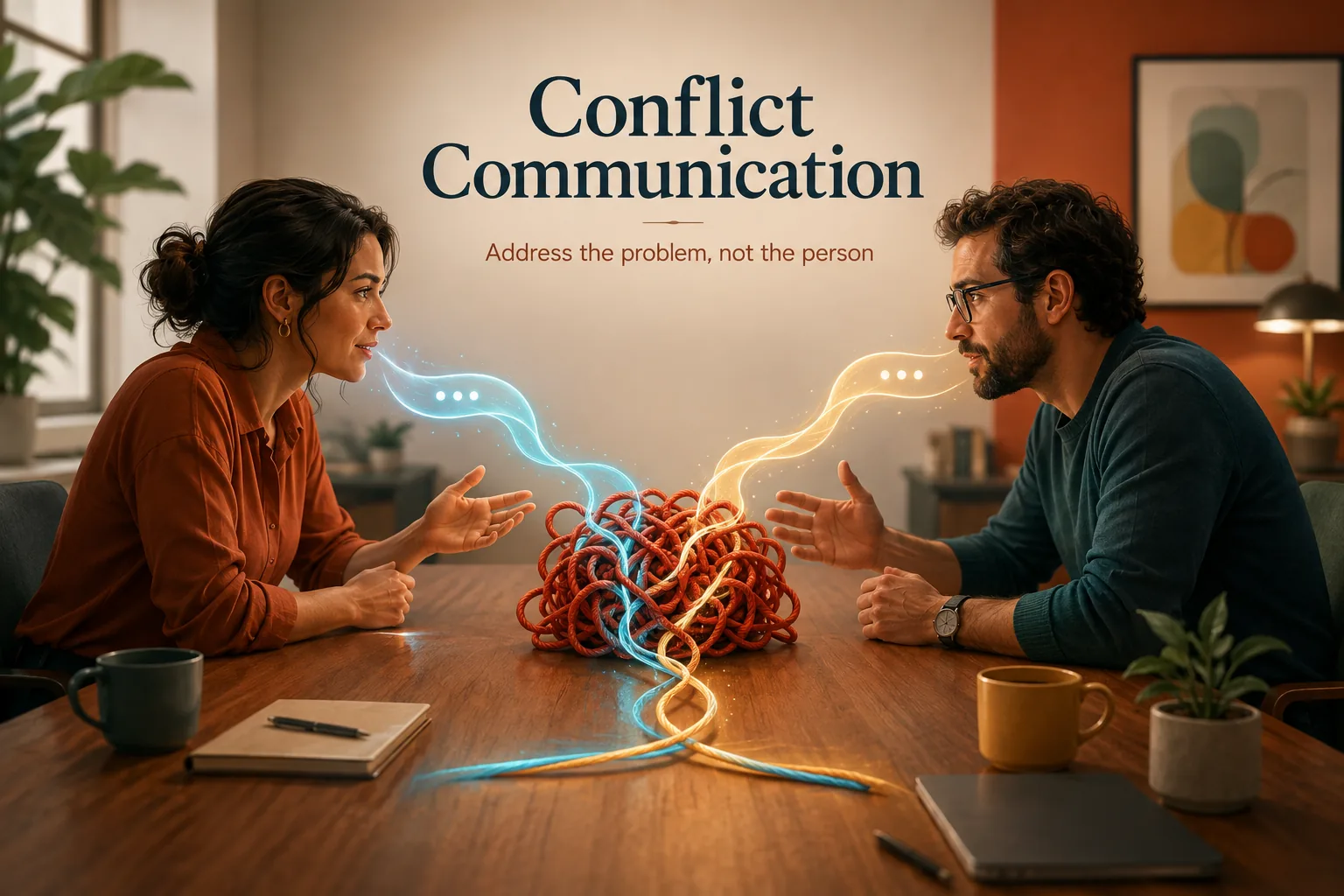
Conflict: A design lead and an engineering manager at a mid-size software company had been disagreeing about product direction for months. The design lead believed the team was shipping features too quickly without adequate user research.
The engineering manager believed the design process was too slow and that speed was essential for competitive survival.
Neither addressed the disagreement directly. Instead, the design lead began making sarcastic comments about "engineering-driven design" in Slack channels.
The engineering manager started assigning work that bypassed the design review process. Other team members noticed the tension and began choosing sides.
Within three months, what had started as a legitimate professional disagreement about process had metastasized into a toxic team dynamic that affected hiring, retention, and product quality.
This trajectory - from legitimate disagreement to organizational damage - is one of the most common and most preventable failures in professional environments. It happens not because the underlying disagreement is irresolvable but because the people involved lack the skills and the courage to address it directly.
Conflict is not the problem. In any organization of more than a handful of people, conflict is inevitable because capable people with different responsibilities, different information, and different values will reach different conclusions.
Unaddressed, poorly managed conflict is the problem. This article examines how professional conflict escalates, what effective conflict communication looks like, and how to navigate the most common types of workplace disagreement productively.
How Conflict Escalates: The Six Stages
Workplace conflict follows a recognizable escalation pattern. Understanding the stages helps you identify where a conflict currently sits and what interventions are appropriate.
Stage 1: Tension - A disagreement exists but has not been named. Both parties are aware of an issue but have not addressed it directly. People are still professional; there is simply an undercurrent of friction.
Stage 2: Debate - The disagreement becomes explicit but remains focused on the substantive issue. Positions are stated, reasoning is shared, both parties are still trying to solve the problem rather than win the argument.
Stage 3: Hardening - Positions solidify. Each party focuses on why they are right rather than on understanding the other's perspective. The disagreement starts generating negative emotions (frustration, resentment, defensiveness). Language becomes more adversarial.
Stage 4: Coalition-Building - Each party begins seeking allies. "Can you believe what X said?" Colleagues are recruited to validate positions and the conflict expands beyond the original parties.
Stage 5: Public Confrontation - The conflict becomes visible and disruptive. Meetings become tense. Written communications take on an adversarial quality that others can observe.
Stage 6: Organizational Damage - The conflict is damaging the team's function. Good people are leaving or considering leaving because of the environment. Work quality and decisions are suffering because collaboration has broken down.
The intervention point that matters most: Stages 1 and 2 are the ideal intervention points. Stage 3 is still manageable. Stages 4 and 5 require significantly more effort and often external help. Stage 6 may be irreparable without significant organizational intervention.
"Conflict is not the problem. Unaddressed conflict is the problem. The cost of avoiding a difficult conversation is almost always higher than the cost of having it - because avoided conflicts do not stay contained.[8] They grow underground and eventually cost far more to resolve." - Kerry Patterson, Crucial Conversations[5]
| Conflict Stage | What Is Happening | Intervention Required | Difficulty |
|---|---|---|---|
| Stage 1: Tension | Unspoken disagreement; friction | Direct conversation between parties | Low |
| Stage 2: Debate | Explicit positions; still substantive | Structured dialogue; active listening | Low to medium |
| Stage 3: Hardening | Positions solidify; negative emotions emerge | Separate positions from interests; acknowledge feelings | Medium |
| Stage 4: Coalition-building | Allies recruited; conflict expands | Manager involvement; mediation | High |
| Stage 5: Public confrontation | Visible disruption; adversarial tone in meetings | Formal mediation; process intervention | Very high |
| Stage 6: Organizational damage | Work quality suffering; people leaving | Senior leadership; possible restructuring | Potentially irreversible |
The Common Failure Modes
Avoidance
The most common response to workplace conflict is avoidance - not addressing the disagreement directly in the hope that it will resolve itself or diminish over time.
Avoidance is rational from the perspective of individual short-term comfort: addressing conflict is uncomfortable, carries social risk, and requires skill that many professionals have not developed.
Why avoidance fails: Conflicts that are avoided do not disappear.[7] They develop underground. The unaddressed tension accumulates, small irritations compound, and the emotional stakes grow.
By the time the conflict surfaces - and it will surface - it is far harder to address because it is now carrying the weight of months of accumulated frustration.
Example: Microsoft's "stack ranking" performance system (eliminated in November 2013, while Steve Ballmer was still CEO, in a change announced by HR chief Lisa Brummel) created structural avoidance of conflict at scale.
Under stack ranking, a fixed percentage of each team was required to receive negative performance ratings regardless of the team's actual performance. This created incentives for team members to undermine each other rather than surface collaborative disagreements.
Problems that should have been addressed openly were instead managed through the indirect channel of performance evaluations.[4]
Escalation Without Communication
The second common failure mode is escalating a conflict - going to a manager, HR, or a senior leader - before attempting direct resolution. This approach treats organizational authority as a conflict resolution mechanism, which it rarely is effectively.
Escalation without prior direct conversation typically:
- Damages the relationship with the person you escalate against
- Creates an adversarial dynamic that makes future collaboration harder
- Rarely produces the outcome you actually want (understanding and resolution) because the third party's role is to manage the situation, not to resolve the underlying disagreement
When escalation is appropriate: When direct conversation has been attempted and failed, when the conflict involves power imbalance (escalating to a manager is sometimes necessary when the other party is that manager), or when the conflict involves policy violations or harmful behavior.
Personalization
Workplace disagreements become dramatically harder to resolve when they shift from substantive (we disagree about the approach) to personal (I don't like or respect you). Personalization happens through several mechanisms:
- Attributing bad outcomes to bad intentions: "They delayed the decision because they wanted us to fail" rather than "They delayed the decision because they were busy"
- Attacking character rather than addressing behavior: "You're so disorganized" rather than "The meeting had no agenda"[10]
- Generalizing specific incidents: "You always do this" rather than "In this specific case"
Once a conflict is personalized, resolution requires rehumanizing the relationship before the substantive issue can be addressed.
The Neuroscience of Conflict
Understanding why conflict triggers such strong reactions helps explain why good intentions are often insufficient for managing it.
The amygdala hijack: When we perceive a threat - including the social threat of conflict - the amygdala, the brain's threat-detection center, can trigger a fight-or-flight response before the prefrontal cortex (which handles rational analysis and nuanced social judgment) has time to process the situation fully.
This "amygdala hijack," described by Daniel Goleman in his work on emotional intelligence, produces reactions that are automatic and emotionally driven rather than deliberate and rationally evaluated.[3]
The practical implication: conflict reactions often feel more certain and more urgent than the actual situation warrants. The defensiveness, the desire to win, the inability to hear the other person's perspective - these are often partly amygdala responses, not purely rational assessments.
Managing the hijack:
- Create deliberate time delay. "Can we schedule a conversation about this tomorrow?" gives the prefrontal cortex time to process.
- Name the emotional state. Research by Matthew Lieberman at UCLA shows that labeling emotions ("I'm feeling defensive right now") actually reduces the intensity of the emotional response by activating prefrontal processing.[6]
- Move the body. Physical movement reduces the physiological arousal that accompanies conflict responses.
The Framework for Productive Conflict Conversations
Preparation
Effective conflict communication requires preparation. Attempting a conflict conversation in the moment, without preparation, almost always produces worse outcomes than a conversation that has been thought through.
Before the conversation:
1. Clarify your actual goal. What outcome would you accept? "I want them to admit they were wrong" is not a resolution goal - it is a victory goal. "I want us to have a shared understanding of the problem and a plan to prevent it from happening again" is a resolution goal.
2. Understand your contribution to the conflict. In almost all professional conflicts, both parties have contributed to the dynamic.
Identifying your own contribution before the conversation serves two purposes: it prevents you from presenting yourself as a pure victim (which triggers defensiveness), and it opens space for the other party to acknowledge their contribution.
3. Gather specific examples. Vague grievances ("You're always difficult in meetings") are harder to address than specific examples ("In the meeting on Monday, when I raised the concerns about the timeline, your response was to say I was being unnecessarily negative in front of the whole team").
Specific examples are also more accurate - they describe what actually happened rather than a generalization.
4. Choose the right time and place. Conflict conversations should happen in private (public confrontations add shame to the emotional mixture, which makes resolution harder) and when both parties have sufficient time and emotional resources. Not right before a major deadline. Not in the ten minutes between back-to-back meetings.
The Conversation Structure
Open with intent, not accusation:
"I'd like to talk about [the specific situation] because I value our working relationship and I think we've been experiencing some friction that's getting in the way. I want to understand your perspective and share mine, and see if we can find a better way forward."
This opening does several things: it names the topic, signals that you value the relationship (which reduces defensiveness), frames the conversation as problem-solving rather than accusation, and invites collaboration.
Use the three-part structure from "Difficult Conversations" (Stone, Patton, Heen):[1]
The what happened conversation: What each party believes happened, their interpretation, and their contribution.
The feelings conversation: How the situation has affected each party emotionally.
The identity conversation: What the conflict threatens in terms of each party's professional identity, values, or self-perception.
Productive conflict conversations address all three layers. Conversations that address only the "what happened" layer often resolve the surface issue while leaving the emotional and identity layers to generate future conflict.
Listen to understand, not to respond:
The most common failure in conflict conversations is spending the time your counterpart is speaking preparing your rebuttal rather than genuinely understanding their perspective. Active listening - attending fully, not interrupting, reflecting back what you hear, and asking clarifying questions - is not just a soft-skills nicety.
It is the mechanism through which you actually understand the other party's perspective, which is the prerequisite for finding genuine resolution.[9]
Example: Roger Fisher and William Ury's negotiation framework in Getting to Yes distinguishes between positions (what each party demands) and interests (what each party actually needs).[2] Effective conflict resolution requires understanding interests, not just positions.
The engineer who says "I need the deadline extended by two weeks" has a position. Understanding their interest - whether it is quality, risk management, or technical completeness - opens up a wider range of potential solutions.
Working Toward Resolution
Focus on interests, not positions. Ask "help me understand why this matters to you" rather than debating which position is correct.
Propose solutions rather than assignments of blame. The productive question is "What would help us work better together?" not "Who was wrong and what should they do to fix it?"
Make explicit agreements. A conflict conversation that ends with vague goodwill ("OK, let's try to work better together") is only marginally more useful than no conversation. Explicit agreements specify what each party will do differently and by when.
Create a follow-up mechanism. Agree on a check-in in two to four weeks to assess whether the situation has improved.
Common Types of Workplace Conflict
Role Ambiguity Conflicts
When responsibility boundaries are unclear, conflicts arise around who owns decisions, who is accountable for outcomes, and whose priorities take precedence when they conflict.
Resolution approach: The conflict is about the work structure, not the people. Focus the conversation on clarifying the roles and decision rights, not on assigning blame for the confusion.
Example: A product manager and a senior engineer conflict over who has final say on technical scope. The conflict cannot be resolved by one party winning - it requires clarifying the organizational structure.
"Let's agree on what decisions belong to each of us and document that for the team" is more productive than "I should have authority because X."
Priority Conflicts
When people have different organizational priorities - different teams, different stakeholders, different objectives - their decisions will conflict even when both are acting in good faith.
Resolution approach: Priority conflicts are usually organizational problems, not individual ones. The person with the best organizational position to resolve priority conflicts is usually not either of the conflicting parties but their shared leader. Surface the conflict at the right organizational level.
Values Conflicts
The hardest conflicts are those rooted in genuine differences in values - about how decisions should be made, what matters most in trade-offs, what the organization's obligations are to its different stakeholders.
Resolution approach: Values conflicts rarely resolve through rational argumentation because values are not primarily rational. The productive path is to understand each party's values clearly, identify where they genuinely overlap (there is usually some overlap), and look for approaches that honor multiple values simultaneously.
If genuine values alignment is impossible - if one party believes user research is fundamental to good product development and the other believes it is an unaffordable luxury in a competitive market - the conflict may not be resolvable without organizational decision-making about which value takes precedence.
For frameworks on communicating effectively across teams, see cross-team communication.
Sources & Further Reading
- Stone, D., Patton, B. & Heen, S. Difficult Conversations: How to Discuss What Matters Most. Penguin Books, 2010.
- Fisher, R. & Ury, W. Getting to Yes: Negotiating Agreement Without Giving In. Penguin Books, 2011.
- Goleman, D. Emotional Intelligence: Why It Can Matter More Than IQ. Bantam Books, 1995.
- Edmondson, A. The Fearless Organization. Wiley, 2018. View source
- Patterson, K., Grenny, J., McMillan, R. & Switzler, A. Crucial Conversations: Tools for Talking When Stakes Are High. McGraw-Hill, 2012. View source
- Lieberman, M. D. Social: Why Our Brains Are Wired to Connect. Crown Publishers, 2013.
- Scott, K. Radical Candor: Be a Kick-Ass Boss Without Losing Your Humanity. St. Martin's Press, 2017. View source
- Lencioni, P. The Five Dysfunctions of a Team. Jossey-Bass, 2002.
- Ury, W. Getting Past No: Negotiating in Difficult Situations. Bantam Books, 1993.
- Rosenberg, M. B. Nonviolent Communication: A Language of Life. PuddleDancer Press, 2015. View source
Research on Conflict Communication: What the Studies Show
The academic study of workplace conflict has produced findings that challenge several intuitions about how and why disagreements escalate.
Kenneth Thomas and Ralph Kilmann's conflict mode research, which produced the widely used Thomas-Kilmann Conflict Mode Instrument (TKI) in 1974, identified five approaches to conflict based on two dimensions: assertiveness (the extent to which you pursue your own concerns) and cooperativeness (the extent to which you pursue others' concerns).
The five modes - competing, collaborating, compromising, avoiding, and accommodating - are not inherently good or bad; their effectiveness depends on the situation.
Thomas and Kilmann's research found that most professionals overuse one or two modes and underuse the others, limiting their ability to respond appropriately across the range of conflict situations they encounter.
In particular, avoiding - the most common default - is effective in very limited circumstances (when the issue is trivial, when emotions are too high for productive conversation) but counterproductive in the situations where most professionals apply it: substantive disagreements that require resolution.
Linda Putnam and Marshall Scott Poole's research on organizational conflict, synthesized in their review "Conflict and Negotiation" (1987), established a distinction that has shaped subsequent research: the difference between substantive conflict (disagreements about tasks, methods, goals, or resources) and affective conflict (interpersonal antagonism and emotional friction).
Their review, and the substantial body of research it helped inspire, has generally found that substantive conflict can be positively associated with decision quality and team performance in at least some circumstances - genuine disagreement about approach can produce better outcomes than premature consensus - while affective conflict has been consistently found to be negatively associated with performance.
The relationship between substantive conflict and performance is more context-dependent than the affective-conflict finding, but the core distinction between the two types of conflict has held up well across subsequent research. The practical implication is that the goal of conflict management is not to eliminate conflict but to keep it in the substantive domain rather than allowing it to shift to the affective domain.
The shift happens through personalization - when disagreements about ideas become interpreted as statements about character or intent.
Amy Edmondson's research on psychological safety has a direct conflict-communication implication that is often overlooked: teams with high psychological safety have more productive conflict, not less.
Edmondson found that in teams where speaking up was safe, team members surfaced disagreements earlier and at lower stakes, before they accumulated into serious problems.
In teams with low psychological safety, disagreements were suppressed until they became crises - at which point they were far harder to address productively.
The counterintuitive finding is that environments that feel the most harmonious - where conflict is rarely visible - are often the environments with the most suppressed conflict, not the least actual disagreement.
John Gottman's research on relationship conflict, developed through his observation of thousands of couples at the University of Washington's "Love Lab," identified four communication patterns he called the "Four Horsemen" that reliably predict relationship breakdown.
These are criticism (attacking character rather than behavior), contempt (treating the other person as inferior), defensiveness (deflecting responsibility), and stonewalling (withdrawing from conversation).
While Gottman's research context was marital relationships, the same four patterns are widely applied by workplace communication researchers and practitioners to professional conflicts, on the reasoning that criticism, contempt, defensiveness, and stonewalling describe general relational dynamics rather than mechanisms unique to marriage.
Contempt in particular - the combination of disrespect and moral superiority - is the most damaging of the four: once contempt enters a professional relationship, the trust required for productive conflict becomes very difficult to restore.
Case Studies: Conflict That Damaged Organizations and Conflict That Strengthened Them
Nokia's internal conflict suppression (2007-2013) has been documented in detail through research by Timo Vuori (Aalto University) and Quy Huy (INSEAD), published in Administrative Science Quarterly in 2016.
Through interviews with 76 Nokia managers and executives, they found that Nokia's decline was not primarily a failure of technical competence or strategic vision - it was a failure of internal communication.
Middle managers knew Nokia's mobile operating system could not compete with iOS and Android.
Engineers who worked with the technology daily understood its limitations. But fear of delivering bad news upward - the organizational equivalent of affective conflict with authority - prevented this information from reaching the people who could act on it.
Senior leaders who received positive assessments made investment decisions that reinforced a failing strategy.
The researchers described the dynamic as a "vicious cycle of fear": senior leaders projected anxiety about Nokia's position that made middle managers afraid to share bad news, which left senior leaders operating on inaccurate information that increased their anxiety.
The conflict that needed to happen - direct, honest disagreement about strategic direction - was suppressed until the external market resolved it.
Intel's "constructive confrontation" culture under Andy Grove represents a deliberate organizational design to make conflict productive. Grove believed that competitive business required rapid correction of mistakes, which required a culture where disagreement was expressed directly and early.
He institutionalized what he called "constructive confrontation" - the norm that any employee could challenge any idea, including Grove's own, if they had better information or analysis.
Grove documented the approach in Only the Paranoid Survive (1996). The culture was demanding and not comfortable for all employees, but it produced a specific organizational benefit: Intel's strategic pivots - including the famous exit from the memory business to focus on microprocessors in 1985 - happened through internal debate that surfaced the right information at the right time.
Without a conflict culture that permitted direct challenge to existing strategy, the pivot might not have happened until market forces made it inevitable at far higher cost.
The Apple-Microsoft collaboration conflicts of the early 1990s illustrate how unaddressed conflict between organizations can damage both parties.
When Microsoft developed Windows - using design elements from the Macintosh interface that Apple alleged were proprietary - the resulting legal conflict consumed enormous resources on both sides and damaged a relationship that had been genuinely productive.
The lesson is not that the conflict should have been avoided - the underlying disagreement about intellectual property was legitimate and required resolution - but that the absence of a relationship-preserving conflict communication framework meant that the only available resolution mechanism was litigation.
Organizations with better conflict communication frameworks between them resolve such disputes through negotiation rather than courts.
Practical Frameworks from Research: Tools for Productive Conflict
Interest-based relational (IBR) approach, developed by Roger Fisher and William Ury at the Harvard Negotiation Project and refined through subsequent research, provides a structured method for transforming positional conflicts into interest-based problem-solving.
The four-step process: (1) separate the people from the problem - treat the relationship as an asset to be preserved, not a casualty of the conflict; (2) focus on interests, not positions - explore what each party actually needs rather than debating their stated demands.
(3) generate multiple options before deciding - brainstorm possibilities without commitment; (4) use objective criteria - evaluate options against standards that both parties accept as legitimate rather than as a test of will.
Organizations that train managers in IBR report measurable reductions in conflict escalation and faster resolution times. The approach is particularly effective for role-ambiguity and priority conflicts where the underlying interests of both parties are compatible even when their stated positions are not.
Cross-Cultural Dimensions of Conflict Communication
The frameworks described earlier in this article were developed primarily within North American and Western European organizational contexts.
Research on how conflict communication differs across cultures reveals that many standard conflict resolution techniques carry cultural assumptions that do not transfer universally - and that applying them without adjustment can escalate rather than resolve conflict in multicultural workplaces.
Michele Gelfand at the University of Maryland and now Stanford, whose research on "tight" vs.
"loose" cultures spans studies in 33 countries published in Science (2011), found that cultures vary dramatically in their tolerance for conflict, their norms about how disagreement should be expressed, and their expectations about who has the right to raise objections.
"Tight" cultures - those with strong norms and low tolerance for norm violation, common in Japan, Singapore, South Korea, and Germany - tend to express conflict indirectly, through intermediaries, or through formal channels rather than direct confrontation.
"Loose" cultures - those with weaker norms and higher tolerance for deviation, common in the United States, Netherlands, Australia, and Brazil - treat direct conflict expression as normal and even healthy.
Gelfand's research found that when tight-culture employees interact with loose-culture managers in the same organization, direct feedback delivery norms produce significantly elevated anxiety and disengagement among tight-culture employees, who interpret directness as public shaming rather than constructive input.
Jeanne Brett at Northwestern's Kellogg School of Management has studied cross-cultural negotiation and conflict resolution across organizations in the United States, Hong Kong, Germany, and Japan.
Her research, synthesized in Negotiating Globally (2001, updated 2014), documents that the interest-based negotiation frameworks taught in Western management programs - which assume parties will directly state their underlying needs - fail systematically with negotiating counterparts from high-context, face-saving cultures.
In Confucian-heritage business cultures, direct admission of a need or vulnerability can damage the negotiating party's standing in ways that make the admission worse than no agreement at all.
Brett found that successful cross-cultural conflict resolution typically requires an indirect approach: surfacing interests through third-party intermediaries, using questions to create space for the other party to volunteer information, and providing face-saving exits from positions rather than requiring parties to explicitly abandon stated positions.
The practical implication for multicultural organizations is that conflict communication training should specify cultural context rather than presenting universal frameworks.
A manager who has been trained in direct confrontation approaches and applies them uniformly across a diverse team will produce significantly different outcomes with different team members - outcomes that may reinforce rather than resolve underlying tensions.
Organizational Design Choices That Shape Conflict Patterns
Many workplace conflicts that appear to be interpersonal are actually symptoms of organizational design decisions that create structural incentives for conflict. Understanding these structural sources changes the appropriate intervention from communication coaching to organizational redesign.
Clayton Christensen at Harvard Business School documented a structural pattern in innovation-intensive organizations, tied to his broader research on modular versus architectural technology and organizational design: when interdependent work is divided between teams with different metrics and different timelines, conflict is structurally inevitable regardless of the individuals involved.
His research on the disk drive industry, published in The Innovator's Dilemma (1997), showed that product teams and sustaining engineering teams in the same company routinely conflicted over resource allocation because their success metrics were designed to be in tension.
Any engineer asked to divide time between product development (rewarded by new features shipped) and sustaining work (rewarded by reliability maintained) faces a structural conflict that no amount of conflict communication training will resolve, because the incentive architecture creates the conflict independent of individual preferences.
Amy Edmondson's studies of surgical teams at Harvard Medical School, published in Management Science (2001), provide a case study in how team structure determines conflict patterns.
Edmondson studied 16 cardiac surgical teams implementing a new minimally invasive surgical technique and found that teams led by surgeons who created psychologically safe environments - where team members could voice concerns, flag errors, and disagree with the surgeon - learned the new technique measurably faster and more effectively than teams led by surgeons who did not, according to the learning-curve data Edmondson and colleagues tracked across the 16 hospital teams studied.
The critical variable was not the team members' willingness to conflict with authority in the abstract; it was whether the team's structure made it safe to surface disagreement in real-time during the procedure.
Teams with high psychological safety did not experience fewer conflicts - they experienced conflicts earlier and at lower stakes, before problems became critical.
Edmondson's finding has been replicated in intensive care units, investment banks, and engineering organizations: structural safety determines whether conflict surfaces productively or suppresses until it causes damage.
Google's Project Aristotle (2012-2015), a study of 180 Google teams to identify what made some teams significantly more effective than others, found that team composition, individual skill levels, and communication styles had less predictive power than a single structural factor: psychological safety.
Teams where members felt safe to take interpersonal risks - including voicing disagreement, admitting mistakes, and challenging assumptions - outperformed equivalent teams without that safety on every performance metric Google tracked.
Crucially, the high-psychological-safety teams did not avoid conflict; they engaged in more conflict, measured by frequency of open disagreement in meetings. But their conflicts were substantive rather than affective - about ideas and approaches rather than personalities and status.
The Google research supports the conclusion that the goal of conflict management is not conflict reduction but conflict channeling: creating structural conditions that keep disagreements in the productive, idea-focused domain rather than the destructive, interpersonal domain.
Marshall Rosenberg's Nonviolent Communication (NVC) framework provides a complementary tool focused on the communication dynamics within conflict conversations.
NVC distinguishes between observations (what actually happened, described neutrally) and evaluations (judgments about what happened), and between feelings (emotional states) and thoughts (interpretations framed as feelings).
In practice: "You dismissed my idea in front of the client" is an observation; "you were disrespectful" is an evaluation.
"I felt embarrassed" describes a genuine emotion; "I feel that you don't respect my expertise" is a thought framed as a feeling.
Rosenberg's research and practice documentation showed that conflicts de-escalate significantly when participants shift from evaluations to observations and from thoughts to genuine feelings.
The shift is simple in concept but requires practice to execute under the stress of actual conflict, which is why NVC training programs consistently show that exposure to the framework alone is insufficient - behavioral change requires repeated practice in lower-stakes settings.
The "third story" concept from Douglas Stone, Bruce Patton, and Sheila Heen'sDifficult Conversations (1999) provides a practical starting point for conflict conversations that avoids the defensive positioning that derails most attempts.
The third story is the description of the conflict that a neutral, informed observer would give - acknowledging that both parties have legitimate perspectives and that the disagreement makes sense from each vantage point.
Opening a conflict conversation with the third story signals that you are not there to prove you are right but to understand a situation that both parties are experiencing differently.
Stone, Patton, and Heen's research on hundreds of difficult conversations found that this opening dramatically reduced defensive escalation and increased the likelihood that the conversation produced genuine resolution rather than temporary ceasefire.