
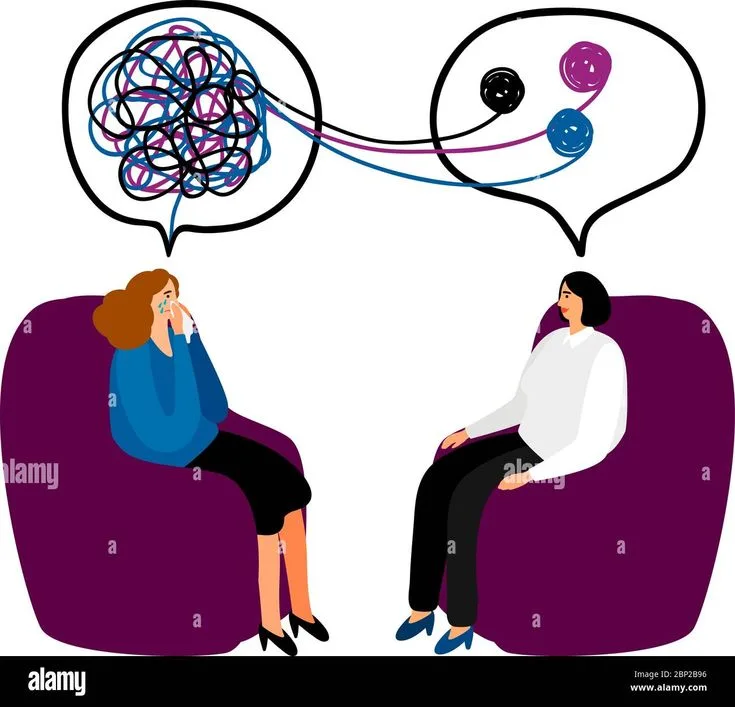
Empathic listening treats another person's experience as something to understand before interpreting, directing, or correcting it. What is empathic listening becomes clearer in this contrast with expert-led approaches: the listener attends to meaning, feeling, and perspective rather than imposing a diagnosis.
In the 1940s, a psychologist named Carl Rogers was developing a new approach to therapy. The dominant models of the time, including Freudian psychoanalysis and behavioral conditioning, positioned the therapist as an expert who diagnosed and treated the patient.
The therapist's role was to interpret the patient's communications in light of established theory, to identify what was really going on beneath the surface, to provide insight and direction.
Rogers thought this was backwards. His clinical experience had convinced him that healing came not from the therapist's interpretations but from the quality of the relationship: specifically, from the experience of being heard without judgment, accepted without conditions, and understood from the inside of one's own experience rather than from the outside of someone else's framework.
He called the core therapeutic skill empathic understanding: "the therapist's sensitive ability and willingness to understand the client's thoughts, feelings and struggles from the client's point of view."
Rogers was writing about therapy. But the skill he was describing, the ability to truly hear another person, turns out to be one of the most consequential and least developed capacities in ordinary human relationships.
What Empathic Listening Actually Is
Beyond Active Listening
Most communication training focuses on active listening: the set of behaviors that signal attention and encourage the speaker to continue. Eye contact. Nodding. Paraphrasing ("so what you're saying is..."). Open-ended questions. Not interrupting. Summarizing.
These behaviors are valuable. They create the conditions for better conversation. But they can be performed without any genuine understanding of the speaker's experience. A listener can paraphrase flawlessly while privately composing their rebuttal.
A listener can maintain eye contact while actually attending to something else entirely.
Empathic listening goes deeper. It involves an internal shift: temporarily suspending your own perspective and genuinely inhabiting the speaker's frame of reference.
It means understanding not just what they said but what it means from inside their experience: what they felt, what it looked like from where they stood, what it means in the context of their life.
Rogers described the experience of being empathically heard as rare and precious precisely because most listening is not of this kind. Most listening is hearing-while-waiting-to-speak, filtering through your own assumptions, or evaluating against your own standards.
The Difference That Makes a Difference
The practical difference between active and empathic listening is subtle but significant in its effects on the person being heard.
When someone is genuinely heard, when their experience is understood from the inside rather than evaluated from the outside, several things tend to happen:
- They feel safe enough to go deeper, to say what they actually mean rather than what they think will be well-received
- They begin to hear themselves more clearly, because the act of articulating to an attentive, non-judgmental listener makes implicit thoughts more explicit
- They are more likely to reach their own insights rather than needing to be given advice
- The relationship develops trust that makes future communication more honest
Rogers documented these effects in therapy. Subsequent research has confirmed similar effects in management, education, medicine, and close relationships. The quality of listening shapes not just what is communicated but whether communication genuinely occurs.
The Levels of Listening
Otto Scharmer's Framework
Otto Scharmer, a senior lecturer at MIT and founder of the Presencing Institute, developed a framework in his Theory U work that describes four qualitatively different ways of listening. The framework is widely used in organizational development and leadership development:
Level 1: Downloading Listening to confirm what you already believe. You are hearing, but you are processing information through the filter of what you already know, selecting what fits your existing framework and ignoring what does not.
The internal experience is one of recognition: "Yes, that's what I expected." Downloading produces no new understanding.
Most people spend most of their time at this level without knowing it. The confirmation bias that governs downloading is largely unconscious: we do not experience ourselves as filtering; we experience ourselves as perceiving accurately.
Level 2: Factual Listening Attending to data and noticing differences from what you expected. At this level, you are genuinely open to new information and will update your understanding based on what you hear. The test: are you noticing things that don't fit your existing model? If so, you are above Level 1.
Most professional communication training aims to get people to this level. Factual listening produces information acquisition and understanding of content.
Level 3: Empathic Listening Shifting from your own perspective to the speaker's, genuinely understanding their experience and viewpoint. This is not agreement. You may see things entirely differently. It is understanding from within their frame of reference.
The internal shift is from "I'm hearing what they think" to "I'm beginning to feel what they feel and see what they see."
Empathic listening changes your relationship to what you are hearing. You are no longer outside the speaker's world evaluating it; you are temporarily inside it.
Level 4: Generative Listening Listening from an open future: allowing the conversation to change not just your information but your sense of what is possible, who you are, and where things might go.
Scharmer associates this with transformative dialogue, with the kind of conversation that opens genuinely new possibilities rather than reallocating familiar options.
Generative listening is rare and cannot be willed; it requires profound openness and is facilitated by the prior development of empathic listening skills.
| Level | What You Are Listening For | Internal Experience | Output |
|---|---|---|---|
| Downloading | Confirmation | Recognition | Reinforced beliefs |
| Factual | New data, content | Attention, updating | Information |
| Empathic | Perspective, emotion, experience | Shift to other's viewpoint | Understanding |
| Generative | Emergence, possibility | Open, present, receptive | New ways of seeing |
Carl Rogers and Unconditional Positive Regard
The Three Core Conditions
Rogers identified three conditions that he believed were both necessary and sufficient for therapeutic change:
Congruence (genuineness): The therapist is authentic and transparent, not performing a role but genuinely present. The listener who is genuinely interested in understanding is fundamentally different from the listener who is performing the behaviors of interest.
Unconditional positive regard: The therapist holds the client's experience in positive regard regardless of its content: without judgment, without conditions, without the sense that some emotional experiences are acceptable and others are not.
This does not mean approving of all behavior; it means valuing the person and their experience as such.
Empathic understanding: The therapist accurately understands the client's experience from the client's frame of reference and communicates that understanding.
Rogers's argument was that these three conditions, when genuinely present, created a relational environment in which change and growth became possible without techniques or interpretations. Being truly heard and accepted was itself therapeutic.
"When a person realizes he has been deeply heard, his eyes moisten. I think in some real sense he is weeping for joy. It is as though he were saying: 'Thank God, somebody heard me. Someone knows what it's like to be me.'" (Carl Rogers)
Applications Beyond Therapy
Rogers explicitly believed that these conditions applied to all meaningful human relationships, and to education, organizational life, and leadership, not only to therapy.
Research has borne this out. Studies in medical contexts have found that patients who feel heard by their physicians have better health outcomes, better adherence to treatment, and higher satisfaction.
Studies in organizational contexts have found that employees who report being genuinely heard by their managers show higher engagement, lower turnover, and better performance.
Studies in education have found that students learn more effectively from teachers they experience as genuinely interested in their understanding.
These effects are not simply about pleasant interactions. Being genuinely heard changes what people communicate, what they are willing to try, and how much cognitive and emotional resource they can bring to a task.
The WAIT Principle
Why Am I Talking?
The WAIT acronym, Why Am I Talking?, is a simple but powerful self-reflective prompt used in coaching, therapy training, and communication development. It asks listeners to pause before speaking and examine their motivation for doing so.
The premise is that a significant proportion of what people say in conversation serves the speaker's needs rather than the conversation's needs:
- Demonstrating knowledge or expertise
- Filling uncomfortable silence
- Redirecting the conversation to a preferred topic
- Reassuring themselves that they understand before understanding is complete
- Reducing the discomfort of hearing something difficult
None of these are illegitimate in all circumstances. But in contexts where the purpose of a conversation is to help someone else think through their situation (a coaching conversation, a difficult personal conversation, a feedback session), the listener's contribution is often less valuable than the space they hold for the speaker to continue.
The WAIT prompt does not suggest that listeners should never speak. It invites a moment of deliberate reflection: is what I'm about to say genuinely going to serve this person's thinking and this conversation's purpose?
Or am I speaking because I am uncomfortable with silence, or because I have something I want to say, regardless of whether it serves them?
Silence as Empathic Presence
Experienced therapists and coaches speak frequently about the power of silence. Silence after a significant statement gives the speaker time to go deeper: to continue past the surface articulation to what they actually mean. Silence communicates that the listener is not rushing to respond, has no agenda to redirect, is genuinely present.
Most untrained listeners find silence uncomfortable and fill it immediately. The impulse is understandable: silence can feel like failure of connection.
But the research on facilitative listening consistently shows that moderate pauses (3-7 seconds after a significant statement) produce deeper and more authentic communication than rapid turn-taking.
What Blocks Empathic Listening
The Internal Voice
Perhaps the most universal barrier to empathic listening is the internal voice that runs while the other person is speaking. This is the voice that:
- Evaluates what is being said ("that's not quite right")
- Prepares a response ("I need to tell them about my experience with this")
- Compares to prior knowledge ("this is like what happened with...")
- Judges the speaker ("they always make this into a bigger deal than it is")
- Plans for what comes after the conversation
This internal processing is not neutral. It consumes attentional resources that would otherwise be available for genuinely attending to the speaker. It filters what we hear through our own frameworks. It keeps us in our own perspective rather than shifting to the speaker's.
Managing the internal voice is the core practical skill of empathic listening. It does not require silencing thought, since that is not possible. It requires noticing when the internal voice is running and returning attention to the speaker.
The Most Common Blocking Behaviors
Matthew McKay, Martha Davis, and Patrick Fanning's research on listening blocks identifies common patterns:
Comparing: Measuring your own experience against the speaker's ("when that happened to me...") rather than receiving theirs as primary.
Mind-reading: Assuming you know what the speaker means or feels without allowing them to tell you.
Rehearsing: Using the time while they speak to prepare your response, which means you are not fully hearing what they are saying.
Filtering: Hearing only what confirms your existing view, blocking out information that does not fit.
Judging: Evaluating the speaker rather than understanding them, which closes down the speaker's willingness to be honest.
Advising: Jumping to solutions before fully understanding the problem. This is one of the most common patterns: the listener who responds to "I'm struggling with X" immediately with "you should do Y", and one of the most frustrating for speakers who wanted to be heard, not fixed.
Derailing: Changing the subject when the content becomes uncomfortable.
Placating: Agreeing with everything to avoid difficulty, which is a way of not really hearing at all.
Research suggests a significant gap between how well people believe they listen and how well they actually do. A 2014 study found that 96% of people describe themselves as good listeners.
Most research on actual listening behavior suggests that most people retain about 25-50% of what they hear in a standard conversation, and that comprehension of emotional content is significantly lower.
Empathic Listening in Practice
The Reflecting Practice
The most practical technique for developing empathic listening is reflective listening: reflecting back what you heard, including the emotional dimension, before moving on to response or question.
The structure:
- Allow a pause after the speaker finishes
- Reflect content: "So what you're describing is..." or "It sounds like what happened was..."
- Reflect emotion: "...and that felt..." or "...and what's hardest about that is..."
- Check understanding: "Is that right? Is there more to it?"
The reflection is not summary or paraphrase for its own sake. It is a demonstration to the speaker that you received their experience, not just their words but their meaning and feeling. When the reflection is accurate, speakers typically respond with a physical relaxation and a deepening of what they are willing to share.
When the reflection is inaccurate, speakers usually correct it. This is useful: it reveals what was not yet understood and invites clarification.
Empathic Inquiry
Empathic inquiry means asking questions that invite deeper sharing rather than questions that redirect to what you want to know. The distinction:
Redirecting question: "You mentioned the project was difficult. Tell me about the timeline." Empathic question: "What made it difficult for you?"
The first question moves the conversation where the listener wants to go. The second invites the speaker to go deeper into their own experience. Empathic questions typically begin with "what" or "how," are open-ended, and are focused on the speaker's experience rather than on gathering specific information.
In Management and Leadership
Research on manager listening consistently shows that employees who feel heard by their managers are more likely to raise problems, offer ideas, take calculated risks, and stay in their roles.
Conversely, managers who are perceived as poor listeners create environments where important information is withheld and problems are concealed until they become crises.
Effective managerial empathic listening does not mean agreeing with everything employees say or abandoning decision-making authority.
It means creating an environment in which employees' actual experience of their work, including difficulties, disagreements, and concerns, is treated as valuable information rather than as inconvenient noise to be managed.
The Zenger/Folkman study of 3,492 participants from their coaching database found that the most effective listeners were perceived not as passive receivers but as active, safe partners who created a psychologically safe environment for thinking.
The best listeners asked questions that promoted discovery, offered feedback in a way that left the speaker's self-esteem intact, and made suggestions about how to move forward.
Empathic Listening vs. Emotional Contagion
A crucial distinction: empathic listening involves understanding another person's emotional experience without being overwhelmed by it.
It is different from emotional contagion (the automatic mirroring of another's emotional state) and from the personal distress that can arise when witnessing suffering triggers your own anxiety rather than compassion.
The distinction matters practically. A listener who is overcome by the speaker's distress cannot be effective. They may rush to reassurance to manage their own discomfort rather than holding space for the speaker to process theirs. They may avoid hearing the full extent of someone's difficulty because the hearing is too painful.
The Buddhist concept of equanimity is relevant here: the capacity to be fully present with another person's suffering without being overwhelmed by it. This is not emotional distance. It is the ability to remain present and functional while fully receiving what is difficult.
Developing this capacity is one of the harder aspects of empathic listening and one reason that professionals whose work involves sustained emotional labor (therapists, physicians, social workers, palliative care nurses) benefit from regular supervision and support to prevent compassion fatigue.
Summary
Empathic listening is not a technique. It is a way of being in conversation: a commitment to temporarily inhabiting another person's perspective before responding from your own.
Its effects are documented across domains from therapy to medicine to management to education: people who feel genuinely heard communicate more honestly, think more clearly, and engage more fully.
The barriers to empathic listening are not failures of skill. They are the ordinary operation of the mind running its habitual patterns: judging, comparing, advising, preparing responses, filtering. The practice of empathic listening is the practice of interrupting those patterns in service of genuine understanding.
What makes it rare is not its difficulty but its cost: it requires setting down your own perspective, at least temporarily, in order to take up someone else's. That is less comfortable than the alternative. It is also far more useful.