
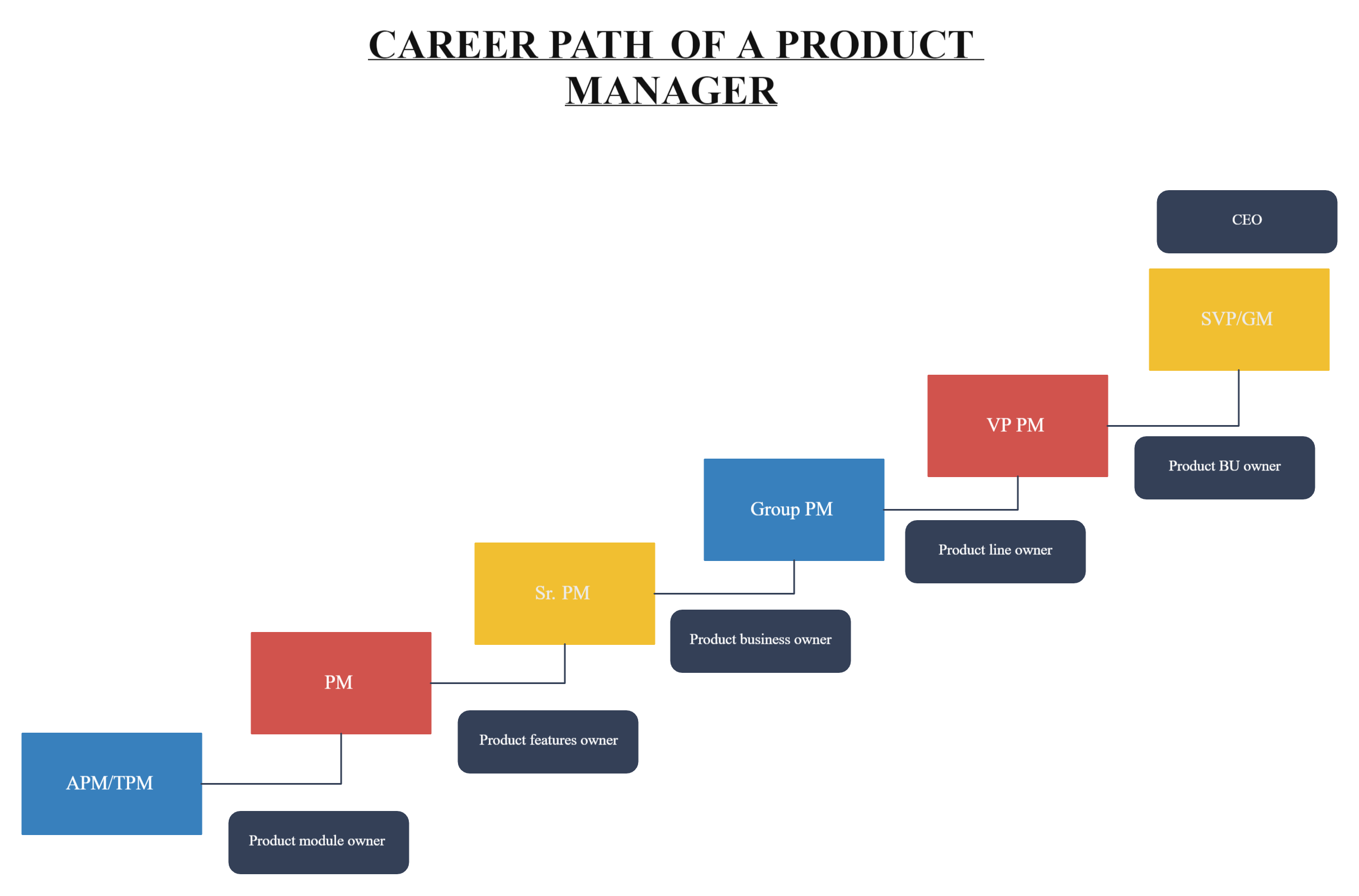
The product manager career path is the progression from entry-level associate product manager (APM) through senior individual contributor or management roles to executive positions like VP of Product and Chief Product Officer (CPO).
Unlike law, medicine, or accounting, there is no bar exam to pass, no licensing body to satisfy, and no universally agreed level structure.
A senior PM at a 50-person startup and a senior PM at Google are doing materially different jobs, often with the same title, and they would not necessarily succeed in each other's environments.
At the same time, clear patterns exist - patterns in how people progress, where the decision points fall, which specializations command premium compensation, and when the moment to jump to a startup is right.
Understanding those patterns separates people who navigate the career intentionally from those who simply wait for things to happen to them.
Product management career progression is unusual in that the path forks at a specific juncture - the senior-to-staff transition - into two tracks with different shapes and requirements.
The management track leads toward Group PM, Director, VP, and CPO, and requires developing skills in organizational leadership, talent development, and executive communication.
The IC track (individual contributor) leads toward Principal PM, Staff PM, and sometimes Distinguished PM, and requires developing extraordinary depth in product judgment and cross-organizational influence without formal authority.
Both tracks exist at large technology companies; most smaller companies only have the management track in any meaningful sense.
This guide maps the full progression from APM to CPO, explains specialist PM roles (growth PM, platform PM, AI PM, monetization PM), addresses the timing question of when to join an early-stage startup, and traces the general manager path that some senior PMs take beyond traditional product management.
"The path from PM to CPO is not a straight line. It goes through moments of failure, periods of ambiguity, and decisions that look wrong in the short term. The people who make it are the ones who stayed curious longer than everyone else." - Gibson Biddle, former VP of Product at Netflix
Key Definitions
IC track (Individual Contributor track): A career path in which a PM advances in seniority, scope, and compensation without managing other PMs.
Senior IC PMs at large companies (often called Principal PM, Staff PM, or Distinguished PM) are analogous to staff or principal engineers: high-leverage individual contributors with organizational influence that comes from the quality of their judgment, not from formal authority.
People manager track: The path from senior PM to Group PM or Director, where the PM begins managing other PMs. This track requires developing coaching, hiring, and organizational design skills that the IC track does not demand with the same intensity.
Scope: In product management, scope refers to the breadth and strategic importance of the product area a PM is responsible for. Progression in the PM career is largely defined by expanding scope - from a single feature to a product, from a product to a product line, from a product line to a business.
Marty Cagan of the Silicon Valley Product Group has argued that scope expansion, not title inflation, is the true measure of PM career growth.
Growth PM: A product manager who specializes in the metrics of user acquisition, activation, retention, revenue, and referral (the AARRR framework popularized by Dave McClure in 2007). Growth PMs work heavily with data, run rapid A/B experiments, and operate at the intersection of product and marketing.
Platform PM: A PM who owns products consumed by other engineers or product teams rather than end users. Platform PMs often work on developer tools, APIs, infrastructure products, or internal tools. This specialization requires deeper technical fluency than most consumer PM roles.
PM Career Levels: Compensation and Scope
| Level | Title | Typical Experience | Total Comp (US, Top Tech, 2025) | Key Milestone |
|---|---|---|---|---|
| 1 | Associate Product Manager (APM) | 0-2 years | $130,000-$180,000 | Structured program, feature ownership |
| 2 | Product Manager (PM) | 2-5 years | $160,000-$270,000 | Full product area ownership |
| 3 | Senior Product Manager | 5-9 years | $230,000-$380,000 | Strategic autonomy, track fork point |
| 4A | Group PM / Director | 7-12 years | $300,000-$700,000+ | Manages 2-8 PMs |
| 4B | Principal / Staff PM (IC) | 7-12 years | $280,000-$600,000+ | Organizational influence, no direct reports |
| 5 | VP of Product | 12-18 years | $450,000-$1,000,000+ | Executive, organization-level strategy |
| 6 | Chief Product Officer (CPO) | 15+ years | $500,000-$2,000,000+ | Board-level product accountability |
Compensation data drawn from Levels.fyi and Glassdoor (2025) for top-tier US technology companies. Total compensation includes base salary, annual bonus, and equity (RSUs or options). Ranges are wide because they span from mid-tier to top-tier companies.
At FAANG-tier companies (Meta, Google, Apple, Amazon, Netflix), compensation at each level skews toward the upper end. At Series B-C startups, base salary is typically 15-25 percent lower but equity participation can substantially exceed these figures if the company succeeds.
Level 1: Associate Product Manager (APM)
The APM role is the entry point for new graduates and career changers who enter through structured programs. The role is explicitly designed for learning: APMs typically rotate through product areas, have dedicated mentors, receive structured training in PM fundamentals, and operate under close supervision from senior PMs or directors.
The primary goal at the APM level is developing core PM competencies: writing product requirements clearly enough that engineers can build from them, running discovery conversations productively with users and stakeholders, coordinating with engineering and design without creating unnecessary blockers, and understanding how to define and measure success for a feature.
APMs who progress fastest demonstrate two qualities that initially appear contradictory: intellectual humility - asking good questions, acknowledging knowledge gaps, seeking feedback actively - alongside the confidence to make and defend decisions when the time comes.
The combination is the hallmark of good PM judgment, and it is visible very early. PMs who are all humility never ship. PMs who are all confidence ship the wrong things.
Entering the APM Pipeline
Formal APM programs exist at Google, Meta, Microsoft, LinkedIn, Uber, Stripe, Salesforce, and many other large companies.
Acceptance rates at the most competitive programs (Google APM, Meta RPM) have fallen to approximately 0.1-0.3 percent as candidate volumes have grown, making them among the most selective entry-level programs in technology.
Many new PMs enter through informal paths rather than formal APM programs - transitioning from engineering, design, data science, consulting, or customer success.
Jackie Bavaro and Gayle Laakmann McDowell, authors of Cracking the PM Interview (2013), note that the majority of working PMs did not enter through formal APM programs, and that demonstrated problem-solving ability matters more than the specific entry path.
Typical duration at this level: 1-2 years before progressing to PM.
Level 2: Product Manager (PM)
The core PM role carries full ownership of a product area or feature set. At this level, the expectation is that you operate with minimal supervision: you understand your users through regular research and data analysis, you own your roadmap and can defend prioritization decisions, you run your cross-functional team effectively, and you are accountable for the metrics in your area.
The PM-to-senior-PM transition is gated by one thing above all others: demonstrated impact.
Companies promote PMs to senior when they have evidence that the PM's product decisions are directly connected to measurable outcomes - growth in key metrics, successful launches that moved business numbers, meaningful user adoption of new capabilities.
PMs who are diligent and operationally competent but cannot point to clear evidence that their decisions drove results stay at this level longer than they should.
The Hardest Skill at This Level
The hardest skill to develop is not writing specs or running standups - it is ambiguity tolerance. A PM who needs to be told what to build will not advance. A PM who consistently identifies the right problems to solve, even without explicit direction from leadership, demonstrates the judgment that earns expanded scope.
Teresa Torres, author of Continuous Discovery Habits (2021), describes this as the shift from "output thinking" (shipping features) to "outcome thinking" (solving problems that move metrics). PMs who make this shift early tend to progress faster than those who remain focused on delivery execution.
Typical duration: 2-4 years at this level before progressing to senior, depending on company growth rate and demonstrated impact.
Level 3: Senior Product Manager
Senior PM is the point at which the career path diverges meaningfully. Senior PMs are expected to own a significant product area with strategic autonomy, influence product strategy beyond their immediate team, mentor and develop junior PMs informally, navigate complex stakeholder relationships without escalating, and drive outcomes at a scale that matters visibly to the business.
At this level, the decision to pursue the IC track or management track becomes live. Many companies require a choice; others allow ambiguity longer.
The honest assessment: if you genuinely enjoy developing other people - giving feedback, coaching through difficult situations, building teams - the management track is more satisfying and typically more lucrative at most companies beyond 500 employees.
If your energy is in product thinking and execution, the IC track at a large technology company can be equally well-compensated and more directly satisfying.
The Promotion Dynamics
The senior PM level is where external visibility begins to matter for career advancement. Senior PMs who speak at conferences, write publicly about product craft, or contribute to industry communities develop relationships and reputation that accelerate the path to director-level roles.
Lenny Rachitsky, whose newsletter on product management reaches over 600,000 subscribers, has noted that the PMs who advance fastest from senior to director have some form of public track record - not because the content itself matters for the promotion, but because the discipline of articulating product thinking publicly sharpens the thinking itself and creates professional optionality.
The senior-to-director transition typically takes 2-4 years and is often the longest promotion gap in the PM career, because it requires demonstrating a qualitatively different set of capabilities rather than simply doing the senior PM job better.
Level 4A (Management Track): Group PM / Director of Product Management
The management track promotion to Group PM or Director requires demonstrating that you can build and lead a team of PMs that produces better outcomes than the individuals would produce separately.
This means hiring well (including the discipline to reject candidates who are good but not right), developing weaker performers through specific coaching, providing clear direction and regular feedback, and creating the conditions for autonomous decision-making by your reports.
Directors at large technology companies are also expected to represent their product domain in executive forums, influence resource allocation across teams, and contribute to company-level product strategy.
The role is less about day-to-day product decisions and more about building the conditions - team, strategy, process, culture - that allow good product decisions to happen reliably at scale.
The Common Derailment
The transition from PM to Director is one of the most common career derailment points. PMs who advance to Director because they were excellent individual contributors often struggle when the job becomes primarily about enabling others.
The skill set required - coaching, hiring, navigating organizational politics, building consensus among peers, managing up - is fundamentally different from the skill set that earned the promotion.
Julie Zhuo, former VP of Design at Facebook, described this transition in The Making of a Manager (2019): "The hardest part of becoming a manager is that the things that made you successful as an individual contributor are not the things that make you successful as a manager."
Organizations can mitigate this by providing explicit management training during the transition - but most do not, expecting new directors to figure out people management through trial and error.
The result is a predictable pattern of technically excellent PMs becoming mediocre managers who are unhappy in the role, creating a lose-lose situation for both the organization and the individual.
Directors of Product Management at mid-to-large technology companies earn $300,000-$700,000+ in total compensation (US, 2025 data from Levels.fyi).
Level 4B (IC Track): Principal PM / Staff PM
At large technology companies, the top of the IC track - Principal PM, Staff PM, or equivalent - involves organizational influence without management authority. Principal PMs are expected to:
- Own product strategy for a large, complex domain
- Set technical and product direction that other PMs and engineering teams follow
- Operate as an internal thought leader on key strategic questions
- Represent the company externally on product and strategy topics
- Resolve cross-organizational conflicts and ambiguity through influence rather than authority
This track exists formally at Google (L6/L7 PM), Meta (E6/E7 IC PM), Amazon (Principal PM-Technical), and Microsoft (Principal PM), among others.
At companies with fewer than approximately 1,000 employees, this track does not meaningfully exist - there are not enough senior PMs to differentiate an IC senior track from the management track.
The IC track requires building cross-organizational influence without formal authority. The most effective senior IC PMs are known throughout the organization for the quality of their judgment, not just the products they own.
Shreyas Doshi, a prominent PM advisor and former PM at Stripe and Google, has described the principal PM role as "being the person everyone consults before making a big product decision, even though you have no authority to make decisions for them."
Level 5 and Above: VP of Product / CPO
VP of Product and CPO are executive roles. At this level, the job is organizational leadership, company strategy, and external representation. The CPO is responsible for:
- Setting the overall product vision and strategy in alignment with the CEO and board
- Building, structuring, and managing a product organization that can execute that strategy
- Representing the product function to investors, customers, and the market
- Making high-stakes product bets on behalf of the company
- Defining the product development process and culture for the entire organization
The CPO role exists at companies large enough to have substantial product organizations - typically 200+ employees with dedicated product teams. At earlier stages, the CEO often serves as the de facto CPO, or the function is led by a VP who reports to the CEO.
The path from Director to VP to CPO typically takes 5-10 additional years after reaching Director, and is as much about board relationships, investor credibility, and demonstrated track record of business outcomes as it is about product craft.
Melissa Perri, author of Escaping the Build Trap (2018), has noted that the CPO role requires "translating product strategy into business language that the board and investors understand," a skill that many excellent product thinkers never develop because they remain focused on the product itself rather than its business context.
Specialist PM Roles
As PM teams grow and product portfolios diversify, specializations develop. Four PM specializations carry notable compensation premiums and demand in 2025-2026:
Growth PM
Specializes in acquisition, activation, retention, and monetization experiments. Growth PMs are comfortable running dozens of A/B tests per quarter, working directly with data engineers on funnel analysis, and building models of user lifecycle value.
The role was formalized by Sean Ellis (who coined the term "growth hacking") and popularized through his book Hacking Growth (2017). High demand at consumer companies; compensation premiums of 15-25 percent over generalist PM roles at equivalent levels.
Platform PM
Owns developer-facing products, internal APIs, or infrastructure surfaces. Platform PMs need deeper technical fluency than consumer PMs - they must understand how developers consume platforms, what makes an API well-designed (consistency, predictability, good error messages), and how to balance developer experience against engineering constraints.
Stripe's API design, widely regarded as an industry benchmark, reflects the influence of strong platform PM thinking.
AI PM
The fastest-growing specialization as of 2025. AI PMs build on and with machine learning models, large language models, or AI-assisted features.
They must understand model evaluation metrics, probabilistic outputs (AI features that are right 85 percent of the time require different UX than deterministic features), safety and alignment considerations, and how to set user expectations for AI system behavior.
A genuine shortage of qualified AI PMs has pushed compensation 20-30 percent above standard PM rates at equivalent levels.
Monetization PM
Focuses on pricing, packaging, and the mechanics of revenue generation - subscription design, freemium-to-paid conversion, marketplace take rates, and payment flow optimization. Common at consumer subscription businesses (Spotify, Duolingo), marketplace companies (Airbnb, Etsy), and B2B SaaS companies with complex pricing models.
Monetization PMs combine product skills with financial modeling and behavioral economics, drawing on concepts from pricing psychology and experimental design.
When to Leave for a Startup
The optimal time to join an early-stage startup is after 5-8 years of PM experience, with a track record of shipping successful products and managing cross-functional complexity. Joining before you have that experience foundation means operating in a high-ambiguity environment without the pattern recognition to navigate it well.
Joining too late (after 15+ years at large companies) can be equally challenging - the muscle memory of operating with large company resources, processes, and support structures can make the transition to a resource-constrained environment genuinely difficult.
The Equity Calculation
The equity calculation matters more than most PMs realize. A Series A startup PM with 0.2-0.5 percent equity and a successful outcome at a $300M acquisition generates $600,000-$1,500,000 pre-tax.
The same individual staying at a big tech company for those same years (typically 4-7 years from Series A to exit) generates comparable or higher returns through RSUs without the downside risk.
The math of startup equity only clearly dominates at outcomes of $500M or greater - and most startups, including most funded startups, do not reach that threshold.
AngelList data suggests that approximately 75 percent of venture-backed startups fail to return investor capital, and the median outcome for employees with equity is zero or near-zero. The equity upside is real but must be evaluated probabilistically, not optimistically.
The Non-Financial Calculation
The non-financial calculation is equally important: startup PMs typically have more scope, more direct ownership, and faster feedback loops on their decisions than PMs at large companies.
For people who find the pace of large company product development frustrating - the reviews, the alignment meetings, the consensus-building - the startup environment can be more energizing even when the financial case is marginal.
The key is being honest with yourself about whether you are drawn to startup life for the right reasons (scope, pace, ownership) or the wrong ones (fantasy of wealth, escape from a bad current situation).
The GM Path
Some senior PMs, particularly those at B2B companies or companies with distinct business lines, evolve into general manager (GM) roles. A GM owns profit-and-loss accountability for a business unit - not just the product, but the revenue, the marketing, the go-to-market strategy, and sometimes the sales team.
The GM path makes the most sense for PMs who have developed strong commercial instincts alongside product expertise, who enjoy the accountability of a P&L rather than finding it stressful, and who work in environments where product and business strategy are inseparable.
B2B SaaS companies, marketplaces, and media technology companies are the most common settings for this transition. Amazon's "single-threaded leader" model, where a senior leader owns all aspects of a business line, is the most prominent institutional expression of the GM path.
The transition from PM to GM requires developing skills in financial management, commercial strategy, and sales leadership that most PM roles do not develop. PMs considering this path should seek exposure to P&L ownership, commercial negotiations, and go-to-market strategy well before making the formal transition.
Practical Takeaways
Advance by expanding scope, not just accumulating years. The fastest-progressing PMs take on adjacent problems beyond their assigned area, volunteer for cross-functional initiatives, and build relationships with leaders in engineering, design, and business before they need those relationships for a promotion conversation.
Scope expansion is the leading indicator of promotion; years of experience is the lagging one.
At the senior-to-director decision point, be honest about what you want. Both the IC and management tracks are legitimate and well-compensated at large companies.
Choosing the management track because it seems like the "right" move, while genuinely preferring individual contribution, leads to mediocre management and a career spent doing draining work.
Choosing the IC track because you are afraid of managing people, when you would actually enjoy developing others, limits your impact unnecessarily.
Build external visibility early. The most mobile senior PMs have public track records - writing, speaking, or community contribution - that create professional optionality independent of their current employer's performance or headcount decisions. External visibility is insurance against organizational instability.
Develop a specialty, but not too early. Generalist PM experience in the first 3-5 years builds the broad pattern recognition that all specializations draw on. Specializing too early limits your perspective; specializing at the senior level amplifies your value.
Understand the business, not just the product. PMs who advance to director and beyond are distinguished by their ability to connect product decisions to business outcomes in language that executives, board members, and investors understand.
Developing financial literacy - understanding unit economics, customer acquisition costs, lifetime value, and how product decisions affect the income statement - is the single highest-ROI investment for PMs aspiring to executive roles.
Sources & Further Reading
- Cagan, M. (2018). INSPIRED: How to Create Tech Products Customers Love (2nd ed.). Wiley.
- Torres, T. (2021). Continuous Discovery Habits: Discover Products That Create Customer Value and Business Value. Product Talk LLC.
- Perri, M. (2018). Escaping the Build Trap: How Effective Product Management Creates Real Value. O'Reilly Media.
- Zhuo, J. (2019). The Making of a Manager: What to Do When Everyone Looks to You. Portfolio/Penguin.
- Ellis, S., & Brown, M. (2017). Hacking Growth: How Today's Fastest-Growing Companies Drive Breakout Success. Crown Business.
- Bavaro, J., & McDowell, G. L. (2013). Cracking the PM Interview. CareerCup.
- Banfield, R., Eriksson, M., & Walkingshaw, N. (2017). Product Leadership: How Top Product Managers Launch Awesome Products and Build Successful Teams. O'Reilly Media.
- Olsen, D. (2015). The Lean Product Playbook: How to Innovate with Minimum Viable Products and Rapid Customer Feedback. Wiley.
- Rachitsky, L. (2022). "Product Manager Levels and Career Progression." Lenny's Newsletter. View source
- Reforge. (2023). "PM Career Paths: IC vs Management Track." View source
- Levels.fyi. (2025). "Product Manager Compensation Data." View source
- First Round Review. (2020). "The PM Career Ladder Explained." View source
- Doshi, S. (2022). "The 3 Types of PMs and Which You Should Become." View source
- Biddle, G. (2021). "How Netflix Built the Next Generation of Product Managers." View source