
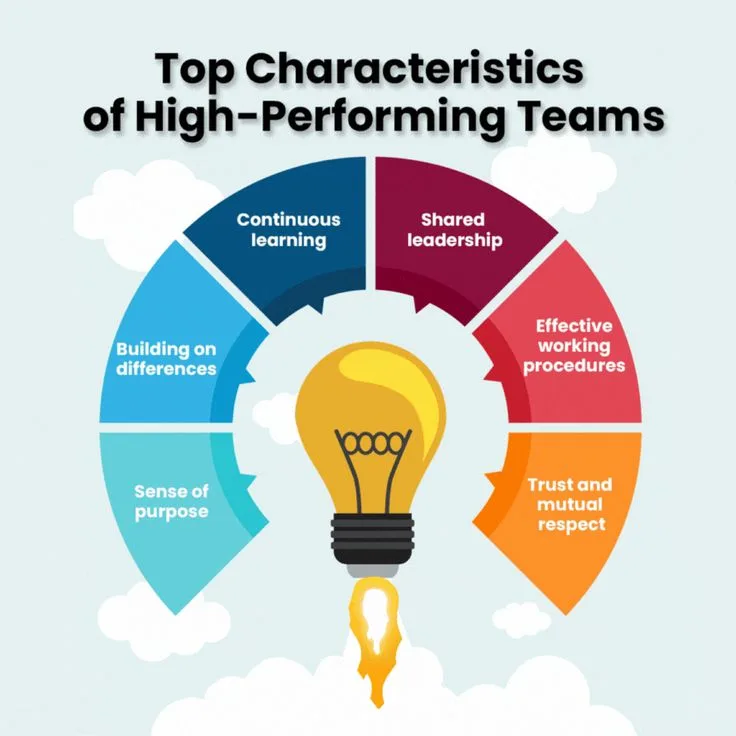
The characteristics of high-performing teams are primarily relational: psychological safety, dependable delivery, clear structure, meaningful work, and a sense of impact. Talent alone does not create collective intelligence and can undermine coordination when too many members compete for central roles. Leaders improve performance by building communication, trust, shared goals, and accountability rather than merely recruiting individual stars.
A high-performing team is a group of interdependent individuals who consistently produce results that exceed the sum of their individual capabilities, sustain that performance over time, and grow stronger through challenges rather than fracturing under pressure.
Building such a team is the central task of leadership - and it is far more difficult than most managers expect, because the factors that drive team performance are counterintuitive and poorly understood by people who have never studied them.
Most managers hire talented people and expect high performance to emerge naturally. It rarely does. The research on team effectiveness has been consistent for decades: talent is necessary but not sufficient.
Google's landmark Project Aristotle study (2012-2016), which analyzed 180 internal teams, found that how team members interact is a stronger predictor of team performance than who is on the team.
A group of brilliant, experienced professionals can underperform a team of less individually distinguished people who trust each other, communicate openly, and hold each other to account.
This is not a soft finding. It has been replicated across industries, cultures, and organizational types. And it means that the primary job of a team leader is not selecting talent - it is creating the conditions under which talent can combine into something greater than itself.
"Not finance. Not strategy. Not technology. It is teamwork that remains the ultimate competitive advantage, both because it is so powerful and so rare." - Patrick Lencioni
What the Research Says About Team Performance
The Myth of the Dream Team
The intuition that assembling the most individually talented people produces the best team is one of the most persistent and costly beliefs in management. It is not well supported by evidence.
Research in sports, business, and science has repeatedly found that teams with high individual star power often underperform expectations, while less individually gifted teams consistently outperform.
A 2014 study by Roderick Swaab, Michael Schaerer, Eric Anicich, Richard Ronay, and Adam Galinsky, published in Psychological Science, examined the relationship between the proportion of top talent on a team and team performance.
They studied professional basketball, baseball, and soccer teams, as well as controlled laboratory experiments. Their finding was striking: beyond a certain threshold, adding more individual stars reduced team performance.
In basketball, the optimal proportion of elite talent was roughly 50-60% of the roster. Teams that exceeded that proportion performed worse because coordination suffered - too many players competing for dominant roles degraded the teamwork that produces wins.
The researchers called this the "too-much-talent effect." It was strongest in sports requiring high interdependence (basketball, soccer) and weaker in sports where individual performance is more separable (baseball).
The implication for organizations is clear: in work that requires coordination and collaboration - which describes most knowledge work - the interaction quality matters more than the talent density.
In a separate line of research, Anita Williams Woolley, Christopher Chabris, Alexander Pentland, Nada Hashmi, and Thomas Malone published a 2010 study in Science that identified a measurable "collective intelligence" factor in groups - analogous to the general intelligence factor in individuals.
Groups that scored high on collective intelligence performed well across a wide range of tasks. The factor was not predicted by the average intelligence of group members or by the intelligence of the smartest member.
Instead, it was predicted by three things: the average social sensitivity of group members (measured by the "Reading the Mind in the Eyes" test), the equality of conversational turn-taking, and the proportion of women on the team (which the researchers attributed to women's higher average social sensitivity).
The recurring lesson: collective performance emerges from interaction quality, not individual talent alone.
Google's Project Aristotle
In 2012, Google launched Project Aristotle, a multi-year internal research initiative designed to identify what made its best teams effective.
Researchers led by Julia Rozovsky studied 180 Google teams using a combination of survey data, performance metrics, and interviews, aiming to determine whether team effectiveness could be predicted from team composition, demographic factors, or other measurable inputs.
The initial hypothesis was that the best teams would share specific compositional characteristics: the right mix of skills, certain personality types, or particular organizational structures. The data did not support this. There were no significant correlations between team composition variables and team effectiveness.
What did predict team effectiveness was how team members interacted. Specifically, five factors emerged as significant:
- Psychological safety: Can team members take risks without fear of punishment or humiliation?
- Dependability: Can team members rely on each other to deliver high-quality work on time?
- Structure and clarity: Are team goals, roles, and plans clear?
- Meaning: Is the work personally meaningful to team members?
- Impact: Do team members believe their work matters?
Of these five, psychological safety was the most consistently important. Teams where members felt safe to speak up, ask questions, admit mistakes, and propose unconventional ideas outperformed teams with similar talent and structure but lower psychological safety.
The research was published in 2016 and drew heavily on the foundational academic work of Harvard Business School professor Amy Edmondson, who had been studying psychological safety in teams since the 1990s.
The Project Aristotle findings aligned with a broader body of research. A 2017 Gallup meta-analysis of 1.2 million employees across 82,000 teams found that teams in the top quartile of engagement outperformed bottom-quartile teams by 21% in profitability and 17% in productivity.
Engagement, in Gallup's framework, is driven primarily by relationship quality with managers and teammates - the same interpersonal dynamics that Project Aristotle identified.
Tuckman's Stages of Team Development
In 1965, educational psychologist Bruce Tuckman published a model of group development that remains the most widely cited framework in team building.
Based on his review of 50 articles on group behavior, Tuckman identified four sequential stages through which groups typically pass as they develop into effective, cohesive teams. He added a fifth stage in 1977 with Mary Ann Jensen.
Understanding these stages is essential because they explain why new teams struggle, why conflict is not only normal but necessary, and why the leader's role must change as the team matures.
Forming
In the forming stage, the team comes together. Members are typically polite, cautious, and oriented toward understanding the group's purpose, structure, and each other. Conflict is minimal because members are still establishing relationships and assessing norms.
Dependence on the leader is high - members look to authority figures for direction and clarity.
During forming, leaders should provide clear purpose and structure, facilitate introductions, and help members understand both the team's goals and each other's strengths. This is also the right time to begin establishing the norms that will govern how the team works.
Research by J. Richard Hackman at Harvard (published in his 2002 book Leading Teams) found that the first few minutes of a team's life together have an outsized influence on its long-term trajectory - the norms established early tend to persist.
Storming
Storming is the stage most teams find uncomfortable and most leaders try to suppress - which is a mistake. As members become more comfortable, they begin advocating for their own ideas, testing the limits of authority, and pushing back on working methods.
Conflict over roles, approaches, and resource allocation is normal and necessary.
Teams that do not storm often have not built the trust needed for honest disagreement, which means they are performing false harmony rather than genuine cohesion. Conflict that is suppressed rather than resolved tends to resurface later, often in more damaging forms.
Research on team conflict by Karen Jehn (1995, published in Administrative Science Quarterly) distinguished between task conflict (disagreements about work content) and relationship conflict (interpersonal friction).
Moderate levels of task conflict actually improved decision quality and team performance, while relationship conflict was consistently harmful.
The leader's role in storming is to facilitate productive conflict rather than eliminate it: creating space for disagreement, ensuring all voices are heard, helping the team develop shared norms for navigating disagreement, and modeling the behavior of engaging with dissenting views honestly rather than defensively.
Norming
In the norming stage, the team establishes shared working agreements. Roles clarify, methods are agreed upon, and trust begins to develop. Members begin to appreciate the diversity of perspectives in the group and work to support each other's contributions. Conflict does not disappear but becomes more constructive.
Norming is where explicit team agreements about communication, decision-making, feedback, and accountability have the most impact. Leaders who invest time in developing these agreements during norming create a foundation for the performing stage.
Edgar Schein's research on organizational culture (1985, Organizational Culture and Leadership) showed that shared assumptions about "how we do things here" are the most powerful driver of group behavior - and the norming stage is when those assumptions are actively being formed.
Performing
Performing teams are self-managing and productive. Members work with high autonomy, handle conflict effectively, support each other's development, and deliver consistently strong results with less need for active leadership intervention. The team has moved from being a group of individuals to functioning as a cohesive unit.
The leader's role in the performing stage shifts from directing and facilitating to enabling and developing. The team needs support for growth, access to resources, and protection from organizational interference, rather than close supervision or conflict mediation.
Hackman's research found that the best team leaders at this stage spend their energy on boundary management - securing resources, buffering the team from external disruption, and creating the conditions for the team to do its best work.
Adjourning
Tuckman added a fifth stage in 1977: Adjourning (sometimes called "Mourning"). When a team completes its work or disbands, members experience a period of reflection, recognition, and sometimes loss.
Managing adjourning well - celebrating achievements, acknowledging contributions, and creating clear closure - respects the relationships built and prepares members for their next teams.
| Stage | Team Focus | Leader Priority | Key Risk |
|---|---|---|---|
| Forming | Orientation and inclusion | Clarity of purpose and structure | Ambiguity; members disengage |
| Storming | Conflict and role definition | Facilitating productive disagreement | Leader suppresses conflict |
| Norming | Establishing working agreements | Building shared norms and trust | Premature consensus |
| Performing | Execution and self-management | Enabling and developing | Complacency; loss of edge |
| Adjourning | Closure and transition | Recognition and celebration | Unresolved tensions carry forward |
The Five Dysfunctions of a Team
Patrick Lencioni's 2002 book The Five Dysfunctions of a Team provides a complementary framework to the research literature, describing five interconnected failure modes that prevent teams from achieving their potential.
The book has sold over three million copies and remains one of the most widely read leadership books in corporate settings - not because it presents new research, but because it synthesizes decades of team research into a model that is immediately actionable.
Lencioni presents the dysfunctions as a pyramid, with each layer resting on the one below it:
1. Absence of Trust
The base of the pyramid is trust - specifically, vulnerability-based trust: the willingness to admit mistakes, acknowledge weaknesses, and ask for help without fear of judgment. Teams without this foundational trust waste energy on self-protection and political positioning rather than genuine collaboration.
This is not trust in the colloquial sense of "I trust you to be competent." It is the deeper form: "I trust you enough to show you where I am weak."
Research by Paul Zak, published in the Harvard Business Review (2017), found that employees in high-trust organizations reported 74% less stress, 106% more energy at work, 50% higher productivity, and 76% more engagement compared to employees in low-trust organizations.
Trust of this kind is not built through team-building activities alone. It is built through repeated experiences of vulnerability being met with support rather than exploitation, and through leaders who model vulnerability themselves.
2. Fear of Conflict
Teams without trust avoid genuine conflict because they are not confident it will remain constructive. They substitute artificial harmony - polite agreement in meetings, private disagreement afterward - for the productive debate that drives good decisions.
The paradox is that teams that avoid conflict are not more peaceful. They tend to experience more backstabbing, passive aggression, and indirect politics than teams that engage in direct, respectful disagreement. Productive conflict - focused on ideas and approaches, not personalities - is a hallmark of effective teams.
Research by Kathleen Eisenhardt, Jean Kahwajy, and L.J. Bourgeois (1997, Harvard Business Review) studied top management teams and found that the highest-performing teams argued more, not less - but their arguments were about strategy and evidence, not about each other.
3. Lack of Commitment
Teams that do not engage in productive conflict rarely achieve genuine commitment. When people cannot voice their real objections in a meeting, they leave without buy-in, even if they nodded along.
Commitment does not require consensus - people can commit to decisions they disagree with, but only if they feel their perspective was genuinely heard.
This insight aligns with procedural justice research by Tom Tyler and Allan Lind (1992), which demonstrated that people accept unfavorable outcomes far more readily when they believe the process was fair and their voice was considered.
4. Avoidance of Accountability
Teams without commitment struggle to hold each other accountable, because there are no clear standards that everyone has genuinely agreed to. Accountability on high-performing teams is primarily peer accountability - members holding each other to the standards they collectively established - not top-down enforcement by managers.
A 2013 survey by the consulting firm VitalSmarts found that 93% of employees reported that their organizations had peers who failed to deliver on commitments - but only 10% said their colleagues would actually address the problem directly.
The gap between recognizing poor performance and addressing it is one of the most common and costly dysfunctions in teams.
5. Inattention to Results
The final dysfunction is placing individual or subgroup interests above collective results. This manifests as protecting departmental budgets, hoarding information, optimizing for personal metrics at the expense of team goals, or prioritizing individual status and recognition over team performance.
Team Size and Composition
How Many People?
The research literature consistently supports keeping teams small. The coordination costs of adding members to a team grow faster than the productivity benefits, because each additional member adds communication channels, creates more coordination needs, and dilutes individual accountability.
The mathematical relationship is straightforward: a team of n members has n(n-1)/2 potential communication channels. A team of 5 has 10 channels; a team of 10 has 45; a team of 15 has 105.
Robin Dunbar's research on social group sizes, originally applied to primate groups and later extended to human organizations, found that humans can maintain approximately:
- 5 people: the closest trust and collaboration layer
- 15 people: a stable work group with regular meaningful interaction
- 50 people: a band-sized group where trust is possible but requires more active maintenance
- 150 people: the "Dunbar number" - the approximate limit for a cohesive social group without formal structure
For operational teams, five to nine members is the range most consistently associated with high performance. Amazon's "two-pizza rule" - if you cannot feed the team with two pizzas, it is too large - reflects the same insight.
Jeff Bezos instituted this principle in the early 2000s, and it became one of Amazon's most widely imitated management practices.
Above roughly 10-12 members, social loafing (reduced individual effort as team size grows, first documented by Max Ringelmann in 1913), coordination overhead, and accountability diffusion reliably reduce per-person productivity.
Hackman's research at Harvard found that the most common mistake in team design is making the team too large. Managers add members to increase capacity, but beyond a threshold the coordination costs outweigh the additional capability.
His recommendation: err on the side of too small, and let the team request additional members if needed.
Diversity and Performance
The relationship between team diversity and performance is more nuanced than it is often presented. The research distinguishes between task-relevant diversity (diversity of skills, expertise, and functional background) and demographic diversity (diversity of gender, ethnicity, age, and background).
Task-relevant diversity consistently improves problem-solving and decision quality, particularly for complex, non-routine tasks.
A 2004 study by Scott Page and Lu Hong, published in the Proceedings of the National Academy of Sciences, demonstrated mathematically that diverse problem-solving approaches outperform uniformly high-ability approaches under a wide range of conditions.
A team with diverse expertise is better equipped to identify blind spots and consider multiple approaches.
Demographic diversity shows more conditional results. Research by Katherine Phillips and colleagues (2014, published in Scientific American) suggests that diverse groups outperform homogeneous groups at complex problem-solving when they also have shared norms for productive disagreement and high psychological safety.
Without those conditions, surface-level diversity can be associated with higher interpersonal friction without commensurate performance gains.
The practical implication: invest in the social conditions - psychological safety, inclusive communication norms, and productive conflict skills - that allow diverse teams to realize the performance benefits their diversity makes possible.
Building Psychological Safety
Since psychological safety emerged from Project Aristotle as the most critical factor in team effectiveness, it deserves focused attention on how to build it deliberately.
What Psychological Safety Is Not
Psychological safety is frequently misunderstood. It is not:
- Requiring everyone to be nice to each other all the time
- Avoiding difficult feedback
- Guaranteeing that no one will be held accountable for performance
- A permanent characteristic of individuals - it is a property of the team environment
- Lower standards or reduced expectations
Amy Edmondson defines psychological safety as "a belief that one will not be punished or humiliated for speaking up with ideas, questions, concerns, or mistakes." It is about interpersonal risk, not professional standards.
In fact, Edmondson's research shows that high-performing teams combine high psychological safety with high accountability - a combination she calls the "learning zone." Teams with high safety but low accountability are comfortable but underperforming ("comfort zone").
Teams with high accountability but low safety are anxious and defensive ("anxiety zone").
How Leaders Build It
Model fallibility: Leaders who openly share their own mistakes, uncertainties, and questions signal that vulnerability is safe. This is the most powerful single action a leader can take to build psychological safety.
Edmondson cites the example of a hospital unit leader who began team meetings by saying, "I may miss something - I need to hear from you."
Respond constructively to bad news: How a leader responds the first time someone brings them a serious problem sets the norm for all future information sharing.
Research by Ethan Burris (2012, Academy of Management Journal) found that employees who received negative responses when voicing concerns were significantly less likely to speak up again - and that this effect extended to peers who merely observed the negative response.
Shooting the messenger destroys psychological safety immediately and durably.
Ask genuine questions: Leaders who ask questions with real curiosity, and visibly use the answers, signal that contributions are valued and that the leader does not already have all the answers.
Address the problem, not the person: When mistakes occur, focus on understanding what went wrong systemically rather than attributing blame to individuals. This normalizes the idea that problems are learning opportunities, not occasions for punishment.
The approach mirrors blameless postmortems practiced by organizations like Google, Etsy, and Netflix - structured reviews of failures that focus on systemic improvement rather than individual blame.
Create turn-taking in discussion: Research by Edmondson and the collective intelligence work by Woolley et al. (2010) found that teams with higher psychological safety and higher collective intelligence show more equal participation in discussion.
Leaders can actively facilitate this by soliciting contributions from quieter members and creating structures (such as brief rounds of individual writing before group discussion) that reduce the dominance of the most vocal voices.
Common Team Leadership Mistakes
Avoiding conflict: Conflict suppression feels like team maintenance but is actually avoidance of the difficult work that builds genuine cohesion. Leaders who pride themselves on running "conflict-free" teams are often running teams with suppressed disagreement and poor decision quality.
For more on why this matters, see adaptive leadership explained.
Unclear goals: Teams cannot perform reliably without clear and shared understanding of what success looks like. Ambiguous goals produce divergent individual efforts that do not add up.
Hackman's research found that clear, compelling direction was one of the three essential conditions for team effectiveness (alongside enabling structure and a supportive organizational context).
Ignoring team development stages: Expecting a new team to perform like an established one is a structural failure. New teams need time and support to move through forming and storming before they can perform. Leaders who skip the investment in team development pay for it later in coordination failures and interpersonal friction.
Micromanaging performing teams: When teams reach the performing stage, over-management reduces motivation and autonomy. The leader's value at this stage is in removing obstacles and securing resources, not in directing work.
Research on servant leadership shows that leaders who shift to a supporting role during this stage achieve better outcomes than those who maintain tight control.
Neglecting psychological safety signals: A single high-profile instance of punishing vulnerability - dismissing someone who raised a concern, humiliating a member who made a mistake in front of the team - can set back psychological safety significantly and affect team behavior for months.
Edmondson's research documents cases where a single incident of punishing candor silenced an entire team for the duration of a leader's tenure.
Tolerating toxic behavior from high performers: Allowing a high-performing individual to undermine team dynamics because of their individual output is one of the most common and destructive leadership failures.
The damage to team trust, psychological safety, and collective motivation consistently outweighs the individual's contribution. For more on this pattern, see toxic leadership explained.
What High-Performing Teams Look Like in Practice
High-performing teams share observable behavioral characteristics that distinguish them from average teams:
- Direct, honest communication: Members say what they think, not what they think others want to hear, and they do so with care for the relationship
- High accountability without fear: Members hold themselves and each other to standards they set collectively
- Efficient conflict resolution: Disagreements are addressed quickly, directly, and without residual resentment
- Continuous improvement orientation: The team regularly reviews its own processes and is willing to change how it works
- Shared celebration of results: Successes are attributed to the team, not captured individually
- Information sharing by default: Knowledge hoarding is treated as a dysfunction, not a power strategy
- Rapid onboarding of new members: The team's norms and expectations are explicit enough that new members can integrate quickly
None of these characteristics emerge automatically. They are built through deliberate practice, consistent leadership behavior, and organizational conditions that support them. Research by Ruth Wageman, J.
Richard Hackman, and Erin Lehman (2005) found that the conditions a leader creates account for roughly 60% of the variation in team performance - far more than the leader's real-time coaching interventions, which accounted for about 30%.
The implication is clear: if you want to lead a high-performing team, spend more time designing the conditions and less time directing the work.
Sustaining Performance Over Time
Building a high-performing team is hard. Sustaining that performance is harder. Teams face predictable threats to sustained performance:
Complacency: Success breeds comfort, and comfort breeds reduced effort. High-performing teams that stop challenging themselves gradually lose their edge. Regular retrospectives, stretch goals, and external benchmarking help counter this tendency.
Membership changes: When a key member leaves or a new member joins, the team can regress to earlier stages of development. Tuckman's model is not strictly linear - teams can cycle back through storming and norming when composition changes.
Leaders should expect this and plan for it rather than being surprised when a previously high-performing team struggles after a personnel change.
Organizational interference: Teams do not exist in a vacuum. Changes in organizational strategy, leadership, or resources can undermine team performance.
Hackman's research identified "supportive organizational context" as one of the essential conditions for team effectiveness - including reward systems that reinforce team rather than individual performance, information systems that provide the data teams need, and educational systems that develop team skills.
Burnout: Sustained high performance without adequate recovery leads to exhaustion. Research on emotional intelligence at work and workplace wellbeing consistently shows that the highest-performing teams over multi-year periods are those that manage energy and recovery, not those that maximize effort at all times.
Summary
High-performing teams are not simply groups of talented people. They are groups of people who have developed the trust, communication norms, shared purpose, and interpersonal habits that allow their collective capabilities to exceed the sum of their individual contributions.
The evidence from Tuckman's stage model, Google's Project Aristotle, Lencioni's dysfunction framework, Hackman's conditions model, and Woolley's collective intelligence research points consistently at the same foundational requirements.
Those requirements are psychological safety, productive conflict, genuine commitment, peer accountability, and shared focus on collective results.
Building these conditions is the primary work of team leadership - not managing tasks, but creating the social environment in which exceptional collective performance becomes possible and sustainable.
Sources & Further Reading
- Edmondson, A. C. (2018). The Fearless Organization: Creating Psychological Safety in the Workplace for Learning, Innovation, and Growth. Wiley. View source
- Hackman, J. R. (2002). Leading Teams: Setting the Stage for Great Performances. Harvard Business School Press.
- Lencioni, P. (2002). The Five Dysfunctions of a Team: A Leadership Fable. Jossey-Bass.
- Tuckman, B. W. (1965). Developmental Sequence in Small Groups. Psychological Bulletin, 63(6), 384-399. DOI: 10.1037/h0022100
- Woolley, A. W., Chabris, C. F., Pentland, A., Hashmi, N., & Malone, T. W. (2010). Evidence for a Collective Intelligence Factor in the Performance of Human Groups. Science, 330(6004), 686-688. DOI: 10.1126/science.1193147
- Swaab, R. I., Schaerer, M., Anicich, E. M., Ronay, R., & Galinsky, A. D. (2014). The Too-Much-Talent Effect: Team Interdependence Determines When More Talent Is Too Much or Not Enough. Psychological Science, 25(8), 1581-1591. DOI: 10.1177/0956797614537280
- Google re:Work. (2016). Guide: Understand Team Effectiveness. View source
- Wageman, R., Hackman, J. R., & Lehman, E. (2005). Team Diagnostic Survey: Development of an Instrument. The Journal of Applied Behavioral Science, 41(4), 373-398. DOI: 10.1177/0021886305281984
- Zak, P. J. (2017). The Neuroscience of Trust. Harvard Business Review, January-February 2017. View source
- Gallup. (2017). State of the American Workplace Report.View source