
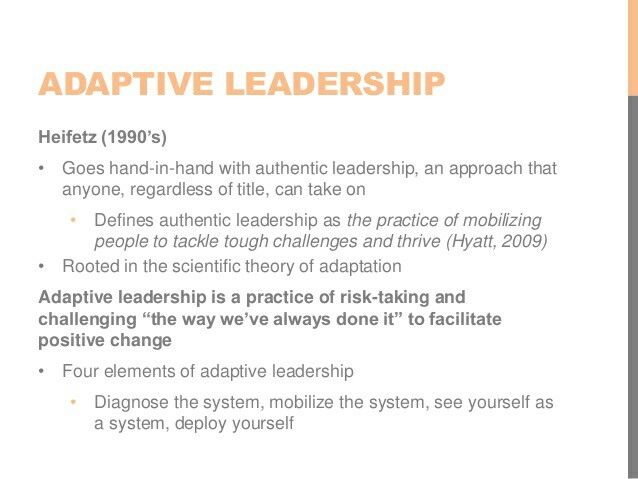
Leadership failures often come from diagnosing a change problem as a technical one. Adaptive leadership separates problems experts can solve from challenges that require stakeholders to change values, beliefs, or behaviors, making diagnosis and shared learning more important than simply deploying an expert solution.
Adaptive leadership is a practical framework for leading through complex change, developed by Ronald Heifetz and Marty Linsky at Harvard Kennedy School.
It distinguishes between technical problems (which have known solutions that experts can implement) and adaptive challenges (which require changes in the values, beliefs, and behaviors of the people involved).
The framework argues that the most common cause of leadership failure is treating adaptive challenges as if they were technical problems - bringing in experts and deploying solutions when what is actually needed is for people to change how they think and behave.
Adaptive leadership provides conceptual tools and practical strategies for navigating this more difficult work.
Most leadership problems are not actually leadership problems. They are change problems. Someone needs to do something differently. A group needs to give up something it values. An organization needs to abandon a comfortable assumption that no longer serves it.
And the people who need to change are, for very understandable reasons, resistant.
This is the territory that adaptive leadership was designed to navigate. Articulated in Heifetz's Leadership Without Easy Answers (1994) and the more practice-oriented Leadership on the Line (2002) by Heifetz and Linsky, the framework draws on Heifetz's dual training as a physician and a political scientist.
The medical influence is evident: just as a doctor must diagnose before prescribing, an adaptive leader must correctly identify the nature of the challenge before intervening.
The political influence is equally present: change always involves competing stakeholders, contested values, and the distribution of losses - territory that requires political skill, not just technical competence.
"The single most important skill in exercising leadership is diagnosis. The single most common cause of failure is misdiagnosis - treating an adaptive challenge as if it were a technical problem." - Ronald Heifetz, Leadership Without Easy Answers (1994)
The Central Insight: Not All Problems Are Alike
The foundation of the adaptive leadership framework is a distinction that sounds simple but has profound implications: the difference between technical problems and adaptive challenges.
Technical Problems
A technical problem is one where the problem is clearly definable and the solution is already known - or can be figured out by someone with sufficient expertise. When your car breaks down, you take it to a mechanic who has the training and tools to fix it.
When the accounting software crashes, the IT department applies the patch. When a surgical procedure is needed, the surgeon's expertise solves it.
Technical problems can be genuinely complex. Brain surgery is technically complex. Designing a rocket engine is technically complex. Launching a satellite requires thousands of coordinated technical decisions.
But they share a defining feature: the solution lies within existing knowledge, and the people who need to change are primarily the experts who apply the solution, not the people experiencing the problem.
Research by Gary Klein (1998) on naturalistic decision-making demonstrates that experts solving technical problems draw on recognition-primed decision-making - pattern matching developed through experience.
This works well for technical challenges but fails catastrophically when applied to adaptive ones, because adaptive challenges are precisely the situations where existing patterns no longer apply.
Adaptive Challenges
An adaptive challenge is fundamentally different. The problem is often not fully defined. The solution is not known in advance. And critically, the solution requires changes in the attitudes, values, beliefs, or behaviors of the people who have the problem.
Consider the following scenarios:
- A healthcare system that needs to shift from episodic sick-care to preventive, population-based care - requiring physicians, insurers, patients, and administrators to fundamentally change how they define and deliver health
- A company whose successful business model is being disrupted by new technology - requiring employees to abandon skills they have spent decades developing
- A family struggling with an aging parent's refusal to accept help - requiring renegotiation of roles, autonomy, and identity
- A nation confronting deep social divisions that decades of policy have failed to resolve - requiring genuine engagement with competing values rather than technical fixes
In each case, experts can provide frameworks and options. But no expert can provide the solution, because the solution requires that the people involved actually change how they think and behave. That work cannot be done for them or to them. It must be done by them.
| Characteristic | Technical Problem | Adaptive Challenge |
|---|---|---|
| Problem definition | Clear and agreed upon | Requires learning; often contested |
| Solution | Known or knowable by experts | Requires discovery through experimentation |
| Who does the work | Experts and authorities | The stakeholders themselves |
| Type of change | Behavioral procedures | Values, beliefs, attitudes, habits |
| Timeline | Often relatively quick | Extended; requires iteration |
| Discomfort level | Manageable | High; involves genuine loss |
| Example | Fixing a broken bone | Changing a patient's lifestyle after a heart attack |
Most real-world leadership situations involve a mixture of both technical and adaptive elements.
A hospital implementing a new electronic health records system faces a technical challenge (installing and configuring the software) layered with an adaptive one (changing how clinicians document, communicate, and think about information flow).
The adaptive leadership framework insists that leaders must correctly identify which elements are technical and which are adaptive - because the interventions required for each are fundamentally different.
Why Adaptive Challenges Are Hard
Adaptive challenges are hard precisely because they require loss. People are asked to give up something they value: a cherished identity, a familiar way of working, a comfortable belief, a position of status, a skill set that has defined them.
Even when the need for change is rationally acknowledged, the emotional cost of adapting is real.
This insight connects to broader research in psychology. Daniel Kahneman and Amos Tversky's prospect theory (1979) demonstrated that humans weigh losses approximately twice as heavily as equivalent gains - a phenomenon called loss aversion.
This means that the pain of giving up something familiar is psychologically more intense than the pleasure of gaining something new, even when the new thing is objectively better. Adaptive leadership recognizes this asymmetry as a structural feature of change, not as irrationality to be overcome through better communication.
The loss creates what Heifetz calls adaptive distress - the anxiety, anger, confusion, and grief that accompany meaningful change. The distress is not a sign that something is wrong with the people experiencing it. It is the natural response to being asked to let go of something significant.
Research on organizational change by John Kotter at Harvard Business School (1996) found that over 70% of major change initiatives fail, and Heifetz would argue that most of these failures result from treating the adaptive elements of change as purely technical problems.
The leadership challenge is to hold people in the productive zone of that distress - enough discomfort to motivate change, not so much that they become overwhelmed and shut down or act out.
The Holding Environment
One of the most important concepts in adaptive leadership is the holding environment - the container that a leader creates to allow adaptive work to happen safely.
The term comes from the developmental psychologist Donald Winnicott (1960), who described how parents create a "holding environment" for young children: a space that is safe enough for the child to explore, experiment, and develop without being overwhelmed.
Heifetz adapted this concept to organizational and political leadership, recognizing that adults doing difficult adaptive work need analogous containment.
A holding environment in an organizational context includes:
Trust: People need to trust that engaging honestly with difficult questions will not result in punishment or humiliation.
Amy Edmondson's research on psychological safety at Harvard Business School (1999) independently confirmed this principle, showing that teams with high psychological safety learn faster and perform better - precisely because members can surface problems and take interpersonal risks without fear.
Without trust, people perform agreement while avoiding the actual adaptive work.
Clear purpose: Shared understanding of why the change matters. Without it, distress feels arbitrary and meaningless, and people cannot generate the motivation to do difficult work. Research by Simon Sinek and others on purpose-driven organizations supports this: people tolerate far more difficulty when they understand why it matters.
Norms of engagement: Agreements about how disagreement will be handled, how voices will be heard, how decisions will be made. These norms prevent adaptive distress from collapsing into interpersonal conflict or organizational chaos.
Authority structures: Clear enough structure that people know who has authority for what decisions, preventing paralysis without removing the discomfort that motivates change. This connects to how to communicate clearly - adaptive work requires explicit communication architecture, not just good intentions.
Pacing: The ability to calibrate the level of heat - moving faster when people are too comfortable to change, slowing down when distress is too high to allow productive work.
Without a holding environment, the adaptive work cannot proceed. People in unbounded distress do not do adaptive work. They flee, fight, or freeze.
The Lure of Technical Solutions
One of the most consistent patterns Heifetz and Linsky describe is the tendency of leaders - and the organizations they lead - to treat adaptive challenges as if they were technical ones. They call this the misdiagnosis problem, and they argue it is the most common reason adaptive efforts fail.
When an adaptive challenge is treated as a technical problem, experts are brought in to "solve" it. Reports are produced. Processes are redesigned. New technologies are deployed. Consultants are hired.
None of these interventions produce lasting change because the actual work - getting people to adopt genuinely new values, perspectives, or behaviors - has been avoided.
The reorganization that accomplishes nothing. The new strategy that nobody actually implements. The culture transformation program that leaves culture unchanged. The diversity initiative that changes demographic numbers without changing daily experience.
These are typically the results of applying technical solutions to adaptive challenges.
Research by McKinsey & Company (2015) found that only 26% of organizational transformations succeed at both improving performance and sustaining those improvements over time.
A 2019 study by Harvard Business Review found similar results, with the majority of failures attributable to "people issues" - precisely the adaptive dimension that technical solutions cannot address.
Part of what makes this pattern so persistent is that technical solutions feel good. They feel like action. They produce deliverables. They give leaders something visible to point to.
The uncomfortable truth that adaptive challenges require is that real change will require real losses - and leaders who raise that reality will meet real resistance. For more on how decision-making under uncertainty works, the adaptive framework provides a complementary lens.
Work Avoidance: The Many Forms of Fleeing the Work
When adaptive challenges are surfaced, groups naturally try to escape the discomfort through work avoidance - behaviors that look like engagement with the problem while actually preventing the difficult work from happening.
Heifetz and Linsky identify several classic work avoidance patterns:
Scapegoating: Finding a person or group to blame for the problem, removing them, and hoping the problem goes away. The scapegoat is often the person who has been most honest about the adaptive challenge - their departure removes the uncomfortable voice while leaving the underlying problem intact.
The psychologist Rene Girard (1972) described scapegoating as a fundamental mechanism by which groups manage internal tension, and Heifetz adapts this insight to organizational dynamics.
Externalizing the enemy: Attributing the need for change to outside forces (competitors, regulators, economic conditions, "the market") rather than examining internal values and behaviors. This relieves the distress but prevents the adaptive work.
Diversionary excitement: Generating enthusiasm around new projects, events, or initiatives that create a sense of progress without requiring the difficult change. Reorganizations, rebranding exercises, and technology deployments often serve this function.
Killing the message: Attacking or marginalizing the credibility of whoever raised the problem, rather than engaging with the substance of what they raised. This connects to the broader phenomenon of shooting the messenger, documented across cultures and centuries.
False consensus: Creating the appearance of agreement without the reality - people say yes in the room and revert to old behaviors outside it. This often results from leaders who cannot tolerate the discomfort of surfaced disagreement.
Research on groupthink by Irving Janis (1972) describes the same dynamic from a different theoretical angle.
Recognizing work avoidance when it appears is one of the most practically valuable skills in adaptive leadership. It requires maintaining diagnostic clarity about what is actually happening rather than accepting surface-level engagement. For related concepts about how groups make decisions, see common decision traps.
The Balcony and the Dance Floor
Heifetz and Linsky use a vivid metaphor to describe the perspective needed for adaptive leadership: the balcony and the dance floor.
When you are on the dance floor, you are immersed in the action. You feel the music, react to the people around you, are swept up in the movement. You can see the immediate situation vividly but cannot perceive the larger patterns - who clusters together, which parts of the floor are crowded, how the energy is shifting.
From the balcony, you can see the dance floor as a whole system. You can observe patterns that are invisible to those on the floor. But you lose the texture, the feel, the immediate intelligence that comes from being in the midst of it.
Effective adaptive leaders move back and forth between the balcony and the dance floor. They are present enough to have credibility and to read the emotional temperature of the group.
But they regularly step back to observe the situation from a distance - asking what is actually happening here, what are the competing factions, where is the work avoidance occurring, what is the conversation that nobody is having?
This is harder than it sounds. The pressure to stay on the dance floor is intense. When things are moving fast, stepping back feels irresponsible. But without the balcony perspective, leaders lose their ability to diagnose the adaptive challenge and can become captured by the very dynamics they need to help navigate.
Chris Argyris at Harvard (1991) described a similar concept as the distinction between single-loop learning (adjusting actions) and double-loop learning (questioning the assumptions behind the actions) - the balcony perspective enables double-loop learning.
How Adaptive Leadership Differs from Other Models
| Framework | Leadership Role | Change Agent | Solution Location | Key Theorist |
|---|---|---|---|---|
| Transactional Leadership | Exchange manager | Leader | Within existing systems | James MacGregor Burns (1978) |
| Transformational Leadership | Visionary inspirer | Leader (charismatic) | Leader's vision | Bernard Bass (1985) |
| Servant Leadership | Resource provider | Leader in service of others | Followers' empowerment | Robert Greenleaf (1970) |
| Adaptive Leadership | Problem diagnostician | The group | In the group's changed behavior | Ronald Heifetz (1994) |
| Situational Leadership | Style adjuster | Leader | Match of style to readiness | Hersey & Blanchard (1969) |
The key distinction for adaptive leadership is that the solution is not the leader's to provide. This runs counter to the dominant cultural model of leadership, which casts the leader as the expert who has the answers.
Adaptive leadership asks leaders to resist that role when the challenge is adaptive - to pose the difficult questions rather than provide premature answers, to frustrate the group's need for certainty rather than satisfy it, and to distribute the work back to the stakeholders who must ultimately do it.
This is politically risky. Groups under adaptive stress want a leader with answers. A leader who says "this is hard and I do not know the answer; we need to work through this together" may face intense pressure, skepticism, and attack.
Leaders who can hold that position - maintaining the productive discomfort without capitulating to pressure for false certainty - are demonstrating genuinely adaptive leadership.
Regulating Distress: The Core Practical Skill
If adaptive leadership has a single most important practical technique, it is distress regulation - the ability to manage the level of anxiety in a group so that it stays in the productive zone.
Too little distress and people have no motivation to change. The adaptive challenge is not felt as urgent. Work avoidance is easy and attractive.
Too much distress and people are overwhelmed. Productive engagement becomes impossible. Conflict, paralysis, or scapegoating takes over.
The effective adaptive leader acts like a thermostat rather than a thermometer - not just reading the temperature but adjusting it.
Research by Richard Boyatzis (2005) on resonant leadership supports this principle, demonstrating that leaders who can manage emotional dynamics in groups produce sustainably better outcomes than those who drive through stress alone.
Tools for raising productive distress when complacency threatens change:
- Bringing in outside perspectives that disrupt comfortable assumptions
- Making the consequences of not changing vivid and concrete (data, stories, site visits)
- Creating structures where competing perspectives must be heard
- Surfacing the tension between stated values and current behavior
- Setting deadlines that create productive urgency
Tools for lowering distress when anxiety threatens to overwhelm:
- Slowing the pace of change
- Clarifying what will remain constant (not everything is changing)
- Acknowledging the loss and the legitimacy of grief
- Celebrating small wins and genuine progress
- Providing clear structure and process when ambiguity is high
- Breaking large adaptive challenges into smaller, more manageable pieces
Practical Applications
In Organizational Leadership
When a company faces a strategic disruption - its core business model under threat from new technology - leaders typically face the temptation to treat this as a technical problem: hire consultants, redesign the strategy, launch a digital transformation initiative.
But if the company's people still hold values, identities, and assumptions built around the old model, the technical interventions will fail.
Clayton Christensen's research on the innovator's dilemma (1997) describes the same phenomenon from a strategy perspective: incumbent organizations fail to adapt not because they lack technical resources but because their values and processes are optimized for the old model.
Adaptive leadership in this context requires creating honest conversations about what must be let go, who will be most affected, and what new capabilities need to be built. It requires pacing those conversations to maintain momentum without overwhelming people's capacity to adapt.
For related thinking on navigating career transitions during such disruptions, see career strategy explained.
In Public Policy and Community Leadership
Adaptive challenges are endemic in public life: addressing entrenched poverty, reforming educational systems, managing immigration debates, responding to public health crises that require behavior change.
The COVID-19 pandemic provided a vivid, global illustration: the technical aspects (developing vaccines, manufacturing PPE, building treatment protocols) were addressed with remarkable speed, while the adaptive aspects (changing individual behavior around masking, distancing, and vaccination) proved far more difficult and divisive - exactly as the Heifetz framework would predict.
The adaptive leadership approach emphasizes the importance of listening to the "music beneath the words" - attending not just to what people say they want but to the values and fears that are driving their stated positions.
In Personal and Team Development
The framework applies to any situation where someone needs to change fundamentally, not just improve technically. Coaching for leadership development, therapy, parenting an adolescent, managing a career transition - all involve adaptive work.
The people involved must change how they see themselves or the world, not just acquire new skills. Understanding emotional intelligence at work provides complementary tools for navigating these personal adaptive challenges.
The Danger to the Leader
One of the distinctive features of Heifetz and Linsky's framework is its unflinching acknowledgment that adaptive leadership is personally dangerous. "Leadership is dangerous," they write in Leadership on the Line. Leaders who raise adaptive challenges make people uncomfortable.
Uncomfortable people find ways to silence or marginalize the leaders who created the discomfort.
They describe the risks as "getting shot off the horse" - being removed from authority, having one's credibility attacked, being marginalized or scapegoated. These risks are real and have ended careers.
Historical examples range from corporate whistleblowers to political reformers to middle managers who surfaced uncomfortable truths about organizational performance.
The protective strategies they recommend include:
Find allies: People who share your diagnosis of the adaptive challenge and can stand alongside you when pressure mounts. Coalitions provide both political protection and reality-testing for your diagnosis.
Keep the opposition close: Understand the legitimate concerns of those who oppose the change. Often they are protecting something genuinely valuable, and their resistance contains important information about what is at stake.
Distinguish the role from the self: The attacks are aimed at the function you are serving - the disturbing voice - not necessarily at you personally. Separating these prevents adaptive challenges from becoming existential personal crises.
Find a sanctuary: A space outside the leadership role where you can process the difficulty, restore yourself, and maintain perspective. Heifetz emphasizes that leaders without sanctuaries burn out, lose perspective, and make increasingly poor decisions.
Why This Framework Endures
Three decades after Leadership Without Easy Answers was published and over two decades after Leadership on the Line, the adaptive leadership framework remains one of the most widely taught models in leadership development programs worldwide - at Harvard Kennedy School, the U.S.
Military War Colleges, corporate leadership programs, and nonprofit capacity-building initiatives.
It endures because it addresses a genuine and persistent gap: the gap between the complexity of real organizational and social change and the simplistic narratives about inspirational heroes with the right vision and the will to execute it. Real change is messy. It requires loss.
It generates resistance. It cannot be executed by the leader alone.
The adaptive leadership framework names these realities directly and provides conceptual tools and practical strategies for navigating them - not by making the work easier, but by making it understandable.
In an era of rapid technological, social, and environmental change, the ability to distinguish technical problems from adaptive challenges and to lead effectively through both may be the defining leadership competency of the coming decades.
Sources & Further Reading
- Heifetz, R. A. (1994). Leadership Without Easy Answers. Harvard University Press. View source
- Heifetz, R. A., & Linsky, M. (2002). Leadership on the Line: Staying Alive Through the Dangers of Leading. Harvard Business Review Press.
- Heifetz, R. A., Grashow, A., & Linsky, M. (2009). The Practice of Adaptive Leadership: Tools and Tactics for Changing Your Organization and the World. Harvard Business Review Press.
- Kotter, J. P. (1996). Leading Change. Harvard Business Review Press.
- Edmondson, A. C. (1999). Psychological Safety and Learning Behavior in Work Teams. Administrative Science Quarterly, 44(2), 350-383. DOI: 10.2307/2666999
- Kahneman, D., & Tversky, A. (1979). Prospect Theory: An Analysis of Decision Under Risk. Econometrica, 47(2), 263-292. DOI: 10.2307/1914185
- Christensen, C. M. (1997). The Innovator's Dilemma. Harvard Business Review Press.
- Argyris, C. (1991). Teaching Smart People How to Learn. Harvard Business Review, 69(3), 99-109. View source
- Janis, I. L. (1972). Victims of Groupthink. Houghton Mifflin.
- McKinsey & Company. (2015). The Irrational Side of Change Management. McKinsey Quarterly.
- Winnicott, D. W. (1960). The Theory of the Parent-Infant Relationship. International Journal of Psycho-Analysis, 41, 585-595.