
What Is Psychological Safety?
Psychological safety is a team climate in which members believe they will not be punished or humiliated for speaking up with ideas, questions, concerns, or mistakes - the shared belief that the team is safe for interpersonal risk-taking. It is a property of the team as a whole, not a fixed trait of any individual member.
The concept was first formally measured by Harvard Business School professor Amy Edmondson in the late 1990s and has since become one of the most replicated constructs in organizational behavior research.[11]
It is not a personality trait or individual characteristic but a property of teams: the same person may feel psychologically safe on one team and not another, depending on how leadership and peer behavior shape the interpersonal climate.
In 2012, Google launched one of the most ambitious internal research projects in corporate history. Codenamed Project Aristotle, it set out to answer a deceptively simple question: what makes a team effective?
The research team studied 180 teams over two years, gathering data on team composition, performance metrics, and dozens of organizational variables.
They expected to find that the best teams were composed of the most talented individuals, or that the best managers had certain leadership styles, or that the right mix of personality types explained success.
What they found surprised them. None of those factors predicted performance reliably. The single most powerful predictor was something more subtle: psychological safety.
What Is Psychological Safety?
Psychological safety is a team climate in which members believe they will not be punished or humiliated for speaking up with ideas, questions, concerns, or mistakes. It is the shared belief that the team is safe for interpersonal risk-taking, and research links it directly to error reporting, learning behavior, and overall team performance.
The concept was first measured and named by Harvard Business School professor Amy Edmondson in the late 1990s. Edmondson was studying medication error rates in hospital nursing teams and expected to find that higher-performing teams made fewer errors.[1]
Instead, she found that higher-performing teams actually reported more errors - not because they were performing worse, but because they felt safe enough to acknowledge and discuss the errors they made.
This counterintuitive finding set the direction for decades of subsequent research. Psychological safety does not make teams complacent. It makes teams honest.
"Psychological safety is not about being nice. It's about giving candid feedback, openly admitting mistakes, and learning from each other." - Amy Edmondson
The Research Foundation: Edmondson and Project Aristotle
Amy Edmondson's Original Studies
Edmondson's research established that psychological safety is both measurable and predictive. Her original seven-item survey scale asks team members to rate agreement with statements including:
- "If you make a mistake on this team, it is often held against you"
- "Members of this team are able to bring up problems and tough issues"
- "It is safe to take a risk on this team"
- "It is easy to speak up on this team about what is on your mind"
Teams scoring higher on this scale consistently showed better learning behavior, lower error cover-up rates, and over time, stronger performance outcomes.
In a landmark study of surgical teams adopting a new cardiac procedure, Edmondson found that teams led by surgeons who explicitly framed the learning process as novel and uncertain - normalizing questions and admitting they did not have all the answers - learned the procedure significantly faster than teams whose surgeons projected unquestioned authority.
Google Project Aristotle Findings
Google's research team confirmed Edmondson's findings at scale.[3] Of the five factors they identified as differentiating high-performing teams - psychological safety, dependability, structure and clarity, meaning, and impact - psychological safety was foundational. Without it, the other four factors were difficult to achieve.
In teams with high psychological safety, members:
- Shared information more readily
- Raised concerns earlier, when they were easier to address
- Offered more diverse ideas and approaches
- Acknowledged uncertainty rather than projecting false confidence
- Learned from failure rather than concealing it
The Scale of the Evidence
The body of research on psychological safety has grown substantially since Edmondson's original work. A meta-analytic review published in Personnel Psychology aggregated 136 independent samples covering more than 22,000 individuals and nearly 5,000 groups.[12]
The results were consistent: psychological safety was one of the strongest and most reliable predictors of team learning behavior, team performance, and individual wellbeing in the dataset.
The effect was not limited to knowledge work or Western organizations. Manufacturing teams, military units, healthcare teams, and software development teams all showed the same basic pattern: when team members believed they could speak up without social penalty, they did so more often, and team outcomes improved as a result.
Why Psychological Safety Is Not the Same as Comfort
A common misunderstanding is that psychological safety means teams avoid conflict, never challenge each other, or always agree. This is the opposite of what the research describes.
High psychological safety teams are often more challenging environments intellectually - precisely because people feel safe to disagree, raise concerns, and push back on poor ideas. The safety is not safety from hard conversations; it is safety from social punishment for engaging in them.
Low psychological safety does not mean teams argue less. It means they argue less about substantive issues that matter, while social tensions fester below the surface. Critical information about problems gets filtered out as it moves up hierarchies. Teams pursue the most visible, safest option rather than the most creative one.
The distinction matters practically. Managers who try to build psychological safety by suppressing conflict or avoiding difficult feedback are doing the opposite of what the research recommends.
Psychological Safety vs. Accountability
Another crucial distinction separates psychological safety from a culture of low standards or tolerance for poor performance. Edmondson's 2-x-2 framework illustrates the four quadrants created by high or low psychological safety combined with high or low performance standards:[2]
| Low Performance Standards | High Performance Standards | |
|---|---|---|
| Low Psychological Safety | Apathy zone - people comply minimally and hide poor results | Anxiety zone - people work hard in fear; hide mistakes and withhold information |
| High Psychological Safety | Comfort zone - people feel good but don't push for excellence | Learning zone - high performance AND candor; the goal |
The learning zone - high safety combined with high standards - is where teams achieve their best work. Leaders who conflate psychological safety with permissiveness miss the whole point: the goal is a team that holds itself to high standards AND feels safe enough to acknowledge when those standards are not being met.
The Cost of Low Psychological Safety: What the Data Shows
The business case for psychological safety is not merely theoretical. Research has quantified its effects across multiple dimensions.
Edmondson's cross-industry research found that teams in the bottom quartile of psychological safety scores reported errors at significantly lower rates than teams in the top quartile - but post-hoc investigation revealed they experienced errors at comparable rates.
The difference was disclosure, not occurrence. In healthcare settings, this pattern is directly linked to patient harm: errors that are not discussed cannot be corrected.
McKinsey's 2021 survey of 1,574 business professionals found that only 26% reported working in organizations with strong psychological safety, and teams with high psychological safety were 1.9x more likely to report high learning behavior and 1.4x more likely to report high job performance.[4]
The gap was largest in industries requiring innovation and rapid adaptation - technology, consulting, and healthcare - where learning speed most directly affects outcomes.
Anita Woolley and colleagues at Carnegie Mellon, studying what they called "collective intelligence" in teams, found that psychological safety was positively correlated with a team's ability to work through complex problems - not because individual members were smarter, but because information flowed more freely within the group.[7]
Teams with low psychological safety suffered from a kind of collective intelligence deficit: the members' knowledge was not pooled effectively because the social environment suppressed its expression.
The Financial Cost of Silence
Gallup's 2022 State of the Global Workplace report estimated that low engagement - strongly correlated with low psychological safety - costs the global economy $7.8 trillion in lost productivity.[5]
That figure reflects the output gap between teams where people are actively contributing ideas, flagging problems, and collaborating versus teams where they are showing up but holding back.
In product development specifically, problems that surface only after engineering is underway are generally more expensive to correct than the same problems caught during design, because more work has already been built on top of the flawed assumption.
The mechanism is psychological safety: teams where people feel safe to raise questions and concerns during design catch problems earlier than teams where concerns are suppressed.
What Destroys Psychological Safety
Understanding what damages psychological safety is as important as knowing what builds it.
Public Humiliation of Mistakes
When a leader responds to a mistake - especially in front of the team - with anger, sarcasm, or blame, the message is clear: this is a team where mistakes are punished. A single visible incident of this type can suppress candid communication for months.
Research by Edmondson and others suggests that the effects are not limited to the person directly humiliated. Observers update their beliefs about safety based on watching how others are treated. The person who sees their colleague embarrassed for raising a concern becomes substantially less likely to raise their own.
Dismissing Ideas Without Engagement
When contributions are consistently ignored or brushed aside without acknowledgment, contributors learn to stop contributing. This is particularly damaging for minority viewpoints and for lower-status team members who already face higher perceived interpersonal risk.
Rewarding Confident Silence
Organizations that consistently promote people who project certainty - and sideline those who acknowledge complexity or ask questions - train employees that admitting uncertainty is career-limiting. The result is systematically overconfident communication that reduces decision quality.
Status Differentials and Interruption Patterns
Research on meeting dynamics consistently finds that higher-status individuals talk more, interrupt more, and have their ideas more readily accepted - regardless of idea quality. In environments where these patterns go unchallenged, lower-status members gradually disengage from substantive contribution.
Micromanagement and Surveillance
A less-discussed threat to psychological safety is excessive monitoring. When employees know that their every communication is tracked, reviewed, or potentially used against them, their communication becomes self-censored and performative.
The increasing use of employee monitoring software in remote work environments - tracking keystrokes, screen captures, active time - has been linked in multiple surveys with increased anxiety and reduced candor.
A Case Study: The Columbia Shuttle Disaster and Missing Psychological Safety
The 2003 Columbia Space Shuttle disaster, in which the shuttle broke apart on re-entry killing all seven crew members, offers one of the most documented examples of what happens when psychological safety breaks down in high-stakes environments.
A piece of insulating foam had struck Columbia's wing during launch. Engineering analysts raised concerns about potential damage, but the warnings were not taken seriously by program managers who had seen foam strikes before without incident.
Analysts who were uncertain about the damage found it difficult to push back against senior managers who were confident there was no problem. Messages were softened. Requests for satellite imagery to assess damage were deprioritized.
The Columbia Accident Investigation Board's report identified organizational and cultural failures alongside technical ones.[8]
The board found that NASA's culture had "the effect of inhibiting dissent." Engineers who raised concerns felt the social cost of challenging authority too high - a classic low-psychological-safety dynamic.
The lesson the report drew was not simply about individual courage. It was about institutional design: organizations in which speaking up feels dangerous will systematically suppress the information they most need to hear.
The same dynamic that makes a product team slow to ship bad news applies, at higher stakes, to organizations where the consequence of missed warning signs is catastrophic.
A Contrasting Case: Beyond the Corporate Team
The same dynamic is not confined to corporate or clinical settings. In schools, for instance, the willingness of teachers to try an unfamiliar approach, ask a colleague for help, or report a problem to administrators early depends heavily on whether doing so is treated as diligence or as an admission of inadequacy.
Where asking for help is read as weakness, teachers absorb problems privately rather than surfacing them, and the institution loses its earliest and cheapest opportunity to respond.
The organizational mechanism was identical to what Edmondson found in operating rooms and Google found in software teams: safety enabled honest communication, which enabled faster learning.
How to Build Psychological Safety as a Manager
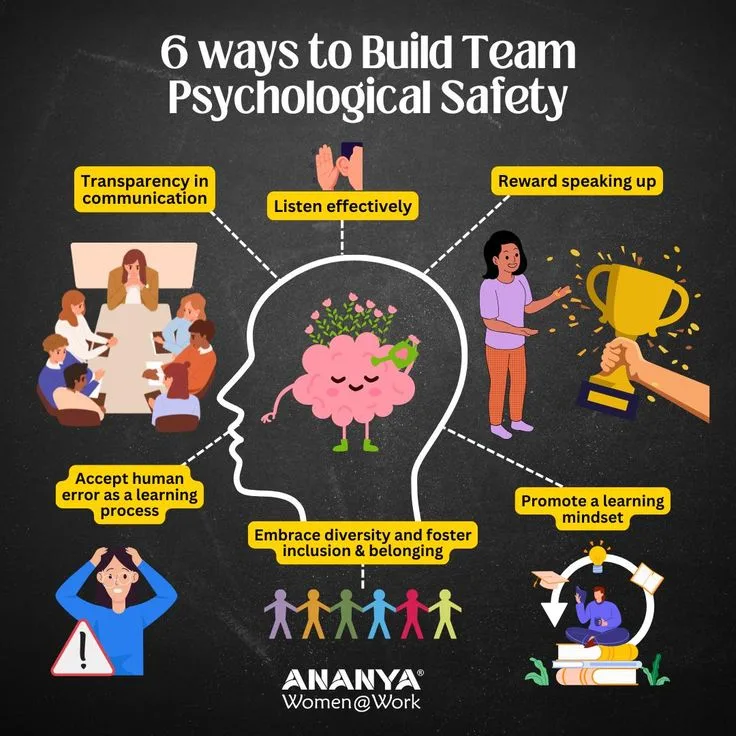
Managers build psychological safety through consistent daily behavior rather than a single initiative: modeling fallibility by admitting mistakes and gaps in knowledge, framing difficult work as a learning process instead of a performance test, responding to bad news with curiosity rather than blame, creating structure so quieter voices get heard, and naming the norm explicitly so the team knows challenge is expected and welcomed.
Model Fallibility
The most powerful thing a leader can do is demonstrate that it is acceptable to be wrong, to not know, and to ask for help. This means explicitly acknowledging your own mistakes, saying "I don't know" when you don't, and publicly asking for input and challenge.
Edmondson calls this leader inclusiveness - inviting participation, acknowledging the limits of your own knowledge, and demonstrating that other perspectives have genuine value.
Frame Work as Learning
When teams are working on novel or complex problems, frame the situation as a learning process rather than a performance evaluation. Language matters: "we're going to figure this out together" signals a different climate than "we need to get this right."
This framing has practical consequences. Edmondson's surgical team research found that this language shift - coming specifically from the lead surgeon - was one of the strongest predictors of how quickly teams learned new techniques.
Respond Productively to Bad News
The most critical moments for psychological safety are when someone brings a problem. If a manager reacts with frustration, blame, or minimizing ("why didn't you tell me sooner?" delivered with irritation), they are training people not to bring problems.
If they react with curiosity and problem-solving orientation, they reinforce that surfacing problems is safe and valued.
A useful default response to concerning news: "Thanks for telling me. Let's figure out what we can do about it."
Create Structure for Inclusion
Not everyone speaks up equally in unstructured settings. Status, personality, and conversational dynamics create patterns that systematically exclude voices. Meeting practices like round-robins, anonymous idea generation, and explicitly inviting quieter members reduce these structural barriers.
Address Interpersonal Risk Explicitly
Some leaders find it valuable to make the psychological safety norm explicit - naming in team discussions that this is a team where challenge is expected and welcomed, and demonstrating through behavior what that means in practice.
The Manager Behaviors That Matter Most
Research by Edmondson and Timothy Clark, author of The 4 Stages of Psychological Safety (2020), identifies a hierarchy of management behaviors that build safety:
| Behavior | Mechanism | Impact Level |
|---|---|---|
| Responding to failures without blame | Signals that errors are information, not crimes | Very high |
| Asking genuine questions rather than rhetorical ones | Signals that other perspectives are valued | High |
| Acknowledging own uncertainty publicly | Normalizes not knowing; reduces performance pressure | High |
| Praising challenge and dissent explicitly | Signals that pushback is welcome | High |
| Scheduling regular one-on-ones with open agendas | Creates private space for concerns that won't surface in groups | Moderate-high |
| Rotating speaking order in meetings | Reduces status-based suppression of quieter voices | Moderate |
No single action is sufficient. Safety is built through consistent behavior over time, not through a single team-building exercise or policy declaration.
Measuring Psychological Safety in Your Team
Edmondson's original scale remains the most validated measurement tool. A simplified version asks team members to anonymously rate agreement with five to seven statements on a 5-point scale. Team scores are calculated as averages, and variations across team members reveal patterns worth investigating.
Common pulse survey questions include:
| Statement | Low score signal |
|---|---|
| "I feel comfortable raising concerns in team meetings" | Meetings may not feel like safe spaces |
| "My team acknowledges and learns from mistakes" | Error culture may be punitive |
| "I can offer opinions that differ from my manager's" | Hierarchy may be suppressing dissent |
| "Team members do not undermine each other's efforts" | Trust or interpersonal dynamics may be damaged |
Scores should be tracked over time, not treated as one-time diagnostics. Patterns matter more than any single data point.
Qualitative Signals to Watch
Numbers are not the only signal. Experienced leaders learn to read the behavioral indicators of low psychological safety before they show up in survey data:
- Meetings where only senior people talk: A reliable indicator of status-based suppression.
- Post-meeting conversations that contradict in-meeting consensus: The real views come out after the meeting - a clear sign that the meeting itself was not safe.
- Problems that surface late: When issues only become visible after they have grown into crises, it usually means people knew earlier but did not feel safe raising them.
- Uniformly positive upward communication: No organization functions without problems. If every status update is positive, information is being filtered.
Psychological Safety, Innovation, and Organizational Performance
The connection between psychological safety and innovation is both intuitive and research-supported. Innovation requires risk-taking - proposing ideas that might fail, sharing work that is incomplete, challenging assumptions that may be correct. In environments where such risks are punished, innovation attempts decline.
A consistent finding across industries is that psychological safety predicts learning behavior - the degree to which teams seek feedback, experiment with new approaches, discuss failures, and ask for help. And learning behavior, in turn, predicts performance in complex, changing environments.
This dynamic is captured in what researchers call the performance-safety paradox: in the short run, psychologically safe teams may appear less polished because they surface more problems and publicly acknowledge more uncertainty. Over time, they solve those problems faster and develop more robust practices.
The Innovation Economy Case
The shift from industrial to knowledge-based economies has made psychological safety more economically critical than it was in the 20th century.
When competitive advantage comes from the quality of ideas, the speed of iteration, and the ability to learn faster than competitors, teams that systematically suppress honest communication are operating with a serious structural disadvantage.
A 2022 analysis by the Boston Consulting Group of 1,200 companies found that those with the highest scores on what BCG called "people-centered management practices" - including psychological safety metrics - showed innovation revenue (revenue from products introduced in the past five years) that was 22% higher than industry peers, after controlling for company size and sector.[9]
Psychological Safety in Remote and Hybrid Teams
Remote work created new challenges for psychological safety. Non-verbal cues that signal attention and receptivity are reduced or absent. Asynchronous communication collapses the social context in which tone is understood.
And the casual conversations that build interpersonal trust - what researchers call the "psychological water cooler" - disappear.
Research on distributed teams suggests that psychological safety in remote settings requires more deliberate effort:
- Shorter feedback loops - the time between raising a concern and getting a response should be short; long silences are interpreted as disapproval
- Explicit norms for video calls - acknowledging latency and speaking order reduces the status dynamics that suppress quieter voices
- Async inclusion - creating written channels where ideas can be submitted and acknowledged independent of who speaks up in meetings
- More frequent check-ins - brief one-on-one conversations that would happen naturally in office settings need to be scheduled in remote ones
The Hybrid Equity Problem
Hybrid work arrangements introduce a specific psychological safety risk: proximity bias. When some team members attend meetings in person while others join remotely, in-person participants tend to have higher influence over the conversation and are more visible to leaders.
Remote participants, aware of this dynamic, often reduce their participation - a rational response to feeling their contributions are less valued.
Organizations that have studied this problem - Microsoft's WorkLab published research on this in 2022 - recommend specific design interventions: requiring all participants to join individually from their own screens even when meeting rooms are available, designating remote advocates in every hybrid meeting, and deliberately seeking remote participants' input before concluding discussions.[10]
The Four Stages of Psychological Safety
Timothy Clark's 2020 framework, building on Edmondson's work, describes psychological safety as developing in four sequential stages within teams and organizations:[6]
Stage 1 - Inclusion Safety: People feel safe being themselves without fear of exclusion. The basic need to belong is met. This is the foundation without which nothing else is possible.
Stage 2 - Learner Safety: People feel safe to learn - to ask questions, make mistakes, experiment, and request feedback without fear of embarrassment. This is where most teams that struggle with learning behavior are blocked.
Stage 3 - Contributor Safety: People feel safe to use their skills and contribute to the work without excessive management, permission-seeking, or second-guessing. They feel genuinely empowered.
Stage 4 - Challenger Safety: People feel safe to challenge the status quo - to question processes, strategies, and decisions at any level of the organization without fear of retaliation.
Most teams achieve Stage 1 and 2. Relatively few consistently achieve Stage 4, which is where the most organizationally valuable communication - early warning of strategic mistakes, challenge of accepted assumptions, escalation of ethical concerns - takes place.
Conclusion
Psychological safety is not a soft concept. It is one of the most robustly measured predictors of team learning and performance in the research literature. It determines whether teams actually use the collective intelligence their members possess, or whether that intelligence stays silent out of social caution.
The work of building it falls primarily on leaders - through how they respond to bad news, how they invite dissent, and how consistently they model the fallibility and openness they want to see. It is built in small moments far more than in grand policy statements. And it is damaged far faster than it is built.
Understanding that reality is the beginning of building teams that work.
Sources & Further Reading
- Edmondson, A. C. (1999). Psychological safety and learning behavior in work teams. Administrative Science Quarterly, 44(2), 350-383.
- Edmondson, A. C. (2018). The Fearless Organization: Creating Psychological Safety in the Workplace for Learning, Innovation, and Growth. Wiley.
- Google re:Work. (2016). Guide: Understand team effectiveness. rework.withgoogle.com.
- McKinsey & Company. (2021). Psychological safety and the critical role of leadership development. mckinsey.com.
- Gallup. (2022). State of the Global Workplace: 2022 Report. Gallup.com.
- Clark, T. R. (2020). The 4 Stages of Psychological Safety: Defining the Path to Inclusion and Innovation. Berrett-Koehler.
- Woolley, A. W., Chabris, C. F., Pentland, A., Hashmi, N., & Malone, T. W. (2010). Evidence for a collective intelligence factor in the performance of human groups. Science, 330(6004), 686-688.
- Columbia Accident Investigation Board. (2003). Columbia Accident Investigation Board Report, Volume 1. NASA.
- Boston Consulting Group. (2022). Winning the Race for Relevance: People-Centered Management and Innovation. BCG.com.
- Microsoft WorkLab. (2022). Hybrid Work Is Just Work. Are We Doing It Wrong? microsoft.com/worklab.
- Newman, A., Donohue, R., & Eva, N. (2017). Psychological safety: A systematic review of the literature. Human Resource Management Review, 27(3), 521-535.
- Frazier, M. L., Fainshmidt, S., Klinger, R. L., Pezeshkan, A., & Vracheva, V. (2017). Psychological safety: A meta-analytic review and extension. Personnel Psychology, 70(1), 113-165.