
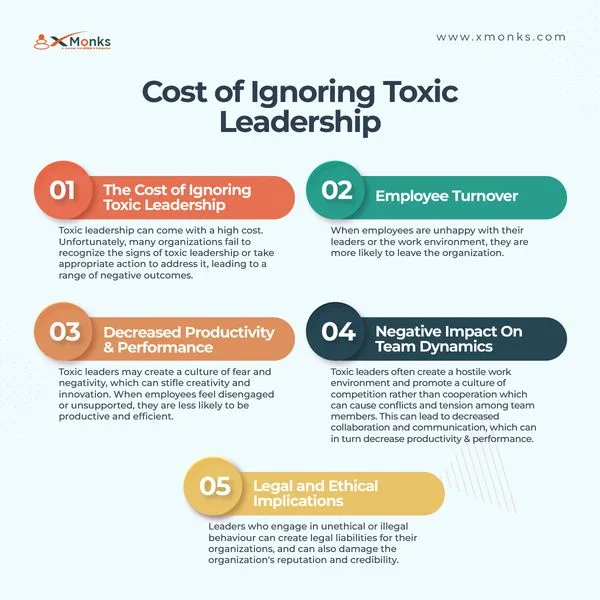
Toxic leadership is a pattern of leader behavior - persistent, systematic, and often deliberate - that damages employee wellbeing, erodes organizational culture, and ultimately degrades performance, even when the leader produces visible short-term results.
It is not about occasional bad days, imperfect communication, or high standards that some employees find uncomfortable. It is about a sustained pattern of behavior that harms the people who work for a leader and the organizations those leaders supposedly serve.
The research on toxic leadership is substantial, spanning organizational psychology, military leadership studies, and management science. The cost data is sobering: Bennett Tepper and colleagues estimated that abusive supervision alone costs U.S.
organizations approximately $23.8 billion annually through lost productivity, healthcare costs, absenteeism, and turnover.
And the organizational mechanisms that allow toxic leaders to persist - upward reporting structures that insulate them from accountability, performance metrics that reward results regardless of human cost, cultural norms that normalize aggression as "toughness" - are instructive about how institutions actually work, as opposed to how they claim to work.
Understanding toxic leadership matters for anyone who works in an organization, because the research shows that most professionals will encounter at least one toxic leader during their career.
A 2010 survey by the Workplace Bullying Institute found that 35% of American workers reported being bullied at work, with the majority of bullying originating from supervisors.
Knowing what you are dealing with, what the research says about your options, and when to leave is among the most practical career knowledge you can have.
"The single biggest decision you make in your job - bigger than all the rest - is who you name manager. When you name the wrong person manager, nothing fixes that bad decision. Not compensation, not benefits - nothing." - Jim Clifton, former CEO, Gallup
Defining Toxic Leadership
The term "toxic leader" entered academic literature most prominently through Marcia Whicker's 1996 book Toxic Leaders: When Organizations Go Bad, and was developed more systematically by scholars including George Reed, whose work with the U.S. Army articulated a model specifically focused on organizational harm.
Reed's definition, published in a 2004 article in Military Review, characterizes toxic leaders as those who have a combination of apparent short-term results and deeply negative effects on organizational climate, follower development, and long-term performance.
A critical element of Reed's model is that toxic leaders often produce results - which is precisely why they are tolerated. The short-term performance masks the long-term destruction happening beneath it.
The research literature uses several related but distinct concepts:
Abusive supervision: Bennett Tepper's construct, introduced in a landmark 2000 paper in the Academy of Management Journal, defined as sustained hostile verbal and nonverbal behaviors by supervisors (excluding physical contact).
This includes ridiculing subordinates, giving silent treatment, reminding employees of past failures, public humiliation, taking credit for subordinates' work, and making threats.
Tepper's construct has become the most widely studied measure of destructive leader behavior, cited in over 3,000 subsequent publications.
Destructive leadership: A broader term, formalized by Stale Einarsen and colleagues (2007), encompassing any pattern of leader behavior that harms the legitimate interests of the organization or followers.
This includes both actively harmful behavior and passive negligence - leaders who harm through what they fail to do (failing to protect, failing to develop, failing to address problems).
Narcissistic leadership: Leadership characterized by grandiosity, entitlement, lack of empathy, and exploitativeness - a personality pattern particularly associated with toxic outcomes.
Research by Seth Rosenthal and Todd Pittinsky (2006) found that narcissistic traits are positively associated with leader emergence (being perceived as leader-like) but negatively associated with long-term leadership effectiveness.
Petty tyranny: A concept developed by Blake Ashforth (1994), describing the exercise of authority through arbitrariness, belittling others, lack of consideration for follower interests, discouraging initiative, and micromanagement.
Ashforth's model emphasizes that petty tyranny arises from the intersection of personality, organizational culture, and the power inherent in supervisory roles.
These constructs overlap but are not identical. The common thread is systematic harm to people and organizations over time - not isolated incidents, but patterns.
The Research Evidence on Costs
Employee Health and Wellbeing
The health effects of working under a toxic leader are not metaphorical. They are measurable, significant, and documented across dozens of studies.
Research consistently shows that employees under abusive supervisors experience:
- Higher rates of job-related anxiety and depression: A 2017 meta-analysis by Jeremy Mackey, Rachel Frieder, Jeremy Brees, and Mark Martinko, published in the Journal of Management, analyzed 136 independent samples and found that abusive supervision was significantly associated with follower psychological distress, including anxiety, depression, and emotional exhaustion.
- Elevated burnout and emotional exhaustion: The same meta-analysis found strong associations between abusive supervision and all three dimensions of burnout: emotional exhaustion, depersonalization, and reduced personal accomplishment.
- Worse physical health outcomes: A 2009 study by Anna Nyberg and colleagues, published in the Journal of Occupational and Environmental Medicine, tracked 3,122 Swedish men over a 10-year period and found that employees who rated their managers as incompetent, inconsiderate, secretive, and uncommunicative had a significantly higher risk of heart attack - a 20-40% increase in cardiac event risk compared to those with better managers.
- More frequent psychosomatic symptoms: Headaches, sleep disturbance, gastrointestinal issues, and chronic fatigue are consistently elevated among employees reporting abusive supervision.
The effect sizes are not trivial. In Mackey et al.'s meta-analysis, the correlation between abusive supervision and emotional exhaustion was r = .42 - a strong effect by social science standards.
Organizational Performance
Toxic leadership degrades organizations in ways that are measurable but often attributed to other causes:
- Higher voluntary turnover among the most capable employees - those with options leave first, creating a negative selection effect where the remaining workforce is disproportionately composed of people who cannot easily find alternatives
- Lower organizational commitment among those who stay, leading to reduced discretionary effort
- Reduced organizational citizenship behavior - employees doing less than their formal role requires, withdrawing the "extras" that make organizations function
- Impaired knowledge sharing and collaboration - employees in fear-based environments hoard information as a survival strategy
- Worse team performance on complex tasks requiring cooperation and creative problem-solving
| Outcome | Effect of Toxic Leadership | Key Research |
|---|---|---|
| Employee turnover intentions | Substantially elevated (r = .39) | Mackey et al. meta-analysis (2017) |
| Organizational commitment | Significantly lower (r = -.35) | Tepper (2000); multiple meta-analyses |
| Job satisfaction | Significantly lower (r = -.38) | Consistent across studies |
| Work-family conflict | Significantly elevated | Tepper, Moss, Lockhart, & Carr (2007) |
| Subordinate mental health | Worse across depression, anxiety, burnout | Mackey et al. (2017); Harris, Kacmar, & Zivnuska (2007) |
| Team performance | Lower on complex, interdependent tasks | Schyns & Schilling meta-analysis (2013) |
| Subordinate counterproductive work behavior | Elevated (retaliation, sabotage, withdrawal) | Mitchell & Ambrose (2007) |
The Psychology of Toxic Leaders
Narcissism and Leadership
A substantial body of research links narcissistic personality traits with toxic leadership outcomes.
The Narcissistic Personality Inventory (NPI), developed by Robert Raskin and Howard Terry (1988), measures narcissism along dimensions including grandiosity (an inflated sense of importance), entitlement, exploitativeness (using others for personal gain), and lack of empathy.
Crucially, narcissistic traits are associated with charisma and confidence that can be initially attractive in leaders.
Research by Amy Brunell and colleagues (2008, published in Personality and Social Psychology Bulletin) found that narcissistic individuals emerged as leaders in leaderless group discussions more frequently than non-narcissistic individuals - they projected confidence, decisiveness, and vision that groups initially found compelling.
The costs emerge over time as the exploitation pattern, lack of genuine concern for followers, and inability to accept feedback or criticism produce dysfunction.
Rosenthal and Pittinsky (2006, The Leadership Quarterly) formalized this as the "narcissistic leadership paradox": the traits that help narcissists attain leadership positions are the same traits that make them destructive in those positions over time.
Organizations that select for confidence and charisma without assessing for empathy and integrity are systematically selecting for narcissistic leaders.
The Grandiose vs. Vulnerable Distinction
Not all narcissistic leaders are the overtly grandiose archetype. Research distinguishes between grandiose narcissism (the dominant, self-aggrandizing type) and vulnerable narcissism (characterized by hypersensitivity, entitlement combined with insecurity, and emotional volatility in response to perceived slights).
Vulnerable narcissists produce toxic leadership through different mechanisms: passive aggression, sabotage of subordinates who are perceived as threats, creation of organizational uncertainty and dependency, and inconsistent behavior that keeps followers in a state of anxious hypervigilance.
Research by Joshua Miller and colleagues (2011, Journal of Personality) found that while grandiose narcissism is more visible and more studied, vulnerable narcissism may be equally harmful in leadership contexts because its effects are more difficult to identify and address.
The Dark Triad in Leadership
Psychologists Delroy Paulhus and Kevin Williams (2002) identified the "Dark Triad" of personality traits - narcissism, psychopathy, and Machiavellianism - as a cluster that is particularly associated with interpersonal exploitation and organizational harm.
Research by Peter Jonason and colleagues (2012) found that Dark Triad traits were associated with both leadership attainment and destructive leadership outcomes, suggesting that the same personality features that help people reach positions of power make them dangerous once there.
This is not a rare phenomenon. A 2010 study by Paul Babiak, Craig Neumann, and Robert Hare, published in Behavioral Sciences and the Law, assessed 203 corporate professionals selected for high-potential leadership development and found that approximately 4% scored at levels consistent with clinical psychopathy - four times the estimated prevalence in the general population.
The researchers concluded that psychopathic traits may be positively selected for in corporate environments that reward charm, risk-taking, and ruthless competition.
The "Brilliant Jerk" Problem
Organizations frequently retain toxic leaders when those leaders produce visible short-term results. The "brilliant jerk" - someone who delivers performance metrics while systematically harming people - is treated as a trade-off to be managed rather than a net harm to be addressed.
The research on this trade-off consistently shows that organizations overweight visible short-term performance and underweight the hidden costs of toxicity. The employees who leave are the ones with options; those who stay are disproportionately those with fewer alternatives.
The culture erosion is gradual and attributed to many causes. The eventual performance collapse, when it comes, is rarely attributed to the toxic leader who created it.
Reed Hastings, co-founder of Netflix, addressed this directly in the company's culture document: "Some companies tolerate brilliant jerks. For us, the cost to teamwork is too high." This position is supported by research.
A 2015 study by Dylan Minor and Michael Housman, analyzing data from over 58,000 workers across 11 firms, found that avoiding a toxic worker is worth roughly twice as much in financial terms as hiring a star performer.
The cost of one toxic employee (in terms of turnover, reduced performance by coworkers, and disciplinary costs) exceeded the benefit of one top-performing employee by a factor of approximately two to one.
How Organizations Enable Toxic Leaders
Toxic leaders do not operate in a vacuum. They exist within organizational systems that can accelerate, tolerate, or reduce their impact.
Understanding these systems is essential because individual-level interventions - coaching the toxic leader, training subordinates to "manage up" - consistently fail when the organizational conditions that produce and protect toxic leaders remain unchanged.
Upward Reporting Structures
In most organizations, the people best positioned to observe toxic behavior are the subordinates of toxic leaders. Those subordinates typically have limited formal power to report upward, face retaliation risks for doing so, and often lack confidence that their reports will be taken seriously.
Research by Ethan Burris (2012, Academy of Management Journal) found that employees who voice concerns to supervisors and receive negative responses are significantly less likely to speak up again - and that this silencing effect extends to peers who merely witness the negative response.
The organizational incentive structure systematically benefits toxic leaders: they are evaluated primarily by their superiors, whom they may manage impressively upward, while their actual behavior toward subordinates - where the harm occurs - is less visible to those with power over promotion and retention decisions.
For more on why this dynamic matters, see what is psychological safety.
Absence of 360-Degree Evaluation
Organizations that use only downward evaluation (supervisors rate subordinates) have less information about leadership behavior than those using 360-degree systems that incorporate subordinate, peer, and supervisor feedback.
Even 360-degree systems can be gamed by sophisticated toxic leaders who understand that their upward and peer ratings matter more to career outcomes than their downward ratings.
Research by Leanne Atwater, David Waldman, and David Brett (2002) found that self-other agreement in 360-degree ratings was lower for narcissistic leaders - they rated themselves significantly higher than their subordinates rated them.
Cultural Norms About Toughness
In organizations with strong norms about competitive intensity - financial services, law, military-adjacent cultures, some technology companies - abusive supervision may be normalized as "high standards" or "tough love." Cultural framing that treats abuse as acceptable or even admirable creates environments where toxic leaders can operate openly.
Research on the investment banking industry (see day in the life of an investment banker) documents how extreme hours and aggressive management styles are often defended as necessary features of elite performance rather than recognized as potentially toxic.
The Organizational Immune Response Problem
Organizations often have an immune response to acknowledging toxic leadership: the problem is reframed as "interpersonal conflict" rather than abuse; the leader "has a particular style that some people find difficult"; the subordinate is "sensitive" or "not a culture fit." These framings protect the organization from the cost and disruption of addressing a toxic leader while systematically failing the people being harmed.
Promotion Systems That Reward Technical Performance
When promotion decisions are based primarily on measurable task performance - sales numbers, project completions, technical output - rather than on leadership behavior, technically strong but people-damaging leaders advance into positions where they manage more people and cause more harm.
This is a structural feature of many organizations, not an accident. The Peter Principle (Laurence Peter, 1969) - the observation that people are promoted based on competence in their current role until they reach a level at which they are incompetent - applies with particular force when "competence" is measured only by technical output and not by leadership quality.
What Individuals Can Do
The research on individual strategies for managing toxic leadership is sobering: most direct approaches - confronting the leader, attempting to reason with them, appealing to their better nature - have limited effectiveness and can backfire, particularly with narcissistic leaders who perceive challenge as threat.
The strategies with better evidence behind them are more indirect.
Documentation
Specific, dated, factual documentation of specific incidents is far more actionable than general characterizations.
"On March 14, during the team meeting, [manager] stated in front of the group that my work was 'worthless' and accused me of 'intentional sabotage'" is something HR and senior leadership can work with.
"My manager is toxic and abusive" is easy to dismiss. Documentation should include dates, witnesses, direct quotes where possible, and the impact on work output.
Social Support
Research on stress and organizational behavior consistently finds that social support - from coworkers, mentors, partners, and professional networks - is one of the most protective factors against the health consequences of working under abusive supervisors.
A 2017 study by Wu and Hu, published in the Journal of Business Ethics, found that coworker support significantly moderated the relationship between abusive supervision and emotional exhaustion.
Coworkers who share your experience of a toxic leader are both a source of reality confirmation (confirming that what you are experiencing is real, not imagined) and practical support.
Strategic Use of Formal Processes
HR complaints about abusive leadership have highly variable outcomes depending on organizational culture, the severity of the behavior, the perceived value of the toxic leader, and documentation quality.
Research by David Cortina and Vicki Magley (2009) found that formal complaints were more likely to result in positive outcomes when: the behavior was well-documented, multiple complainants corroborated the pattern, the organization had clear policies and enforcement mechanisms, and senior leadership was genuinely committed to addressing the issue.
Employees considering formal complaints should have realistic expectations about outcomes and should have clear, specific documentation before initiating a process.
External Network Building
The most effective protection against a toxic supervisor is having genuine exit options. Building and maintaining professional networks outside your current organization creates real alternatives that reduce the power differential with the abusive leader and provide a genuine escape valve.
For guidance on this, see career strategy explained.
Honest Evaluation of Exit
Research consistently finds that the mental health costs of sustained abusive supervision are significant and long-lasting. The Nyberg et al. (2009) study documenting elevated cardiac risk operated over a 10-year window - the health costs compound over time.
The calculation "I will stay and manage this" needs to be made honestly against the documented health consequences of chronic exposure to abusive supervisors. There is no stigma in leaving a situation that is causing measurable harm; there is a significant cost in staying too long.
What Organizations Should Do
Selection and Assessment
Personality assessment in leadership selection, including measures of narcissism and Dark Triad traits (narcissism, psychopathy, Machiavellianism), can identify high-risk candidates before they are placed in positions where they can cause harm.
These tools are imperfect - narcissistic individuals are skilled at impression management during selection processes - but they are substantially better than ignoring the evidence.
Research by Hogan and Hogan (2001, The Leadership Quarterly) found that personality-based assessment of leadership derailment risk significantly improved prediction of leader failure.
Leadership Development That Addresses Behavior, Not Just Skills
Much leadership development focuses on strategic thinking, communication, and technical skills while treating interpersonal behavior toward subordinates as secondary.
Organizations serious about preventing toxic leadership invest in behavior-focused development, 360-degree feedback with accountability consequences, and coaching that explicitly addresses abusive patterns.
Research by Avey, Wu, and Holley (2015) found that leadership development programs that included specific behavioral feedback from subordinates produced measurably better leadership outcomes than programs focused solely on skill development.
Psychological Safety and Reporting Mechanisms
Creating genuine psychological safety for subordinates to report toxic behavior - including anonymous reporting channels with real confidentiality protections - is a structural requirement. Without safe reporting, toxic behavior remains invisible to those with authority to address it.
Amy Edmondson's research on psychological safety in healthcare settings found that teams with higher psychological safety reported more errors but had fewer actual errors - because the reporting itself enabled learning and correction.
Accountability Without Favoritism
The credibility of any anti-toxic-leadership initiative depends on applying standards consistently to high-performing leaders as well as low-performing ones. Organizations that tolerate toxic behavior from revenue-generating leaders while removing it from others send a clear message about what the organization actually values.
Research by Robert Cialdini (2003) on organizational ethical climate found that consistency of enforcement was the strongest predictor of whether organizational values influenced actual behavior.
Redefining Leadership Success Metrics
Organizations that measure and reward leaders only on business outcomes inevitably select for leaders who optimize those outcomes at the expense of people.
Adding explicit people-leadership metrics - team engagement scores, 360-degree feedback results, retention rates among high performers, subordinate development outcomes - to promotion and compensation criteria changes what behaviors get reinforced.
The Ripple Effects: How Toxicity Spreads
Research has documented that toxic leadership does not confine its damage to the direct relationship between leader and subordinate. Its effects radiate outward through teams, families, and organizations in ways that multiply the original harm.
Downstream Abusive Supervision (The Cascade Effect)
Studies by Tepper and colleagues, as well as research by Marie Mitchell and Maureen Ambrose (2007, Academy of Management Journal), found that subordinates of abusive supervisors are themselves more likely to engage in abusive supervision behaviors toward their own direct reports.
The pattern cascades down organizational hierarchies: employees who are mistreated model the behavior they observe and reproduce it when they have authority over others.
Research by Robert Hoobler and Daniel Brass (2006) found that this trickle-down effect was mediated by displaced aggression - leaders who are abused take out their frustration on subordinates who are safer targets than their own abusers.
This makes toxic leadership a self-replicating phenomenon that can transform organizational culture over time rather than remaining contained at one level.
Family and Home Life Spillover
Work stress caused by abusive supervision does not stay at the office. Research by Simon Lloyd D.
Restubog, Kristin Scott, and Thomas Zagenczyk (2011, Journal of Management) documented significant spillover from abusive supervision to home life: employees under abusive managers reported worse family functioning, more conflict at home, and reduced marital satisfaction.
The 2007 Tepper et al. study specifically measured work-family conflict as an outcome of abusive supervision and found it significantly elevated. Organizations that tolerate toxic leadership externalize the costs of that decision to employees' families.
Psychological Safety Destruction
Amy Edmondson's research on psychological safety documents how essential it is to innovation, quality improvement, and organizational learning. Toxic leadership is among the most efficient destroyers of psychological safety.
When employees observe or experience retaliation for speaking up, reporting problems, or expressing disagreement, the entire team learns to stay silent.
The silence that follows a toxic leader's tenure can persist long after the leader has left - a phenomenon researchers call the "chilling effect."
The Tenure Effect
Organizational behavior research suggests that the longer a toxic leader remains in place, the larger and more persistent the damage. Short tenures of abusive supervision produce acute harm that organizations can recover from relatively quickly.
Long tenures produce cultural entrenchment: the most psychologically healthy employees leave, those who remain adapt their behavior to survive in the toxic environment, and the organization selects over time for employees and behaviors that are compatible with the toxic leader's style.
Recovery from long-tenure toxic leadership may require restructuring teams, changing culture deliberately, and sometimes replacing large portions of the workforce that was shaped by the toxic environment.
What Toxic Leadership Is Not
Precision matters in defining toxic leadership, because over-broad definitions reduce the signal value of the concept and make it harder to address genuinely harmful patterns.
High standards are not toxic leadership. Demanding performance, maintaining accountability, and giving honest negative feedback are not forms of abuse.
The difference lies in whether the leader treats employees as people to be developed or objects to be exploited, and whether the challenge comes with support and development or with humiliation and threat.
For more on the distinction between demanding and destructive leadership, see what is leadership.
Conflict is not toxicity. Disagreement, tension, and interpersonal friction are normal organizational phenomena. Toxic leadership is a pattern, not an instance. A manager who has one bad day is not toxic; a manager who has bad days that always land on the same subordinates is exhibiting a pattern.
Difficult decisions are not toxic leadership. Layoffs, restructuring, and communicating unwelcome information are legitimate organizational functions that can be done with care for employee dignity.
The manner of delivery matters - toxic leaders use these moments to assert power; effective leaders use them to demonstrate respect even when the news is painful.
Summary
Toxic leadership is a pattern of systematic harm to employees and organizations, driven by narcissistic personality traits, abusive supervision behaviors, and organizational systems that tolerate or reward results regardless of how they are achieved. It is not rare, not inevitable, and not beyond the capacity of organizations to address.
The evidence on costs - to employee health, organizational commitment, team performance, and long-term organizational viability - is substantial and consistent across decades of research.
The mechanisms by which organizations enable toxic leaders - upward reporting structures, absence of 360-degree accountability, cultural normalization of toughness, performance metrics that ignore human costs - are well understood.
For individuals, the most effective strategies are documentation, social support, strategic use of formal processes, external network development, and honest evaluation of whether the costs of staying outweigh the costs of leaving.
For organizations, the most effective interventions are at the selection, assessment, and accountability levels - changing the conditions that produce and sustain toxic leaders rather than reacting to individual incidents after the damage is done.
Toxic leadership is not inevitable in organizations. It is, however, predictable where the organizational conditions that enable it are left unaddressed.
Sources & Further Reading
- Tepper, B. J. (2000). Consequences of Abusive Supervision. Academy of Management Journal, 43(2), 178-190. DOI: 10.5465/1556375
- Reed, G. E. (2004). Toxic Leadership. Military Review, 84(4), 67-71. View source
- Mackey, J. D., Frieder, R. E., Brees, J. R., & Martinko, M. J. (2017). Abusive Supervision: A Meta-Analysis and Empirical Review. Journal of Management, 43(6), 1940-1965. DOI: 10.1177/0149206315573997
- Whicker, M. L. (1996). Toxic Leaders: When Organizations Go Bad. Quorum Books.
- Ashforth, B. (1994). Petty Tyranny in Organizations. Human Relations, 47(7), 755-778. DOI: 10.1177/001872679404700701
- Nyberg, A., Alfredsson, L., Theorell, T., Westerlund, H., Vahtera, J., & Kivimaki, M. (2009). Managerial Leadership and Ischaemic Heart Disease Among Employees. Journal of Occupational and Environmental Medicine, 66(1), 51-55. DOI: 10.1136/oem.2008.039362
- Babiak, P., Neumann, C. S., & Hare, R. D. (2010). Corporate Psychopathy: Talking the Walk. Behavioral Sciences and the Law, 28(2), 174-193. DOI: 10.1002/bsl.925
- Minor, D., & Housman, M. (2015). Toxic Workers. Harvard Business School Working Paper 16-057. View source
- Rosenthal, S. A., & Pittinsky, T. L. (2006). Narcissistic Leadership. The Leadership Quarterly, 17(6), 617-633. DOI: 10.1016/j.leaqua.2006.10.005
- Schyns, B., & Schilling, J. (2013). How Bad Are the Effects of Bad Leaders? A Meta-Analysis. The Leadership Quarterly, 24(1), 138-158. DOI: 10.1016/j.leaqua.2012.09.001
- Hogan, R., & Hogan, J. (2001). Assessing Leadership: A View from the Dark Side. International Journal of Selection and Assessment, 9(1-2), 40-51. DOI: 10.1111/1468-2389.00162