
The Collapse of the Degree Requirement
Between 2017 and 2024, the share of U.S. job postings requiring a bachelor's degree fell from roughly 51 percent to 44 percent, according to analysis from the Burning Glass Institute and Harvard Business School's Managing the Future of Work project.
The researchers called the shift a structural reset in hiring, not a cyclical adjustment tied to labor shortages.
Companies that dropped degree requirements between 2019 and 2022 included IBM, Accenture, Bank of America, Dell, and Google.
The Tony Blair Institute for Global Change documented that "skills-first" hiring expanded fastest in technology, marketing, and operations, where portfolios, certifications, and demonstrable work samples outperformed transcripts as predictors of job performance.
"A bachelor's degree has become a very noisy signal. We found that non-degree workers, when hired, performed similarly to degree holders but stayed in their roles 34 percent longer on average."
- Joseph Fuller, Harvard Business School, Managing the Future of Work initiative, 2022[1]
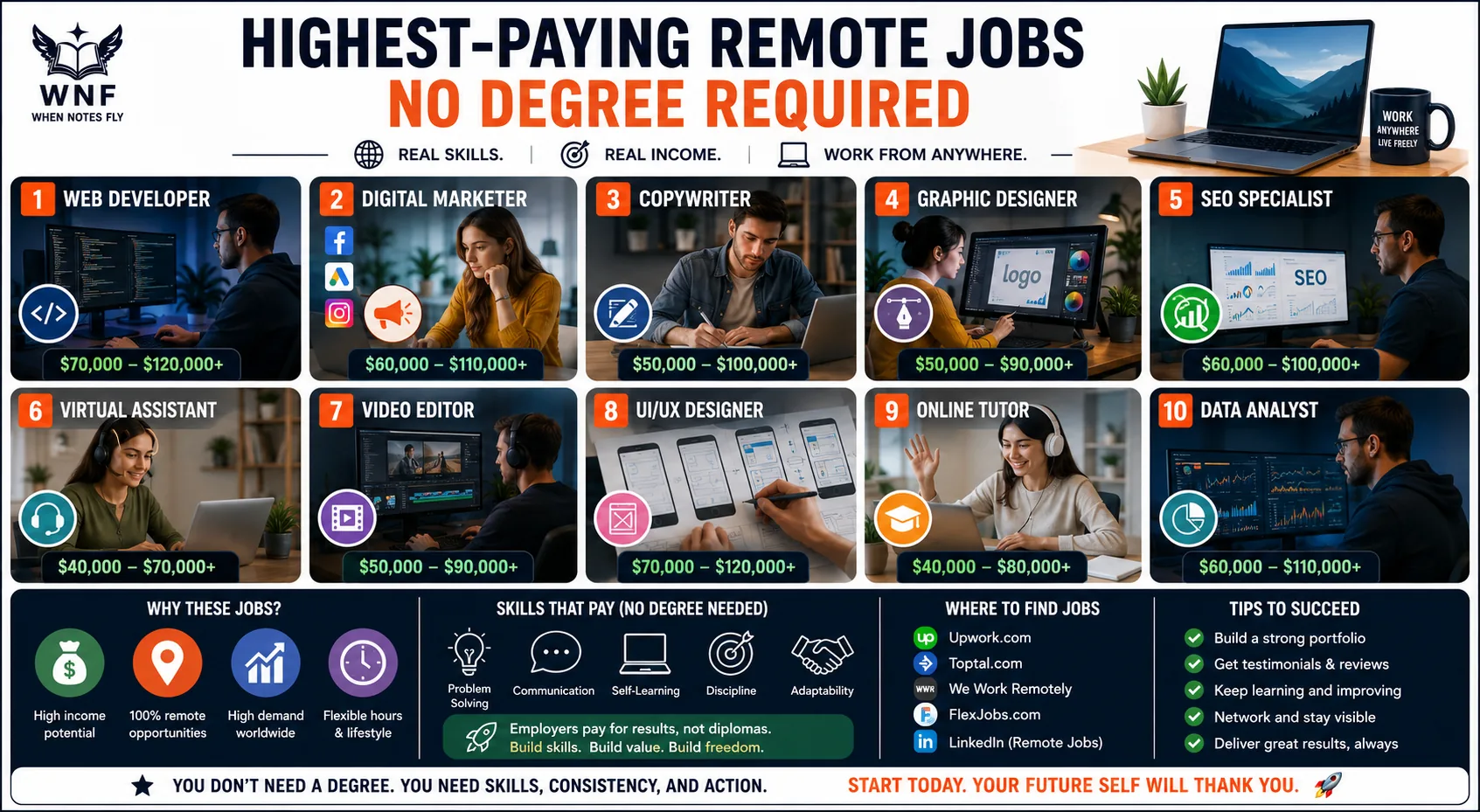
This article catalogs ten remote roles where experience, certifications, and demonstrated output matter more than a diploma. Salary ranges reflect 2024 data from the U.S. Bureau of Labor Statistics Occupational Employment and Wage Statistics program, LinkedIn Salary Insights, and Payscale aggregates.[2]
How to Read the Salary Data
The salary brackets below combine three sources: the 2024 BLS OEWS release (for the median), LinkedIn's 2024 Workforce Insights (for entry and senior percentiles), and Levels.fyi (for tech-adjacent senior comp). Remote-specific premiums or discounts are called out where data exists.
| Role | Entry (25th) | Median (50th) | Senior (90th) | Typical Time to First Job |
|---|---|---|---|---|
| Software Developer | $68,000 | $98,000 | $168,000 | 9 to 18 months |
| UX Designer | $62,000 | $86,000 | $142,000 | 6 to 12 months |
| Digital Marketing Manager | $58,000 | $82,000 | $135,000 | 4 to 9 months |
| Copywriter | $48,000 | $72,000 | $128,000 | 3 to 9 months |
| SaaS Sales Representative | $55,000 (base) | $95,000 OTE | $180,000 OTE | 3 to 6 months |
| Project Manager | $64,000 | $92,000 | $138,000 | 6 to 12 months |
| Data Analyst | $60,000 | $84,000 | $130,000 | 6 to 12 months |
| Cybersecurity Analyst | $70,000 | $102,000 | $155,000 | 9 to 15 months |
| Customer Success Manager | $58,000 | $88,000 | $140,000 | 3 to 6 months |
| Technical Writer | $60,000 | $88,000 | $125,000 | 4 to 8 months |
OTE stands for On-Target Earnings, the industry convention for roles with commission.
1. Software Developer
Software developers build, test, and maintain applications. The BLS projects 17 percent job growth from 2023 to 2033, far above the national average. Stack Overflow's 2024 Developer Survey found that 50.1 percent of professional developers hold a bachelor's degree or higher, meaning nearly half do not.[3]
Self-taught pathway: Structured curricula such as The Odin Project, freeCodeCamp, and CS50x from Harvard are free. Expect 800 to 1,500 hours of focused practice to reach employability, which translates to 9 to 18 months at 15 to 25 hours per week.
Portfolio expectation: Three to five shipped projects on GitHub, at least one full-stack application deployed to a public URL, and visible contributions to an open-source repository.
Certifications that help for hiring managers without a CS degree filter:
- AWS Certified Developer Associate
- Meta Front-End Developer Professional Certificate
- Google Associate Cloud Engineer
Developers preparing for cloud and DevOps certifications often pair hands-on labs with structured exam prep.
2. UX Designer
User experience designers research users, prototype flows, and test interfaces. NN/g's 2024 salary survey reported a global average of $103,000 for mid-level UX designers, with U.S. remote roles trending 8 to 12 percent higher than comparable in-office positions.
Self-taught pathway: Google UX Design Professional Certificate (six months at ten hours per week), Interaction Design Foundation coursework, and three portfolio case studies showing problem framing, research, wireframes, prototypes, and usability testing.
Tools hiring managers expect: Figma, Miro, Maze or UserTesting, and at least conversational fluency with HTML and CSS.
Why degrees matter less here: UX hiring is portfolio-driven. A recruiter typically evaluates three case studies in under fifteen minutes, and the narrative clarity of the portfolio predicts callbacks better than education.
3. Digital Marketing Manager
Digital marketers run paid acquisition, SEO, email, and content programs. HubSpot's 2024 State of Marketing report found that 61 percent of marketing hires in 2023 were evaluated on campaign results and certifications rather than degree pedigree.[5]
Core skill clusters:
- Paid media (Google Ads, Meta Ads Manager, LinkedIn Campaign Manager)
- SEO (technical audits, keyword research, content strategy)
- Marketing automation (HubSpot, Marketo, Customer.io)
- Analytics (GA4, Looker Studio, attribution modeling)
Certification path (three to six months): Google Ads certifications, HubSpot Inbound and Content Marketing, Meta Blueprint, and Semrush SEO Fundamentals.
Writing quality is the highest-leverage subskill inside digital marketing.
4. Copywriter
Copywriters produce sales pages, ad copy, email sequences, landing pages, and brand voice documents. The Professional Writers Alliance 2023 survey found that freelance copywriters with three or more years of experience averaged $112,000 in annual billings, with the top quartile exceeding $180,000.
Skill-up timeline: Three to nine months. Study direct-response classics (Ogilvy, Sugarman, Schwartz), apprentice through a paid program such as Copyhackers' 10x Freelance Copywriter, and build a spec portfolio of ten pieces before seeking paid work.
Niches that pay highest: B2B SaaS, financial services, healthcare, and technical products where subject matter expertise compounds with writing skill.
5. SaaS Sales Representative
Software-as-a-service sales roles span SDR (Sales Development Representative, the entry tier), AE (Account Executive), and customer-facing senior positions. Bridge Group's 2024 SaaS AE Metrics Report recorded median base salary at $74,000 with $148,000 on-target earnings for mid-market Account Executives.[6]
Why no degree: Hiring managers evaluate role plays, pipeline management, and discovery calls. Platforms like Pavilion, Sales Assembly, and Winning by Design run cohort-based programs that feed graduates directly to hiring companies.
Fastest path in: Apply for SDR roles at Series B to Series D SaaS companies with strong ramp programs. Typical ramp is three to six months, and promotion to AE within 18 to 24 months is standard.
6. Project Manager
Project managers coordinate scope, schedule, and resources. PMI's 2024 Salary Survey reported median U.S. compensation of $120,000 for credentialed project managers across all industries, with tech and healthcare skewing higher.[7]
Two primary certification tracks:
- PMP (Project Management Professional): Requires 36 months of documented project experience if you hold a four-year degree, or 60 months without. CAPM is the entry-level alternative for those without experience.
- Professional Scrum Master (PSM) I and II: No experience prerequisite. Agile-focused and widely accepted.
Skill-up timeline: Six to twelve months to earn CAPM or PSM I, then document real project work at a current job or through pro bono consulting.
7. Data Analyst
Data analysts pull, clean, and visualize data for business decisions. The BLS projects 23 percent growth in data-related roles through 2032.
Required technical stack:
- SQL (absolutely non-negotiable)
- Excel or Google Sheets at an advanced level
- Python or R for statistical work
- A visualization tool (Tableau, Power BI, or Looker)
Certification path:
- Google Data Analytics Professional Certificate (six months at ten hours per week)
- Microsoft Power BI Data Analyst Associate (PL-300)
- Tableau Desktop Specialist
8. Cybersecurity Analyst
Cybersecurity analysts monitor networks, investigate incidents, and harden systems. (ISC)2's 2024 Cybersecurity Workforce Study estimated a global workforce gap of 4.8 million professionals, the largest labor shortage in any technology domain.[4]
Entry-level certification stack (nine to fifteen months):
- CompTIA Security+ (foundational, broadly respected)
- CompTIA CySA+ or Cisco CyberOps Associate
- Optional: (ISC)2 Certified in Cybersecurity (free exam voucher as of 2024)
Entry-point titles: SOC Analyst, Security Operations Analyst Tier 1, IT Security Analyst. Remote SOC roles became widespread after 2021 because security operations centers are already software-mediated.
"We hire for curiosity, resilience, and a documented ability to learn hard things quickly. The Security Plus certification tells me a candidate can commit to a 900-page curriculum. The degree tells me they had parents with money."
- Jadee Hanson, Chief Information Security Officer, Vanta (interview in Dark Reading, 2023)
9. Customer Success Manager
Customer Success Managers (CSMs) help SaaS customers adopt, expand, and renew. Gainsight's 2024 Customer Success Index reported median CSM compensation at $92,000 base and $108,000 OTE in the U.S., with senior CSMs on enterprise accounts exceeding $160,000 OTE.
Why CSM is a career-change magnet: The role rewards empathy, project management instincts, and business-context fluency. Teachers, account managers, hospitality managers, and former consultants transition in frequently.
Skill-up timeline: Three to six months. Complete Gainsight's Pulse+ curriculum or Success Coaching's CCSM Level 1, build one sample customer journey map, and interview three practicing CSMs for informational calls.
10. Technical Writer
Technical writers produce API documentation, software guides, and engineering communications. The Society for Technical Communication's 2023 salary survey reported median U.S. compensation of $89,500, with API documentation specialists exceeding $115,000.
Required portfolio:
- Two API reference samples (OpenAPI-based)
- One quickstart tutorial
- One conceptual guide explaining an architectural pattern
Tooling: Markdown, Git, a static site generator (Docusaurus, MkDocs, or Hugo), and familiarity with at least one programming language for accurate code samples.
Comparing the Tracks
| Role | Upfront Cost | Revenue Ramp | Ceiling (Individual Contributor) |
|---|---|---|---|
| Software Developer | $0 to $400 (books, bootcamps optional) | Slow first year, steep after | $300K+ at senior IC |
| UX Designer | $400 (Google Cert + Figma) | Moderate | $220K+ at senior IC |
| Digital Marketing | $200 (certifications) | Fast | $200K+ at Director |
| Copywriter | $0 to $2,000 (books, coaching) | Fast once niched | $300K+ freelance |
| SaaS Sales | $0 (employer-trained) | Fast | $500K+ at enterprise AE |
| Project Manager | $405 to $575 (PMP exam) | Moderate | $180K+ at senior PM |
| Data Analyst | $300 (certifications) | Moderate | $200K+ at senior analyst |
| Cybersecurity | $370 (Security+) | Slow to moderate | $220K+ at senior IC |
| Customer Success | $0 to $1,500 (coaching) | Fast | $200K+ at enterprise CSM |
| Technical Writer | $0 to $500 (tooling) | Moderate | $180K+ at principal writer |
Negotiating Remote Offers Without a Degree
Non-degree candidates often under-negotiate because they assume the lack of credentials weakens leverage. The data suggests otherwise.
LinkedIn's 2024 Salary Transparency report found that candidates who asked about salary range early in the process and countered the first offer received 7 to 12 percent higher final compensation than candidates who accepted the first offer, independent of educational background.
Three negotiation moves work particularly well for non-degree candidates:
Anchor on market data, not your last salary. Levels.fyi, Glassdoor, and Payscale provide role-and-location-specific compensation data that removes the anchor of a lower previous salary.
A developer earning $70,000 at a prior role who presents $115,000 market data for their current skill level has a stronger starting position than one who reveals the $70,000 figure.
Bundle compensation components. Base salary is the most visible line but often the least flexible. Equity grants, sign-on bonuses, learning and development stipends, home office allowances, and additional PTO are all negotiable and often have more room to move than base.
Remote-first companies frequently offer home office budgets of $1,000 to $3,000 that go unclaimed because candidates do not ask.
Use competing offers as leverage without bluffing. A single competing offer, even from a smaller company, shifts negotiating dynamics. Recruiters routinely ask about other processes.
A truthful response that identifies the range of other offers ($95K to $115K across three processes, for example) anchors the conversation at the top of your verified market range.
Remote Job Search Infrastructure
The channels that produce the most non-degree hires differ from traditional job-search advice. The highest-yield platforms as of 2024, per hiring data from Teal, Huntr, and individual recruiter commentary:
| Platform | Strength | Role Types |
|---|---|---|
| Volume, direct messages to recruiters | All categories | |
| Wellfound (formerly AngelList Talent) | Startup remote roles | Engineering, product, design |
| We Work Remotely | Fully remote filter | All categories |
| Remote OK | Transparent salary ranges | Engineering, design, marketing |
| Otta | Curated startup roles | Product, engineering, design |
| Dice | Technical roles | Engineering, data, security |
| BuiltIn | Tech-company concentration | Engineering, product, marketing |
Outbound search often outperforms inbound applications for non-degree candidates. The workflow: identify 20 target companies per month, find the hiring manager for each relevant role on LinkedIn, send a short message referencing specific work of theirs and attaching a portfolio link.
Response rates of 15 to 25 percent are typical for well-targeted outreach, compared to response rates below 2 percent for cold applications to public postings.
The Credentialing Question
"The credential that matters is the one your hiring manager recognizes. In 2024, that is overwhelmingly a CompTIA, AWS, Google, or Meta certificate for technical roles, and a visible portfolio or demonstrable revenue impact for creative and go-to-market roles."[8]
- Byron Auguste, CEO of Opportunity@Work, in Harvard Business Review, March 2024
The through line across all ten roles is the same: evidence beats credentials. Hiring managers who have abandoned degree filters now read portfolios, GitHub repositories, writing samples, campaign results, and certification transcripts. Each of those artifacts is something a motivated learner can produce in under a year.
Frequently Asked Questions
Do I need to live in a high-cost city to earn these salaries?
No. Fully remote roles priced to national or global bands have narrowed the geographic premium. Buffer's 2024 State of Remote Work report found that 71 percent of remote companies pay based on role and experience, not location. Companies like GitLab, Automattic, and HubSpot publish transparent remote salary formulas.
How do I get my first job when every posting wants experience?
Build public artifacts that substitute for work history. For developers, ship three full-stack projects and contribute to one open-source repository. For designers, publish three case studies. For marketers, run a campaign for a nonprofit or local business and document the results.
Recruiters care about evidence of competence, not whether a past employer wrote you a W-2.
Should I pay for a bootcamp?
Only if the bootcamp has a published, audited outcomes report (Council on Integrity in Results Reporting, CIRR, is the main accreditor) showing median graduate salary, six-month placement rate, and default rates on income-share agreements.
Most high-cost bootcamps do not outperform structured self-study combined with a paid cohort-based program under $2,000.
Sources & Further Reading
Fuller, J., Langer, C., Nitschke, J., O'Kane, L., Sigelman, M., & Taska, B. (2022). The Emerging Degree Reset. The Burning Glass Institute and Harvard Business School. DOI: 10.2139/ssrn.4018101
U.S. Bureau of Labor Statistics. (2024). Occupational Employment and Wage Statistics, May 2024.View source
Stack Overflow. (2024). 2024 Developer Survey.View source
(ISC)2. (2024). 2024 Cybersecurity Workforce Study.View source
HubSpot. (2024). State of Marketing Report 2024.View source
Bridge Group. (2024). SaaS AE Metrics Report.
Project Management Institute. (2024). Earning Power: Project Management Salary Survey, 13th Edition. View source
Auguste, B. (2024). The skills-first hiring revolution is finally here. Harvard Business Review, March 2024.