
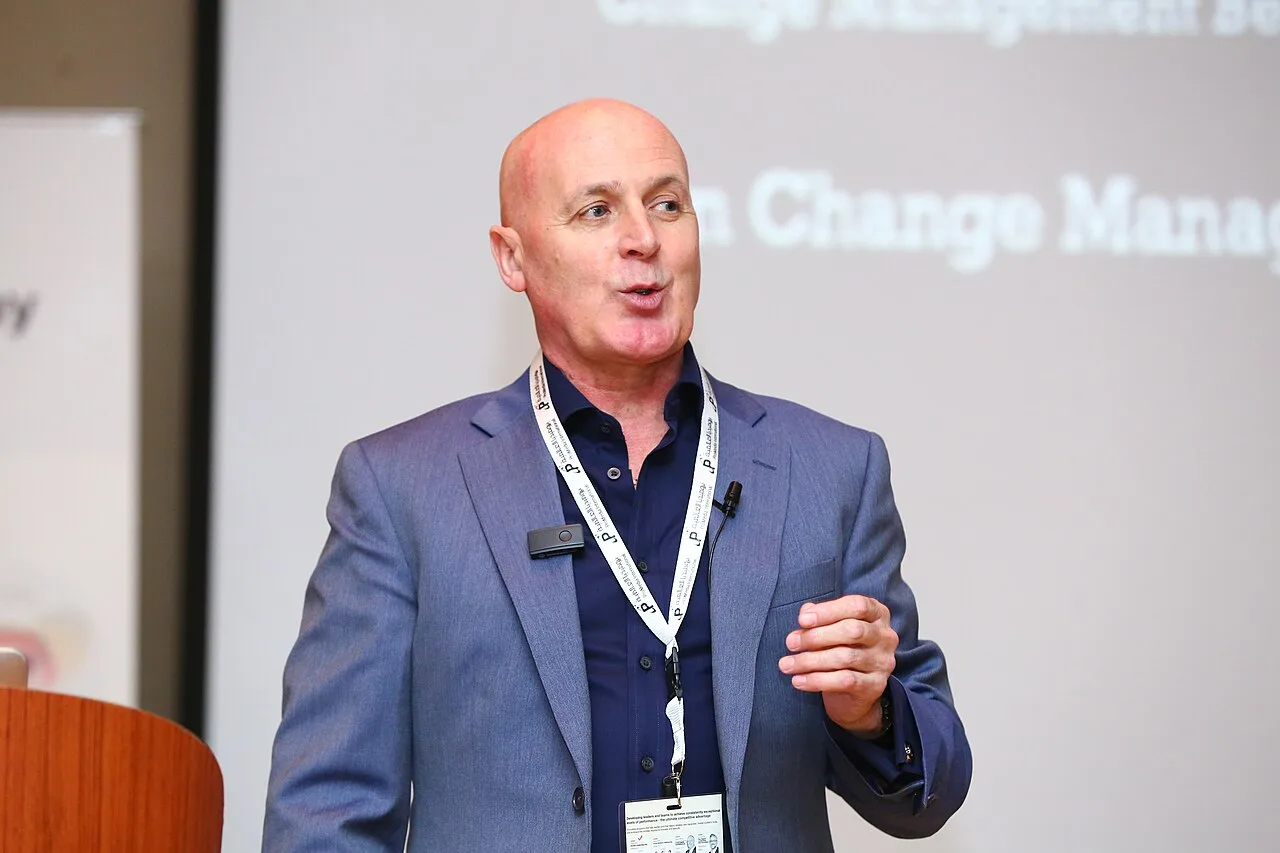
Change management addresses the human transition required when organizations introduce new systems, processes, structures, or behaviors. It differs from project management by focusing on resistance, adoption, capability building, and the gap between technical deployment and changed practice. Successful change management treats resistance as information, relies on leaders modeling desired behavior, and recognizes that psychological adjustment takes longer than an implementation announcement.
Organizations change constantly, but they transform rarely, and transforming successfully is startlingly difficult. A widely repeated claim holds that McKinsey research has consistently found "70% of large-scale organizational change initiatives fail." That specific figure does not trace back to any real McKinsey study; it appears to originate from an unsupported line in a 2000 Harvard Business Review article, not from McKinsey's own survey data.
McKinsey's actual published transformation research (including a 2008/2009 survey of more than 3,000 executives) paints a somewhat different picture: roughly one in three transformations succeed, a lower success rate than most executives would like, but a more nuanced story than a flat "70% fail."
New systems get implemented but not used. Restructurings are announced but the old power structures reassert themselves. Cultural change programs produce new language without new behavior.
The discipline designed to improve these odds is change management: the structured approach to guiding individuals, teams, and organizations from a current state to a desired future state.
It differs from project management, which handles the technical implementation, by focusing specifically on the human side of change: why people resist it, what they need to embrace it, and how to design transitions that produce real adoption rather than nominal compliance.
Understanding change management is valuable not only for executives and HR professionals but for anyone leading a team, implementing a new process, or trying to understand why good ideas fail to take hold.
What Change Management Actually Addresses
A common failure in organizational change is treating it as a technical problem: design the new system, implement it, train people, done. This works for simple, low-impact changes. It fails for complex changes that require people to work differently, let go of familiar practices, or accept losses of status, autonomy, or certainty.
Change management adds structure to three problems that technical implementation ignores:
The psychological transition. William Bridges, in Managing Transitions (1991), made a crucial distinction: change is situational (the new system is live on Monday), while transition is psychological (the process of letting go of the old way and embracing the new one).
People do not resist change; they resist transition. A change can happen in an instant; the transition it requires takes much longer and cannot be compressed simply by communicating more loudly or frequently.
The adoption gap. Technology implementations, process redesigns, and organizational restructurings are often measured by deployment success (was the system installed? was the announcement made?) rather than adoption success (are people actually using it differently?)
The adoption gap between technical deployment and behavioral change is where value is lost and where change management focuses.
Resistance as information. Resistance to change is often treated as an obstacle to overcome. The more productive framing is that resistance is information about what the change is costing people and what concerns have not been addressed.
Leaders who treat resistance as a signal rather than a problem gain insight that helps them refine the change or improve the conditions for adoption.
Why Change Fails: The McKinsey Evidence
McKinsey has run this research repeatedly over the years, most notably a large-scale survey of executives fielded in 2008 and published in 2009. The survey is real, but the specific breakdown of failure causes and success multipliers that often circulate alongside it (precise percentages, "three times more likely," and similar figures) cannot be confirmed against any locatable McKinsey publication, so they are not reproduced here as exact statistics.
What is well documented across McKinsey's transformation research, in broad terms rather than precise percentages, is that resistance from employees and unsupportive behavior from managers are consistently identified as the leading causes of failure, more so than inadequate resources or other structural barriers. These are human and cultural factors, not technical ones.
Organizations that treat change management as secondary to technical implementation are specifically underinvesting in the dimensions that determine whether transformations succeed.
McKinsey's research also points to consistent correlates of success: transformations tend to fare better when senior leaders visibly model the behaviors they are asking of others, and when the organization invests in capability building, teaching people the new skills the change requires, rather than assuming skills will develop on their own.
The Hidden Costs of Failed Transformation
The financial impact of failed change initiatives is rarely measured but substantial.
Prosci's benchmarking research, including its long-running Best Practices in Change Management studies, has repeatedly found that organizations with weaker change management capability spend substantially more on change initiatives overall than those with mature capabilities.
This is largely due to rework, delayed adoption, and the productivity losses of prolonged transition periods, though a precise "two to three times" multiplier could not be confirmed in Prosci's published materials.
The intangible costs are equally significant. Failed transformations erode trust in leadership, increase cynicism about future initiatives ("here we go again"), and create a cultural debt that compounds over time.
Organizations with a history of poorly managed change find each subsequent transformation harder: employees have learned not to invest in changes that have historically been reversed or abandoned.
Multiple studies from research organizations including IBM's Institute for Business Value have examined the link between change management maturity and financial performance, generally finding that organizations with stronger change capability outperform peers financially, though a specific "30% higher financial performance, top versus bottom quartile" study could not be located in IBM's published research.
Directionally, this is consistent with the broader pattern in the field: change management competence functions as a genuine strategic differentiator, even where precise figures vary or are difficult to verify across studies.
Kotter's 8-Step Model: The Most Influential Framework
John Kotter, a Harvard Business School professor, spent years studying why change initiatives succeed and fail before publishing Leading Change in 1996. His 8-step model is the most widely cited change management framework, applied in organizations globally:
Step 1: Create a Sense of Urgency
Change requires energy, and energy requires urgency. Kotter found that the most common early failure is underestimating how much complacency exists in organizations and how much urgency is required to overcome it.
Urgency is not panic or manufactured crisis; it is a genuine, widely shared understanding that the status quo is untenable: the cost of not changing is real and increasing.
The best urgency is founded in facts: market data, competitive analysis, customer feedback, or performance trends. Urgency created through emotional manipulation or exaggerated threats backfires when people see through it.
Step 2: Build a Guiding Coalition
No single leader, however powerful, can drive large-scale organizational change alone. Successful transformations require a coalition of influential people who are committed to the change, credible to different constituencies in the organization, and willing to work together across traditional silos.
The coalition is not the same as the project steering committee. It needs genuine champions, not nominal sponsors. And it needs to represent the real organizational influence map, which often differs from the formal hierarchy.
Step 3: Form a Strategic Vision and Initiatives
Change needs a clear, compelling destination. Kotter's model distinguishes between a vision (an aspirational description of where the organization is going) and initiatives (the specific projects that will take it there).
Both matter: vision without concrete initiatives is vague aspiration; initiatives without a compelling vision are a disconnected project list.
The vision must be communicable in under five minutes to be useful. If it takes a slide deck to explain where the organization is going and why, the vision has not been distilled into its essential form.
Step 4: Enlist a Volunteer Army
Transformations that rely solely on top-down mandate produce compliance without commitment. Sustainable change requires broad energy from people throughout the organization who understand and share the vision.
Kotter's later work (particularly Accelerate, 2014) emphasized that organizations need a "volunteer army": people who engage with change because they believe in it, not just because they were told to.
Enlisting volunteers requires creating participation opportunities: change ambassador networks, co-design of implementation details, piloting with early adopters who become advocates.
Step 5: Enable Action by Removing Barriers
Even people who are genuinely committed to a change will fail if the organization's structures, processes, and systems are misaligned with the new direction.
Change leaders must actively identify and remove barriers: outdated incentive structures that reward the old behavior, technological constraints that make the new process harder, or managers who use their positional authority to undermine the change.
Step 6: Generate Short-Term Wins
Large transformations unfold over years. Without intermediate milestones, change initiatives lose momentum as the gap between current reality and the aspirational future vision grows discouraging.
Short-term wins are planned, meaningful, visible improvements that demonstrate the change is working and build the credibility of the change effort.
Short-term wins are not just morale boosters: they provide evidence that counters skeptics, justify continued investment, and give the guiding coalition concrete examples to build on.
Step 7: Sustain Acceleration
The most dangerous period in a transformation is after the first visible successes. Declaring victory too early and releasing the pressure allows the organization to drift back toward old patterns.
Kotter's model emphasizes that the initial wins should be used to accelerate the next round of change, using credibility built by early successes to tackle bigger, harder changes.
Step 8: Institute the Change
Change is not complete when it is implemented; it is complete when it is embedded in the organization's culture and identity, when people talk about it as "how we do things here" rather than "that new initiative." Institutionalization requires connecting the change to performance systems (rewards, promotions, resource allocation) and ensuring that the leaders who modeled the new behaviors are recognized and advanced.
Prosci ADKAR: A Complementary Individual-Level Model
Kotter's model operates at the organizational level. Prosci's ADKAR model, developed by Jeff Hiatt, operates at the individual level: it describes what must happen within each person for change to succeed.
ADKAR is an acronym:
- A: Awareness: Does the person understand why the change is happening?
- D: Desire: Do they want to support and participate in the change?
- K: Knowledge: Do they know how to change, including what skills and behaviors are required?
- A: Ability: Can they actually demonstrate the required skills and behaviors?
- R: Reinforcement: Is the new behavior being reinforced after the change?
The power of ADKAR is diagnostic. When an individual is struggling with a change, you can identify precisely where they are blocked.
Someone who understands why the change is happening (has Awareness) but does not want to support it (lacks Desire) needs a different intervention than someone who wants to support the change but does not know how (lacks Knowledge).
| ADKAR Component | Symptom of Absence | Typical Intervention |
|---|---|---|
| Awareness | "I don't understand why this is changing" | Communication: reasons, context, consequences of not changing |
| Desire | "I don't want to change" | Engagement: address concerns, involve in design, incentives |
| Knowledge | "I don't know how to do this" | Training, coaching, job aids |
| Ability | "I'm trying but struggling" | Practice, mentoring, performance support |
| Reinforcement | "We changed for a while but drifted back" | Recognition, accountability systems, measurement |
ADKAR is particularly useful for managers implementing changes with their teams because it gives them a structured way to have individual conversations about where people are and what support they need, rather than assuming the change has been adopted because it was announced.
Using ADKAR in Practice: A Real-World Example
Consider a financial services firm implementing a new CRM system. Using the ADKAR lens, the change management team might discover:
- Front-line advisors lack Awareness: they have heard the system is changing but do not understand why the current system is being replaced or what problem the new one solves
- Branch managers have Awareness and Desire but lack Knowledge: they understand the need but have not received adequate training
- A subset of experienced advisors have all of A, D, and K but lack Ability: they attended training but the system's interface is confusing and they struggle under time pressure with clients
- Early adopters who mastered the system are starting to drift because Reinforcement is absent: managers are not tracking adoption and the old workarounds are still permitted
Each of these gaps requires a different intervention. Treating the whole population with more training ignores the real distribution of barriers and wastes resources on interventions that will not move the needle.
Prosci's 2023 benchmarking report, which analyzed data from over 2,000 change projects across 70 countries, found that organizations that used a structured change management methodology were six times more likely to meet project objectives than those without.
Resistance: Information, Not Obstacle
The most common change management mistake is treating resistance as an enemy to overcome rather than a signal to investigate.
Resistance has causes. People resist changes for understandable reasons:
- Loss: The change requires giving up something they value, such as status, familiar routines, relationships, expertise, or autonomy.
- Uncertainty: The future state is unclear, and uncertainty is inherently threatening.
- Distrust: Past changes were poorly managed or betrayed commitments, creating reasonable skepticism about this one.
- Disagreement: The person believes the change is genuinely a bad idea and the concerns have not been adequately addressed.
Each of these causes requires a different response. Resistance driven by loss cannot be addressed with more communication about the benefits; it needs acknowledgment of what is being lost and support for the transition.
Resistance driven by distrust cannot be addressed with more assurances; it needs consistent follow-through over time to rebuild credibility.
"Resistance is the immune system of the organization: it exists for reasons, and suppressing it without understanding it is as dangerous as suppressing a fever without treating its cause."
Leaders who genuinely engage with the concerns driving resistance (not as a manipulation technique but as honest inquiry) frequently discover legitimate issues with the change design that can be addressed, improving both the quality of the change and the likelihood of adoption.
Mapping the Resistance Landscape
Before launching a major change initiative, experienced change managers conduct a stakeholder resistance analysis, systematically identifying which groups are most at risk of resistance and why.
A typical resistance map plots stakeholders on two dimensions: level of influence (how much power they have to block or enable the change) and current disposition (from active opposition to active support).
The quadrant that requires the most immediate attention is high-influence stakeholders with negative or uncertain disposition: these are the change blockers who can derail an initiative despite widespread support elsewhere.
| Stakeholder Disposition | High Influence | Low Influence |
|---|---|---|
| Active supporter | Leverage as change champion | Engage as ambassador |
| Passive | Convert with engagement | Inform and include |
| Skeptical | Priority engagement, address concerns directly | Monitor and include |
| Active opponent | Critical: understand concerns, consider co-design | Manage impact on others |
The goal is not to manufacture false enthusiasm. It is to understand which resisters have legitimate concerns that might improve the change, which resisters are protecting interests worth acknowledging, and which resisters are genuinely wrong about the merits and need a different kind of engagement.
The Individual Transition Curve
William Bridges' transition model describes the psychological journey individuals make through change. Based on his earlier work on life transitions, Bridges identified three zones:
Endings: The first requirement of any change is letting go of the current state. This involves loss: of familiar ways, comfortable expertise, established relationships, or a clear sense of identity.
Organizations that rush through this phase, eager to get to the new beginning, leave people unable to commit to the future because they have not properly processed the loss.
The Neutral Zone: The uncomfortable middle ground after the old way has ended but before the new way has been established. This is the most dangerous and most generative phase. Productivity often dips; anxiety is high; people are vulnerable to abandoning the change.
It is also the phase of greatest creativity and adaptation if leaders create the conditions for it.
New Beginnings: When people start to internalize the new identity, build new competencies, and commit to the new direction. New beginnings cannot be forced or scheduled; they emerge from the successful navigation of the previous two phases.
The Grief Curve and the Elisabeth Kubler-Ross Connection
Bridges' model has parallels with the change curve model adapted from Elisabeth Kubler-Ross's work on grief (originally applied to terminal illness). In organizational change contexts, the curve describes a predictable emotional journey:
Shock and denial (the announcement) → Anger and frustration (the reality of what is required) → Bargaining (attempts to find alternatives or compromises) → Depression and uncertainty (the neutral zone, when old anchors are gone) → Acceptance and integration (the beginning of genuine adoption)
Understanding that these emotional phases are normal and predictable allows change leaders to design appropriate support at each stage rather than being surprised when people do not immediately embrace a change that was clearly explained and well-designed.
Organizational vs Individual Change
Change management operates simultaneously at two levels that require different approaches:
Organizational change involves the structures, processes, systems, culture, and strategy of the organization. It requires strategic clarity, leadership alignment, resource allocation, and system redesign. Kotter's model primarily operates at this level.
Individual change involves the knowledge, skills, attitudes, and behaviors of each person. It is ultimately the aggregate of individual changes that constitutes organizational change. ADKAR operates at this level.
The most common failure is investing heavily in organizational change (new org structures, new systems, new strategies) while underinvesting in individual change (the transitions each person must make to actually work differently). You can restructure an organization on paper without changing what anyone actually does on Tuesday morning.
Digital Transformation: Change Management at Scale
One of the most consequential applications of change management in the 2020s is digital transformation: the sweeping technological and organizational changes involved in shifting to cloud-based operations, data-driven decision-making, and digitally mediated customer experiences.
Digital transformation fails at particularly high rates. McKinsey's survey research on digital transformations, most clearly documented in a 2018 report, found that fewer than 30% of digital transformation efforts succeeded in achieving their goals; a widely cited later McKinsey figure put the share that achieved and sustained performance improvement even lower, around 16%.
Analyses attributing the high failure rate to underinvestment in the human and organizational dimensions, relative to technology selection and implementation, are common in the change management and digital transformation literature.
The patterns are predictable: a new enterprise system is selected and implemented by a small technology team, rolled out with insufficient user training, resisted by employees who were not consulted during selection, and ultimately abandoned or used in workaround ways that eliminate its intended benefits.
Effective digital transformation applies change management from the earliest stages of technology selection: involving end users in requirements definition, and building adoption planning into the project budget.
Practitioners commonly suggest that a meaningful share of a technology project's budget, sometimes cited in the range of 10-20%, should support change management activities, though this is more a rule of thumb used in the field than a figure traceable to one specific study. Adoption metrics should also be measured alongside deployment milestones.
Change Management in Practice: What Actually Works
Research from Prosci's benchmarking studies, drawing on data from thousands of change projects, identifies the factors most strongly correlated with change success:
Active and visible sponsorship by the primary senior leader is the single most important success factor.
Not nominal endorsement ("I signed off on the project charter") but visible, ongoing engagement: speaking about why the change matters, participating in launch events, removing barriers when they arise, and being seen to work differently.
Structured change management process applied from the beginning of the project, not added as a communication campaign at the end.
Dedicated change management resources: people who own the adoption and commitment dimensions of the change, with enough time and authority to do the work.
Employee engagement and participation in designing how the change is implemented (not whether it happens, but how it happens in their context).
Measurement and tracking of adoption and behavior change alongside technical deployment metrics.
The Change Management ROI Question
Organizations frequently ask whether change management investment pays off in measurable terms. The evidence is consistent: yes, significantly.
Prosci's benchmarking research has found that projects with excellent change management substantially outperform those with poor change management on the outcomes that matter most, commonly cited as being around six times more likely to meet or exceed project objectives and roughly five times more likely to stay on schedule, with a smaller though still meaningful advantage on staying within budget.
The investment required for structured change management typically runs 3-8% of total project cost for a mid-sized initiative. Against the documented improvement in project success rates and the avoided costs of failed adoption, the ROI is substantial in most realistic scenarios.
Towers Watson (now WTW) has run several waves of research on change and communication effectiveness over the years, consistently finding that companies with highly effective change and communication practices were substantially more likely to outperform peers financially. In some waves this was cited as roughly 3.5 times more likely to significantly outperform, with other waves reporting double-digit percentage differences in shareholder returns.
This correlation does not isolate change management from the broader organizational capabilities it reflects, and the exact figures vary by study year.
Building Organizational Change Capability
The goal for mature organizations is not just to manage individual changes better; it is to build organizational change capability: the institutional skill to manage change effectively as a recurring organizational competency rather than as an extraordinary event.
Organizations with high change capability share several characteristics identified by the Center for Creative Leadership in their 2023 research:
- Change management infrastructure: Dedicated change management practitioners, shared methodologies, and centers of excellence
- Leadership development: Executive and management development programs that include change leadership skills
- Lessons learned processes: Systematic capture and reuse of insights from previous change initiatives
- Change readiness assessment: Regular evaluation of the organization's current capacity and appetite for change, used to calibrate the pace and scope of new initiatives
- Resilience culture: A broader organizational culture that treats uncertainty and adaptation as normal rather than threatening
Building this capability is itself a change management challenge. Organizations that successfully develop institutional change competence tend to have had a catalytic failure (a major change initiative that failed visibly and expensively) that created sufficient urgency to invest in the underlying capability.
The most effective path is using the post-mortem of a failed transformation to build the case for systematic capability development.
Summary
Change management is the discipline of taking the human side of organizational change as seriously as the technical side. It addresses the psychological transitions individuals must make, the resistance that emerges from legitimate concerns and real losses, and the conditions that allow adoption to become embedded rather than superficial.
The 70% change failure rate is not inevitable. It reflects the systematic underinvestment in the change management activities that research consistently identifies as the primary determinants of success: visible leadership modeling, active management of resistance as information, deliberate individual-level transition support, and the discipline to sustain pressure for long enough that new behaviors become new habits.
The most useful frameworks, Kotter's 8-step model for organizational change leadership and Prosci's ADKAR for individual-level diagnosis, address different but complementary questions. Used together, they provide both the strategic roadmap and the individual-level diagnostic capability that successful transformations require.
The emerging imperative is not just better change management for individual initiatives, but the development of organizational change capability as a strategic asset: the ability to continuously adapt at the speed markets and technologies require, without the predictable costs of initiatives that deploy new capabilities without embedding new behaviors.