
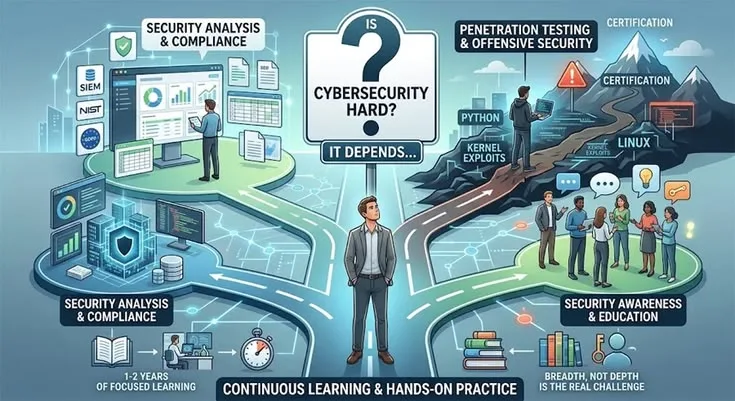
Both paths offer demanding technical work and strong prospects, but their daily responsibilities, culture, progression, and fit differ substantially. Choosing cybersecurity or software engineering calls for looking beyond salary and overlap in skills to the kind of work a person will actually do.
Software engineering and cybersecurity are the two most prominent technical career paths of the past decade, and they overlap enough in skill requirements and employment context that candidates frequently face a genuine choice between them.
Both fields offer strong salaries, significant intellectual challenge, continuous learning demands, and excellent long-term employment prospects. Both are increasingly central to how organisations operate.
And yet the day-to-day work, the cultural context, the career progression structures, and the personal characteristics that predict success differ enough to make the comparison genuinely meaningful.
The choice is further complicated by the way both fields are marketed to career changers. Software engineering has a well-established pipeline - computer science degrees, coding bootcamps, portfolio projects, interview preparation resources - that makes the entry path feel navigable even when the process is gruelling.
Cybersecurity is equally well-marketed but less clearly structured: the certification ecosystem is vast, the range of specialisations is confusing for newcomers, and entry-level roles often have requirements that create genuine catch-22 situations.
A clear-eyed comparison requires setting aside the marketing and looking at what each career actually delivers across multiple dimensions: compensation at each level, growth trajectory, work culture, work-life balance, entry difficulty, AI impact, and the realistic path into each field.
This article compares cybersecurity and software engineering across those dimensions with current data, addresses the significant overlap between them that creates useful switching pathways, examines the hybrid roles that combine both disciplines at premium compensation, and provides a practical framework for choosing between them based on existing skills, working preferences, and long-term goals.
It also covers the frequently neglected question of burnout - both fields have it, in different forms, for different reasons.
"Security and software engineering are not competing disciplines - they are the same discipline conducted at different phases of the system lifecycle.[7] The best security engineers are excellent software engineers who have chosen to focus on failure modes." - Google SRE, 'Building Secure and Reliable Systems,' 2020
Key Definitions
Application Security (AppSec): The cybersecurity specialisation focused on securing software applications. AppSec engineers review code for vulnerabilities, work with development teams to implement secure development practices, and conduct application-level security testing.[8]
This role sits directly at the intersection of software engineering and security.
DevSecOps: The integration of security practices into DevOps workflows. DevSecOps engineers build security tooling into CI/CD pipelines, automate vulnerability scanning, and bridge the cultural gap between development velocity and security requirements.
Penetration Testing (Pen Testing): Authorised security testing that simulates real-world attacks against applications, networks, or infrastructure. Application pen testers need deep software engineering knowledge to understand and exploit the vulnerabilities they find.
Security Operations Centre (SOC): A team responsible for monitoring, detecting, and responding to security incidents in real time. SOC analysts are often the entry-level role in defensive security. The work is shift-based and high-pressure.
Bug Bounty: A programme where companies pay external researchers for reporting security vulnerabilities before malicious actors find them. Software engineers who understand web application architecture are well-positioned because they can identify and exploit vulnerabilities at the code and logic level, not just the network level.
Threat Modelling: The structured analysis of a system to identify potential attack vectors and their likely impact. A practice that requires both security knowledge and software systems understanding.
Cybersecurity vs Software Engineering: Side-by-Side Comparison
| Dimension | Software Engineering | Cybersecurity (overall) | Cybersecurity (specialist roles) |
|---|---|---|---|
| US median salary (BLS 2024) | $132,270 | $120,360 | $155,000-$200,000+ |
| Entry-level salary range | $85,000-$105,000 | $65,000-$82,000 (SOC analyst) | Varies by specialisation |
| Senior-level salary range | $155,000-$220,000 | $155,000-$200,000 | $175,000-$250,000 (AppSec, cloud security) |
| FAANG / elite tier total comp | $350,000-$700,000+ (RSUs) | $250,000-$500,000 (security engineers) | Variable |
| BLS projected job growth (2022-2032) | 26% | 32% | - |
| Open job postings (US, 2024) | ~350,000 | ~265,000 | - |
| Unfilled positions globally (ISC2, 2024) | - | 3.5 million | - |
| Typical degree requirement | CS, CE, or bootcamp | IT, CS, or certifications | Certification-heavy |
| Primary entry paths | CS degree, bootcamp, portfolio | Helpdesk-to-SOC, certifications, CS degree | OSCP, CISSP, cloud certifications |
| Interview format | LeetCode, system design | Scenario-based, cert knowledge, hands-on | CTF performance, tooling knowledge |
| Remote work availability | Very high | High (varies by role) | High for AppSec, GRC; lower for SOC |
| Shift work / on-call | Minimal (product on-call) | Heavy in SOC/IR roles | Low in AppSec, GRC |
| Burnout rate | 30-35% report concern | 47% report serious concern (ISC2, 2023) | Lower in non-operational roles |
| AI displacement risk | Moderate (code generation) | Low-moderate | Low (adversarial judgment) |
| Career ceiling | Staff/Principal Engineer, VP Engineering | CISO, VP Security | Director of Security Engineering |
| Ease of entry from zero | High (bootcamp pipeline) | Low-moderate (experience required) | Low (years + certifications) |
Salary Comparison: The Honest Numbers
Headline salary comparisons between these fields are frequently misleading because they compare median job categories rather than equivalent experience levels and specialisations. The nuanced picture:
Software Engineering (US, 2024):
| Level | National Median | Major Tech Market | FAANG Total Comp |
|---|---|---|---|
| Entry-level (0-2 years) | $85,000-$105,000 | $100,000-$130,000 | $150,000-$200,000 TC |
| Mid-level (3-6 years) | $120,000-$160,000 | $140,000-$185,000 | $250,000-$350,000 TC |
| Senior (7+ years) | $155,000-$220,000 | $185,000-$250,000 | $350,000-$550,000 TC |
| Staff / Principal (10+ years) | $200,000-$280,000 | $240,000-$350,000 | $500,000-$750,000 TC |
Cybersecurity (US, 2024):
| Role / Level | Salary Range | Notes |
|---|---|---|
| SOC Analyst L1 (entry) | $55,000-$78,000 | Shift work, high volume |
| SOC Analyst L2/L3 | $80,000-$110,000 | Incident handling, threat hunting |
| Security Engineer (mid) | $110,000-$155,000 | Cloud security, AppSec, detection engineering |
| Senior Security Engineer | $155,000-$210,000 | Architecture-level decisions |
| AppSec Engineer (senior) | $165,000-$225,000 | Commands premium for SWE + security overlap |
| Cloud Security Architect | $175,000-$240,000 | High demand, scarce supply |
| Pen Tester / Red Team Lead | $130,000-$190,000 | Consulting rates can exceed these |
| CISO (large enterprise) | $300,000-$700,000+ | Executive total comp including equity |
The honest summary: software engineering has a higher floor at entry level and a higher ceiling through equity at top-tier tech companies.[3] Cybersecurity matches or exceeds software engineering at the specialised technical level (AppSec, cloud security, offensive security) and exceeds it substantially at the executive level (CISO).[4]
The entry-level gap ($65,000-$82,000 SOC analyst vs $85,000-$105,000 junior software engineer) is real and meaningful for people making career decisions, but specialist cybersecurity roles at mid-career are fully competitive.
Source: US Bureau of Labor Statistics Occupational Outlook Handbook 2024; Levels.fyi 2024; SANS Salary Survey 2024.
Job Market and Growth Projections
The US Bureau of Labor Statistics projects software developer and QA analyst employment to grow 26 percent from 2022 to 2032, adding approximately 411,400 new jobs.[1]
Information security analyst employment is projected to grow 32 percent over the same period - faster than software engineering, faster than nearly every other occupational category, and faster than the rate needed to fill the talent gap.
The ISC2 2024 Cybersecurity Workforce Study estimated a global shortage of 3.5 million cybersecurity professionals.[2] This shortfall has been persistent and has not closed significantly despite a decade of industry investment in workforce development.
The structural reason is demand growing faster than supply at every level of the talent pipeline.[10]
Software engineering faces a different structural challenge. AI-assisted code generation (GitHub Copilot, Cursor, Claude, Gemini) is creating genuine productivity multipliers that reduce the headcount needed for certain categories of development work - particularly routine code generation, boilerplate, simple feature implementation, and test writing.[9]
The premium is shifting toward complex system design, code review and quality oversight, and directing AI-generated code rather than writing all code from scratch.[11] This is not mass displacement, but it is a real structural shift in what software engineers are paid for.
Cybersecurity is less exposed to this shift. Security work requires adversarial thinking, contextual judgment, understanding attacker motivation and capability, and the kind of creative problem-solving in ambiguous situations that current AI systems cannot reliably replicate without human oversight.
Defensive security decision-making in real incidents requires trust and accountability that organisations are not currently willing to delegate to automated systems.
Projection summary: Both fields have strong outlooks. Cybersecurity has structurally stronger employment growth and less near-term AI displacement pressure. Software engineering has a larger absolute job market and stronger equity compensation upside at top-tier companies.
Skill Overlap and the Switching Paths
The overlap between the two disciplines is substantial enough that switching is genuinely feasible in both directions with appropriate preparation. Understanding the overlap also explains why hybrid roles command premiums.
Skills that transfer from software engineering to cybersecurity:
- Programming competence (Python, scripting languages) - essential for security automation, tooling development, and malware analysis
- Understanding of web application architecture - required for AppSec and web pen testing
- API and database knowledge - enables understanding of injection attacks, authentication flaws, API security
- Systems thinking and debugging methodology - applicable to incident investigation and root cause analysis
- DevOps and CI/CD experience - directly applicable to DevSecOps
- Software design patterns knowledge - enables threat modelling and secure architecture review
Skills that transfer from cybersecurity to software engineering:
- Network and protocol understanding
- Operating system internals knowledge (especially Windows and Linux internals)
- Risk thinking and failure mode analysis (useful in software reliability engineering)
- Regulatory and compliance awareness (useful in fintech, healthcare SWE roles)
- Understanding of authentication systems (OAuth, SAML, FIDO2) - valuable for identity-adjacent engineering
Skills that do NOT transfer easily in either direction:
- Statistical methods and ML (SWE to data engineering or ML engineering)
- SIGINT and signals analysis (very specialised security)
- Formal computer science theory (relevant for some SWE interview preparation, not security)
Realistic switching timelines:
A software engineer switching to cybersecurity (targeting AppSec or security engineering) can realistically make the transition in 6-12 months with structured study, a OSCP or cloud security certification, CTF practice, and a focused job search targeting roles that explicitly value development background.
The transition is among the smoothest possible because software engineers arrive with the hardest-to-teach part already done.
A cybersecurity professional targeting software engineering needs to build a demonstrable development portfolio. This is achievable but typically takes 12-18 months for professionals who write code regularly (AppSec, DevSecOps) and 18-24 months for those in more operational roles (SOC, GRC).
The portfolio must include completed, testable software projects, not just security tools or scripts.
Hybrid Roles: The Highest-Value Intersection
The roles at the intersection of software engineering and cybersecurity consistently command salary premiums over either discipline in isolation.[6] They are also the most defensible long-term positions against AI displacement because they require judgment that spans two complex domains.
| Role | Primary Skills Required | Median US Salary (2024) | Growth Outlook |
|---|---|---|---|
| Application Security Engineer | Software development + OWASP + threat modelling | $135,000-$185,000 | Very high |
| DevSecOps Engineer | CI/CD + security tooling + cloud | $130,000-$180,000 | Very high |
| Security Software Engineer | SWE + security tooling development | $140,000-$190,000 | High |
| Detection Engineer | SIEM + scripting + threat intelligence | $120,000-$165,000 | High |
| Malware Analyst / Reverse Engineer | Assembly + debugging + binary analysis | $130,000-$200,000 | Moderate |
| Cloud Security Architect | Cloud platforms + IAM + security architecture | $175,000-$250,000 | Very high |
| Bug Bounty Researcher (independent) | Web hacking + code review + report writing | $50,000-$500,000+ | Variable |
Application security engineering is the most accessible hybrid entry point for software engineers moving toward security. The role involves reviewing application code for vulnerabilities, working alongside development teams in the SDLC, running SAST/DAST tooling, and conducting manual code review.[12]
The compensation premium over either a pure developer or a pure security analyst reflects the scarcity of people who can do both competently.
Work Culture and Burnout: The Real Comparison
The most significant qualitative difference between the two careers at the operational level is in on-call expectations, adversarial pressure, and the psychological experience of the work.
Software engineering typically operates on business-hours schedules with on-call rotations for production incidents. On-call in mature software engineering teams is often light - a few incidents per quarter - with post-incident reviews and engineering investment to reduce future paging frequency.
Remote work is highly normalised. The cultural environment emphasises autonomy, personal productivity, and asynchronous communication.
Cybersecurity varies enormously by specialisation. SOC and incident response roles often involve rotating shifts including nights and weekends, 24/7 on-call rotations, and irregular hours during active incidents that cannot wait for business hours.
Application security, cloud security, and governance/risk/compliance (GRC) roles more closely resemble software engineering in schedule quality. But any role adjacent to security operations - and most blue team roles are - carries substantially more schedule pressure than equivalent software engineering positions.
The burnout statistics are notable: ISC2's 2023 Cybersecurity Workforce Study found 47 percent of cybersecurity professionals reported burnout as a serious concern, compared to 30-35 percent in comparable surveys of software engineering professionals.[5]
The difference is attributable primarily to three factors: SOC and incident response shift patterns; the perpetual adversarial pressure of defending against motivated attackers who innovate continuously; and understaffing driven by the skills gap, which means individuals carrying workloads designed for larger teams.
Burnout in software engineering is real but typically attributable to different causes: unrealistic delivery deadlines, excessive on-call load at high-growth companies, or extended periods of technical debt remediation. These are often more amenable to organisational intervention than the structural understaffing of security teams.
Assessment: If schedule predictability and work-life balance are top priorities, software engineering is the safer choice. AppSec, cloud security, and GRC roles within cybersecurity can match software engineering in schedule quality. Operational security roles (SOC, IR) are among the highest-burnout positions in the technology industry.
Personality and Interest Framework: Which Field Fits You
Rather than a quiz format (which oversimplifies), a framework of tendencies that genuinely predict fit:
You are likely a better fit for software engineering if:
- You are most energised when you ship something tangible - a feature, a product, a tool that users interact with
- You prefer building new systems over investigating broken or malicious ones
- Schedule predictability is a non-negotiable requirement for your life circumstances
- You are interested in working at top-tier tech companies where engineering equity compensation peaks
- You find the structured hiring pipeline (LeetCode, system design) motivating rather than arbitrary
- You are comfortable with work that can feel abstract from end users for extended periods
You are likely a better fit for cybersecurity if:
- You are drawn to adversarial thinking - understanding how systems fail and how attackers exploit them
- You are motivated by defending real people and organisations against real threats
- You have existing IT, networking, or systems administration background that makes the helpdesk-to-SOC pipeline accessible
- You want a career path that can lead to management and executive roles (CISO) with high total compensation
- You are comfortable with ambiguity - investigations often start with incomplete information
- The breadth of specialisations (from highly technical offensive work to management-focused GRC to compliance) appeals to you
You are a natural fit for hybrid roles if:
- You have developed programming skills and find yourself drawn to security questions within software development
- You are frustrated by security teams that cannot speak the language of developers, or development teams that treat security as someone else's problem
- You are willing to invest in both domains in parallel (security certifications alongside software portfolio projects)
The Decision in Practice: A Realistic Assessment
There is no objectively correct answer to whether cybersecurity or software engineering is the better career. Both are excellent choices by most objective criteria. What follows is an honest assessment of which factors should weight the decision.
Weight software engineering more heavily if: you are starting from zero with no prior IT background; your immediate financial situation requires the higher entry-level salary floor; you are unwilling to tolerate the helpdesk pipeline; or you are particularly interested in building consumer products.
Weight cybersecurity more heavily if: you have existing IT experience that makes the entry easier than it would be from zero; you are genuinely motivated by the adversarial and defensive nature of the work (not just by the marketing); or you are interested in a field where the talent shortage means competent practitioners advance faster than in well-saturated software engineering.
Weight hybrid roles most heavily if: you already have one of the two skill sets and are looking to differentiate; you want maximum compensation at the specialist level without taking an executive track; or you are concerned about long-term AI displacement and want to occupy a position that requires two difficult domains simultaneously.
The career market in 2024-2026 favours practitioners who can work across the boundary - security engineers who write production-quality code, and software engineers who understand security deeply enough to build systems that do not require remediation. That boundary is where demand is growing fastest and where supply is most constrained.
Sources & Further Reading
- US Bureau of Labor Statistics, Software Developers and Security Analysts, Occupational Outlook Handbook 2024. bls.gov/ooh
- ISC2 Cybersecurity Workforce Study 2024. isc2.org/research
- Levels.fyi Software Engineering Compensation Data 2024. levels.fyi
- SANS Institute, Cybersecurity Salary Survey 2024. sans.org
- Stack Overflow Developer Survey 2024. stackoverflow.com/insights/survey
- LinkedIn Jobs on the Rise 2024: Top Tech Roles. linkedin.com/pulse
- Google SRE. 'Building Secure and Reliable Systems.' O'Reilly, 2020.
- OWASP Application Security Verification Standard v4.0. owasp.org
- GitHub State of the Octoverse 2024: Developer Trends. github.com/about/octoverse
- CompTIA Cybersecurity Workforce Trends Report 2024. comptia.org
- McKinsey Global Institute. 'The Future of Work in Tech.' McKinsey, 2024. mckinsey.com
- SANS Application Security Curriculum 2024. sans.org/appsec