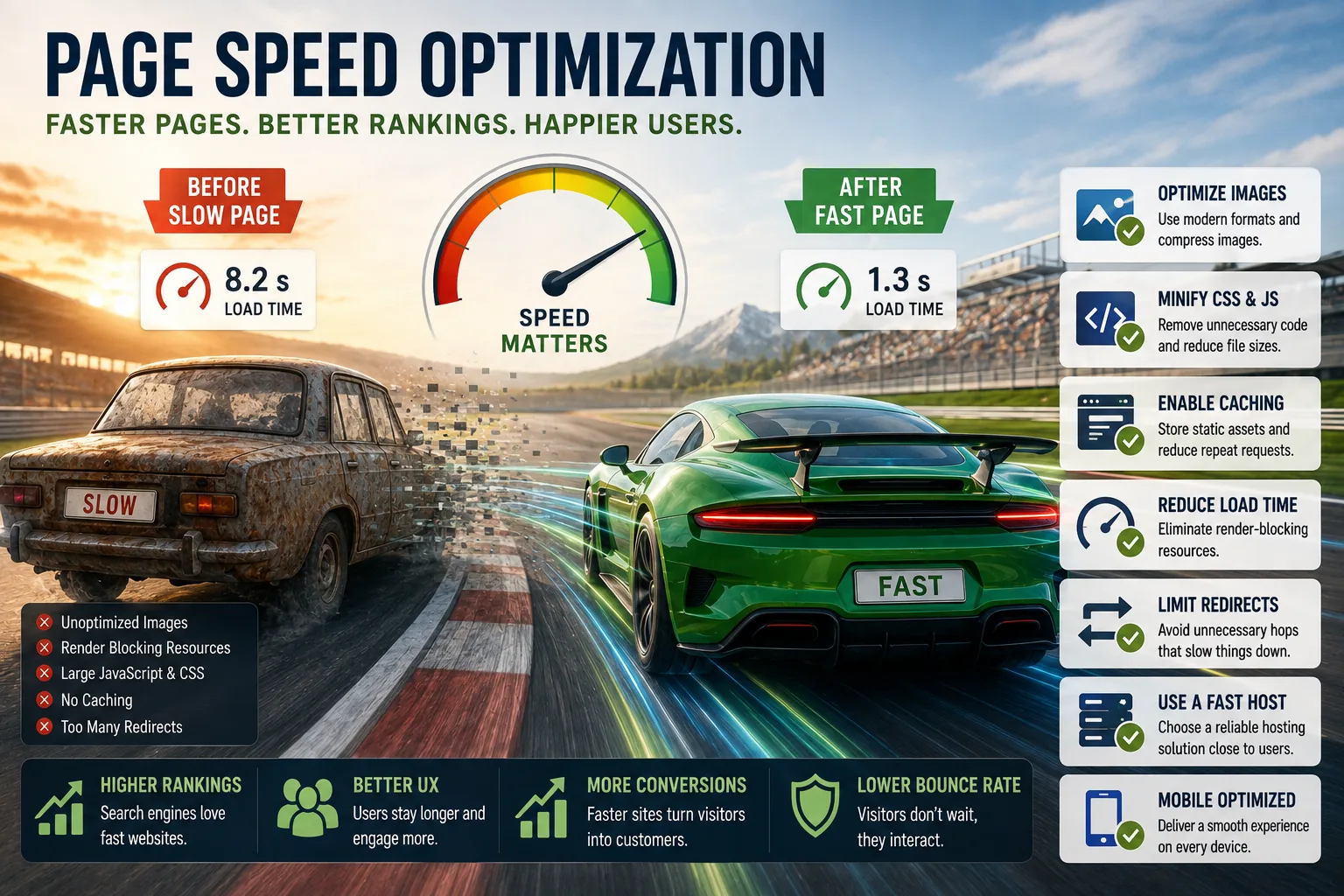
This is a complete, plain-English guide to Core Web Vitals - what each of Google's three metrics (LCP, INP, and CLS) actually measures, why they affect your rankings and your users, and how to read and improve your scores.
What Are Core Web Vitals?
Core Web Vitals are a set of three standardized performance metrics defined by Google that measure the real-world user experience of a web page: Largest Contentful Paint (LCP), which tracks how quickly the main content loads; Interaction to Next Paint (INP), which measures how fast the page responds to user input; and Cumulative Layout Shift (CLS), which quantifies how much visible content moves unexpectedly during loading.[4]
Introduced as ranking signals in 2021, Core Web Vitals are evaluated using field data collected from real Chrome users rather than simulated tests, meaning a page's scores reflect actual visitor experiences across diverse devices and network conditions.
A site passes each metric by reaching Google's defined threshold at the 75th percentile of page visits: under 2.5 seconds for LCP, under 200 milliseconds for INP, and under 0.1 for CLS.
Introduction: When User Experience Became a Ranking Factor
In 2020, Google announced a seismic shift (with the page experience rollout beginning in June 2021) in how it evaluates websites. For decades, SEO focused primarily on content relevance, backlink authority, and technical crawlability. Then Google announced:
"Page experience will become a ranking factor."
Not just whether search engines could access your content, but whether humans enjoy using your site.
This wasn't theoretical. Google introduced Core Web Vitals-three specific, measurable metrics capturing loading speed, interactivity, and visual stability.[1] Sites failing these benchmarks could be outranked by competitors with better user experiences, even if their content was comparable.
The impact was immediate:
The Guardian optimized Core Web Vitals and saw mobile engagement increase 15% and time on page improve significantly.
Economic Times improved their Largest Contentful Paint (LCP) from 4.5 seconds to 2.5 seconds, resulting in a 43% increase in page views and 23% bounce rate reduction.
Vodafone achieved under-2-second LCP and saw an 8% sales increase and 15% improvement in lead-to-visit rates.
Why did Google do this?
Users abandon slow, janky websites. Research consistently shows:
- 53% of mobile users abandon sites taking over 3 seconds to load
- 79% of shoppers who experience poor performance are less likely to purchase again
- Every 100ms delay in load time decreases conversions by ~7%
If Google wants to serve the best results, they can't ignore user experience. A technically perfect, content-rich page that frustrates users with slow loads and layout shifts isn't serving searchers well.
Core Web Vitals measure what matters to users:
- Largest Contentful Paint (LCP): How long until the main content loads?
- First Input Delay (FID) / Interaction to Next Paint (INP): How responsive is the page when I interact?
- Cumulative Layout Shift (CLS): Does content jump around unexpectedly?
This article provides a comprehensive guide to Core Web Vitals: what each metric measures, why it matters, how to diagnose problems, optimization strategies, measurement tools, and how Core Web Vitals fit into broader SEO strategy.
Part 1: Understanding Core Web Vitals
What Core Web Vitals Measure
Core Web Vitals quantify user experience through three specific metrics:
1. Largest Contentful Paint (LCP) - Loading Performance
- Measures: Time until the largest visible content element renders
- Target: Under 2.5 seconds
- Captures: Perceived loading speed
2. First Input Delay (FID) / Interaction to Next Paint (INP) - Interactivity
- FID measures: Delay before browser responds to first user interaction[3]
- FID target: Under 100 milliseconds
- INP measures: Responsiveness to all user interactions (replacing FID in 2024)[5]
- INP target: Under 200 milliseconds
- Captures: How quickly the page responds when users try to interact
3. Cumulative Layout Shift (CLS) - Visual Stability
- Measures: How much visible content shifts position unexpectedly during loading
- Target: Score under 0.1
- Captures: Visual stability and predictability
Why These Three Metrics?
They map to fundamental user frustrations:
LCP → "This page is taking forever to load"
- User arrives, sees white screen or loading spinner
- Waits, gets impatient
- Often abandons before content appears
FID/INP → "I clicked but nothing happened"
- User taps a button or link
- Nothing responds
- Clicks again, still nothing
- Feels broken and frustrating
CLS → "I clicked the wrong thing because content jumped"
- User starts reading or about to click
- Content suddenly shifts down
- Clicks wrong link or loses reading position
- Jarring, makes site feel unreliable
Lab Data vs. Field Data
Understanding the difference is critical:
Lab Data (Synthetic Testing):
- Simulated page loads in controlled conditions
- Tools: Lighthouse, PageSpeed Insights, WebPageTest
- Pros: Consistent, repeatable, immediate feedback
- Cons: Single device/network; may not reflect real users
Field Data (Real User Monitoring):
- Actual measurements from real users visiting your site
- Tools: Chrome User Experience Report (CrUX), Google Analytics, RUM services
- Pros: Real-world data across diverse devices, networks, locations
- Cons: Requires traffic; aggregated over time (slower to update)
For Google rankings, field data matters most. Google uses CrUX (Chrome User Experience Report) data from real Chrome users to evaluate Core Web Vitals.[10] Lab data helps diagnose issues, but field data is your source of truth.
Performance Thresholds
Google defines three performance tiers:
| Metric | Good (Green) | Needs Improvement (Yellow) | Poor (Red) |
|---|---|---|---|
| LCP | 2.5s | 2.5s - 4.0s | > 4.0s |
| FID | 100ms | 100ms - 300ms | > 300ms |
| INP | 200ms | 200ms - 500ms | > 500ms |
| CLS | 0.1 | 0.1 - 0.25 | > 0.25 |
The 75th percentile rule:
Google evaluates at the 75th percentile of page visits. This means 75% of user experiences should achieve "good" scores.
Why 75th percentile, not average?
- Ensures you're optimizing for typical users, not just best-case scenarios
- Accounts for slower devices, poor networks, different geographies
- Prevents gaming the system by optimizing only for ideal conditions
"Speed is not just a feature. Speed is the most important feature."
Fred Wilson
Part 2: Largest Contentful Paint (LCP)
What LCP Measures
LCP identifies when the largest visible element in the viewport renders.[2]
Typical LCP elements:
- Hero images or banners
- Large text blocks or headings
- Video thumbnails
- Background images (with text overlays)
Important: LCP only measures above-the-fold content-what's visible without scrolling. Content below the fold doesn't affect LCP.
Why LCP Matters
LCP captures perceived loading speed. Users judge how fast a page loads by when they can see and engage with the main content, not when the entire page finishes loading.
Research findings:
- Sites with LCP under 2.5s have 70% lower bounce rates than sites over 4s
- Portent found that pages loading in 1 second convert 2.5 better than pages loading in 5 seconds[9]
- For every additional second of LCP, conversions typically drop 7-10%
Common Causes of Poor LCP
1. Slow server response times (TTFB)
Problem: If your server takes 1+ seconds to respond, LCP can't start until then.
Solutions:
- Upgrade hosting: Shared hosting often has slow response times; consider VPS or dedicated servers
- Use a CDN: Content Delivery Networks serve content from servers geographically close to users
- Implement caching: Server-side caching (Redis, Memcached) reduces database queries[15]
- Optimize database queries: Slow queries delay server response
- Edge computing: Use edge functions (Cloudflare Workers, AWS Lambda@Edge) for dynamic content
2. Render-blocking resources
Problem: CSS and JavaScript files that must load before content can display delay LCP.
Solutions:
- Minimize CSS/JS: Remove unused code; compress files
- Defer non-critical JavaScript: Use
deferorasyncattributes - Inline critical CSS: Include CSS needed for above-the-fold content directly in HTML[13]
- Split code: Load only what's needed initially; lazy load the rest
Example:
<!-- Bad: Blocks rendering -->
<script src="large-bundle.js"></script>

<!-- Good: Deferred -->
<script src="large-bundle.js" defer></script>

<!-- Critical CSS inlined -->
<style>
  /* Only styles for above-the-fold content */
  .hero { ...
}
</style>
3. Large, unoptimized images
Problem: The biggest culprit for poor LCP. Uncompressed, oversized images take forever to load.
Solutions:
- Compress images: Use tools like ImageOptim, Squoosh, TinyPNG
- Modern formats: WebP and AVIF are 25-50% smaller than JPEG/PNG with same quality[7]
- Responsive images: Serve appropriate sizes for different devices using
srcset - Lazy load below-the-fold images: But NOT the LCP image (defeats the purpose)
- CDN for images: Faster delivery from geographically distributed servers
Example:
<!-- Optimized image with modern formats and responsive sizes -->
<picture>
  <source srcset="hero-800.avif 800w, hero-1200.avif 1200w, hero-1600.avif 1600w" type="image/avif">
  <source srcset="hero-800.webp 800w, hero-1200.webp 1200w, hero-1600.webp 1600w" type="image/webp">
  <img src="hero-1200.jpg"
       srcset="hero-800.jpg 800w, hero-1200.jpg 1200w, hero-1600.jpg 1600w"
       sizes="(max-width: 800px) 100vw, 1200px"
       alt="Hero image"
       width="1200"
       height="600">
</picture>
4.
Client-side rendering delays
Problem: JavaScript frameworks (React, Vue, Angular) that render content client-side can delay LCP significantly. The browser must:
- Download JavaScript bundle
- Parse and execute JavaScript
- Render content
Solutions:
- Server-Side Rendering (SSR): Generate HTML on the server; content appears immediately
- Static Site Generation (SSG): Pre-build pages at build time (Gatsby, Next.js, Hugo)
- Progressive hydration: Send static HTML first (fast LCP), add interactivity later
- Minimize JavaScript before LCP: Reduce or defer JS that runs before LCP element appears
LCP Optimization Strategies
1. Identify your LCP element
Use Chrome DevTools or PageSpeed Insights to see which element is LCP. Optimize specifically for that element.
2. Preload critical resources
Tell the browser to prioritize fetching your LCP resource:
<!-- Preload LCP image -->
<link rel="preload" as="image" href="hero-image.jpg">

<!-- Preload critical font -->
<link rel="preload" as="font" href="font.woff2" type="font/woff2" crossorigin>
3. Set priority hints
Modern browsers support fetchpriority attribute:
<img src="hero.jpg" fetchpriority="high" alt="...">4. Set explicit image dimensions
Always include width and height attributes so browsers reserve correct space:
<img src="photo.jpg" width="800" height="600" alt="...">This prevents layout shifts and allows browsers to calculate aspect ratio for responsive sizing.
5. Optimize the critical rendering path
Critical rendering path: The sequence of steps browsers take from receiving HTML to rendering pixels on screen.[6]
Optimization:
- Minimize render-blocking resources
- Inline critical CSS
- Defer non-critical JavaScript
- Reduce document size
Real-World LCP Example
Before optimization:
- LCP: 4.8 seconds
- LCP element: Hero image (1.2MB JPEG)
- Bottlenecks: Render-blocking CSS, unoptimized image, slow server
Optimizations applied:
- Compressed image from 1.2MB to 180KB (WebP format)
- Implemented responsive images for different devices
- Preloaded LCP image:
<link rel="preload" as="image" href="hero.webp"> - Inlined critical CSS (1.5KB)
- Deferred non-critical JavaScript
- Upgraded to CDN for faster delivery
After optimization:
- LCP: 1.8 seconds
- Improvement: 62% faster
- Impact: Bounce rate decreased 28%, conversions increased 19%
Part 3: First Input Delay (FID) and Interaction to Next Paint (INP)
Understanding Interactivity Metrics
FID (First Input Delay):
- Measures delay between user's first interaction and browser's response
- Target: Under 100ms
- Status: Replaced by INP in March 2024
INP (Interaction to Next Paint):
- Measures responsiveness of ALL interactions throughout page lifecycle
- Target: Under 200ms
- Status: Official Core Web Vital as of 2024
Why the transition? FID only measured the first interaction, which might not be representative.[8] INP measures all interactions, providing a complete picture of responsiveness.
What These Metrics Measure
The user experience:
- User clicks a button, taps a link, or types in a form
- FID/INP measures: How long until the browser starts processing that interaction?
What delays processing?
JavaScript blocking the main thread. Browsers are single-threaded for JavaScript execution. While JavaScript is running, the browser can't respond to user input.
Example scenario:
- Page loads, executing 300KB of JavaScript
- User tries to click menu button at 1.2 seconds
- JavaScript is still executing (parsing, running)
- Click doesn't register until JavaScript finishes at 1.5 seconds
- FID: 300ms (poor)
Common Causes of Poor FID/INP
1. Large JavaScript bundles
Problem: Loading 500KB+ of JavaScript that must parse and execute blocks interactivity.
Solutions:
- Code splitting: Load only what's needed initially
- Tree shaking: Remove unused code
- Lazy loading: Load additional code as needed
- Dynamic imports:
import('./module.js').then(...)
2. Long-running JavaScript tasks
Problem: Any JavaScript task taking over 50ms blocks the main thread.
Solutions:
- Break up long tasks: Split into smaller chunks
- Yield to main thread: Use
setTimeout()orrequestIdleCallback()between chunks - Web Workers: Offload heavy computation to background threads
Example:
// Bad: Long task blocks main thread
function processLargeArray(items) {
  items.forEach(item => expensiveOperation(item));
}

// Good: Yielding between chunks
async function processLargeArray(items, chunkSize = 100) {
  for (let i = 0; i < items.length; i += chunkSize) {
    const chunk = items.slice(i, i + chunkSize);
    chunk.forEach(item => expensiveOperation(item));

    // Yield to main thread
    await new Promise(resolve => setTimeout(resolve, 0));
  }
}
3.
Third-party scripts
Problem: Analytics, ads, chat widgets, social embeds-each adds JavaScript blocking interactivity.
Solutions:
- Defer loading: Load after initial interaction
- Facade patterns: Show static placeholder until user clicks to activate
- Reduce dependencies: Remove unnecessary scripts
- Host yourself: For critical scripts, host them for more control
Example facade:
<!-- Show static YouTube thumbnail until user clicks -->
<div class="youtube-facade" data-video-id="dQw4w9WgXcQ">
  <img src="thumbnail.jpg" alt="Video thumbnail">
  <button>Play Video</button>
</div>

<script>
  // Only load full YouTube iframe when user clicks
  document.querySelector('.youtube-facade').addEventListener('click', function() {
    const iframe = document.createElement('iframe');
    iframe.src = `https://www.youtube.com/embed/${this.dataset.videoId}?autoplay=1`;
    this.replaceWith(iframe);
  });
</script>
4.
Heavy event handlers
Problem: Click handlers that do expensive calculations or DOM manipulations delay the next paint.
Solutions:
- Optimize handlers: Minimize work done
- Debounce/throttle: Limit how often handlers run
- Use CSS for animations: Offload to GPU
INP Optimization Strategies
1. Identify slow interactions
Use Chrome DevTools Performance profiler:
- Open DevTools > Performance
- Record while interacting with page
- Look for long tasks (yellow/red blocks over 50ms)
- Identify what JavaScript is running
2. Minimize main thread work
Total Blocking Time (TBT) is a lab metric that correlates with FID/INP.[16] It sums all long tasks. Lower TBT = better interactivity.
Strategies:
- Defer non-critical JavaScript
- Remove unused code
- Code split large bundles
- Use web workers for heavy computation
3. Optimize event handlers
// Bad: Heavy work on every scroll
window.addEventListener('scroll', function() {
  updateScrollPosition();
  recalculateLayout();
  updateAnimations();
});

// Good: Throttled and optimized
let ticking = false;
window.addEventListener('scroll', function() {
  if (!ticking) {
    window.requestAnimationFrame(function() {
      updateScrollPosition();
      ticking = false;
    });
    ticking = true;
  }
});
4.
Minimize DOM size
Large DOMs (thousands of elements) make JavaScript operations slower. Keep DOM lean:
- Lazy load content below fold
- Virtualize long lists (render only visible items)
- Remove unnecessary elements
Part 4: Cumulative Layout Shift (CLS)
Understanding Visual Stability
CLS quantifies unexpected layout shifts that occur during page load and throughout its lifecycle.
User frustration scenario:
- User starts reading article
- Image loads, pushing content down
- User loses reading position
- User tries to click link
- Ad loads above link, pushing it down
- User clicks ad instead (accidental click)
This is awful UX. CLS measures and penalizes it.
"Users form opinions of your site within 50 milliseconds of loading it. Layout shifts in those first moments are catastrophic."
Addy Osmani
How CLS is Calculated
Every unexpected layout shift contributes to CLS score.
Formula:
CLS = Impact Fraction Distance FractionImpact Fraction: Percentage of viewport affected by shift
Distance Fraction: Distance the element moved (relative to viewport)
Example:
- Element occupies 50% of viewport
- Shifts down by 25% of viewport height
- Shift score: 0.50 → 0.25 = 0.125
- Result: Already exceeds 0.1 target with single shift
CLS is cumulative: All unexpected shifts during page lifecycle add up.
Common Causes of Layout Shifts
1. Images without dimensions
Problem: Browsers don't know image size before it loads, so they allocate no space. When image loads, content shifts.
Solution: Always include width and height attributes:
<!-- Bad: No dimensions -->
<img src="photo.jpg" alt="Photo">

<!-- Good: Explicit dimensions -->
<img src="photo.jpg" width="800" height="600" alt="Photo">
For responsive images, set aspect ratio in CSS:
img {
  max-width: 100%;
  height: auto;
}
Browsers calculate correct aspect ratio from width/height attributes even as image scales responsively.
2. Ads, embeds, and iframes without reserved space
Problem: Third-party content loads late and pushes content down.
Solution: Reserve space before content loads:
/* Reserve space for ad */
.ad-slot {
  min-height: 250px;
}

/* Or use aspect ratio */
.ad-slot {
  aspect-ratio: 300 / 250;
}
For responsive embeds:
.embed-container {
  position: relative;
  padding-bottom: 56.25%; /* 16:9 aspect ratio */
  height: 0;
}

.embed-container iframe {
  position: absolute;
  top: 0;
  left: 0;
  width: 100%;
  height: 100%;
}
3. Dynamically injected content
Problem: Adding banners, notifications, or content above existing content causes shifts.
Solutions:
- Reserve space for dynamic content before it loads
- Insert content below viewport (doesn't shift visible content)
- Require user interaction (click to reveal) rather than auto-inject
4. Web fonts causing FOIT/FOUT
Problem:
- FOIT (Flash of Invisible Text): Text invisible while font loads
- FOUT (Flash of Unstyled Text): Text renders in fallback font, then shifts when custom font loads with different metrics
Solutions:
Use font-display: swap:
@font-face {
  font-family: 'CustomFont';
  src: url('font.woff2') format('woff2');
  font-display: swap; /* Show fallback immediately */
}
Preload critical fonts:
<link rel="preload" href="font.woff2" as="font" type="font/woff2" crossorigin>Use fallback fonts with similar metrics:
body {
  font-family: 'CustomFont', 'Arial', sans-serif;
  /* Arial has similar metrics to many custom fonts, minimizing shift */
}
5. Animations and transitions
Problem: Animating properties that affect layout causes shifts.
Solutions:
Use transform and opacity (don't trigger layout):
/* Bad: Animates height (causes reflow) */
.element {
  transition: height 0.3s;
}

/* Good: Uses transform (GPU accelerated, no reflow) */
.element {
  transition: transform 0.3s;
  transform: translateY(20px);
}
Properties safe to animate:
transform(translate, scale, rotate)opacity
Avoid animating:
height,widthmargin,paddingtop,left,right,bottom
CLS Optimization Strategies
1. Set explicit sizes on all media
<!-- Images -->
<img src="photo.jpg" width="800" height="600" alt="...">

<!-- Videos -->
<video src="video.mp4" width="1920" height="1080" poster="thumbnail.jpg"></video>

<!-- Iframes -->
<iframe src="embed.html" width="560" height="315"></iframe>
2.
Reserve space for dynamic content
Skeleton screens:Show placeholders matching expected layout:
.skeleton-card {
  height: 300px;
  background: linear-gradient(90deg, #f0f0f0 25%, #e0e0e0 50%, #f0f0f0 75%);
  background-size: 200% 100%;
  animation: loading 1.5s infinite;
}

@keyframes loading {
  0% { background-position: 200% 0; }
  100% { background-position: -200% 0; }
}
3. Use aspect-ratio CSS property
Modern browsers support aspect-ratio:
.video-container {
  aspect-ratio: 16 / 9;
}

.square-placeholder {
  aspect-ratio: 1;
}
4. Preconnect to required origins
Establish connections early to reduce third-party content load time:[14]
<link rel="preconnect" href="https://fonts.googleapis.com">
<link rel="preconnect" href="https://cdn.example.com">
Testing CLS
Chrome DevTools:
- Open DevTools > More tools > Rendering
- Check "Layout Shift Regions"
- Reload page; shifts highlighted in blue
PageSpeed Insights: Shows CLS score and identifies elements causing shifts.
Web Vitals Chrome Extension: Reports CLS as you navigate the page.
Part 5: Measuring and Monitoring Core Web Vitals
Tools for Measurement
Field Data Tools (Real Users):
1. Google Search Console
- What: Free tool showing Core Web Vitals for your site
- Data source: Chrome User Experience Report (CrUX)
- Access: Search Console > Experience > Core Web Vitals
- Pros: Official Google data; what affects rankings
- Cons: Requires minimum traffic; 28-day aggregation
2. PageSpeed Insights
- What: Analyzes URL; shows both field data (CrUX) and lab data (Lighthouse)[11]
- URL:View source
- Pros: Combines real-world and simulated data; specific recommendations
- Cons: Single URL at a time
3. Chrome User Experience Report (CrUX)
- What: Google's dataset from millions of Chrome users
- Access: BigQuery, CrUX Dashboard, CrUX API
- Pros: Comprehensive; can analyze competitors
- Cons: Requires technical setup
4. Real User Monitoring (RUM) Tools
- Examples: Google Analytics 4 (with web-vitals.js), Cloudflare Analytics, SpeedCurve, Sentry
- Pros: Real-time data; can segment by user, device, page type
- Cons: Requires integration; some have costs
Lab Data Tools (Simulated):
1. Lighthouse (Chrome DevTools)
- Access: Chrome DevTools > Lighthouse tab
- Pros: Immediate feedback; detailed diagnostics
- Cons: Single device/network; may not reflect real users
2. WebPageTest
- URL:View source
- Pros: Test from multiple locations; detailed waterfalls; device emulation[12]
- Cons: Slower than Lighthouse
3. Chrome DevTools Performance Profiler
- Access: Chrome DevTools > Performance tab
- Pros: See exactly when metrics occur; identify bottlenecks
- Cons: Requires technical expertise
Monitoring Strategy
1. Use field data as source of truth
Weekly/Monthly:
- Check Search Console's Core Web Vitals report
- Track trends over time
- Identify problematic page groups
2. Use lab data for diagnosis
When field data shows problems:
- Run PageSpeed Insights to understand why
- Use Chrome DevTools to trace exact causes
- Test fixes in lab before deploying
3. Segment and prioritize
Focus on:
- High-traffic pages (most user impact)
- Key conversion pages (business impact)
- Worst-performing pages (biggest opportunity)
- Mobile specifically (mobile-first indexing)
4. Automated monitoring
Set up:
- Lighthouse CI: Run tests on every deployment
- Performance budgets: Alert when thresholds exceeded
- Production RUM: Catch real-world regressions
Example Lighthouse CI budget:
{
  "ci": {
    "assert": {
      "assertions": {
        "largest-contentful-paint": ["error", {"maxNumericValue": 2500}],
        "cumulative-layout-shift": ["error", {"maxNumericValue": 0.1}],
        "total-blocking-time": ["error", {"maxNumericValue": 200}]
      }
    }
  }
}
Interpreting Results
Understanding the scores:
All metrics "Good":
- Excellent! Monitor to maintain
- Continue testing on new features
One metric "Poor":
- Prioritize fixing that metric
- Often one bottleneck causing the issue
All metrics "Poor":
- Start with LCP (usually easiest impact)
- Then CLS (often quick fixes)
- Then FID/INP (may require more work)
Lab vs. field discrepancy:
- Lab scores excellent, field scores poor: Performance degrades on slow devices/networks
- Lab scores poor, field scores good: Optimization working in real world; lab too pessimistic
Part 6: Core Web Vitals in SEO Strategy
The Role in Rankings
Core Web Vitals are one factor among hundreds.
Important truths:
1. Not dominant
- Content quality and relevance matter more
- Excellent content with average performance > Thin content with excellent performance
2. Tiebreaker effect
- When content quality is similar, Core Web Vitals can be deciding factor[17]
- Competitive niches where this matters most
3. Mobile-first impact
- Google uses mobile experience for indexing and ranking
- Mobile Core Web Vitals scores matter most
4. User signal reinforcement
- Good Core Web Vitals → Lower bounce rates, longer sessions, more engagement
- These user signals also impact rankings
- Indirect but powerful effect
"Ultimately, Google's goal is to show users the best page for their query. A page that loads fast and feels responsive is a better page than one that doesn't-all else being equal."
Google Search Central
Integration with Technical SEO
Core Web Vitals don't exist in isolation:
1. Crawlability and indexability
- Must be crawlable first (robots.txt, XML sitemaps, internal linking)
- Performance doesn't matter if not indexed
2. Mobile-friendliness
- Responsive design
- Readable text without zooming
- Adequate tap target spacing
- Part of overall Page Experience
3. HTTPS
- Secure connections required
- Ranking factor since 2014
4. No intrusive interstitials
- Pop-ups blocking content penalized
- Especially on mobile
Core Web Vitals are most measurable part of Page Experience but not the only part.
Strategic Priorities by Site Type
New or low-authority sites:
- Focus first: Content quality, backlinks, technical SEO basics
- Core Web Vitals: Achieve "Good" threshold, but don't obsess
- Rationale: Need foundational authority to compete
Established sites with good content:
- Focus: Core Web Vitals become high-value optimization
- Opportunity: Competitive edge in saturated niches
- Rationale: Already have content/authority foundation
E-commerce sites:
- Critical: Core Web Vitals directly impact conversions
- Business case: Faster sites = higher sales
- ROI: SEO benefit is bonus on top of business value
News and time-sensitive content:
- Essential: Speed critical for capturing trending traffic
- Advantage: Rank during news cycle or miss opportunity
Common Mistakes
1. Over-optimizing at expense of functionality
- Removing useful images or features just to improve scores
- Metrics are means to better UX, not end goal
2. Ignoring content for speed
- Fast-loading thin content won't rank
- Balance speed with content depth
3. Focusing only on lab scores
- Real user field data matters for rankings
- Don't sacrifice real UX chasing perfect lab scores
4. One-time optimization
- Performance degrades over time
- Requires ongoing monitoring and maintenance
The Balanced Approach
1. Build valuable, authoritative content
- Comprehensive, helpful, original
- Serves user intent
2. Ensure technical SEO fundamentals
- Crawlable, indexable, mobile-friendly, HTTPS
3. Optimize Core Web Vitals to "Good"
- Under 2.5s LCP, 200ms INP, 0.1 CLS
- Good enough; perfection not necessary
4. Monitor and maintain
- Field data regularly
- Prevent regressions
5. Don't sacrifice quality for marginal gains
- 1.5s LCP vs. 2.0s LCP: Minimal SEO difference
- Focus on getting from Poor to Good, not Good to Perfect
Conclusion: User Experience as Competitive Advantage
Core Web Vitals represent a fundamental shift in SEO: From "Can search engines access my content?" to "Do humans enjoy using my site?"
The metrics are simple but powerful:
- LCP: Is the main content loading fast?
- INP: Does the page respond when I interact?
- CLS: Does content jump around unexpectedly?
Together, they capture whether your site provides a smooth, frustration-free experience.
The business case extends beyond rankings:
- Lower bounce rates: Users stay when pages load fast
- Higher conversions: Speed directly correlates with sales
- Better engagement: Stable, responsive pages encourage exploration
- Competitive advantage: In crowded markets, UX differentiates
The path to optimization:
1. Measure using field data (Search Console, CrUX) as source of truth2. Diagnose using lab tools (PageSpeed Insights, Lighthouse) to understand causes3. Optimize focusing on biggest bottlenecks (usually images, JavaScript, server response)4. Monitor continuously to prevent regressions and maintain performance
Core Web Vitals aren't just another SEO checklist item. They're a commitment to putting users first-building sites that are fast, responsive, and stable because that's what users deserve.
Google will continue evolving these metrics as web technology and user expectations change. But the underlying philosophy is permanent: Sites that serve users well will be rewarded with better rankings and better business outcomes.
Start measuring your Core Web Vitals today. Identify your biggest opportunities. Fix them systematically. Your users-and your search rankings-will thank you.
What Google's Research and Engineering Reveal About Core Web Vitals
Core Web Vitals did not emerge from marketing considerations - they were developed through years of user research and engineering experimentation at Google, with the underlying methodology documented in technical papers and engineering blog posts.
The CrUX Dataset and 75th Percentile Decision: Philip Walton, a software engineer on Google's Chrome team who designed the Core Web Vitals scoring methodology, published a 2020 web.dev blog post titled "Defining the Core Web Vitals metrics thresholds" that explains the data science behind the threshold choices.
Walton analyzed the CrUX (Chrome User Experience Report) dataset - which collects performance data from real Chrome browser sessions across billions of page loads globally - and found that the 75th percentile threshold was the point at which user satisfaction, as measured by abandonment rates and engagement signals, began to correlate most strongly with performance scores.
The specific thresholds (2.5s LCP, 200ms INP, 0.1 CLS) were not arbitrary round numbers but empirically derived from the distribution of real-world performance data and its correlation with measured user behavior.
INP's Development from FID Limitations: The transition from First Input Delay to Interaction to Next Paint was documented by Annie Sullivan and Nicolás Perez Parizeau in a 2021 web.dev post.
Sullivan, a software engineer on the Chrome Speed Metrics team, explained that FID measured only the delay before the browser began processing the first user interaction, not the full time until the user saw a response.
For complex interactions like form submissions, the actual user experience included rendering time after the interaction was processed - which FID did not capture.
INP measures the full input-to-paint latency for all interactions throughout the page lifecycle, weighted toward the worst interaction experienced. This makes INP a substantially more honest measure of interactivity as users experience it.
The Economic Case for Core Web Vitals: Google's research team published findings through the Think With Google platform documenting the relationship between page performance and business outcomes across their advertising and commerce network.
A 2019 analysis of Google's retail partner data found that mobile sites achieving sub-3-second load times saw 50% lower cart abandonment rates than slower counterparts.
A separate 2020 analysis of travel booking sites found that sites improving LCP from the "Poor" to "Good" category saw an average 18% improvement in lead completion rates.
These figures are not theoretical - they represent aggregated performance data from real commerce transactions.
The HTTP Archive's Web Almanac Core Web Vitals Chapter: The HTTP Archive, which crawls and analyzes the performance of millions of websites, publishes an annual Web Almanac with a dedicated chapter on Core Web Vitals.
The 2023 edition found that 43% of websites passed all three Core Web Vitals thresholds on mobile (up from 29% in 2021), with LCP remaining the most difficult metric to pass.
The Almanac's analysis found that the most common LCP element was an image element (72% of pages), followed by text blocks (16%), with the median LCP image size being 147KB on desktop and 87KB on mobile - evidence that image optimization remains the single highest-impact optimization for most sites.
Google's Internal Ranking Experiments: While Google does not publish the specific weight assigned to Core Web Vitals in its ranking algorithm, John Mueller addressed the question at a March 2021 Search Central office hours session: "Core Web Vitals are a tiebreaker.
They're not going to outweigh the relevance and quality of your content. But they do matter, especially in close competitions."
Mueller's framing - "tiebreaker" - has been the most precise public statement about the relative weight of Core Web Vitals in the ranking system and is consistent with what controlled experiments by SEO testing firms have found: improving Core Web Vitals scores produces ranking improvements most reliably for pages that are near ranking competitors with similar authority and content quality.
Real-World Core Web Vitals Case Studies
The practical impact of Core Web Vitals optimization is best understood through documented case studies with specific, verifiable results rather than theoretical projections.
The Guardian's LCP Optimization: The Guardian, the UK news publication, published a detailed technical case study on web.dev in 2021 documenting their Core Web Vitals optimization program. Their primary challenge was LCP: hero images on article pages were averaging 4.2 seconds on mobile, placing them in the "Poor" category.
The engineering team implemented a combination of preloading the LCP image with <link rel="preload">, switching from JPEG to WebP for all editorial images (reducing image sizes by an average of 31%), and implementing a CDN for image delivery.
The result was an LCP improvement from 4.2 seconds to 2.1 seconds on mobile. Guardian's data showed a 15% reduction in article bounce rates on mobile and a 22% improvement in pages per session for mobile users entering through organic search - suggesting the improvements affected not just the direct LCP metric but downstream engagement behavior.
Tokopedia's INP Reduction (Indonesia's Largest E-Commerce): Tokopedia, Indonesia's largest e-commerce marketplace, presented a case study at Google's Chrome Dev Summit 2022 documenting their INP optimization journey.
Their product listing pages had INP scores averaging 380ms (in the "Poor" range) due to heavy JavaScript frameworks handling filter interactions.
The engineering team implemented several changes: breaking up long JavaScript tasks using requestIdleCallback, offloading product image lazy-loading to a Web Worker, and deferring third-party analytics scripts until after first user interaction.
INP improved from 380ms to 170ms (in the "Good" range). Tokopedia reported that the improved responsiveness correlated with a 7.5% increase in add-to-cart conversion rates on product listing pages, representing a significant revenue impact given the site's transaction volume.
Carpe.com's CLS Resolution and Revenue Impact: Carpe, a skincare brand, documented their CLS problem and resolution in a web.dev case study. Their product pages had CLS scores of 0.38 due to late-loading product imagery pushing the "Add to Cart" button out of position during page load.
Users were accidentally clicking promotional banners instead of the add-to-cart button. After implementing explicit width and height attributes on all product images and reserving space for the promotional banner with a min-height CSS rule, CLS dropped to 0.02.
The company reported a 3.8% reduction in accidental promotional banner clicks and a 5.2% improvement in add-to-cart conversion rates on affected pages - a direct revenue link to what might seem like a purely technical metric.
Netzwelt's Core Web Vitals and Search Rankings: Netzwelt, a German technology news site, published data in 2021 showing that after optimizing Core Web Vitals from failing to passing thresholds, they observed ranking improvements for 81% of the pages that had been optimized, with an average rank improvement of 1.2 positions.
While the study acknowledged confounding factors (content was updated alongside technical optimization), it represented one of the more controlled published analyses of the ranking impact.
The finding aligns with Mueller's "tiebreaker" framing: in a competitive German technology news market, where many sites publish comparable content, the Core Web Vitals improvement produced measurable competitive ranking advantage.
Key Metrics That Actually Matter for Core Web Vitals
Not all metrics reported by performance tools are equally actionable. The metrics with direct connection to Core Web Vitals scores and documented ranking impact are a smaller set.
LCP (75th Percentile, Mobile, Field Data): The metric Google uses for ranking decisions is specifically the 75th percentile LCP from field data on mobile devices. Lighthouse lab scores and desktop field data are diagnostic tools, not the ranking signal.
Search Console's Core Web Vitals report segments by mobile and desktop, showing which device type is the source of "Poor" or "Needs Improvement" ratings.
Ahrefs' 2022 analysis of Core Web Vitals data across their index found that the average LCP for pages ranking in positions 1-3 was 2.1 seconds on mobile (field data), compared to 3.4 seconds for pages ranking in positions 11-20 - a measurable correlation though not necessarily causal.
Total Blocking Time (Lab Metric) as INP Proxy: INP is measurable only through field data - it requires real user interactions. For lab-based testing and CI/CD integration, Total Blocking Time (TBT) is the best available proxy. Google's documentation explicitly recommends TBT as the lab equivalent of INP.
A TBT below 200ms in Lighthouse lab tests correlates with INP scores in the "Good" range for most sites. Lighthouse's performance score weights TBT at 30%, tied with LCP as the largest single contributor to the Lighthouse score.
CrUX API Origin-Level Data: The Chrome UX Report API (available free with a Google Cloud account) provides CrUX data at the origin level (entire domain) rather than per-page, making it useful for competitive benchmarking.
Requesting the API endpoint for competitors' domains returns their Core Web Vitals percentile distributions, enabling a direct comparison without needing access to their internal tools. This is the same data source Google uses for ranking decisions.
The benchmark from CrUX data across the top 1 million origins (published in HTTP Archive's 2023 Almanac): median LCP is 2.7 seconds on mobile, median INP is 206ms, and median CLS is 0.09.
TTFB as LCP Upstream Metric: Time to First Byte (TTFB) is not a Core Web Vitals metric but is the server-side determinant of the earliest possible LCP. Google's documentation for optimizing LCP explicitly identifies TTFB as the first optimization target.
The benchmark from PageSpeed Insights data: TTFB under 800ms is necessary but not sufficient for achieving LCP under 2.5s. Sites with TTFB above 1.5 seconds cannot achieve "Good" LCP regardless of other optimizations. The CrUX dataset provides TTFB percentile data that enables benchmarking TTFB against the competitive set.
Sources
Google. (2024). Core Web Vitals. Retrieved from View source
Google. (2024). Optimize Largest Contentful Paint. Retrieved from View source
Google. (2024). Optimize First Input Delay. Retrieved from View source
Google. (2024). Optimize Cumulative Layout Shift. Retrieved from View source
Google. (2024). Interaction to Next Paint (INP). Retrieved from View source
Grigorik, I. (2013). High Performance Browser Networking. Sebastopol, CA: O'Reilly Media.
Osmani, A. (2021). Image Optimization. Retrieved from View source
Walton, P. (2022). Towards a better responsiveness metric. Web.dev Blog. Retrieved from View source
Delaney, K., & Sullivan, A. (2020). The impact of page speed on conversions. Portent Research. Retrieved from View source
Google. (2024). Chrome User Experience Report. Retrieved from View source
Google. (2024). PageSpeed Insights. Retrieved from View source
WebPageTest. (2024). WebPageTest Documentation (docs.webpagetest.org).
Souders, S. (2007). High Performance Web Sites: Essential Knowledge for Front-End Engineers. Sebastopol, CA: O'Reilly Media.
Grigorik, I. (2012). "High Performance Networking in Google Chrome." Retrieved from View source
Archibald, J. (2013). "Offline Cookbook." Web Fundamentals. Retrieved from View source
Wagner, J. (2020). "Lighthouse performance scoring." Web.dev. Retrieved from View source
Google. (2024). Search Central: Core Web Vitals and page experience in Google Search. Retrieved from View source
Further Reading
Walton, P. (2020). Defining the Core Web Vitals metrics thresholds. Web.dev Blog. Retrieved from View source