
Behavioral design applies psychology, behavioral economics, neuroscience, and sociology to products, systems, and environments that shape behavior. Its central lesson is that decisions depend on cues, effort, social context, emotion, rewards, defaults, and limited attention rather than rational evaluation alone. The Fogg Behavior Model frames action as motivation, ability, and a prompt, emphasizing that reducing friction is often more reliable than trying to increase motivation.
Behavioral design is the deliberate application of behavioral science - psychology, behavioral economics, neuroscience, and sociology - to the design of products, systems, and environments with the explicit goal of shaping human behavior.
It is the discipline behind why you reach for your phone without quite knowing why, why a progress bar makes you feel compelled to complete a profile, and why a notification arrives at exactly the right moment of boredom.
These experiences are not accidents of engineering. They are the outputs of a field that treats how people actually think and decide as the primary design constraint, rather than how we assume rational people should behave.
Understanding behavioral design matters whether you are building products, working with institutions that affect large numbers of people, or simply trying to understand why the digital world is shaped the way it is - and why you sometimes do things online that you did not consciously choose to do.
The Foundation: Why Traditional Design Failed
Traditional design assumed a rational user. You give people a useful feature, explain its benefits clearly, and they will use it. The problem is that human behavior rarely operates this way.
A half-century of behavioral research has demolished this assumption. Daniel Kahneman and Amos Tversky documented systematic cognitive biases in their foundational work on prospect theory (1979) and heuristics and biases (1974). B.F. Skinner established the power of reinforcement schedules in shaping behavior (1938).
Herbert Simon introduced the concept of bounded rationality (1955) - the insight that human decision-making is limited by available information, cognitive capacity, and time, and that people use shortcuts rather than optimization.
The cumulative finding from this research: behavior is shaped less by rational evaluation and more by:
- The immediate environment and its cues
- The cognitive and physical effort required
- Social context and norms
- Emotional state at the moment of decision
- The structure of rewards and feedback
- Defaults and the path of least resistance
Behavioral design takes these findings seriously as design constraints. If you want behavior to occur, you need to work with these mechanisms, not assume people will override them through willpower or information.
BJ Fogg's Behavior Model: The Core Framework
The most influential framework in behavioral design comes from BJ Fogg, a researcher at Stanford University's Persuasive Technology Lab who has been studying the intersection of technology and behavior change since the late 1990s.
The Fogg Behavior Model (FBM), formalized in a 2009 paper presented at the Persuasive Technology Conference, makes a precise claim: behavior happens when three elements are present simultaneously.
B = MAP
- M - Motivation: the desire to perform the behavior
- A - Ability: the capacity to perform it (how easy or hard it is)
- P - Prompt: a cue that triggers the behavior at the right moment
If any element is missing or insufficient, the behavior will not occur. This sounds obvious but has profound design implications.
The Action Line
Fogg visualizes the model as a graph with Motivation on the vertical axis and Ability on the horizontal axis. A curve - the "Action Line" - separates behaviors that occur from those that do not. Behaviors above and to the right of the curve happen when prompted; behaviors below and to the left do not.
The key insight: there are two ways to get a behavior above the action line. You can increase motivation (harder, slower, less reliable) or increase ability by reducing the effort required (easier, faster, more reliable).
Most product teams focus too much on motivation and not enough on ability - they build marketing campaigns when they should be removing friction.
Ability: The Most Underused Lever
Making a behavior easier is almost always more effective than making it more appealing. This principle explains many of the most successful behavioral design interventions in the real world:
- Default enrollment in retirement savings programs increased participation from approximately 40% to approximately 90% in the cases studied by Richard Thaler and Shlomo Benartzi (2004, published in the Journal of Political Economy) - without changing motivation at all. The behavior became the default rather than the exception.
- Amazon's one-click purchase (patented 1999) removed the friction of re-entering payment and shipping information, dramatically increasing conversion. The desire to buy had not changed; the effort required to complete the purchase had been reduced to almost nothing.
- Suicide prevention interventions that replaced pill bottles with blister packs reduced paracetamol overdose deaths in the UK by 43% in the decade following the 1998 Medicines Act, according to a 2013 study by Keith Hawton and colleagues published in the BMJ. The intervention did not change people's desires - it increased the friction of accessing a lethal dose meaningfully enough to interrupt the impulsive act.
Fogg calls the practical application of this principle Tiny Habits: the easier a behavior is, the less motivation is required to perform it. The design implication is to make your desired behavior as small and simple as possible.
"Open the app" is easier than "plan your week." "Drink one glass of water" is easier than "stay hydrated."
Prompts: The Forgotten Element
The most technically sophisticated product fails if no one encounters it at the right moment. Prompts come in three types:
External prompts: Notifications, emails, physical cues, other people's behavior. The challenge is timing: a prompt that arrives when motivation is high and ability is present will succeed; the same prompt at the wrong moment will be ignored or resented.
Research by Oulasvirta and colleagues (2012) documented how phone use becomes a habitual 'checking' behavior, with many checks triggered by external prompts rather than conscious intent; later industry estimates have put the average user at well over a hundred checks per day.
Internal prompts: Emotional states - boredom, loneliness, anxiety, curiosity - that cause the user to seek behavior without external cuing. This is why Instagram is opened during moments of social comparison, and why snacking correlates with stress.
Internal prompts are powerful precisely because they are automatic and operate below conscious awareness.
Environmental prompts: The arrangement of the physical or digital environment itself. A fruit bowl on the counter is a prompt to eat fruit; a candy jar is a prompt to eat candy.
Brian Wansink's research at the Cornell Food and Brand Lab demonstrated that simply making food more visible and convenient increased consumption by 30-70%, regardless of hunger or preference.
The Hook Model: Engineering Habit Loops
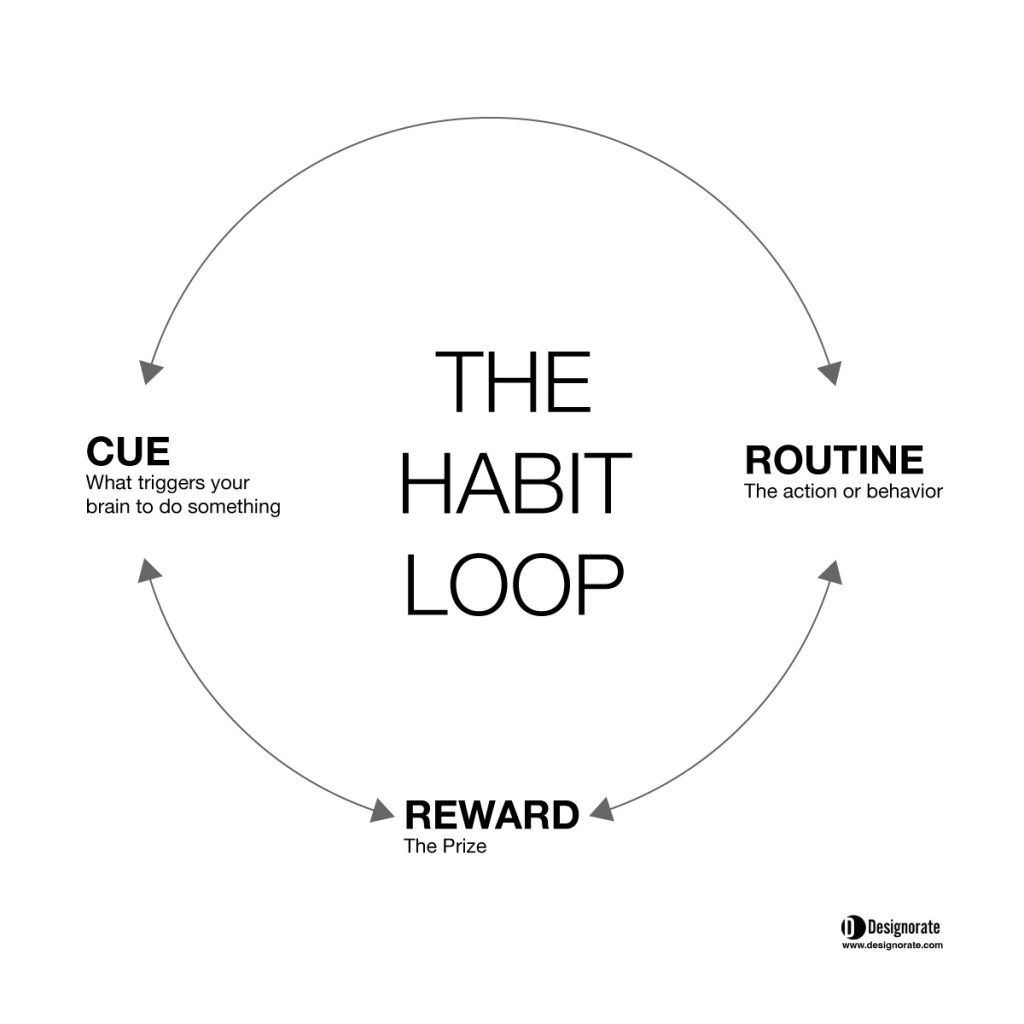
Where Fogg's model explains whether a single behavior will occur, Nir Eyal's Hook Model (from his 2014 book Hooked: How to Build Habit-Forming Products) describes how to build products that users return to habitually - without needing external prompts.
The Hook has four stages:
1. Trigger
The initial cue that initiates the behavior. External triggers (notifications, emails, advertisements) are used in early product adoption. The goal is to move users toward internal triggers - emotional states that cue app use automatically.
Instagram's internal trigger is a social emotion: curiosity about what others are doing, mild FOMO (fear of missing out), or the desire for social validation. The trigger does not require Instagram to do anything. The user's own emotional state drives them to the product.
2. Action
The simplest possible behavior in anticipation of reward. Eyal draws on Fogg here: the action must require minimal motivation and minimal ability. Scrolling is almost free. Liking requires one tap. The action is designed to be as frictionless as possible.
3. Variable Reward
This is the mechanism that makes habit loops compulsive rather than merely habitual. Drawing on B.F. Skinner's research on intermittent reinforcement schedules (1957), Eyal notes that unpredictable rewards are more compelling than predictable ones.
A slot machine delivers a reward on a variable ratio schedule - sometimes you win, sometimes you do not, and the unpredictability is precisely what keeps people pulling the lever. Social media feeds operate on the same principle. Sometimes you scroll and find something thrilling; sometimes there is nothing.
The uncertainty is motivating. Research by Wolfram Schultz (1997) demonstrated that dopamine neurons fire most strongly not for the reward itself, but for the prediction of an uncertain reward - the anticipation of potential pleasure.
Eyal identifies three types of variable rewards:
- Rewards of the tribe: Social validation - likes, comments, shares, follower counts
- Rewards of the hunt: Information and resources - a good article, a relevant email, a valuable search result
- Rewards of the self: Mastery and completion - finishing a task, achieving a level, completing a collection
4. Investment
The fourth stage is what makes Hooks compound over time. Users invest in the product - time, data, social connections, content - in a way that makes future engagement more likely and departure more costly.
A social network's value increases as your network grows. Your Spotify recommendations improve with use. Your Notion workspace becomes more valuable as it contains more of your information.
These investments create what economists call switching costs and what behavioral scientists call endowment effects - the tendency, documented by Kahneman, Knetsch, and Thaler (1990), for people to value things more highly simply because they own them.
The investment also often loads the next trigger: you post content and then check back to see the response. The cycle repeats.
| Hook Stage | Behavioral Science Mechanism | Design Example |
|---|---|---|
| Trigger | Environmental cues, emotional states | Notification at moment of inactivity |
| Action | Ability maximization, friction reduction | Pull-to-refresh, infinite scroll |
| Variable Reward | Intermittent reinforcement (Skinner) | Social feed with unpredictable content |
| Investment | Sunk cost, endowment effect (Kahneman) | Building a profile, growing a network |
Choice Architecture and Nudge Theory
Behavioral design extends beyond digital products into any environment where choices are made. Choice architecture - the arrangement of options and their presentation - powerfully shapes which options are chosen, independent of their objective merits.
Richard Thaler and Cass Sunstein's nudge theory (from their 2008 book Nudge: Improving Decisions About Health, Wealth, and Happiness) formalizes this: small, non-coercive changes to choice architecture can produce large changes in behavior at low cost and without restricting freedom of choice.
Classic nudge applications with documented results:
Organ donation defaults. Research by Eric Johnson and Daniel Goldstein (2003), published in Science, showed that countries using opt-out organ donation (where you are registered unless you actively opt out) have dramatically higher donation rates than opt-in countries.
The opt-out systems average above 90% registration; opt-in systems average around 15%. The people are the same; the default is different.
Cafeteria placement. When healthy foods are placed at eye level and at the front of cafeteria lines, consumption increases significantly - without removing any options or changing prices. Wansink and Hanks (2013) documented that rearranging a school cafeteria increased fruit and vegetable consumption by 25%.
Energy conservation.Robert Cialdini and the Opower team demonstrated that showing households their consumption compared to neighbors (a social norm prompt) reduced energy use by 2-4% on average - in ways that price signals alone had not achieved. The program scaled to millions of households.
Retirement savings. The Save More Tomorrow program (Benartzi and Thaler, 2004) committed employees in advance to allocating a portion of future salary increases to retirement accounts.
Savings rates increased from 3.5% to 13.6% over four pay raises because the program worked with present bias (the commitment was to future income, not present income) rather than against it.
"For good or ill, choice architects have enormous power over other people's choices. A good rule of thumb is to 'nudge' in the direction that will help people achieve their own goals." - Richard Thaler and Cass Sunstein, Nudge (2008)
Dark Patterns: When Behavioral Design Turns Adversarial
Behavioral design can be used to help people make better decisions in line with their own goals. It can also be used to exploit cognitive biases to extract value from users against their interests.
Dark patterns - a term coined by UX researcher Harry Brignull in 2010 - are design techniques that use behavioral science principles against users. They are technically effective: they work. They increase conversion, reduce cancellation, and maximize revenue extraction.
They also represent a fundamental betrayal of the trust users place in products.
Common Dark Patterns
Roach motel: Easy to enter, difficult to leave. Subscription sign-up takes two clicks; cancellation requires navigating multiple screens, calling a phone number, or waiting on hold. The FTC's 2023 proposed "click-to-cancel" rule would require that cancellation be as easy as enrollment.
Confirmshaming: The "decline" option is written to induce guilt. "No thanks, I don't want to grow my business" as the opt-out for a marketing newsletter.
Hidden costs: Prices are shown without taxes, fees, or mandatory add-ons until the checkout stage, exploiting the sunk cost of invested time and the pain of abandoning a nearly completed process.
Misdirection: Attention is drawn to a promotional deal while a pre-checked upsell quietly processes in the background.
False urgency: Countdown timers on prices that reset when they expire. "Only 3 left in stock" that does not reflect actual inventory. A 2019 study by the Norwegian Consumer Council documented these practices across major booking platforms.
Privacy zuckering: Privacy settings designed to be confusing, default to maximum data sharing, and bury the minimum-sharing option behind multiple steps. Named after Facebook's privacy practices.
Regulators are responding. The EU's General Data Protection Regulation (GDPR), the Digital Services Act (2022), and the US Federal Trade Commission have all issued guidance or enforcement actions against dark patterns.
The FTC's 2022 report specifically named dark patterns as a priority enforcement area, and the EU's European Data Protection Board issued guidelines in 2023 on recognizing and addressing dark patterns in social media interfaces.
Ethical Behavioral Design: The Line Between Helping and Manipulating
The same knowledge that enables dark patterns enables genuinely beneficial design. The distinction lies not in technique but in intent and alignment of interests.
Ethical behavioral design uses behavioral science in service of user goals, not in opposition to them. The key question is: whose behavior is being changed, and toward whose ends?
BJ Fogg has been explicit about this: his work on persuasive technology is intended to help people achieve their own goals, not to serve as a toolkit for exploitation. He has expressed increasing concern about how his research has been used commercially.
Eyal has added nuance through his concept of the manipulation-facilitator matrix, which asks product designers to distinguish between products that change behavior in ways the user would endorse (facilitators) and products that change behavior against user interests (manipulators).
The ethical test: would the user, with full information about how the product works, still choose to use it?
Concrete ethical guidelines emerging from the field:
- Align the product's goals with user goals. If the product only succeeds when it manipulates users into actions they would not choose with full information, it is not ethically defensible.
- Make stopping as easy as starting. Subscription cancellation should be as simple as subscription enrollment. This is becoming a legal requirement in multiple jurisdictions.
- Defaults should reflect what most users would actually want if they thought about it. Default to privacy, not data sharing. Default to the less expensive option.
- Disclose the mechanism. Telling users that a product uses behavioral techniques to encourage use is compatible with the technique still working - as open-label placebos demonstrate, transparency does not necessarily eliminate the effect.
Behavioral Design in Health and Public Policy
Some of the most socially significant applications of behavioral design occur outside commercial products.
Medication Adherence
Non-adherence to prescribed medication contributes to approximately 125,000 preventable deaths annually in the United States, according to a 2012 analysis in the Annals of Internal Medicine.
The World Health Organization estimated in 2003 that adherence to long-term therapies in developed countries averages only 50%. Behavioral design approaches to adherence include:
- Pill organizers with visual feedback (ability improvement)
- SMS reminders at consistent times (external prompts)
- Apps that gamify streaks (variable reward and investment)
- Pharmacy blister packs that make dose history visible (environmental cue)
Clinical Decision Support
Hospitals have used behavioral design to reduce medical errors. Defaulting electronic health records to weight-based drug dosing calculations reduces dosing errors without requiring doctors to remember to calculate.
Atul Gawande's surgical safety checklist, adopted by the WHO in 2009, uses behavioral design principles - structured prompts, social accountability, default completion - to ensure critical steps are completed.
A 2009 study in the New England Journal of Medicine found that implementing the checklist reduced surgical complications by 36% and deaths by 47%.
Financial Behavior
Beyond retirement savings, behavioral design has been applied to:
- Tax compliance: personalized letters framing tax payment as normative - "9 in 10 of your neighbors have already filed" - increased compliance in HMRC studies conducted by the UK's Behavioural Insights Team (2012)
- Debt repayment: presenting the smallest debt prominently rather than the highest-interest debt exploits the completion drive to build momentum - the "debt snowball" method popularized by financial advisors
- Charitable giving: asking people at a moment of positive emotion, like a salary increase, rather than in general campaigns
For related concepts, see what is behavioral economics, how habits form and change, the science of persuasion, and ethical persuasion.
The Design Practitioner's Checklist
If you are designing a product, a service, or any system where you want specific behaviors to occur, behavioral design offers a practical diagnostic:
Identify the specific behavior you want to occur. Not "engagement" - exactly what action, at what moment, by whom.
Diagnose why it is not occurring. Using Fogg's model: is motivation insufficient? Is the behavior too difficult? Is the prompt absent or poorly timed?
Address ability first. Almost always easier and more reliable than increasing motivation. Remove every possible friction point from the desired behavior.
Design prompts for the right moment. A prompt that arrives when the user is already doing something related is far more effective than a generic notification.
Build in feedback and variable reward. Progress visibility, social elements, and unpredictable positive feedback sustain behavior over time.
Encourage investment early. Get users to put something of theirs into the product as soon as possible - even small amounts - to build attachment and switching costs.
Align your goals with user goals. Build for the long term. Products that exploit users get regulated, abandoned, or publicly denounced - and the regulatory environment is tightening.
Sources & Further Reading
- Fogg, B. J. (2009). A Behavior Model for Persuasive Design. Proceedings of the 4th International Conference on Persuasive Technology. DOI: 10.1145/1541948.1541999
- Fogg, B. J. (2019). Tiny Habits: The Small Changes That Change Everything. Houghton Mifflin Harcourt.
- Eyal, N. (2014). Hooked: How to Build Habit-Forming Products. Portfolio/Penguin.
- Thaler, R. H., & Sunstein, C. R. (2008). Nudge: Improving Decisions About Health, Wealth, and Happiness. Yale University Press.
- Thaler, R. H., & Benartzi, S. (2004). Save More Tomorrow: Using Behavioral Economics to Increase Employee Saving. Journal of Political Economy, 112(S1), S164-S187. DOI: 10.1086/380085
- Kahneman, D., & Tversky, A. (1979). Prospect Theory: An Analysis of Decision Under Risk. Econometrica, 47(2), 263-292.
- Johnson, E. J., & Goldstein, D. (2003). Do Defaults Save Lives? Science, 302(5649), 1338-1339. DOI: 10.1126/science.1091721
- Schultz, W., Dayan, P., & Montague, P. R. (1997). A Neural Substrate of Prediction and Reward. Science, 275(5306), 1593-1599.
- Hawton, K., et al. (2013). Long-Term Effect of Reduced Pack Sizes of Paracetamol on Poisoning Deaths and Liver Transplant Activity in England and Wales. BMJ, 346, f403. DOI: 10.1136/bmj.f403
- Haynes, A. B., et al. (2009). A Surgical Safety Checklist to Reduce Morbidity and Mortality in a Global Population. NEJM, 360(5), 491-499. DOI: 10.1056/NEJMsa0810119
- Brignull, H. (2010). Dark Patterns: Deception vs. Honesty in UI Design. View source
- Federal Trade Commission. (2022). Bringing Dark Patterns to Light. FTC Staff Report. View source