
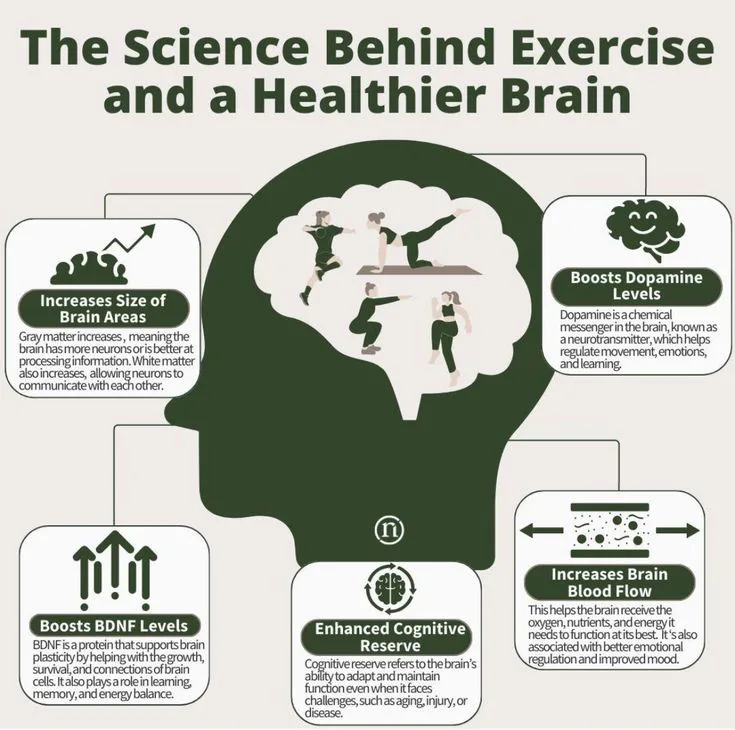
Why Exercise Is Good for the Brain
Exercise benefits the brain through a set of well-characterized biological mechanisms: it increases production of brain-derived neurotrophic factor (BDNF), stimulates the growth of new neurons in the hippocampus, reduces chronic inflammation, and modulates the hormonal stress response.
These effects translate into measurable improvements in mood, anxiety, memory, attention, and long-term protection against cognitive decline and dementia.
The relationship is dose-dependent and robust across age groups, making regular physical activity one of the most evidence-supported interventions available for mental health and cognitive function.
In 1978, a psychiatrist named John Greist at the University of Wisconsin published an unusual clinical study. He had recruited patients with mild to moderate depression and randomly assigned them to two groups: one received traditional psychotherapy; the other was put on a running program.
At the end of ten weeks, the runners had improved at least as much as the therapy group. Several had improved more.
The medical establishment was not convinced. Running as a treatment for depression seemed too simple, too cheap, too lacking in mechanism. The idea that moving your body could reshape your emotional state seemed almost embarrassingly unscientific.
Forty-five years later, the evidence is overwhelming. Hundreds of randomized controlled trials, thousands of observational studies, and a detailed mechanistic understanding of how exercise changes the brain have confirmed what Greist's small study suggested.
Exercise is among the most potent interventions known for improving mood, reducing anxiety, enhancing memory, and protecting against the cognitive decline of aging. The question is no longer whether exercise benefits the brain; it is how, and by how much.
The answers reveal something important about the brain itself. The brain is not fixed hardware running permanent software. It is plastic - constantly remodeling its physical structure in response to what you do. And few things you can do reshape the brain as rapidly, broadly, and durably as sustained physical activity.
"If exercise were a drug, it would be the most valuable pharmaceutical ever invented." - John Ratey, Spark: The Revolutionary New Science of Exercise and the Brain (2008)
Key Definitions
BDNF (Brain-Derived Neurotrophic Factor) - A protein produced primarily by neurons that promotes neuronal survival, growth, and the formation of new synaptic connections.
Often called "Miracle-Gro for the brain." BDNF is central to the mechanisms by which exercise benefits cognition; exercise reliably increases BDNF in the hippocampus and prefrontal cortex. Reduced BDNF is associated with depression, cognitive decline, and Alzheimer's disease.
Neurogenesis - The birth of new neurons. For most of the 20th century, the dogma was that adult mammals do not generate new neurons. In the 1990s, researchers discovered that the adult hippocampus continues to produce new neurons (adult hippocampal neurogenesis, AHN).
Aerobic exercise is among the most potent known stimulators of AHN. The functional significance of adult neurogenesis is still debated, but it is associated with improved learning, memory, and mood regulation.
HPA axis (Hypothalamic-Pituitary-Adrenal axis) - The hormonal stress response system. The hypothalamus signals the pituitary gland, which signals the adrenal glands to release cortisol. Acute cortisol elevation is adaptive; chronic elevation (from chronic stress) damages the hippocampus, impairs memory, and contributes to depression.
Regular aerobic exercise reduces HPA axis reactivity - the same stressors produce smaller cortisol responses in physically fit individuals.
Endocannabinoid system - A lipid signaling system involved in mood, pain, appetite, and cognition. Endocannabinoids are the body's natural cannabis-like molecules.
Intense aerobic exercise increases circulating endocannabinoids (particularly anandamide), producing the euphoric, anxiolytic "runner's high" - previously (incorrectly) attributed to endorphins. Endorphins are too large to cross the blood-brain barrier; endocannabinoids are not.
Neuroplasticity - The brain's capacity to change its structure and function in response to experience. Includes synaptic plasticity (strengthening or weakening of individual synapses), axonal remodeling, and structural changes in gray and white matter volume.
Exercise promotes neuroplasticity through BDNF, IGF-1, and other growth factors.[6]
IGF-1 (Insulin-like Growth Factor 1) - A growth hormone mediator produced in the liver during exercise. IGF-1 crosses the blood-brain barrier and promotes neurogenesis, synaptic plasticity, and neuroprotection. IGF-1 contributes to exercise-induced improvements in cognition independent of BDNF.
VO2 max - The maximum rate of oxygen consumption during maximal exertion - the gold standard measure of cardiovascular fitness. Higher VO2 max is consistently associated with larger hippocampal volume, better cognitive performance, and reduced dementia risk.
Improving VO2 max through aerobic training correlates with cognitive improvements in randomized trials.
Cognitive reserve - The brain's resilience against damage - the ability to maintain cognitive function despite accumulating neuropathology.
People with more cognitive reserve (from education, intellectual engagement, and physical fitness) can tolerate more Alzheimer's pathology before showing symptoms. Exercise builds cognitive reserve by increasing hippocampal volume, synaptic density, and vascular health.
The Neurochemistry of Mood: Exercise as a Natural Antidepressant
Monoamine Neurotransmitters
The monoamine hypothesis of depression holds that depression involves deficient activity of serotonin, dopamine, and/or norepinephrine in key brain circuits.
Whether this is the primary cause of depression is debated, but increasing monoamine activity reliably reduces depression symptoms - which is why SSRIs (serotonin reuptake inhibitors), SNRIs, and MAOIs work.
Exercise does the same thing through different mechanisms:
Serotonin: Aerobic exercise increases serotonin synthesis and release, particularly in limbic regions.[9] Serotonin regulates mood, appetite, sleep, and social behavior. The exercise-induced serotonin increase is thought to contribute to post-exercise mood improvement and to longer-term antidepressant effects.
Dopamine: Exercise increases dopamine synthesis and activates reward circuits. Post-exercise dopamine elevation contributes to motivation, pleasure, and the reinforcing quality of exercise itself (which is why regular exercisers often miss it when they stop).
Low dopaminergic function is implicated in anhedonia - the loss of pleasure characteristic of depression.
Norepinephrine: Exercise acutely elevates norepinephrine, improving energy, attention, and mood. Norepinephrine is involved in the stress response (fight-or-flight), but at appropriate levels it promotes alertness and positive affect.
BDNF: The Deep Mechanism
The monoamine effects explain acute mood improvement during and shortly after exercise.[5] The deeper, more durable antidepressant mechanism involves BDNF.
Depression is associated with reduced hippocampal volume and reduced BDNF. Chronic stress shrinks the hippocampus through cortisol-mediated BDNF suppression and reduced neurogenesis. Antidepressants increase BDNF - but so does exercise, often more strongly.
In the landmark Carek et al. analysis and multiple subsequent meta-analyses, the magnitude of exercise's antidepressant effect correlates with BDNF increases. Exercise and antidepressants may work through partially overlapping mechanisms; there is evidence of synergy when combined.
The Evidence: Exercise vs. Antidepressants
The SMILE trial (Blumenthal et al., 1999): 156 adults with major depressive disorder randomized to aerobic exercise alone, sertraline alone, or combination.[2] After 16 weeks: all three groups improved similarly. At 10-month follow-up: the exercise group had the lowest relapse rate (approximately 8% vs. 38% for sertraline alone).
A 2023 BMJ meta-analysis (Singh et al.), an overview of 97 systematic reviews covering 1,039 trials and 128,119 participants, found exercise significantly more effective than active controls for depression, anxiety, and psychological distress, with effect sizes comparable to or exceeding those of psychotherapy and pharmacotherapy for mild to moderate presentations.[3]
This does not mean exercise should replace antidepressants for severe depression, or for patients who need rapid relief. It does mean that exercise should be a standard component of depression treatment - not an optional lifestyle suggestion.
Memory and Learning: The Hippocampus Under a Microscope
Aerobic Exercise Grows the Hippocampus
The hippocampus, critical for learning and memory, is among the brain structures most vulnerable to aging and stress. Adult hippocampal volume declines approximately 1-2% per year in sedentary older adults - contributing to age-related memory decline.
In 2011, Kirk Erickson and colleagues published a landmark randomized controlled trial.[1] Older adults (average age 66) were randomly assigned to aerobic training (walking 3 times/week, 40 minutes) or stretching (active control) for one year.
Results after one year: the aerobic group showed a 2% increase in hippocampal volume; the control group showed the typical 1.4% decline - a net difference of 3.4%. The aerobic group showed better spatial memory, higher BDNF levels, and stronger hippocampal-prefrontal connectivity.
A 2% increase sounds modest; in a 66-year-old, it represents approximately reversing one to two years of aging-related atrophy. And it took only one year of moderate exercise three times per week.
The Mechanism: Neurogenesis and Angiogenesis
Exercise increases adult hippocampal neurogenesis - new neurons - through BDNF and IGF-1. In rodent models, running increases newborn neurons in the dentate gyrus (a hippocampal subregion) by several-fold. These new neurons are more excitable and more easily incorporated into memory circuits.
Exercise also induces angiogenesis - new blood vessel formation - in the hippocampus and other brain regions. Better vascular supply means more oxygen, more glucose, and better clearance of metabolic waste. Vascular health is a major determinant of cognitive health, particularly important for preventing vascular dementia.
Children, Schools, and Academic Performance
The evidence on exercise and academic performance in children is striking. A 2012 systematic review found that physical activity was associated with improved attention, working memory, and academic achievement in school-aged children.
The FIT Kids randomized controlled trial (Davis et al.) found that children who received after-school aerobic activity showed greater improvements in executive function and academic achievement than controls.
This creates a particularly frustrating policy irony: as schools have faced academic pressure, physical education time has been reduced - often to create more time for academic instruction.
The neuroscience suggests this tradeoff is counterproductive; physical activity supports the very cognitive functions (attention, working memory, executive function) that determine academic performance.
Exercise and Mental Health: Effects by Condition
| Condition | Evidence Quality | Effect Size | Best Evidence |
|---|---|---|---|
| Major depression | Very strong (218 RCTs in 2023 meta-analysis) | Large | Comparable to antidepressants for mild-moderate |
| Generalized anxiety | Strong | Moderate-Large | Acute single sessions reduce anxiety for 4-8 hours |
| Panic disorder | Moderate | Moderate | Interoceptive exposure mechanism |
| ADHD | Moderate | Moderate | Single sessions improve attention acutely |
| PTSD | Emerging | Moderate | Trauma-sensitive yoga and aerobic exercise |
| Cognitive decline | Strong (observational) | Moderate | 30-40% reduced dementia risk with active lifestyle |
| Mild cognitive impairment | Moderate (RCTs) | Moderate | Aerobic training improves executive function |
Stress, Anxiety, and the Resilient Brain
Toughening the Stress Response
Regular exercisers respond differently to psychological stress than sedentary individuals. When confronted with a stressful task (public speaking, cold water immersion, frustrating problems), fit individuals show:
- Smaller cortisol spikes
- Faster cortisol recovery
- Lower resting heart rate and lower stress-induced heart rate increases
- Less subjective anxiety and distress
This "cross-stressor adaptation" - aerobic training building resilience to psychological stressors - reflects fundamental changes in HPA axis regulation and autonomic nervous system function. The body learns to modulate its stress response more effectively.
Reducing Anxiety Sensitivity
Anxiety sensitivity - fear of the physical sensations of anxiety (racing heart, shortness of breath, sweating) - is a transdiagnostic risk factor for anxiety disorders, particularly panic disorder.
High anxiety sensitivity means that normal physiological arousal triggers catastrophic interpretation ("I'm having a panic attack"; "something is wrong").
Exercise produces the same physiological sensations as anxiety - elevated heart rate, sweating, shortness of breath - in a non-threatening context, with a clear cause. Repeated pairing of these sensations with successful completion of physical activity builds tolerance for the sensations themselves.
This interoceptive exposure is similar to the exposure therapy used in anxiety treatment, and likely explains why regular exercisers show lower anxiety sensitivity.
Cognitive Aging: Exercise as Neuroprotection
Dementia Risk
The 2020 Lancet Commission on Dementia identified physical inactivity as one of 12 modifiable risk factors collectively responsible for up to 40% of dementia cases.[4]
Observational studies consistently find that physically active individuals have approximately 30-40% lower risk of Alzheimer's disease and vascular dementia compared to sedentary individuals, after controlling for other risk factors.
The mechanisms are multiple: direct BDNF-mediated neuroprotection; reduced vascular disease (vascular risk factors are strongly linked to both vascular dementia and Alzheimer's); anti-inflammatory effects (chronic neuroinflammation contributes to Alzheimer's pathology); reduced insulin resistance (impaired brain insulin signaling is implicated in Alzheimer's); and the cognitive reserve built through a lifetime of physical activity.
Timing: It's Never Too Late
Brain plasticity in response to exercise is maintained into very old age. Studies of octogenarians show measurable cognitive improvements from aerobic training programs.
A 2019 meta-analysis found significant cognitive benefits of exercise interventions in older adults with mild cognitive impairment - the stage between normal aging and dementia.
The effect size is modest in those with existing cognitive impairment; the preventive effect across a lifetime is larger. As with most health behaviors, the greatest benefit comes from sustained activity across decades rather than late-in-life correction.
How Much, What Kind?
The dose-response relationship is non-linear and favorable: the largest gains come from moving off the couch entirely, and the WHO's 150 minutes of moderate or 75 minutes of vigorous aerobic activity per week marks the threshold for major benefits. Aerobic exercise has the strongest evidence for hippocampal growth and mood, resistance training improves executive function, and the type you'll actually do consistently matters more than any single best option.
The Dose-Response Relationship
The dose-response relationship between exercise and brain benefits is non-linear and generally favorable. The largest gains come from moving from complete sedentary status to any regular activity.
The WHO guidelines - 150 minutes moderate-intensity or 75 minutes vigorous aerobic activity per week - represent a threshold at which major health and cognitive benefits accrue.
For mood and acute anxiety, a single 20-30 minute session of moderate aerobic activity produces measurable improvement for 4-8 hours. Even 11 minutes of daily movement reduces mortality risk in large population studies.
Which Type of Exercise Works Best?
Aerobic exercise has the strongest evidence for neurogenesis, hippocampal growth, and mood benefits, while resistance training distinctly improves executive function and reduces depression and anxiety. HIIT delivers large neurochemical effects in shorter sessions, and mind-body practices like yoga and tai chi support stress reduction. No single type is best for everyone: the exercise you will do consistently produces the greatest long-term brain benefit.
| Exercise Type | Primary Brain Benefit | Mechanism | Time Commitment |
|---|---|---|---|
| Aerobic (running, cycling, swimming) | Hippocampal growth, BDNF, mood | Neurogenesis, angiogenesis, monoamines | 150 min/week moderate |
| Resistance training | Executive function, depression | IGF-1, inflammation reduction | 2-3 sessions/week |
| HIIT | Acute neurochemical effects | Endocannabinoids, BDNF spike | 75 min/week vigorous |
| Yoga / Tai Chi | Stress reduction, anxiety | Vagal activation, mindfulness | 2-3 sessions/week |
| Walking | General cognitive health | Cardiovascular, low-impact | Daily, any amount |
Aerobic exercise has the strongest evidence for neurogenesis, hippocampal growth, BDNF, and mood/cognitive effects. Activities: running, cycling, swimming, brisk walking, rowing, dancing.
Resistance training produces distinct benefits: improved executive function, reduced depression and anxiety through different mechanisms (IGF-1, myokine release, reduced inflammation). Particularly beneficial for older adults at risk of sarcopenia.
High-intensity interval training (HIIT) produces large neurochemical effects in shorter sessions; may be more time-efficient for busy individuals, though requires adequate fitness base.
Mind-body exercise (yoga, tai chi): growing evidence for benefits on stress, anxiety, and executive function through mechanisms including vagal activation, mindfulness-based attention training, and physical activity combined.
The consistent finding: the best exercise for the brain is the one you will do consistently. Adherence over years matters more than any specific protocol.
The Prefrontal Cortex: Executive Function and Self-Control
While much of the research focus has been on the hippocampus, the prefrontal cortex (PFC) - the brain's executive center - shows equally significant responses to aerobic training.[7] The PFC governs working memory, cognitive flexibility, inhibitory control, attention, and planning.
These are the executive functions that determine academic and professional performance, emotional regulation, and social behavior.
A major 2003 meta-analysis by Colcombe and Kramer examined 18 randomized controlled trials of physical fitness training in older adults. The finding: aerobic fitness training preferentially benefited executive function over other cognitive domains.
The effect size for executive function was approximately twice that for non-executive cognitive tasks - a striking selective enhancement.
Why does aerobic exercise preferentially strengthen executive function? Several mechanisms converge:
PFC blood flow: The prefrontal cortex is particularly sensitive to cerebral blood flow changes. Even during a single bout of aerobic exercise, cerebral blood flow to the PFC increases substantially - providing more oxygen and glucose to a region that demands them during cognitive work.
BDNF in PFC: The prefrontal cortex has the second-highest density of TrkB receptors (BDNF receptors) after the hippocampus. Exercise-induced BDNF reaches the PFC and promotes synaptic plasticity, dendritic arborization, and new protein synthesis that strengthens PFC networks.
Cortisol protection: Chronic cortisol excess - the neurochemical signature of chronic stress - preferentially damages the prefrontal cortex, impairing its connections to the amygdala and weakening top-down emotion regulation. Exercise's cortisol-normalizing effect specifically protects this circuitry.
Gray matter volume: Studies using structural MRI consistently find greater PFC gray matter volume in physically fit compared to sedentary adults. Longitudinal aerobic training studies show measurable PFC volume increases after 6-12 months of regular training.
The practical implication is significant: if you want to be sharper at work, better at resisting impulses, and more emotionally regulated - the most underutilized tool is probably regular aerobic exercise.
Exercise Across the Lifespan: Early and Late Gains
Children and Adolescents
The brain develops most rapidly during the first two decades of life. Physical activity during this period shapes brain architecture in ways that persist for decades.
A 2019 study tracking over 4,500 children from age 9 to 15 found that those with higher cardiorespiratory fitness had larger hippocampal volumes, better performance on relational memory tasks, and lower rates of ADHD symptoms. The effect was dose-dependent: more fitness, more brain benefit.
The FIT Kids randomized controlled trial enrolled 221 7-to-9-year-old children and assigned them to an after-school physical activity program or a waitlist control.
After 9 months, the exercise group showed significantly greater improvements in executive function, behavioral regulation, and cognitive flexibility - the exact functions most predictive of school success and life outcomes.
This evidence has generated a difficult policy irony: school systems facing academic pressure have systematically cut physical education to create more time for tested subjects. The neuroscience suggests this tradeoff degrades the cognitive substrate on which academic performance depends.
Older Adults and the Neuroprotective Window
One of the most clinically significant findings in exercise neuroscience is that the brain benefits of physical activity are maintained into very old age. Neuroplasticity does not stop at 60, 70, or even 80.
A 2019 meta-analysis of exercise interventions in older adults with mild cognitive impairment (the preclinical stage of dementia) found significant improvements in global cognition, executive function, and memory across 12 studies. The effect sizes were modest - exercise does not reverse dementia.
But in a disease with no effective pharmacological treatment, these modest effects matter considerably.
| Age Group | Key Benefit | Optimal Type | Key Evidence |
|---|---|---|---|
| Children (7-14) | Executive function, memory, attention | Aerobic, skill-based | FIT Kids RCT, multiple cohort studies |
| Adolescents (14-20) | Emotional regulation, depression prevention | Mixed aerobic and resistance | Meta-analyses; longitudinal cohort data |
| Young adults (20-40) | Stress resilience, mood, cognitive performance | Aerobic + resistance | SMILE trial, cross-sectional data |
| Middle age (40-60) | Dementia prevention, hippocampal protection | Sustained aerobic | Lancet Commission, longitudinal cohorts |
| Older adults (60+) | Cognitive reserve, balance, depression | Walking, resistance | Erickson 2011 RCT, MCI meta-analyses |
The Social and Psychological Dimensions
The neurobiological mechanisms for exercise's brain benefits operate in the context of real human behavior - and human behavior around exercise is heavily shaped by psychological factors that the neuroscience alone cannot capture.
Self-efficacy and mastery: Completing a workout - particularly one that was challenging - produces a sense of accomplishment and self-efficacy that generalizes. This is separate from the neurochemical reward. People who exercise consistently often report improved general confidence and sense of competence that extends well beyond fitness.
John Ratey's clinical work suggests this self-efficacy boost is a distinct mechanism contributing to exercise's antidepressant effects.[8]
Routine and rhythm: Exercise's mental health benefits appear to require consistency over time. The brain benefits documented in RCTs emerged after weeks to months of regular training.
This is why habit formation - the automatization of exercise behavior so it requires minimal decision-making - is as important as any specific exercise protocol.
Irregular exercise with occasional intense sessions appears to produce smaller and less durable benefits than consistent moderate exercise.
Social exercise: Group exercise, team sports, and workout partners add a social connection dimension to the neurobiological benefits. The social connection itself has independent brain benefits - reduced cortisol, reduced loneliness-related inflammation.
Exercise formats that combine physical activity with social engagement may be superior for mental health to solitary exercise, though both benefit.
Practical Applications: Designing for Brain Health
The scientific literature offers increasingly specific guidance on optimizing exercise for brain outcomes:
Timing: Exercise performed in the morning may produce greater alertness and working memory benefits that last through the day. Exercise within 4 hours of learning a new skill appears to enhance consolidation of that skill, possibly through BDNF's role in synaptic strengthening.
Several studies find that spacing aerobic exercise and then studying (rather than concurrent) produces superior retention.
Combining with cognitive challenges: Animal models suggest that combined physical and cognitive challenge - exercising while learning something new, running in novel environments rather than on a familiar treadmill - produces larger neurogenesis responses than either alone.
Human studies on "exergaming" (interactive video games requiring physical movement) show greater executive function benefits than passive aerobic exercise alone, consistent with this model.
Intensity matters for neurochemistry: For acute endocannabinoid release and immediate mood effects, moderate-to-vigorous intensity is necessary. Light walking does not produce the same endocannabinoid surge as a run.
For long-term structural changes (hippocampal volume), moderate sustained aerobic exercise appears sufficient. HIIT protocols produce large acute neurochemical effects but require adequate fitness base and recovery.
Minimum effective dose: For most cognitive and mood benefits, the evidence supports that even 11 minutes of daily moderate activity reduces mortality risk. Single sessions of 20-30 minutes produce measurable immediate mood and anxiety benefits lasting 4-6 hours.
Weekly 150 minutes of moderate activity - the WHO recommendation - captures most of the documented brain benefits. Diminishing returns appear above approximately 300 minutes per week for mental health outcomes specifically.
For related concepts, see how sleep works, how habits form and change, and why do we age.
Sources & Further Reading
- Erickson, K. I., et al. (2011). Exercise Training Increases Size of Hippocampus and Improves Memory. Proceedings of the National Academy of Sciences, 108(7), 3017-3022. DOI: 10.1073/pnas.1015950108
- Blumenthal, J. A., et al. (1999). Effects of Exercise Training on Older Patients With Major Depression. Archives of Internal Medicine, 159(19), 2349-2356. DOI: 10.1001/archinte.159.19.2349
- Singh, B., et al. (2023). Effectiveness of Physical Activity Interventions for Improving Depression, Anxiety and Distress: An Overview of Systematic Reviews. British Journal of Sports Medicine, 57(18), 1203-1209. DOI: 10.1136/bjsports-2022-106195
- Livingston, G., et al. (2020). Dementia Prevention, Intervention, and Care: 2020 Report of the Lancet Commission. Lancet, 396(10248), 413-446. DOI: 10.1016/S0140-6736(20)30367-6
- Heijnen, S., Hommel, B., Kibele, A., & Colzato, L. S. (2016). Neuromodulation of Aerobic Exercise - A Review. Frontiers in Psychology, 6, 1890. DOI: 10.3389/fpsyg.2015.01890
- Cotman, C. W., Berchtold, N. C., & Christie, L. A. (2007). Exercise Builds Brain Health: Key Roles of Growth Factor Cascades and Inflammation. Trends in Neurosciences, 30(9), 464-472. DOI: 10.1016/j.tins.2007.06.011
- Hillman, C. H., Erickson, K. I., & Kramer, A. F. (2008). Be Smart, Exercise Your Heart: Exercise Effects on Brain and Cognition. Nature Reviews Neuroscience, 9(1), 58-65. DOI: 10.1038/nrn2298
- Ratey, J. J. (2008). Spark: The Revolutionary New Science of Exercise and the Brain. Little, Brown.
- Dishman, R. K., et al. (2006). Neurobiology of Exercise. Obesity, 14(3), 345-356. DOI: 10.1038/oby.2006.46