
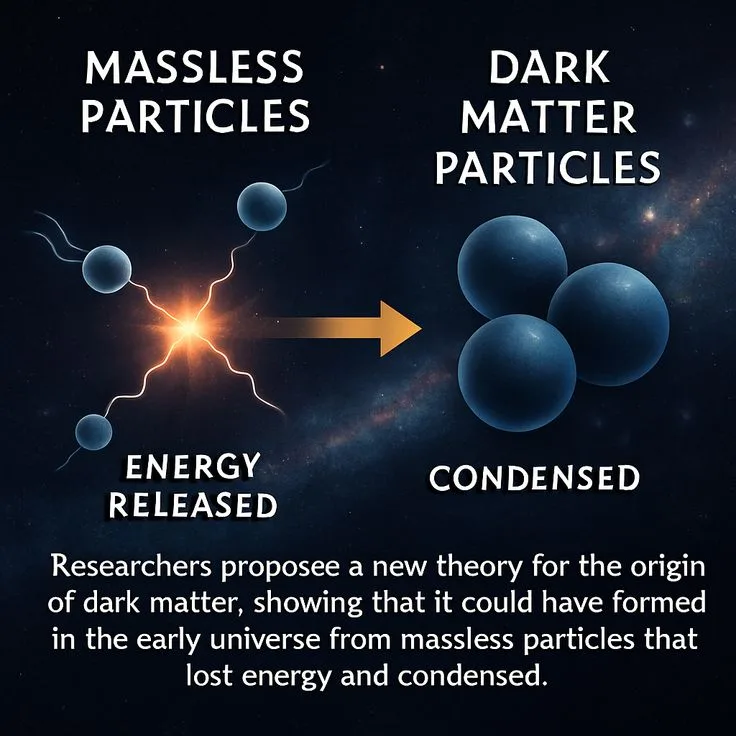
Dark matter is a form of matter that does not interact with electromagnetic radiation but exerts gravitational effects, accounting for approximately 27% of the universe's total energy content.
Dark energy is a form of energy permeating all space, responsible for the accelerating expansion of the universe, accounting for approximately 68% of total energy content.
Together, they constitute 95% of everything that exists - and neither has been directly detected or identified. All the atoms, stars, planets, and galaxies that humanity has ever observed make up just 5% of the cosmos.
In 1933, Swiss astronomer Fritz Zwicky was studying the Coma Cluster - a collection of over 1,000 galaxies roughly 320 million light-years from Earth.
He measured the velocities of individual galaxies within the cluster and applied the virial theorem: a cluster of objects orbiting in a gravitational system should have a specific relationship between their kinetic energy (how fast they move) and the gravitational potential energy (how much mass is holding them together).
The galaxies in the Coma Cluster were moving far too fast. If the cluster's gravity came only from the visible stars and gas, it would not have nearly enough mass to hold the galaxies together at those velocities. The cluster should be flying apart. It was not flying apart.
Zwicky concluded that there must be enormous amounts of invisible "dunkle Materie" - dark matter - providing the gravitational glue the visible matter could not. He estimated the cluster contained 400 times more dark mass than luminous mass.
His conclusion, published in Helvetica Physica Acta, was largely ignored for four decades.
In the 1970s, astronomer Vera Rubin produced independent, overwhelming evidence from a completely different type of observation - and dark matter's existence became the consensus view of cosmology.
Then in 1998 came the second shock. Two independent teams studying distant supernovae expected to measure the rate at which the universe's expansion was slowing down. Instead, they found the expansion was speeding up.
Something was pushing the universe apart - something that accounted for roughly 68% of the universe's total energy content and whose physical nature was entirely unknown.
"Not only are we not at the center of the universe, but we're not even made of the dominant stuff of the universe. We're like a thin frosting on a very large, very dark cake." - Vera Rubin
The Composition of the Universe
Before diving into the evidence, it helps to understand the basic accounting. The Lambda-CDM model - the standard model of cosmology, where Lambda refers to the cosmological constant (dark energy) and CDM refers to Cold Dark Matter - describes a universe with a remarkably simple composition:
| Component | Share of Total Energy | What It Is | Status |
|---|---|---|---|
| Dark energy | ~68% | Energy driving accelerating expansion | Detected indirectly; identity unknown |
| Dark matter | ~27% | Gravitating matter that does not emit light | Detected indirectly; identity unknown |
| Ordinary (baryonic) matter | ~5% | Atoms, molecules, stars, planets, gas, dust, people | Well understood |
| Photons + neutrinos | <1% | Radiation and nearly massless particles | Well understood |
These proportions are not guesses. They are precisely measured from the cosmic microwave background (Planck satellite, 2018 results), the large-scale distribution of galaxies (Sloan Digital Sky Survey, Dark Energy Survey), and the observed expansion history of the universe (Type Ia supernova surveys).
The numbers are consistent across all independent measurement methods to within a few percent - one of the great triumphs of modern cosmology.
The implication is staggering: the entire enterprise of physics, chemistry, and biology - everything we have ever directly studied - concerns just 5% of what exists.
The Evidence for Dark Matter
1. Galaxy Rotation Curves
Vera Rubin and collaborator Kent Ford spent the 1970s measuring the rotational velocities of stars at different distances from the centers of spiral galaxies, beginning with the Andromeda galaxy (M31) in their landmark 1970 paper in the Astrophysical Journal.
The prediction from Newtonian gravity was clear: stars at the outer edges of galaxies should orbit more slowly than those closer to the mass-concentrated center - just as Neptune orbits the Sun more slowly than Mercury. This is called a Keplerian decline.
The observations contradicted this prediction completely. Stars at the outer edges of galaxies orbit at roughly the same speed as stars near the center - flat rotation curves instead of the predicted declining ones. This requires the gravitational force on outer stars to be much larger than visible matter alone can produce.
The explanation: galaxies are embedded in vast, roughly spherical dark matter halos extending far beyond the visible disk - typically 10 to 30 times the radius of the visible galaxy. This dark halo's gravitational pull supplements the visible matter's pull, keeping outer stars moving fast enough to remain in orbit.
"I had no expectation that I would find what I found. I was looking for evidence of a simple, Keplerian decline. What I found was flat rotation curves. The data told a different story than we expected." - Vera Rubin, interview (1996)
Rubin's measurements, combined with Zwicky's earlier cluster work and subsequent observations from radio astronomy (hydrogen gas rotation curves extending even further out than visible stars), established dark matter as the consensus explanation by the early 1980s.
By the mid-1980s, the existence of dark matter was accepted by the overwhelming majority of astrophysicists, even though no one knew what it was.
Rubin was widely expected to receive a Nobel Prize for her work but never did - she died in 2016. The Vera C. Rubin Observatory in Chile, expected to begin full operations in 2025, is named in her honor and will survey billions of galaxies to further constrain dark matter and dark energy models.
2. The Bullet Cluster: Dark Matter Directly Imaged
The most direct evidence for dark matter comes from the Bullet Cluster (1E 0657-558), a pair of galaxy clusters that collided roughly 150 million years ago.
The collision, first analyzed by Douglas Clowe and colleagues in a 2006 paper in the Astrophysical Journal Letters, provides a natural experiment that effectively separates dark matter from ordinary matter.
When two galaxy clusters collide:
- Visible gas (which makes up most of the visible matter in clusters) interacts electromagnetically, heating to millions of degrees and slowing dramatically - it piles up in the collision zone
- Dark matter (if it exists and interacts only gravitationally) passes through without slowing, continuing on its original trajectory
- Stars (also primarily interacting gravitationally at these separations) pass through largely unimpeded
Using X-ray observations from the Chandra Space Telescope (detecting the hot visible gas) and gravitational lensing maps (detecting total mass regardless of its luminosity), astronomers compared where the visible gas was versus where the total mass was.
In the Bullet Cluster, the visible gas is concentrated at the center of the collision. The gravitational mass (detected by lensing) is distributed on either side of the collision - coinciding with the positions of the galaxies and stars, not with the gas.
Dark matter clearly separated from the visible gas during the collision, moving through rather than interacting.
This is direct visual evidence that most of the cluster's mass is non-baryonic and non-interacting - dark matter. It is extremely difficult to explain with modified gravity theories, which predict that the gravitational lensing signal should follow the visible gas.
3. Large-Scale Structure Formation
Computer simulations of the universe's evolution from the tiny CMB fluctuations to the present-day cosmic web - the filaments, voids, and clusters of galaxies spanning hundreds of millions of light-years - can only match observations when dark matter is included.
Without dark matter, gravity from visible matter alone cannot produce the large-scale structure we observe on the correct timescale.
The tiny temperature fluctuations in the CMB (one part in 100,000) represent density variations in the early universe that were too small for ordinary matter's gravity alone to collapse into galaxies within 13.8 billion years.
Dark matter, which does not interact with radiation and therefore could begin gravitationally collapsing earlier than ordinary matter, provided the scaffolding.
The Sloan Digital Sky Survey (SDSS), which mapped the positions of over a million galaxies, revealed a cosmic web of filaments and voids that precisely matches the predictions of Lambda-CDM simulations. The visible universe is, in a real sense, a map drawn in lit places within a pre-existing dark matter skeleton.
4. The Cosmic Microwave Background
The CMB provides perhaps the most precise evidence for dark matter's existence and quantity. The pattern of temperature fluctuations in the CMB - specifically, the relative heights and positions of the acoustic peaks in the CMB power spectrum - depends sensitively on the ratio of dark matter to ordinary matter in the early universe.
The Planck satellite's 2018 measurements of the CMB power spectrum independently determine that dark matter constitutes 26.8% of the total energy density, in excellent agreement with measurements from galaxy rotation curves, gravitational lensing, and large-scale structure.
The fact that four completely independent methods converge on the same answer is among the strongest evidence that dark matter is real, not an artifact of a single measurement technique.
The Evidence for Dark Energy
The Supernova Discovery
In 1998, two independent teams - the Supernova Cosmology Project led by Saul Perlmutter (Lawrence Berkeley National Laboratory) and the High-Z Supernova Search Team led by Brian Schmidt (Australian National University) and Adam Riess (then at UC Berkeley) - were using Type Ia supernovae as "standard candles" to measure cosmic distances.
Type Ia supernovae occur when a white dwarf star in a binary system accretes enough matter to exceed the Chandrasekhar limit (approximately 1.4 solar masses), triggering a thermonuclear explosion of consistent brightness.
Because their intrinsic brightness is nearly constant, astronomers can calculate how bright they should appear at a given distance and compare to how bright they actually appear. The difference reveals their distance.
Both teams expected to find a decelerating expansion - gravity from all the matter in the universe should be slowing the expansion down. Both found instead that distant supernovae were dimmer than expected, meaning they were farther away than deceleration would predict. The universe's expansion was accelerating.
Something was pushing the universe apart, overcoming gravity on the largest scales. Something with negative pressure - the defining physical property of dark energy - fills all of space and grows more dominant as the universe expands and matter dilutes.
"I was so shocked that I thought I had made an error. I went back and checked everything. The data kept saying the same thing: the universe is accelerating. I had to accept it." - Adam Riess, Nobel Lecture (2011)
Perlmutter, Schmidt, and Riess were awarded the Nobel Prize in Physics in 2011 for this discovery. It ranks among the most surprising experimental results in the history of physics.
Corroborating Evidence
The supernova discovery did not stand alone for long. Multiple independent lines of evidence confirmed the accelerating expansion:
- CMB measurements (WMAP, Planck): The geometry of the universe is flat, which combined with the measured matter density requires dark energy to make up the difference - approximately 68%.
- Baryon acoustic oscillations (BAO): The characteristic spacing of galaxies, imprinted by sound waves in the early universe, provides an independent standard ruler confirming the expansion history.
- Galaxy cluster counts: The number of massive galaxy clusters observed at different epochs matches predictions only if dark energy is included.
The Dark Energy Survey (DES), which operated from 2013 to 2019 using the 4-meter Blanco Telescope in Chile, surveyed 300 million galaxies and provided the most precise measurements of dark energy's behavior to date.
Its results are consistent with a cosmological constant - dark energy that does not change over time - though the error bars remain large enough that time-varying dark energy cannot be fully excluded.
What Dark Matter and Dark Energy Might Be
Dark Matter Candidates
WIMPs (Weakly Interacting Massive Particles) remain the most theoretically motivated candidates.
They arise naturally in supersymmetric extensions of the Standard Model of particle physics, have the right properties to have been produced in the Big Bang in the correct quantities (the so-called "WIMP miracle"), and could in principle be detected in underground detectors, at particle colliders, or through annihilation products in space.
The search for WIMPs has been extensive and, so far, unsuccessful. Experiments including XENON1T (Gran Sasso, Italy), LUX-ZEPLIN (Sanford Underground Research Facility, South Dakota), and PandaX (Jinping Underground Laboratory, China) have placed increasingly tight constraints on WIMP properties, ruling out large regions of the parameter space that supersymmetric theories predicted.
The null results do not rule out WIMPs entirely - lighter or more weakly interacting WIMPs remain possible - but the leading WIMP candidates have been significantly constrained.
Axions have gained attention as WIMP searches have remained empty-handed. Originally proposed in 1977 by Roberto Peccei and Helen Quinn to solve the strong CP problem in quantum chromodynamics (why the strong nuclear force does not violate CP symmetry, though it is allowed to), axions could have the right properties to constitute dark matter if their mass falls in the range of 10^-6 to 10^-3 eV - roughly a trillion times lighter than an electron.
The ADMX (Axion Dark Matter Experiment) at the University of Washington uses resonant microwave cavities in strong magnetic fields to search for the conversion of dark matter axions into detectable photons.
ADMX has begun probing the theoretically preferred mass range, and results are expected to either detect axions or exclude significant portions of the parameter space within the next decade.
Primordial black holes - black holes formed in the early universe, before the formation of stars - were revived as candidates after gravitational wave detections by LIGO (Laser Interferometer Gravitational-Wave Observatory, first detection 2015) showed more black holes of intermediate mass than expected.
Constraints from various observations (microlensing surveys, CMB distortions, and neutron star captures) limit the fraction of dark matter they can constitute, but they remain possible contributors, particularly in the mass range of 10^-12 to 10^-7 solar masses.
Dark Energy Candidates
Cosmological constant (vacuum energy): The simplest explanation - empty space has an inherent energy density, represented by Einstein's Lambda term. This fits all current observations perfectly. The theoretical problem is severe: quantum field theory predicts vacuum energy 10^122 times larger than observed.
This is the cosmological constant problem - the worst disagreement between theory and observation in the history of physics.
Nobel laureate Steven Weinberg noted in 1989 that the observed value is suspiciously close to the value that barely allows structure (galaxies, stars, planets) to form - an observation that fuels anthropic arguments.
Quintessence: A hypothetical dynamic scalar field whose energy density evolves with time, proposed by physicists including Robert Caldwell, Rahul Dave, and Paul Steinhardt in 1998. Unlike the cosmological constant (fixed vacuum energy), quintessence predicts slight variations in the dark energy density over cosmic history.
Future precision measurements - particularly from the Euclid space telescope (ESA, launched 2023) and the Nancy Grace Roman Space Telescope (NASA, planned launch 2027) - could distinguish quintessence from the cosmological constant by measuring whether the dark energy equation of state parameter w deviates from -1.
Modified gravity: Perhaps dark energy and dark matter are artifacts of using the wrong theory of gravity on large scales.
Modified gravity theories - including MOND (Modified Newtonian Dynamics, proposed by Mordehai Milgrom in 1983), f(R) gravity, and TeVeS (Tensor-Vector-Scalar gravity) - attempt to explain observations without introducing new forms of matter and energy.
MOND has notable success explaining galaxy rotation curves from a single parameter but struggles to explain the Bullet Cluster, the CMB power spectrum, and large-scale structure simultaneously. No modified gravity theory has yet matched all observations as well as Lambda-CDM.
Current and Future Experiments
The search for dark matter and dark energy is among the most active areas in physics. Major ongoing and planned experiments include:
| Experiment | Target | Method | Status |
|---|---|---|---|
| LUX-ZEPLIN (LZ) | WIMPs | Underground liquid xenon detector | Operating (South Dakota) |
| ADMX | Axions | Resonant microwave cavity | Operating (Washington) |
| Euclid | Dark energy | Space telescope mapping galaxy shapes | Operating (ESA, launched 2023) |
| Vera Rubin Observatory | Both | Ground survey of billions of galaxies | Commissioning (Chile) |
| Roman Space Telescope | Dark energy | Space telescope supernova survey | Planned launch ~2027 (NASA) |
| CMB-S4 | Inflation + dark matter | Ground-based CMB telescope array | Under construction |
| DESI | Dark energy | Spectroscopic galaxy survey (BAO) | Operating (Arizona) |
The Dark Energy Spectroscopic Instrument (DESI), which began science operations in 2021 at Kitt Peak National Observatory, is creating the most detailed three-dimensional map of the universe ever made by measuring the redshifts of 40 million galaxies and quasars.
Its first-year results, published in 2024, showed intriguing hints that dark energy may not be constant - that w may have evolved over cosmic time - though the statistical significance is not yet sufficient to claim a detection.
The Deepest Unsolved Problem in Physics
The cosmological constant problem - why is the observed dark energy density 10^122 times smaller than quantum field theory predicts? - is often described as the worst prediction in the history of physics. The discrepancy between theory and observation is larger than for any other physical quantity ever measured.
Proposed resolutions include:
- The anthropic principle: Universes with larger cosmological constants do not allow galaxies and stars to form; we necessarily observe a universe compatible with our existence. This requires a multiverse - a vast landscape of universes with different cosmological constants - from which we observe a survivable one.
- Supersymmetry cancellations: In supersymmetric theories, contributions from bosons and fermions to vacuum energy partially cancel. But supersymmetry (if it exists) is clearly broken at energies we can probe, and the cancellation is not complete enough to explain the observed value.
- New physics: The discrepancy may point to fundamental flaws in our understanding of quantum field theory, gravity, or both. A complete theory of quantum gravity may resolve the puzzle, but none exists.
The two great unsolved problems in fundamental physics - quantum gravity and the cosmological constant problem - are closely related. Solving one may illuminate the other.
Why It Matters
We live in a universe that is 95% mystery - and the mystery, precisely measured, is one of the greatest achievements of modern science.
The discovery of dark matter and dark energy reshaped cosmology in the same way that the discovery of the expanding universe did a century ago: by revealing that reality is far stranger and larger than anyone had imagined.
The Standard Model of particle physics - humanity's most successful scientific theory, predicting experimental results to 12 decimal places - describes only 5% of what exists.
Something fundamental is missing from our understanding, and finding it will likely require new physics as revolutionary as relativity or quantum mechanics.
The search is underway. Within the next decade, experiments like Euclid, the Vera Rubin Observatory, DESI, and next-generation dark matter detectors will either identify dark matter, constrain dark energy's behavior, or produce surprises that redirect the field entirely.
Whatever the outcome, it will advance our understanding of a universe whose deepest nature remains, for now, profoundly and precisely unknown.
For related concepts, see how the universe began, how gravity works, and what is quantum mechanics.
Sources & Further Reading
- Zwicky, F. (1933). Die Rotverschiebung von extragalaktischen Nebeln. Helvetica Physica Acta, 6, 110-127. (English translation: General Relativity and Gravitation, 41, 207-224, 2009.)
- Rubin, V., & Ford, W. K. (1970). Rotation of the Andromeda Nebula from a Spectroscopic Survey of Emission Regions. Astrophysical Journal, 159, 379-403. DOI: 10.1086/150317
- Clowe, D., et al. (2006). A Direct Empirical Proof of the Existence of Dark Matter. Astrophysical Journal Letters, 648, L109-L113. DOI: 10.1086/508162
- Perlmutter, S., et al. (1999). Measurements of Omega and Lambda from 42 High-Redshift Supernovae. Astrophysical Journal, 517, 565-586. DOI: 10.1086/307221
- Riess, A. G., et al. (1998). Observational Evidence from Supernovae for an Accelerating Universe and a Cosmological Constant. Astronomical Journal, 116, 1009-1038. DOI: 10.1086/300499
- Planck Collaboration. (2020). Planck 2018 Results: Cosmological Parameters. Astronomy & Astrophysics, 641, A6. DOI: 10.1051/0004-6361/201833910
- Carroll, S. M. (2001). The Cosmological Constant. Living Reviews in Relativity, 4, 1. DOI: 10.12942/lrr-2001-1
- Bertone, G., Hooper, D., & Silk, J. (2005). Particle Dark Matter: Evidence, Candidates and Constraints. Physics Reports, 405(5-6), 279-390. DOI: 10.1016/j.physrep.2004.08.031
- Weinberg, S. (1989). The Cosmological Constant Problem. Reviews of Modern Physics, 61(1), 1-23.
- Milgrom, M. (1983). A Modification of the Newtonian Dynamics as a Possible Alternative to the Hidden Mass Hypothesis. Astrophysical Journal, 270, 365-370.
- DESI Collaboration. (2024). DESI 2024 Results: Constraints on Dark Energy. arXiv preprint.
- Panek, R. (2011). The 4 Percent Universe: Dark Matter, Dark Energy, and the Race to Discover the Rest of Reality. Houghton Mifflin Harcourt.