
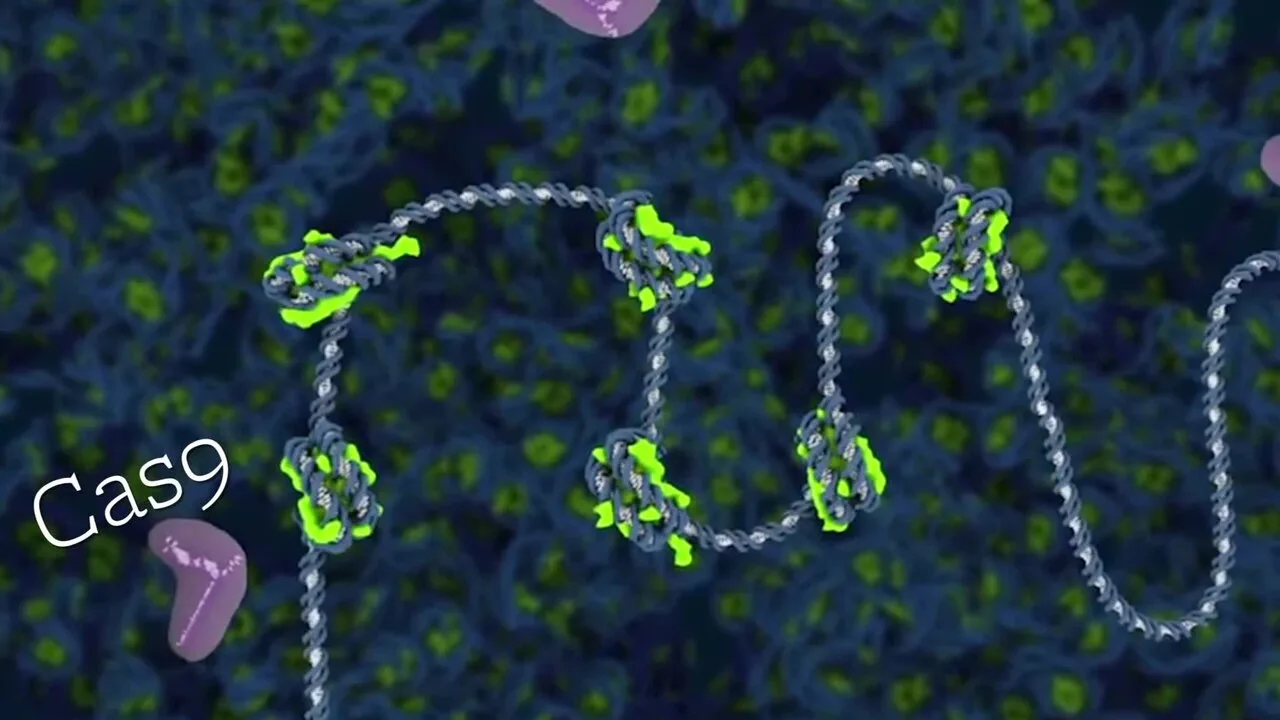
CRISPR began as a microbial defense system that stores fragments of viral DNA and uses matching sequences to recognize later infections. CRISPR gene editing repurposes this machinery: guide RNA directs Cas proteins to a DNA target, then cellular repair changes the sequence. Variants such as base and prime editing expand precision, while germline editing raises questions because changes could be inherited.
Yoshizumi Ishino was sequencing a region of the E. coli genome in 1987, working at Osaka University on an entirely different problem, when he noticed something strange.
Embedded in the bacterial DNA were repeated sequences that had no business being there - palindromic repeats, identical to one another, separated by short stretches of sequence that seemed to have no obvious source or function.
He published his findings, included the anomalous sequences in a figure, and added a footnote: "The biological significance of these sequences is unknown." Then he moved on.
That sentence would eventually become one of the most consequential understatements in the history of science.
The sequences Ishino had noticed were CRISPR - Clustered Regularly Interspaced Short Palindromic Repeats - and they were the signature of an immune system that bacteria and archaea had been using to defend themselves against viral attack for perhaps a billion years.
Within thirty-five years of that throwaway footnote, the same molecular machinery would be reprogrammed into a tool that could rewrite any DNA sequence in any organism, cure genetic diseases that had seemed untreatable for generations, and win the Nobel Prize in Chemistry.
The story of CRISPR is a case study in how basic research with no obvious practical application - a microbiologist puzzling over repeating sequences in salt-tolerant archaea, another researcher trying to understand how dairy bacteria resist bacteriophage infection - compounds unexpectedly into a technology that reshapes medicine.
It is also a story about the speed at which science can move from discovery to clinical application when the underlying mechanism is clean, the tool is flexible, and the unmet medical need is urgent. The first CRISPR-based therapy was approved by the FDA in December 2023, thirty-six years after Ishino's footnote.
"We knew we had something special when we could design a single molecule - a piece of RNA - and direct a protein to cut DNA anywhere we wanted. The programmability was the revolution." - Jennifer Doudna, A Crack in Creation (2017)
Key Definitions
CRISPR: Clustered Regularly Interspaced Short Palindromic Repeats - the bacterial DNA sequences that gave the gene editing technology its name; the biological record of past viral infections.
Cas9: CRISPR-associated protein 9, the molecular scissors most commonly used in CRISPR gene editing; a DNA endonuclease that cuts both strands of the double helix at a specified location.
Guide RNA (gRNA): A short RNA molecule, typically 20 nucleotides, designed to base-pair with a specific DNA target sequence and direct Cas9 to the correct genomic location.
PAM sequence: Protospacer Adjacent Motif - a short DNA sequence (NGG for SpCas9) that must be present immediately adjacent to the target site for Cas9 to bind and cut.
NHEJ: Non-Homologous End Joining - the cell's primary DNA repair pathway after a double-strand break; error-prone, often introducing small insertions or deletions that disrupt gene function.
HDR: Homology-Directed Repair - a more precise repair pathway that can incorporate a provided DNA template to make specific sequence substitutions; requires a homologous repair template and is most efficient in dividing cells.
Base editing: A CRISPR variant developed by David Liu's lab that directly converts one DNA base to another (A to G, or C to T) without making a double-strand break.
Prime editing: A more versatile CRISPR variant (Liu lab, 2019) capable of making any base substitution, plus small insertions and deletions, using a pegRNA and reverse transcriptase; analogous to "search and replace" in a word processor.
Germline editing: Editing of sperm, egg, or embryo cells such that the change is heritable - present in all cells of the resulting organism and potentially passed to future generations.
How Bacteria Discovered CRISPR First
Francisco Mojica was not thinking about gene editing when he began studying the strange repeating sequences in the archaea he was culturing from the hypersaline lagoons near Alicante, Spain in the early 1990s.
Haloferax mediterranei thrived in conditions that would kill most organisms, and Mojica was interested in how it maintained its biology in such extremes.
But as he sequenced its genome, he kept encountering the same anomalous pattern Ishino had seen in E. coli: identical repeats separated by unique spacer sequences of roughly the same length.
Over the following decade, as genome sequencing technology improved and more microbial genomes became available, Mojica saw the same patterns in organism after organism - bacteria and archaea across wildly different environments, all sharing this distinctive repeat-spacer architecture.
In 2003, searching a database of viral sequences, he found the crucial clue: the spacer sequences between the repeats matched viral DNA.[2] The spacers were not random.
They were fragments of viruses that had attacked the bacterium at some point in its past, incorporated into the genome as a molecular memory of infection.
The implication was astonishing. Bacteria had an adaptive immune system - something biologists had generally thought was a vertebrate innovation - that worked by storing snippets of viral DNA and using them to recognize and destroy matching viruses upon reinfection.
When Mojica tried to publish this interpretation, journals rejected it repeatedly. His manuscript explaining the viral-spacer connection was declined by Nature, Molecular Microbiology, and Nucleic Acids Research before finally being accepted by the Journal of Molecular Evolution in 2005.
The CRISPR name was coined by Ruud Jansen and colleagues in 2002 to describe the distinctive clustered repeat architecture they observed across multiple microbial genomes.
By the mid-2000s, multiple research groups - including those of Eugene Koonin, John van der Oost, and Sylvain Moineau working on dairy-industry bacteriophage resistance - had converged on the same conclusion: CRISPR was an adaptive microbial immune system that stored viral sequences and used them to mount a targeted immune response.
The next question was how.
The Mechanism: RNA-Guided DNA Cutting
The mechanistic breakthrough required understanding the Cas proteins - the enzymes encoded alongside the CRISPR repeats in microbial genomes.
Different organisms had different Cas protein repertoires, but a pattern emerged: the CRISPR RNA (crRNA), derived from the repeat-spacer array, guided Cas proteins to matching foreign DNA, and the Cas proteins cut it.
Jennifer Doudna at UC Berkeley and Emmanuelle Charpentier at Umea University (later Max Planck Institute) joined forces to understand the biochemistry of one particular system from Streptococcus pyogenes: the Cas9 protein.[6] In a landmark 2012 paper published in Science, they showed several things simultaneously.
First, Cas9 uses a dual-RNA guide structure - the crRNA and a separate transactivating crRNA (tracrRNA) - to recognize its target. Second, by fusing these two RNA components into a single "single guide RNA" (sgRNA), they created a simpler, programmable system.[1]
Third, and most importantly: they demonstrated that by designing a new sgRNA with any 20-nucleotide sequence of their choosing, they could direct Cas9 to cut any DNA target bearing that sequence plus an adjacent NGG PAM motif.
The programmability was the revolution. Earlier gene editing tools - zinc-finger nucleases (ZFNs) and TALENs - could in principle target any sequence, but designing new variants required engineering new proteins, which was slow, expensive, and required specialized expertise.
With CRISPR-Cas9, changing the target required nothing more than synthesizing a new 20-nucleotide RNA sequence - a procedure that any molecular biology laboratory could accomplish in days and for minimal cost.
From Bacterial Immune System to Human Cells
The 2012 Doudna-Charpentier paper demonstrated CRISPR-Cas9 editing in biochemical reactions and bacterial cells. The critical next step was showing it worked in human (and other eukaryotic) cells.
Feng Zhang at the Broad Institute (MIT/Harvard), working simultaneously and independently, published in January 2013 in Science showing that CRISPR-Cas9 could edit human and mouse cells in culture. George Church's laboratory at Harvard published essentially the same finding simultaneously.
A patent dispute between the Broad Institute and UC Berkeley over who deserved priority for the human-cell application became one of the most consequential intellectual property battles in the history of biotechnology.
The CRISPR-Cas9 system required some modifications to function in eukaryotic cells. Nuclear localization signals were added to help Cas9 enter the cell nucleus. Codon optimization improved expression.
But the fundamental mechanism was unchanged: the sgRNA base-pairs with the target DNA, Cas9 cleaves both strands, and the cell's repair machinery handles the break.
The same two pathways operate in human cells as in bacteria: NHEJ (which disrupts the gene) and HDR (which, given an appropriate DNA template, can make precise substitutions).
The years from 2013 to 2018 produced an explosion of research applications as laboratories worldwide adopted CRISPR as their standard tool for studying gene function, creating disease models in animals, and developing therapeutic candidates.
CRISPR knockout libraries - allowing systematic disruption of every gene in the human genome to ask which ones are required for particular cellular functions - transformed cancer biology and drug target identification.
CRISPR-based genome-wide association studies moved from statistical association to functional investigation in months rather than years.
The Molecular Mechanics in Detail
Understanding how CRISPR-Cas9 actually works at the molecular level clarifies both its power and its limitations.
The guide RNA begins the process by base-pairing with the complementary strand of the target DNA in a sequence-specific manner. This works on the same logic as all nucleic acid hybridization: A pairs with T (in DNA) or U (in RNA), and C pairs with G.
The 20 nucleotides of the guide RNA are designed to match the 20 nucleotides of the target strand on one side of the PAM sequence. Cas9 first scans the genome by binding to PAM sequences (NGG motifs, which occur roughly every 8 base pairs in a typical genome) and then "checks" whether the adjacent sequence matches the guide RNA.
If there is sufficient complementarity, the double helix unwinds and the guide RNA forms a hybrid with the target strand.
A conformational change in Cas9 then positions two catalytic domains - the RuvC and HNH domains - to cut the non-complementary strand and the complementary strand respectively, generating a blunt-ended double-strand break.
What happens next depends on which repair pathway is active. NHEJ, which operates in virtually all cell types, ligates the broken ends quickly but imprecisely, often introducing one or a few nucleotide insertions or deletions at the cut site.
If these indels fall in the coding sequence of a gene and shift the reading frame, the gene is effectively disabled - the resulting protein is truncated or nonsensical.
This is the standard approach for gene knockout experiments and for therapeutic strategies where the goal is to disrupt a gene (such as knocking out the BCL11A enhancer to reactivate fetal hemoglobin in the sickle cell therapy).
HDR, in contrast, can incorporate an externally provided DNA template. If a stretch of DNA with the desired sequence change is introduced along with the CRISPR components, and if the cell is actively dividing (HDR operates primarily in the S and G2 phases of the cell cycle), the cell may use the template to make a precise substitution.
This is how researchers can create specific point mutations in research models, and how therapeutic strategies involving precise correction of disease-causing mutations would work.
HDR is considerably less efficient than NHEJ in most cell types and nearly absent in non-dividing cells, which limits its therapeutic applications.
| Repair pathway | Efficiency | Precision | Main application |
|---|---|---|---|
| NHEJ | High | Low (insertions/deletions) | Gene disruption, knockout |
| HDR | Low-moderate (in dividing cells) | High (with template) | Precise correction |
| Base editing (no DSB) | Moderate-high | High (single-base changes) | Point mutation correction |
| Prime editing (no DSB) | Moderate | Very high (any change) | Versatile correction |
Beyond Cas9: Expanding the Toolkit
The field moved rapidly beyond the original Cas9 from S. pyogenes. Alternative Cas proteins with different PAM requirements, smaller sizes (important for viral delivery), or higher specificity were identified from other microbial species.
CjCas9 from Campylobacter jejuni and SaCas9 from Staphylococcus aureus are small enough to be packaged in adeno-associated viral vectors alongside their guide RNAs, enabling in vivo delivery.
CRISPRi and CRISPRa - interference and activation - expanded the toolkit beyond editing. By fusing a catalytically dead Cas9 (dCas9, which cannot cut DNA) to transcriptional repressors or activators, researchers can silence or amplify any gene's expression without altering the DNA sequence.
This allows reversible modulation of gene activity, which is valuable both for research and, potentially, for therapeutic applications where permanent editing is not desired.
Base editing, from David Liu's laboratory at the Broad Institute, represented the first genuinely new approach to precision editing. Published in 2016, the cytosine base editors (CBEs) use a CBE-deaminase fusion to convert C to T at target sites without a double-strand break.[5]
The 2017 adenine base editors (ABEs) enable A-to-G conversion. Because many disease-causing mutations are single-nucleotide changes, and because roughly half of all known pathogenic point mutations can in principle be corrected by a C-to-T or A-to-G change, base editing has immediate therapeutic relevance.
Clinical trials for base-editing therapies targeting sickle cell disease, beta-thalassemia, and transthyretin amyloidosis are underway.
Prime editing, described by Liu's group in a 2019 Nature paper, added another layer of capability.
Using a prime editing guide RNA (pegRNA) that carries both the targeting sequence and the desired edit sequence, along with a reverse transcriptase enzyme fused to a Cas9 nickase, prime editing can install any of the twelve possible base substitutions, plus small insertions and deletions, with high precision.[3]
The range of editable mutations is substantially broader than base editing.
Prime editing's efficiency in vivo remains an active area of development, but early in vivo results in animal models have been promising.
The First Approved CRISPR Therapy
The clinical milestone that made December 2023 a turning point in medicine was the FDA approval of Casgevy (exagamglogene autotemcel), developed by Vertex Pharmaceuticals and CRISPR Therapeutics.
Casgevy treats sickle cell disease and transfusion-dependent beta-thalassemia by a mechanism that illustrates how the first generation of CRISPR therapies was designed: ex vivo editing of cells extracted from the patient.
The logic exploits a biological fact: humans produce two forms of hemoglobin, fetal and adult. Fetal hemoglobin (HbF), which predominates in the developing fetus and newborn, can carry oxygen efficiently and does not sickle. After birth, a genetic switch silences HbF production and activates adult hemoglobin (HbA).
In sickle cell disease, the adult hemoglobin carries a single point mutation that causes it to polymerize under low-oxygen conditions, deforming red blood cells into the characteristic sickle shape and causing the vaso-occlusive crises that damage organs and cause severe pain.
If HbF production could be reactivated in adult red blood cells, it would compensate for the defective HbA.
Casgevy works by using CRISPR-Cas9 to disrupt the enhancer of the BCL11A gene in the patient's own hematopoietic stem cells.
BCL11A is the transcriptional repressor that silences fetal hemoglobin after birth; disrupting its erythroid enhancer (without disrupting its function in immune cells) allows HbF reactivation in red blood cell precursors.
The patient's stem cells are harvested, edited ex vivo, and reinfused after myeloablative conditioning.
Clinical trial data published by Frangoul and colleagues in the New England Journal of Medicine in 2021 and expanded in subsequent trial updates showed that 29 of 29 patients with severe sickle cell disease remained free of severe vaso-occlusive crises after the treatment.[4]
The results were dramatic enough that the FDA approval process moved with unusual speed.
The He Jiankui Controversy and Germline Governance
The most scientifically and ethically consequential misuse of CRISPR occurred in November 2018, when Chinese biophysicist He Jiankui announced at the Second International Summit on Human Genome Editing in Hong Kong that twin girls had been born following embryo editing with CRISPR-Cas9.
He had targeted the CCR5 gene, which encodes a co-receptor used by HIV to enter T cells, on the theory that CCR5 disruption would confer HIV resistance. The father was HIV-positive.
The response from the scientific community was swift and almost uniformly condemnatory. The medical justification was inadequate: the transmission risk from a virally suppressed HIV-positive father to children was effectively zero with standard precautions, and conventional prevention methods existed.
The editing was reportedly mosaic - not all cells in the embryos were uniformly edited - leaving uncertain protection and uncertain risk. CCR5 plays roles in immune function beyond HIV entry, and its complete disruption has been associated with increased susceptibility to West Nile virus and influenza in population studies.
Crucially, He had worked covertly, obtained falsified ethics approvals, and deceived collaborators and funding bodies. He was convicted in China in 2019 and sentenced to three years in prison.
The incident galvanized the scientific community's discussions of germline editing governance.
A subsequent report by an international commission convened by the National Academies of Sciences, Engineering, and Medicine and the Royal Society concluded that heritable human genome editing should not proceed unless strict criteria were met, including the establishment of preclinical evidence about safety and efficacy, a transparent societal process for reaching conclusions about the appropriateness of the application, and a robust regulatory pathway.
The report was careful to leave open the possibility that germline editing might someday be justified for preventing serious genetic diseases where no reasonable alternatives exist, while insisting that the He Jiankui experiment met none of the necessary conditions.
Limitations and the Road Ahead
The remaining limitations of CRISPR technology define the current research agenda.
Off-target editing - CRISPR cutting at unintended genomic locations - has been substantially reduced by engineering more specific Cas9 variants (eSpCas9, HiFi Cas9) and by optimizing delivery timing, but it cannot yet be ruled out entirely, particularly for therapeutic applications where long-term safety monitoring of treated individuals is required.
Delivery to target tissues in vivo is the primary bottleneck for most therapeutic applications. The success of Casgevy depends on ex vivo editing - removing cells from the body, editing them, and returning them - which works for blood and immune cells but cannot be applied to liver, muscle, lung, or brain.
Lipid nanoparticles, which the mRNA COVID vaccines made famous, can deliver CRISPR components to hepatocytes (liver cells) effectively, and in vivo CRISPR therapies targeting liver conditions are in clinical trials.
Other tissues remain more challenging. Adeno-associated viral vectors can reach muscle, retina, and nervous system cells, but their carrying capacity is limited and pre-existing immune responses to the viral capsid can complicate delivery.
The deeper limitation is biological rather than technical: CRISPR can edit one gene at a time with precision, but most diseases and traits are polygenic, influenced by hundreds or thousands of variants distributed across the genome. CRISPR cannot simultaneously and safely edit hundreds of loci.
For the vast majority of complex conditions - cardiovascular disease, type 2 diabetes, psychiatric disorders, intelligence - CRISPR therapy is not a realistic near-term approach, regardless of technical improvements.
What the next generation of CRISPR-derived technologies - base editors, prime editors, epigenome editors, RNA editors - may accomplish is still taking shape. The trajectory from Ishino's unexplained footnote in 1987 to an approved human therapy in 2023 covered thirty-six years.
The trajectory from today's base editors and prime editors to broader therapeutic applications may be considerably shorter.
Related Articles
Sources & Further Reading
- Jinek, M., Chylinski, K., Fonfara, I., Hauer, M., Doudna, J. A., & Charpentier, E. (2012). A programmable dual-RNA-guided DNA endonuclease in adaptive bacterial immunity. Science, 337(6096), 816-821. DOI: 10.1126/science.1225829
- Mojica, F. J. M., Diez-Villasenor, C., Garcia-Martinez, J., & Soria, E. (2005). Intervening sequences of regularly spaced prokaryotic repeats derive from foreign genetic elements. Journal of Molecular Evolution, 60(2), 174-182. DOI: 10.1007/s00239-004-0046-3
- Anzalone, A. V., Randolph, P. B., Davis, J. R., Sousa, A. A., Koblan, L. W., Levy, J. M., ... & Liu, D. R. (2019). Search-and-replace genome editing without double-strand breaks or donor DNA. Nature, 576(7785), 149-157. DOI: 10.1038/s41586-019-1711-4
- Frangoul, H., Altshuler, D., Cappellini, M. D., Chen, Y. S., Domm, J., Eustace, B. K., ... & Corbacioglu, S. (2021). CRISPR-Cas9 gene editing for sickle cell disease and beta-thalassemia. New England Journal of Medicine, 384(3), 252-260. DOI: 10.1056/NEJMoa2031054
- Komor, A. C., Kim, Y. B., Packer, M. S., Zuris, J. A., & Liu, D. R. (2016). Programmable editing of a target base in genomic DNA without double-stranded DNA cleavage. Nature, 533(7603), 420-424. DOI: 10.1038/nature17946
- Doudna, J. A. (2017). A Crack in Creation: Gene Editing and the Unthinkable Power to Control Evolution. Houghton Mifflin Harcourt.