
Einstein: On the morning of November 6, 1919, Arthur Stanley Eddington presented his results to a packed joint meeting of the Royal Society and the Royal Astronomical Society in London. Eddington had sailed to Principe Island, off the west coast of Africa, to photograph stars near the sun during the total solar eclipse of May 29, 1919.
The eclipse offered the only moment when stars appearing close to the sun's disc could be observed - the sun's overwhelming glare made them invisible at all other times.
The question Eddington was answering had been posed by Einstein himself: does the sun's gravity bend light? Newton's theory predicted that gravity might affect light, but only half as much as Einstein's general theory of relativity predicted. A measurement during totality would settle it.
Eddington's measurements showed that starlight passing close to the sun was deflected by approximately 1.75 arcseconds - matching Einstein's prediction almost exactly, and more than twice the Newtonian value.[5] The president of the Royal Society, J.J.
Thomson, declared it the greatest discovery in the history of gravitation since Newton. The next day, headlines across the world announced that Newton had been overthrown. Albert Einstein, then forty years old and largely unknown outside scientific circles, became a global celebrity overnight.
Letters and telegrams flooded his office. A student asked him what he would have thought if Eddington's measurement had disagreed with his prediction. Einstein replied, famously and perhaps apocryphally: then I would have felt sorry for the dear Lord - the theory is correct.
The confidence was justified - not by Einstein's personality, but by the theory's extraordinary internal coherence and the decade of effort that had preceded it. General relativity is not simply a more accurate version of Newton's gravity.
It is a fundamentally different description of what gravity is, what space and time are, and how mass shapes the universe. In the century since Eddington's eclipse, every experimental test has confirmed its predictions.
It underlies GPS navigation, explains black holes, predicted gravitational waves detected a hundred years after they were theorized, and describes the large-scale structure and history of the cosmos. It also breaks down at singularities in ways that signal the limits of our understanding, pointing toward a physics not yet built.
"Space acts on matter, telling it how to move. In turn, matter reacts back on space, telling it how to curve." - John Archibald Wheeler, A Journey into Gravity and Spacetime (1990)
Key Definitions
Special relativity: Einstein's 1905 theory describing the physics of objects moving at constant velocities, establishing that the speed of light is constant for all observers and deriving time dilation, length contraction, and mass-energy equivalence.
General relativity: Einstein's 1915 extension incorporating acceleration and gravity, which describes gravity as the curvature of spacetime caused by mass and energy.
Spacetime: The four-dimensional continuum combining three spatial dimensions and one time dimension, which can be curved by mass and energy.
Equivalence principle: The observation that the effects of gravitational acceleration are locally indistinguishable from the effects of inertial acceleration, forming the conceptual foundation of general relativity.
Geodesic: The straightest possible path through curved spacetime. Objects in free fall - including orbiting planets and falling apples - follow geodesics, which is why we experience their motion as gravity.
Event horizon: The boundary around a black hole beyond which no signal or matter can escape. Defined by the Schwarzschild radius for a non-rotating black hole.
Gravitational time dilation: The phenomenon by which clocks in stronger gravitational fields run slower than clocks in weaker gravitational fields, a direct prediction of general relativity.
Gravitational waves: Ripples in the curvature of spacetime that propagate outward from accelerating massive objects, traveling at the speed of light.
Einstein field equations: The set of ten interrelated differential equations that describe how the distribution of mass and energy determines the curvature of spacetime.
Singularity: A point at which the equations of general relativity produce infinite values of curvature, signaling the breakdown of the theory in that regime.
Key Tests and Confirmations of General Relativity
| Test | Prediction | Result | Significance |
|---|---|---|---|
| Mercury's perihelion precession | 43 arcseconds per century unaccounted for by Newtonian gravity | Exact match with GR calculation (1915) | First empirical confirmation; resolved a 56-year anomaly |
| Eddington eclipse experiment | Starlight deflected by 1.75 arcseconds near the sun | 1.75 0.3 arcseconds (1919) | Made Einstein globally famous; confirmed gravity bends light |
| Gravitational redshift (Pound-Rebka) | Photons lose energy climbing out of a gravitational well | Fractional shift of ~2.5 10^-15 over 22.5 m confirmed (1959) | Confirmed gravitational time dilation at terrestrial scale |
| GPS satellite clock corrections | Clocks 20,200 km up run fast by ~38 microseconds/day (net GR + SR effect) | Correction built in; without it, GPS error accumulates at ~11 km/day | Most commercially important test; GR is engineering reality |
| Binary pulsar energy loss (Hulse-Taylor) | Orbit decays at rate matching gravitational wave emission | Matches GR within 0.3% over decades | First indirect evidence for gravitational waves; Nobel 1993 |
| Gravitational waves (LIGO GW150914) | Black hole mergers produce spacetime ripples at speed of light | Signal detected September 14, 2015; waveform matches GR prediction | First direct detection; Nobel 2017; confirmed black hole binary mergers |
| Black hole imaging (EHT) | Event horizon shadow with bright ring at predicted size | M87* imaged 2019; Sgr A* imaged 2022 | Visual confirmation of event horizons predicted by Schwarzschild solution |
The Special Theory: A Necessary Prologue
General relativity grew from special relativity, which Einstein published in 1905 - a decade earlier. The core problem special relativity addressed was a contradiction between classical mechanics and Maxwell's equations for electromagnetism.
Maxwell's equations predicted that electromagnetic waves travel at a fixed speed, approximately 300,000 kilometers per second. Classical mechanics said that speeds should add and subtract: a ball thrown from a moving train travels at the train's speed plus the throwing speed.
If light behaved similarly, its speed should vary depending on the motion of the observer or the source. Experiments, most decisively the Michelson-Morley experiment of 1887, showed that the speed of light was the same regardless of how fast the observer was moving. Something had to give.
Einstein's resolution was radical: accept the constancy of the speed of light as fundamental, and derive the consequences. The consequences were strange. Time dilates - clocks in motion run slower than stationary clocks. Lengths contract in the direction of motion.
Simultaneity is relative - two events that appear simultaneous to one observer may appear sequential to another moving relative to the first. Most famously, mass and energy are equivalent: E = mc2, meaning that a small amount of mass corresponds to an enormous amount of energy.
Special relativity, despite these oddities, was confirmed by experiments within years of publication and is today verified to extraordinary precision in particle accelerators that must account for relativistic mass increase to design their magnets.
But special relativity was incomplete: it applied only to observers moving at constant velocity - the special case of inertial frames. It had nothing to say about acceleration, and it treated gravity as Newton had: a force acting instantaneously at a distance in flat, unchanging space.
This incompleteness was what Einstein spent the next decade addressing.
The Happiest Thought: From Special to General
In 1907, working as a patent clerk in Bern and writing a review article on special relativity, Einstein had what he later described as the happiest thought of his life. He imagined a man falling freely from the roof of a house. The falling man, Einstein realized, would not feel his own weight.
In free fall, the gravitational force and the inertial response to it cancel perfectly. A falling person in a closed room cannot tell whether they are weightless in deep space or in free fall near a massive object.
Conversely, a person in an accelerating rocket in empty space cannot distinguish their experience from standing on Earth's surface in gravity.
This equivalence principle - the local physical equivalence of gravitational and inertial acceleration - had a devastating implication. If you are in an accelerating room and you fire a light beam horizontally, the beam curves downward as the room accelerates up beneath it.
If gravity and acceleration are equivalent, then light must curve in a gravitational field. But if light curves, and if special relativity says that time is linked to geometry, then gravity must curve time itself. Time must pass differently at different gravitational potentials: slower near massive objects, faster far from them.
The mathematical machinery required to express this insight was beyond what Einstein had. General relativity required describing curvature in four-dimensional spacetime, which demanded Riemannian differential geometry - mathematics developed by Bernhard Riemann in the 1850s for entirely different purposes.
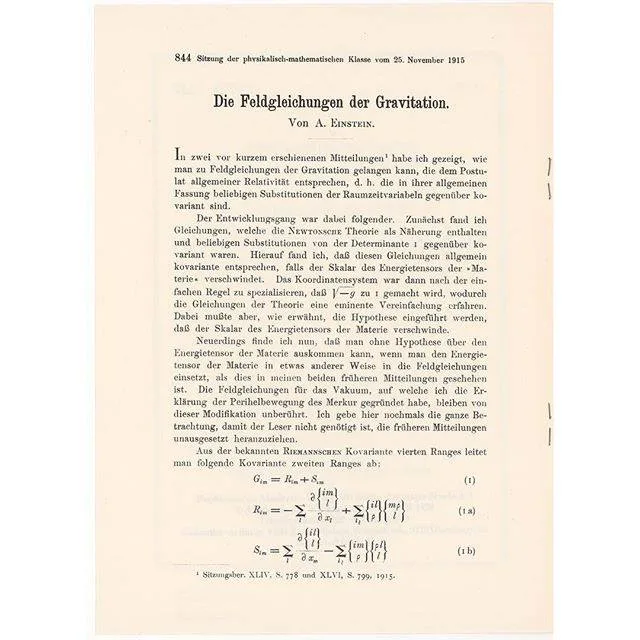
Einstein spent years learning it, enlisting his mathematician friend Marcel Grossmann. The field equations emerged in November 1915 in a furious final push during which Einstein was in competition with the mathematician David Hilbert.
The equations describe how the geometry of spacetime is related to the distribution of mass and energy.[1] In Wheeler's famous formulation: mass tells spacetime how to curve, and spacetime tells mass how to move.[6]
Curved Spacetime and Orbits
The rubber sheet analogy - a heavy ball placed on a stretched sheet, creating a depression that causes nearby marbles to spiral inward - captures something true about general relativity but misleads in important ways.
The depression in the sheet is a spatial curve; general relativity involves curvature of spacetime, including the time dimension.
It is the curvature of the time dimension that dominates for slow-moving objects like planets, where spatial curvature corrections are small.
A more accurate intuition: the Earth does not orbit the Sun because the Sun pulls on it. The Earth orbits because the Sun's mass curves the spacetime in its vicinity, and the Earth is following the straightest possible path - a geodesic - through that curved spacetime.
In flat spacetime, the straightest path between two points in four dimensions is a straight line in space. In curved spacetime near the Sun, the straightest path through four dimensions traces an ellipse in three-dimensional space. Gravity is not a force acting between objects. It is geometry.
This reframing had immediate practical consequences. The anomalous precession of Mercury's perihelion had been a nagging problem for astronomers since Urbain Le Verrier first quantified it in 1859.
Mercury's closest approach to the Sun - its perihelion - shifts by about 575 arcseconds per century due to the gravitational perturbations of other planets. But 43 arcseconds per century remained after accounting for all known gravitational influences.
When Einstein applied his field equations to Mercury's orbit, he obtained precisely 43 arcseconds - a perfect accounting of the discrepancy. He later described this calculation as producing such excitement that he could not sleep for several days.
Gravitational Time Dilation and GPS
One of general relativity's most counterintuitive predictions is that time passes at different rates at different gravitational potentials. Deep in a gravitational well - near a massive object - time passes more slowly than at a distance. This is not a metaphor or a measurement artifact.
It is a real, measurable effect confirmed by multiple experiments.
The Pound-Rebka experiment, conducted at Harvard in 1959, measured the gravitational redshift of gamma rays over a 22.5-meter vertical drop - the height of the Jefferson Physical Laboratory.
Using gamma rays of exquisitely precise frequency, Robert Pound and Glen Rebka confirmed that photons climbing upward out of Earth's gravitational field lose energy and shift to lower frequency (redshift) by exactly the amount general relativity predicted (doi: 10.1103/PhysRevLett.3.439).[3]
The fractional frequency shift over 22.5 meters is approximately 2.5 x 10^-15 - a measurement that required the newly developed Mossbauer effect for gamma ray spectroscopy.
The practical consequences of gravitational time dilation are built into every GPS satellite. GPS satellites orbit at approximately 20,200 kilometers above Earth's surface, where gravity is weaker. The gravitational time dilation causes their atomic clocks to run fast by approximately 45 microseconds per day.
Special relativistic time dilation from their orbital velocity causes the clocks to run slow by about 7 microseconds per day. The net effect is a drift of 38 microseconds per day - fast.
Since light travels 30 centimeters in a nanosecond, 38 microseconds corresponds to a positional error of about 11 kilometers per day, accumulating continuously.
GPS engineers corrected for this before launch, setting satellite atomic clocks to tick slightly slower than ground standards so that the relativistic corrections restore them to ground time in orbit.
Without this correction, GPS would be useless for navigation within hours. General relativity is not academic physics. It is an engineering constraint of the infrastructure that guides billions of people daily.
Gravitational Lensing
The 1919 eclipse measurement confirmed that the sun's gravity bends light. The effect scales with the mass of the deflecting object: more massive objects bend light more strongly. This has made gravitational lensing one of the most powerful tools in modern observational cosmology.
When a massive galaxy cluster lies between Earth and a more distant galaxy, the cluster acts as a gravitational lens: it bends the light from the distant galaxy around it, distorting and amplifying the image. The distorted images appear as arcs or rings - Einstein rings, when alignment is perfect - around the lensing cluster.
By measuring the degree of lensing, astronomers can calculate the total mass of the intervening cluster, including mass that is not luminous.
Gravitational lensing provided some of the earliest independent evidence for dark matter: the lensing effects of clusters are far larger than can be explained by their visible stars and gas alone, requiring several times more mass in an invisible form.
The Bullet Cluster, formed from the collision of two galaxy clusters, has been analyzed through lensing and found to contain a spatial separation between the hot gas (which slowed during the collision) and the dark matter (which passed through unimpeded) - a result widely cited as direct evidence for the particle nature of dark matter.
Gravitational Waves: A Century from Prediction to Detection
Einstein's field equations predicted gravitational waves in 1916: that accelerating masses should produce ripples in the curvature of spacetime, propagating outward at the speed of light. Einstein himself was ambivalent about whether they were physically real or mathematical artifacts.
A gravitational wave passing through matter alternately stretches and compresses distances in perpendicular directions, in a quadrupolar pattern. The first detected gravitational wave signal moved LIGO's mirrors by a distance one-thousandth the diameter of a proton.
Indirect evidence for gravitational waves came in 1974 when Russell Hulse and Joseph Taylor discovered the first binary pulsar system - two neutron stars orbiting each other and losing energy at exactly the rate general relativity predicts from gravitational wave emission.
Hulse and Taylor received the 1993 Nobel Prize for this discovery. But direct detection required an instrument of extraordinary precision.
The Laser Interferometer Gravitational-Wave Observatory, LIGO, was built to detect gravitational waves directly. With two facilities in Hanford, Washington and Livingston, Louisiana, each with L-shaped arms four kilometers long, LIGO uses laser interferometry to measure distance changes at a sensitivity of 10^-18 meters.
On September 14, 2015, both detectors registered a brief signal: a rising frequency chirp lasting approximately 0.2 seconds, followed by a ringdown.
Analysis revealed it was produced by two black holes - approximately 29 and 36 times the mass of the Sun - merging approximately 1.3 billion light years from Earth. In the final fraction of a second, the merger radiated more energy in gravitational waves than all the stars in the observable universe emit in light.
The signal, designated GW150914, matched the waveform predicted by general relativity with extraordinary precision. The detection was published in Physical Review Letters in 2016 (doi: 10.1103/PhysRevLett.116.061102).[2]
Rainer Weiss, Barry Barish, and Kip Thorne received the 2017 Nobel Prize in Physics. Since then, LIGO and its European partner Virgo have detected dozens of gravitational wave events, including collisions between neutron stars and mixed black hole-neutron star systems.
Black Holes and Event Horizons
Karl Schwarzschild solved Einstein's field equations for a perfectly spherical mass in 1916, just months after they were published - while serving in the German army on the Russian front. His solution contained a peculiarity: at a critical radius, now called the Schwarzschild radius, the equations became singular.
For a mass equivalent to the Sun, the Schwarzschild radius is approximately 3 kilometers. For Earth, it is about 9 millimeters.
Einstein initially believed this singularity was a mathematical artifact. Robert Oppenheimer and Hartland Snyder showed in 1939 that a sufficiently massive star undergoing collapse would reach the Schwarzschild radius, creating a region from which no signal could escape.
The term black hole was coined by John Wheeler in 1967. Roger Penrose proved in 1965 that the formation of a singularity is an inevitable consequence of gravitational collapse beyond a certain mass threshold (doi: 10.1103/PhysRevLett.14.57).[4] Penrose received the Nobel Prize in Physics in 2020 partly for this work.
The event horizon is the point of no return. From outside, an infalling object appears to slow down and redden as it approaches the event horizon, eventually appearing frozen at its surface as its redshifted signals asymptotically approach infinite redshift.
From the perspective of the infalling object, no dramatic event marks the crossing of the horizon - it passes through seamlessly, though it can never communicate what happens next to outside observers.
The Event Horizon Telescope collaboration combined radio telescopes across the globe into a virtual Earth-sized interferometer and in 2019 published the first direct image of the shadow of a black hole's event horizon: the supermassive black hole at the center of the galaxy M87, 6.5 billion times the mass of the Sun, 55 million light years away.[7]
In 2022, the same collaboration published the first image of Sagittarius A*, the 4-million solar mass black hole at the center of the Milky Way. Both images showed the distinctive bright ring and central shadow predicted by general relativity.
Where General Relativity Breaks Down
General relativity's success is extraordinary. Yet physicists know it is incomplete.
The theory predicts its own failure: singularities - points of infinite density at the centers of black holes and at the Big Bang - are loci where the equations produce infinities, signaling breakdown of the description.
The real physical situation at those points cannot be described by general relativity.
The deeper problem is that general relativity and quantum mechanics are mutually incompatible. General relativity is a classical field theory of a continuous, smooth spacetime. Quantum mechanics describes fields as quantized, with discrete energy exchanges and irreducible probabilistic uncertainties.
When physicists attempt to quantize gravity - to describe gravitons, the hypothetical force-carrying particles of gravity, in the manner that quantum field theory describes photons and gluons - the calculations produce non-renormalizable infinities that cannot be absorbed by the mathematical procedures that handle the other fundamental forces.
The regime where both theories must apply simultaneously - near singularities, at the Planck scale of 10^-35 meters - is beyond current experimental reach. String theory and loop quantum gravity represent the two most developed attempts to construct a quantum theory of gravity consistent with general relativity in the appropriate limit.
Neither has yet produced a testable prediction that has been confirmed. The reconciliation of general relativity with quantum mechanics remains the central open problem of fundamental physics.
Cosmological Implications
Einstein's equations, applied to the universe as a whole, describe its large-scale dynamics. When applied in 1917, the equations predicted a universe that was either expanding or contracting. Einstein found this prediction unphysical and introduced a cosmological constant to produce a static universe.
After Edwin Hubble's 1929 discovery that distant galaxies are receding, with recession velocity proportional to distance, Einstein called the cosmological constant his greatest blunder.
The expanding universe implied that if you run time backward, all matter converges to an initial point of extreme density - the Big Bang.
Observations of Type Ia supernovae in 1998 by two independent teams revealed that the expansion of the universe is accelerating, not decelerating.
The cosmological constant - now interpreted as the energy density of empty space, called dark energy - has been reinstated as the dominant component of the universe's energy budget: approximately 68% of the total.
Dark matter comprises roughly 27%, and ordinary matter only about 5%. The cosmological constant remains theoretically mysterious: quantum field theory's prediction of vacuum energy density is off from the observed value by roughly 120 orders of magnitude, one of the largest discrepancies in all of physics.
General relativity also predicts gravitational lensing on cosmological scales, the bending of the cosmic microwave background's path, and the overall shape of the observable universe.
Every cosmological observation to date is consistent with the standard model of cosmology, Lambda-CDM, which is built on the framework of general relativity.
The theory published in 1915, tested in a tropical eclipse in 1919, today describes the largest structures ever observed and guides the instruments that navigate every aircraft, ship, and smartphone on Earth.
Cross-References
Sources & Further Reading
- Einstein, A. (1915). Die Feldgleichungen der Gravitation. Sitzungsberichte der Preussischen Akademie der Wissenschaften, 844-847.
- Abbott, B. P., et al. (LIGO Scientific Collaboration and Virgo Collaboration). (2016). Observation of gravitational waves from a binary black hole merger. Physical Review Letters, 116(6), 061102. DOI: 10.1103/PhysRevLett.116.061102
- Pound, R. V., & Rebka, G. A. (1959). Gravitational red-shift in nuclear resonance. Physical Review Letters, 3(9), 439-441. DOI: 10.1103/PhysRevLett.3.439
- Penrose, R. (1965). Gravitational collapse and space-time singularities. Physical Review Letters, 14(3), 57-59. DOI: 10.1103/PhysRevLett.14.57
- Dyson, F. W., Eddington, A. S., & Davidson, C. (1920). A determination of the deflection of light by the Sun's gravitational field, from observations made at the total eclipse of May 29, 1919. Philosophical Transactions of the Royal Society A, 220, 291-333.
- Wheeler, J. A. (1990). A Journey into Gravity and Spacetime. Scientific American Library.
- Event Horizon Telescope Collaboration. (2019). First M87 event horizon telescope results. Astrophysical Journal Letters, 875(1), L1.