
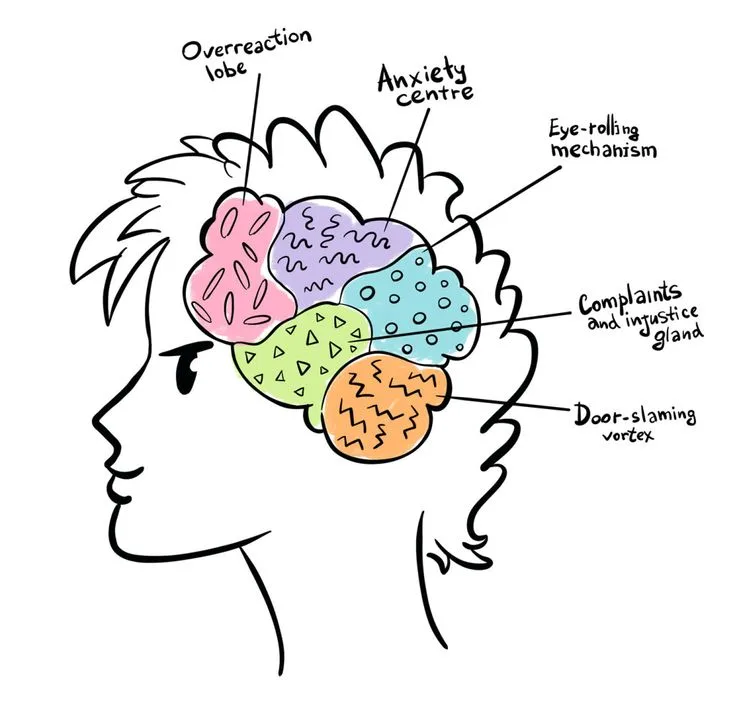
For most of human history, adolescent behavior was explained through moral frameworks: teenagers were seen as lacking in discipline, deficient in character, insufficiently supervised, or simply choosing to be difficult.
The emotional volatility, the risk-taking, the moodiness, the intense self-consciousness, the pull toward peers and away from parents - these were problems to be corrected, evidence of immaturity or sin or permissive parenting.
Neuroscience has offered a different explanation.
The adolescent brain is not a defective adult brain. It is a brain in a specific developmental phase - one with its own logic, its own evolutionary purpose, and its own characteristic strengths and vulnerabilities.
The behaviors that puzzle or frustrate parents and teachers are, in many cases, not bugs but features of this phase: features shaped by millions of years of evolution to serve specific adaptive purposes.
Understanding them does not eliminate the need for guidance and limits. But it makes the behavior comprehensible in a way that moral frameworks alone cannot, and it reveals both the extraordinary potential and the genuine vulnerabilities of this developmental window.
"The teenage brain is not broken. It's a fully operational brain that is optimized for a different set of tasks than the adult brain." - Sarah-Jayne Blakemore, UCL
Key Definitions
Prefrontal cortex (PFC) - The frontmost region of the frontal lobe, responsible for executive functions: impulse control, long-term planning, risk assessment, decision-making, weighing consequences, and regulating emotional responses.
The last major brain region to complete development, not reaching full maturity until approximately age 25.
Synaptic pruning - The elimination of unused or redundant synaptic connections during brain development, refining neural circuits and increasing efficiency. Dramatic pruning occurs in the prefrontal cortex during adolescence - gray matter volume peaks in early adolescence then declines as pruning proceeds.
Myelination - The formation of myelin sheaths around axons, dramatically increasing the speed and reliability of neural transmission. Proceeds throughout adolescence and into the mid-20s, particularly in the prefrontal cortex and long-range frontal-parietal connections.
Dual systems model - Laurence Steinberg's framework proposing that adolescent risk-taking reflects an imbalance between a fully developed, hyperreactive reward/emotional system (subcortical limbic structures) and an incompletely developed regulatory system (prefrontal cortex).[3]
Ventral striatum - A subcortical structure central to reward processing, motivation, and dopamine signaling, including the nucleus accumbens. Shows heightened reactivity to rewards and novelty in adolescence.
Critical/sensitive period - A developmental window during which the brain is especially responsive to experience, capable of forming lasting neural patterns from environmental inputs. Adolescence is a sensitive period for social skills, emotional learning, language, and many other domains.
Circadian phase delay - The biological shift in sleep-wake timing that occurs with puberty, pushing the circadian clock approximately 2-3 hours later and making early morning wakefulness genuinely difficult neurobiologically.
Temporal discounting (hyperbolic discounting) - The tendency to disproportionately devalue future rewards relative to immediate ones. More pronounced in adolescence due to heightened reward system responsivity; contributes to impulsive choices that sacrifice long-term benefit for immediate reward.
Adolescent Brain Development Timeline
| Age Range | Key Brain Change | Behavioral Correlate | Implication for Adults |
|---|---|---|---|
| ~10-12 years | Synaptic pruning begins in PFC; gray matter peaks | Emotional intensity increasing; peer importance rising | Period of maximum sensitivity to experience and environment |
| ~12-15 years | Ventral striatum (reward) fully reactive; PFC still immature | Heightened risk-taking; sensation-seeking; poor impulse control | Peer influence at maximum; reward salience extremely high |
| ~14-16 years | Myelination accelerating in corticolimbic circuits | Emotional regulation slightly improving; still volatile | Reasoning capacity developing but not yet reliable under stress |
| ~16-18 years | PFC-limbic connectivity improving; sleep phase delay at peak | Better abstract reasoning; still impulsive under peer observation | School start times misaligned with biology; major decisions best with adult scaffold |
| ~18-22 years | White matter connectivity continuing; late pruning in PFC | Improved executive function; continued vulnerability to addiction | Legal age of majority precedes neurological full maturity |
| ~22-25 years | PFC myelination substantially complete | Adult-level impulse control and long-term planning | Full brain maturity; risk-taking normalizes |
The Architecture of the Developing Brain
The human brain develops from the inside out and from the back to the front - a sequence with profound implications for adolescent behavior.[5]
Subcortical structures - the amygdala, hippocampus, striatum, and nucleus accumbens - are among the first to mature. These are the brain's emotional, reward, and survival systems. By early adolescence, they are largely adult-equivalent in structure, if not always in connectivity.
The cerebral cortex develops later, and within the cortex, there is a posterior-to-anterior gradient: sensory and motor areas mature first; association areas last; the prefrontal cortex - the most anterior, most recently evolved, and most distinctively human region - matures last of all.
Across species, PFC development correlates with lifespan: humans have the most extensive PFC of any species, and the longest developmental period before full adulthood.
The relative duration of adolescence is partly the developmental cost of having a prefrontal cortex sophisticated enough to enable all that makes humans distinctively human.
Two Waves of Brain Change
Sarah-Jayne Blakemore at University College London has described adolescent brain development as involving two major waves.[1]
The first wave is synaptic pruning. Brain gray matter volume - reflecting the density of synaptic connections - peaks in the prefrontal cortex around age 11-12 in girls and 14-15 in boys, then declines through adolescence and into young adulthood.
This is not loss of brain tissue; it is refinement. The brain eliminates unused synaptic connections ("use it or lose it") and strengthens active ones, increasing the efficiency and specialization of the circuits that remain. The adolescent PFC is in the middle of this refinement process - still being sculpted by experience.
The second wave is myelination - the formation of insulating myelin sheaths around axons. Myelination dramatically increases the speed and reliability of neural transmission; it is roughly analogous to upgrading from dial-up to fiber optic internet.
Myelination proceeds from posterior to anterior, reaching the prefrontal cortex last, continuing into the mid-20s.
The combined effect: the PFC in a 16-year-old is structurally and functionally different from the PFC in a 25-year-old - less well-connected, less rapidly transmitting, less efficiently pruned - even when both perform normally on casual assessment.
The Dual Systems Mismatch: Why Adolescents Take Risks
The most influential framework for understanding adolescent risk-taking is Laurence Steinberg's dual systems model, developed from both behavioral research and neuroimaging data.[2]
The model proposes a developmental mismatch:
The reward system (limbic/striatal system): Reaches peak sensitivity in mid-adolescence. The nucleus accumbens and ventral striatum - the brain's reward circuitry - show heightened dopamine responsivity in adolescence compared to both children and adults.
Novelty, excitement, and potential reward are neurologically amplified. This produces the characteristic adolescent sensation-seeking: the desire for new experiences, intense stimulation, and activities that feel genuinely alive in a way that routine does not.
The regulatory system (prefrontal cortex): Still developing throughout adolescence. The capacity for deliberate impulse inhibition, long-term consequence evaluation, and effortful self-regulation is not yet fully operational.
The imbalance produces the characteristic adolescent profile: high motivation toward exciting, rewarding, novel activities combined with limited capacity to inhibit the impulse when the prefrontal cost-benefit analysis would counsel restraint.
Peers Change Everything
One of Steinberg's most important findings involved social context. In a simulated driving task, adults and adolescents performed similarly when completing the task alone, taking comparable risks.
When informed that two same-age peers were watching in an adjacent room, adolescents significantly increased risk-taking - running more yellow lights, making riskier maneuvers.[6] Adults showed no change.
fMRI data showed why: peer presence specifically activated the ventral striatum in adolescents. Knowing that peers were observing made the potential reward of exciting driving behavior neurologically more salient.
This is not peer pressure in the folk sense - no one told the adolescents to drive recklessly. The presence of peers upregulated the reward system, making risky options feel more attractive.
The phenomenon extends beyond driving experiments: across dozens of real-world risk behaviors, adolescent risk-taking is substantially higher in peer contexts than alone.
This pattern makes evolutionary sense. Adolescence is the developmental period for building peer relationships outside the family - the social structures that will define adult life. Heightened responsiveness to peer social signals is adaptive for this purpose.
The same mechanism that makes adolescents vulnerable to peer-influenced risk-taking also makes them highly socially attuned, capable of forming intense and lasting peer bonds, and motivated to invest in social relationships.
The Emotional Adolescent: Neurobiological Reasons for the Drama
The emotional intensity of adolescence - the seemingly disproportionate responses to social slights, the volatility, the oscillation between elation and despair - is not simply melodrama or attention-seeking. It reflects genuine neurobiological differences.
Amygdala Reactivity
The amygdala, the brain's primary threat-detection and emotional-response center, shows heightened activity in adolescence. When adolescents view emotional faces - particularly fearful, angry, or socially evaluative expressions - amygdala activation is stronger than in children or adults.
More importantly, the connectivity between the amygdala and the prefrontal cortex - which provides top-down regulation, context, and cognitive reappraisal - is still developing in adolescence.
Adults faced with a threatening social stimulus can relatively rapidly apply PFC-mediated regulation: "this is not as dangerous as it seems; here is a different way to interpret this." Adolescents do this less efficiently, partly because the circuitry connecting amygdala to PFC is less mature.
The result: emotional responses that are both more intense (amygdala) and less effectively regulated (PFC) than in adults.
Social Pain and the Adolescent Brain
Naomi Eisenberger's research established that social rejection activates the same neural systems as physical pain - particularly the dorsal anterior cingulate cortex (dACC) and anterior insula. In adolescents, these social pain signals are specifically amplified.
The sensitivity to social evaluation - what peers think, whether one is included or excluded, how one is perceived - peaks in mid-adolescence and is neurologically amplified relative to both childhood and adulthood.
An embarrassing moment that an adult would process and largely forget within hours can feel catastrophic to a 15-year-old partly because it genuinely registers differently in the adolescent brain.
This sensitivity serves adaptive purposes: being highly attuned to social evaluation is useful for the peer group navigation that is adolescence's primary developmental task.
But it also means that social media environments that supply constant quantified social evaluation - likes, views, follower counts - are landing on brains specifically engineered to be maximally sensitive to those signals.
The Puberty Transition
Puberty does not merely produce physical changes - it triggers neurobiological reorganization.
Gonadal hormones (testosterone, estrogen, progesterone) have direct effects on the brain. Both testosterone and estrogen have receptors in limbic structures (amygdala, hippocampus) and modulate dopamine and serotonin signaling.
In girls, the shift in estrogen levels at puberty alters serotonin dynamics in ways that increase vulnerability to depression - a possible explanation for the gender divergence in depression rates that emerges in adolescence (equivalent before puberty; girls significantly higher after).
The pubertal surge in stress-axis reactivity is also significant: the HPA axis (hypothalamic-pituitary-adrenal axis, which produces cortisol in response to stress) becomes more reactive at puberty, and this elevated stress reactivity persists throughout adolescence.
Social stressors - which the adolescent brain registers intensely - trigger stronger and more prolonged cortisol responses than in children or adults.
Sleep and the Adolescent Circadian Clock
One of the most practically consequential and most frequently dismissed findings of adolescent neuroscience involves sleep.
Mary Carskadon at Brown University has spent decades documenting the circadian phase delay that occurs at puberty.[4] The biological clock - regulated by the suprachiasmatic nucleus of the hypothalamus - shifts approximately 2-3 hours later during adolescence.
This is not primarily a behavioral or social preference. It is a biological shift: melatonin secretion begins later in the evening, alertness is genuinely reduced in the morning.
The typical adolescent's biology makes falling asleep before 11pm difficult and waking before 8am functionally equivalent to middle-of-the-night waking for an adult.
The School Start Time Problem
Most US high schools begin classes between 7:00 and 8:00am. Given the circadian phase delay and the typical bedtime of 11pm-midnight for adolescents, this produces chronic sleep restriction of 1-3 hours per night - week after week, through the school year.
The consequences of this chronic sleep restriction are now well-documented:
- Cognitive: Impaired memory consolidation, attention, and problem-solving - all of which require the sleep stages (particularly slow-wave sleep and REM) that are cut short by early rising
- Emotional: Sleep loss amplifies amygdala reactivity and reduces PFC regulation - worsening the emotional volatility already characteristic of adolescence
- Physical: Growth hormone is primarily secreted during slow-wave sleep; chronic sleep restriction during the growth period has developmental consequences
- Risk behavior: Sleepy teenagers have worse impulse control, make riskier decisions, and - critically - have dramatically higher rates of traffic accidents (drowsy driving is responsible for a disproportionate share of adolescent crash fatalities)
- Mental health: Sleep deprivation independently predicts depression and anxiety; adolescents who sleep less are significantly more likely to report depressive symptoms
Seattle Public Schools shifted high school start times from 7:50am to 8:45am in 2016. Kyla Wahlstrom's evaluation found significant improvements in attendance, grades, and student-reported wellbeing.[7] Traffic accident rates involving teen drivers in the district declined by approximately 23%.
The American Academy of Pediatrics, the American Medical Association, and the CDC have all recommended that middle and high schools begin no earlier than 8:30am. As of 2024, approximately 23 states have passed laws or resolutions recommending later start times; California mandated them for all public schools beginning in 2022.
The Plasticity Double-Edge: Opportunity and Vulnerability
Adolescence is a sensitive period - a developmental window of heightened neuroplasticity during which experience shapes the brain more durably than at other times.
This creates both remarkable opportunity and genuine risk.
The Upside
Skills acquired intensively during adolescence are more thoroughly incorporated into neural architecture than equivalent skills learned later. Language acquisition, musical training, athletic skills, mathematical reasoning, social skills - all benefit from adolescent investment in ways that adult learners may not fully replicate.
This is the basis for educational investment during adolescence: the teenage brain is more efficiently shaped by experience than the adult brain.
Positive experiences - intellectually stimulating environments, emotionally healthy relationships, skill development, exposure to art and literature and complex ideas - are being literally incorporated into the brain's structure.
The Downside
The same plasticity that enables efficient positive learning also means that harmful experiences have larger effects.
Substance use: Adolescent onset of alcohol and drug use is associated with dramatically worse long-term outcomes than adult onset - not simply because of more years of use, but because the developing brain is incorporating the drug experience into its structure.
The dopamine system being shaped during the sensitive period is being shaped partly around the drug.
Studies consistently find that adolescent-onset alcohol use predicts higher rates of alcohol use disorder, greater cognitive deficits, and more extensive structural brain changes than adult-onset use with equivalent lifetime quantity. Every year that substance use initiation is delayed reduces risk.
Stress and trauma: Severe stress during adolescence - abuse, family instability, community violence, social trauma - has larger effects on brain structure and function than equivalent adult stress, through direct hormonal effects on the developing brain and through the encoding of threat-response patterns during a sensitive period for emotional learning.
The implications are ethical as well as scientific: the adolescent brain's vulnerability to environmental influence is an argument for investing heavily in safe, stimulating, emotionally supportive adolescent environments - and for recognizing that deprivation or harm during this period is not something adolescents simply "get over."
Identity and the Social Brain
The adolescent brain is not simply a risk-taking machine. It is also engaged in a complex, biologically-driven project: building an adult identity.
Erik Erikson proposed in 1968 that the central developmental task of adolescence is identity formation - the exploration and commitment of values, beliefs, vocational direction, and relational styles that will define adult life.
This exploration requires trial and error, experimentation with different identities and social groups, and a period of what he called "role moratorium" - sanctioned uncertainty.
Neuroscience has connected this to the social brain's reorganization. The medial prefrontal cortex and temporoparietal junction - regions involved in thinking about oneself and thinking about others' mental states - show dramatically increased activity during adolescence, particularly when adolescents are thinking about what peers think of them.
The adolescent preoccupation with social evaluation, peer relationships, and personal reputation is not vanity. It is the social brain's intensive development of the capacities that adult social life requires - theory of mind, social cognition, self-concept calibration through social feedback.
Blakemore's "imaginary audience" research - adolescents' sense that they are constantly being observed and evaluated - reflects hyperactivation of the social brain's mentalizing networks during this sensitive period for social learning.
What Adults Should Do With This
The neuroscience of adolescent development does not counsel either permissiveness (they can't help it, they have no PFC) or dismissal (it's just a phase, they'll grow out of it). It counsels calibrated response.
Adolescents need external scaffolding for the regulatory functions their developing PFCs cannot yet provide reliably: structured environments, consistent limits, adult supervision particularly in peer contexts and high-arousal situations, and deliberate practice at low-stakes decision-making.
They also need developmentally appropriate autonomy: the identity exploration and peer relationship building that adolescence is biologically designed for requires some degree of independence and challenge. Excessive restriction prevents the experience that builds the very capacities being developed.
Most concretely, the evidence supports: later school start times (one of the highest-ROI policy interventions available); delaying legal alcohol access (which directly delays adolescent onset); and creating safe environments for supervised risk-taking and identity exploration.
It also supports recognizing that adolescent-onset of most risk behaviors (substance use, sexual activity, gambling) is disproportionately consequential relative to adult onset, justifying correspondingly stronger prevention focus on this age group.
For related articles, see how social media rewires the brain, how addiction works, how sleep works, and how willpower works.
Sources & Further Reading
- Blakemore, S.-J. (2012). Imaging Brain Development: The Adolescent Brain. NeuroImage, 61(2), 397-406. DOI: 10.1016/j.neuroimage.2011.11.080
- Steinberg, L. (2008). A Social Neuroscience Perspective on Adolescent Risk-Taking. Developmental Review, 28(1), 78-106. DOI: 10.1016/j.dr.2007.08.002
- Casey, B. J., Jones, R. M., & Hare, T. A. (2008). The Adolescent Brain. Annals of the New York Academy of Sciences, 1124, 111-126. DOI: 10.1196/annals.1440.010
- Carskadon, M. A. (2011). Sleep in Adolescents: The Perfect Storm. Pediatric Clinics of North America, 58(3), 637-647. DOI: 10.1016/j.pcl.2011.03.003
- Gogtay, N., et al. (2004). Dynamic Mapping of Human Cortical Development During Childhood Through Early Adulthood. PNAS, 101(21), 8174-8179. DOI: 10.1073/pnas.0402680101
- Gardner, M., & Steinberg, L. (2005). Peer Influence on Risk Taking, Risk Preference, and Risky Decision Making in Adolescence and Adulthood. Developmental Psychology, 41(4), 625-635. DOI: 10.1037/0012-1649.41.4.625
- Wahlstrom, K., et al. (2014). Examining the Impact of Later High School Start Times on the Health and Academic Performance of High School Students. University of Minnesota. View source