
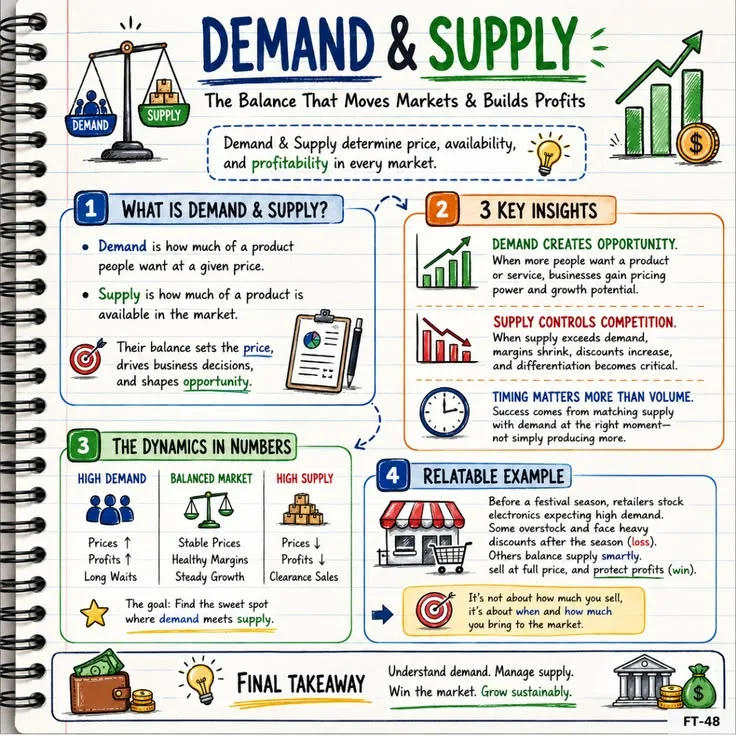
If you've ever wondered why prices spike, crash, or stubbornly stay high, this is a hands-on walkthrough of supply and demand (the simple model behind it all), explained through everyday examples like gas, housing, and concert tickets.
Why did gasoline prices spike when Russia invaded Ukraine? Why does housing become unaffordable in booming cities? Why do concert tickets for popular artists cost $800 on StubHub when they sold for $75 at the box office? The same framework answers all of these questions: supply and demand.
Supply and demand is the foundational model of how prices form in competitive markets. It is not a theory about human psychology or political choices; it is a description of the mechanics by which millions of independent decisions by buyers and sellers produce prices.
Understanding it explains not just economics textbooks but the real-world phenomena that shape daily life.
This model has been tested, refined, and confirmed across centuries of market data. It is the most broadly validated framework in economics. When prices behave in ways that seem mysterious or unfair, supply and demand almost always provides the underlying explanation - even when that explanation is uncomfortable.
The Demand Curve
Demand in economics has a specific meaning: the quantities of a good that consumers are willing and able to purchase at various prices, other things being equal.
The central insight is the law of demand: as price rises, quantity demanded falls. As price falls, quantity demanded rises. This inverse relationship holds for nearly all goods and reflects a combination of three effects:
The substitution effect: as a good becomes more expensive, consumers switch to alternatives. If beef prices rise, some consumers buy more chicken. If air travel gets expensive, some consumers take the train.
The income effect: a price increase reduces consumers' real purchasing power. They can afford less with the same income, so they buy less.
Diminishing marginal utility: each additional unit of a good provides less satisfaction than the previous one. At a higher price, the marginal unit is worth less to the consumer than what they would pay.
The demand curve plots price on the vertical axis and quantity on the horizontal axis. It slopes downward from left to right, reflecting the inverse relationship.
Shifts in the Demand Curve
The demand curve shows quantity demanded at each price, holding everything else constant. When something other than price changes, the entire curve shifts.
Demand increases (shifts right) when:
- Consumer income rises (for normal goods)
- The price of a substitute good rises (more people want beef when chicken prices rise)
- The price of a complementary good falls (lower car prices increase demand for fuel)
- Consumer tastes shift toward the good
- Future prices are expected to be higher (buy now before prices rise)
Demand decreases (shifts left) when the opposite occurs. This distinction - between a movement along the demand curve (caused by a price change) and a shift of the demand curve (caused by a change in something else) - is one of the most important and most commonly confused concepts in economics.
Normal Goods, Inferior Goods, and Giffen Goods
Most goods behave predictably: demand rises with income. These are called normal goods. Steaks, vacation travel, and smartphones are normal goods - people buy more of them as they get wealthier.
Inferior goods behave the opposite way: demand falls as income rises, because consumers switch to better alternatives. Bus travel, generic store-brand foods, and certain low-quality items are often inferior goods. When someone gets a raise, they may switch from the bus to the car.
Giffen goods are a theoretical curiosity: goods so deeply inferior that the income effect outweighs the substitution effect, producing an upward-sloping demand curve (demand rises as price rises).
They were named after Victorian economist Sir Robert Giffen, who reportedly observed Irish peasants buying more potatoes as prices rose because rising potato prices made them too poor to afford meat, so they consumed even more potatoes.
Economists debate whether true Giffen goods exist in practice, though a 2008 study by Robert Jensen and Nolan Miller documented what may be genuine Giffen behavior for staple grains among poor households in China.
The Supply Curve
Supply is the quantities of a good that producers are willing to offer for sale at various prices.
The law of supply: as price rises, quantity supplied rises. As price falls, quantity supplied falls. This positive relationship reflects that higher prices make production more profitable, drawing in more producers and incentivizing existing producers to increase output.
The supply curve slopes upward from left to right.
Shifts in the Supply Curve
Supply shifts when production costs change, when technology improves, when the number of producers changes, or when the prices of related goods change.
Supply increases (shifts right) when:
- Production costs fall (cheaper raw materials, better technology)
- Government subsidizes production
- The number of producers in the market increases
- Technology improves production efficiency
Supply decreases (shifts left) when costs rise, government taxes production, or disruptions reduce production capacity.
Technology as a Supply Shifter
Few forces have shifted supply curves more dramatically than technology. Between 2009 and 2023, the price of utility-scale solar photovoltaic panels fell by approximately 90%, driven primarily by improvements in manufacturing technology and economies of scale in Chinese production.
This massive rightward shift in the supply curve for solar energy drove adoption that would have seemed impossible at earlier price points. The same dynamic played out in LED lighting (costs fell roughly 85% between 2008 and 2020), lithium-ion batteries, and semiconductor chips under Moore's Law.
When technology drives down production costs, the supply curve shifts right and prices fall - benefiting consumers and sometimes enabling entirely new industries and behaviors.
Market Equilibrium
The equilibrium price is where the demand curve and supply curve intersect. At this price, the quantity consumers want to buy exactly equals the quantity producers want to sell. There is no surplus (excess supply) and no shortage (excess demand).
The concept of equilibrium can seem static, but markets are constantly moving toward it dynamically:
When price is above equilibrium: supply exceeds demand. Sellers have unsold inventory. They cut prices to attract buyers. As prices fall, quantity demanded rises and quantity supplied falls, moving toward equilibrium.
When price is below equilibrium: demand exceeds supply. Shortages emerge. Sellers raise prices because they can. As prices rise, quantity demanded falls and quantity supplied rises, moving toward equilibrium.
This self-correcting dynamic - often called the price mechanism - is one of the most powerful and underappreciated forces in economics. Prices are not just numbers; they are signals carrying information about scarcity and abundance.
"The price system is a mechanism for communicating information. The marvel is that in a case like that of a scarcity of one raw material, without an order being issued, without more than perhaps a handful of people knowing the cause, tens of thousands of people whose identity could not be ascertained, are made to use the material or its products more sparingly." - Friedrich Hayek, "The Use of Knowledge in Society," 1945
How Fast Do Markets Reach Equilibrium?
The speed at which markets clear varies enormously by good and market structure.
Financial markets can reach new equilibria in milliseconds. When unexpected news hits - an earnings surprise, a central bank announcement, a geopolitical shock - algorithmic traders reprice securities almost instantaneously.
Commodity markets adjust over weeks to months. A drought that destroys a crop creates a shortage; prices spike quickly, but increasing supply requires waiting for the next growing season.
Housing markets adjust over years or decades. Building new housing units requires permits, financing, construction time, and regulatory approval. This slow supply response is a central reason why housing price shocks persist long after other commodity price shocks resolve.
Labor markets adjust slowly due to worker and employer adjustment costs - job search, hiring processes, relocation. Wages can remain above or below market-clearing levels for extended periods.
Price Elasticity: How Sensitive Are Markets?
Not all markets respond to price changes in the same way. Price elasticity of demand measures the responsiveness of quantity demanded to a change in price.
The formula: elasticity = % change in quantity demanded / % change in price
| Elasticity Value | Meaning | Example |
|---|---|---|
| Greater than 1 | Elastic: consumers are sensitive to price | Luxury cars, restaurant meals |
| Equal to 1 | Unit elastic: response exactly proportional | Some consumer goods |
| Less than 1 | Inelastic: consumers are relatively insensitive | Insulin, gasoline, tobacco |
| 0 | Perfectly inelastic: quantity does not change with price | Life-saving medication (theoretically) |
Why Elasticity Matters
Elasticity has practical implications for who bears the burden of taxes and price increases.
When demand is inelastic, a price increase falls mostly on consumers. A gas tax is largely paid by drivers because they have limited ability to reduce consumption in the short run. The seller can pass the tax on because buyers have few alternatives.
When demand is elastic, a price increase falls mostly on producers. A luxury goods tax reduces sales, hurting producers who cannot simply raise prices without losing customers to alternatives or to abstaining entirely.
This is why sin taxes (on tobacco and alcohol) are levied on products with inelastic demand: governments can raise revenue without dramatically reducing consumption, because consumers are relatively insensitive to the price increase.
The Elasticity of Supply
Elasticity applies to supply as well as demand. Price elasticity of supply measures how much the quantity supplied responds to a price change.
Supply tends to be more elastic over longer time horizons. In the short run, a factory cannot quickly add capacity; supply is relatively inelastic. Over years, new factories can be built, new entrants can enter the market, and supply becomes much more elastic.
This time dimension explains why commodity price spikes often resolve over time. After the 2021 lumber price spike - when lumber prices rose nearly 400% during the pandemic housing boom - supply responded over subsequent months as mills ramped production, and prices collapsed back toward pre-pandemic levels by late 2021.
Real-World Applications
Housing: Why Cities Become Unaffordable
Housing in economically dynamic cities provides a clear example of supply and demand at work - and of what happens when supply cannot respond to demand.
When a city's economy grows - more high-paying jobs, more people wanting to live there - demand for housing increases. The demand curve shifts right. In a normal market, this would trigger new construction: higher prices make building more profitable, supply increases, and prices stabilize at a higher but sustainable level.
But housing supply is constrained by geography (you cannot build in San Francisco Bay) and regulation (zoning laws, building height limits, lengthy permitting processes).
When supply cannot respond to demand, prices absorb the entire shock of the demand increase instead of being shared between price and quantity. The result is the housing affordability crisis in cities like San Francisco, New York, and London.
Studies of cities that liberalized zoning - Tokyo is the most often cited example - show that allowing dense construction keeps housing costs stable even as the city grows.
Tokyo's housing costs have been roughly flat in real terms for decades, while comparable world cities have seen massive price increases. The mechanism is straightforward: supply can expand to meet demand.
The numbers are striking: between 2012 and 2022, median home prices in San Francisco rose from approximately $550,000 to over $1.3 million. The US national median rose from about $177,000 to $428,000 over the same period.
By contrast, Tokyo, which has added roughly 150,000 housing units per year consistently, kept its housing costs among the most stable of any major global city.
Oil: Global Markets and Geopolitical Shocks
Oil markets demonstrate how supply shocks transmit through the price mechanism to the entire global economy.
In 1973, OPEC members cut oil production in response to US support for Israel during the Yom Kippur War. The supply curve for oil shifted sharply left.
With demand relatively inelastic in the short run (people cannot immediately replace their cars with fuel-efficient vehicles), prices rose dramatically - oil prices quadrupled in a matter of months.
The price signal transmitted itself throughout the economy. Every product with oil as an input - plastics, fertilizer, transportation - became more expensive. The recession of 1974-75 was partly a supply shock transmitted through energy prices.
When Russia invaded Ukraine in 2022 and Western nations sanctioned Russian energy exports, the same mechanism operated again. The supply of Russian oil and gas to Europe fell sharply. Natural gas prices in Europe spiked more than 500% at their peak.
The price signal - extraordinary profitability - triggered a massive response: accelerated deployment of renewable energy, new LNG import infrastructure, and conservation measures that would not have been economically justified at lower prices.
Concert Tickets: Suppressed Prices and Secondary Markets
Concert ticket pricing is a fascinating case study in what happens when sellers deliberately price below equilibrium.
Major artists often price tickets well below market-clearing levels. The reasons are partly reputational (pricing in reach of ordinary fans), partly practical (preventing criticism), and partly commercial (merchandise and concession revenue at shows benefits from large audiences).
But below-equilibrium pricing creates excess demand: more people want tickets than are available.
This excess demand finds an outlet on the secondary market, where tickets are resold at prices that reflect the true equilibrium. Taylor Swift tickets for her Eras Tour 2023 sold for an average of $1,600 on StubHub, multiples of their face value.
The gap between face price and resale price represents the subsidy the artist was providing to fans - value that was captured instead by scalpers and resellers.
Dynamic pricing - adjusting ticket prices to market conditions in real time, as airlines do - has been adopted by some artists and venues. Beyonce's Renaissance tour used dynamic pricing; some tickets adjusted upward from face value as demand materialized.
The economic logic is sound: it captures value for the artist and reduces the secondary market premium. The PR challenge is that consumers who have internalized the idea of "fair" ticket prices resent paying market value for experiences they expect to be accessible.
The Labor Market: Wages as Prices
The labor market is fundamentally a supply and demand market where the price is the wage. Workers supply labor; employers demand it. The equilibrium wage is where the quantity of labor supplied equals the quantity demanded.
When a skill becomes rare - say, machine learning engineers in the early 2020s - demand outstrips supply and wages spike.
The median salary for machine learning engineers in the US exceeded $150,000 by 2022, drawing more workers to acquire those skills (shifting supply right over time) and incentivizing companies to invest in tools that required fewer such engineers (reducing demand over time).
Both responses push toward equilibrium.
When labor demand falls - as in economic recessions - wages are famously "sticky downward." Workers resist nominal wage cuts; employers are reluctant to impose them.
This stickiness means that adjustment often occurs through layoffs (reducing quantity) rather than wage reductions (reducing price), a departure from the clean equilibrium model that has significant consequences for unemployment.
Price Floors and Price Ceilings: Government Intervention
Markets do not always produce outcomes that societies find acceptable. Governments frequently intervene to set prices above or below equilibrium. The economic analysis of these interventions is among the clearest applications of supply and demand.
Price Floors (Minimum Prices)
A price floor is a minimum price set above the equilibrium. Sellers cannot legally sell below this price.
The most significant price floor in most countries is the minimum wage. Setting a wage floor above the equilibrium wage for low-skill labor has the intended effect of raising earnings for those who remain employed.
The standard economic prediction is also a surplus of labor (unemployment): at the higher wage, more people want to work than employers want to hire.
The minimum wage debate has generated decades of empirical research. A landmark 1994 study by economists David Card and Alan Krueger compared employment in fast food restaurants across the New Jersey-Pennsylvania border after New Jersey raised its minimum wage.
They found no significant negative employment effect, challenging the standard prediction.
Subsequent research has produced mixed findings; the consensus is that moderate minimum wage increases produce modest or zero employment effects, while very large increases do reduce employment, particularly for the youngest and least-experienced workers.
Agricultural price supports - minimum prices for crops, often set above market levels - produce visible surpluses.
The European Union's Common Agricultural Policy and the US farm subsidy system have generated famous examples of "butter mountains" and "grain lakes": surplus production that governments must buy and store because the price floor produces more supply than demand absorbs.
Price Ceilings (Maximum Prices)
A price ceiling is a maximum price set below the equilibrium. Sellers cannot legally charge above this price.
The most studied price ceiling is rent control. Designed to keep housing affordable, rent control caps what landlords can charge. The economic prediction: a shortage, because the artificially low price increases quantity demanded while reducing quantity supplied.
The empirical evidence largely supports this prediction. A 2019 Stanford study by Diamond, McQuade, and Qian examined San Francisco's rent control expansion in 1994. The findings: rent control reduced rental housing supply by 15% as landlords converted apartments to condos and redeveloped properties.
The policy protected existing tenants (who benefited enormously from below-market rents) at the cost of new renters, who faced higher market rents because supply had contracted.
Research by Asquith, Bhardwaj, and Bhardwaj (2019) found similar effects in other cities. Rent control typically benefits a subset of long-term tenants while reducing the overall stock of affordable housing over time.
This does not mean price ceilings are always wrong - the distributional benefits to existing tenants can be large and politically important - but it does mean that the full economic analysis must account for the supply-side effects that the ceilings create.
Gasoline Price Controls: A Historical Case Study
One of the starkest demonstrations of price ceiling effects occurred in the United States during the 1970s energy crisis. The Nixon administration imposed price controls on gasoline in 1971 as part of broader wage and price controls.
With the price held below equilibrium during the 1973 oil embargo, the quantity demanded exceeded quantity supplied - the textbook prediction played out visibly.
The result was gasoline rationing lines stretching around city blocks, odd-even rationing systems (based on license plate numbers), and widespread shortages. Consumers spent hours in queues - a form of non-price rationing that destroyed economic value.
When President Carter began decontrolling prices in 1979 and Reagan completed decontrol in 1981, prices rose sharply but shortages disappeared. The price signal, freed to function, cleared the market.
The Economics of Supply and Demand in Healthcare
Healthcare is an industry where standard supply and demand assumptions break down in instructive ways, revealing both the power and limits of the model.
Third-party payment divorces the consumer from the full price of the service. When a patient's insurance pays 90% of a medical bill, the patient faces a price of 10 cents on the dollar.
Quantity demanded at this effective price is far higher than it would be at full price - a well-documented phenomenon called moral hazard in insurance economics. This contributes to higher overall healthcare spending.
Information asymmetry means patients often cannot assess which treatments are necessary or effective - a fact doctors exploit in some settings (supplier-induced demand) or navigate responsibly in others. The normal assumption that buyers know what they're purchasing is severely compromised.
Emergency care is the limit case: a patient in cardiac arrest cannot shop for the best price or negotiate. Demand is essentially perfectly inelastic in the moment - they will pay anything. This is why uninsured emergency care bills are frequently catastrophic.
Despite these complications, supply and demand dynamics still operate in healthcare markets where they can. Generic drug markets, for instance, are highly competitive: when a drug patent expires and multiple manufacturers enter, prices typically fall 80-90% within a year as competition drives toward the competitive equilibrium.
The Hatch-Waxman Act (1984) was designed specifically to facilitate this supply response, and its effects on pharmaceutical pricing have been enormous.
When Supply and Demand Breaks Down
The supply and demand model is powerful but operates under assumptions that are sometimes violated.
Market power: When one seller controls enough of the market to influence prices (a monopoly), they can charge above the competitive equilibrium. The standard supply and demand analysis assumes no individual participant can influence prices.
Externalities: When a transaction affects parties not involved in the exchange, market prices do not capture the full social cost or benefit. Carbon emissions are the canonical example: the market price of burning fuel does not include the climate cost imposed on others.
Pollution, public health effects, and traffic congestion are all negative externalities that the price mechanism fails to internalize without intervention.
Information asymmetry: The model assumes buyers and sellers know what they are exchanging. In used car markets (George Akerlof's famous "Market for Lemons" analysis), sellers know the quality of their cars and buyers do not. This information asymmetry can cause markets to unravel.
Public goods: Goods that are non-excludable (you cannot prevent people from using them) and non-rivalrous (one person's use does not reduce availability to others) are typically undersupplied by markets. National defense, basic research, and broadcast television are examples.
Understanding when the model applies and when it does not is as important as understanding the model itself. Supply and demand is a powerful lens, not a complete theory of everything.
The Price Mechanism as Information Processing
One of the deepest insights about supply and demand is that the price mechanism is not primarily about money - it is about information processing on a massive scale.
No single person, organization, or government could possibly know the preferences, constraints, and capabilities of every buyer and seller in a modern economy. The number of distinct economic decisions made each day - what to produce, how much to charge, what to buy, where to invest - is astronomical.
The genius of the price mechanism is that it aggregates this information automatically, through decentralized decisions, without anyone needing to understand the whole picture.
When coffee harvests in Brazil are damaged by frost, the supply of coffee falls. Prices rise worldwide. Consumers reduce consumption, switch to tea, or pay more. Producers elsewhere respond by planting more coffee. Importers seek alternative sources.
All of this happens without any central coordinator - the price signal alone conveys all the relevant information to all the relevant parties.
This insight, associated most strongly with Friedrich Hayek's 1945 paper "The Use of Knowledge in Society," has profound implications for economic policy.
It explains why central planning - attempting to replicate the price mechanism's information processing through administrative decisions - consistently underperforms market economies: no planner has access to the distributed local knowledge that prices automatically synthesize.
Supply, Demand, and Economic Inequality
Supply and demand also shapes the distribution of income, a fact that sits uncomfortably with the model's politically neutral framing.
The wage a worker earns is the price of their labor, determined by the supply and demand for their particular skills. When the supply of workers with certain skills is high relative to demand - as with many routine manual jobs - wages are low.
When supply is constrained relative to demand - as with surgeons, software engineers, or top athletes - wages are high.
Over recent decades, technological change has shifted labor demand away from routine tasks (easily automated) and toward non-routine cognitive tasks (harder to automate). This has produced diverging wages: the premium for college education over high school education increased substantially between 1980 and 2020.
The wage premium for the top 1% of earners has grown dramatically. These patterns can be partially explained by skill-biased technological change operating through labor supply and demand.
This does not mean labor market outcomes are "natural" or beyond policy influence. Supply and demand operates within institutional frameworks: labor laws, union rights, minimum wages, and education systems all shift the supply and demand curves. Policy choices shape the framework within which market forces operate.
Summary: The Essential Lessons
Supply and demand is more than an economic model - it is a framework for thinking about how decentralized decision-making produces order, how prices carry information, and how interventions in markets produce intended and unintended consequences.
The key lessons:
Prices signal scarcity: rising prices tell producers to produce more and consumers to economize; falling prices do the opposite. The price mechanism processes information that no central authority possesses.
Equilibrium is dynamic, not static: markets are constantly adjusting. The speed of adjustment depends on how responsive supply and demand are to price changes.
Elasticity determines who bears costs: inelastic demanders (those with few alternatives) bear the burden of price increases. Elastic demanders (those with options) can escape them.
Government interventions have predictable side effects: price ceilings cause shortages; price floors cause surpluses. These effects can be weighed against the distributional benefits, but they cannot be wished away.
The model has limits: externalities, market power, information asymmetry, and public goods all represent cases where market prices fail to reflect true social costs and benefits, creating grounds for intervention.
The elegance of supply and demand is that it provides a consistent, testable framework for predicting how markets behave. The discipline it requires is to follow the logic wherever it leads - including to conclusions that may be politically inconvenient or counterintuitive.