
A black hole is a region of spacetime where gravity prevents matter, radiation, and information from escaping once they cross the event horizon. Understanding black holes means treating gravity as extreme spacetime curvature, not simply a pulling force. Their observable mass, charge, and spin, luminous accretion disks, time dilation, and unresolved singularities connect general relativity with unanswered questions about quantum gravity.
On April 10, 2019, the Event Horizon Telescope collaboration released the first photograph of a black hole.[3] The image showed a glowing orange ring - superheated plasma orbiting at relativistic speeds - surrounding a dark circular shadow roughly the size of our entire solar system.
The black hole was M87*, 6.5 billion times the mass of the Sun, 55 million light-years from Earth.
The image was not merely beautiful. It was experimental confirmation of predictions that had come from pure mathematics - from solutions to Einstein's field equations written down more than a century earlier by Karl Schwarzschild, who solved them in 1915 while serving in the German army on the Russian front and sent his solution to Einstein from the trenches.[1]
Black holes are among the most extreme objects in the universe: regions where spacetime curvature is so severe that even light cannot escape.
Understanding them requires understanding how gravity works not as a force pulling objects together (Newton's picture) but as the curvature of spacetime itself (Einstein's picture) - and what happens when that curvature becomes extreme enough to prevent anything from escaping.
"Black holes are where God divided by zero." - Albert Einstein (attributed; the sentiment reflects genuine physicist humor about singularities)
Key Definitions
Black hole - A region of spacetime where the gravitational field is so strong that no matter, radiation, or information can escape once inside the event horizon.
Black holes are not empty space - they contain extreme concentrations of mass (in a stellar black hole, the mass of a star compressed to near-zero volume). They are characterized by three external observable properties: mass, electric charge, and angular momentum (spin).
Event horizon - The boundary of a black hole - the surface of no return. At the event horizon, the escape velocity equals exactly the speed of light. Inside the event horizon, all paths through spacetime lead toward the singularity, regardless of direction or speed.
The event horizon has no physical surface - no barrier to cross - it is a mathematical boundary in spacetime. An infalling observer would not notice anything locally unusual at the moment of crossing.
Singularity - The mathematical point (or ring, for rotating black holes) at the center of a black hole where density and spacetime curvature become infinite according to general relativity.[6] At the singularity, the laws of physics as currently formulated break down.
Most physicists believe quantum gravitational effects become important before an actual singularity forms - resolving the infinity - but no confirmed theory of quantum gravity exists to describe it.
Schwarzschild radius - The radius at which an object's escape velocity equals the speed of light. If an object is compressed below its Schwarzschild radius, it becomes a black hole. For the Sun, the Schwarzschild radius is approximately 3 km (the Sun's actual radius is 700,000 km).
For Earth, it is about 9 mm. Formula: rs = 2GM/c, where G is the gravitational constant, M is mass, and c is the speed of light.
Stellar black hole - A black hole formed from the collapse of a massive star (typically 20+ solar masses) at the end of its life. Stellar black holes range from roughly 3 to a few tens of solar masses. The initial mass function of stars means stellar black holes are the most common type.
Supermassive black hole (SMBH) - A black hole with mass ranging from millions to tens of billions of solar masses. Found at the centers of nearly all large galaxies, including the Milky Way (Sagittarius A*, approximately 4 million solar masses).
Formation mechanism not fully understood; likely involves a combination of early universe black hole seeding, mergers, and gas accretion over billions of years.
Intermediate mass black hole (IMBH) - Black holes in the range of 100 to 100,000 solar masses, filling the gap between stellar and supermassive. Long hypothesized but only confirmed relatively recently through gravitational wave observations of heavy merger events.
Accretion disk - A disk of gas and dust spiraling inward toward a black hole, heated to millions of degrees by friction and compression.
As infalling matter converts gravitational potential energy to heat, accretion disks are among the most luminous objects in the universe - active galactic nuclei (quasars) are powered by accretion onto supermassive black holes and can outshine entire galaxies.
Hawking radiation - Theoretical thermal radiation emitted by black holes due to quantum field theory effects near the event horizon. Predicted by Stephen Hawking in 1974. Arises from virtual particle-antiparticle pairs: one particle falls inside the event horizon and the other escapes, carrying energy away.
The black hole slowly loses mass ("evaporates") at a rate inversely proportional to its mass. For stellar black holes, the radiation temperature is far below the cosmic microwave background; detection is currently impossible.
Gravitational time dilation - Time passes more slowly in stronger gravitational fields, as predicted by general relativity.
Near the event horizon, time dilation becomes extreme: from an outside observer's perspective, an infalling object appears to slow down and freeze asymptotically at the event horizon, never quite crossing it (and its emitted light becoming infinitely redshifted and faint).
The infalling observer experiences nothing unusual at the event horizon and crosses it in finite proper time.
Spaghettification - The tidal stretching of an infalling object as it approaches a black hole's singularity. The gravitational force on the near side (closer to the singularity) is stronger than on the far side; the difference pulls the object apart lengthwise while compressing it laterally, stretching it into a thin strand.
For stellar black holes, spaghettification occurs outside or near the event horizon. For supermassive black holes, it occurs inside the event horizon, potentially after the event horizon crossing is uneventful.
Formation: How Black Holes Are Born
Stellar Black Holes from Core Collapse
A star is a gravitational battle. For millions to billions of years, a star's outward radiation pressure (from nuclear fusion in the core) balances inward gravitational compression. The star maintains its size and shine.
When the star exhausts its nuclear fuel, this balance ends. The core collapses - catastrophically fast. For stars up to roughly 8 solar masses, the core collapses to a white dwarf - supported by electron degeneracy pressure.
For stars between roughly 8 and 20 solar masses, the collapse produces a neutron star - supported by neutron degeneracy pressure, with mass up to about 3 solar masses packed into a sphere roughly 20 km across.
For stars above approximately 20 solar masses, the collapsing core exceeds the maximum mass a neutron star can support (the Tolman-Oppenheimer-Volkoff limit, roughly 2-3 solar masses). Nothing stops the collapse. The core implodes to a singularity, and a stellar black hole is born.
The outer layers of the star are blasted outward in a supernova explosion - one of the most energetic events in the universe - while the core vanishes behind an event horizon.
A core-collapse supernova releases roughly 10^44 joules of energy in a matter of seconds, more than the Sun will emit over its entire 10-billion-year lifetime, and approximately 99% of that energy escapes as neutrinos rather than light.
"Gravitational collapse is the inescapable destiny of every stellar object above a critical mass.[5] When the last nuclear fuel is exhausted, nothing in the universe can prevent the formation of a black hole." - Kip Thorne, Black Holes and Time Warps (1994)
The Nuclear Burning Sequence
Understanding why the collapse becomes inevitable requires understanding the sequence of nuclear fusion stages that precede it. Stars do not burn only hydrogen. As each fuel source runs out, the core contracts and heats until the next fuel ignites.
The sequence for a massive star runs: hydrogen burning (10 million years), helium burning (1 million years), carbon burning (1,000 years), neon burning (1 year), oxygen burning (6 months), silicon burning (1 day). Silicon burning produces iron and nickel - elements at the bottom of the nuclear binding energy curve.
Unlike every previous stage, iron fusion does not release energy - it requires energy. The last fuel has run out. There is no next stage. The core collapses in less than a second.
Supermassive Black Holes
Supermassive black holes present a harder formation problem. The Milky Way's Sagittarius A* has 4 million solar masses. M87* has 6.5 billion. These cannot have formed from single stellar collapses.
Leading hypotheses include:
Direct collapse: In the early universe, massive clouds of gas may have collapsed directly into black holes of 10,000 to 1 million solar masses, bypassing the stellar phase.
Runaway mergers: In densely-packed early star clusters, stars may have merged faster than they evolved, producing very massive stars that then collapsed.
Accretion over billions of years: Smaller black holes grew by consuming surrounding gas and dust over cosmic time.
All three mechanisms may have contributed. The formation of the first supermassive black holes - detected in quasars at high redshift, only hundreds of millions of years after the Big Bang - remains one of the unsolved problems of observational cosmology.
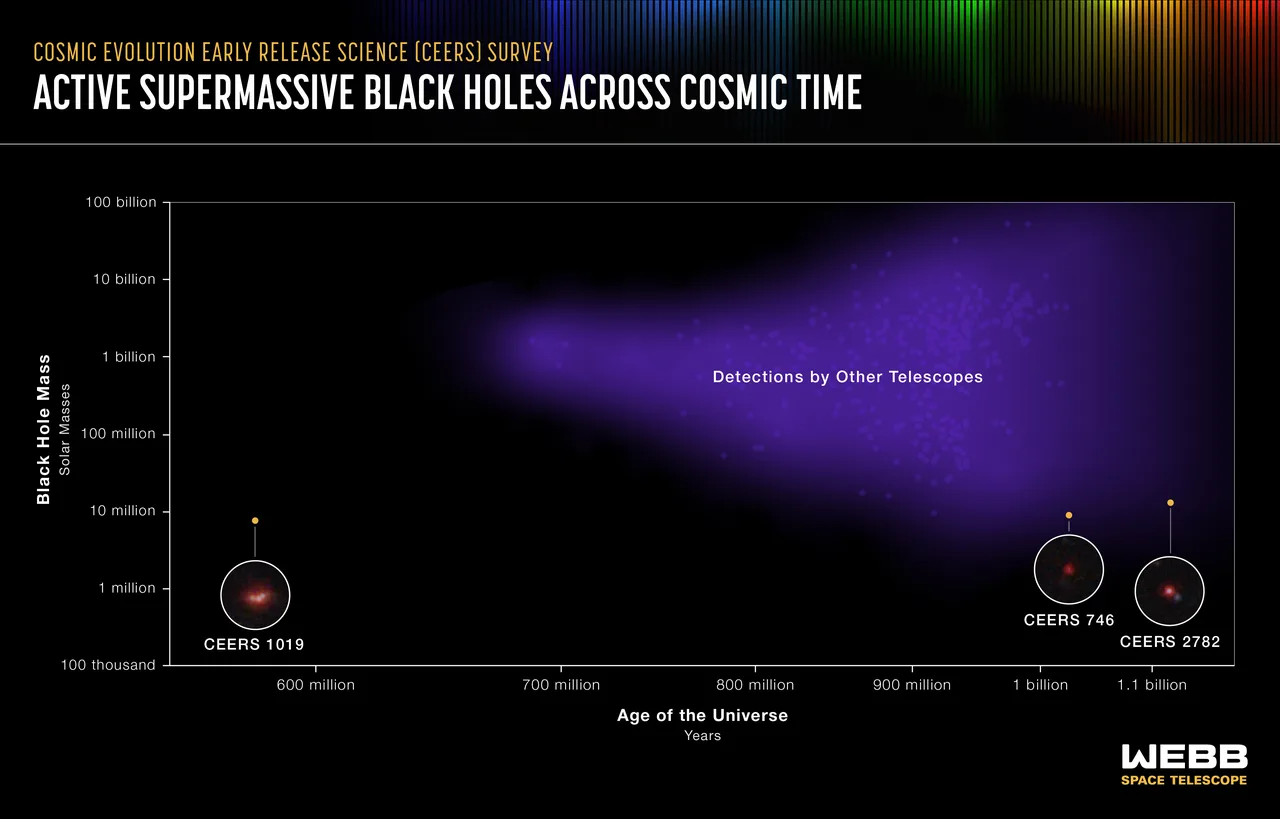
The James Webb Space Telescope, launched in December 2021, has detected supermassive black holes in galaxies just 500-700 million years after the Big Bang, further deepening the mystery of how they grew so large so fast.
Tidal Disruption Events
Occasionally, a star wanders too close to a supermassive black hole and is torn apart by tidal forces before it can cross the event horizon. This tidal disruption event (TDE) produces a dramatic brightening as the stellar debris falls onto the black hole and forms a temporary accretion disk.
TDEs can briefly outshine an entire galaxy and are detectable across cosmological distances. The first confirmed TDE was observed in 1999 by the ROSAT X-ray satellite; by 2024, dozens have been catalogued.
The Event Horizon: The Point of No Return
The event horizon's defining property is escape velocity. Escape velocity is the minimum speed needed to escape a gravitational field without further propulsion. For Earth, it is about 11.2 km/s. For the Sun, 617 km/s. At the event horizon, escape velocity is exactly the speed of light.
Since nothing in the universe travels faster than light (in vacuum), nothing inside the event horizon can escape. This is not a barrier in the usual sense - an infalling observer passes through the event horizon smoothly and would not notice anything locally unusual.
But their future is now completely determined: all paths through spacetime lead toward the singularity. They cannot go back, cannot stop, cannot send any signal outward.
Gravitational Time Dilation at the Event Horizon
General relativity predicts time dilation: clocks in stronger gravitational fields run slower. The closer an object is to the event horizon, the more time dilation it experiences relative to a distant observer.
From a distant observer's perspective, watching an object fall into a black hole reveals extreme time dilation as the object approaches the event horizon.
The infalling object appears to move slower and slower, its emitted light becoming increasingly redshifted (lower frequency, lower energy) as photons struggle to escape the deepening gravitational well.
In the limit, the object appears to asymptotically approach the event horizon, never quite crossing it, its image fading to invisibility as the photons' energy redshifts to nothing.
The infalling object, however, experiences no such drama. From their perspective, they cross the event horizon in finite time - and the distant universe continues to exist outside, compressed into an ever-smaller circle of view ahead of them as the singularity approaches.
The Information Paradox
One of the deepest unsolved problems in theoretical physics arises directly from Hawking radiation: the black hole information paradox. If a black hole forms from a complex system (say, a library of books), processes Hawking radiation, and eventually evaporates completely, where did the information about the library go?
Quantum mechanics insists that information cannot be destroyed - the quantum state of a system at one time uniquely determines its state at any other time.
General relativity, as Hawking originally argued, suggests that Hawking radiation is purely thermal and carries no information about what fell in. These two principles are in direct conflict.
Hawking himself spent decades maintaining that information is lost in black holes - and then changed his mind in 2004, betting John Preskill a reference book that information is preserved.
The firewall paradox, proposed in 2012 by Ahmed Almheiri, Donald Marolf, Joseph Polchinski, and James Sully (AMPS), sharpened the conflict: they argued that information preservation requires that infalling observers hit a wall of high-energy radiation at the event horizon - contradicting general relativity's prediction of a smooth crossing.[9]
The resolution likely requires a complete theory of quantum gravity.
Black Hole Types and Properties
The no-hair theorem (developed by Werner Israel, Brandon Carter, and others in the late 1960s) states that a black hole can be completely characterized by just three external properties:
| Property | Description | Effect |
|---|---|---|
| Mass (M) | Total mass-energy inside the event horizon | Determines event horizon radius |
| Charge (Q) | Electric charge | Charged black holes have a Reissner-Nordström geometry; astrophysical black holes likely have near-zero charge |
| Angular momentum (J) or spin | Rotation | Rotating black holes (Kerr black holes) drag spacetime with them (frame dragging); have an ergosphere outside the event horizon |
Most astrophysical black holes are well-described as Kerr black holes - rotating and uncharged.[7] Rotating black holes have an ergosphere, a region outside the event horizon where spacetime itself rotates with the black hole.
Objects in the ergosphere can extract energy from the black hole's rotation (the Penrose process), theoretically allowing energy extraction.
Black Hole Size Comparison
To appreciate the range of black holes, consider their sizes relative to familiar objects:
| Black Hole | Mass (Solar Masses) | Schwarzschild Radius | Comparison |
|---|---|---|---|
| Stellar (minimum) | ~3 | ~9 km | Small city |
| Cygnus X-1 | ~21 | ~62 km | Large city |
| Sagittarius A* (Milky Way) | ~4 million | ~12 million km | ~9 times the Sun's radius |
| M87* | ~6.5 billion | ~19 billion km | Larger than our solar system |
| TON 618 (largest known) | ~66 billion | ~195 billion km | ~1,300 AU |
The largest known black holes dwarf entire solar systems. TON 618, a quasar 10.4 billion light-years away, contains 66 billion solar masses - its event horizon is so large that light would take 13 days just to cross from one side to the other.
Hawking Radiation and Black Hole Evaporation
In 1974, Stephen Hawking made one of the most surprising theoretical predictions in modern physics: black holes are not entirely black.[2] Quantum effects near the event horizon cause them to emit thermal radiation and slowly lose mass.
The mechanism involves quantum vacuum fluctuations. Quantum field theory predicts that the vacuum is not empty - virtual particle-antiparticle pairs constantly appear and annihilate. Near the event horizon, one of a pair may fall inside while the other escapes.
The escaping particle carries real energy (extracted from the black hole's gravitational field), and the black hole's mass correspondingly decreases.
The temperature of Hawking radiation is inversely proportional to the black hole's mass:
T = c / (8GMkB)
For a stellar black hole of 10 solar masses, this temperature is approximately 6 10 Kelvin - far colder than the 2.7 K cosmic microwave background. The black hole absorbs CMB radiation faster than it emits Hawking radiation; it is net gaining mass, not losing it.
For a black hole to evaporate significantly, it would need to be extraordinarily small - a 10 kg black hole would have a temperature of ~10 K and evaporate in about a second. Such primordial black holes might have formed in the early universe; if so, they would be evaporating or already evaporated today.
The evaporation timescale for a black hole scales as the cube of its mass. A stellar black hole of 10 solar masses would take approximately 2 10^67 years to evaporate - incomprehensibly longer than the current age of the universe (13.8 10^9 years). For supermassive black holes, the timescale extends to 10^100 years or beyond.
"Black holes ain't as black as they are painted. They are not the eternal prisons they were once thought. Things can get out of a black hole, both to the outside, and possibly to another universe." - Stephen Hawking, final public lecture (2016)
Gravitational Waves from Black Hole Mergers
When two black holes orbit each other and spiral inward, they emit gravitational waves - ripples in the fabric of spacetime predicted by Einstein's general relativity in 1916 but not directly detected for a century.
On September 14, 2015, the Laser Interferometer Gravitational-Wave Observatory (LIGO) detected gravitational waves for the first time.[8]
The signal, known as GW150914, came from the merger of two black holes roughly 1.3 billion light-years away, with masses of approximately 36 and 29 solar masses merging into a single black hole of about 62 solar masses.
The "missing" 3 solar masses of energy was radiated as gravitational waves in less than a second - a peak power output approximately 50 times greater than all the stars in the observable universe combined.
The detection by Rainer Weiss, Kip Thorne, and Barry Barish (who shared the 2017 Nobel Prize in Physics) opened a new window on the universe. As of 2024, LIGO-Virgo-KAGRA have detected over 90 gravitational wave events, the majority involving black hole mergers.
What Gravitational Waves Tell Us
Gravitational wave observations have revealed that black holes in merging binaries tend to be heavier than expected - raising questions about their formation channels.
The detection of GW190521 in 2019 involved black holes of 85 and 66 solar masses merging into a 142-solar-mass intermediate black hole - the first confirmed detection of an intermediate mass black hole.
Additionally, wave observations have precisely measured spin parameters that are otherwise inaccessible, building a demographic picture of the black hole population.
Jets and Active Galactic Nuclei
Some actively feeding black holes launch extraordinary relativistic jets - beams of plasma, magnetic fields, and high-energy particles ejected at speeds approaching the speed of light, perpendicular to the accretion disk, extending for hundreds of thousands or even millions of light-years.
The most energetic phenomena in the universe - quasars - are powered by accretion onto supermassive black holes in distant galaxies. The most luminous quasars emit roughly 10^41 watts, more than a thousand times the total luminosity of the Milky Way's 200-400 billion stars, from a region no larger than our solar system.
Quasar activity peaked around 10 billion years ago and has been declining as black holes consumed available gas and their host galaxies aged.
The M87 jet is one of the most studied in astrophysics, extending approximately 5,000 light-years from the galaxy's core.
Features within the jet have been observed moving at apparent superluminal speeds - not actually faster than light, but an optical illusion arising from nearly light-speed motion directed almost along the line of sight.
Imaging Black Holes: The Event Horizon Telescope
The Event Horizon Telescope is not a single telescope but a global array of radio observatories that operate as a single Earth-sized interferometer through a technique called Very Long Baseline Interferometry (VLBI).
By synchronizing observations from telescopes at the South Pole, Hawaii, Chile, Spain, and elsewhere, it achieves an angular resolution sufficient to image the shadow of a black hole's event horizon.
In 2019, EHT imaged M87*: a 6.5-billion-solar-mass black hole at the center of galaxy M87. The image showed a bright ring of glowing plasma - the accretion disk heated to billions of degrees - surrounding a darker central region: the black hole's shadow.
The shadow is roughly 2.5 times larger than the event horizon itself, because photon orbits and gravitational lensing amplify the apparent shadow size.
In 2022, EHT imaged Sagittarius A*, our own galaxy's central black hole - much closer (27,000 light-years), but also much smaller (4 million solar masses), making it harder to image because gas orbits the black hole in minutes rather than days, and the image blurs during the long integration time needed.[4]
The 2022 Sagittarius A* image confirmed that the shadow's size and shape are consistent with general relativity's predictions at the level of 10% precision - a direct test of gravity in the strong-field regime, exactly where departures from general relativity are expected if alternative theories are correct.
No significant departures were found, further cementing general relativity's standing.
The Photon Sphere
Just outside the event horizon lies the photon sphere - the radius at which photons can orbit the black hole in circular orbits. For a non-rotating black hole, this is at 1.5 times the Schwarzschild radius.
Photons at this radius are in unstable equilibrium: a slight inward perturbation sends them spiraling into the event horizon; a slight outward perturbation allows them to escape.
Light grazing the photon sphere can orbit multiple times before escaping, creating multiple concentric ring images of the accretion disk visible in detailed simulations. The bright ring seen in EHT images is dominated by photons that have completed approximately half an orbit around the black hole before escaping toward Earth.
Black Holes as Cosmic Engines
Black holes are not merely destructive endpoints - they play active roles in shaping the galaxies around them.[10]
The M-sigma relation, discovered in 2000, shows that the mass of a galaxy's central black hole correlates strongly with the velocity dispersion of stars in the galaxy's bulge - a surprising correlation given that the black hole's gravitational influence extends over only a tiny fraction of the galaxy's volume.
This correlation suggests black hole feedback: as a supermassive black hole accretes matter, it releases enormous energy in the form of radiation and jets. This energy heats and expels surrounding gas, quenching star formation in the host galaxy.
A galaxy that begins forming stars too rapidly essentially throttles itself through the energy released by its central black hole. This co-evolution of black holes and galaxies - still not fully understood - may explain why galaxies come in two broad populations: actively star-forming and quiescent.
The Future of Black Hole Research
Several frontiers are actively being explored as of the mid-2020s:
Next-generation EHT aims to add space-based baselines and higher-frequency observations, enabling movies of black hole accretion rather than static images, and measurements of black hole spin.
LISA (Laser Interferometer Space Antenna), a planned ESA space-based gravitational wave detector scheduled for launch in the 2030s, will detect gravitational waves from supermassive black hole mergers across the observable universe - events invisible to ground-based detectors.
Pulsar timing arrays have begun detecting a stochastic gravitational wave background consistent with the accumulated signal of many supermassive black hole binary mergers throughout the universe - a detection announced independently by multiple groups in 2023.[11]
Quantum gravity research continues grappling with the information paradox. String theory, loop quantum gravity, and holographic approaches (the AdS/CFT correspondence) all suggest that black hole interiors are more complex than classical general relativity implies, and that information is preserved in ways we do not yet fully understand.
"If I have seen further, it is by standing on the shoulders of giants." - Isaac Newton (1675), a sentiment that resonates with black hole research: from Newton's gravity to Einstein's relativity to Hawking's quantum insight, each generation has revealed a stranger and richer cosmos.
For related concepts, see how the universe began, dark matter and dark energy explained, and how gravity works.
Sources & Further Reading
- Schwarzschild, K. (1916). ber das Gravitationsfeld eines Massenpunktes nach der Einsteinschen Theorie. Sitzungsberichte der Königlich Preussischen Akademie der Wissenschaften, 1916, 189-196.
- Hawking, S. W. (1974). Black Hole Explosions? Nature, 248(5443), 30-31. DOI: 10.1038/248030a0
- Event Horizon Telescope Collaboration. (2019). First M87 Event Horizon Telescope Results. Astrophysical Journal Letters, 875, L1. DOI: 10.3847/2041-8213/ab0ec7
- Event Horizon Telescope Collaboration. (2022). First Sagittarius A* Event Horizon Telescope Results. Astrophysical Journal Letters, 930, L12. DOI: 10.3847/2041-8213/ac6674
- Thorne, K. S. (1994). Black Holes and Time Warps: Einstein's Outrageous Legacy. W. W. Norton.
- Penrose, R. (1965). Gravitational Collapse and Space-Time Singularities. Physical Review Letters, 14(3), 57-59. DOI: 10.1103/PhysRevLett.14.57
- Kerr, R. P. (1963). Gravitational Field of a Spinning Mass as an Example of Algebraically Special Metrics. Physical Review Letters, 11(5), 237-238. DOI: 10.1103/PhysRevLett.11.237
- Abbott, B. P., et al. (LIGO Scientific Collaboration and Virgo Collaboration). (2016). Observation of Gravitational Waves from a Binary Black Hole Merger. Physical Review Letters, 116(6), 061102. DOI: 10.1103/PhysRevLett.116.061102
- Almheiri, A., Marolf, D., Polchinski, J., & Sully, J. (2013). Black Holes: Complementarity or Firewalls? Journal of High Energy Physics, 2013(2), 62. DOI: 10.1007/JHEP02(2013)062
- Gebhardt, K., et al. (2000). A Relationship Between Nuclear Black Hole Mass and Galaxy Velocity Dispersion. Astrophysical Journal Letters, 539(1), L13-L16. DOI: 10.1086/312840
- Agazie, G., et al. (NANOGrav Collaboration). (2023). The NANOGrav 15-year Data Set: Evidence for a Gravitational-Wave Background. Astrophysical Journal Letters, 951, L8. DOI: 10.3847/2041-8213/acdac6