
At the 2011 FailCon conference in San Francisco-a gathering dedicated to celebrating entrepreneurial failure-a parade of founders took the stage to share stories of their startup collapses.
The audience, largely composed of aspiring entrepreneurs, applauded each tale of lost millions, wasted years, and crashed companies with the enthusiasm usually reserved for success stories.
One speaker described burning through $10 million in investor capital before shutting down; the audience cheered.
Another described laying off sixty employees; the audience nodded sagely about "learning experiences." A third described how his failed startup had consumed three years of his life, his marriage, and his health; the audience responded with a standing ovation.
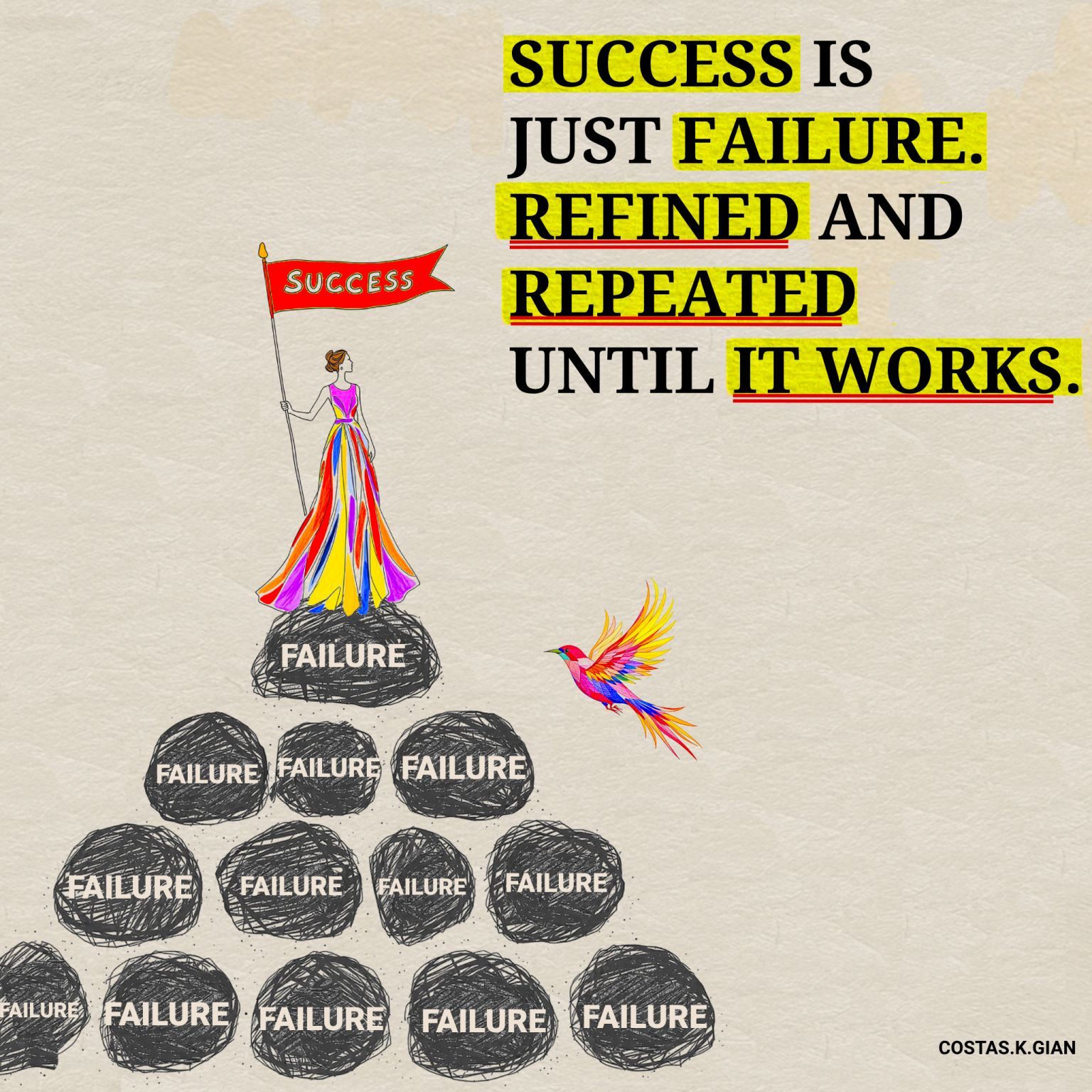
Welcome to failure culture-the distinctive Silicon Valley ideology that reframes business failure from a devastating loss into a badge of honor, a learning experience, and even a prerequisite for future success. "Fail fast, fail often," the mantra goes.
"Move fast and break things." "If you're not failing, you're not trying hard enough." In this cultural framework, failure is not merely tolerated-it is celebrated, discussed publicly with pride, and treated as evidence of the ambition and risk-taking that the startup culture prizes above almost everything else.
"Ever tried. Ever failed. No matter. Try again. Fail again. Fail better." - Samuel Beckett
Failure culture was born from a genuine and valuable insight: that the stigma around business failure discourages the risk-taking and experimentation that innovation requires.
If entrepreneurs are paralyzed by the fear of failure, they will not attempt the ambitious projects that, when they succeed, produce transformative products and services.
Reducing the stigma of failure frees people to take risks, try unconventional approaches, and pursue ideas that established institutions would reject as too uncertain.
But like many ideas that begin as useful correctives, failure culture has evolved into something more complicated and more problematic than its originators intended.
The celebration of failure has become, in many contexts, a performative ritual that romanticizes loss, obscures real harm, justifies reckless decision-making, and serves the interests of those who can afford to fail while ignoring those who cannot.
What Is Startup Failure Culture?
Startup failure culture is the set of beliefs, practices, and social norms within the entrepreneurial ecosystem that treats business failure as normal, acceptable, educational, and even desirable. Its core tenets include:
Failure is inevitable. The vast majority of startups fail-estimates range from 60% to 90% depending on definitions and timeframes. In an environment where failure is the statistical norm, stigmatizing failure would stigmatize most participants.
Failure is educational. Each failure teaches lessons that could not have been learned through success. Failed founders gain knowledge about markets, customers, team dynamics, execution challenges, and personal limitations that textbooks and mentors cannot provide.
Failure demonstrates ambition. In failure culture, having failed at something ambitious is more respected than having succeeded at something modest. A founder who attempted to build a billion-dollar company and failed is seen as more admirable than one who built a profitable small business.
This connects to the broader mythology of the heroic entrepreneur explored in founder mythology.
Failure is temporary. Successful founders often have multiple failures in their history. Steve Jobs was fired from Apple before returning to make it the world's most valuable company. Reid Hoffman's SocialNet failed before LinkedIn succeeded. Max Levchin had four failed startups before co-founding PayPal.
Failure should be shared. Public discussion of failure-through conference talks, blog posts, podcasts, and social media-normalizes the experience, reduces stigma, and allows others to learn from mistakes they did not have to make themselves.
"Failure is simply the opportunity to begin again, this time more intelligently." - Henry Ford
What Does "Fail Fast" Actually Mean?
The phrase "fail fast" is the operational principle of failure culture. It derives from lean startup methodology, developed by Eric Ries and influenced by Steve Blank's customer development process.
The Original Meaning
In its original formulation, "fail fast" is a discipline of rapid experimentation:
- Form a hypothesis about what customers want and what will work
- Build the minimum viable product (MVP) necessary to test that hypothesis
- Test the hypothesis against real customer behavior
- If the hypothesis is wrong, recognize it quickly ("fail fast") rather than investing months or years in a direction that is not working
- Use the learning from the failure to form a better hypothesis
- Repeat
In this framework, "failure" means invalidating a hypothesis-discovering that a particular product, market, strategy, or approach does not work. The failure is small (a single experiment), fast (days or weeks, not years), and informative (it produces specific learning that guides the next experiment).
This is a rigorous, disciplined approach to innovation under uncertainty. It is intellectually descended from the scientific method: form hypotheses, test them, learn from the results, revise, and test again.
Understanding how learning actually works reveals why this structured approach is so important-learning from failure is not automatic; it requires deliberate reflection and mechanism.
There is nothing romantic or celebratory about it. It is simply a practical methodology for navigating uncertainty efficiently.
The Cultural Distortion
The cultural version of "fail fast" has drifted far from this disciplined original:
- "Fail fast" has become "failure is good": The methodology's acceptance of small experimental failures has been extrapolated into a general celebration of failure at any scale
- "Fail fast" has become "fail spectacularly": The methodology's emphasis on small, quick experiments has been distorted into admiration for large, dramatic failures
- "Fail fast" has become "don't worry about failing": The methodology's recommendation to accept and learn from failed experiments has been distorted into a license for carelessness and recklessness
- "Fail fast" has become "failure is a credential": The methodology's recognition that failed experiments produce useful learning has been distorted into a belief that failure itself is valuable regardless of what was learned
Who Bears the Costs of Startup Failure?
One of the most important and most overlooked questions about failure culture is who actually pays when a startup fails. The answer reveals that the costs of failure are distributed very differently from how failure culture presents them.
Founders
Founders bear real costs when their startups fail: lost time (often years), lost opportunity cost (salary and career advancement they would have received in conventional employment), damaged personal relationships (startup intensity is notoriously destructive to marriages and friendships), and psychological harm (depression, anxiety, and loss of identity are common among founders of failed startups).
However, founders in the Silicon Valley ecosystem also have significant buffers against these costs:
- Many come from privileged backgrounds with family wealth to fall back on
- The startup ecosystem provides rapid re-employment for experienced founders, even those who have failed
- Failure carries social capital within the ecosystem-a failed founder is often more attractive to investors and employers than someone who never tried
- The failure narrative provides a compelling personal story for future fundraising
Employees
Employees of failed startups often bear disproportionate costs relative to founders:
- Job loss: Employees lose their jobs, often with minimal notice and sometimes without severance
- Worthless equity: Employees who accepted below-market salaries in exchange for equity compensation find that equity is worthless when the company fails
- Career disruption: Time spent at a failed startup may be perceived negatively by future employers outside the startup ecosystem
- No upside narrative: Unlike founders, employees do not benefit from the social capital of failure. A founder who failed can raise money for a new startup; an employee who worked at a failed startup is simply unemployed
The question of who bears responsibility for these costs-versus who is merely held accountable-is examined in the context of responsibility versus accountability in organizational settings.
Investors
Venture capital investors expect most of their portfolio companies to fail. The VC model is built on the assumption that a few massive successes (10x-100x returns) will more than compensate for many failures (total loss). Individual investors in a diversified portfolio can absorb failures without financial devastation.
However, angel investors (individuals who invest personal capital, often in early-stage startups) may suffer significant financial harm from startup failures. Angel investments are typically undiversified, meaning a single failure can represent a large proportion of the investor's total startup exposure.
Communities and Customers
Startup failures can harm communities and customers who depended on the startup's products or services:
- Customers who built workflows around a startup's product lose access when the company shuts down
- Communities that relied on a startup for employment or services face disruption
- Contractors and suppliers who provided goods and services to the startup may not be paid
- Cities that provided tax incentives or regulatory accommodations to attract the startup receive no return on their investment
| Stakeholder | Costs of Failure | Buffers/Protections | Failure Culture Recognition |
|---|---|---|---|
| Founders | Time, opportunity cost, relationships, psychology | Privilege, ecosystem social capital, re-employment | High-failure framed as their learning experience |
| Employees | Jobs, equity value, career disruption | Limited-severance varies, equity usually worthless | Low-rarely mentioned in failure narratives |
| VC Investors | Capital loss on individual investment | Portfolio diversification, tax benefits | Moderate-accepted as cost of doing business |
| Angel Investors | Personal capital, potentially significant | Limited diversification | Low-individual losses rarely discussed |
| Communities | Services, employment, tax revenue | Minimal | Very low-externalized costs ignored |
What Is Failure Theater?
Failure theater is the performative public discussion of failure that has become a ritual of startup culture. It manifests in conference talks, blog posts, podcasts, and social media posts in which successful people share carefully curated stories of their past failures.
How Failure Theater Works
- A successful person (someone who has ultimately achieved significant wealth, status, or influence) shares a story about an earlier failure
- The story is narratively structured as a hero's journey: struggle, failure, learning, eventual triumph
- The audience derives inspiration from the story: "If this successful person failed and recovered, so can I"
- The story reinforces the failure culture narrative: failure is temporary, educational, and a stepping stone to success
What Failure Theater Conceals
Failure theater is problematic not because the stories are untrue but because they are systematically unrepresentative:
- Survivorship bias: Only people who eventually succeeded get platforms to share their failure stories. The thousands of people who failed and never recovered do not get conference invitations, book deals, or media profiles. This is one of the most pervasive cognitive biases distorting how the startup world understands its own outcomes.
- Narrative polish: Failure stories told by successful people are retrospectively organized to emphasize the lessons learned and the growth achieved. The actual experience of failure-the confusion, the despair, the lack of clear lessons, the randomness-is smoothed into a coherent narrative that serves the speaker's current self-presentation.
- Privilege erasure: Failure stories told by successful people rarely acknowledge the safety nets that made recovery possible: family wealth, educational credentials, social networks, racial and gender privilege, geographic luck. The narrative "I failed and recovered through grit and learning" conceals "I failed and recovered because I had resources that most people do not have."
- Minimized harm: Failure stories focus on the founder's personal experience and learning while minimizing the harm to others-employees who lost jobs, investors who lost money, customers who lost services.
The Function of Failure Theater
Failure theater serves the ideological function of maintaining the startup ecosystem's legitimacy. If failure is educational and temporary, then the ecosystem's extraordinarily high failure rate is not a problem-it is a feature.
If failure affects primarily the founder (who learns and recovers), then the externalized costs of failure (to employees, communities, and investors) need not be addressed.
If failure is a stepping stone to success, then the system that produces massive inequality (a few spectacular winners and many quiet losers) is justified as meritocratic.
"Success has a thousand fathers, but failure is an orphan unless you can package that failure into a TED talk, in which case it has a thousand fathers again." - Anonymous startup critic
Does Failure Culture Discriminate?
The benefits of failure culture are not equally distributed across demographic groups.
The Safety Net Problem
Failure culture assumes that everyone can afford to fail. In reality, the ability to absorb failure varies enormously:
- Wealthy founders can fail multiple times because they have personal savings, family support, and no dependents who will suffer from their loss of income
- Middle-class founders can fail once, maybe twice, before financial constraints force them into conventional employment
- Working-class founders may not be able to absorb even a single failure without devastating financial consequences
This means that failure culture disproportionately benefits people who are already privileged. The mantra "fail fast, fail often" is excellent advice for someone with a trust fund and no dependents. It is terrible advice for someone supporting a family on their savings.
Racial and Gender Disparities
Research consistently shows that the consequences of failure are distributed unequally across racial and gender lines:
- Black and Latino founders receive a disproportionately small share of venture capital funding, making each failure more consequential because the next funding round is harder to secure
- Women founders receive lower valuations and less funding than men with comparable companies, meaning their margin for error is smaller
- Black founders who fail are less likely to receive second-chance funding than white founders who fail, directly contradicting the failure culture narrative that failure leads to future opportunity
- The "pattern matching" that VCs use to evaluate founders tends to penalize demographic groups that are underrepresented among previous successes
Failure culture's promise-that failure leads to learning, which leads to future success-is much more reliably true for white men from affluent backgrounds than for anyone else.
What Can You Actually Learn from Failure?
The claim that failure is educational is not wrong, but it is much more limited and complicated than failure culture suggests.
What Failure Can Teach
- What doesn't work in a specific context: A failed product launch teaches that this specific product, in this specific market, at this specific time, did not attract enough customers
- Execution mistakes: Failed execution teaches specific lessons about hiring, management, product development, or sales that can be applied to future endeavors
- Market realities: Failed market entries teach about customer behavior, competitive dynamics, and market timing that are specific to the particular market
- Personal limits: Failure teaches founders about their own strengths, weaknesses, and tolerance for uncertainty, risk, and stress
What Failure Cannot Teach
- Universal startup wisdom: Lessons from one failure in one context are often not transferable to different products, markets, or time periods
- How to succeed: Knowing what does not work does not necessarily reveal what does work. The space of possible approaches is vast, and eliminating one failure point does not illuminate the path to success.
- Causal attribution: Failure is usually multicausal-a combination of product, market, team, timing, execution, and luck factors. Attributing failure to a single cause ("we didn't have product-market fit") often oversimplifies a complex outcome. These attribution errors are a well-documented subset of common decision traps.
The Learning Problem
Research on learning from failure, including extensive studies by organizational scholars Vinit Desai and Amy Edmondson, reveals several problems with the assumption that failure automatically produces learning:
- Attribution error: People tend to attribute their failures to external factors (bad market, bad timing, bad luck) rather than to their own decisions, reducing the learning potential
- Emotional interference: The emotional pain of failure can interfere with the reflective analysis that learning requires
- Narrative distortion: People construct retrospective narratives of their failures that are more coherent, more causal, and more flattering than the actual experience-they learn the narrative rather than the reality
- Superstitious learning: People draw lessons from failures that are not actually supported by the evidence, because the desire for meaning exceeds the available data
"Most people do not learn from failure. They learn from failure narratives which are a very different thing." - Amy Edmondson, Harvard Business School
How Should We Think About Startup Failure?
A healthier approach to failure culture would incorporate several corrections to the current ideology.
Acknowledge the Reality Without Romanticizing
The high failure rate of startups is a real phenomenon that should be acknowledged honestly:
- Most startups fail. This is a statistical reality, not a badge of honor.
- Failure is painful. It causes real harm to founders, employees, investors, and communities.
- Some failures produce learning. Many do not.
- The ability to absorb failure is a privilege, not a universal capacity.
Distinguish Types of Failure
Not all failures are equal, and failure culture's refusal to distinguish between them is one of its most significant problems:
- Experimental failure (a hypothesis was tested and invalidated) is genuinely educational and represents good methodology
- Execution failure (a viable idea was poorly implemented) may produce learning about execution but does not validate the "fail to learn" narrative-better execution would have produced success without failure
- Negligent failure (avoidable problems were ignored because speed was prioritized over care) is not educational-it is irresponsible
- Ethical failure (failure resulted from cutting ethical corners) should not be celebrated under any circumstances
Account for Externalized Costs
A responsible approach to failure would explicitly address the costs borne by people other than the founder:
- Employees deserve fair compensation, honest communication about company prospects, and reasonable severance when companies fail
- Investors deserve honest reporting about company performance and prospects rather than optimistic spin designed to delay the recognition of failure
- Communities deserve honest engagement about the risks and limitations of startup-provided services
- Customers deserve responsible wind-down processes when companies fail, including data portability and reasonable transition periods
Equalize Access to Failure
If failure culture is correct that failure is educational and that risk-taking produces innovation, then the benefits of these dynamics should be accessible to everyone, not just those with the privilege to absorb repeated failures:
- Social safety nets (universal healthcare, unemployment insurance, affordable housing) reduce the personal cost of failure and make risk-taking accessible to people without inherited wealth
- Equitable access to startup funding ensures that the opportunity to fail and learn is not restricted to demographic groups that VCs preferentially fund
- Worker protections ensure that the costs of startup failure are not disproportionately borne by employees who had the least say in the decisions that led to failure
The goal is not to eliminate failure culture but to make it honest: acknowledging that failure is real, costly, and unevenly distributed, while preserving the genuine value of reducing stigma, encouraging experimentation, and learning from mistakes.
A failure culture that takes these realities seriously would be less romantic and less comfortable than the current version-but it would also be more just, more honest, and ultimately more useful for building an entrepreneurial ecosystem that serves everyone, not just those who can afford to lose.
What Research Shows About Failure Culture
The academic study of failure, learning, and organizational psychology has produced findings that both support and complicate the popular failure culture narrative.
Amy Edmondson's psychological safety research at Harvard Business School is foundational here. Edmondson's 1996 study of hospital nursing teams found that teams with higher reported error rates were actually performing better-not because they made more mistakes, but because they felt safe admitting and discussing them.
High-performing teams reported more failures precisely because they had the psychological safety to surface problems rather than conceal them.
Her 2011 Harvard Business Review article "Strategies for Learning from Failure" introduced a taxonomy that the failure culture movement rarely acknowledges: preventable failures (caused by deviance or inattention), complexity failures (caused by uncertainty and novel circumstances), and intelligent failures (genuine experiments in new territory).
Only the third type deserves the celebration that failure culture extends to all three.
Carol Dweck's growth mindset research at Stanford University provides a psychological framework for understanding when failure produces growth and when it produces learned helplessness.
Dweck's decades of research, synthesized in Mindset (2006), distinguishes between a fixed mindset (believing ability is innate and fixed) and a growth mindset (believing ability develops through effort and learning).
People with a growth mindset respond to failure by increasing effort and changing strategies.
People with a fixed mindset respond by disengaging or attributing failure to external factors. Failure culture assumes a growth mindset but rarely addresses the work of cultivating one-particularly in demographic groups whose failure has historically been attributed to innate deficiency rather than circumstance.
James Reason's human error research at the University of Manchester offers a systems-level corrective to the individualistic failure narrative.
Reason's 1990 book Human Error and his development of the "Swiss cheese model" demonstrated that most consequential failures in complex systems result not from individual bad judgment but from the alignment of multiple small failures-each individually caught by adjacent layers, but occasionally slipping through.
His subsequent work on "high-reliability organizations" showed that organizations that perform well under challenging conditions do not celebrate failure; they are exquisitely sensitive to early warning signals and invest heavily in preventing failures before they cascade.
Reason's framework suggests that "fail fast" advice is most appropriate for systems where failures are cheap and informative, and most dangerous in complex systems where small failures can cascade.
Research on failure rates and recovery challenges the romantic narrative directly. A 2010 study by Paul Gompers and colleagues in the Journal of Financial Economics found that entrepreneurs with a prior success had a 30% chance of success in subsequent ventures, while first-time entrepreneurs had an 22% chance and those with a prior failure a 20% chance.
This supports the "failure as learning" narrative. However, a 2019 study published in Nature by Yian Yin and colleagues tracked 776,721 grant applications and 46,313 startups and found strong evidence of a "learning plateau": most of the learning value from failure occurs in the first few failures, with diminishing returns thereafter.
Serial failure does not produce serial learning.
Real-World Case Studies in Failure Culture
FailCon's own trajectory is instructive. The FailCon conference-the event that opened this article-began in 2009 and ran for several years before going on hiatus. Its founder, Cassandra Phillips, was among the organizers.
What she did not say, but what is worth observing, is that the discourse had perhaps overcorrected. The conference closed not because failure was too stigmatized but possibly because it had become too normalized.
The Jawbone story illustrates failure culture at scale. Jawbone, the consumer electronics company behind the Up fitness tracker and Bluetooth speakers, raised over $900 million in venture capital before failing in 2017. It was one of the largest venture-backed failures in Silicon Valley history.
Founder and CEO Hosain Rahman gave no public FailCon-style retrospective. The 500 employees who lost jobs received minimal severance. The investors, who had continued funding the company through years of missed targets, took significant losses.
The product users who had built fitness-tracking habits around the Up band lost their data and devices. Jawbone's failure received surprisingly little failure-culture celebration-perhaps because the sheer scale of harm made the usual narrative difficult to sustain.
Theranos represents the dark end of failure culture's spectrum. Elizabeth Holmes famously embraced failure culture rhetoric-"fake it till you make it," the valorization of audacity, the dismissal of critics as people who "didn't get it"-to build a company that defrauded investors of hundreds of millions of dollars and potentially endangered patients with inaccurate medical test results.
Holmes's defense at her 2021 criminal trial implicitly invoked failure culture: she believed in the vision, she was taking the risks that Silicon Valley celebrated, she was failing forward.
The jury convicted her on four counts (three of wire fraud and one of conspiracy to commit wire fraud) in January 2022. Theranos is a case study in how failure culture's rhetoric can provide cover for conduct that has nothing to do with the genuine learning from experimental failure that the rhetoric claims to celebrate.
Basecamp/37signals offers a counterexample. Founders Jason Fried and David Heinemeier Hansson built a profitable software company by explicitly rejecting the "move fast and fail" ethos of startup culture.
They wrote Rework (2010) and later It Doesn't Have to Be Crazy at Work (2018) arguing that thoughtful, sustainable work-avoiding the reckless failures that the startup culture celebrated-produced better outcomes for founders, employees, and customers alike.
The company has been profitable for decades, has never taken venture capital, and has retained employees for years rather than cycling through burnout. Their experience suggests that the binary between "fail fast or fall behind" is false.
The Evidence: What Works and What Does Not
What the evidence supports:
Small, structured experiments with clear hypotheses and fast feedback loops produce genuine learning. Eric Ries's lean startup methodology, properly applied, does this.
Companies like Amazon (which runs thousands of A/B tests simultaneously), Booking.com, and Netflix use disciplined experimentation that embodies the best of what "fail fast" intended: not celebrating dramatic failures but systematically eliminating wrong hypotheses cheaply.
Removing stigma from failure within organizational boundaries produces measurable benefits.
Edmondson's research across hospitals, financial services firms, and manufacturing plants consistently finds that teams where people feel safe admitting mistakes and near-misses learn faster and produce better outcomes.
This is not the same as celebrating failure publicly-it is creating the internal conditions for honest diagnosis.
Social safety nets reduce the personal cost of failure and increase risk-taking in economically productive ways. Countries with stronger social insurance systems (universal healthcare, robust unemployment benefits, accessible retraining) show higher rates of new business formation, not lower.
The entrepreneur who can fail without losing healthcare for their family faces a materially different risk calculus than one who cannot.
What the evidence does not support:
The claim that failure reliably produces learning in proportion to its scale. Large, expensive failures do not produce correspondingly large learnings. The learning from a failed startup is often "I should not have done that startup" rather than generalizable wisdom about markets, products, or strategy.
The claim that failure is roughly equally distributed and recoverable across demographic groups.
The research is consistent: Black and Latino founders, women founders, and founders without elite educational credentials recover from failure at lower rates and with fewer opportunities than their white, male, Ivy League counterparts.
Failure culture's promises are not race- or gender-neutral.
The claim that public failure narratives transfer meaningful knowledge. Autobiographical accounts of failure are compelling stories, but they suffer from survivorship bias, narrative distortion, and the curse of knowledge in ways that make them poor vehicles for the practical wisdom they claim to offer.
The Psychology of Learning from Failure: What the Science Actually Shows
The popular claim that failure is "the best teacher" is not wrong, but it is considerably more qualified than failure culture presents it.
The psychological research on error, attribution, and organizational learning reveals specific conditions under which failure produces genuine knowledge, and specific conditions under which it produces rationalization, avoidance, or superstitious learning.
Vinit Desai at the University of Colorado Boulder published a landmark study in 2015 in the Academy of Management Journal examining whether organizations that experienced operational failures actually improved their subsequent performance.
Analyzing data from semiconductor manufacturers across a 15-year period, Desai found a nuanced pattern: failures that were widely distributed across the organization-experienced by many people in many roles-did improve subsequent performance, because the failure produced widespread experience with what went wrong.
But failures that were concentrated in specific teams or roles showed much weaker learning effects, because the learning did not transfer organizationally.
His conclusion has direct implications for startup failure culture: the failure of a startup typically concentrates the failure experience in its founders, while the employees, customers, and investors who also experienced the failure do not develop the organizational mechanisms to integrate that learning.
Startup failure culture's individualistic framing what did the founder learn?-systematically ignores the organizational dimension of failure learning.
Dean Shepherd at Indiana University's Kelley School of Business (later Notre Dame) has produced the most sustained psychological research on how founders actually respond to startup failure, beginning with the 2003 Academy of Management Review paper "Learning from Business Failure" and subsequent research.
Shepherd's grief model treats business failure as a genuine loss requiring a grief process before learning can begin.
His empirical research consistently finds that founders who attempt to suppress grief and immediately "learn" from failure actually learn less than founders who allow themselves to experience the emotional impact before attempting analysis.
The implication for failure culture's celebratory tone is significant: the conference talk where a successful founder cheerfully recounts their failure, three years later, from a position of subsequent success, is not a model for how to process failure-it is a retrospective performance that obscures the emotional reality of the experience.
Failure culture's injunction to celebrate failure publicly may actually impede the private processing that genuine learning requires.
The most important recent contribution to understanding failure learning comes from the 2019 Nature study by Yian Yin, Yang Wang, and Dashun Wang at Northwestern University.
Analyzing 776,721 NIH grant applications and 46,313 startup companies over multi-decade periods, they found strong evidence for a learning plateau in failure experience.
The first failure produced measurable performance improvement in subsequent attempts for a meaningful minority of subjects.
But subsequent failures showed rapidly diminishing learning returns-and for a significant subset, serial failure was associated with declining rather than improving performance.
The study's most counterintuitive finding: those who failed once and recovered were not distinguished from those who failed and did not recover by skill, intelligence, or experience, but by specific behavioral differences in how they responded to failure in the immediate aftermath.
Those who diversified their approach, sought new information sources, and made specific changes to their strategy recovered. Those who persisted with their existing approach, attributed failure primarily to external factors, and made minimal behavioral changes did not recover.
This finding suggests that failure culture's emphasis on the fact of failure rather than the behavioral response to failure misses the critical variable.
Sector and Demographic Disparities in Failure Recovery: The Evidence
Research has documented substantial variation in failure recovery rates across sectors, demographic groups, and geographic contexts-variation that failure culture's universalist narrative systematically obscures.
Alicia Robb and Robert Fairlie at the University of California Santa Cruz have produced the most systematic research on racial disparities in startup failure and recovery.
Their analysis of Census Bureau data, published in the Journal of Economics and Management Strategy in 2009 and updated with subsequent data, found that Black-owned businesses failed at rates roughly 50% higher than white-owned businesses of comparable age, size, and industry, even after controlling for observable differences in founder education, experience, and market access.
The primary explanatory factor was differential access to financial capital at the startup stage: Black entrepreneurs were significantly more likely to undercapitalize their businesses (using personal savings rather than external financing), making them more vulnerable to demand fluctuations and less able to weather the inevitable early losses that most startups experience.
The failure culture narrative that emphasizes grit, learning, and recovery implicitly assumes that founders have the financial buffers to survive failure and try again-an assumption that is systematically less valid for Black and Latino entrepreneurs than for white entrepreneurs.
The gender dimension of failure culture has been examined extensively by researchers Dana Kanze at London Business School and colleagues.
Their 2018 study in the Academy of Management Journal, "We Ask Men to Win and Women Not to Lose," documented that venture capital investors systematically ask female founders prevention-focused questions (about minimizing losses and avoiding risks) while asking male founders promotion-focused questions (about maximizing gains and pursuing opportunities).
Founders who received promotion-focused questions raised on average seven times as much capital as those who received prevention-focused questions. The relevance to failure culture: prevention-focused funding decisions mean female founders receive less buffer capital and thus have less financial margin to absorb failure and recover.
This is not a cultural attitude toward failure but a structural disadvantage created by the very investors who espouse failure culture's celebrate-and-recover narrative.
Geographic context also matters substantially. Ethan Mollick at the Wharton School published research in 2012 in Management Science examining how local entrepreneurial density affected individual startup success.
In high-density startup environments like San Francisco and New York, failed founders had dramatically better re-employment outcomes than failed founders in low-density environments: the ecosystem's demand for experienced startup talent meant that failure was genuinely career-neutral or even career-positive.
In low-density environments, the same failure was much more likely to result in permanent exit from entrepreneurship, because the labor market for "experienced startup founder" was thin and the stigma from failure was not offset by ecosystem demand.
Failure culture, developed primarily within and for high-density startup ecosystems, exports its advice to low-density environments where the institutional conditions that make failure recovery feasible do not exist.
Sources & Further Reading
Ries, E. (2011). The Lean Startup: How Today's Entrepreneurs Use Continuous Innovation to Create Radically Successful Businesses. Crown Business. View source
Edmondson, A.C. (2011). "Strategies for Learning from Failure." Harvard Business Review, 89(4), 48-55. View source
Cannon, M.D. & Edmondson, A.C. (2005). "Failing to Learn and Learning to Fail (Intelligently)." Long Range Planning, 38(3), 299-319. DOI: 10.1016/j.lrp.2005.04.005
Desai, V. (2015). "Learning Through the Distribution of Failures Within an Organization." Academy of Management Journal, 58(4), 1032-1050. DOI: 10.5465/amj.2013.0949
Gompers, P. et al. (2010). "Performance Persistence in Entrepreneurship." Journal of Financial Economics, 96(1), 18-32. DOI: 10.1016/j.jfineco.2009.11.001
Thiel, P. (2014). Zero to One: Notes on Startups, or How to Build the Future. Crown Business. View source
Blank, S. (2013). "Why the Lean Start-Up Changes Everything." Harvard Business Review, 91(5), 63-72. View source
Kanze, D. et al. (2018). "We Ask Men to Win and Women Not to Lose: Closing the Gender Gap in Startup Funding." Academy of Management Journal, 61(2), 586-614. DOI: 10.5465/amj.2016.1215
McGrath, R.G. (1999). "Falling Forward: Real Options Reasoning and Entrepreneurial Failure." Academy of Management Review, 24(1), 13-30. DOI: 10.5465/amr.1999.1580438
Sitkin, S.B. (1992). "Learning Through Failure: The Strategy of Small Losses." Research in Organizational Behavior, 14, 231-266. View source
Shepherd, D.A. (2003). "Learning from Business Failure: Propositions of Grief Recovery for the Self-Employed." Academy of Management Review, 28(2), 318-328. DOI: 10.5465/amr.2003.9416377