
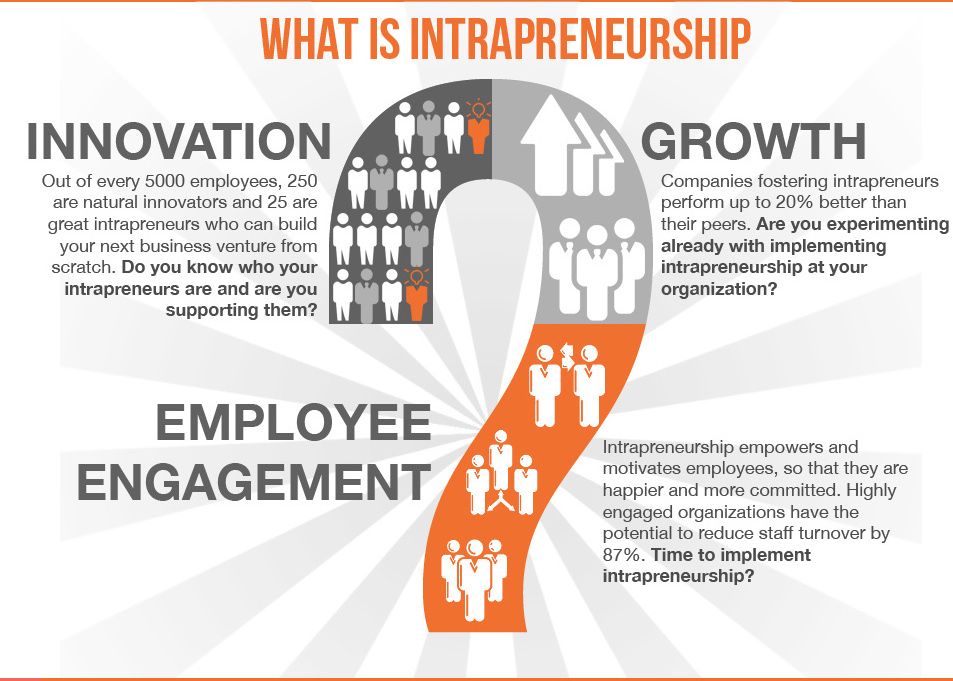
Intrapreneurship is the practice of applying entrepreneurial thinking, initiative, and risk-taking within an established organization - using the company's resources, brand, distribution channels, and institutional knowledge to build something new, rather than starting from scratch on the outside.
An intrapreneur identifies opportunities that the existing business has missed, champions ideas through layers of organizational resistance, and drives innovation to completion inside a corporate structure that was designed for efficiency, not exploration.
The term was coined by Gifford Pinchot III in his 1985 book Intrapreneuring: Why You Don't Have to Leave the Corporation to Become an Entrepreneur.
Pinchot had observed a pattern that troubled him: large organizations routinely drove away their most entrepreneurially inclined employees - people who found the bureaucratic environment stifling and left to start companies - and then watched those former employees build the very innovations their former employers had failed to pursue.
His argument was straightforward: corporations could retain this talent and capture this value by creating internal conditions that allowed entrepreneurial behavior to survive.
That argument remains as relevant in 2026 as it was in 1985. A McKinsey Global Innovation Survey (2023) found that 84 percent of executives considered innovation "extremely important" to their growth strategy, yet only 6 percent were satisfied with their organization's innovation performance.
The gap between intention and execution is where intrapreneurship lives - and where it most often dies.
"An intrapreneur is a person within a large corporation who takes direct responsibility for turning an idea into a profitable finished product through assertive risk-taking and innovation." - Gifford Pinchot III, Intrapreneuring (1985)
The Story That Started It All: Post-it Notes and the Power of Protected Time
In 1968, a 3M scientist named Spencer Silver accidentally created something no one had asked for: a low-tack, pressure-sensitive adhesive that stuck reliably but could be removed cleanly without leaving residue. It was, by the standards of adhesive chemistry, a failure - the whole point of adhesives was to bond permanently.
Silver spent the next six years presenting his curious creation at internal 3M seminars, trying to find someone who could imagine a use for it. No one could. A solution in search of a problem.
In 1974, Art Fry, a 3M product development engineer who sang in a church choir, was frustrated by a small recurring annoyance: his paper bookmark kept falling out of his hymnal during services. He remembered Silver's peculiar adhesive from one of those internal seminars.
What if you combined the two - a slip of paper with a repositionable adhesive strip that could mark a page without damaging it?
Fry began developing the product using 3M's "15 percent time" - a policy, established in 1948, allowing engineers to spend 15 percent of their working hours on self-initiated projects not assigned by management. The product faced years of internal skepticism.
Senior executives questioned whether anyone would pay money for "a notepad that doesn't stick properly." An initial test launch in four cities in 1977 produced disappointing sales.
A second test in Boise, Idaho, in 1978, which included free samples distributed to offices, produced explosive demand - once people used the product, they could not imagine working without it.
The Post-it Note launched nationally in 1980 and became one of the most successful office products in commercial history. By 2024, 3M's Post-it brand generated over $1 billion in annual revenue.
The innovation survived because 3M's structure gave it room to survive - protected time, tolerance for years of uncertain exploration, and a culture that did not require proven ROI before allowing engineers to pursue an idea.
This is an intrapreneurship story. Not every intrapreneurship story ends like this one. But the Post-it Note illustrates the structural conditions that make intrapreneurship possible - and, by contrast, what their absence destroys.
The Intrapreneur vs. the Entrepreneur
The distinction between intrapreneurs and entrepreneurs is structural rather than psychological. Research by Joseph Schumpeter (1934) and later by Howard Stevenson at Harvard Business School (1983) established that entrepreneurship is fundamentally about the pursuit of opportunity beyond the resources currently controlled.
Both intrapreneurs and entrepreneurs exhibit this orientation: initiative, tolerance for ambiguity, creative problem-solving, willingness to challenge the status quo, and persistence in the face of rejection.
What differs is the environment and the risk profile:
| Dimension | Entrepreneur | Intrapreneur |
|---|---|---|
| Resources | Self-funded or investor-funded | Uses company capital, infrastructure, and talent |
| Financial risk | Personal capital at stake | No personal financial risk (career risk instead) |
| Speed of execution | Fast - no approvals needed | Slower - subject to organizational approval processes |
| Infrastructure | Must build everything from scratch | Leverages existing brand, distribution, customer base |
| Upside potential | Full equity in created value | Salary, bonus, possible equity participation |
| Primary constraints | Market forces, capital availability | Internal politics, budget cycles, cultural resistance |
| Failure consequences | Business failure, personal financial loss | Career stagnation, project cancellation, political damage |
| Autonomy | Full decision-making authority | Must persuade others to allocate resources |
Neither model is universally superior. Entrepreneurs can move faster and capture more upside. Intrapreneurs can leverage resources that would take a startup years to build and can scale innovations through existing distribution channels that a new company would have no access to.
The intrapreneurial path makes the most sense when the innovation benefits substantially from the established organization's assets - its brand credibility, its customer relationships, its regulatory expertise, its manufacturing capacity, its data - and when those assets would be difficult or impossible to replicate quickly from outside.
Amazon Web Services could only have been built by a company that had already invested billions in server infrastructure. The PlayStation could only have been built by a company with Sony's manufacturing capabilities and global distribution network.
Famous Intrapreneurial Successes
The canonical examples of intrapreneurship illuminate both what it looks like in practice and the specific organizational conditions that enabled survival.
Gmail and Google's 20% Time
Paul Buchheit joined Google in 1999 as employee number 23. By 2001, he had begun building what would become Gmail as a side project under Google's well-known "20% time" policy - which allowed engineers to spend one-fifth of their working hours on projects not assigned by management.
The project faced sustained internal skepticism. Critics within Google argued that email was a commodity, that storage costs made a 1-gigabyte free email service financially implausible, and that the project diverted engineering resources from core search work.
Buchheit persisted, supported by co-founder Sergey Brin, who recognized the project's strategic potential.
Gmail launched as a limited invite-only beta on April 1, 2004 - April Fools' Day, which led to widespread initial disbelief that it was real.
The 1GB of free storage it offered was so dramatically beyond the 2-4 megabytes offered by Hotmail and Yahoo Mail that it permanently disrupted the email industry. By 2024, Gmail had over 1.8 billion active users, making it the most widely used email service in the world.
The Gmail story illustrates three structural requirements for intrapreneurship: protected time for exploration, tolerance for projects without immediate business cases, and senior sponsorship willing to shield promising work from internal pressure.
Sony PlayStation
In 1988, Ken Kutaragi was a Sony engineer working with Nintendo to develop the sound chip for the Super Nintendo Entertainment System. During this collaboration, Kutaragi became convinced that Sony should enter the games hardware market directly - a conviction that was deeply unpopular within Sony's leadership.
Sony's core businesses were consumer electronics and entertainment media. Games were seen as low-prestige toys, beneath Sony's brand positioning. Several senior executives argued forcefully against the project.
Norio Ohga, Sony's CEO, reportedly overruled his own board to allow Kutaragi to proceed, saying he saw something in the engineer's passion and technical vision that the business cases could not capture.
The PlayStation launched in Japan in December 1994 and in North America in September 1995. It sold over 100 million units worldwide, redefined the console gaming industry, and became one of the most profitable product lines in Sony's history.
The PlayStation division (now Sony Interactive Entertainment) generated $29.3 billion in revenue in fiscal year 2023. Kutaragi eventually became President of Sony Computer Entertainment, earning the title "The Father of the PlayStation."
Amazon Web Services
Amazon Web Services (AWS) is perhaps the most consequential intrapreneurial success in modern business history.
Launched publicly in 2006, it began as an internal infrastructure project: Amazon had built sophisticated server management, storage, and computing systems for its own retail operations and recognized that this infrastructure might be valuable to other businesses.
The project was championed internally without certainty about its commercial viability. Jeff Bezos's well-documented tolerance for long-horizon, uncertain investments was the enabling condition.
Internal teams had to persuade skeptics that a retail company should become an enterprise technology provider - a strategic leap that made no sense to analysts accustomed to categorizing companies by industry.
By 2023, AWS generated nearly $91 billion in annual revenue and accounted for the majority of Amazon's operating profit. It is now the dominant cloud computing platform, used by Netflix, NASA, the CIA, and millions of startups and enterprises worldwide.
A retail company's internal infrastructure project became the foundation of modern cloud computing.
Lockheed Martin's Skunk Works
Not all intrapreneurship stories come from Silicon Valley. Lockheed Martin's Skunk Works division, formally the Advanced Development Programs, was established in 1943 by engineer Clarence "Kelly" Johnson to develop the XP-80 jet fighter under extreme time pressure during World War II.
Johnson negotiated a set of operating principles that insulated Skunk Works from Lockheed's normal bureaucratic processes: a small, hand-picked team; direct access to senior leadership; minimal paperwork; and the authority to make decisions without committee approval.
These principles, later formalized as "Kelly's 14 Rules," produced a succession of breakthrough aircraft including the U-2 spy plane, the SR-71 Blackbird, and the F-117 Nighthawk stealth fighter.
The Skunk Works model demonstrated that intrapreneurship could work in highly regulated, capital-intensive industries - not just in software. The key was structural separation from the parent organization's management processes combined with access to its resources.
How Large Companies Kill Innovation
Despite the Post-it Notes, Gmails, and PlayStations, most large organizations are structurally hostile to intrapreneurship. Understanding the specific mechanisms matters because they are systematic, not random - and they can be counteracted if leadership understands what it is fighting against.
Short-Term Financial Pressure
Public companies face quarterly earnings expectations that create relentless pressure to maximize near-term margins. Investment in exploratory projects that will not produce returns for three to seven years creates a drag on short-term profitability that analysts and shareholders penalize.
A 2022 study by Harvard Business Review found that the average tenure of a Fortune 500 CEO had declined to 4.8 years, creating a structural incentive to optimize for results within that window.
Executives whose compensation is tied primarily to annual financial performance rationally avoid speculative investments.
The result is systematic under-investment in the exploratory work from which breakthrough innovations emerge - what James March of Stanford described in his seminal 1991 paper as the tension between "exploitation" (optimizing what you already do) and "exploration" (discovering what you might do next).
"Organizations that engage exclusively in exploitation will ordinarily suffer from obsolescence. Organizations that engage exclusively in exploration will ordinarily suffer from failure to appropriate the returns of their discoveries." - James March, "Exploration and Exploitation in Organizational Learning" (1991)
The Business Case Trap
Most organizations require formal business cases before allocating significant resources to a new project. Business cases require projected revenues, cost estimates, and ROI timelines.
But genuine innovation - the kind that creates new categories rather than incrementally improving existing ones - cannot be projected with any accuracy because there is no comparable prior work to reference.
Jeff Bezos described this trap explicitly in his 2016 letter to Amazon shareholders: "The most important things we've done at Amazon cannot have been justified in a business case. If you needed a business case for it, it would never have happened."
The Post-it Note would not have passed a business case test in 1974. Gmail would not have passed one in 2001. AWS would not have passed one in 2003. The business case requirement filters out exactly the innovations that are most valuable - the ones that are too novel for their returns to be estimated.
Career Incentives That Reward Reliability
In most organizations, career advancement is driven by reliable execution of assigned work rather than by entrepreneurial initiative.
A 2012 study by Wharton School professor Ethan Mollick found that in large corporations, managers who consistently delivered on commitments were promoted at nearly twice the rate of those who pursued high-variance, innovative projects - even when the innovative projects occasionally produced exceptional results.
This creates rational incentives to avoid intrapreneurial behavior. Failure in service of an innovative project carries career costs that ordinary underperformance on assigned work does not. The ambitious employee calculates, correctly, that predictable execution is a safer path to advancement than creative risk-taking.
The Antibody Response
Clayton Christensen's research on the innovator's dilemma (1997) described the organizational mechanism that kills disruptive projects: they threaten existing business units, whose leaders rationally resist them.
A new product that cannibalizes an existing revenue stream will be opposed by the managers responsible for that revenue stream - not from malice, but from rational self-interest and legitimate concern for their teams and customers.
This "antibody response" means that even when senior leadership genuinely wants to encourage innovation, middle management instinctively protects its existing territories.
The immune system of the organization attacks new ideas the same way a biological immune system attacks foreign bodies - automatically, efficiently, and often without conscious intent.
Steve Blank, the Stanford professor whose Customer Development work underpins the Lean Startup methodology, calls this phenomenon "innovation theater" - organizations that create innovation labs, hackathons, and ideation workshops while leaving the structural incentives that kill new ideas completely intact.
Structures That Enable Intrapreneurship
The organizations that most consistently produce intrapreneurial successes share structural features that counteract the natural organizational immune response. These are not cultural platitudes about "being innovative" - they are specific, implementable mechanisms.
Protected Discretionary Time
Google's 20% time and 3M's 15% time are the most famous examples, but the principle is generalizable: providing employees with time that is explicitly outside the scope of assigned work, not tracked against project budgets, and free from the requirement to produce immediate deliverables.
Research on creativity by Teresa Amabile at Harvard Business School (published in The Progress Principle, 2011) demonstrated that intrinsic motivation - working on something because you find it inherently interesting - is the strongest predictor of creative output, far exceeding external incentives like bonuses or deadlines.
Protected time creates the conditions for intrinsic motivation by removing the pressure to justify every hour against a predetermined business objective.
The practical challenge is that discretionary time policies often erode under workload pressure. Google's 20% time, for example, has been described by some engineers as "120% time" - something you do in addition to, not instead of, your full-time assigned work.
The policy's effectiveness depends on whether management genuinely protects the time or merely tolerates it in theory while loading employees with enough assigned work to consume it in practice.
Internal Incubators and Venture Studios
Some large organizations have created separate internal innovation units that operate with ring-fenced budgets, different governance rules, and explicit permission to experiment and fail.
| Organization | Innovation Unit | Notable Outcomes |
|---|---|---|
| Alphabet | X (formerly Google X) | Waymo (self-driving cars), Loon (internet balloons), Wing (drone delivery) |
| Amazon | Lab126 | Kindle, Echo/Alexa, Fire TV |
| Apple | Internal product development (no separate label) | iPhone, iPad, Apple Watch |
| Lockheed Martin | Skunk Works | U-2, SR-71, F-117 |
| Samsung | C-Lab (Creative Lab) | Multiple spin-offs including Monit (IoT sensor startup) |
| Microsoft | Microsoft Garage | Multiple experimental products and internal tools |
The risk with internal incubators is what Vijay Govindarajan (Dartmouth Tuck School of Business) calls the "innovation ghetto" - units that become so separate from the core business that they cannot transfer innovations back into it.
The most successful examples maintain enough connection to the parent organization to leverage its resources while protecting enough independence to escape its immune response.
Stage-Gate Processes with Learning Criteria
Traditional stage-gate project management evaluates projects at decision points on financial return projections. In intrapreneurial contexts, this selects against early-stage innovation because genuinely new ideas cannot produce reliable financial projections.
An alternative approach, advocated by Rita McGrath of Columbia Business School in Discovery-Driven Growth (2009), evaluates early-stage projects on what they have learned rather than what they have earned: What assumptions have been tested?
What has been discovered about customer needs? What pivots have been made based on evidence? This allows small bets to accumulate information before the question of commercial viability becomes appropriate to ask.
The parallel with startup methodology is intentional. Eric Ries's Lean Startup framework - build, measure, learn - was designed for exactly this problem: making progress under conditions of extreme uncertainty.
Applying it inside a corporation requires adapting the framework to organizational realities, but the core principle holds: learn cheaply before committing expensively.
Executive Sponsorship
The Sony PlayStation would not exist without Norio Ohga's personal sponsorship of Kutaragi's project against significant internal opposition. Gmail might not exist without Sergey Brin's support for Buchheit's work.
AWS might not exist without Bezos's willingness to fund infrastructure development without a clear business model.
Executive sponsorship serves two critical functions: providing resources without requiring a fully developed business case, and shielding the project from the organizational immune response.
Without someone with authority willing to say "this matters and I'm protecting it," intrapreneurial projects are easily killed by bureaucratic friction - not by a single dramatic rejection, but by the accumulation of small delays, additional approval requirements, and resource reallocation requests that slowly starve the project of momentum.
A Boston Consulting Group study (2023) found that organizations with identified executive sponsors for innovation initiatives were 2.6 times more likely to bring those innovations to market successfully than organizations where innovation was managed through committee.
Explicit Career Paths for Innovation
Organizations that want to retain and develop intrapreneurial talent need to create career paths that reward it. If the only promotion path requires managing people and delivering predictable quarterly results, entrepreneurially inclined employees will leave to start companies.
Some organizations have created explicit "innovation contributor" or "technical fellow" tracks that allow entrepreneurially oriented employees to advance without managing large teams, analogous to the "individual contributor" paths that became standard in software engineering during the 2010s.
3M's dual-ladder system, which has existed since the 1960s, allows scientists and engineers to advance to the equivalent of vice president without taking on management responsibilities - a structural incentive that has contributed to 3M's disproportionate innovation output over decades.
The Limits of Intrapreneurship
Intellectual honesty requires acknowledging that not all innovation is best pursued inside large organizations. Some types of disruption are, as Christensen argued, structurally very difficult to pursue internally.
Disruptive innovations that address smaller markets than the existing business, that have lower initial margins, or that genuinely threaten existing business units face structural headwinds inside established companies that no amount of organizational design can fully overcome.
Kodak's engineers invented the digital camera in 1975 but could not pursue it aggressively because doing so would have cannibalized Kodak's enormously profitable film business. The innovation eventually destroyed Kodak anyway - but it was built by companies that had no film revenue to protect.
There are also genuine cultural and cognitive incompatibilities between entrepreneurial and bureaucratic modes of operation.
The cognitive demands of intrapreneurship - uncertainty tolerance, comfort with failure, bias toward action over process - exist in real tension with the requirements of large-organization management, which rewards predictability, consensus, and risk management.
Research by Saras Sarasvathy at the University of Virginia (2001) on effectual reasoning found that successful entrepreneurs think fundamentally differently from managers trained in causal reasoning - they start with means rather than ends, embrace surprises rather than avoiding them, and form partnerships rather than conducting competitive analyses.
Asking a large organization to accommodate both modes of thinking simultaneously is asking it to hold two contradictory operating philosophies at once. The organizations that do this well are rare precisely because it is genuinely difficult.
Measuring Intrapreneurial Success
One reason intrapreneurship is difficult to sustain is that it is difficult to measure. Traditional business metrics - revenue, profit margin, market share - are lagging indicators that take years to reflect the value of exploratory work. Organizations need leading indicators that track intrapreneurial activity and health.
| Metric | What It Measures | Why It Matters |
|---|---|---|
| Percentage of revenue from products less than 3 years old | Innovation output | 3M targets 30% - one of the strongest innovation commitments in industry |
| Number of experiments run per quarter | Exploration activity | Volume of small bets indicates cultural health |
| Time from idea to first customer test | Speed of learning | Shorter cycles mean faster validation or invalidation |
| Employee retention among identified innovators | Talent retention | High turnover among creative employees signals structural problems |
| Number of ideas that received funding | Pipeline health | A healthy pipeline has many small bets, not a few large ones |
| Cross-functional project participation | Collaboration breadth | Innovation typically requires knowledge from multiple domains |
Practical Guidance for Aspiring Intrapreneurs
If you are an employee with an entrepreneurial idea inside a large organization, the research and historical record suggest several practical strategies.
Start small and prove assumptions cheaply. Do not ask for a large budget or a dedicated team before you have evidence that the idea has merit. Build a prototype, run a small test, gather data. The Post-it Note's breakthrough moment was a small-scale free sample distribution in Boise, Idaho - not a national launch.
Find your executive sponsor early. Identify a senior leader who has demonstrated willingness to champion unconventional projects and whose strategic interests align with your idea. Present evidence, not just enthusiasm.
Frame the opportunity in terms the organization already values. If the company values customer retention, frame your innovation as a retention play. If it values operational efficiency, frame it as an efficiency play. The substance of the innovation matters less than its legibility to decision-makers.
Build a coalition of allies across functions. Intrapreneurial projects that have support from engineering, marketing, and finance are harder to kill than projects championed by a single department. Cross-functional support also provides access to diverse expertise and resources.
Document your learning systematically. When the inevitable skepticism arrives, you need to be able to show what you have tested, what you have learned, and why the evidence supports continued investment. Narrative enthusiasm is not enough; data is your armor.
Conclusion: Structures Over Individuals
The Post-it Note was, by 3M's own account, nearly killed multiple times before it succeeded. Spencer Silver spent six years unable to find a use for his adhesive. Art Fry spent years persuading a skeptical organization that a repositionable bookmark was worth developing.
Ken Kutaragi survived multiple attempts to cancel the PlayStation. Paul Buchheit built Gmail against internal arguments that Google had no business in email.
These individuals were exceptional. But their innovations survived because their organizations had built the structural conditions - protected time, executive sponsorship, tolerance for uncertainty, career paths that did not punish exploration - in which such work could be done.
The structures matter more than the individuals. The organizations that consistently produce intrapreneurial innovations are the ones that have built conditions favorable to creative risk-taking - and protected those conditions against the natural organizational forces that would rather manage what already works than invest in what might.
Every large company says it values innovation. The ones that mean it have built the structures to prove it.
Sources & Further Reading
- Pinchot, G. Intrapreneuring: Why You Don't Have to Leave the Corporation to Become an Entrepreneur. Harper & Row, 1985.
- Christensen, C. M. "The Innovator's Dilemma: When New Technologies Cause Great Firms to Fail." Harvard Business Review Press, 1997.
- March, J. G. "Exploration and Exploitation in Organizational Learning." Organization Science, vol. 2, no. 1, 1991, pp. 71-87.
- Amabile, T., & Kramer, S. The Progress Principle: Using Small Wins to Ignite Joy, Engagement, and Creativity at Work. Harvard Business Review Press, 2011.
- McGrath, R. G., & MacMillan, I. C. Discovery-Driven Growth. Harvard Business Review Press, 2009.
- Sarasvathy, S. D. "Causation and Effectuation: Toward a Theoretical Shift from Economic Inevitability to Entrepreneurial Contingency." Academy of Management Review, vol. 26, no. 2, 2001, pp. 243-263.
- Stevenson, H. H. "A Perspective on Entrepreneurship." Harvard Business School Working Paper, 1983.
- Schumpeter, J. A. The Theory of Economic Development. Harvard University Press, 1934.
- McKinsey & Company. "The Eight Essentials of Innovation." McKinsey Quarterly, 2023.
- Boston Consulting Group. "Most Innovative Companies 2023." BCG Global, 2023.
- Govindarajan, V., & Trimble, C. The Other Side of Innovation: Solving the Execution Challenge. Harvard Business Review Press, 2010.
- Blank, S. "Why the Lean Start-Up Changes Everything." Harvard Business Review, May 2013.
- Rich, B. R., & Janos, L. Skunk Works: A Personal Memoir of My Years at Lockheed. Little, Brown and Company, 1994.
- Mollick, E. "People and Process, Suits and Innovators: The Role of Individuals in Firm Performance." Strategic Management Journal, vol. 33, no. 9, 2012, pp. 1001-1015.
- Ries, E. "The Lean Startup." Crown Business, 2011.